
Voice Gateways Lecture 6 PSTN TDM Components Voice
- Slides: 45
Voice Gateways Lecture 6
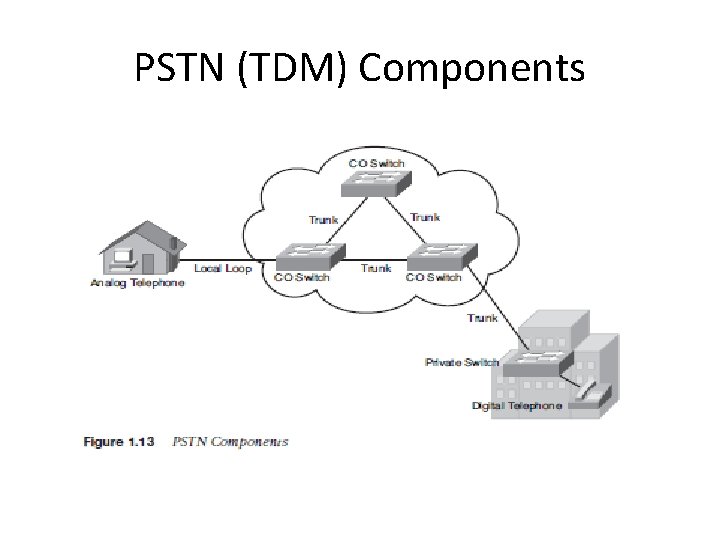
PSTN (TDM) Components
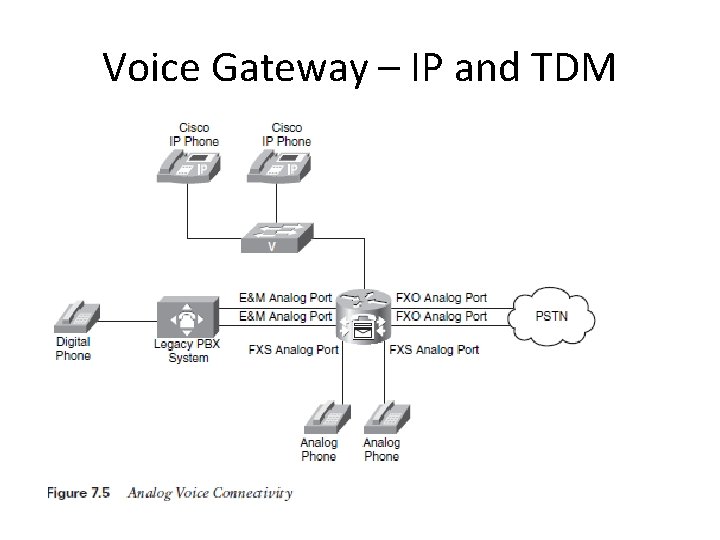
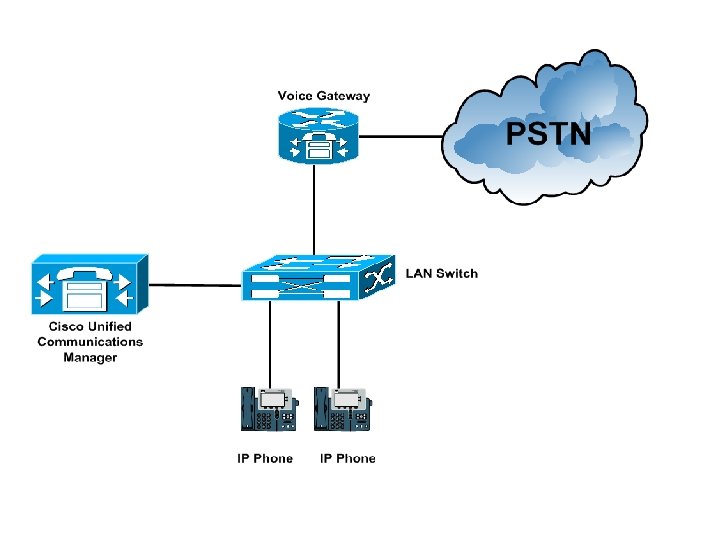
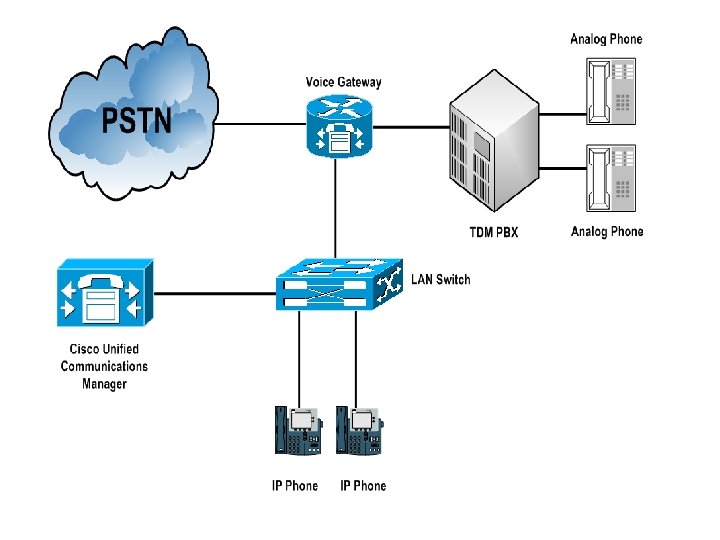
Voice Gateway – IP and TDM
Useful Information • Analogue Circuits – Amplitude, Frequency, Wavelength • Digital Signalling – What is the difference between TDM and Vo. IP? – They are both digital signalling! • ISDN – Also digital. • Call control signalling in TDM – CAS, CCS, R 2, SS 7. • E & M Signalling
Voice Terminology • ANI - Automatic Number Identification (ANI) refers to the telephone number of the calling party. • CAC - Call Admission Control (CAC) is the tracking of bandwidth resources and traffic requests for the purposes of preventing oversubscription within the constraints of the current bandwidth. CAC prevents endpoints from sending more information, or attempting to send more information, than the available bandwidth can handle.
• Caller ID - Caller ID (CID) describes the delivery of a calling name or number, or both. • CLID - Calling Line Identifier (CLID) is similar to ANI and refers to the number of the calling party. • CNID - The Calling Number Identification or Calling Name Identification is the same as the ANI. • DNIS - The Dialled Number Identification Service is the telephone number of the called party. This refers to the number that the telephone company sends to the destination. The DNIS may or may not be the actual number the calling party dials to reach the destination. For example, the caller may dial one number, but it may be translated or redirected by the telephone provider and those digits would be sent to the destination.
• Serialization -is the insertion of bits onto a link. Serialization delay is the amount of time it takes for a networking device, such as a router, to encode a packet onto the wire for transmission. Serialization delay is incurred when encapsulating or segmenting a data stream into packets for egress from a given interface. The interface must service the packets one at a time, which in turn results in the delay. • VAD - Voice Activity Detection is a voice encoding algorithm that takes note of silence during voice conversations and suppresses the transmission of voice packets that contain no actual data within them.
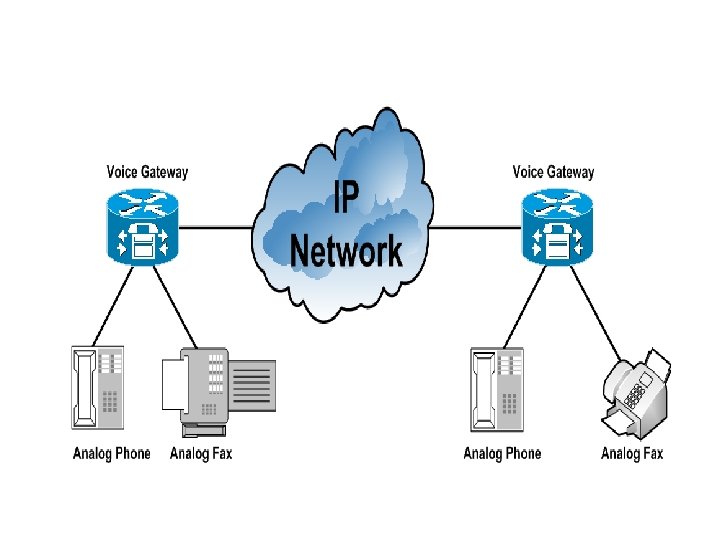
Voice Gateway • Interfaces IP and PSTN networks • Performs call setup and teardown between IP and PSTN • Relays DTMF tones • Supports IP and TDM control protocols • Supports analogue FAX machines
Voice Gateway Components • • • Foreign Exchange Office (FXO) Ear and Mouth (E&M) Foreign Exchange Station (FXS) E 1 Primary Rate Interface ISDN Basic Rate Interface ISDN E 1 R 2 – (Serial cable) – Leased line R 1# show version (will show all interfaces) R 1# show voice port summary
Voice Gateway Types • Cisco IOS Routers - 1700, 2600, 2800, etc • Standalone Voice Gateways – Cisco Analogue Telephone Adapter (ATA) devices, and Cisco Voice Gateway (VG 200 Series) • Switch Modules - Cisco Catalyst 6500 switches and 7600 Series routers
Voice Gateway Capabilities • When choosing a voice gateway for Cisco Vo. IP networks, it is important to ensure that the selected gateway supports the following four core requirements: • 1. Dual Tone Multi Frequency Relay 2. Supplementary Services 3. Communications Manager Redundancy 4. Call Survivability
Voice Gateway Types • Cisco voice gateway solutions are divided into three distinct categories. These categories are: • 1. Cisco IOS Routers 2. Standalone Voice Gateways 3. Switch Modules
Digital Signal Processor (DSP) • The DSP is used in the voice gateway router to convert analogue voice signals to digital signals suitable for the IP network inside. • DSP’s provide 4 critical functions in gateways; • Voice Termination • Transcoding • Conferencing • Media Termination Point • http: //www. youtube. com/watch? v=6 hfk. JPw. P 5 X 4
1 - Voice Termination • Voice termination applies to a call that has two call legs, one leg on a time-division multiplexing (TDM) interface and the second leg on a Voice over IP (Vo. IP) connection. • This termination function is performed by digital signal processor (DSP) resources.
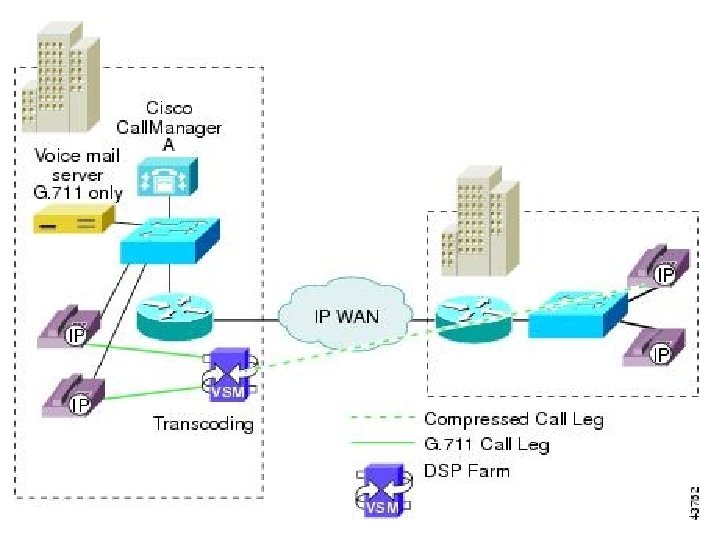
2 - Transcoding • After a WAN-enabled network is implemented, voice compression between sites represents the recommended design choice to save WAN bandwidth. • This choice presents the question of how WAN users IP-enabled applications, which support only G. 711 voice connections. • Using hardware-based transcoding services to convert the compressed voice streams into G. 711 provides the solution.
3 - Conferencing • Connecting sites across an IP WAN for conference calls presents a complex scenario. • In this scenario, the modules must perform the conferencing service as well as the IP-to-IP transcoding service to uncompress the WAN IP voice connection. • In the Figure a remote user joins a conference call at the central location. This three-participant conference call uses seven DSP channels on the Catalyst 4000 module and three DSP channels on the Cisco Catalyst 6000.
Conferencing - ctd • This three-participant conference call uses seven DSP channels on the Catalyst 4000 module and three DSP channels on the Cisco Catalyst 6000. • The following list gives the channel usage:
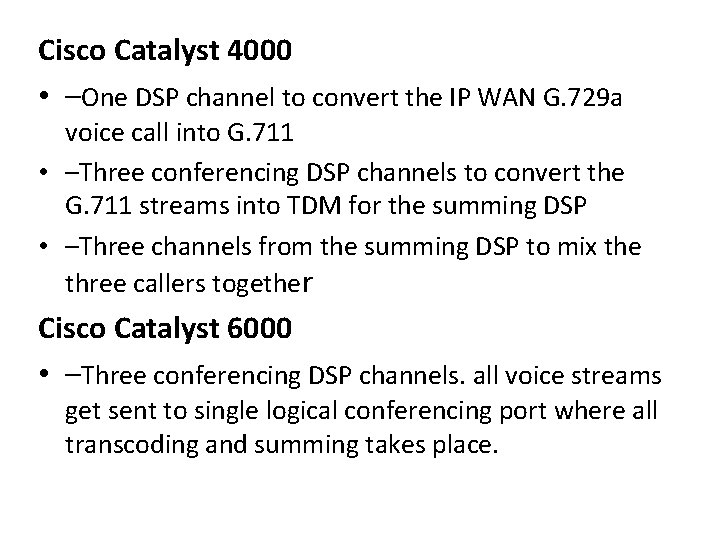
Cisco Catalyst 4000 • –One DSP channel to convert the IP WAN G. 729 a voice call into G. 711 • –Three conferencing DSP channels to convert the G. 711 streams into TDM for the summing DSP • –Three channels from the summing DSP to mix the three callers together Cisco Catalyst 6000 • –Three conferencing DSP channels. all voice streams get sent to single logical conferencing port where all transcoding and summing takes place.
4 – Media Termination Point • A Media Termination Point software device allows Cisco Unified Communications Manager to relay calls that are routed through SIP or H. 323 endpoints or gateways. • You can allocate a media termination point device because of DTMF or RSVP requirements. When a media termination point is allocated for RSVP, you can insert it between any type of endpoint device, including SIP or H. 323 devices.
Summary • • Voice Gateways Circuit signalling Analogue Circuits FXO & FXS Ports, E&M ports Digital circuits – TDM ISDN DSP Resources including Voice Encoding
Converged Network Design Lecture 6 B
Agenda • • Consolidation Cisco IP Telephony – IP Telephony Components • • • But First …. Quality Of Service (Qo. S) IP Phone Roadmap Call Manager 3. 0 – Distributed Call Processing – Catalyst Enhancements • • So how does this all work then Cisco AVVID Application Integration Design Guide Summary
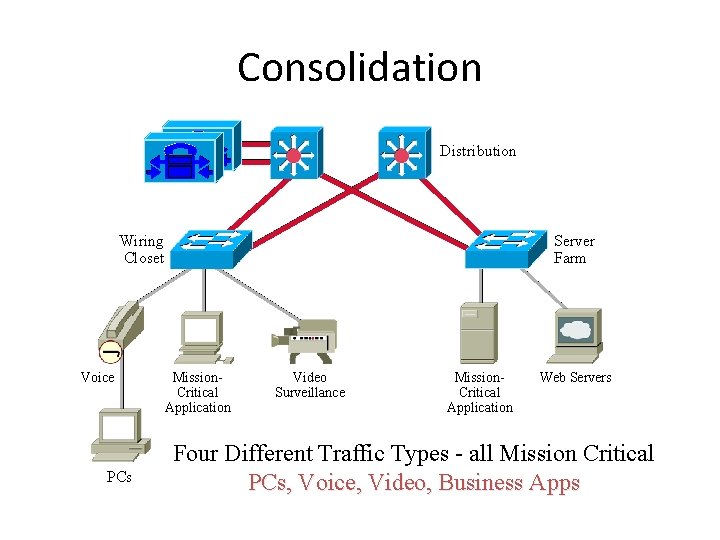
Consolidation Distribution Wiring Closet Voice PCs Server Farm Mission. Critical Application Video Surveillance Mission. Critical Application Web Servers Four Different Traffic Types - all Mission Critical PCs, Voice, Video, Business Apps
Key Technology Requirements for IP Telephony • Reliability – Dial tone is always there • Quality of Service – WAN and LAN, good quality voice always! • Power & Current Infrastructure Integration – eg: cabling, integration with current PBX • Scalability to Large Campus Sizes – Need to move beyond the current 200 user limit • Application Integration - Current and Future – Call processing, Unified Messaging, Call center etc. integration in the Enterprise space is fundamental
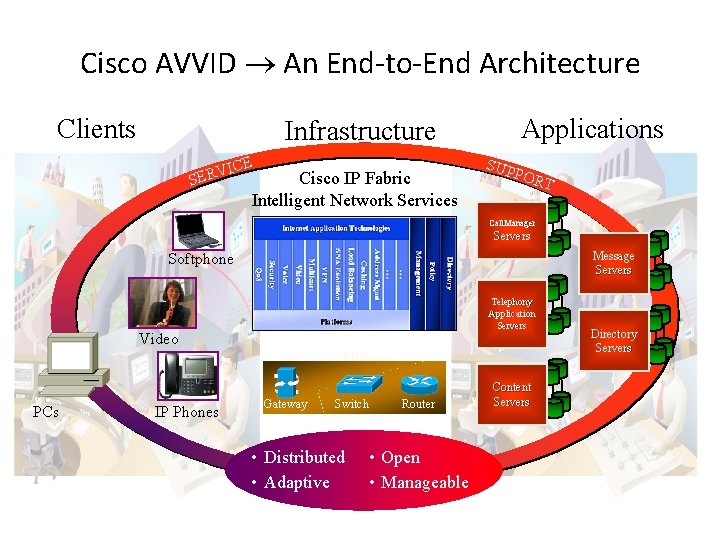
Cisco AVVID An End-to-End Architecture Clients Applications Infrastructure VICE R E S Cisco IP Fabric Intelligent Network Services SUP POR T Call. Manager Servers Message Servers Softphone Message Telephony Server Application Servers Video Platforms PCs IP Phones Gateway Switch • Distributed • Adaptive Router • Open • Manageable Content Servers Paging Directory Servers
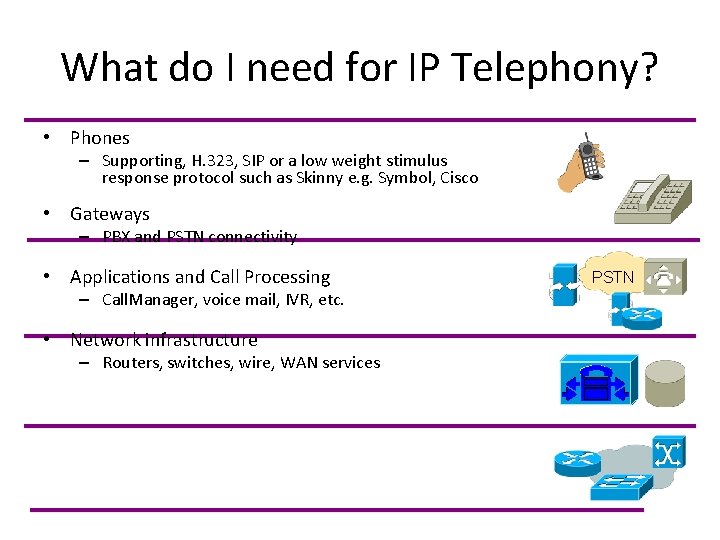
What do I need for IP Telephony? • Phones – Supporting, H. 323, SIP or a low weight stimulus response protocol such as Skinny e. g. Symbol, Cisco • Gateways – PBX and PSTN connectivity • Applications and Call Processing – Call. Manager, voice mail, IVR, etc. • Network infrastructure – Routers, switches, wire, WAN services PSTN
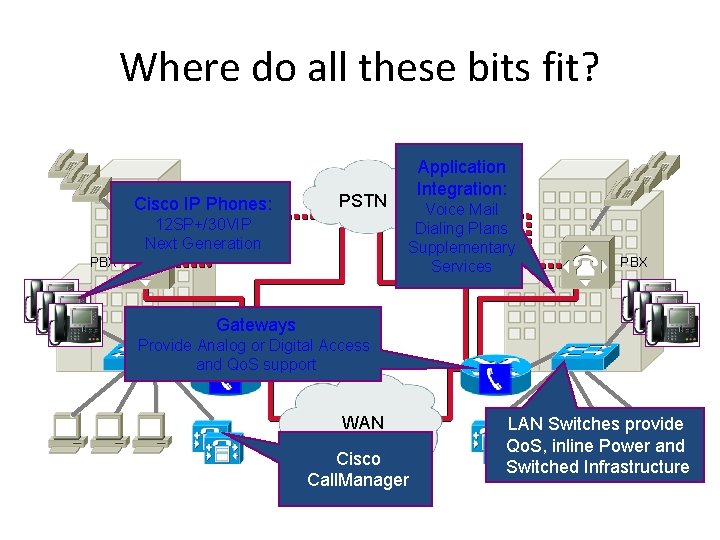
Where do all these bits fit? Cisco IP Phones: PSTN 12 SP+/30 VIP Next Generation PBX Application Integration: Voice Mail Dialing Plans Supplementary Services PBX Gateways Provide Analog or Digital Access and Qo. S support WAN Cisco Call. Manager LAN Switches provide Qo. S, inline Power and Switched Infrastructure
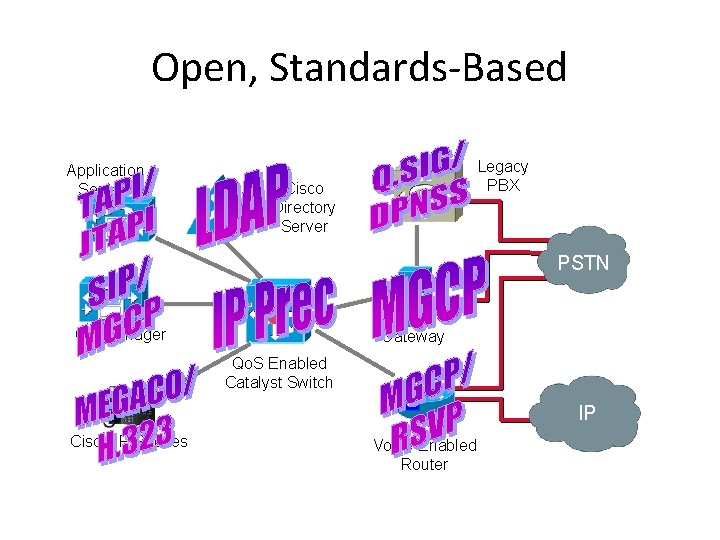
Open, Standards-Based Application Servers Legacy PBX Cisco Directory Server PSTN Call. Manager Gateway Qo. S Enabled Catalyst Switch IP Cisco IP Phones Voice-Enabled Router
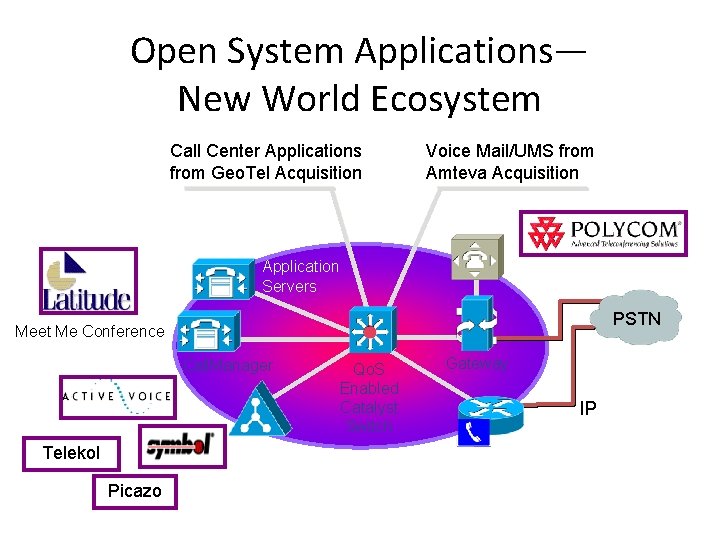
Open System Applications— New World Ecosystem Call Center Applications from Geo. Tel Acquisition Voice Mail/UMS from Amteva Acquisition Application Servers PSTN Meet Me Conference Call. Manager Telekol Picazo Qo. S Enabled Catalyst Switch Gateway IP
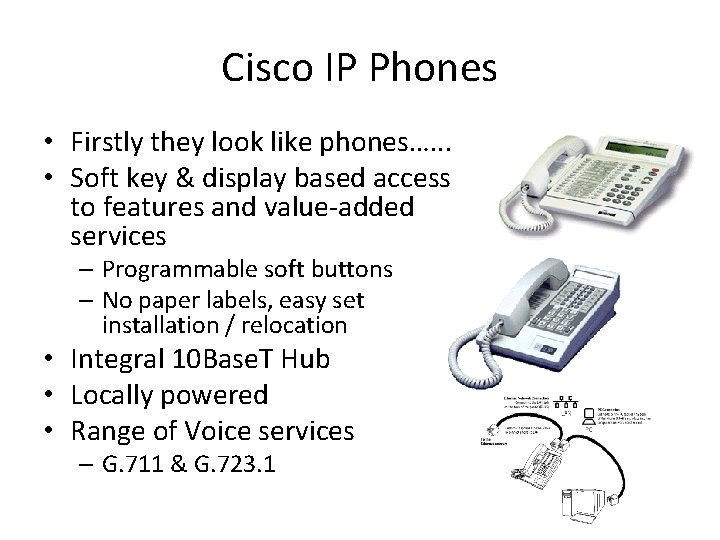
Cisco IP Phones • Firstly they look like phones…. . . • Soft key & display based access to features and value-added services – Programmable soft buttons – No paper labels, easy set installation / relocation • Integral 10 Base. T Hub • Locally powered • Range of Voice services – G. 711 & G. 723. 1
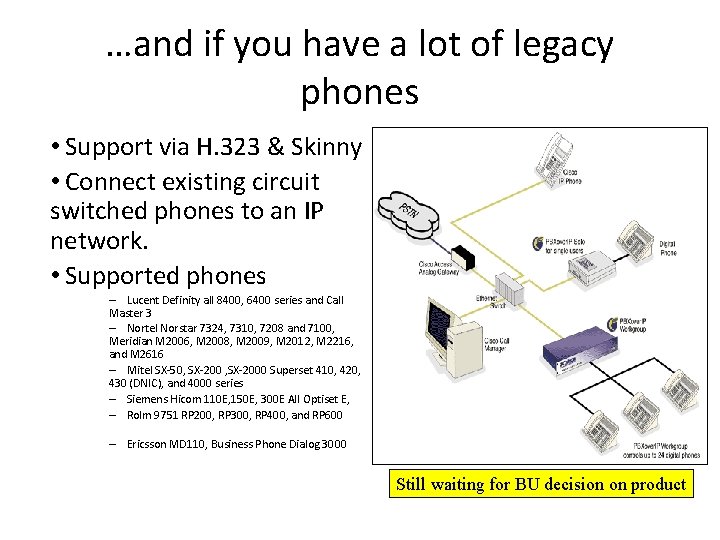
…and if you have a lot of legacy phones • Support via H. 323 & Skinny • Connect existing circuit switched phones to an IP network. • Supported phones – Lucent Definity all 8400, 6400 series and Call Master 3 – Nortel Norstar 7324, 7310, 7208 and 7100, Meridian M 2006, M 2008, M 2009, M 2012, M 2216, and M 2616 – Mitel SX-50, SX-2000 Superset 410, 420, 430 (DNIC), and 4000 series – Siemens Hicom 110 E, 150 E, 300 E All Optiset E, – Rolm 9751 RP 200, RP 300, RP 400, and RP 600 – Ericsson MD 110, Business Phone Dialog 3000 Still waiting for BU decision on product
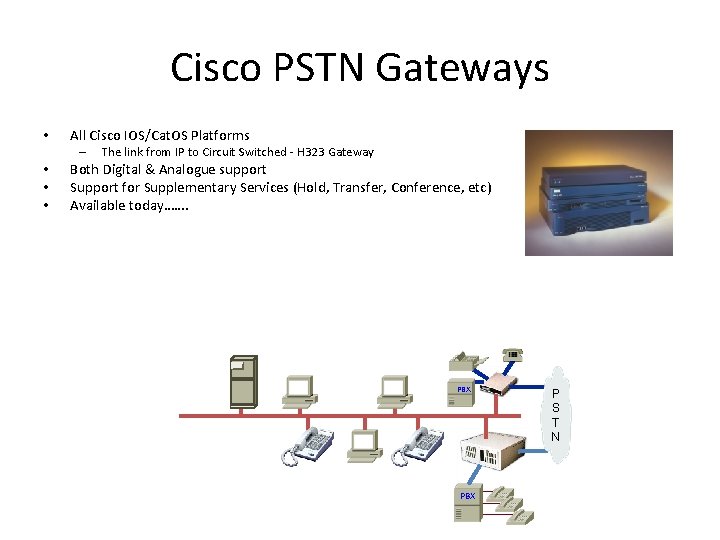
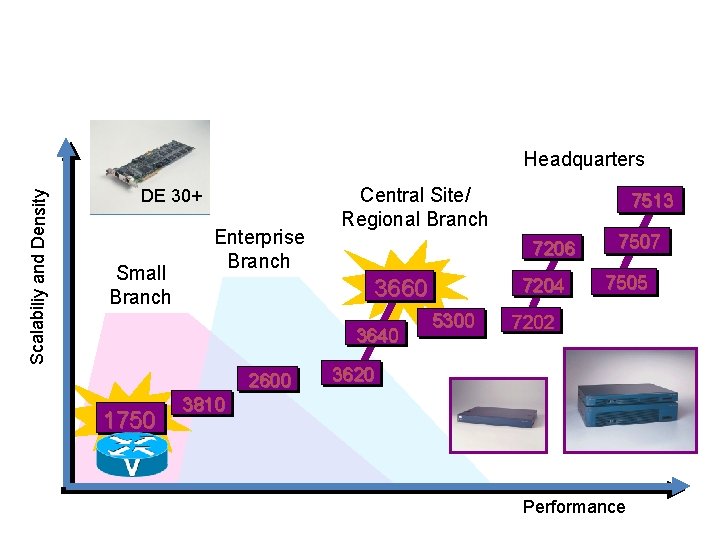
Cisco PSTN Gateways • All Cisco IOS/Cat. OS Platforms – • • • The link from IP to Circuit Switched - H 323 Gateway Both Digital & Analogue support Support for Supplementary Services (Hold, Transfer, Conference, etc) Available today……. PBX P S T N
Cisco Multiservice Gateways Scalabiliy and Density Headquarters DE 30+ Small Branch Enterprise Branch Central Site/ Regional Branch 7206 3660 3640 2600 1750 7513 7204 5300 7507 7505 7202 3620 3810 Performance
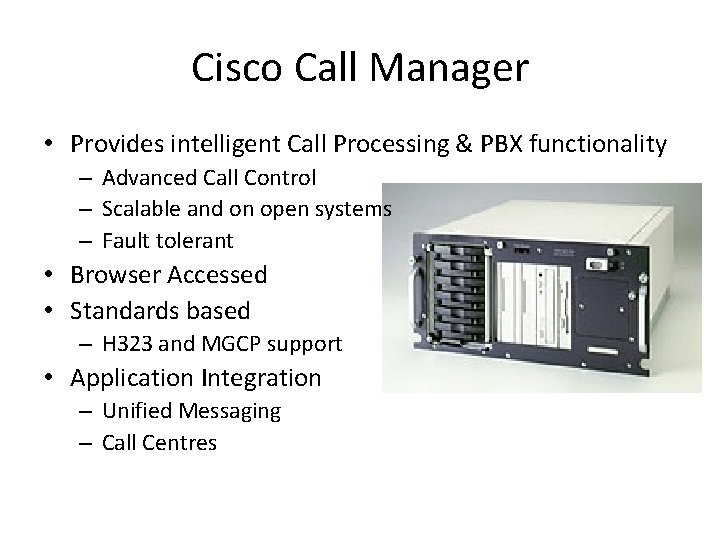
Cisco Call Manager • Provides intelligent Call Processing & PBX functionality – Advanced Call Control – Scalable and on open systems – Fault tolerant • Browser Accessed • Standards based – H 323 and MGCP support • Application Integration – Unified Messaging – Call Centres
Quality of Service - What is it? • Qo. S = Preferential treatment • Qo. S prioritizes traffic into service levels and provides preferential treatment to some traffic at the expense of lower priority traffic – Needed in both the LAN and the WAN • All traffic gets the same service – We now have the possibility of three types of traffic, all delay sensitive • A traditional network is best-effort ! – This will not work with a heavily loaded Voice enabled network
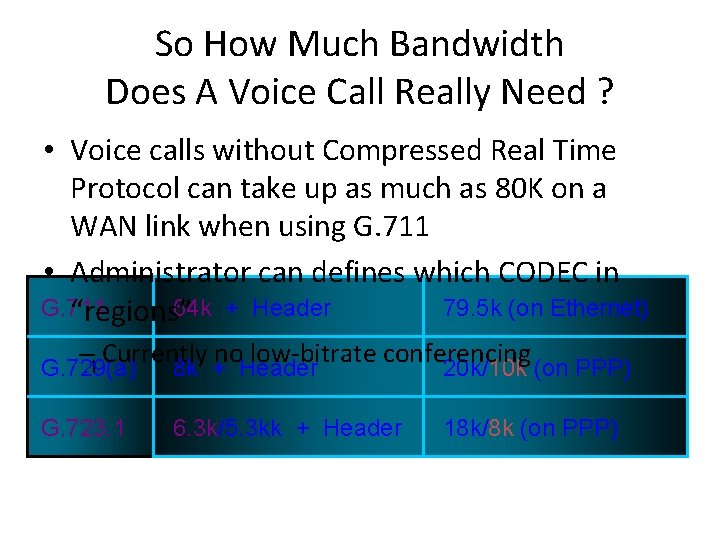
So How Much Bandwidth Does A Voice Call Really Need ? • Voice calls without Compressed Real Time Protocol can take up as much as 80 K on a WAN link when using G. 711 • Administrator can defines which CODEC in G. 711 64 k + Header 79. 5 k (on Ethernet) “regions” – Currently no low-bitrate conferencing 8 k + Header 20 k/10 k (on PPP) . 1 G. 729(a) G. 723. 1 6. 3 k/5. 3 kk + Header 18 k/8 k (on PPP)
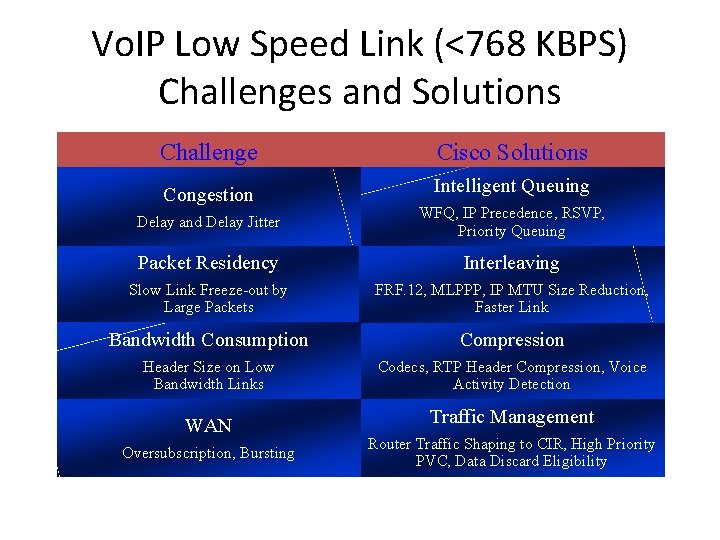
Vo. IP Low Speed Link (<768 KBPS) Challenges and Solutions Challenge Cisco Solutions Congestion Intelligent Queuing Delay and Delay Jitter WFQ, IP Precedence, RSVP, Priority Queuing Packet Residency Interleaving Slow Link Freeze-out by Large Packets FRF. 12, MLPPP, IP MTU Size Reduction, Faster Link Bandwidth Consumption Compression Header Size on Low Bandwidth Links Codecs, RTP Header Compression, Voice Activity Detection WAN Oversubscription, Bursting Traffic Management Router Traffic Shaping to CIR, High Priority PVC, Data Discard Eligibility
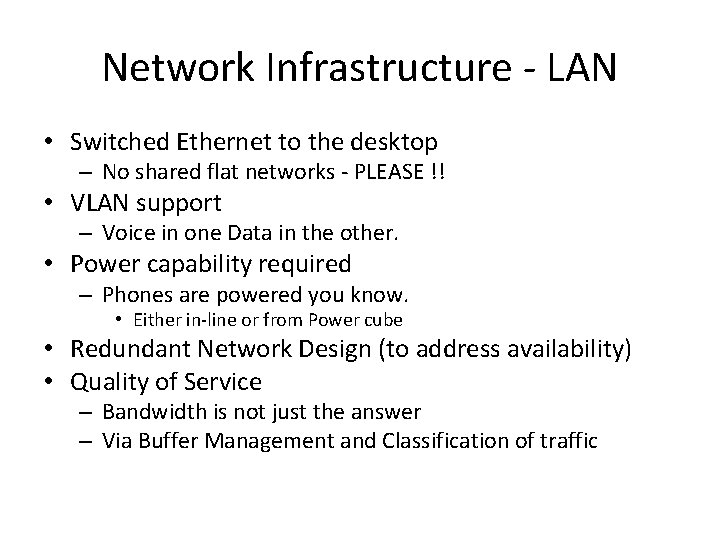
Network Infrastructure - LAN • Switched Ethernet to the desktop – No shared flat networks - PLEASE !! • VLAN support – Voice in one Data in the other. • Power capability required – Phones are powered you know. • Either in-line or from Power cube • Redundant Network Design (to address availability) • Quality of Service – Bandwidth is not just the answer – Via Buffer Management and Classification of traffic
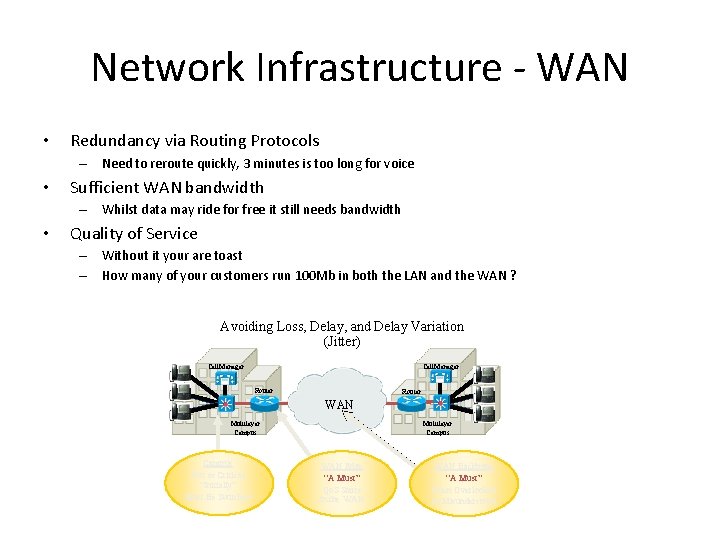
Network Infrastructure - WAN • Redundancy via Routing Protocols – Need to reroute quickly, 3 minutes is too long for voice • Sufficient WAN bandwidth – Whilst data may ride for free it still needs bandwidth • Quality of Service – Without it your are toast – How many of your customers run 100 Mb in both the LAN and the WAN ? Avoiding Loss, Delay, and Delay Variation (Jitter) Call. Manager Router WAN Multilayer Campus Not as Critical “Initially” Must Be Switched Multilayer Campus WAN Edge “A Must” Qo. S Starts in the WAN Backbone “A Must” Often Overlooked or Misunderstood
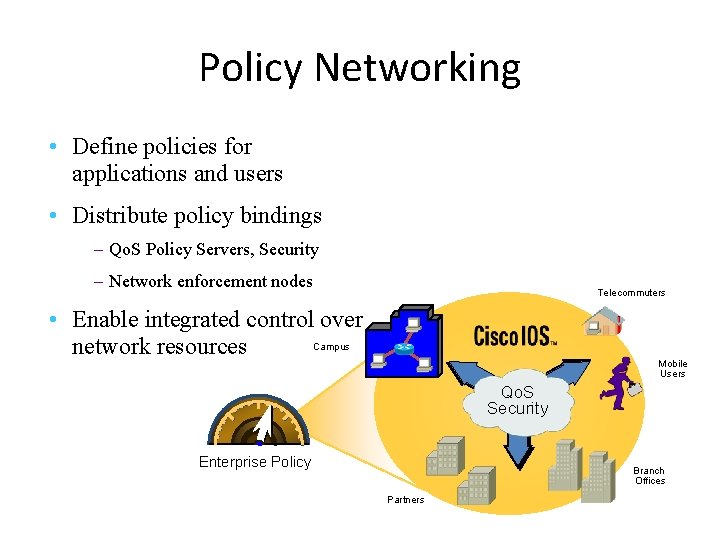
Policy Networking • Define policies for applications and users • Distribute policy bindings – Qo. S Policy Servers, Security – Network enforcement nodes Telecommuters • Enable integrated control over Campus network resources Mobile Users Qo. S Security Enterprise Policy Branch Offices Partners
Summary & Conclusion • LAN & WAN Infrastructure needs Qo. S – Without it give up and go home ! • Network Design should support redundancy – Voice systems do today ! • Cisco’s has solutions to support Voice/Video/Data enabled networks • Cisco AVVID Packet Voice Is A Real Solution ! • Cisco AVVID Architecture – Powerful, flexible IP architecture that supports Intelligent Integrated Applications • Cisco AVVID Advanced Applications