
Voice Biometrics and Blockchain Achieving Interoperable Data Exchange
Voice Biometrics and Blockchain: Achieving Interoperable Data Exchange in Healthcare Ben Chevallereau, Ph. D Gracie Carter, CSM Jim Nasr, MBA Sweta Sneha, Ph. D
Non-Interoperability • Patients do not control flow of information • Patients are unaware of the data lifecycle • Vendor lock in • Protectionist business models • Health data stagnates in data silos • Code depreciation • Insecure • Faxing, or patient couriers of records
Unstainable spending Noninteroperability: Cost of complacency • CMS reports that heath care spending accounted for 17. 9% of the GDP in 2016 and projected to rise to 19. 7% by 2026 Deaths due to incomplete patient histories • Greater than 250, 000 deaths per year are due to medical error, this makes it the third leading cause of death Health information controlled by small number of vendors. • EPIC- 51% of population’s health information
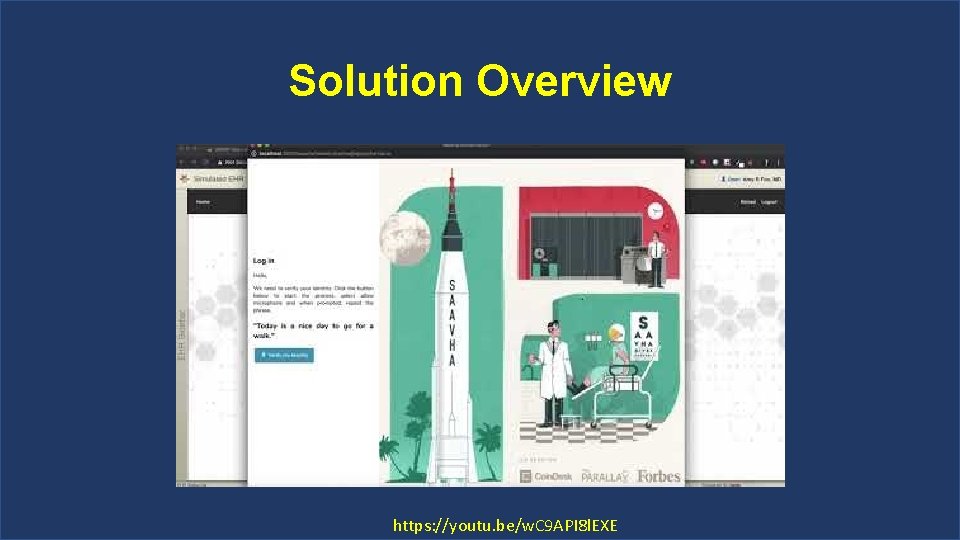
Solution Overview https: //youtu. be/w. C 9 API 8 l. EXE
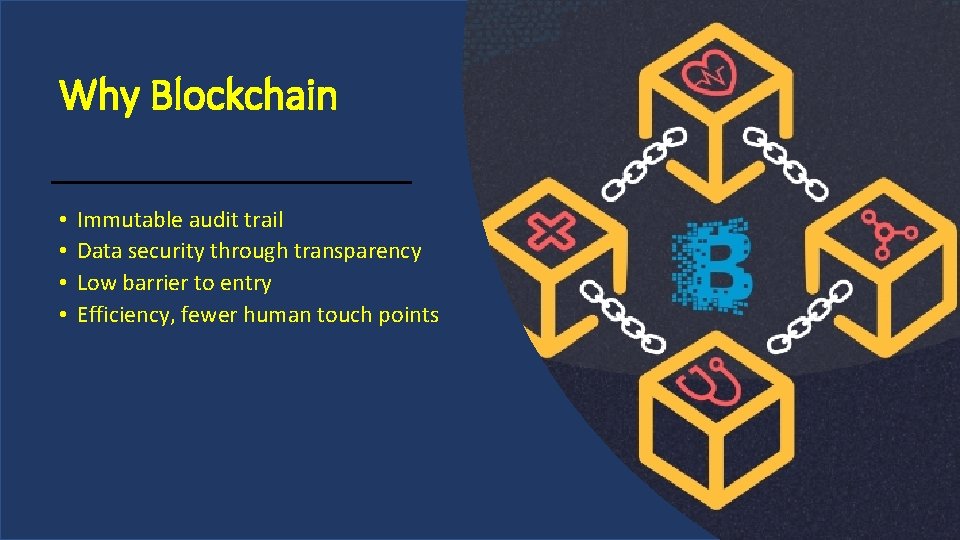
Why Blockchain • • Immutable audit trail Data security through transparency Low barrier to entry Efficiency, fewer human touch points
Why Bio. Metrics • Biometrics allow for patient specific signifier: their voice • Returns a unique identifier stored with a trusted third party • No sensitive information is stored on the Blockchain • Familiarity with AI (Alexa, Siri) • Ease of Use. No additional equipment required for Provider or Patient
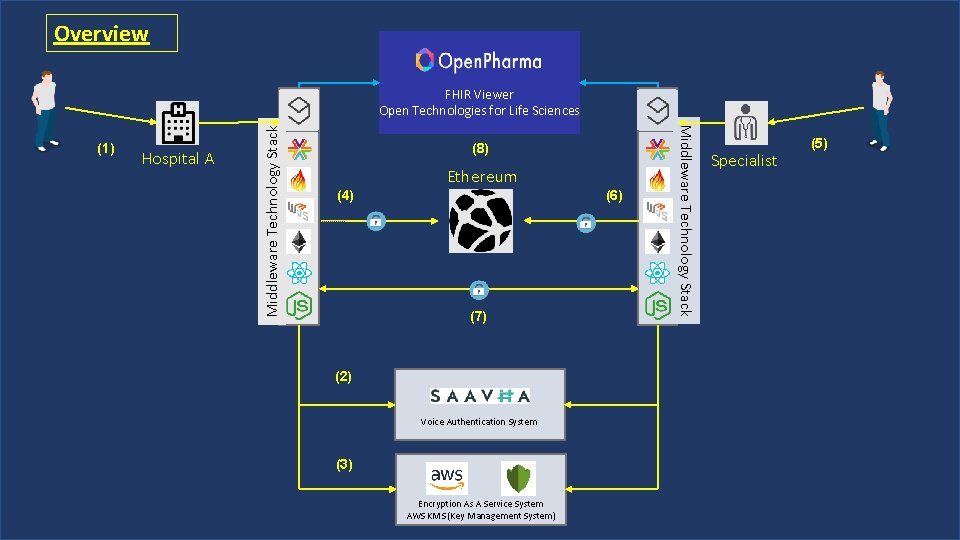
Overview Hospital A (8) Ethereum (4) (6) (7) (2) Voice Authentication System (3) Encryption As A Service System AWS KMS (Key Management System) Middleware Technology Stack (1) Middleware Technology Stack FHIR Viewer Open Technologies for Life Sciences Specialist (5)
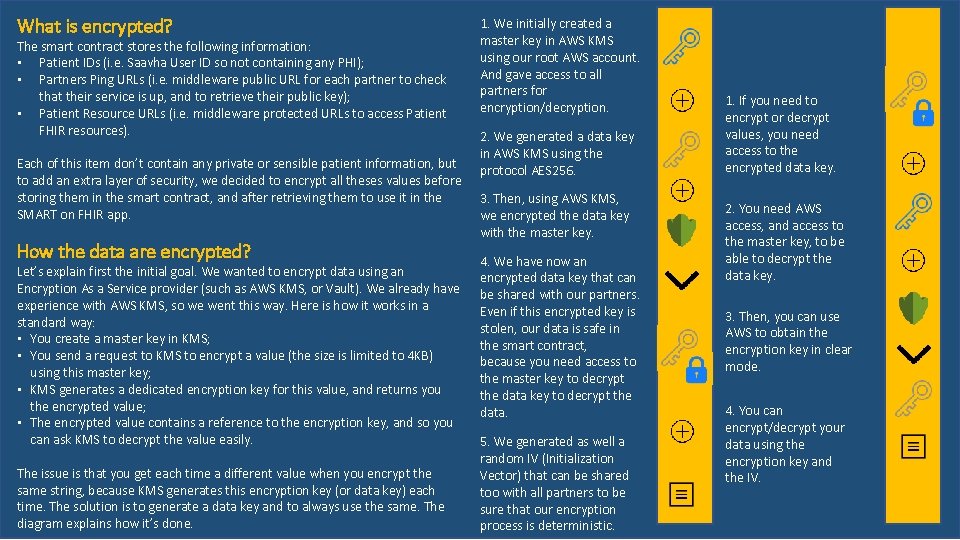
What is encrypted? The smart contract stores the following information: • Patient IDs (i. e. Saavha User ID so not containing any PHI); • Partners Ping URLs (i. e. middleware public URL for each partner to check that their service is up, and to retrieve their public key); • Patient Resource URLs (i. e. middleware protected URLs to access Patient FHIR resources). Each of this item don’t contain any private or sensible patient information, but to add an extra layer of security, we decided to encrypt all theses values before storing them in the smart contract, and after retrieving them to use it in the SMART on FHIR app. How the data are encrypted? Let’s explain first the initial goal. We wanted to encrypt data using an Encryption As a Service provider (such as AWS KMS, or Vault). We already have experience with AWS KMS, so we went this way. Here is how it works in a standard way: • You create a master key in KMS; • You send a request to KMS to encrypt a value (the size is limited to 4 KB) using this master key; • KMS generates a dedicated encryption key for this value, and returns you the encrypted value; • The encrypted value contains a reference to the encryption key, and so you can ask KMS to decrypt the value easily. The issue is that you get each time a different value when you encrypt the same string, because KMS generates this encryption key (or data key) each time. The solution is to generate a data key and to always use the same. The diagram explains how it’s done. 1. We initially created a master key in AWS KMS using our root AWS account. And gave access to all partners for encryption/decryption. 2. We generated a data key in AWS KMS using the protocol AES 256. 3. Then, using AWS KMS, we encrypted the data key with the master key. 4. We have now an encrypted data key that can be shared with our partners. Even if this encrypted key is stolen, our data is safe in the smart contract, because you need access to the master key to decrypt the data. 5. We generated as well a random IV (Initialization Vector) that can be shared too with all partners to be sure that our encryption process is deterministic. 1. If you need to encrypt or decrypt values, you need access to the encrypted data key. 2. You need AWS access, and access to the master key, to be able to decrypt the data key. 3. Then, you can use AWS to obtain the encryption key in clear mode. 4. You can encrypt/decrypt your data using the encryption key and the IV.
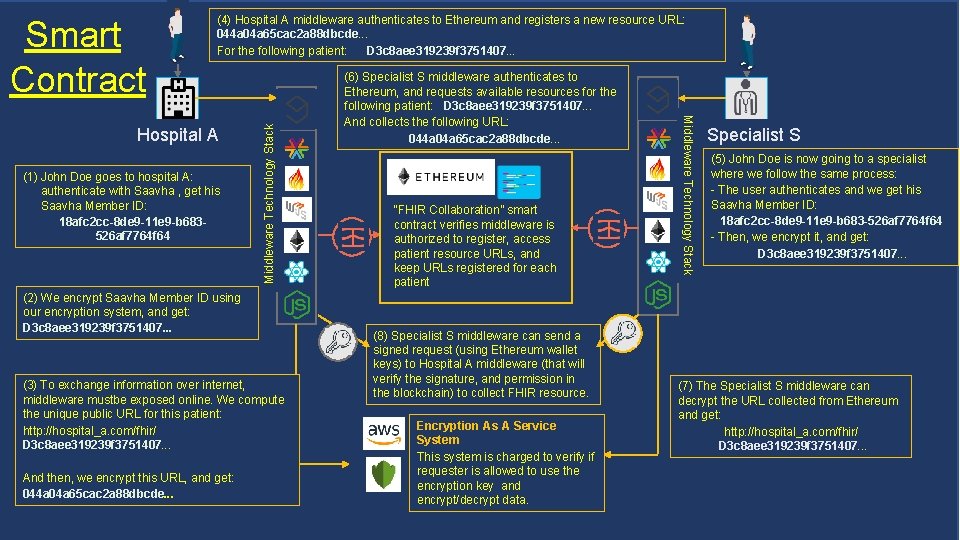
(1) John Doe goes to hospital A: authenticate with Saavha , get his Saavha Member ID: 18 afc 2 cc-8 de 9 -11 e 9 -b 683526 af 7764 f 64 (2) We encrypt Saavha Member ID using our encryption system, and get: D 3 c 8 aee 319239 f 3751407. . . (3) To exchange information over internet, middleware mustbe exposed online. We compute the unique public URL for this patient: http: //hospital_a. com/fhir/ D 3 c 8 aee 319239 f 3751407. . . And then, we encrypt this URL, and get: 044 a 04 a 65 cac 2 a 88 dbcde. . . (6) Specialist S middleware authenticates to Ethereum, and requests available resources for the following patient: D 3 c 8 aee 319239 f 3751407. . . And collects the following URL: 044 a 04 a 65 cac 2 a 88 dbcde. . . “FHIR Collaboration” smart contract verifies middleware is authorized to register, access patient resource URLs, and keep URLs registered for each patient (8) Specialist S middleware can send a signed request (using Ethereum wallet keys) to Hospital A middleware (that will verify the signature, and permission in the blockchain) to collect FHIR resource. Encryption As A Service System This system is charged to verify if requester is allowed to use the encryption key and encrypt/decrypt data. Middleware Technology Stack Hospital A Middleware Technology Stack Smart Contract (4) Hospital A middleware authenticates to Ethereum and registers a new resource URL: 044 a 04 a 65 cac 2 a 88 dbcde. . . For the following patient: D 3 c 8 aee 319239 f 3751407. . . Specialist S (5) John Doe is now going to a specialist where we follow the same process: - The user authenticates and we get his Saavha Member ID: 18 afc 2 cc-8 de 9 -11 e 9 -b 683 -526 af 7764 f 64 - Then, we encrypt it, and get: D 3 c 8 aee 319239 f 3751407. . . (7) The Specialist S middleware can decrypt the URL collected from Ethereum and get: http: //hospital_a. com/fhir/ D 3 c 8 aee 319239 f 3751407. . .
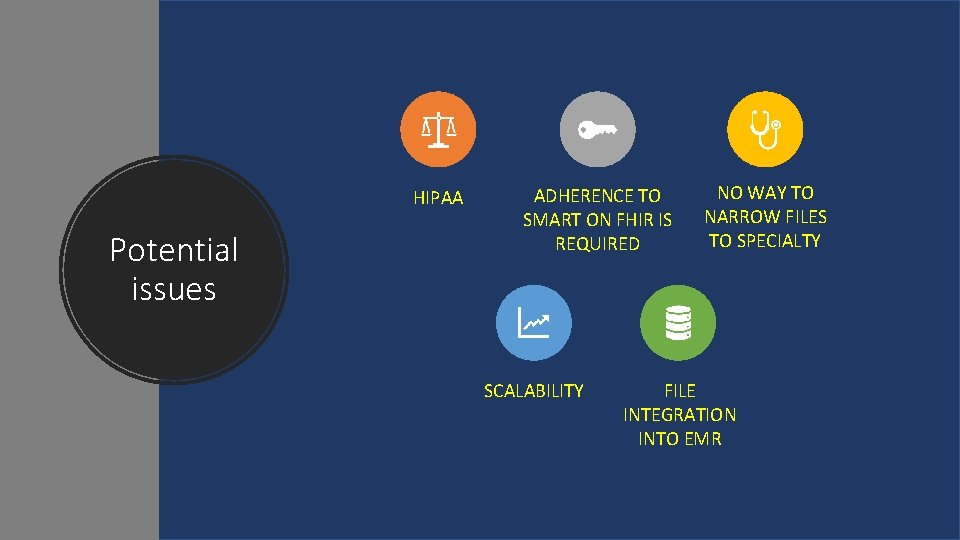
HIPAA Potential issues ADHERENCE TO SMART ON FHIR IS REQUIRED SCALABILITY NO WAY TO NARROW FILES TO SPECIALTY FILE INTEGRATION INTO EMR
- Slides: 10