
voice 21 The Oracy Project An overview Oracy
- Slides: 11
voice 21 The Oracy Project An overview Oracy is the effective use of spoken language, at school, at work and beyond
Voice 21: an overview Voice 21 is a joint project between School 21, Cambridge University and the Education Endowment Foundation. Oracy is a fundamental life skill which is currently ignored in schools. It is important for children today and as they grow up. The project aims to develop students’ oracy skills by developing, testing and then rolling out an assessment tool and curriculum resources. Its long term ambition is to help oracy achieve equal status with literacy and numeracy. Phase one of the project runs until October 2014.
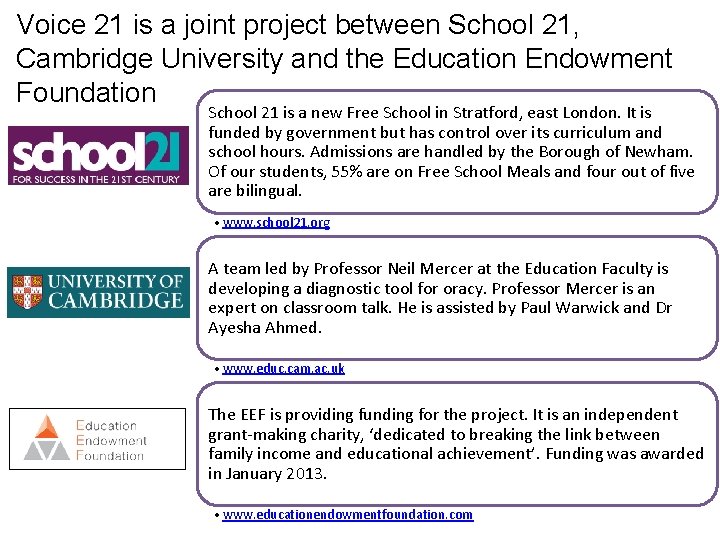
Voice 21 is a joint project between School 21, Cambridge University and the Education Endowment Foundation School 21 is a new Free School in Stratford, east London. It is funded by government but has control over its curriculum and school hours. Admissions are handled by the Borough of Newham. Of our students, 55% are on Free School Meals and four out of five are bilingual. • www. school 21. org A team led by Professor Neil Mercer at the Education Faculty is developing a diagnostic tool for oracy. Professor Mercer is an expert on classroom talk. He is assisted by Paul Warwick and Dr Ayesha Ahmed. • www. educ. cam. ac. uk The EEF is providing funding for the project. It is an independent grant-making charity, ‘dedicated to breaking the link between family income and educational achievement’. Funding was awarded in January 2013. • www. educationendowmentfoundation. com
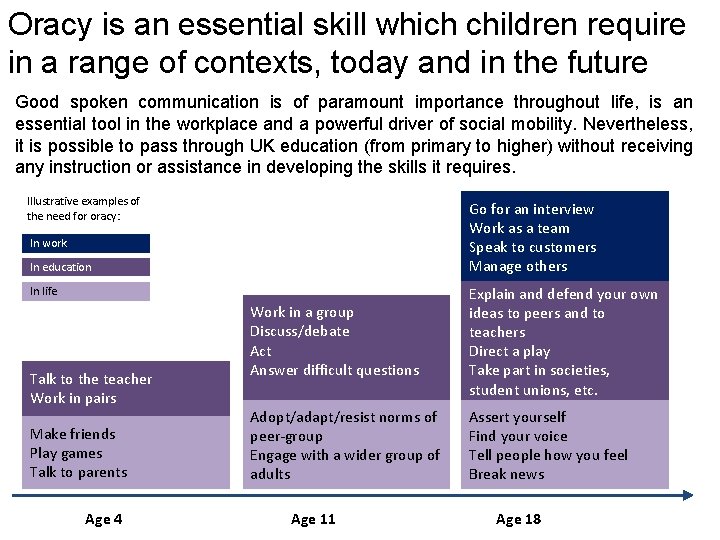
Oracy is an essential skill which children require in a range of contexts, today and in the future Good spoken communication is of paramount importance throughout life, is an essential tool in the workplace and a powerful driver of social mobility. Nevertheless, it is possible to pass through UK education (from primary to higher) without receiving any instruction or assistance in developing the skills it requires. Illustrative examples of the need for oracy: Go for an interview Work as a team Speak to customers Manage others In work In education Work in a group Discuss/debate Act Answer difficult questions Explain and defend your own ideas to peers and to teachers Direct a play Take part in societies, student unions, etc. Adopt/adapt/resist norms of peer-group Engage with a wider group of adults Assert yourself Find your voice Tell people how you feel Break news In life Talk to the teacher Work in pairs Make friends Play games Talk to parents Age 4 Age 11 Age 18
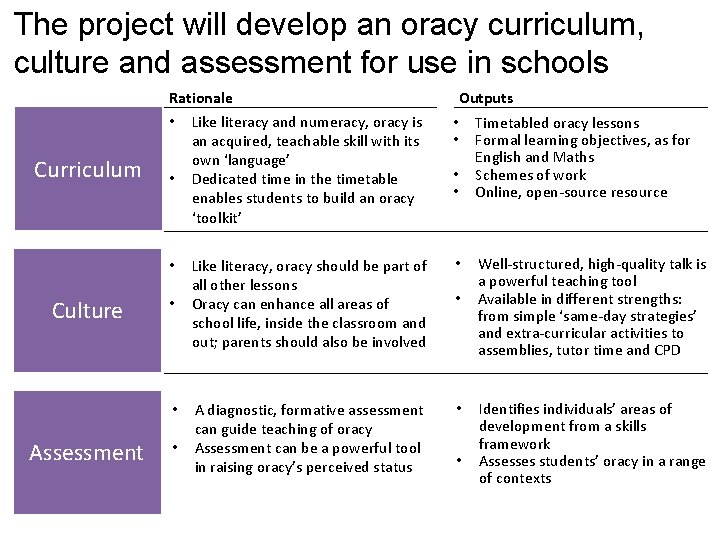
The project will develop an oracy curriculum, culture and assessment for use in schools Curriculum Rationale • Like literacy and numeracy, oracy is an acquired, teachable skill with its own ‘language’ • Dedicated time in the timetable enables students to build an oracy ‘toolkit’ • Culture • • Assessment • Outputs • • Like literacy, oracy should be part of all other lessons Oracy can enhance all areas of school life, inside the classroom and out; parents should also be involved • A diagnostic, formative assessment can guide teaching of oracy Assessment can be a powerful tool in raising oracy’s perceived status • • • Timetabled oracy lessons Formal learning objectives, as for English and Maths Schemes of work Online, open-source resource Well-structured, high-quality talk is a powerful teaching tool Available in different strengths: from simple ‘same-day strategies’ and extra-curricular activities to assemblies, tutor time and CPD Identifies individuals’ areas of development from a skills framework Assesses students’ oracy in a range of contexts
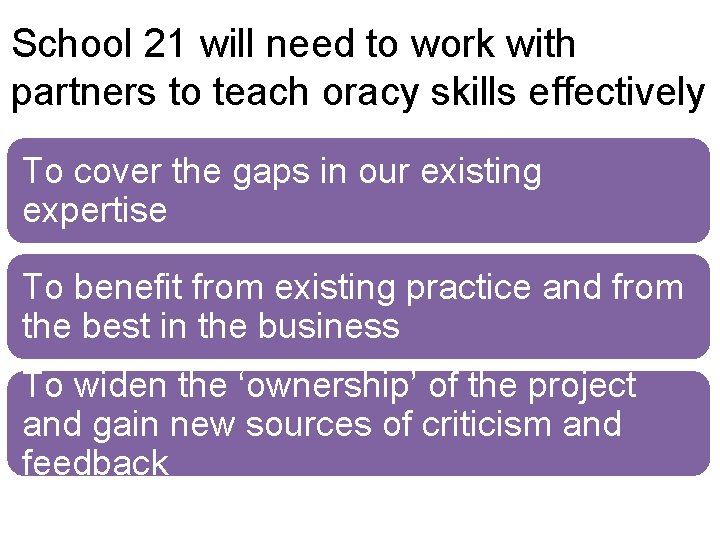
School 21 will need to work with partners to teach oracy skills effectively To cover the gaps in our existing expertise To benefit from existing practice and from the best in the business To widen the ‘ownership’ of the project and gain new sources of criticism and feedback
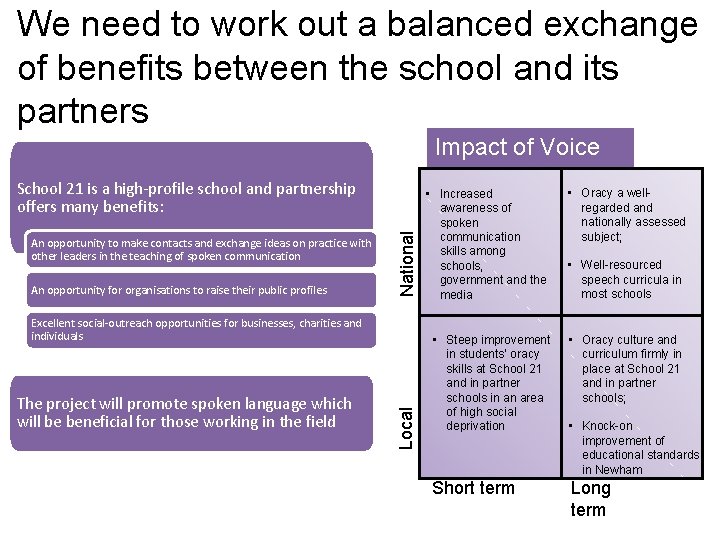
We need to work out a balanced exchange of benefits between the school and its partners Impact of Voice 21 An opportunity to make contacts and exchange ideas on practice with other leaders in the teaching of spoken communication An opportunity for organisations to raise their public profiles National School 21 is a high-profile school and partnership offers many benefits: The project will promote spoken language which will be beneficial for those working in the field Local Excellent social-outreach opportunities for businesses, charities and individuals • Increased awareness of spoken communication skills among schools, government and the media • Oracy a wellregarded and nationally assessed subject; • Well-resourced speech curricula in most schools • Steep improvement in students’ oracy skills at School 21 and in partner schools in an area of high social deprivation • Oracy culture and curriculum firmly in place at School 21 and in partner schools; Short term Long term • Knock-on improvement of educational standards in Newham
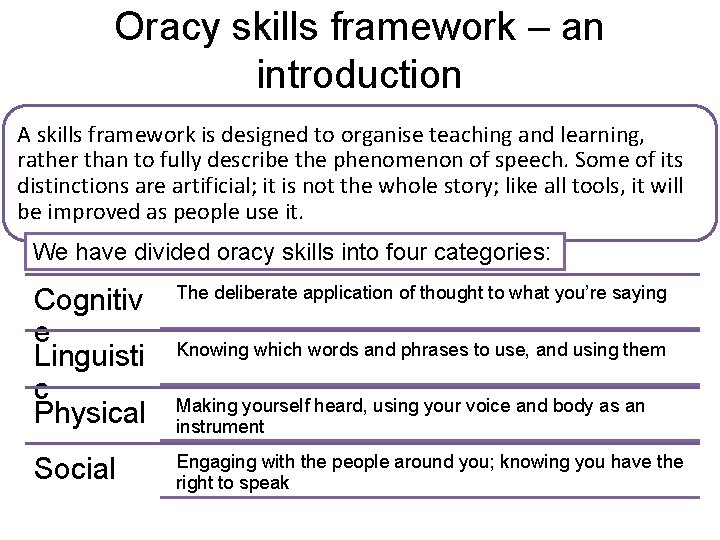
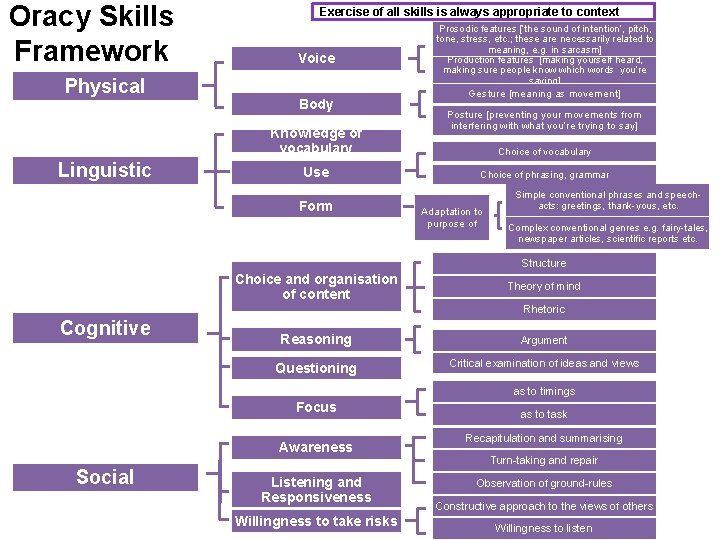
Oracy skills framework – an introduction A skills framework is designed to organise teaching and learning, rather than to fully describe the phenomenon of speech. Some of its distinctions are artificial; it is not the whole story; like all tools, it will be improved as people use it. We have divided oracy skills into four categories: Cognitiv e Linguisti c Physical The deliberate application of thought to what you’re saying Social Engaging with the people around you; knowing you have the right to speak Knowing which words and phrases to use, and using them Making yourself heard, using your voice and body as an instrument
Oracy Skills Framework Physical Exercise of all skills is always appropriate to context Voice Body Knowledge of vocabulary Linguistic Use Form Prosodic features [‘the sound of intention’, pitch, tone, stress, etc. ; these are necessarily related to meaning, e. g. in sarcasm] Production features [making yourself heard, making sure people know which words you’re saying] Gesture [meaning as movement] Posture [preventing your movements from interfering with what you’re trying to say] Choice of vocabulary Choice of phrasing, grammar Adaptation to purpose of Simple conventional phrases and speechacts: greetings, thank-yous, etc. Complex conventional genres e. g. fairy-tales, newspaper articles, scientific reports etc. Structure Choice and organisation of content Theory of mind Rhetoric Cognitive Reasoning Argument Questioning Critical examination of ideas and views as to timings Focus Awareness Social Listening and Responsiveness Willingness to take risks as to task Recapitulation and summarising Turn-taking and repair Observation of ground-rules Constructive approach to the views of others Willingness to listen
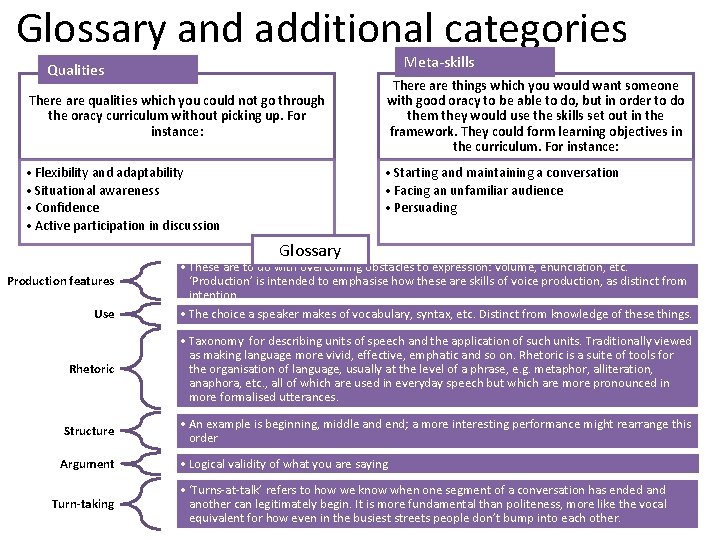
Glossary and additional categories Meta-skills Qualities There are qualities which you could not go through the oracy curriculum without picking up. For instance: • Flexibility and adaptability • Situational awareness • Confidence • Active participation in discussion There are things which you would want someone with good oracy to be able to do, but in order to do them they would use the skills set out in the framework. They could form learning objectives in the curriculum. For instance: • Starting and maintaining a conversation • Facing an unfamiliar audience • Persuading Glossary Production features Use • These are to do with overcoming obstacles to expression: volume, enunciation, etc. ‘Production’ is intended to emphasise how these are skills of voice production, as distinct from intention. • The choice a speaker makes of vocabulary, syntax, etc. Distinct from knowledge of these things. Rhetoric • Taxonomy for describing units of speech and the application of such units. Traditionally viewed as making language more vivid, effective, emphatic and so on. Rhetoric is a suite of tools for the organisation of language, usually at the level of a phrase, e. g. metaphor, alliteration, anaphora, etc. , all of which are used in everyday speech but which are more pronounced in more formalised utterances. Structure • An example is beginning, middle and end; a more interesting performance might rearrange this order Argument • Logical validity of what you are saying Turn-taking • ‘Turns-at-talk’ refers to how we know when one segment of a conversation has ended another can legitimately begin. It is more fundamental than politeness, more like the vocal equivalent for how even in the busiest streets people don’t bump into each other.
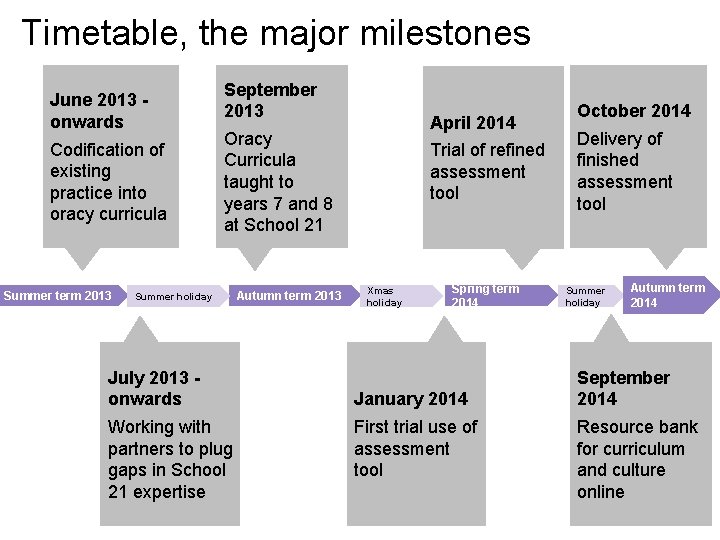
Timetable, the major milestones June 2013 onwards Codification of existing practice into oracy curricula Summer term 2013 September 2013 April 2014 Oracy Curricula taught to years 7 and 8 at School 21 Summer holiday July 2013 onwards Working with partners to plug gaps in School 21 expertise Autumn term 2013 Trial of refined assessment tool Xmas holiday Spring term 2014 January 2014 First trial use of assessment tool October 2014 Delivery of finished assessment tool Summer holiday Autumn term 2014 September 2014 Resource bank for curriculum and culture online