
Vocational Training Policy of the European Union Dr
- Slides: 10
Vocational Training Policy of the European Union Dr Knut Diekmann Association of German Chambers of Industrie and Commerce Dr. Knut Diekmann, DIHK e. V. , HU Berlin, 5. August 2013
historical setting • European continent with different traditions – dual principle: theoretical and practical parts – school-based VET – lack of VET: training on the job • one of the most important infrastructures and powers in the hands of the member-states • educational systems as effective barriers against mobility and free movement of labour (as one of the freedoms of the common market) • late in process of European integration: starting point 1995 Dr. Knut Diekmann, DIHK e. V. , HU Berlin, 5. August 2013
challenges change of policy: 1. EU institutions: gaining political influence breaking national powers reserving powers in the EU-treaty 2. developping a vision with added value for all players: European area of vocational training Dr. Knut Diekmann, DIHK e. V. , HU Berlin, 5. August 2013
policy targets aims of European policy on VET: - moderate harmonization via standards - common terms - orientation towards labour market needs transparency and comparability common concepts: lifeling learning, learning outcomes, knowledge/skill/competency, non-formal and informal learning common infrastructure: matrix incl. descriptors, levels of excellence, domains Dr. Knut Diekmann, DIHK e. V. , HU Berlin, 5. August 2013
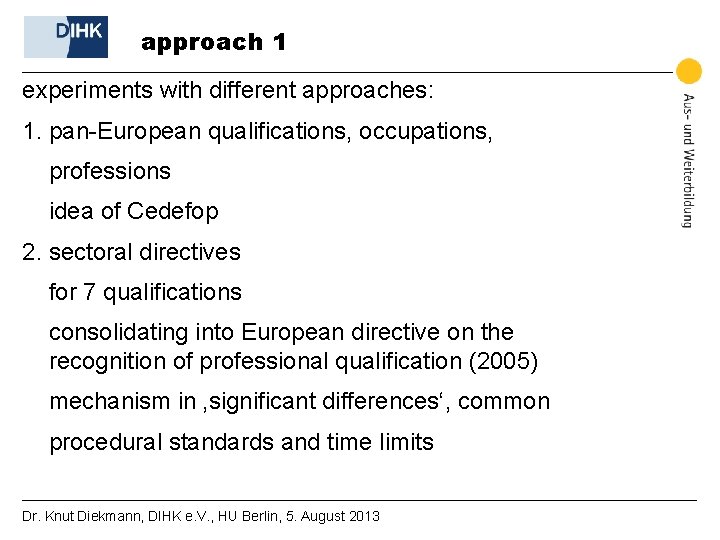
approach 1 experiments with different approaches: 1. pan-European qualifications, occupations, professions idea of Cedefop 2. sectoral directives for 7 qualifications consolidating into European directive on the recognition of professional qualification (2005) mechanism in ‚significant differences‘, common procedural standards and time limits Dr. Knut Diekmann, DIHK e. V. , HU Berlin, 5. August 2013
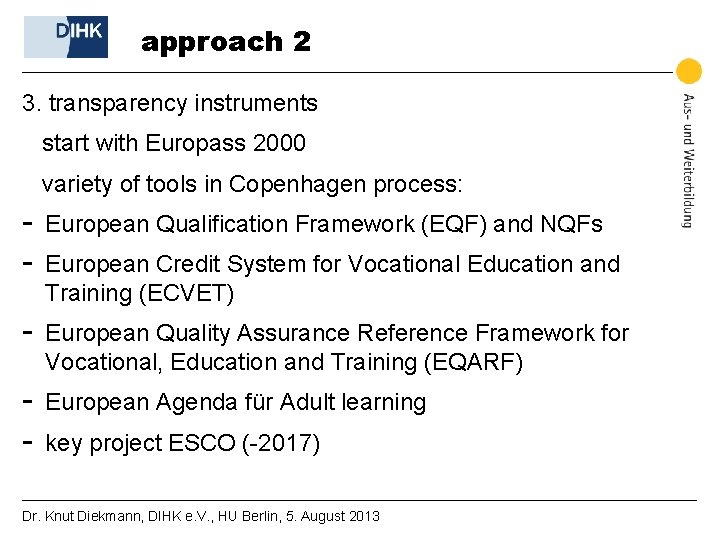
approach 2 3. transparency instruments start with Europass 2000 variety of tools in Copenhagen process: - European Qualification Framework (EQF) and NQFs - European Quality Assurance Reference Framework for Vocational, Education and Training (EQARF) - European Agenda für Adult learning European Credit System for Vocational Education and Training (ECVET) key project ESCO (-2017) Dr. Knut Diekmann, DIHK e. V. , HU Berlin, 5. August 2013
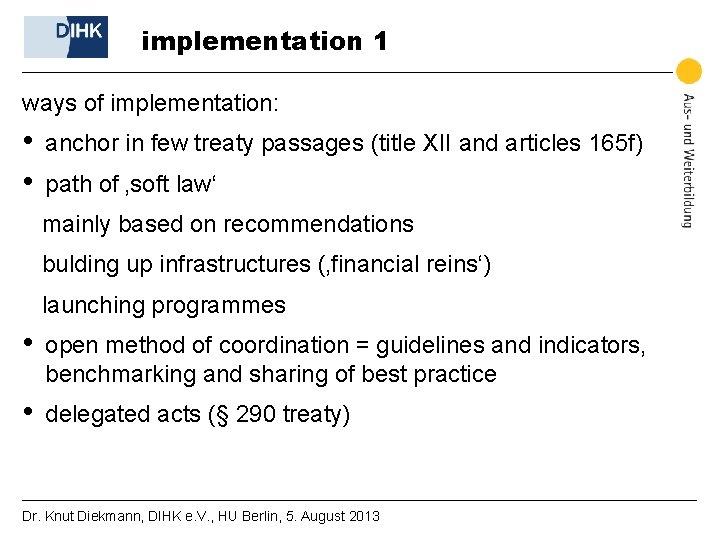
implementation 1 ways of implementation: • • anchor in few treaty passages (title XII and articles 165 f) path of ‚soft law‘ mainly based on recommendations bulding up infrastructures (‚financial reins‘) launching programmes • open method of coordination = guidelines and indicators, benchmarking and sharing of best practice • delegated acts (§ 290 treaty) Dr. Knut Diekmann, DIHK e. V. , HU Berlin, 5. August 2013
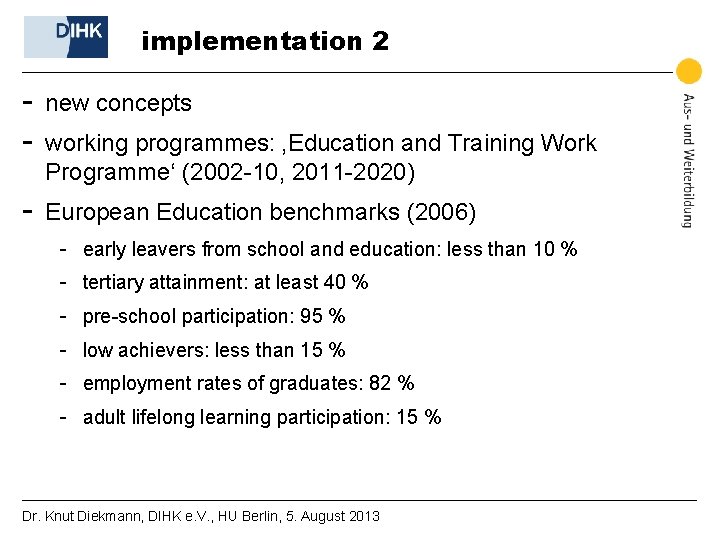
implementation 2 - new concepts - European Education benchmarks (2006) working programmes: ‚Education and Training Work Programme‘ (2002 -10, 2011 -2020) - early leavers from school and education: less than 10 % tertiary attainment: at least 40 % pre-school participation: 95 % low achievers: less than 15 % employment rates of graduates: 82 % adult lifelong learning participation: 15 % Dr. Knut Diekmann, DIHK e. V. , HU Berlin, 5. August 2013
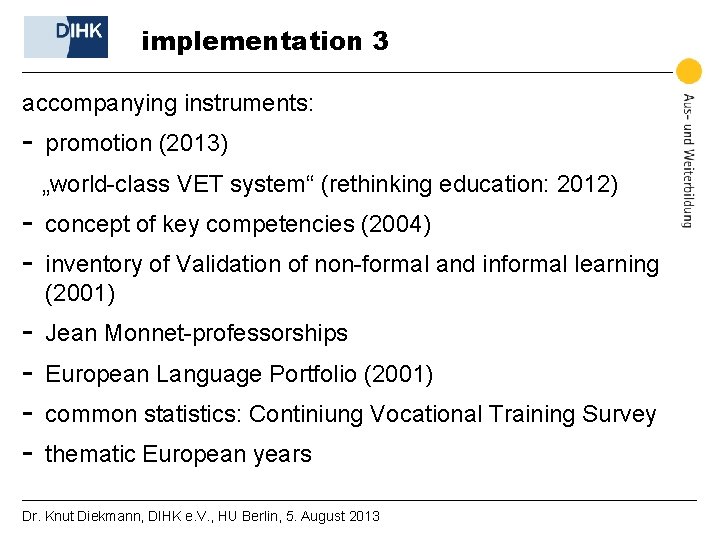
implementation 3 accompanying instruments: - promotion (2013) „world-class VET system“ (rethinking education: 2012) - concept of key competencies (2004) - Jean Monnet-professorships inventory of Validation of non-formal and informal learning (2001) European Language Portfolio (2001) common statistics: Continiung Vocational Training Survey thematic European years Dr. Knut Diekmann, DIHK e. V. , HU Berlin, 5. August 2013
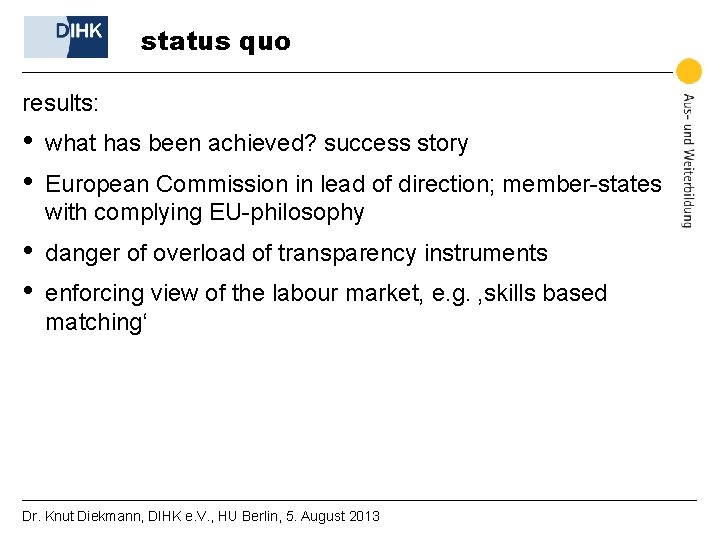
status quo results: • • what has been achieved? success story • • danger of overload of transparency instruments European Commission in lead of direction; member-states with complying EU-philosophy enforcing view of the labour market, e. g. ‚skills based matching‘ Dr. Knut Diekmann, DIHK e. V. , HU Berlin, 5. August 2013