
Vocal Cord Paralysis Medialization Laryngoplasty University of Texas
- Slides: 66
Vocal Cord Paralysis Medialization Laryngoplasty University of Texas Medical Branch Shashidhar S. Reddy, MD, MPH Faculty Sponsor: Anna Pou, MD April 2004 1
Overview ¡ ¡ ¡ ¡ Anatomy of the Larynx Function of the Larynx Causes of Vocal Cord Paralysis Evaluation of Vocal Cord Paralysis Anterior TVC Medialization Posterior TVC Medialization Overview of Treatment for Bilateral Vocal Cord Paralysis Conclusion (Key Points) 2
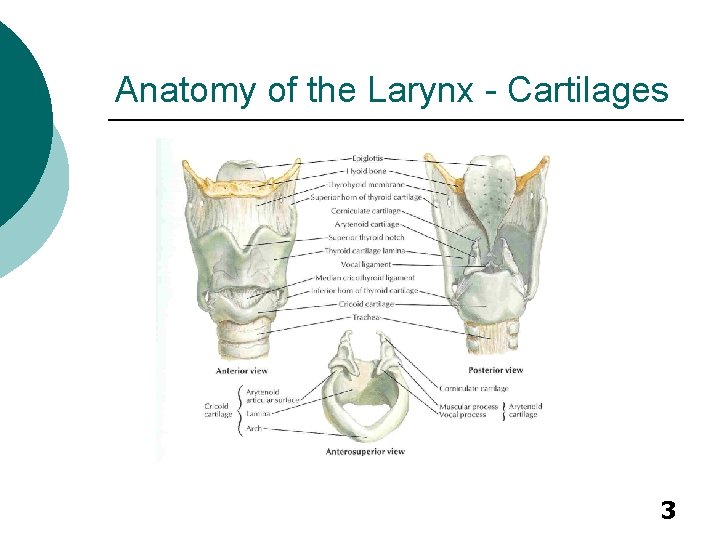
Anatomy of the Larynx - Cartilages 3
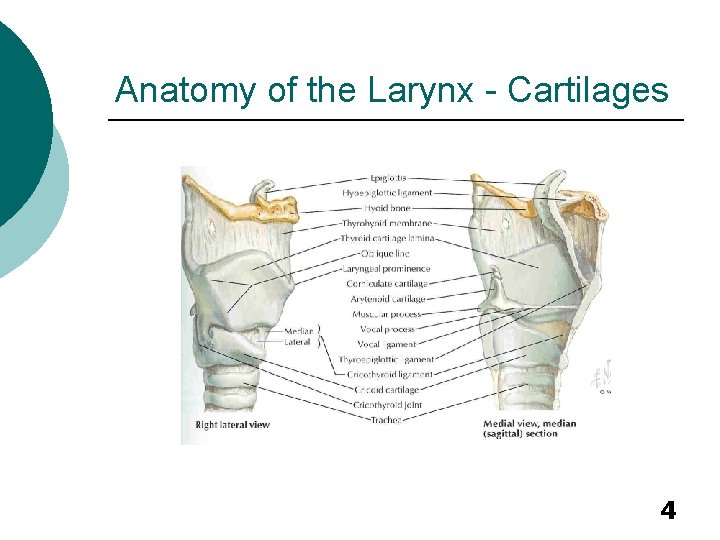
Anatomy of the Larynx - Cartilages 4
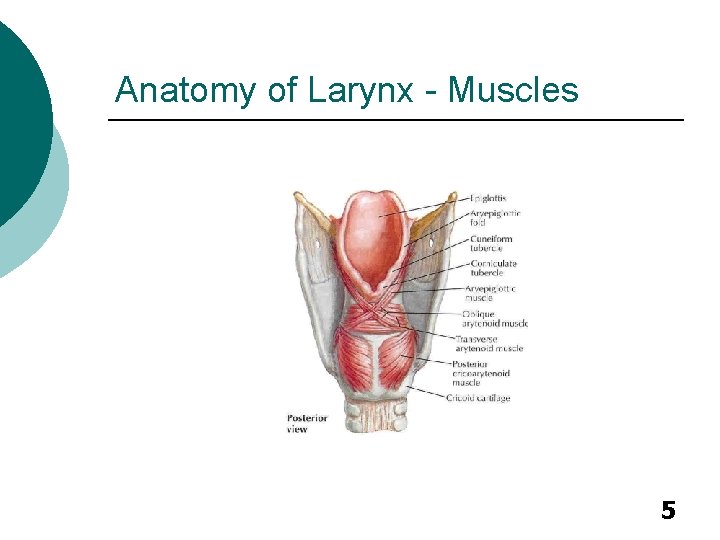
Anatomy of Larynx - Muscles 5
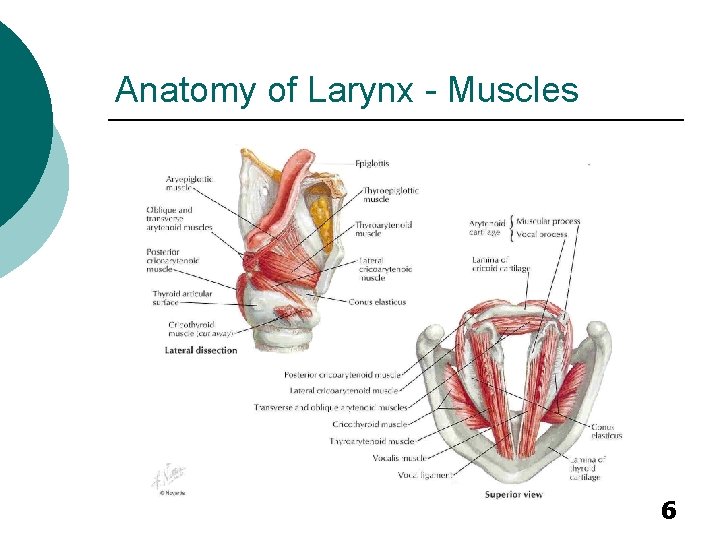
Anatomy of Larynx - Muscles 6
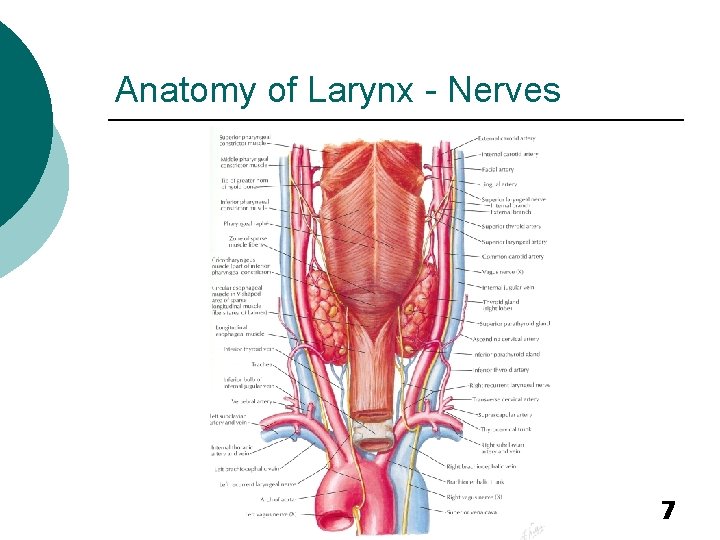
Anatomy of Larynx - Nerves 7
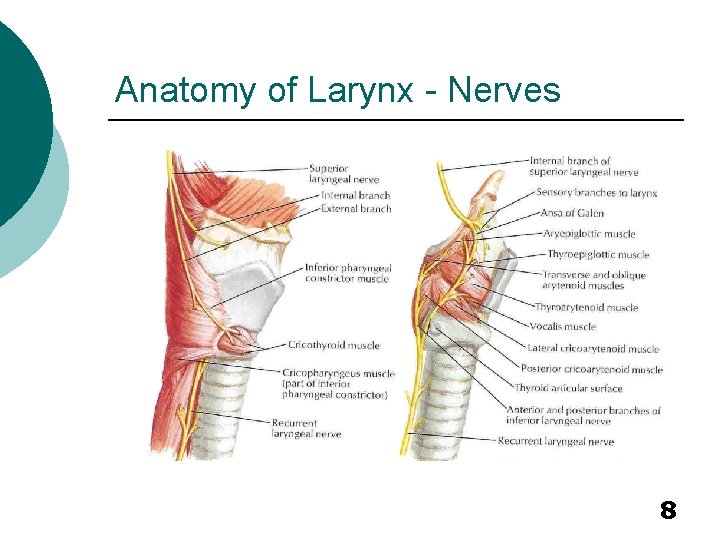
Anatomy of Larynx - Nerves 8
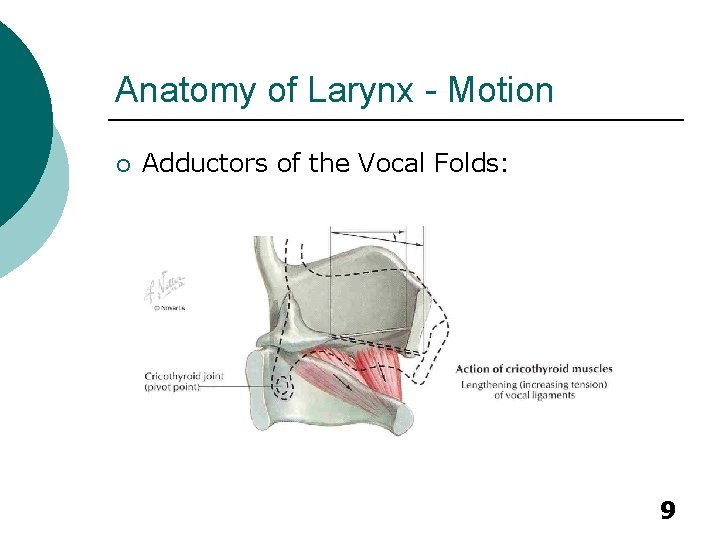
Anatomy of Larynx - Motion ¡ Adductors of the Vocal Folds: 9
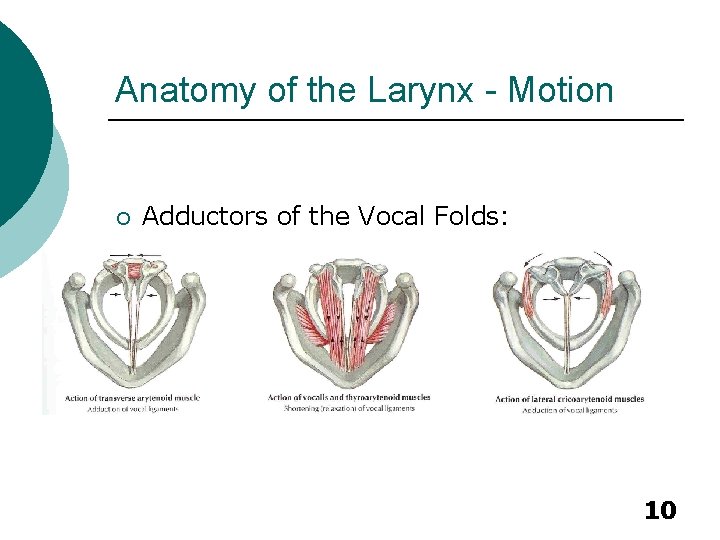
Anatomy of the Larynx - Motion ¡ Adductors of the Vocal Folds: 10
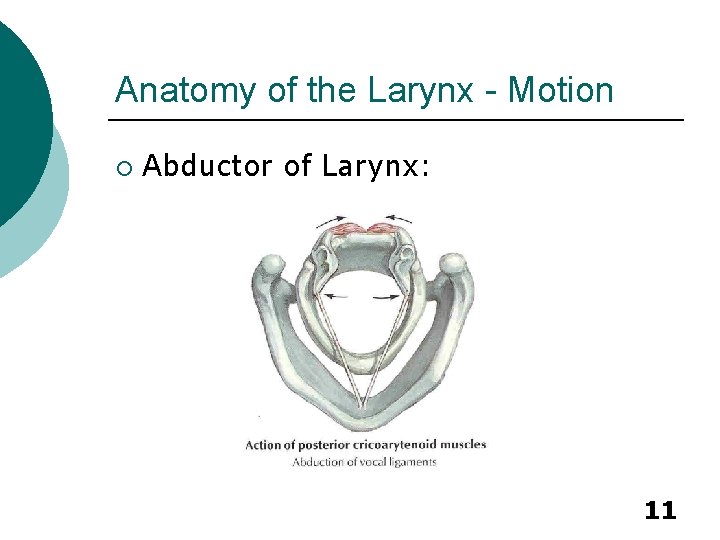
Anatomy of the Larynx - Motion ¡ Abductor of Larynx: 11
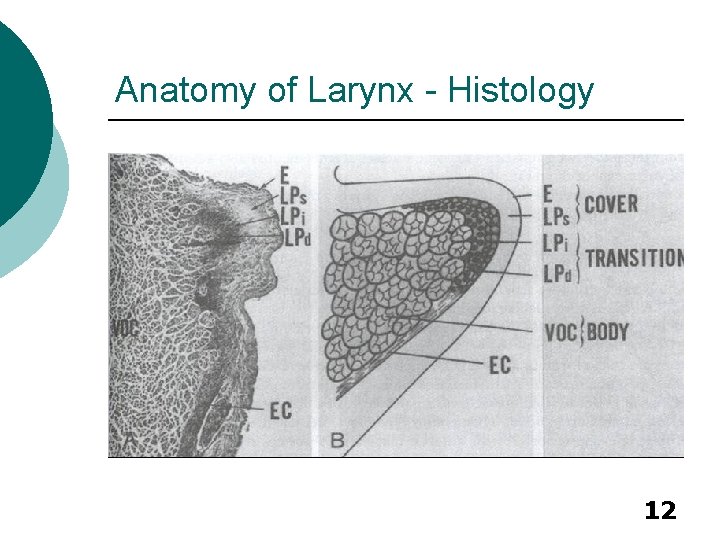
Anatomy of Larynx - Histology 12
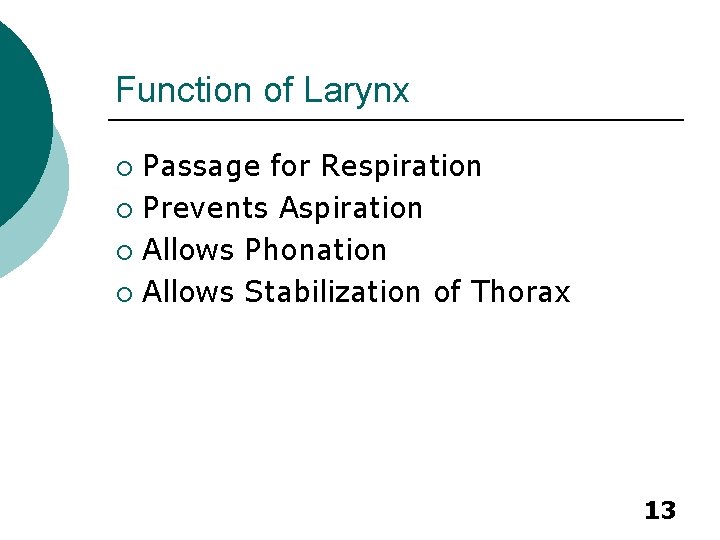
Function of Larynx Passage for Respiration ¡ Prevents Aspiration ¡ Allows Phonation ¡ Allows Stabilization of Thorax ¡ 13
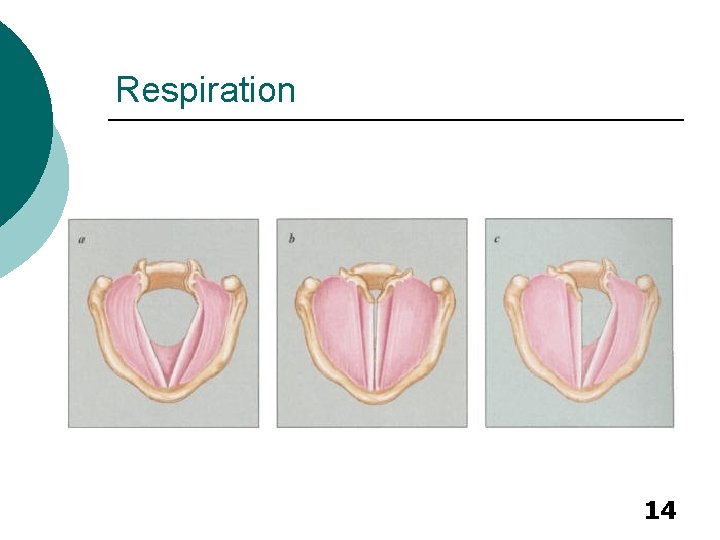
Respiration 14
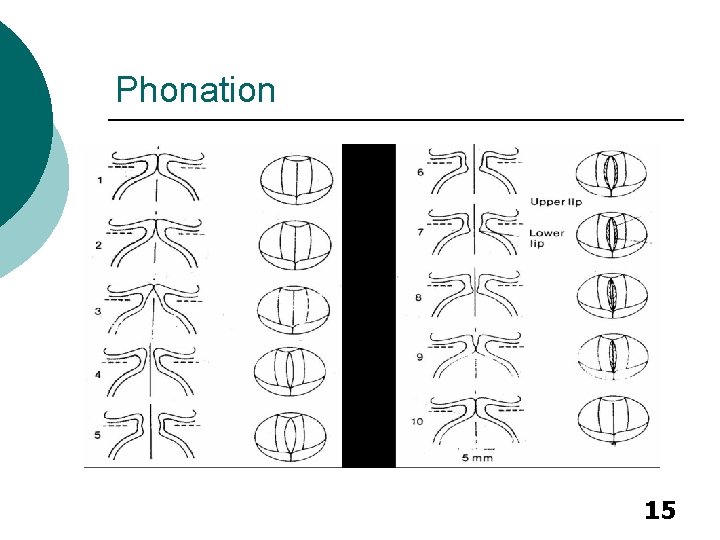
Phonation 15
Vocal Cord Paralysis Etiology, Preoperative Evaluation, Treatment 16
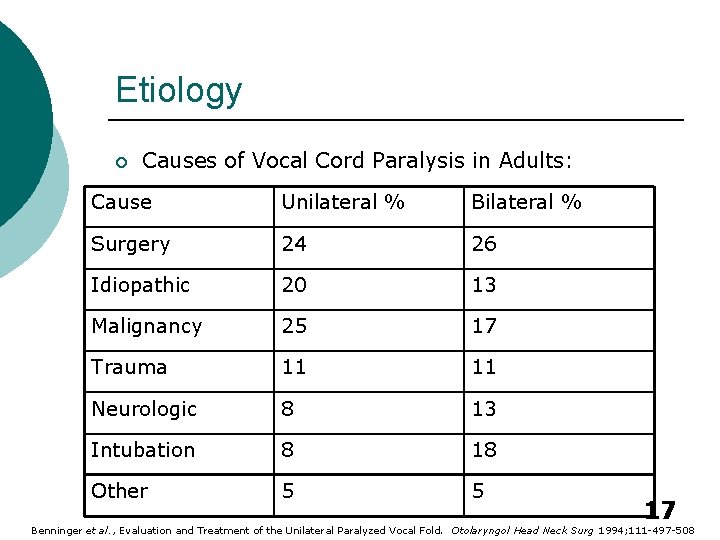
Etiology ¡ Causes of Vocal Cord Paralysis in Adults: Cause Unilateral % Bilateral % Surgery 24 26 Idiopathic 20 13 Malignancy 25 17 Trauma 11 11 Neurologic 8 13 Intubation 8 18 Other 5 5 17 Benninger et al. , Evaluation and Treatment of the Unilateral Paralyzed Vocal Fold. Otolaryngol Head Neck Surg 1994; 111 -497 -508
Evaluation – Patient History Alcohol and Tobacco Usage ¡ Voice Abuse ¡ URI and Allergic Rhinitis ¡ Reflux ¡ Neurologic Disorders ¡ History of Trauma or Surgery ¡ Systemic Illness – Rheumatoid ¡ Duration – Affects Prognosis ¡ 18
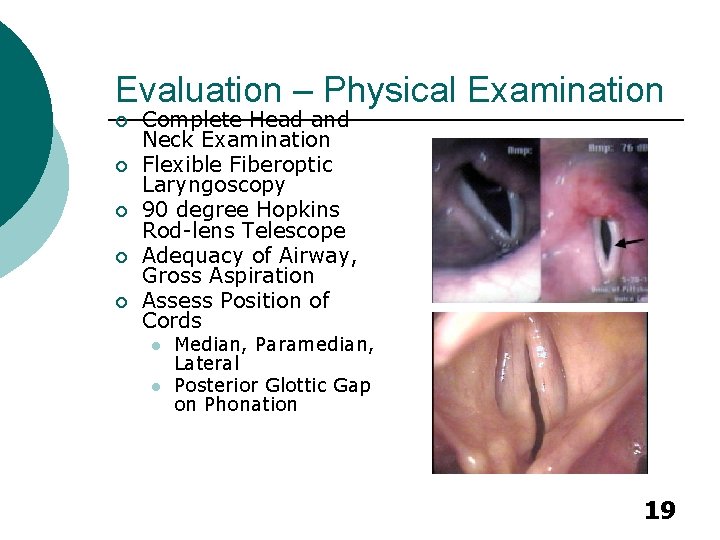
Evaluation – Physical Examination ¡ ¡ ¡ Complete Head and Neck Examination Flexible Fiberoptic Laryngoscopy 90 degree Hopkins Rod-lens Telescope Adequacy of Airway, Gross Aspiration Assess Position of Cords l l Median, Paramedian, Lateral Posterior Glottic Gap on Phonation 19
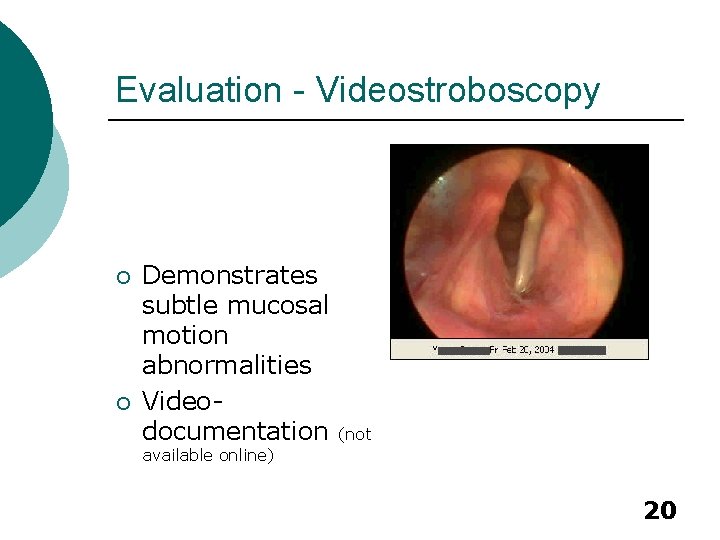
Evaluation - Videostroboscopy ¡ ¡ Demonstrates subtle mucosal motion abnormalities Videodocumentation (not available online) 20
Evaluation - Electromyography Assesses integrity of laryngeal nerves ¡ Differentiates denervation from mechanical obstruction of vocal cord movement ¡ Electrode in Thyroarytenoid and Cricothyroid ¡ 21
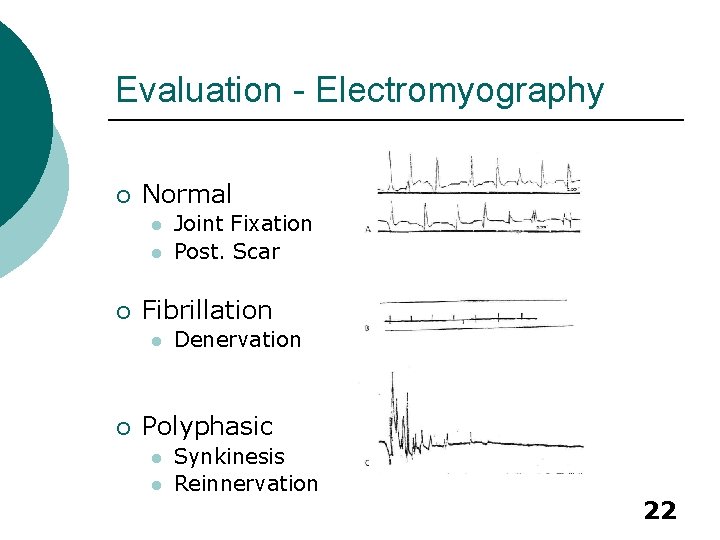
Evaluation - Electromyography ¡ Normal l l ¡ Fibrillation l ¡ Joint Fixation Post. Scar Denervation Polyphasic l l Synkinesis Reinnervation 22
Evaluation - Imaging ¡ Chest X-ray l ¡ Screen for intrathoracic lesions MRI of Brain l Screen for CNS disorders CT Skull Base to Mediastinum ¡ Direct Laryngoscopy ¡ l Palpate arytenoids, especially when no L-EMG 23
Evaluation – Unilateral Paralysis ¡ Preoperative Evaluation l l Speech Therapy Assess patient’s vocal requirements Do not perform irreversible interventions in patients with possibility of functional return for 6 -12 months Surgery often not necessary in paramedian positioning 24
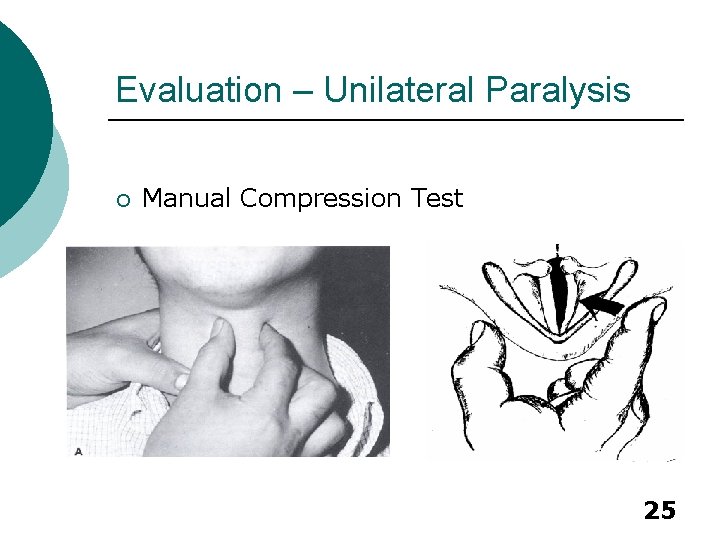
Evaluation – Unilateral Paralysis ¡ Manual Compression Test 25
Evaluation – Unilateral Paralysis Assess extent of posterior glottic gap ¡ Consider consenting patient for both anterior and posterior medialization procedures ¡ 26
Management – Unilateral Paralysis ¡ Type of Anesthesia l Local – allows patient to phonate Careful administration of IV sedation ¡ Internal superior laryngeal nerve block at the thyrohyoid membrane ¡ Glossopharyngeal nerve block at the inferior pole of the tonsils ¡ Flexible endoscope allows visualization ¡ l l Laryngeal Mask General 27
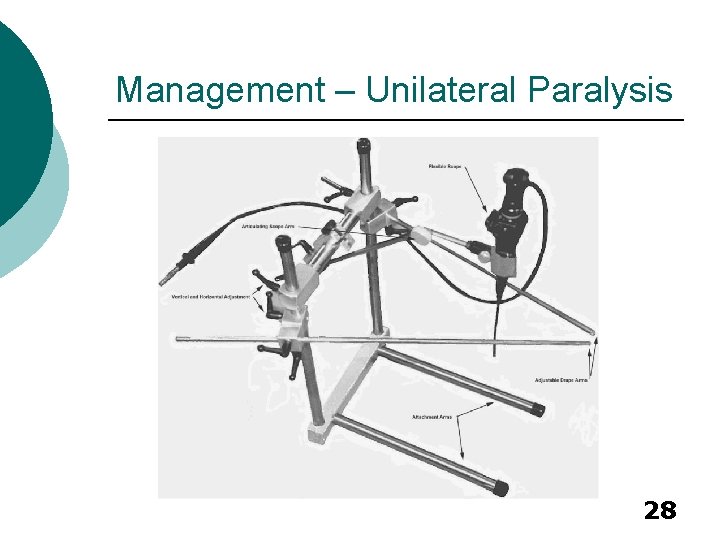
Management – Unilateral Paralysis 28
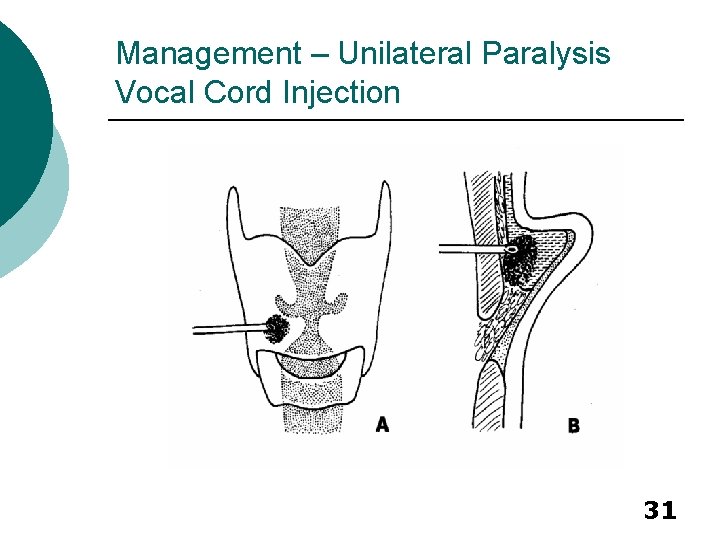
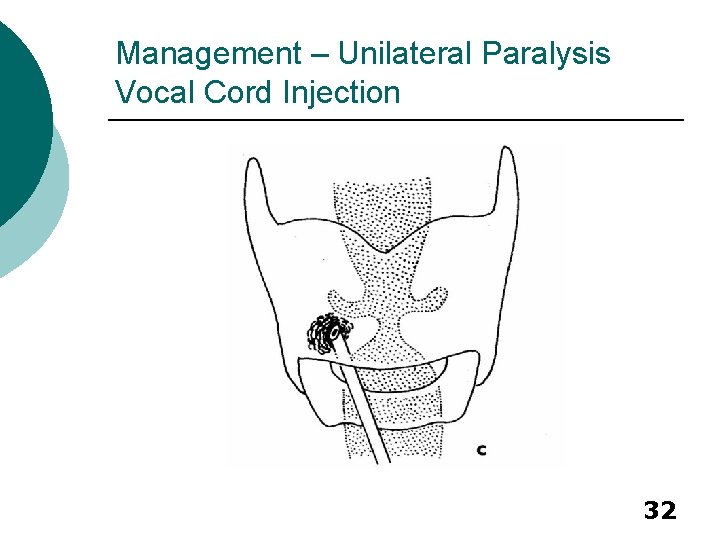
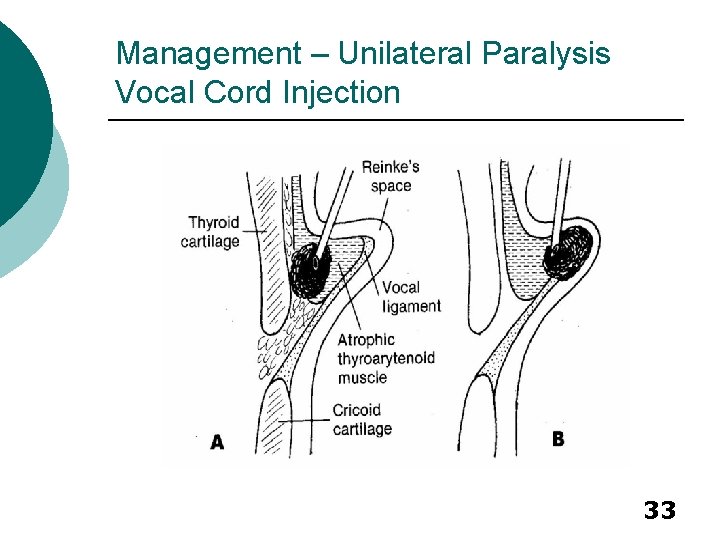
Management – Unilateral Paralysis Vocal Cord Injection Adds fullness to the vocal cord to help it better appose the other side ¡ Injection technique is similar regardless of material used ¡ Injection into thyroarytenoid/vocalis ¡ Injection can be done endoscopically or percutaneiously ¡ Poor correction of posterior glottic gap ¡ 29
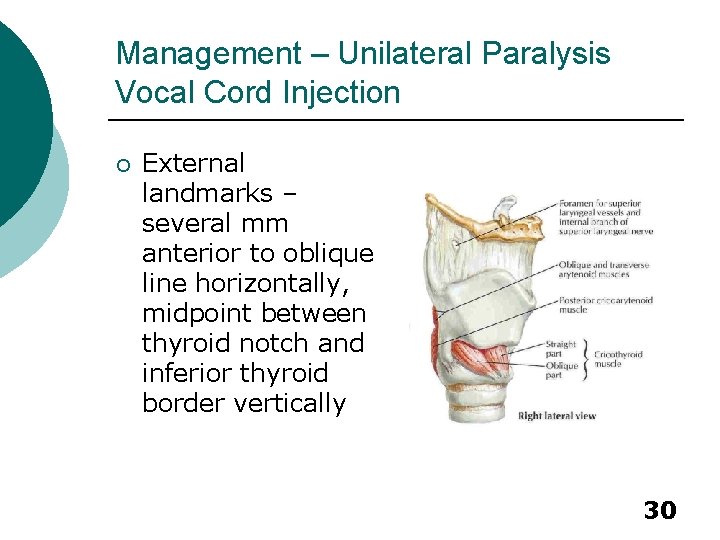
Management – Unilateral Paralysis Vocal Cord Injection ¡ External landmarks – several mm anterior to oblique line horizontally, midpoint between thyroid notch and inferior thyroid border vertically 30
Management – Unilateral Paralysis Vocal Cord Injection 31
Management – Unilateral Paralysis Vocal Cord Injection 32
Management – Unilateral Paralysis Vocal Cord Injection 33
Management – Unilateral Paralysis Vocal Cord Injection - Materials ¡ ¡ ¡ Teflon Fat Collagen l l l ¡ ¡ ¡ Autologous Collagen Homologous Micronized Alloderm (Cymetra) Heterologous Bovine Collagen (Zyderm Hyaluronic Acid Calcium Hydroxyapatite gel (Radiance FN) Polydimethylsiloxane gel (Bioplastique) 34
Management – Unilateral Paralysis Vocal Cord Injection ¡ Teflon - the first biosynthetic material specifically designed for implantation l Advantages Inexpensive and easily administered ¡ Immediate voice improvement ¡ l Disadvantages: Irreversible ¡ Granuloma formation leads to vocal cord stiffening ¡ Migration ¡ Useful mainly in terminal patients ¡ 35
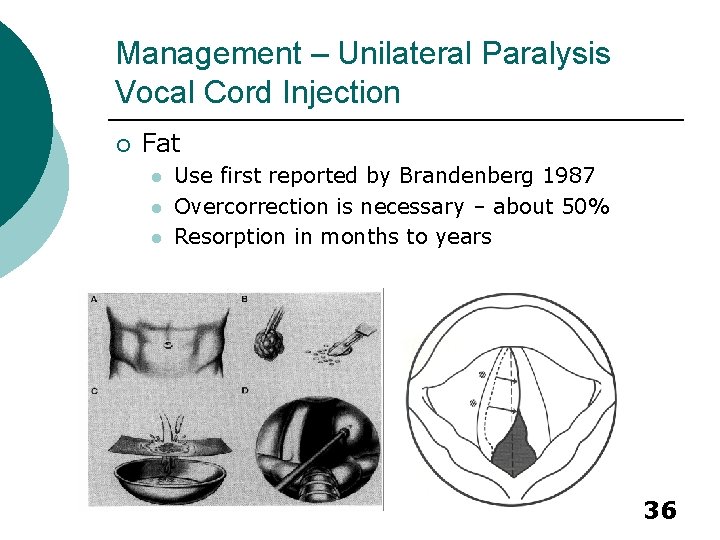
Management – Unilateral Paralysis Vocal Cord Injection ¡ Fat l l l Use first reported by Brandenberg 1987 Overcorrection is necessary – about 50% Resorption in months to years 36
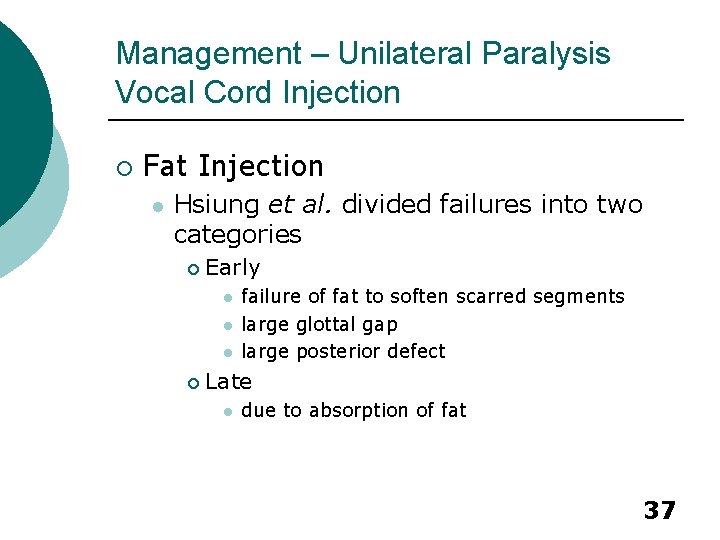
Management – Unilateral Paralysis Vocal Cord Injection ¡ Fat Injection l Hsiung et al. divided failures into two categories ¡ Early l l l ¡ failure of fat to soften scarred segments large glottal gap large posterior defect Late l due to absorption of fat 37
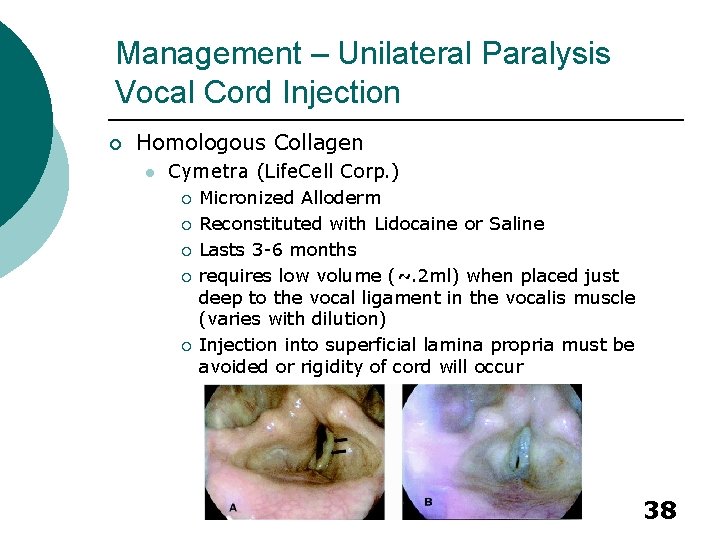
Management – Unilateral Paralysis Vocal Cord Injection ¡ Homologous Collagen l Cymetra (Life. Cell Corp. ) ¡ ¡ ¡ Micronized Alloderm Reconstituted with Lidocaine or Saline Lasts 3 -6 months requires low volume (~. 2 ml) when placed just deep to the vocal ligament in the vocalis muscle (varies with dilution) Injection into superficial lamina propria must be avoided or rigidity of cord will occur 38
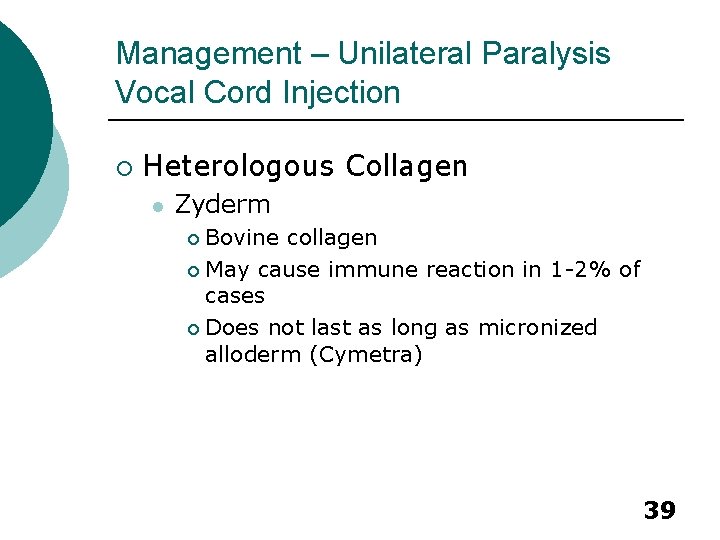
Management – Unilateral Paralysis Vocal Cord Injection ¡ Heterologous Collagen l Zyderm Bovine collagen ¡ May cause immune reaction in 1 -2% of cases ¡ Does not last as long as micronized alloderm (Cymetra) ¡ 39
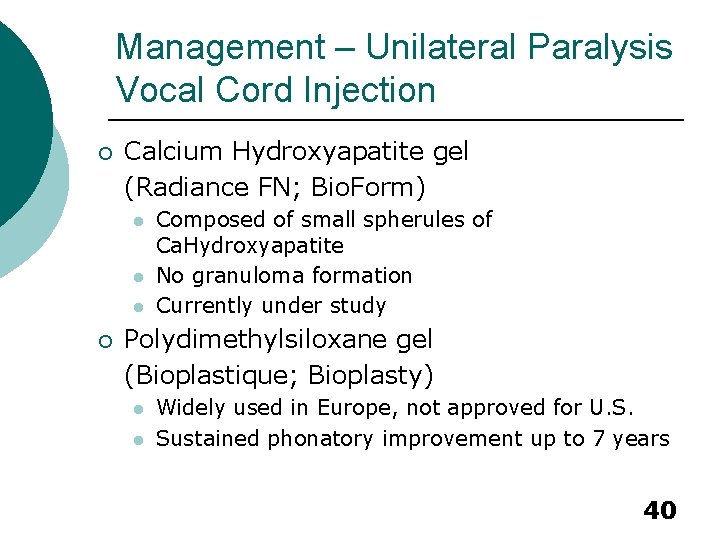
Management – Unilateral Paralysis Vocal Cord Injection ¡ Calcium Hydroxyapatite gel (Radiance FN; Bio. Form) l l l ¡ Composed of small spherules of Ca. Hydroxyapatite No granuloma formation Currently under study Polydimethylsiloxane gel (Bioplastique; Bioplasty) l l Widely used in Europe, not approved for U. S. Sustained phonatory improvement up to 7 years 40
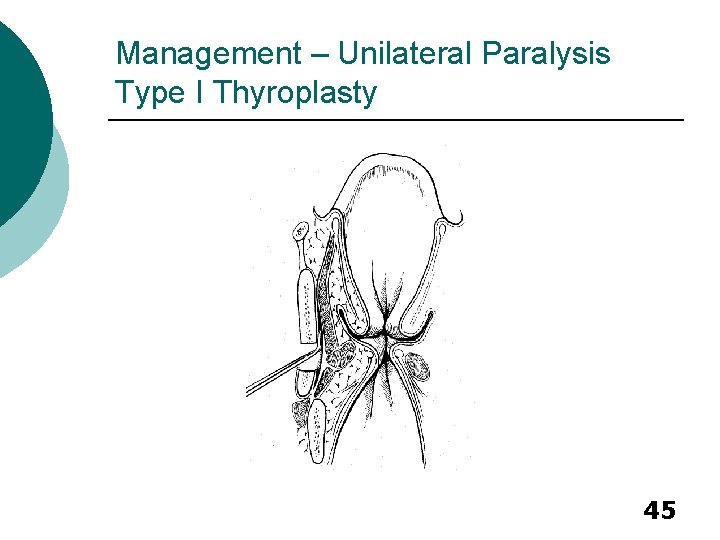
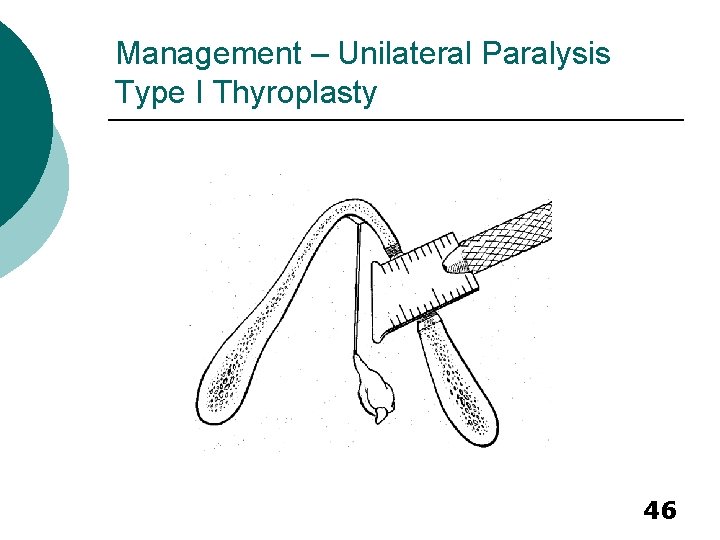
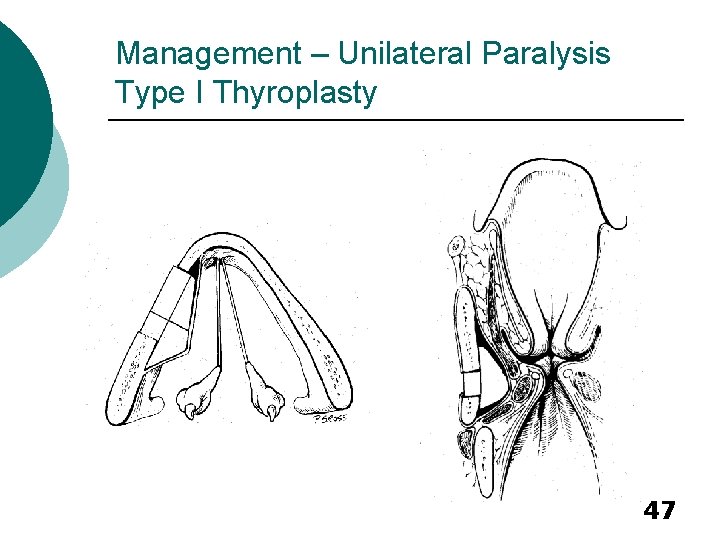
Management – Unilateral Paralysis Type I Thyroplasty First described by Payr and reintroduced by Ishiki in 1974 ¡ Variety of materials used for implants ¡ l l l ¡ Autologous Cartilage Silastic Hydroxyapatite Gore-Tex Titanium Useful for anterior glottic gap 41
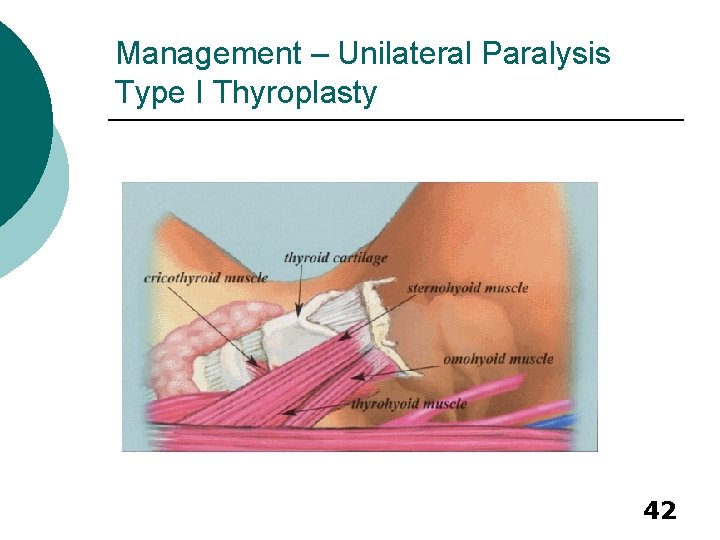
Management – Unilateral Paralysis Type I Thyroplasty 42
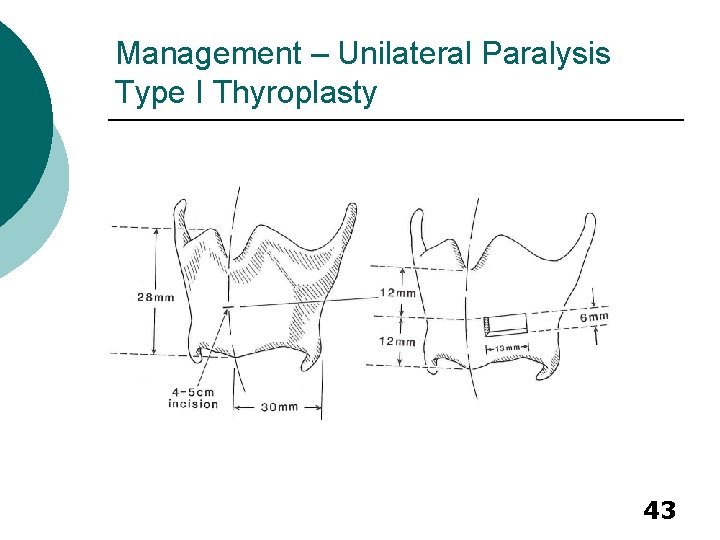
Management – Unilateral Paralysis Type I Thyroplasty 43
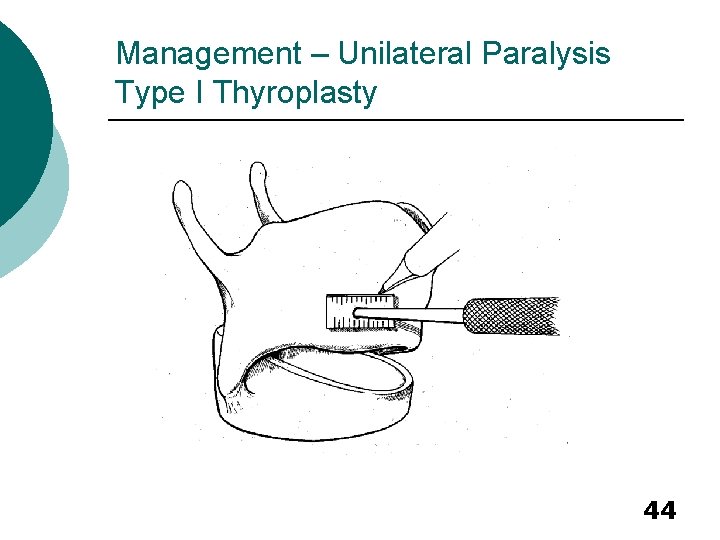
Management – Unilateral Paralysis Type I Thyroplasty 44
Management – Unilateral Paralysis Type I Thyroplasty 45
Management – Unilateral Paralysis Type I Thyroplasty 46
Management – Unilateral Paralysis Type I Thyroplasty 47
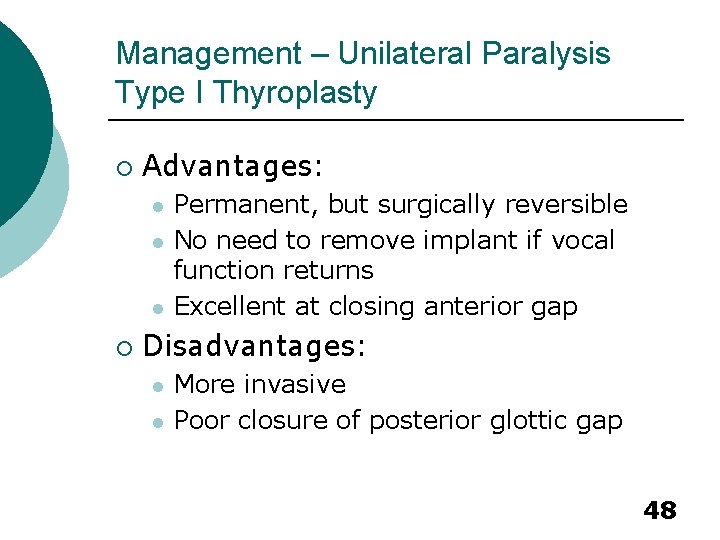
Management – Unilateral Paralysis Type I Thyroplasty ¡ Advantages: l l l ¡ Permanent, but surgically reversible No need to remove implant if vocal function returns Excellent at closing anterior gap Disadvantages: l l More invasive Poor closure of posterior glottic gap 48
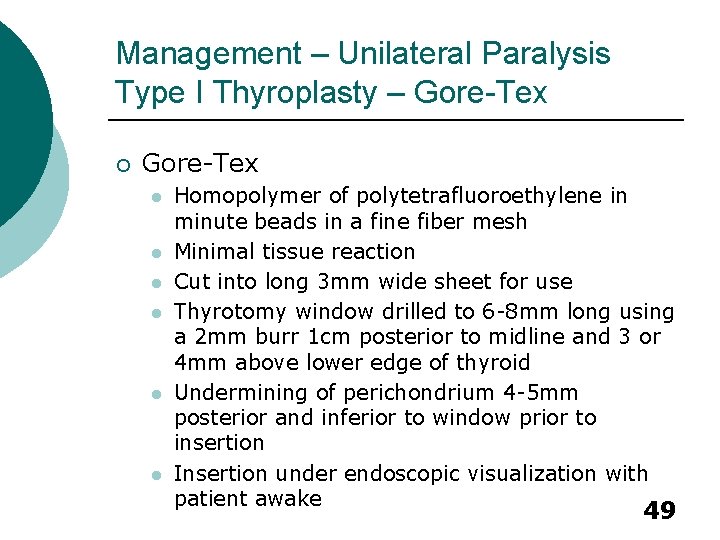
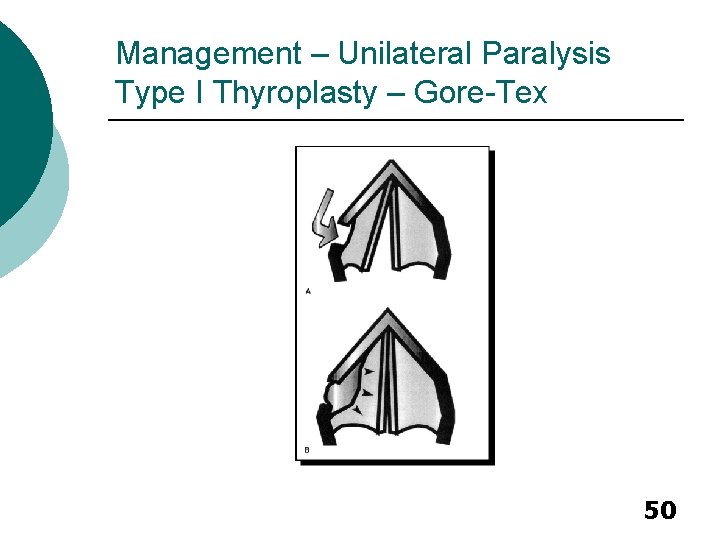
Management – Unilateral Paralysis Type I Thyroplasty – Gore-Tex ¡ Gore-Tex l l l Homopolymer of polytetrafluoroethylene in minute beads in a fine fiber mesh Minimal tissue reaction Cut into long 3 mm wide sheet for use Thyrotomy window drilled to 6 -8 mm long using a 2 mm burr 1 cm posterior to midline and 3 or 4 mm above lower edge of thyroid Undermining of perichondrium 4 -5 mm posterior and inferior to window prior to insertion Insertion under endoscopic visualization with patient awake 49
Management – Unilateral Paralysis Type I Thyroplasty – Gore-Tex 50
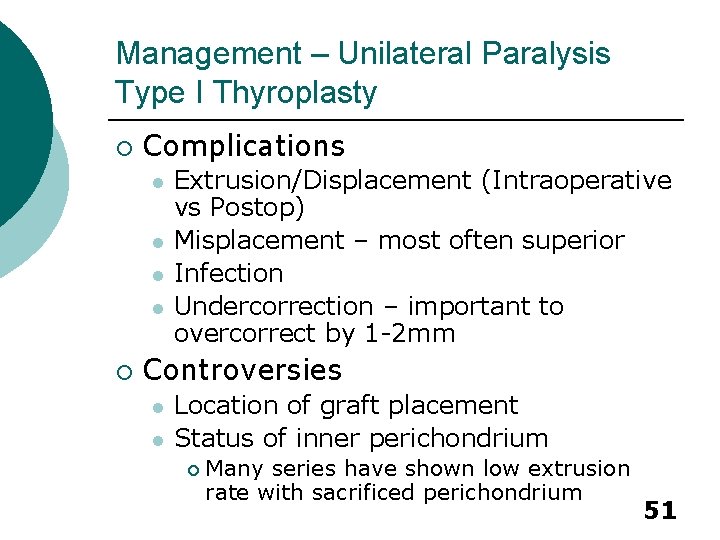
Management – Unilateral Paralysis Type I Thyroplasty ¡ Complications l l ¡ Extrusion/Displacement (Intraoperative vs Postop) Misplacement – most often superior Infection Undercorrection – important to overcorrect by 1 -2 mm Controversies l l Location of graft placement Status of inner perichondrium ¡ Many series have shown low extrusion rate with sacrificed perichondrium 51
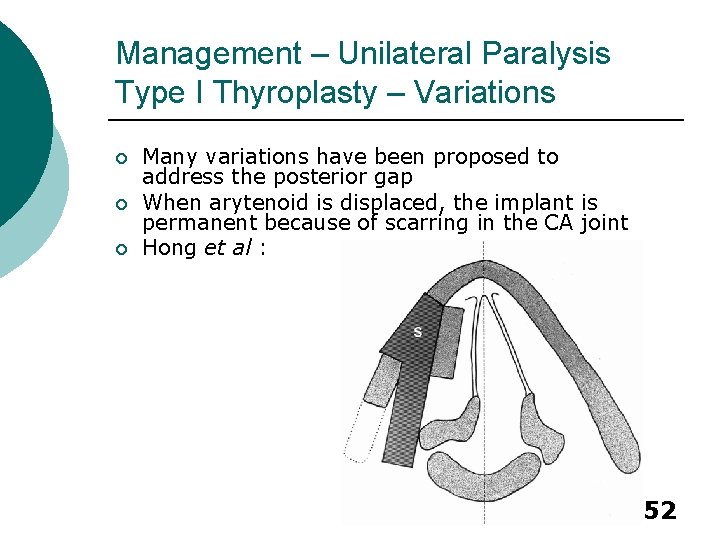
Management – Unilateral Paralysis Type I Thyroplasty – Variations ¡ ¡ ¡ Many variations have been proposed to address the posterior gap When arytenoid is displaced, the implant is permanent because of scarring in the CA joint Hong et al : 52
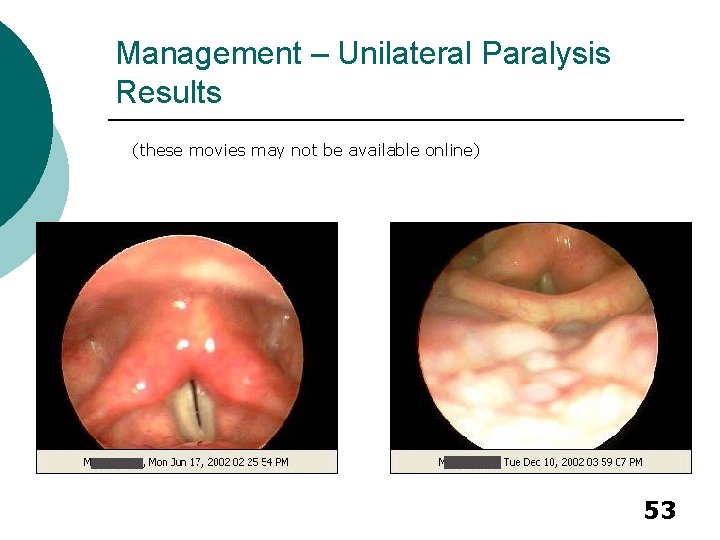
Management – Unilateral Paralysis Results (these movies may not be available online) 53
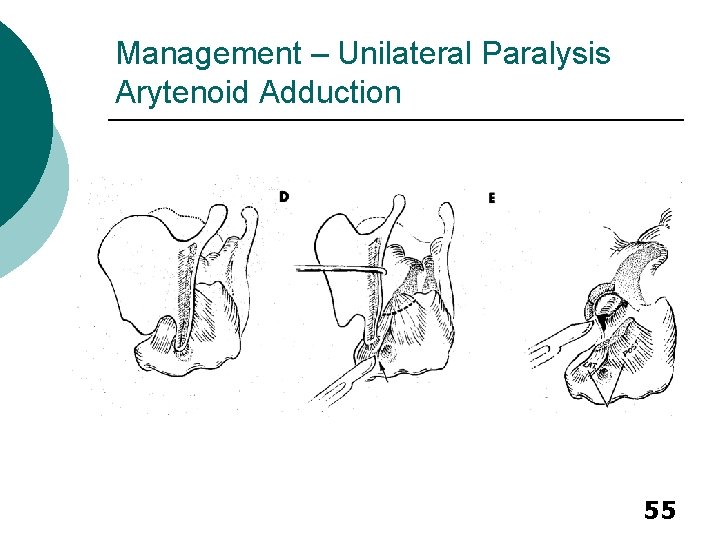
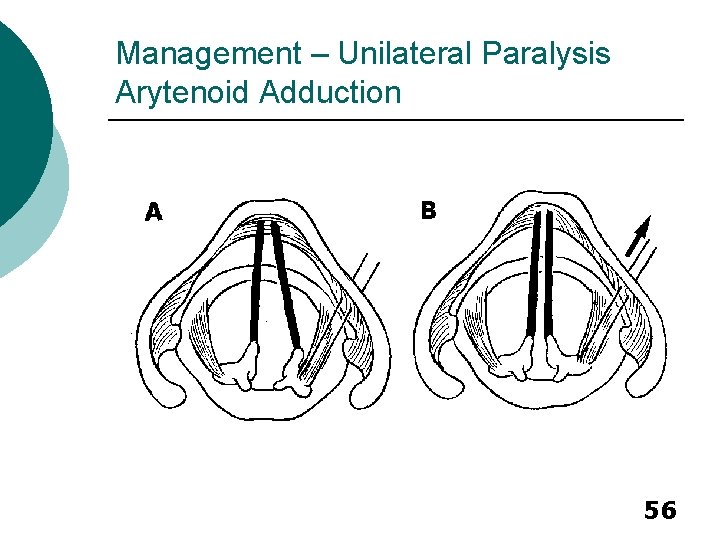
Management – Unilateral Paralysis Arytenoid Adduction ¡ Arytenoid Adduction l l First described by Ishiki with modifications by Zeitels and others Addresses posterior glottic gap by pulling arytenoid into adducted position Difficult to predict which patients will benefit preoperatively. Most advocate use in combination with anterior medialization 54
Management – Unilateral Paralysis Arytenoid Adduction 55
Management – Unilateral Paralysis Arytenoid Adduction 56
Management – Unilateral Paralysis Arytenoid Adduction – Modifications ¡ ¡ Endoscopic Approaches Suture Placed to Cricoid Cartilage l ¡ Simulates action of lateral cricoarytenoid Zeitels Modification – Arytenopexy l l Presumably allows a more physiologic positioning of the arytenoid Involves suturing the arytenoid in a more posterior and medial position to allow more tension on flaccid cord Cricothyroid subluxation mimics action of cricothyroid muscle Modifications should be used selectively 57
Management – Unilateral Paralysis Arytenoid Adduction ¡ Complications l l Sutures too tight – may displace arytenoid complex anteriorly, adversely affecting voice Entry of piriform sinus 58
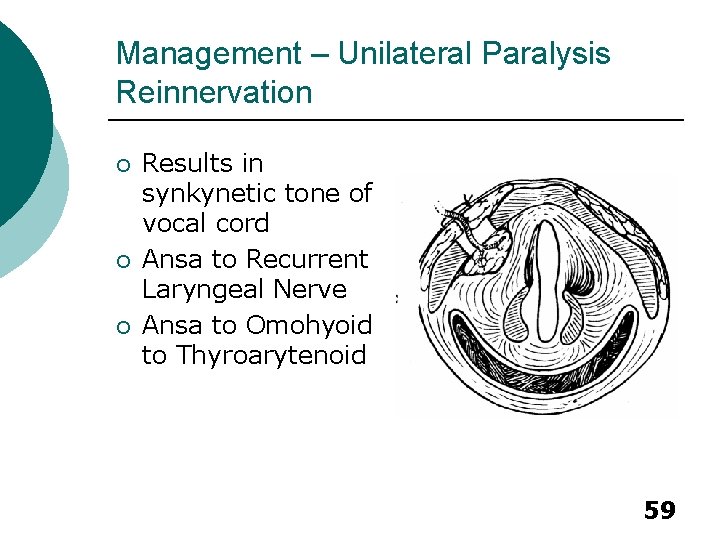
Management – Unilateral Paralysis Reinnervation ¡ ¡ ¡ Results in synkynetic tone of vocal cord Ansa to Recurrent Laryngeal Nerve Ansa to Omohyoid to Thyroarytenoid 59
Management – Unilateral Paralysis Reinnervation Hypoglossal to recurrent laryngeal nerve ¡ Crossed nerve grafts or wire conduction prostheses from one muscle to its paralyzed counterpart are being researched ¡ 60
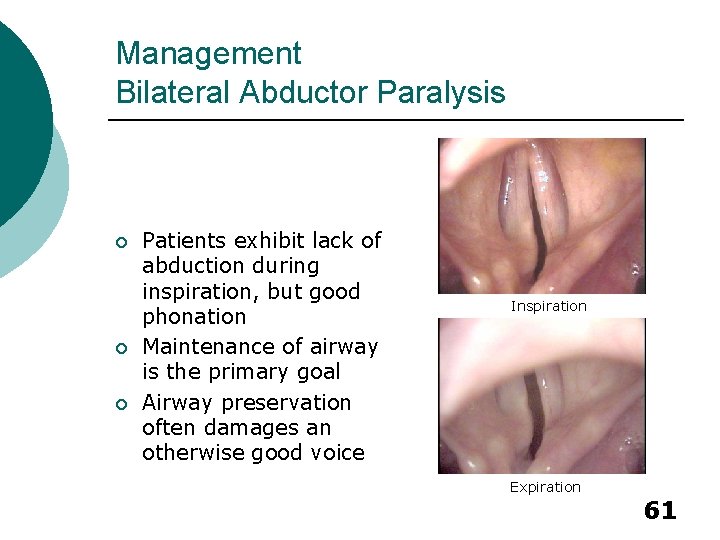
Management Bilateral Abductor Paralysis ¡ ¡ ¡ Patients exhibit lack of abduction during inspiration, but good phonation Maintenance of airway is the primary goal Airway preservation often damages an otherwise good voice Inspiration Expiration 61
Management Bilateral Abductor Paralysis ¡ Tracheostomy l l l Gold standard Most adults will require this Speaking valves aid in phonation Laser Cordectomy ¡ Laser Cordotomy ¡ Woodman Arytenoidectomy ¡ 62
Bilateral Abductor Paralysis ¡ Phrenic to Posterior Cricoarytenoid anastamosis l l ¡ Allows abduction during inspiration Preserves voice when successful Electrical Pacing l l Timed to inspiration with electrode placed on posterior cricoarytenoid Long-term efficacy not yet shown 63
Bilateral Adductor Paralysis Patients have good airway with breathy voice ¡ Goal is to prevent aspiration and improve phonation while preserving airway ¡ Aforementioned medialization techniques can be applied ¡ Patients may need tracheostomy if over-medialized ¡ 64
Conclusions – Key Points ¡ Anatomy l ¡ Causes of Vocal Cord Paralysis l ¡ TVC positioned at about ½ vertical height of the anterior thyroid cartilage and is anterior to the oblique line Iatrogenic (Surgery and intubation #1) Evaluation l Realize that some function may return with time (6 -12 months) 65
Conclusions – Key Points ¡ Management – Unilateral Paralysis l l l ¡ Anterior and Posterior Glottic gap must be addressed Arytenoid adduction is irreversible Continued improvement up to 1 yr after Type I thyroplasty Management – Bilateral Paralysis l Preservation of airway is most important goal 66