
Vocabulary youll need Physicsclassroom com Lessons Waves 1
Vocabulary you’ll need … Physicsclassroom. com: Lessons Waves 1 -4 AND Sound & music 1 -5
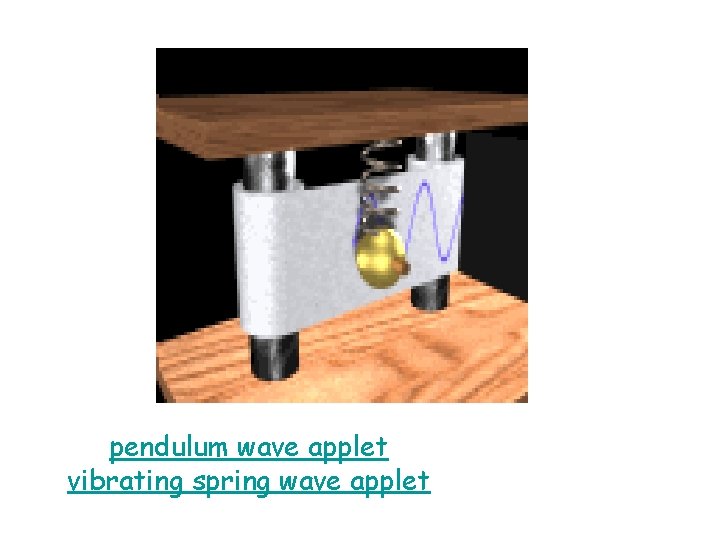
pendulum wave applet vibrating spring wave applet
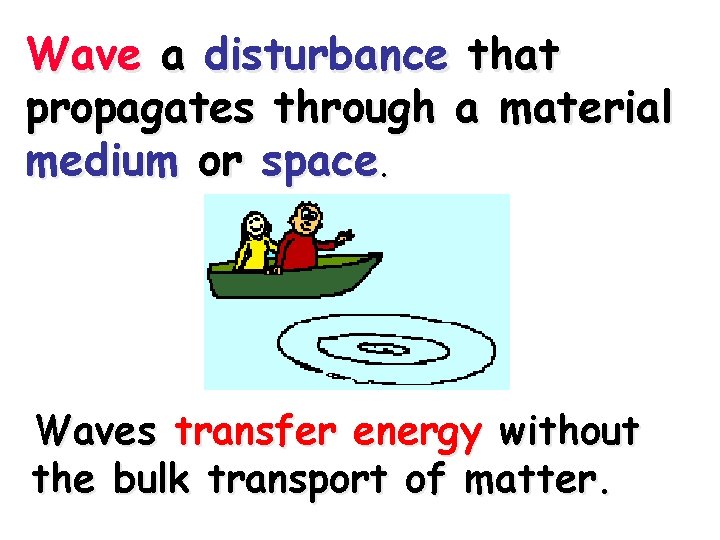
Wave a disturbance that propagates through a material medium or space. Waves transfer energy without the bulk transport of matter.
Types of Waves are classified by 1) The use of a medium or not to carry the energy 2) The way they vibrate relative to the motion of the wave
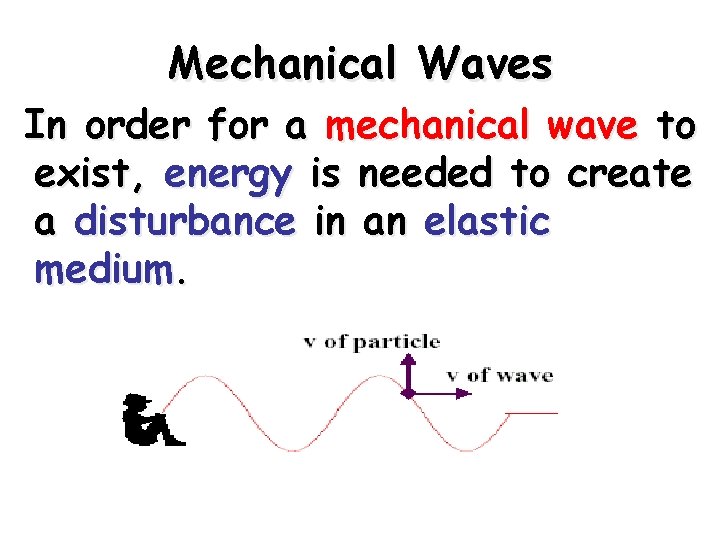
Mechanical Waves In order for a mechanical wave to exist, energy is needed to create a disturbance in an elastic medium.
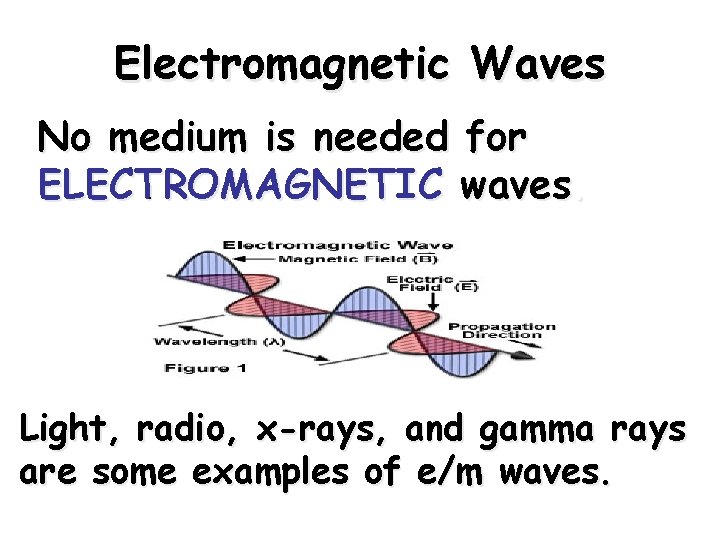
Electromagnetic Waves No medium is needed for ELECTROMAGNETIC waves. . Light, radio, x-rays, and gamma rays are some examples of e/m waves.
ELECTROMAGNETIC WAVES All e/m waves travel through free space at a speed of approximately 3. 00 x 108 m/s or 186, 000 miles/sec. This speed is known as the speed of light c.
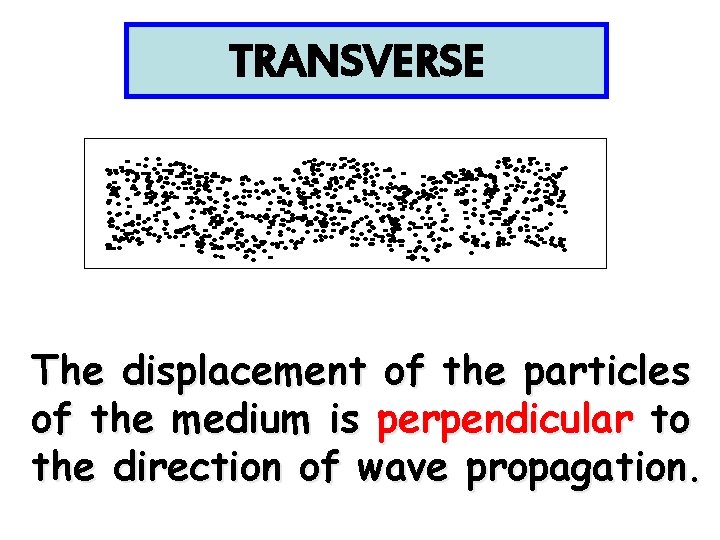
TRANSVERSE The displacement of the particles of the medium is perpendicular to the direction of wave propagation.
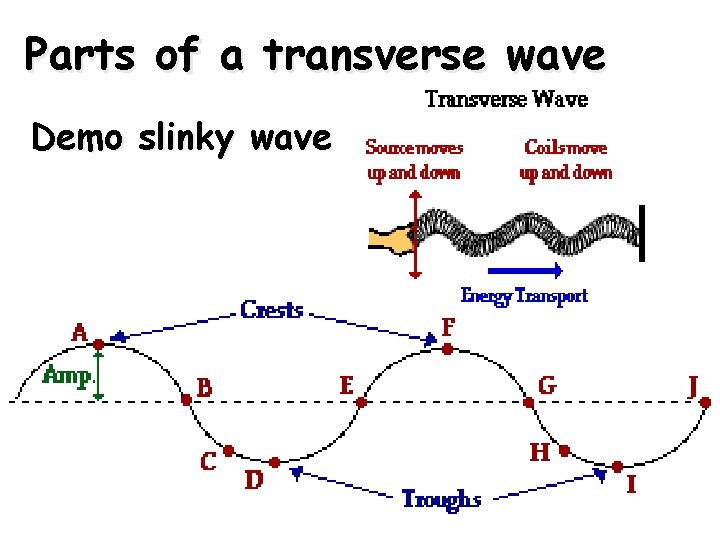
Parts of a transverse wave Demo slinky wave
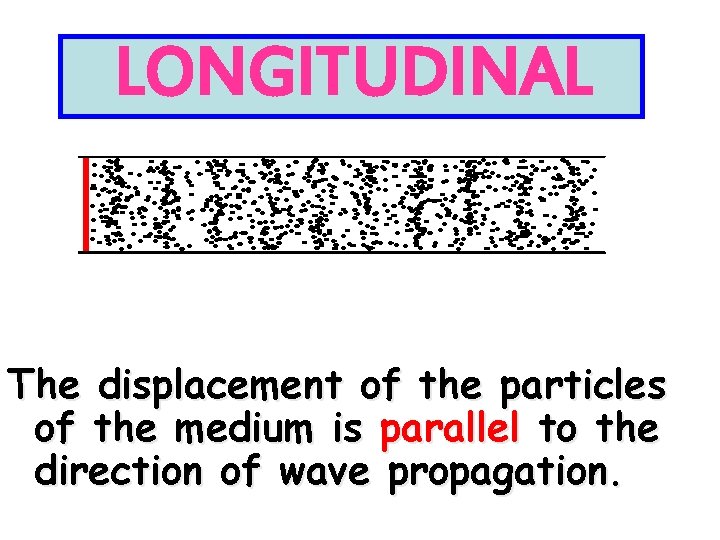
LONGITUDINAL The displacement of the particles of the medium is parallel to the direction of wave propagation.

Slinky demo…
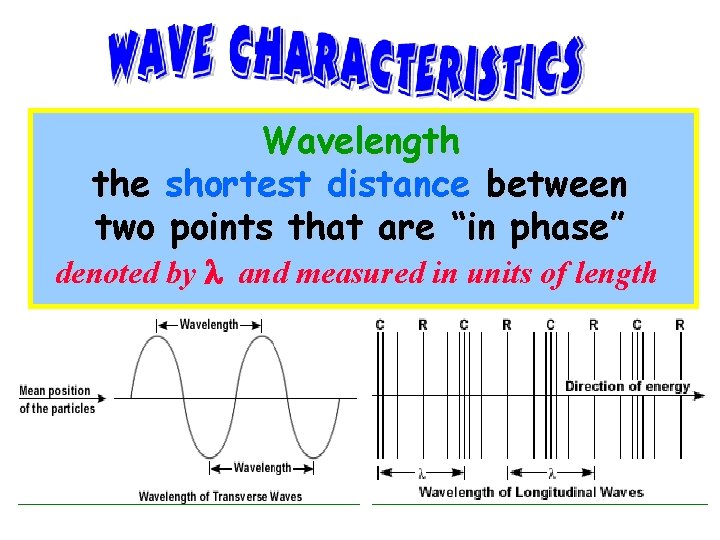
Wavelength the shortest distance between two points that are “in phase” denoted by l and measured in units of length
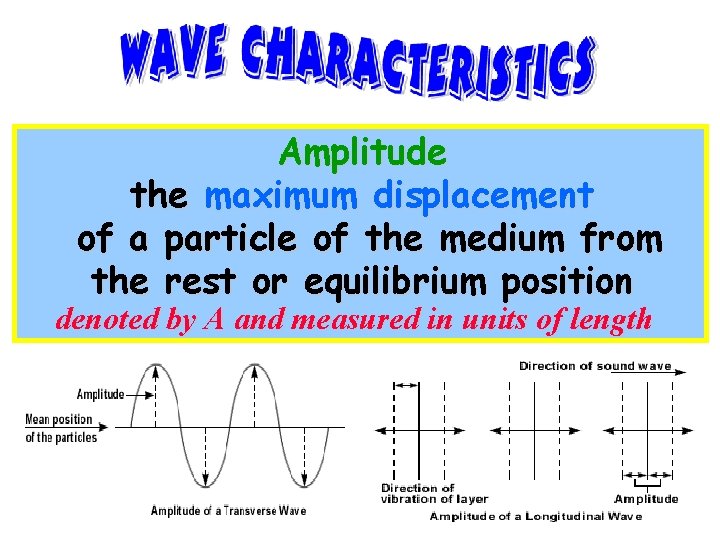
Amplitude the maximum displacement of a particle of the medium from the rest or equilibrium position denoted by A and measured in units of length
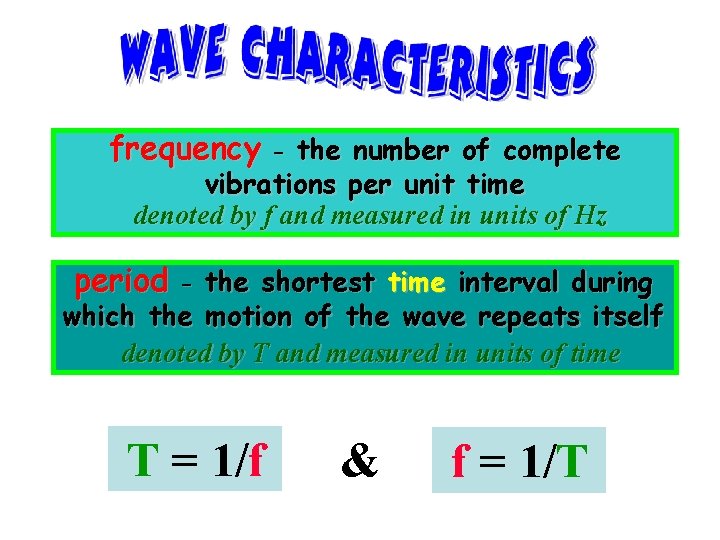
frequency - the number of complete vibrations per unit time denoted by f and measured in units of Hz period - the shortest time interval during which the motion of the wave repeats itself denoted by T and measured in units of time T = 1/f & f = 1/T
Reflection the turning back of a wave when it reaches the boundary of the medium through which it is traveling
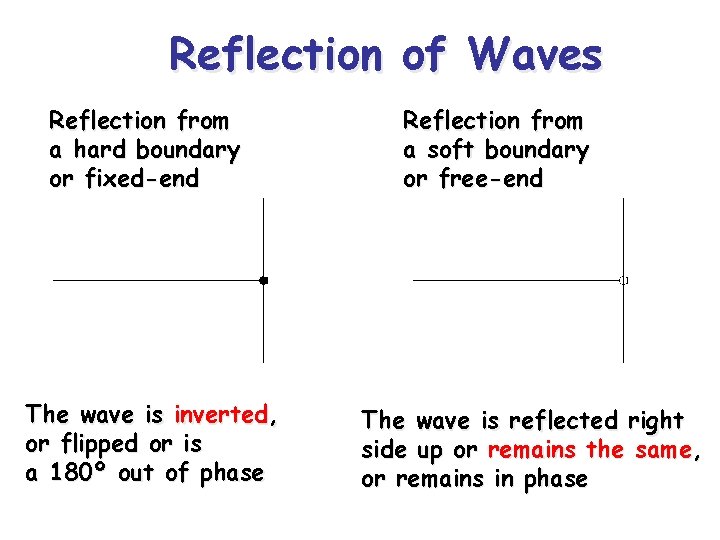
Reflection of Waves Reflection from a hard boundary or fixed-end The wave is inverted, or flipped or is a 180º out of phase Reflection from a soft boundary or free-end The wave is reflected right side up or remains the same, or remains in phase
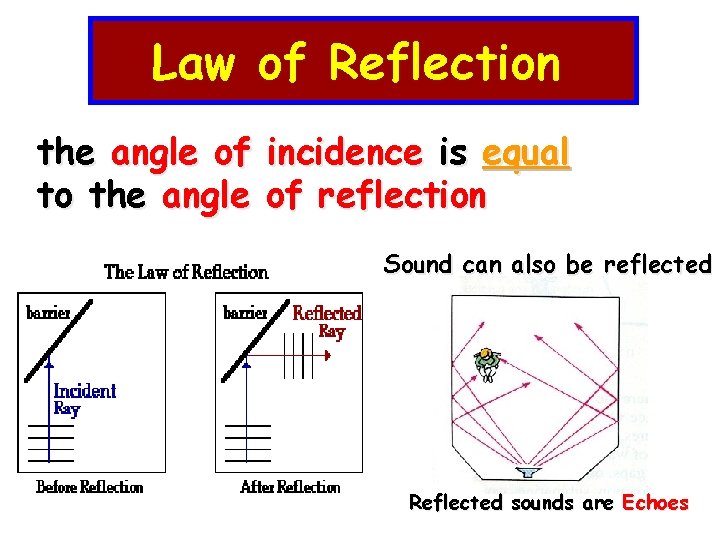
Law of Reflection the angle of to the angle incidence is equal of reflection Sound can also be reflected Reflected sounds are Echoes
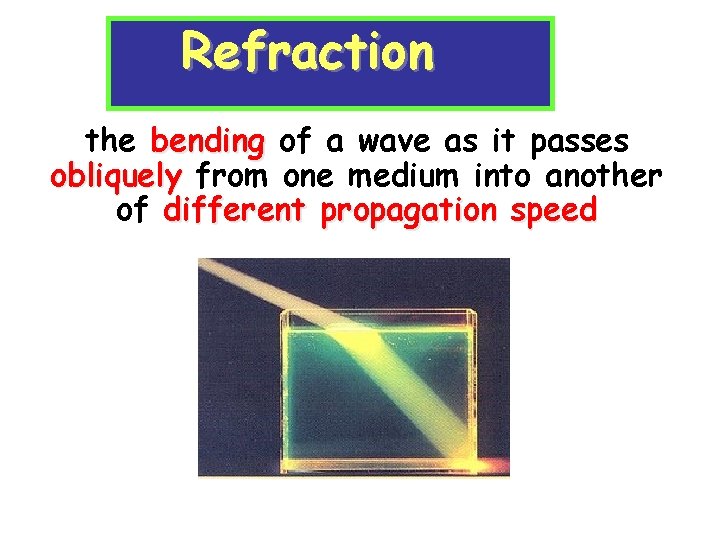
Refraction the bending of a wave as it passes obliquely from one medium into another of different propagation speed
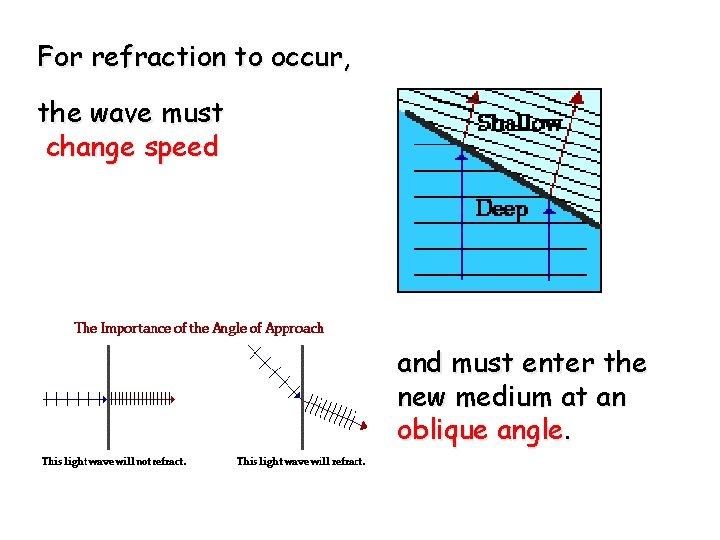
For refraction to occur, the wave must change speed and must enter the new medium at an oblique angle.
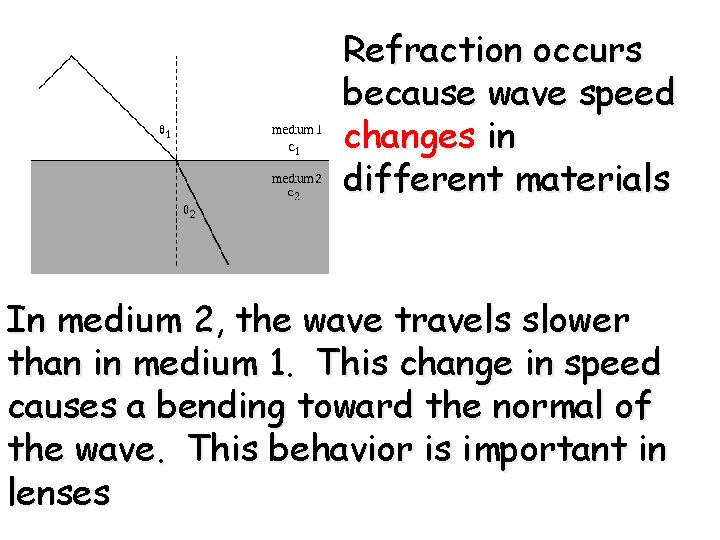
Refraction occurs because wave speed changes in different materials In medium 2, the wave travels slower than in medium 1. This change in speed causes a bending toward the normal of the wave. This behavior is important in lenses
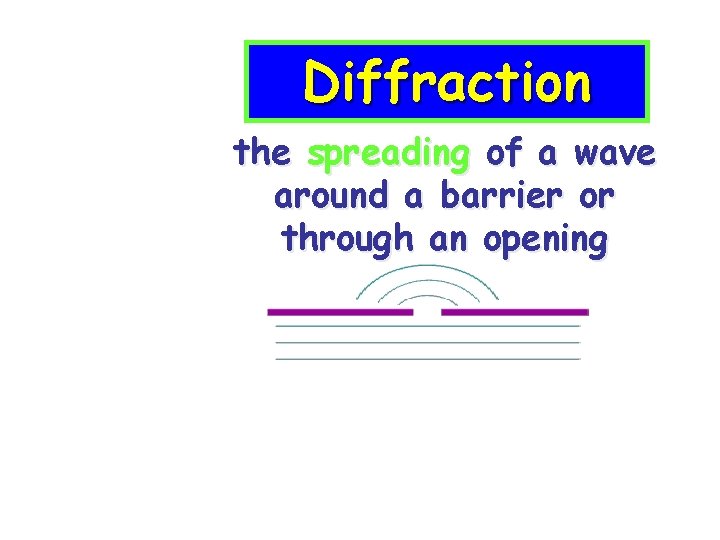
Diffraction the spreading of a wave around a barrier or through an opening
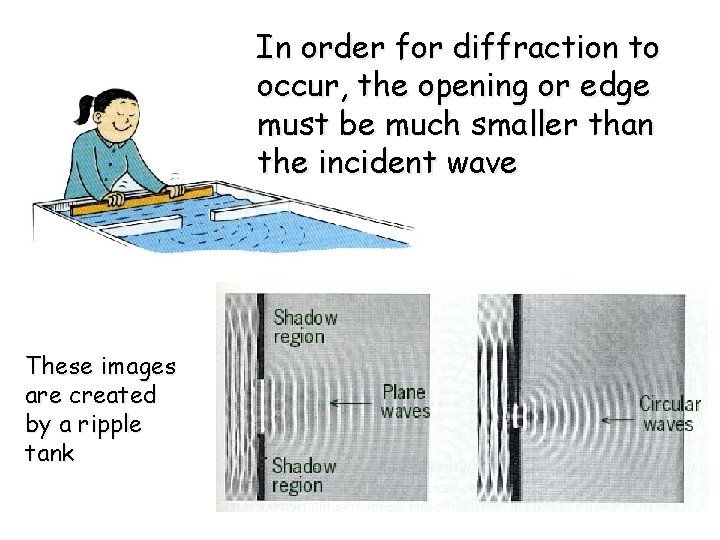
In order for diffraction to occur, the opening or edge must be much smaller than the incident wave These images are created by a ripple tank
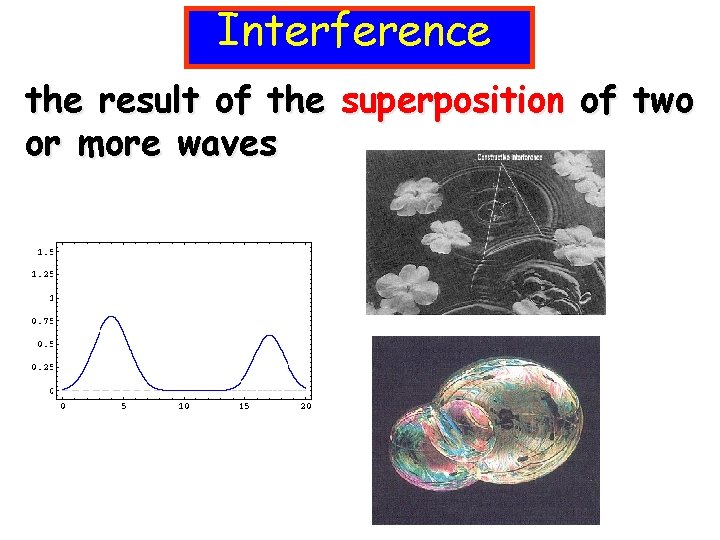
Interference the result of the superposition of two or more waves
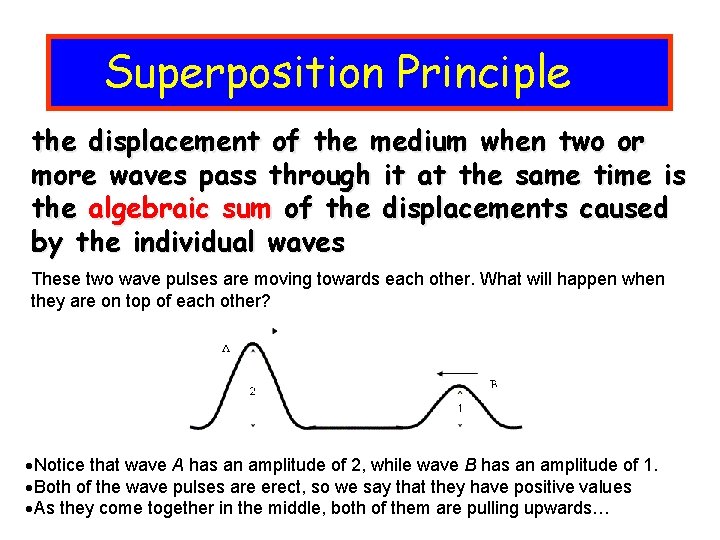
Superposition Principle the displacement of the medium when two or more waves pass through it at the same time is the algebraic sum of the displacements caused by the individual waves These two wave pulses are moving towards each other. What will happen when they are on top of each other? Notice that wave A has an amplitude of 2, while wave B has an amplitude of 1. Both of the wave pulses are erect, so we say that they have positive values As they come together in the middle, both of them are pulling upwards…
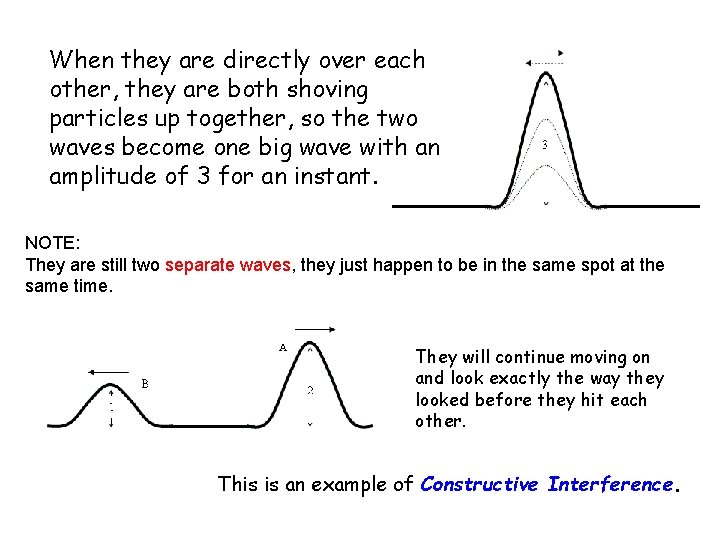
When they are directly over each other, they are both shoving particles up together, so the two waves become one big wave with an amplitude of 3 for an instant. NOTE: They are still two separate waves, they just happen to be in the same spot at the same time. They will continue moving on and look exactly the way they looked before they hit each other. This is an example of Constructive Interference.
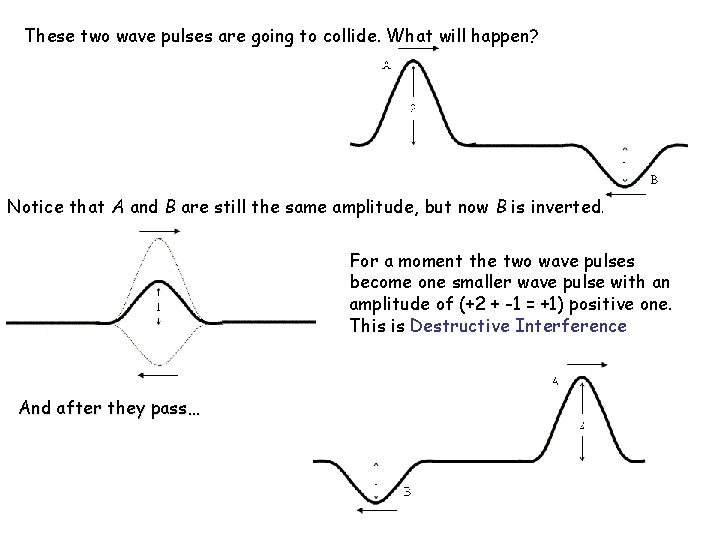
These two wave pulses are going to collide. What will happen? Notice that A and B are still the same amplitude, but now B is inverted. For a moment the two wave pulses become one smaller wave pulse with an amplitude of (+2 + -1 = +1) positive one. This is Destructive Interference And after they pass…
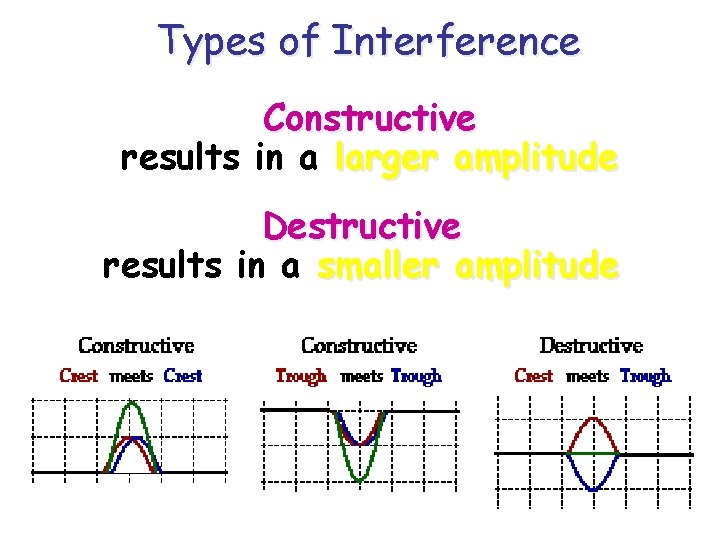
Types of Interference Constructive results in a larger amplitude Destructive results in a smaller amplitude
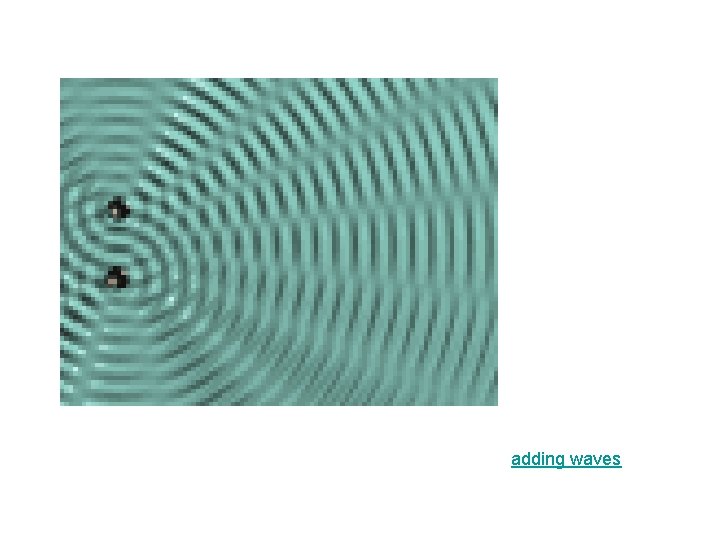
adding waves
http: //www. youtube. com/watch? v=16 VDa 65 e 3 Qw
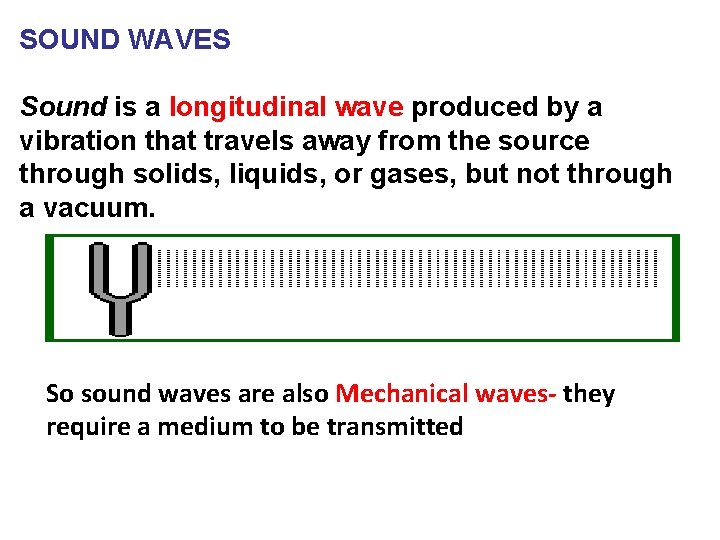
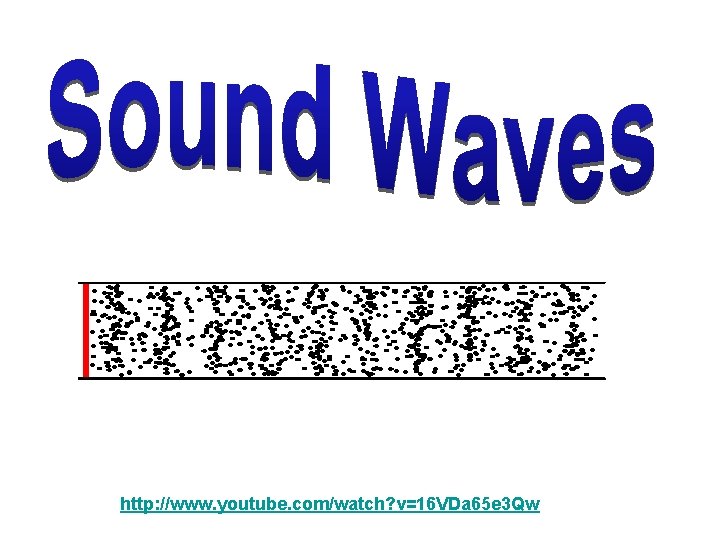
SOUND WAVES Sound is a longitudinal wave produced by a vibration that travels away from the source through solids, liquids, or gases, but not through a vacuum. So sound waves are also Mechanical waves- they require a medium to be transmitted
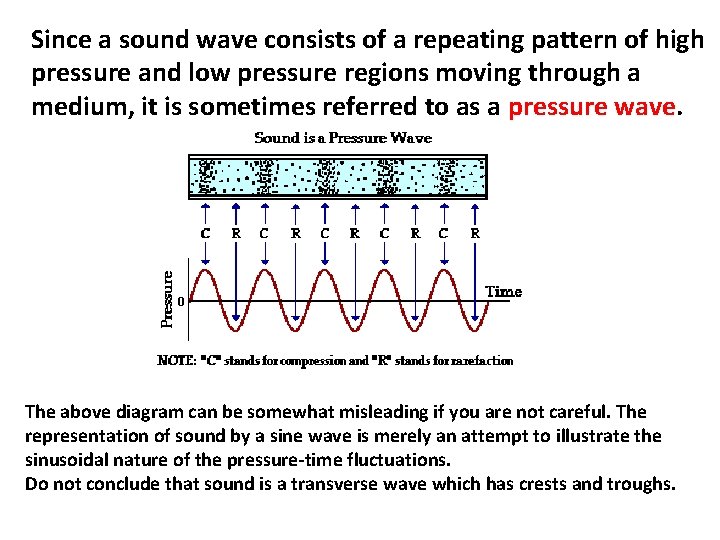
Since a sound wave consists of a repeating pattern of high pressure and low pressure regions moving through a medium, it is sometimes referred to as a pressure wave. The above diagram can be somewhat misleading if you are not careful. The representation of sound by a sine wave is merely an attempt to illustrate the sinusoidal nature of the pressure-time fluctuations. Do not conclude that sound is a transverse wave which has crests and troughs.
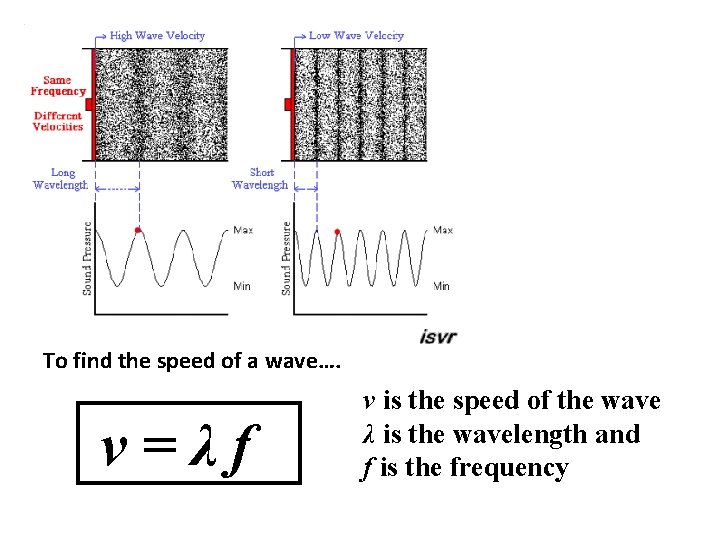
To find the speed of a wave…. v=λf v is the speed of the wave λ is the wavelength and f is the frequency
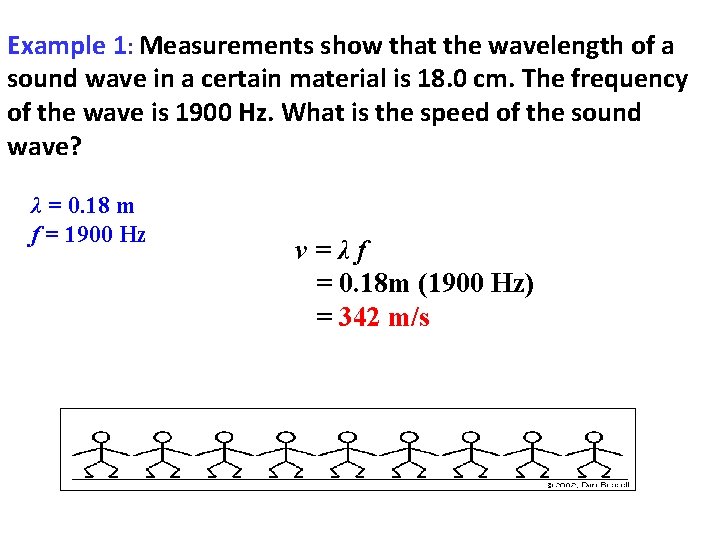
Example 1: Measurements show that the wavelength of a sound wave in a certain material is 18. 0 cm. The frequency of the wave is 1900 Hz. What is the speed of the sound wave? λ = 0. 18 m f = 1900 Hz v=λf = 0. 18 m (1900 Hz) = 342 m/s
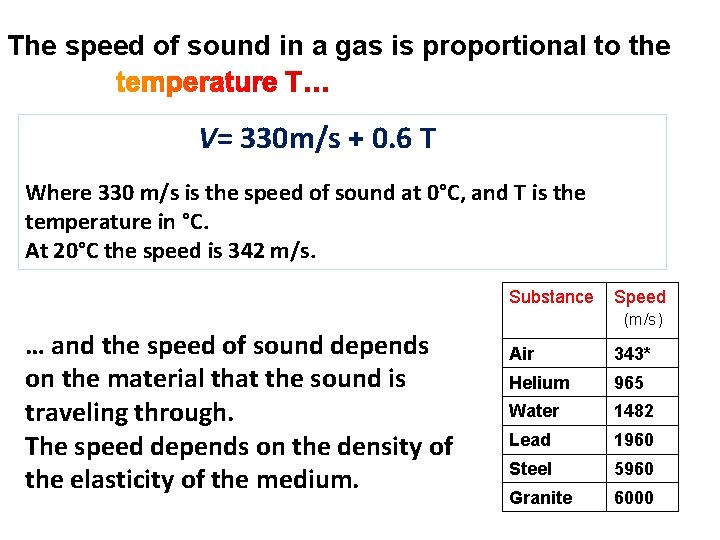
The speed of sound in a gas is proportional to the V= 330 m/s + 0. 6 T Where 330 m/s is the speed of sound at 0°C, and T is the temperature in °C. At 20°C the speed is 342 m/s. Substance … and the speed of sound depends on the material that the sound is traveling through. The speed depends on the density of the elasticity of the medium. Speed (m/s) Air 343* Helium 965 Water 1482 Lead 1960 Steel 5960 Granite 6000
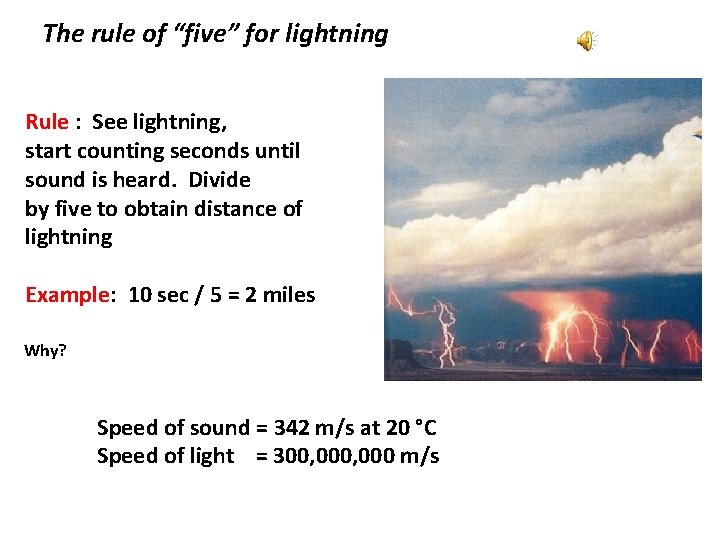
The rule of “five” for lightning Rule : See lightning, start counting seconds until sound is heard. Divide by five to obtain distance of lightning Example: 10 sec / 5 = 2 miles Why? Speed of sound = 342 m/s at 20 °C Speed of light = 300, 000 m/s
We detect two characteristic of sound: pitch and loudness. Pitch is how high or low the sound seems. (use forks and wave box) It is measured by the frequency. The higher the frequency the higher the pitch. The lower the frequency the lower the pitch. Loudness refers to the Intensity of a sound. Energy in a wave is show by the amplitude It is measured in decibels (db) (a logarithmic scale)
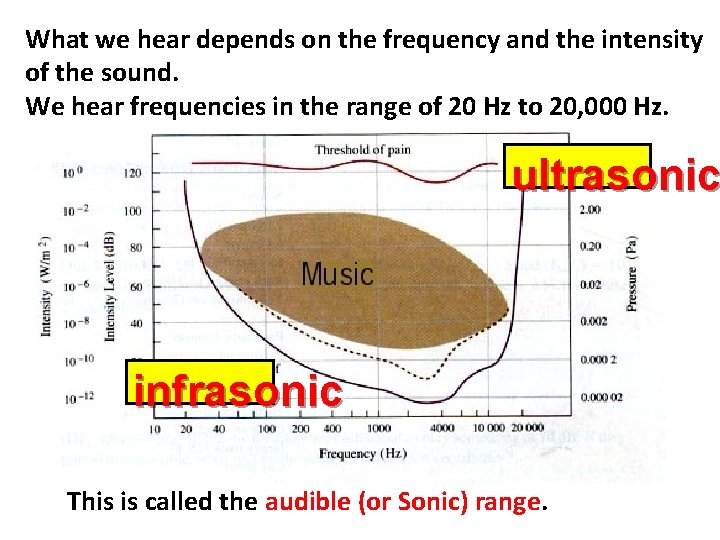
What we hear depends on the frequency and the intensity of the sound. We hear frequencies in the range of 20 Hz to 20, 000 Hz. ultrasonic infrasonic This is called the audible (or Sonic) range.
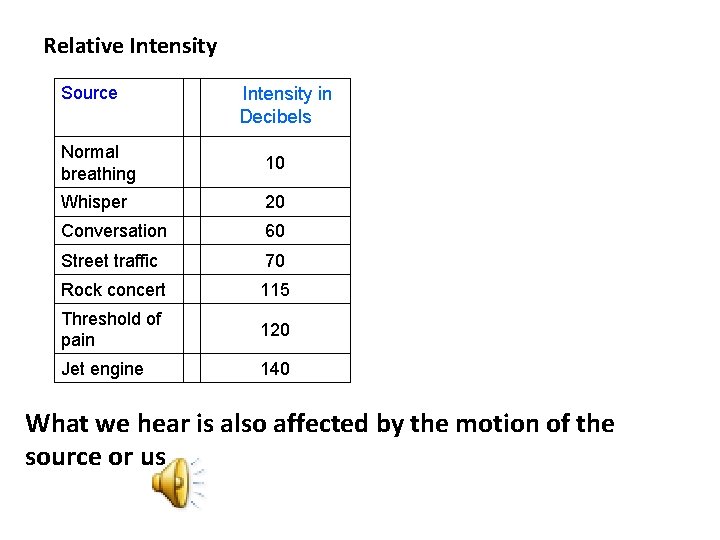
Relative Intensity Source Intensity in Decibels Normal breathing 10 Whisper 20 Conversation 60 Street traffic 70 Rock concert 115 Threshold of pain 120 Jet engine 140 What we hear is also affected by the motion of the source or us
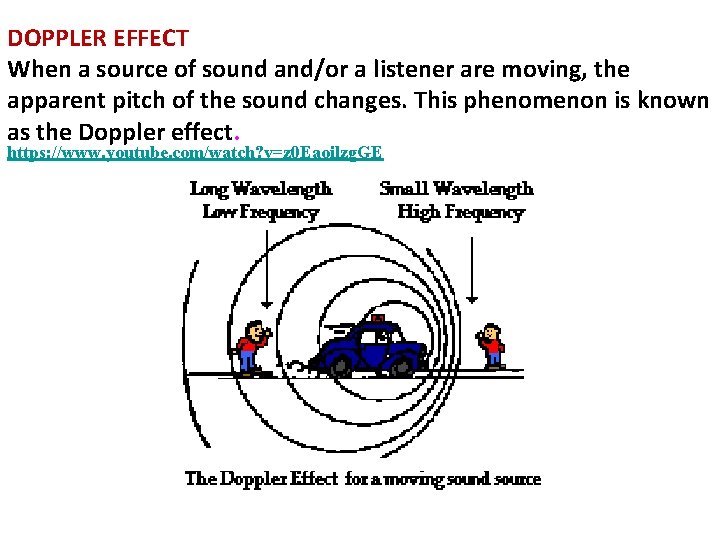
DOPPLER EFFECT When a source of sound and/or a listener are moving, the apparent pitch of the sound changes. This phenomenon is known as the Doppler effect. https: //www. youtube. com/watch? v=z 0 Eaoilzg. GE
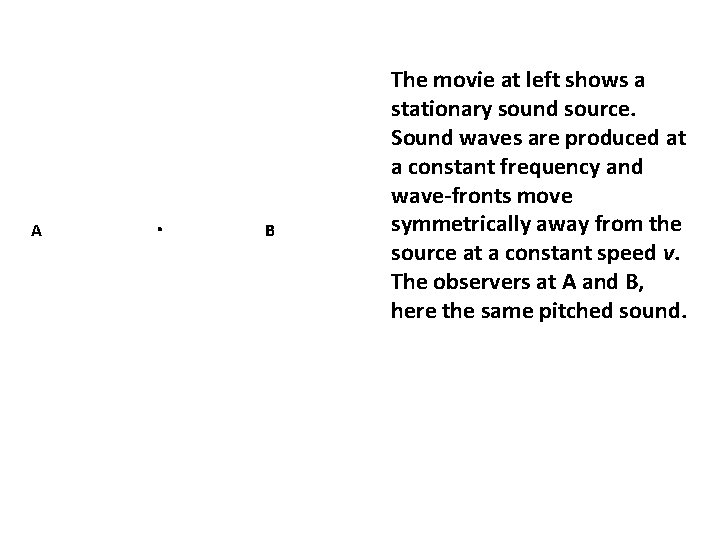
A B The movie at left shows a stationary sound source. Sound waves are produced at a constant frequency and wave-fronts move symmetrically away from the source at a constant speed v. The observers at A and B, here the same pitched sound.
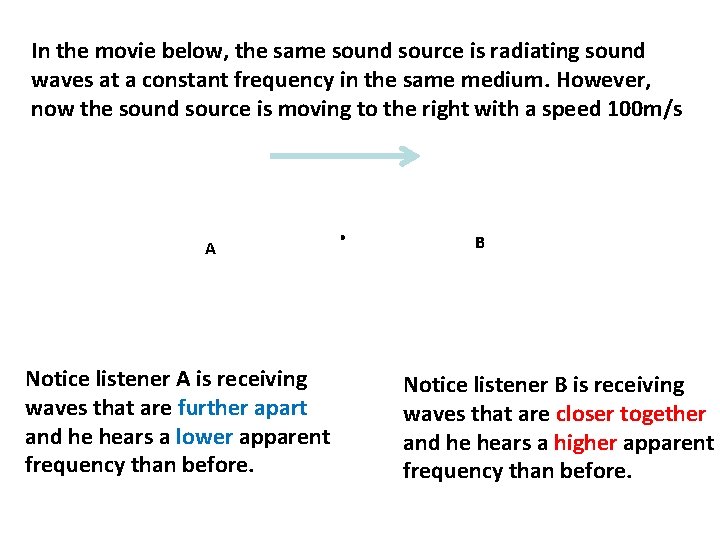
In the movie below, the same sound source is radiating sound waves at a constant frequency in the same medium. However, now the sound source is moving to the right with a speed 100 m/s A Notice listener A is receiving waves that are further apart and he hears a lower apparent frequency than before. B Notice listener B is receiving waves that are closer together and he hears a higher apparent frequency than before.
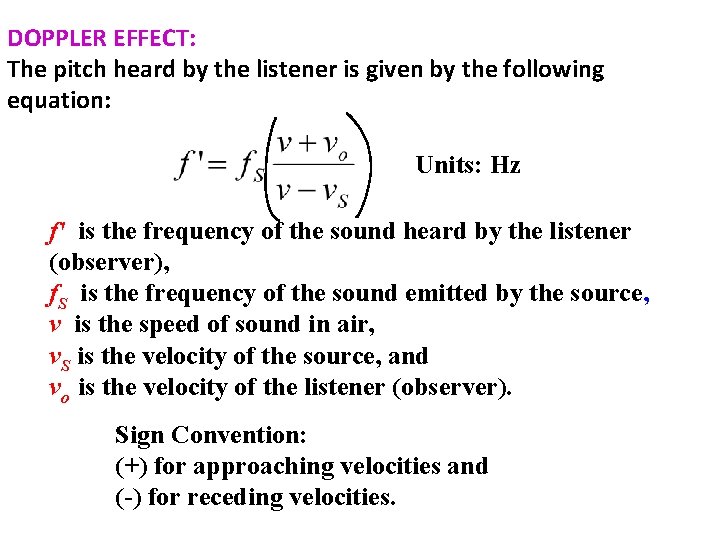
DOPPLER EFFECT: The pitch heard by the listener is given by the following equation: Units: Hz f' is the frequency of the sound heard by the listener (observer), f. S is the frequency of the sound emitted by the source, v is the speed of sound in air, v. S is the velocity of the source, and vo is the velocity of the listener (observer). Sign Convention: (+) for approaching velocities and (-) for receding velocities.
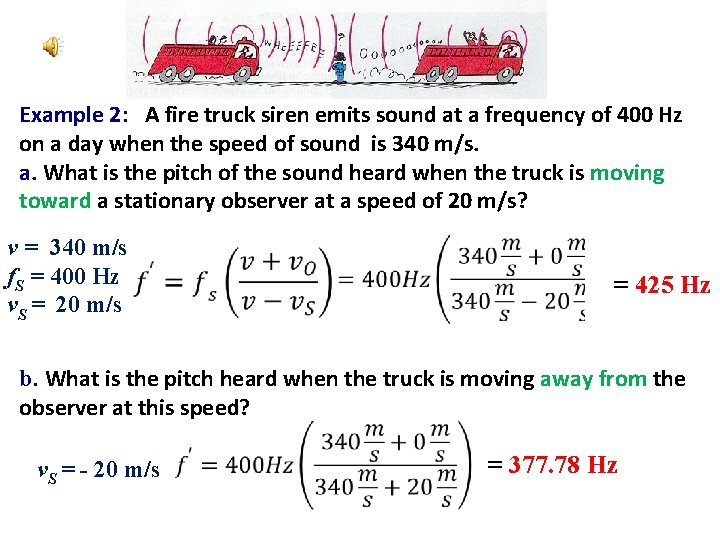
Example 2: A fire truck siren emits sound at a frequency of 400 Hz on a day when the speed of sound is 340 m/s. a. What is the pitch of the sound heard when the truck is moving toward a stationary observer at a speed of 20 m/s? v = 340 m/s f. S = 400 Hz v. S = 20 m/s = 425 Hz b. What is the pitch heard when the truck is moving away from the observer at this speed? v. S = - 20 m/s = 377. 78 Hz
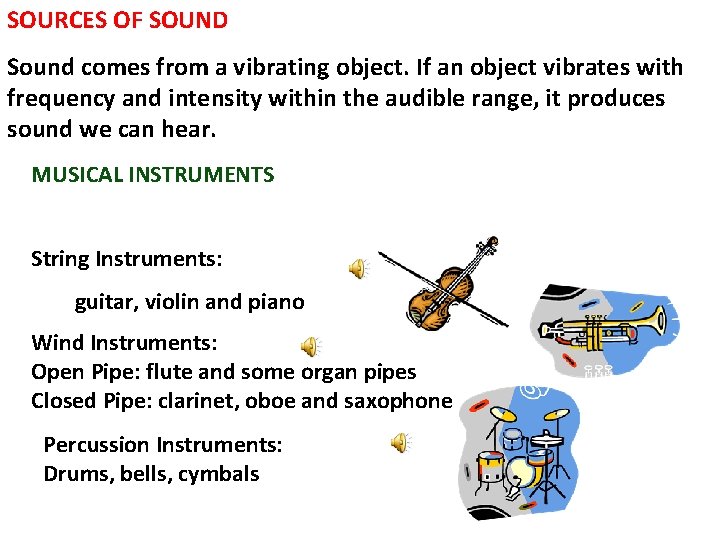
SOURCES OF SOUND Sound comes from a vibrating object. If an object vibrates with frequency and intensity within the audible range, it produces sound we can hear. MUSICAL INSTRUMENTS String Instruments: guitar, violin and piano Wind Instruments: Open Pipe: flute and some organ pipes Closed Pipe: clarinet, oboe and saxophone Percussion Instruments: Drums, bells, cymbals
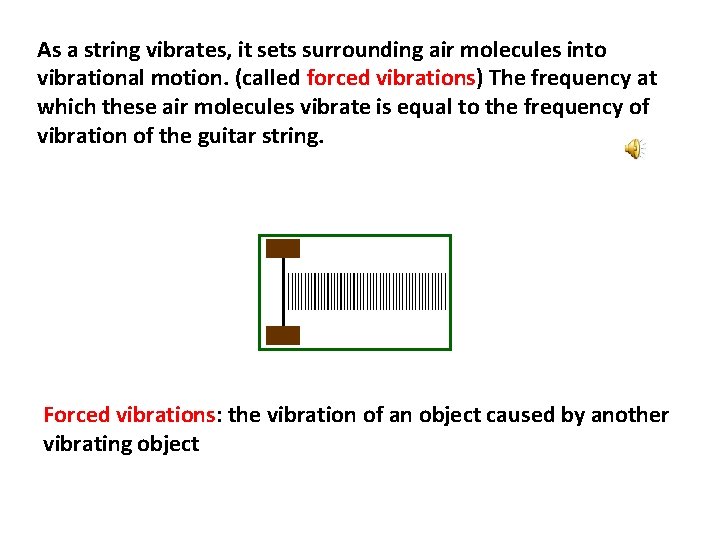
As a string vibrates, it sets surrounding air molecules into vibrational motion. (called forced vibrations) The frequency at which these air molecules vibrate is equal to the frequency of vibration of the guitar string. Forced vibrations: the vibration of an object caused by another vibrating object
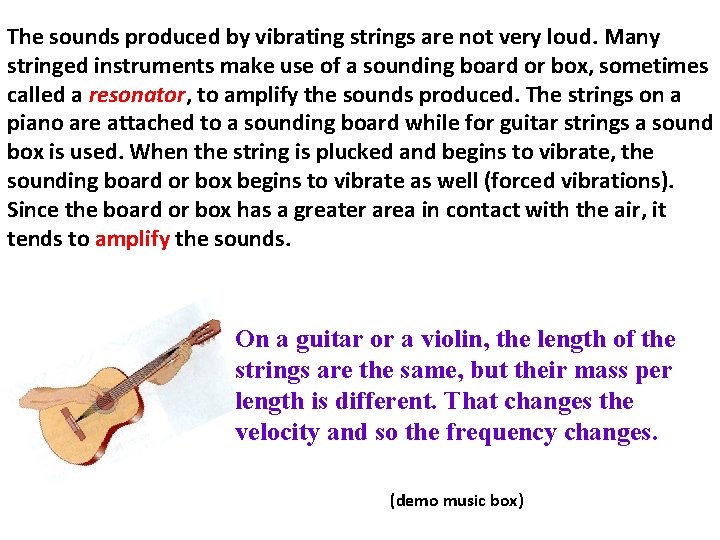
The sounds produced by vibrating strings are not very loud. Many stringed instruments make use of a sounding board or box, sometimes called a resonator, to amplify the sounds produced. The strings on a piano are attached to a sounding board while for guitar strings a sound box is used. When the string is plucked and begins to vibrate, the sounding board or box begins to vibrate as well (forced vibrations). Since the board or box has a greater area in contact with the air, it tends to amplify the sounds. On a guitar or a violin, the length of the strings are the same, but their mass per length is different. That changes the velocity and so the frequency changes. (demo music box)
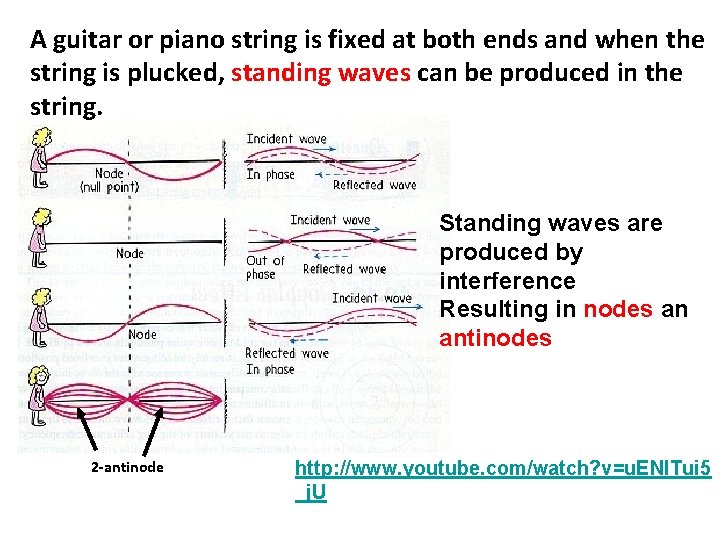
A guitar or piano string is fixed at both ends and when the string is plucked, standing waves can be produced in the string. Standing waves are produced by interference Resulting in nodes an antinodes 2 -antinode http: //www. youtube. com/watch? v=u. ENITui 5 _j. U
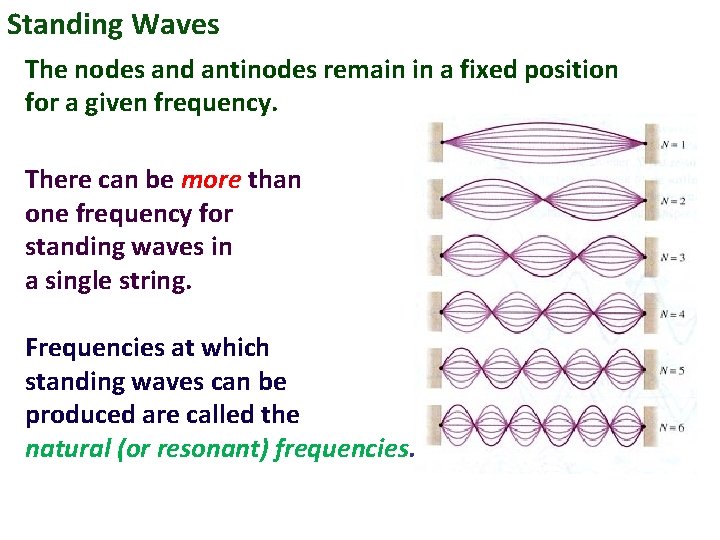
Standing Waves The nodes and antinodes remain in a fixed position for a given frequency. There can be more than one frequency for standing waves in a single string. Frequencies at which standing waves can be produced are called the natural (or resonant) frequencies.
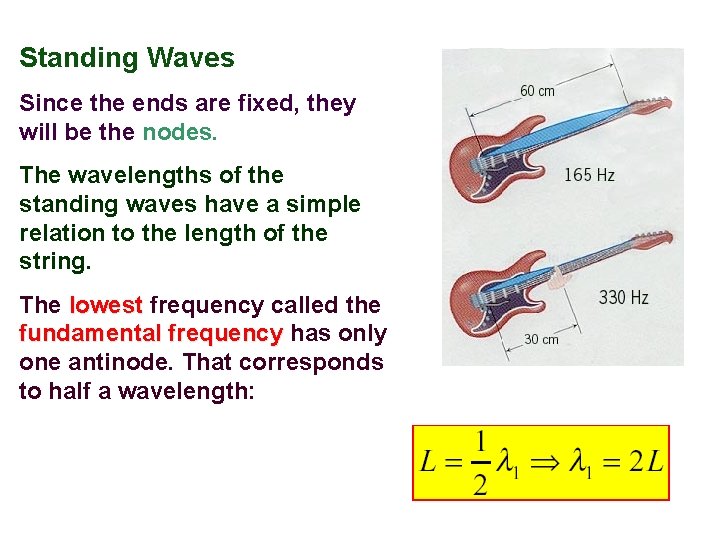
Standing Waves Since the ends are fixed, they will be the nodes. The wavelengths of the standing waves have a simple relation to the length of the string. The lowest frequency called the fundamental frequency has only one antinode. That corresponds to half a wavelength:
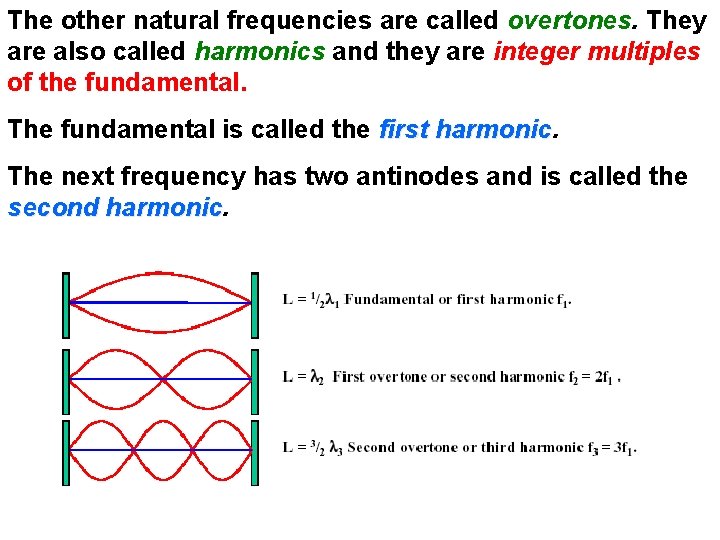
The other natural frequencies are called overtones. They are also called harmonics and they are integer multiples of the fundamental. The fundamental is called the first harmonic The next frequency has two antinodes and is called the second harmonic
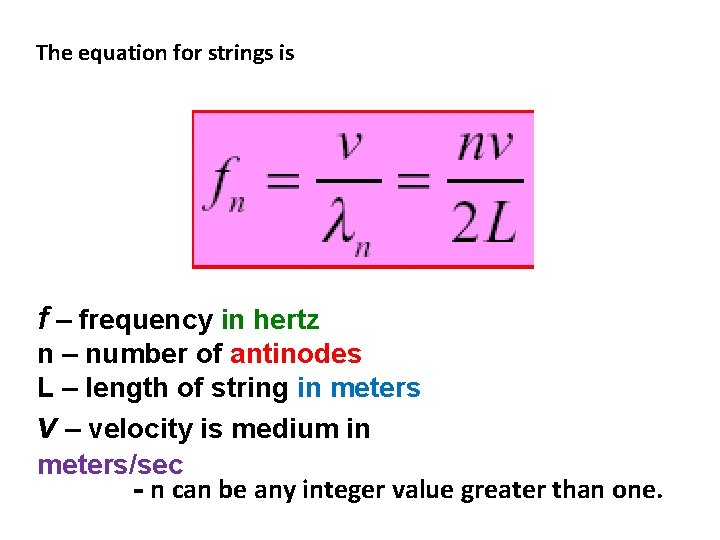
The equation for strings is f – frequency in hertz n – number of antinodes L – length of string in meters v – velocity is medium in meters/sec - n can be any integer value greater than one.
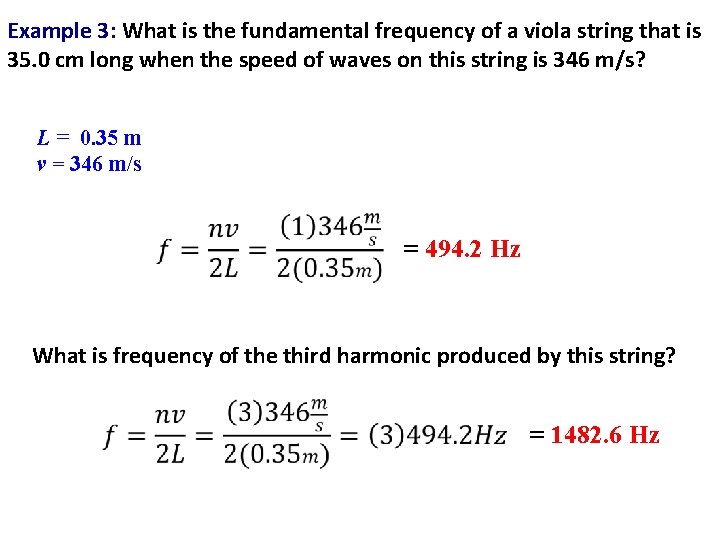
Example 3: What is the fundamental frequency of a viola string that is 35. 0 cm long when the speed of waves on this string is 346 m/s? L = 0. 35 m v = 346 m/s = 494. 2 Hz What is frequency of the third harmonic produced by this string? = 1482. 6 Hz
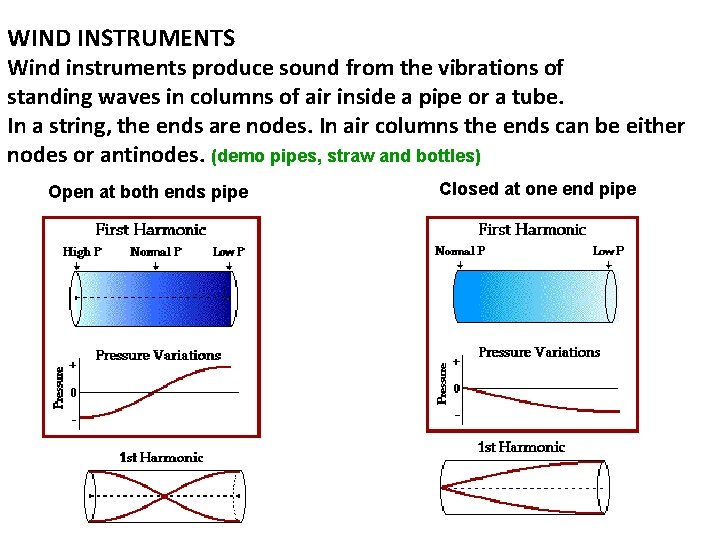
WIND INSTRUMENTS Wind instruments produce sound from the vibrations of standing waves in columns of air inside a pipe or a tube. In a string, the ends are nodes. In air columns the ends can be either nodes or antinodes. (demo pipes, straw and bottles) Open at both ends pipe Closed at one end pipe
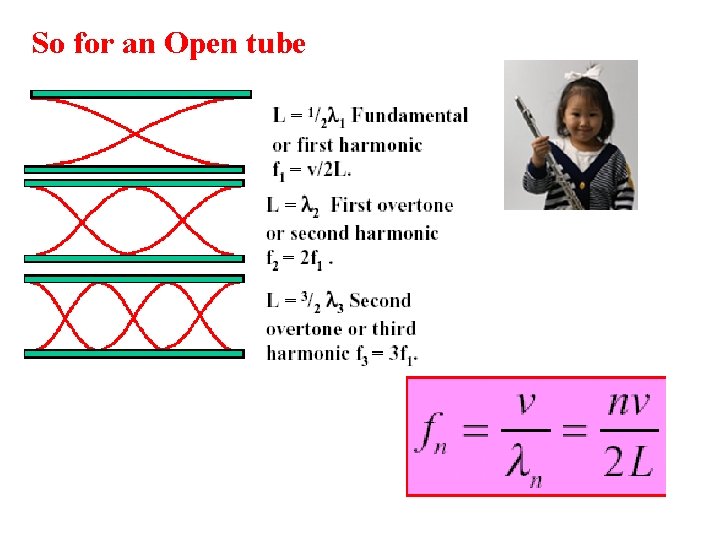
So for an Open tube
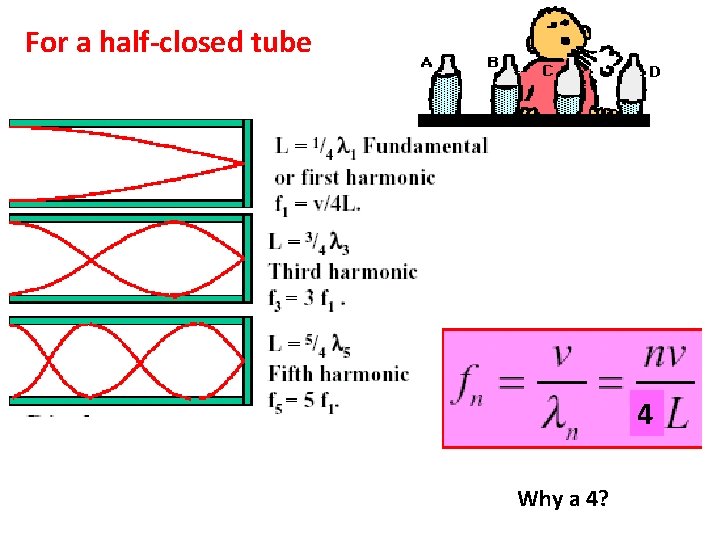
For a half-closed tube 4 Why a 4?
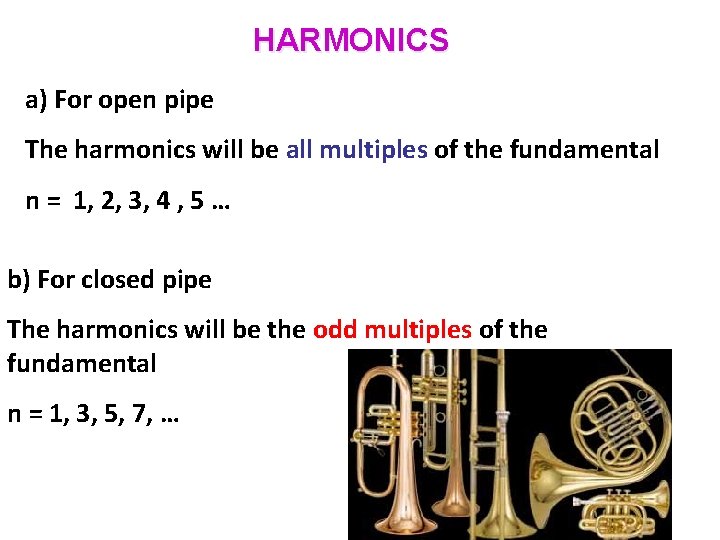
HARMONICS a) For open pipe The harmonics will be all multiples of the fundamental n = 1, 2, 3, 4 , 5 … b) For closed pipe The harmonics will be the odd multiples of the fundamental n = 1, 3, 5, 7, …
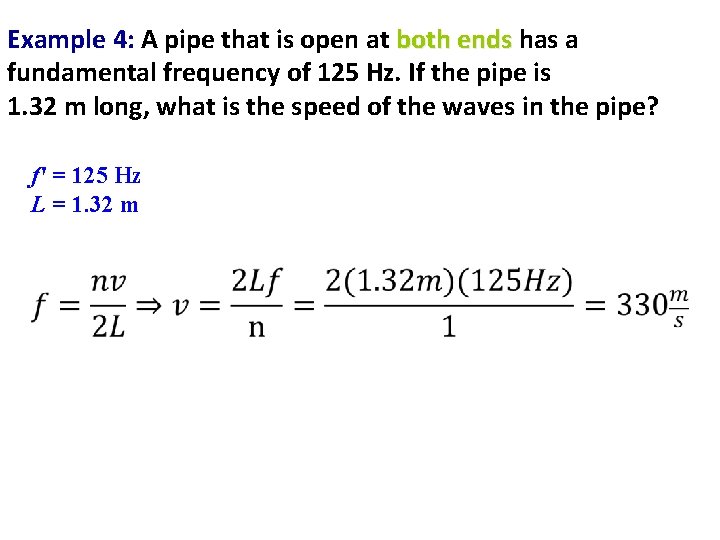
Example 4: A pipe that is open at both ends has a fundamental frequency of 125 Hz. If the pipe is 1. 32 m long, what is the speed of the waves in the pipe? f' = 125 Hz L = 1. 32 m
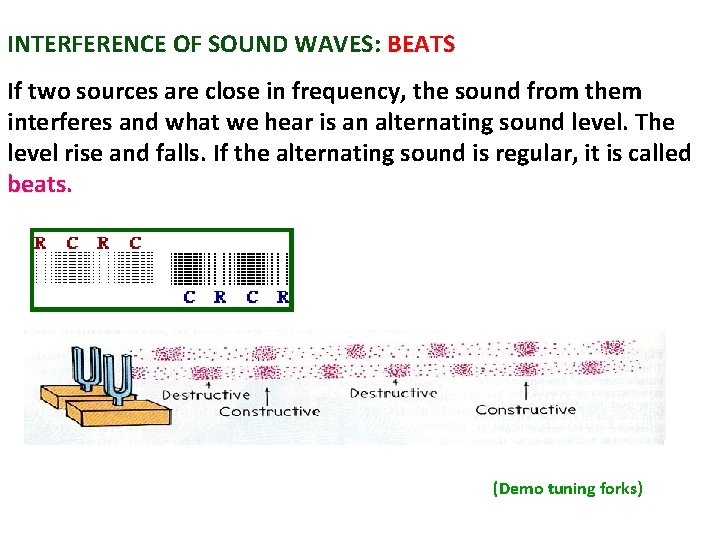
INTERFERENCE OF SOUND WAVES: BEATS If two sources are close in frequency, the sound from them interferes and what we hear is an alternating sound level. The level rise and falls. If the alternating sound is regular, it is called beats. (Demo tuning forks)
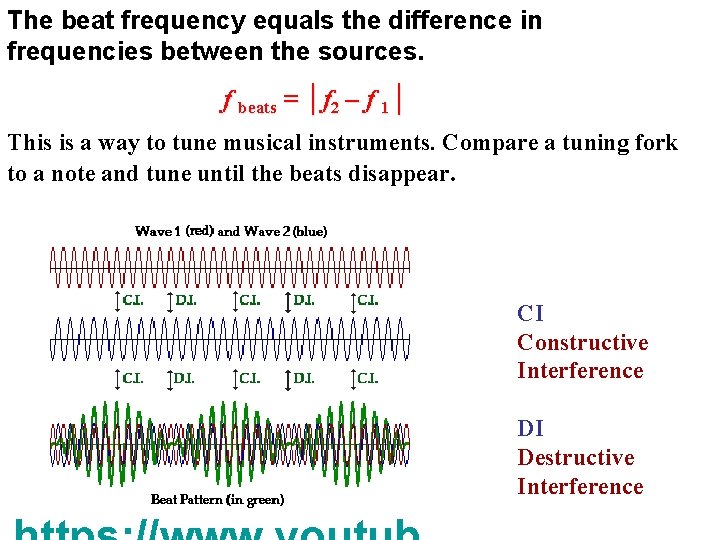
The beat frequency equals the difference in frequencies between the sources. f beats = │f 2 – f 1│ This is a way to tune musical instruments. Compare a tuning fork to a note and tune until the beats disappear. CI Constructive Interference DI Destructive Interference
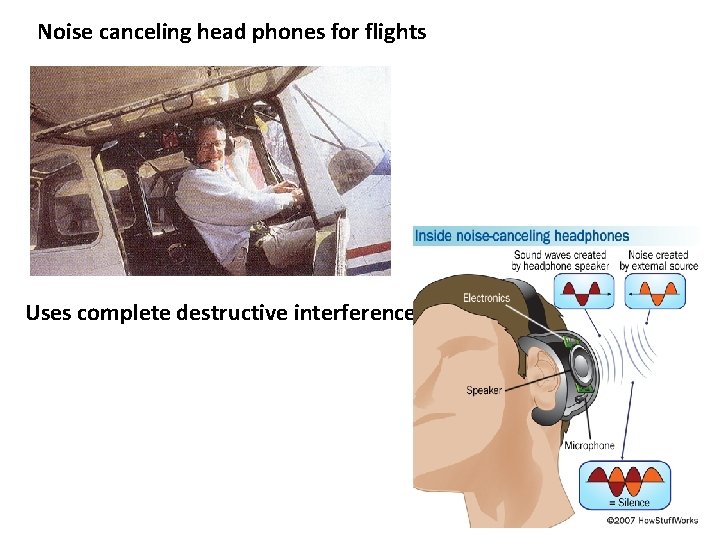
Noise canceling head phones for flights Uses complete destructive interference
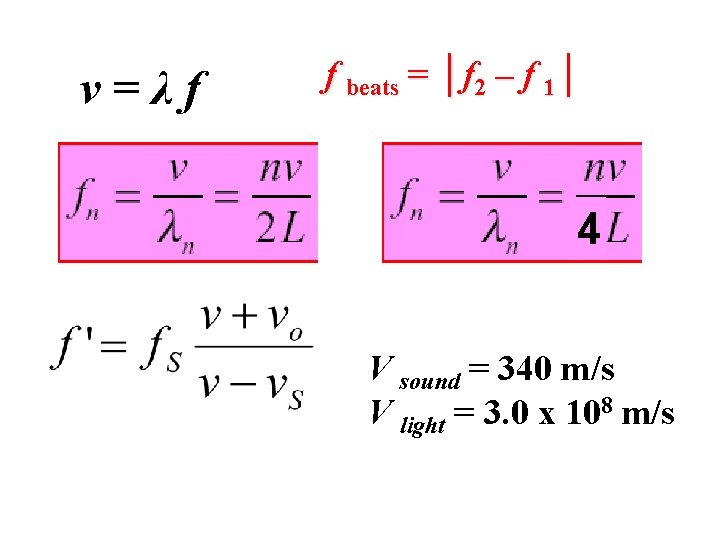
v=λf f beats = │f 2 – f 1│ 4 V sound = 340 m/s V light = 3. 0 x 108 m/s
- Slides: 61