
Vocabulary Words Acceleration The rate at which velocity
Vocabulary Words
Acceleration
The rate at which velocity is changing in magnitude, direction or both
Average Speed
Path distance divided by time interval

Elapsed Time

Time that passed since the beginning of an event

Free Fall
Motion under the influence of the gravitational force
Instantaneous Speed
Speed at any instant of time

Rate
How much something changes per unit of time
Relative
Regarded in relation to something else
Speed
How fast something is moving, distance moved over time
Velocity
Speed together with the direction of motion

CHAPTER 3

COMPONENT
One of the vectors, often mutually perpendicular, whose sum is a resultant vector.

Projectile
An object that moves through the air or space acted on only by gravity.

Resolution
The process of determining the components of a vector.

Resultant
The vector sum of two or more component vectors.

Satellite
An object that falls around Earth or some other body rather than into it.
Scalar Quantity
A scaled amount only.

Vector
An arrow whose length represents the magnitude of a quantity and whose direction represents the direction of the quantity.
Vector Quantity
Includes a magnitude and direction.

KEY TERMS: CHAPTER 4

EQUILIBRIUM

In general, a state of balance

FORCE

ANY PUSH OR PULL

FRICTION
THE FORCE THAT RESISTS RELATIVE MOTION OF OBJECTS OR MATERIALS

INERTIA
THE RELUCTANCE OF ANY BODY TO CHANGE ITS STATE OF MOTION

KILOGRAM
SI UNIT OF MOTION
LAW OF INERTIA
EVERY BODY CONTINUES IN ITS STATE OF REST OR MOTION IN A STRAIGHT LINE AT A CONSTANT SPEED UNLESS COMPELLED TO CHAGE THAT STATE BY A

MASS

THE AMOUNT OF MATTER IN AN OBJECT

NET FORCE
THE COMBINATION OF ALL OF THE FORCES THAT ACT ON AN OBJECT

NEWTON
SI UNIT OF FORCE
NEWTON’S FIRST LAW
THE LAW OF INERTIA
NORMAL FORCE
FOR AN OBJECT RESTING ON A HORIZONTAL SURFACE THE UPWARD FORCE THAT BALANCES THE WEIGHT OF THE OBJECT

SUPPORT FORCE
FORCE THAT COMPLETELY BALANCES THE WEIGHT OF AN OBJECT AT REST

WEIGHT
THE FORCE ON A BODY DUE TO THE GRAVITATIONAL ATTRACTION OF ANOTHER BODY
Newton’s second law of motion- force and acceleration CHAPTER 5
Air resistance Friction, or drag, that acts on something moving through the air.
Fluid Anything that flows, in particular, any liquid or gas.
Free-body diagram A diagram showing all the forces acting on an object.
Inversely When two values change in opposite directions, so that if one is doubled the other is reduced to one half, they are said to be inversely proportional to each other.
Newton’s second law The acceleration produced by a net force on a body is directly proportional to the magnitude of the net force, is in the same direction as the net force, and is inversely proportional to the mass of the body.
Pascal The SI unit of pressure. One Pascal of pressure exerts a normal force of one Newton per square meter.
Pressure Force per surface area where the force is normal to the surface; measured in Pascals.
Terminal Velocity Terminal speed together with the direction (down for falling objects).
Terminal speed The speed at which the acceleration of a falling object is zero because friction balances the weight.

Key Terms CHAPTER SIX
One of the pair of forces described in Newton’s Third Law
Action Force
A mutual action between objects where each object exerts an equal but opposite force on the other

Interaction
Whenever one body exerts a force on another body the second body exerts an equal and opposite force on the first
Newton’s Third Law
The force that is equal in strength and opposite in direction to the action force, which acts simultaneously on whatever is exerting the action force
Reaction Force
Chapter 7 Vocabulary MOMENTUM
Electric charge that remains unchanged during interactions CONSERVED
Colliding objects rebound without lasting deformation or heat generation ELASTIC COLLISION
Product of force and time interval during which force acts IMPULSE
Colliding objects become distorted andor generate heat during the collision INELASTIC COLLISION
Absence of a net external force, the momentum of an object or system of objects is unchanged LAW OF CONSERVATION OF MOMENTUM
Product of mass and the velocity of an object -Has Magnitude and direction MOMENTUM (LINEAR MOMENTUM)
Chapter 8 Vocabulary ENERGY
Useful work output divided by the total work input EFFICIENCY

Enables an object to do something ENERGY

Pivot point FULCRUM

SI unit of work JOULE
Energy of motion equal to half the mass, multiplied by the speed squared KINETIC ENERGY
Energy can’t be created or destroyed LAW OF CONSERVATION OF ENERGY
Machine made of bar that turns about a fixed point LEVER
Device used to multiple forces or simply to change direction of forces MACHINE
Ratio of output force to the input MECHANICAL ADVANTAGE
Energy due to position or movement of something MECHANICAL ENERGY

Stored and held in readiness POTENTIAL ENERGY
Rate at which work is done or energy is transformed, equal to the work done or energy transformed divided by time -Measured in Watts POWER
Kind of lever used to change direction of a force PULLEY

SI unit of power WATT
The product of a force of an object and the distance through which the object is moved WORK
States that whenever work is done, energy changes WORK-ENERGY THEOREM
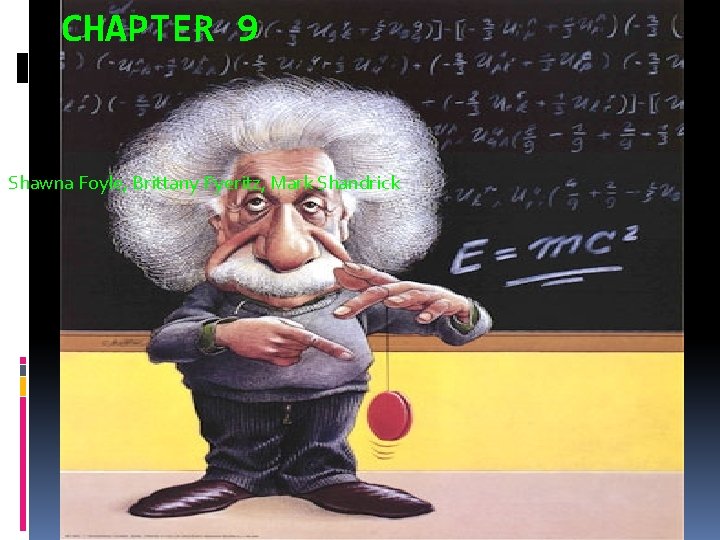
CHAPTER 9 Shawna Foyle, Brittany Pyeritz, Mark Shandrick

AXi. S
The straight line around which an object may rotate or revolve. A horizontal or vertical reference line in a graph
CENTRi. FUGAL FORCE
• The outward force on a rotating or revolving body - Fictitious (made up)
CENTRi. PETAL FORCE
• The center directed force that causes an object to move in a curved path
Linear Speed
• The path of distance moved per unit of time - Aka speed

Revolution
• Motion of an object turning around an axis outside the object
Rotation
• The spinning motion that takes place when an object rotates about an axis - Located within the object
Rotational Speed
• The number of rotations or revolutions per unit of time - Measured in revolutions per minute - RPM

Tangential Speed
• The speed of an object moving around a circular path

CHAPTER 10
Center of Gravity
• Point at the center of an objects weight distribution where the force of gravity can be considered to act

Center of Mass
• Point at the center of an objects mass distribution where all its mass can be considered to be concentrated
Neutral Equilibrium
• The state of an object balanced so any small movement neither raises nor lowers its center of gravity

Stable Equilibrium
• The state of an object balanced so that any small displacement or rotation raises the center of gravity

Unstable Equilibrium
The state of an object balance so any small displacement or rotation lowers center of gravity

By Steve Schott Nick Pesanka & Jake Pulsifer VOCAB FOR CHPT. !!-!2
Ch. 11 Angular momentum
Ch. 11 The production of rotational inertia and rotational
Ch. 11 LAW OF CONSERVATION OF ANGULAR MOMENTUM
Ch. 11 If no unbalanced external torque acts on a rotating system the angular momentum of that system is constant.
Ch. 11 LEVER ARM
Ch. 11 The perpendicular distance between an axis and the line of action of a force that tends to produce rotation about the
Ch. 11 Linear momentum
Ch. 11 Product of the mass and the velocity of an object, a. k. a.
Ch. 11 Rotational inertia
Ch. 11 The reluctance of an object to change its state of rotation, determined by the distribution of the mass of the object in the
Ch. 11 Rotational Velocity
Ch. 11 Rotational speed together with a direction for the axis of rotation or
Ch. 11 The rotational analog of force is _______. Hint: Tends to produce rotational acceleration.
Ch. 11 Torque DUH.
- Slides: 149