
VOCABULARY WORD DESCRIPTION WORD BANK Compound Interest Rate
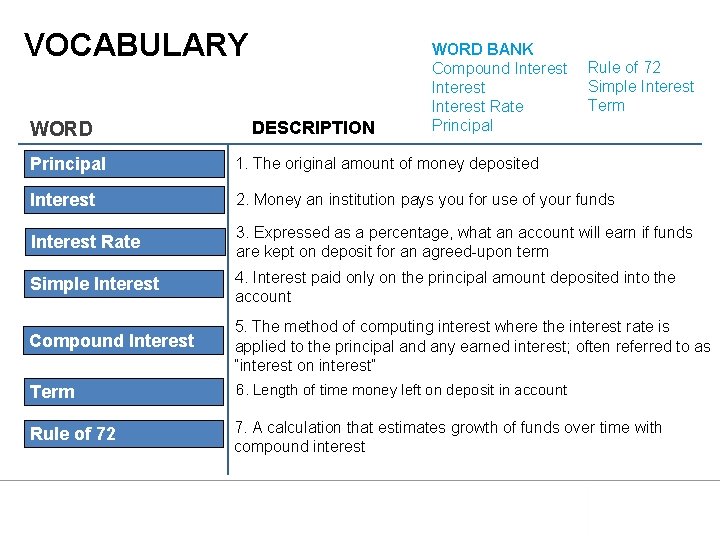
VOCABULARY WORD DESCRIPTION WORD BANK Compound Interest Rate Principal Rule of 72 Simple Interest Term Principal 1. The original amount of money deposited Interest 2. Money an institution pays you for use of your funds Interest Rate 3. Expressed as a percentage, what an account will earn if funds are kept on deposit for an agreed-upon term Simple Interest 4. Interest paid only on the principal amount deposited into the account Compound Interest 5. The method of computing interest where the interest rate is applied to the principal and any earned interest; often referred to as “interest on interest” Term 6. Length of time money left on deposit in account Rule of 72 7. A calculation that estimates growth of funds over time with compound interest 1
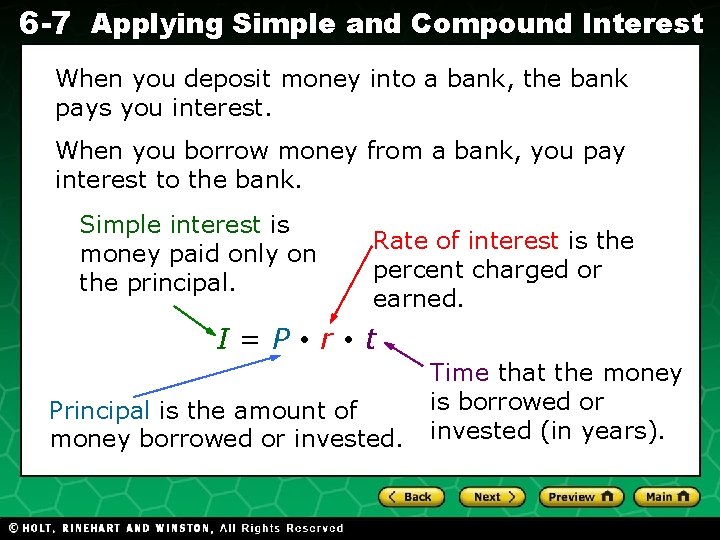
6 -7 Applying Simple and Compound Interest When you deposit money into a bank, the bank pays you interest. Evaluating Algebraic Expressions When you borrow money from a bank, you pay interest to the bank. Simple interest is money paid only on the principal. I=P Rate of interest is the percent charged or earned. r t Principal is the amount of money borrowed or invested. Time that the money is borrowed or invested (in years).
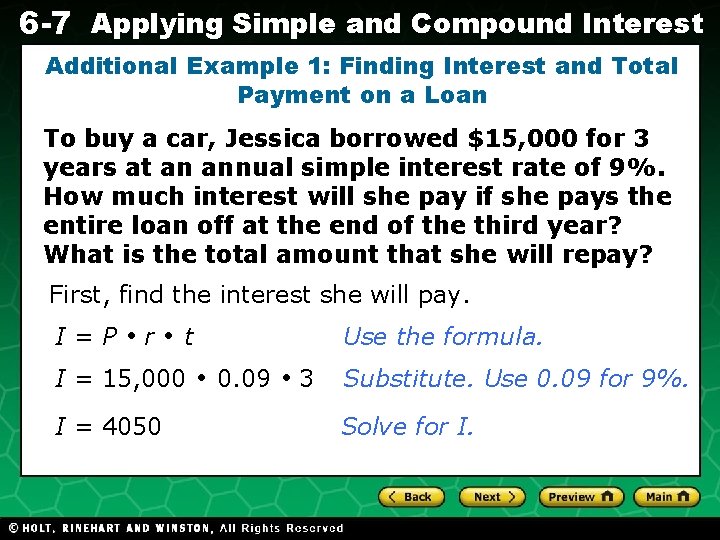
6 -7 Applying Simple and Compound Interest Additional Example 1: Finding Interest and Total Payment on a Loan Evaluating Algebraic To buy a car, Jessica borrowed Expressions $15, 000 for 3 years at an annual simple interest rate of 9%. How much interest will she pay if she pays the entire loan off at the end of the third year? What is the total amount that she will repay? First, find the interest she will pay. I=P r t I = 15, 000 I = 4050 Use the formula. 0. 09 3 Substitute. Use 0. 09 for 9%. Solve for I.
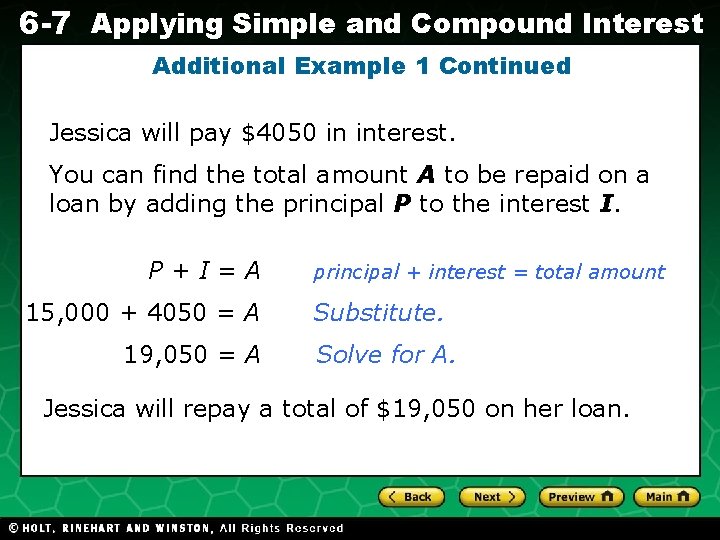
6 -7 Applying Simple and Compound Interest Additional Example 1 Continued Evaluating Algebraic Jessica will pay $4050 in interest. Expressions You can find the total amount A to be repaid on a loan by adding the principal P to the interest I. P+I=A 15, 000 + 4050 = A 19, 050 = A principal + interest = total amount Substitute. Solve for A. Jessica will repay a total of $19, 050 on her loan.
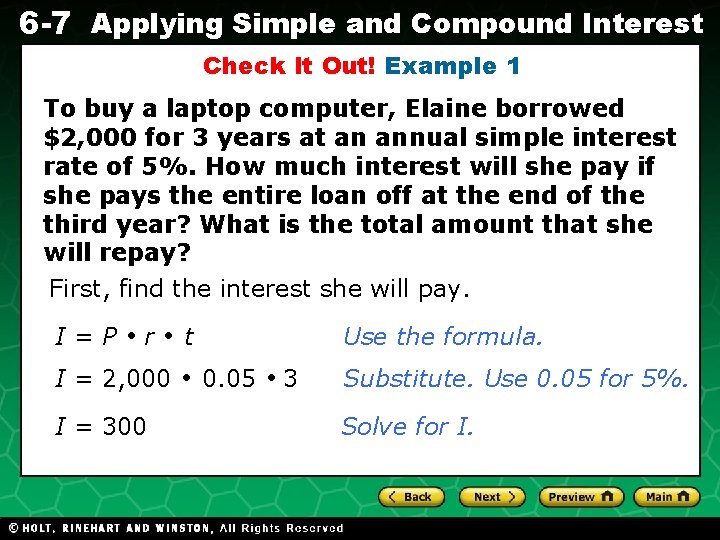
6 -7 Applying Simple and Compound Interest Check It Out! Example 1 To buy a laptop computer, Elaine borrowed Evaluating $2, 000 for 3 years. Algebraic at an annual. Expressions simple interest rate of 5%. How much interest will she pay if she pays the entire loan off at the end of the third year? What is the total amount that she will repay? First, find the interest she will pay. I=P r I = 2, 000 I = 300 t Use the formula. 0. 05 3 Substitute. Use 0. 05 for 5%. Solve for I.

6 -7 Applying Simple and Compound Interest Check It Out! Example 1 Continued Evaluating Elaine will pay $300 Algebraic in interest. Expressions You can find the total amount A to be repaid on a loan by adding the principal P to the interest I. P+I=A 2000 + 300 = A 2300 = A principal + interest = total amount Substitute. Solve for A. Elaine will repay a total of $2300 on her loan.
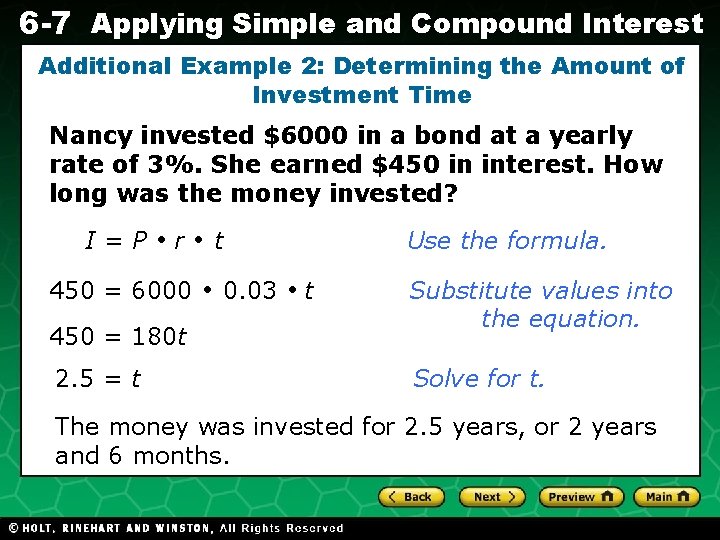
6 -7 Applying Simple and Compound Interest Additional Example 2: Determining the Amount of Investment Time Evaluating Algebraic Expressions Nancy invested $6000 in a bond at a yearly rate of 3%. She earned $450 in interest. How long was the money invested? I=P r 450 = 6000 450 = 180 t 2. 5 = t t 0. 03 Use the formula. t Substitute values into the equation. Solve for t. The money was invested for 2. 5 years, or 2 years and 6 months.

6 -7 Applying Simple and Compound Interest Check It Out! Example 2 TJ invested $4000 Algebraic in a bond at Expressions a yearly rate of Evaluating 2%. He earned $200 in interest. How long was the money invested? I=P r 200 = 4000 200 = 80 t 2. 5 = t t 0. 02 Use the formula. t Substitute values into the equation. Solve for t. The money was invested for 2. 5 years, or 2 years and 6 months.
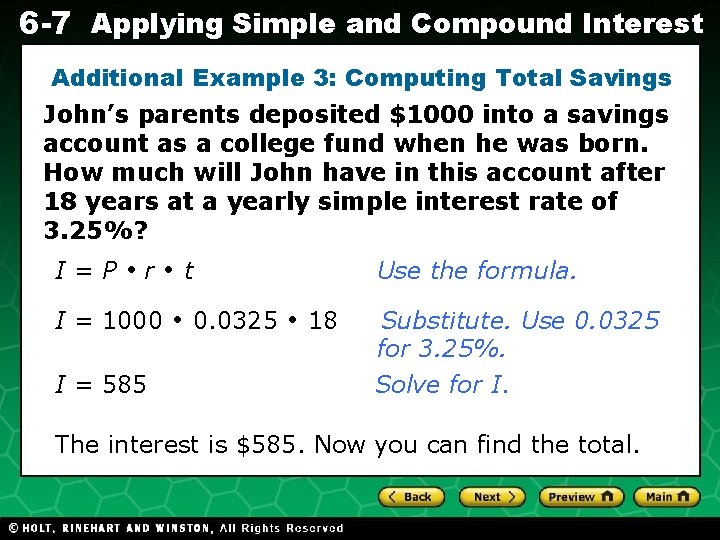
6 -7 Applying Simple and Compound Interest Additional Example 3: Computing Total Savings John’s parents deposited $1000 into a savings Evaluating Algebraic Expressions account as a college fund when he was born. How much will John have in this account after 18 years at a yearly simple interest rate of 3. 25%? I=P r I = 1000 I = 585 t 0. 0325 Use the formula. 18 Substitute. Use 0. 0325 for 3. 25%. Solve for I. The interest is $585. Now you can find the total.
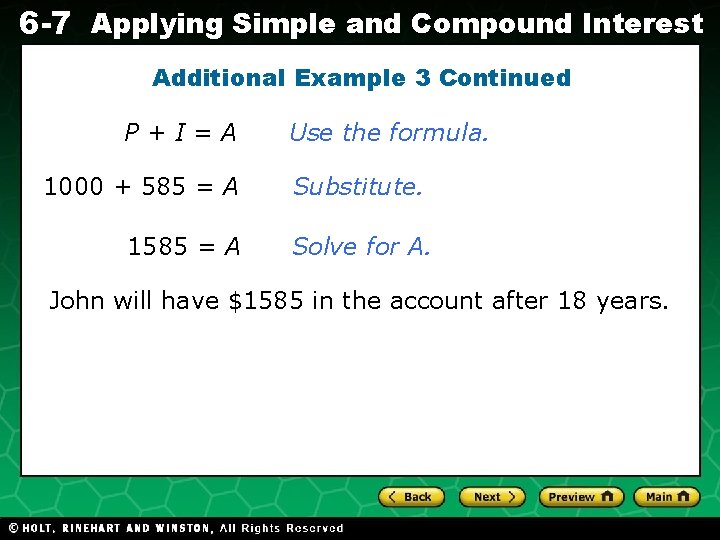
6 -7 Applying Simple and Compound Interest Additional Example 3 Continued Evaluating Algebraic Expressions P+I=A Use the formula. 1000 + 585 = A 1585 = A Substitute. Solve for A. John will have $1585 in the account after 18 years.
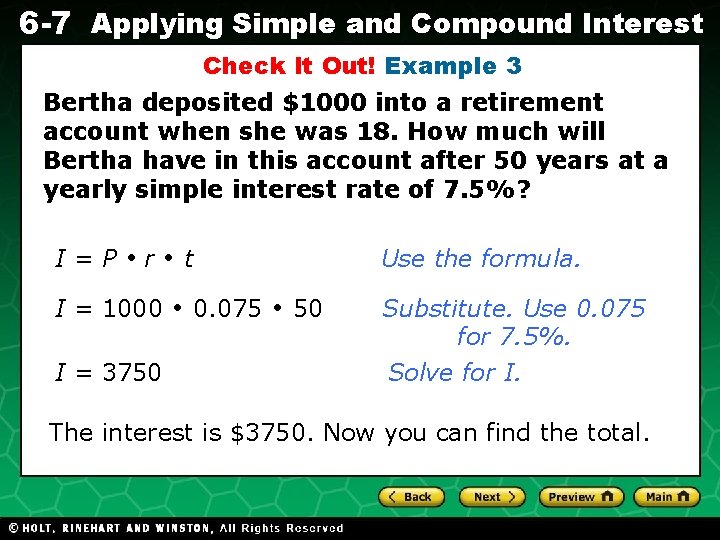
6 -7 Applying Simple and Compound Interest Check It Out! Example 3 Bertha deposited $1000 into a retirement Evaluating account when she. Algebraic was 18. How. Expressions much will Bertha have in this account after 50 years at a yearly simple interest rate of 7. 5%? I=P r I = 1000 I = 3750 t 0. 075 Use the formula. 50 Substitute. Use 0. 075 for 7. 5%. Solve for I. The interest is $3750. Now you can find the total.
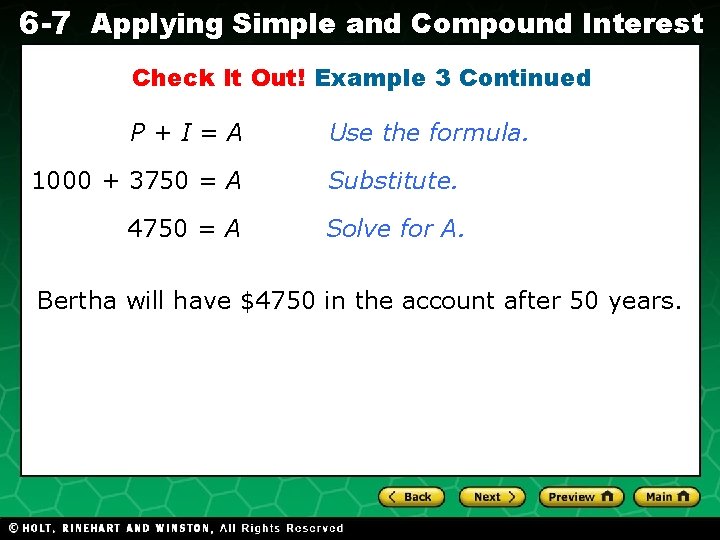
6 -7 Applying Simple and Compound Interest Check It Out! Example 3 Continued Evaluating Algebraic Expressions P+I=A Use the formula. 1000 + 3750 = A Substitute. 4750 = A Solve for A. Bertha will have $4750 in the account after 50 years.
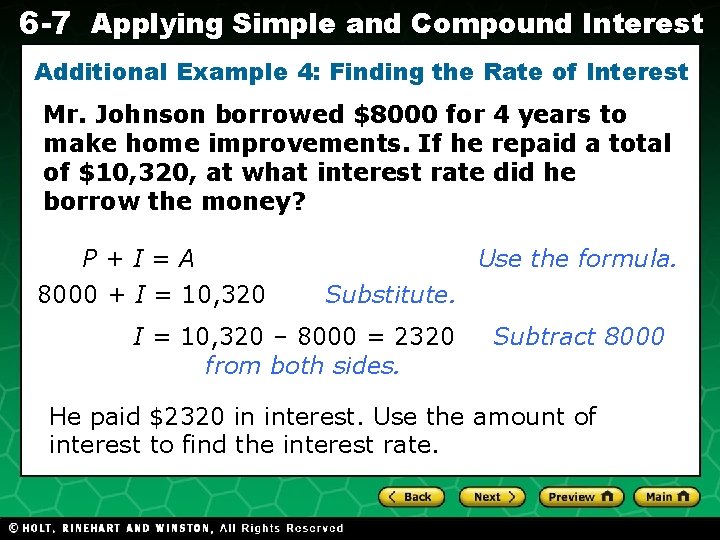
6 -7 Applying Simple and Compound Interest Additional Example 4: Finding the Rate of Interest Mr. Johnson borrowed $8000 for 4 years to Evaluating Algebraic Expressions make home improvements. If he repaid a total of $10, 320, at what interest rate did he borrow the money? P+I=A 8000 + I = 10, 320 Use the formula. Substitute. I = 10, 320 – 8000 = 2320 from both sides. Subtract 8000 He paid $2320 in interest. Use the amount of interest to find the interest rate.
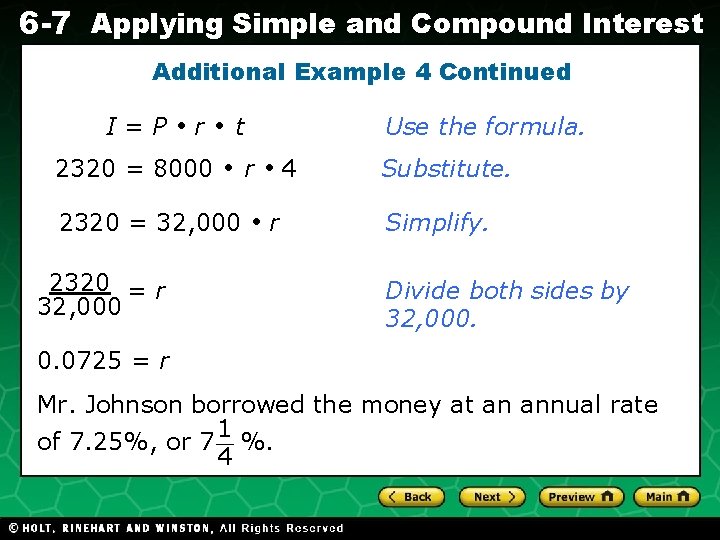
6 -7 Applying Simple and Compound Interest Additional Example 4 Continued I = P r t Use the formula. Evaluating Algebraic Expressions 2320 = 8000 2320 = 32, 000 2320 = r 32, 000 r r 4 Substitute. Simplify. Divide both sides by 32, 000. 0. 0725 = r Mr. Johnson borrowed the money at an annual rate 1 of 7. 25%, or 7 %. 4
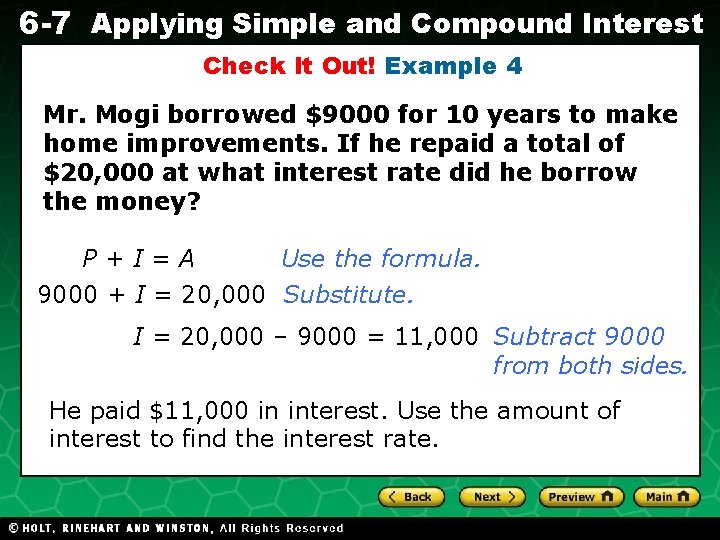
6 -7 Applying Simple and Compound Interest Check It Out! Example 4 Mr. Mogi borrowed $9000 for 10 years to make Evaluating Algebraic Expressions home improvements. If he repaid a total of $20, 000 at what interest rate did he borrow the money? P+I=A Use the formula. 9000 + I = 20, 000 Substitute. I = 20, 000 – 9000 = 11, 000 Subtract 9000 from both sides. He paid $11, 000 in interest. Use the amount of interest to find the interest rate.
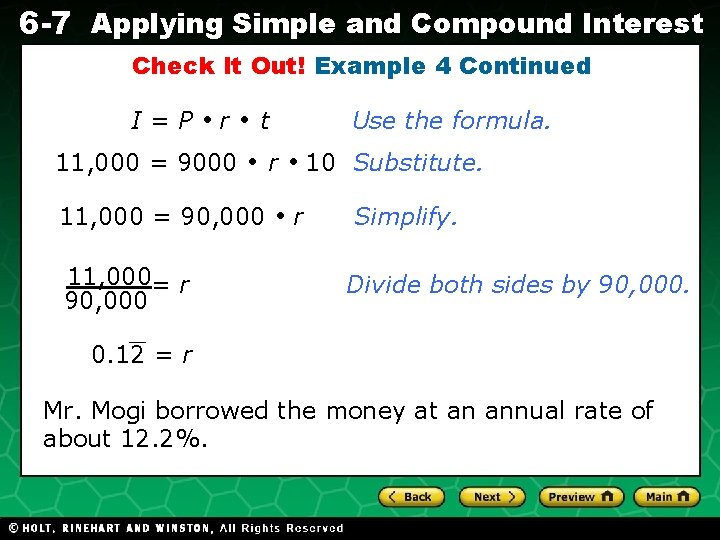
6 -7 Applying Simple and Compound Interest Check It Out! Example 4 Continued I = P r t Algebraic Use the formula. Evaluating Expressions 11, 000 = 9000 11, 000 = 90, 000 11, 000= r 90, 000 r r 10 Substitute. Simplify. Divide both sides by 90, 000. 0. 12 = r Mr. Mogi borrowed the money at an annual rate of about 12. 2%.
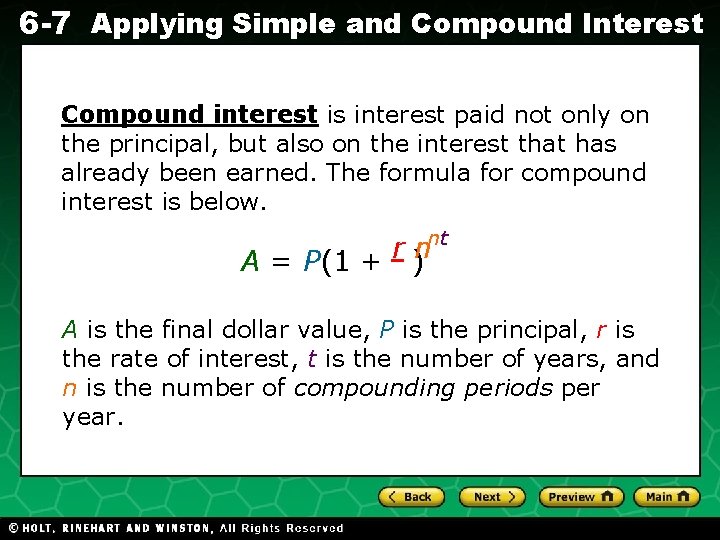
6 -7 Applying Simple and Compound Interest Compound interest is interest paid not only on Evaluating Algebraic Expressions the principal, but also on the interest that has already been earned. The formula for compound interest is below. nt r n A = P(1 + ) A is the final dollar value, P is the principal, r is the rate of interest, t is the number of years, and n is the number of compounding periods per year.
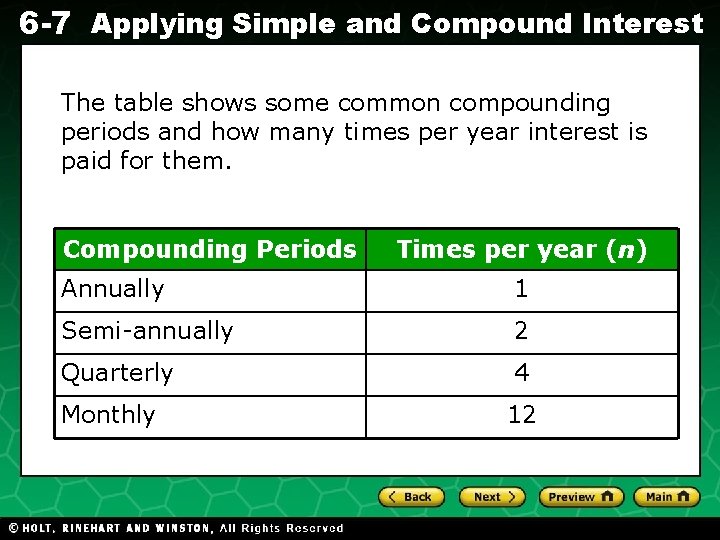
6 -7 Applying Simple and Compound Interest The table shows some common compounding Evaluating Algebraic periods and how many times per Expressions year interest is paid for them. Compounding Periods Times per year (n) Annually 1 Semi-annually 2 Quarterly 4 Monthly 12
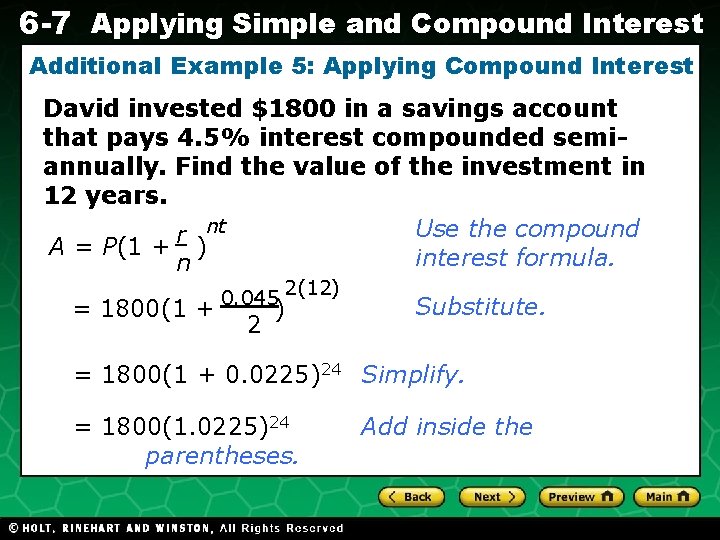
6 -7 Applying Simple and Compound Interest Additional Example 5: Applying Compound Interest David invested $1800 in a savings account Algebraic Expressions that. Evaluating pays 4. 5% interest compounded semiannually. Find the value of the investment in 12 years. Use the compound r nt A = P(1 + ) interest formula. n = 1800(1 + 0. 045 2(12) t 2 ) Substitute. = 1800(1 + 0. 0225)24 Simplify. = 1800(1. 0225)24 parentheses. Add inside the
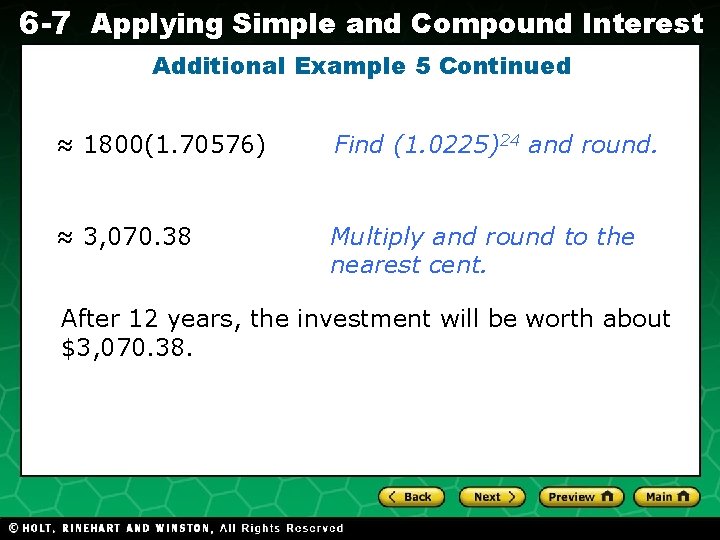
6 -7 Applying Simple and Compound Interest Additional Example 5 Continued Evaluating Algebraic Expressions 24 ≈ 1800(1. 70576) Find (1. 0225) and round. ≈ 3, 070. 38 Multiply and round to the nearest cent. After 12 years, the investment will be worth about $3, 070. 38.
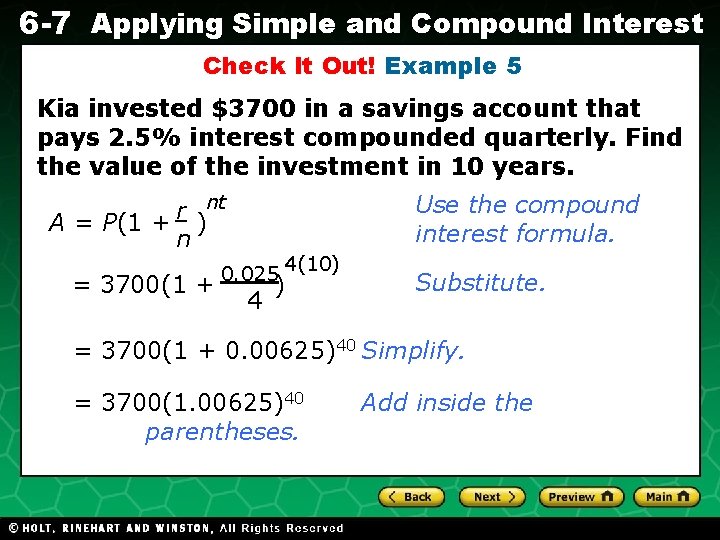
6 -7 Applying Simple and Compound Interest Check It Out! Example 5 Kia invested $3700 in a savings account that pays. Evaluating 2. 5% interest. Algebraic compounded. Expressions quarterly. Find the value of the investment in 10 years. Use the compound interest formula. r nt A = P(1 + ) n = 3700(1 + 0. 025 4(10) t 4 ) Substitute. = 3700(1 + 0. 00625)40 Simplify. = 3700(1. 00625)40 parentheses. Add inside the
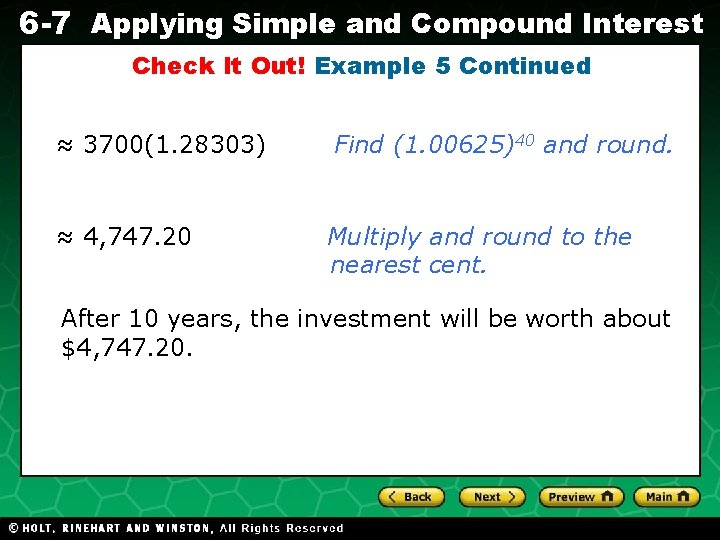
6 -7 Applying Simple and Compound Interest Check It Out! Example 5 Continued Evaluating Algebraic Expressions 40 ≈ 3700(1. 28303) Find (1. 00625) and round. ≈ 4, 747. 20 Multiply and round to the nearest cent. After 10 years, the investment will be worth about $4, 747. 20.
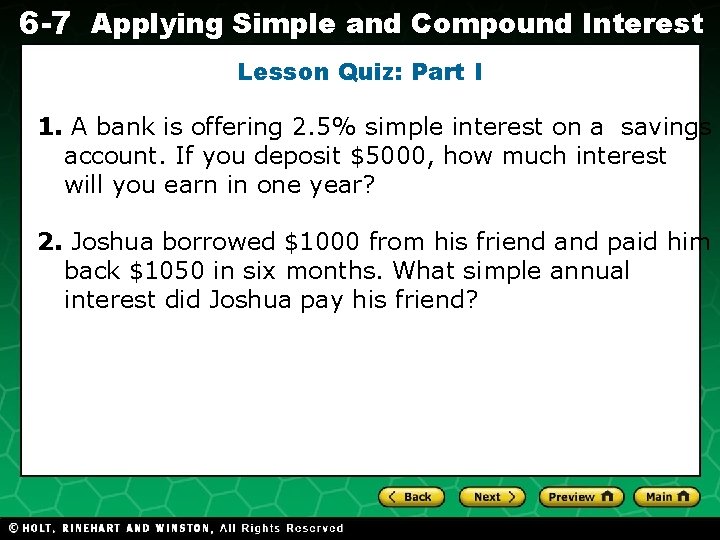
6 -7 Applying Simple and Compound Interest Lesson Quiz: Part I 1. A Evaluating bank is offering Algebraic 2. 5% simple interest on a savings Expressions account. If you deposit $5000, how much interest will you earn in one year? 2. Joshua borrowed $1000 from his friend and paid him back $1050 in six months. What simple annual interest did Joshua pay his friend?
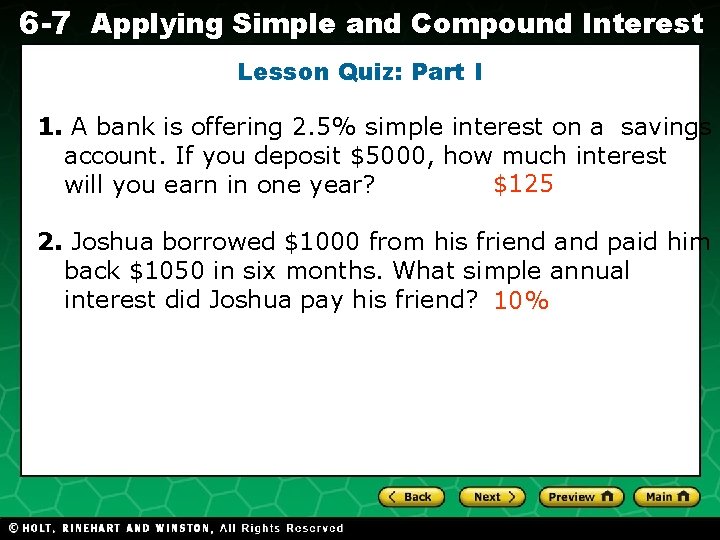
6 -7 Applying Simple and Compound Interest Lesson Quiz: Part I 1. A Evaluating bank is offering Algebraic 2. 5% simple interest on a savings Expressions account. If you deposit $5000, how much interest $125 will you earn in one year? 2. Joshua borrowed $1000 from his friend and paid him back $1050 in six months. What simple annual interest did Joshua pay his friend? 10%
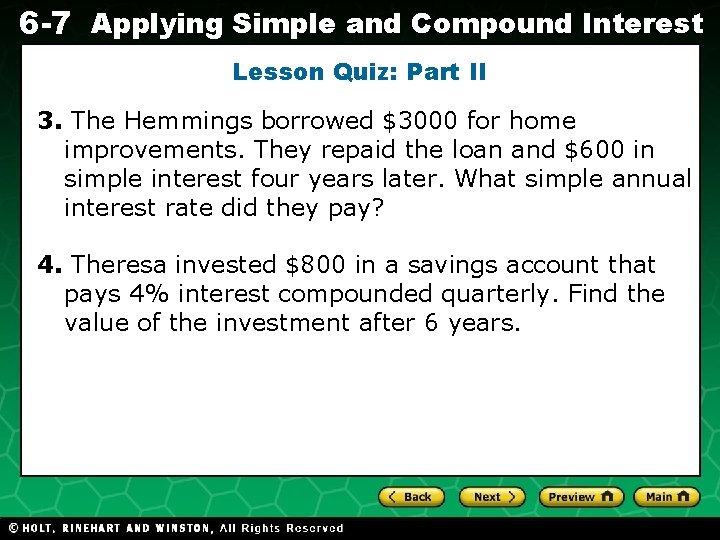
6 -7 Applying Simple and Compound Interest Lesson Quiz: Part II 3. The Hemmings borrowed $3000 Expressions for home Evaluating Algebraic improvements. They repaid the loan and $600 in simple interest four years later. What simple annual interest rate did they pay? 4. Theresa invested $800 in a savings account that pays 4% interest compounded quarterly. Find the value of the investment after 6 years.
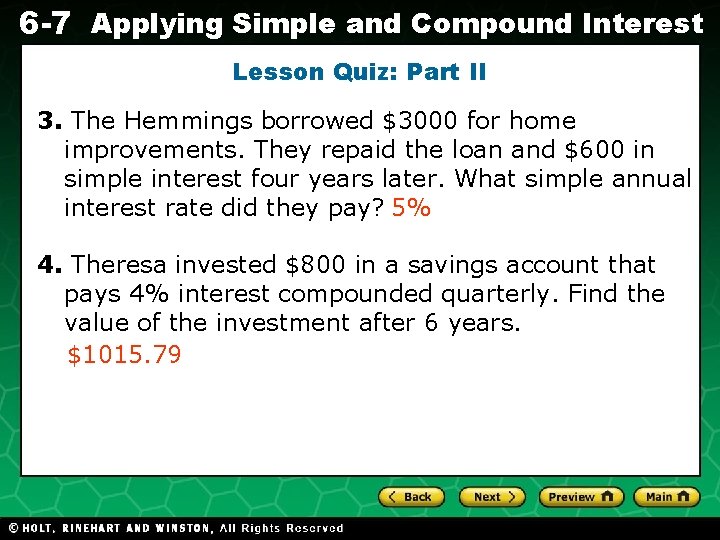
6 -7 Applying Simple and Compound Interest Lesson Quiz: Part II 3. The Hemmings borrowed $3000 Expressions for home Evaluating Algebraic improvements. They repaid the loan and $600 in simple interest four years later. What simple annual interest rate did they pay? 5% 4. Theresa invested $800 in a savings account that pays 4% interest compounded quarterly. Find the value of the investment after 6 years. $1015. 79
Lesson 4: Back to School WATCH IT GROW: RULE OF 72 With the rule of 72, you can estimate the growth of funds over time with compound interest. You calculate the length of time (in years) for a principal deposit to double. You divide 72 by the rate of return. EXAMPLE: • Say you deposit $5, 000 today at an 8% interest rate. • Apply the rule: 72 ÷ 8 = 9 • The principal will double every 9 years. 27
Lesson 4: Back to School RULE OF 72 CALCULATIONS: PROBLEM #1 If you deposit $50, 000, how many years will it take for it to grow to $100, 000? At 4% annual interest • 72 ÷ 4 = 18 years At 6% annual interest • 72 ÷ 6 = 12 years At 9% annual interest • 72 ÷ 9 = 8 years At 12% annual interest • 72 ÷ 12 = 6 years 28
Lesson 4: Back to School RULE OF 72 CALCULATIONS: PROBLEM #2 What interest rate do you need to grow $50, 000 to $100, 000? IN 2 YEARS? • 72 ÷ 2 = 36% IN 5 YEARS? • 72 ÷ 5 = 14. 4% IN 10 YEARS? • 72 ÷ 10 = 7. 2% IN 20 YEARS? • 72 ÷ 20 = 3. 6% 29
- Slides: 29