
VOCABULARY Teaching pronunciation of words HOW MANY SYLLABLES
VOCABULARY Teaching pronunciation of words
HOW MANY SYLLABLES? What are some techniques you know to figure out the number of syllables in English words?
A FEW METHODS 4. The "Robot Speak Method" Rules a. Make believe you are a robot from the year 2000. 1. The "Listen Method" Rules b. Say a word as this robot. a. Say the word. c. Pay attention to the pauses you make. b. How many times do you hear A, E, I, O, or U as a separate sound? d. How many parts did you break your word into? c. This is the number of syllables. Example: • robot = "ro" *pause* "bot". . . 2 syllables 2. The "Chin Method" Rules e. This is the number of syllables. a. Put your hand under your chin. b. Say the word. 5. The "Written Method" Rules c. How many times does your chin touch your hand? a. Count the number of vowels (A, E, I, O, U) in the d. This is the number of syllables. word. • Add 1 every time the letter 'y' makes the sound 3. The "Clap Method" Rules of a vowel (A, E, I, O, U). a. Clapping may help you find syllables. • Subtract 1 for each silent vowel (like the silent b. Say the word. 'e' at the end of a word). c. Clap each time you hear A, E, I, O, or U as a separate sound. b. Subtract 1 for each diphthong or triphthong in the d. The number of claps is the number of syllables. word. • Diphthong: when 2 vowels make only 1 sound (au, oy, oo) • Triphthong: when 3 vowels make only 1 sound
MY FAVORITE RECIPE Count the number of vowels (including y) If it ends in e the e doesn’t count (unless it ends in consonant le i. e. little Vowel clusters usually count as one However eo, io, sometimes count as 2
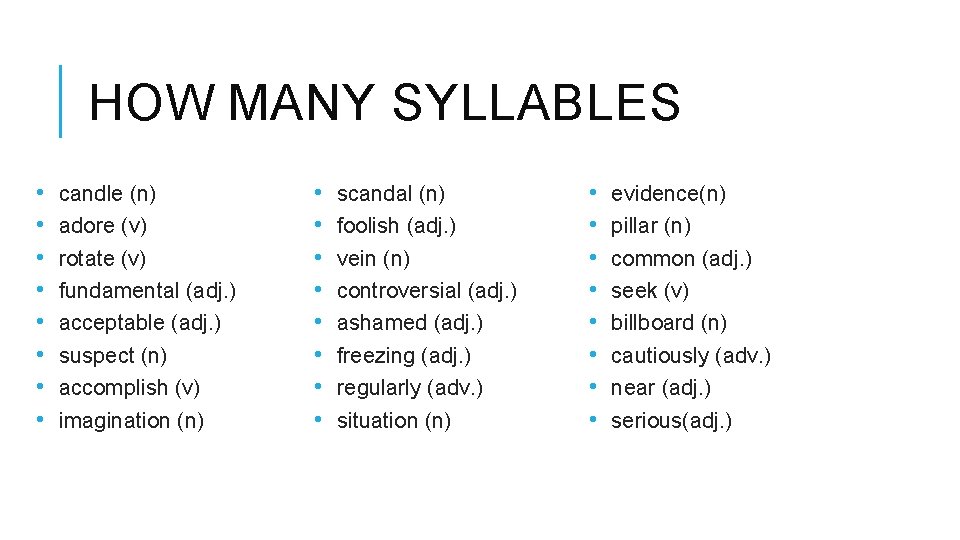
HOW MANY SYLLABLES • • candle (n) adore (v) rotate (v) fundamental (adj. ) acceptable (adj. ) suspect (n) accomplish (v) imagination (n) • • scandal (n) foolish (adj. ) vein (n) controversial (adj. ) ashamed (adj. ) freezing (adj. ) regularly (adv. ) situation (n) • • evidence(n) pillar (n) common (adj. ) seek (v) billboard (n) cautiously (adv. ) near (adj. ) serious(adj. )
DRILLING 1. Chaining 2. Backchaining 3. Rythm
- Slides: 6