
Vocabulary Learning in the EAL Classroom By Meredith
Vocabulary Learning in the EAL Classroom By Meredith Cicerchia
Why is vocabulary so important? • Linked to success in Listening, Speaking, Reading and Writing • The more words you know, the more you can learn • Most commonly used measure of proficiency by researchers
Which words should you teach? • High frequency English vocab • Content that appears in textbooks and course materials • Wordlists they’ll be tested on • Words that are useful for the individual • Words that are meaningful to the individual
What does it mean to know a word? • You can have: • receptive knowledge, which is being able to: 1. Recognise its form in spoken and/or written input 2. Link a word’s form to its meaning • productive knowledge: 1. Say it (and pronounce it correctly? ) 2. Write it (and spell it correctly? ) 3. Use it know its part of speech or how the meaning changes • Additionally: Linguistic chunks, collocates, synonyms, antonyms etc. Nation (2001)
How to ensure a student has learned a word? Trick question! A) Choosing the definition in m/c B) Filling in the blank using a word bank C) Completing a gap-fill from memory D) Saying a word as part of an oral response E) Using a word correctly in free writing All of these are good ways to measure word knowledge. Which ones you use depends on the proficiency level of your learner and what you’re trying to assess.
Learn Vocabulary • Through direct study • Contextualize Classroom lessons, outside activities, glossed texts • Decontextualized Vocabulary lists, flashcards • Through incidental learning • Exposure via games, encounters in physical environment, guessing from context in reading and listening
There are different approaches • Rote learning and memorization • Task based learning (vocab is a byproduct of completing a task) • Input enhancement (emphasizing something with your voice, writing it on the board, underlining words on a page) • The communicative approach
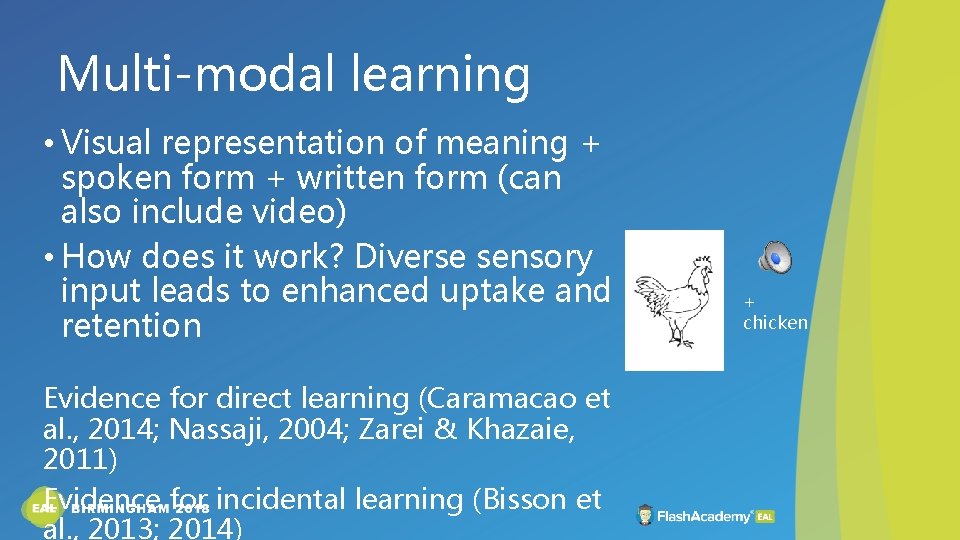
Multi-modal learning • Visual representation of meaning + spoken form + written form (can also include video) • How does it work? Diverse sensory input leads to enhanced uptake and retention Evidence for direct learning (Caramacao et al. , 2014; Nassaji, 2004; Zarei & Khazaie, 2011) Evidence for incidental learning (Bisson et al. , 2013; 2014) + chicken
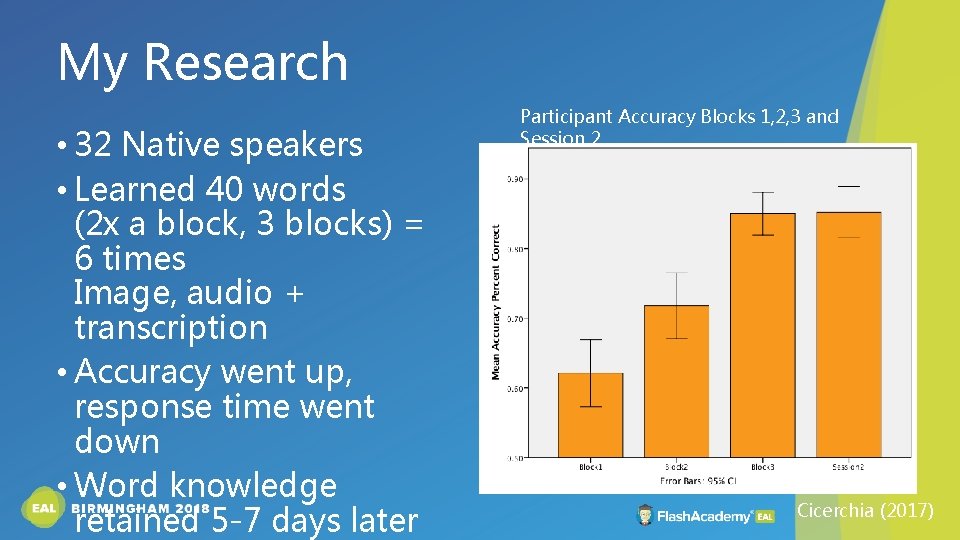
My Research • 32 Native speakers • Learned 40 words (2 x a block, 3 blocks) = 6 times Image, audio + transcription • Accuracy went up, response time went down • Word knowledge retained 5 -7 days later Participant Accuracy Blocks 1, 2, 3 and Session 2 Cicerchia (2017)
Which factors most impacted on accuracy and response times? • Number of letters, Number of Syllables Response time • Number of unfamiliar phonemes Accuracy • What does this mean? • Maximizing exposure to the sounds of a new language is important
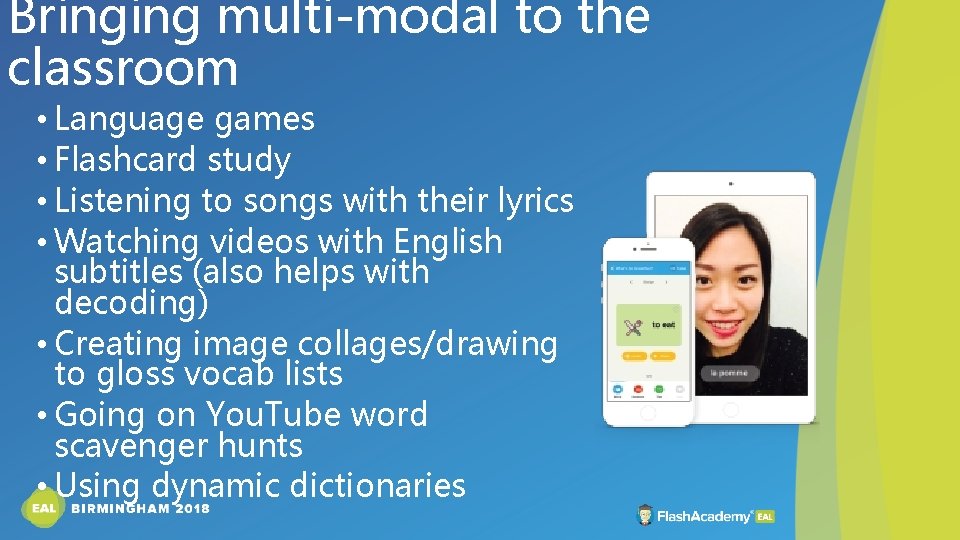
Bringing multi-modal to the classroom • Language games • Flashcard study • Listening to songs with their lyrics • Watching videos with English subtitles (also helps with decoding) • Creating image collages/drawing to gloss vocab lists • Going on You. Tube word scavenger hunts • Using dynamic dictionaries
What helps words make it into long-term memory? • Opening affective barriers through fun and creative activities • Repetition, repetition • Learning language that’s meaningful for the individual • Exposure to words in diverse contexts • Moving beyond receptive to productive exercises
Things to keep in mind • No two EAL learners are alike. • The learnability of a word (how hard it is to learn) is different for every word, for every learner. • Some students have never been taught how to learn vocabulary. • Introduce a variety of approaches and actively teach vocabulary acquisition strategies so every student has the chance to find a way that works for him or her.
THANK YOU If you have any questions, or want to know more, feel free to send me an email! Meredith Cicerchia Meredith. cicerchia@nottingham. ac. uk (or) meredithcicerchia@gmail. com
- Slides: 14