
Vocabulary Irritability Contractility Motor unit Neuromuscular junctions Synaptic

Vocabulary • • Irritability Contractility Motor unit Neuromuscular junctions • Synaptic cleft • Neurotransmitter • Myosin heads • Graded responses • Direct phosphorylation • Anaerobic glycolysis • Aerobic Respiration 2

Properties of Skeletal Muscle Activity (single cells or fibers) · Irritability – ability to receive and respond to a _____ · Contractility – ability to _______ when an adequate stimulus is received Copyright © 2003 Pearson Education, Inc. publishing as Benjamin Cummings Slide 6. 13

Nerve Stimulus to Muscles · Skeletal muscles must be stimulated by a nerve to contract (motor neuron) · Motor _____ · One neuron · Muscle cells stimulated by that neuron Copyright © 2003 Pearson Education, Inc. publishing as Benjamin Cummings Figure 6. 4 a Slide 6. 14
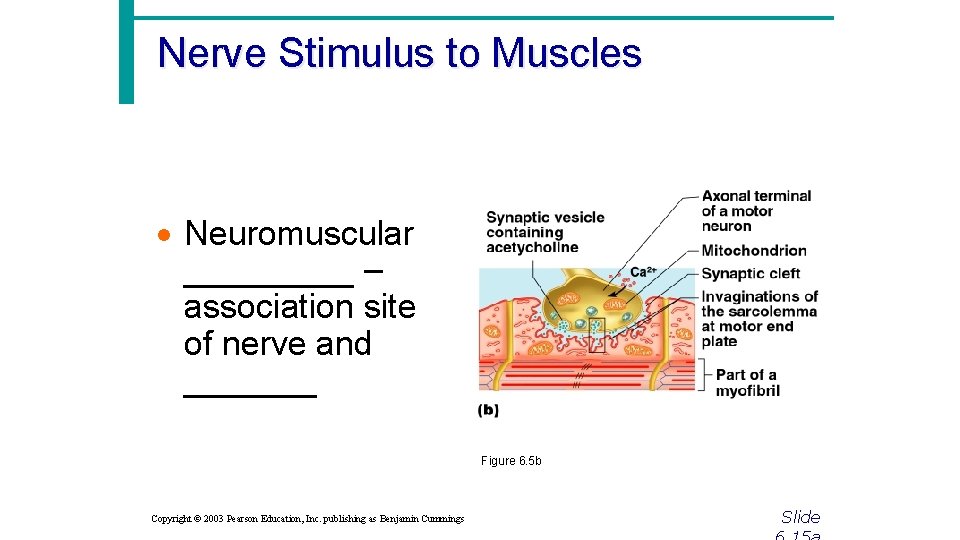
Nerve Stimulus to Muscles · Neuromuscular _____ – association site of nerve and _______ Figure 6. 5 b Copyright © 2003 Pearson Education, Inc. publishing as Benjamin Cummings Slide

Nerve Stimulus to Muscles · Synaptic _____ – gap between nerve and muscle · Nerve and muscle do not make contact · Area between nerve and muscle is filled with interstitial ______ Copyright © 2003 Pearson Education, Inc. publishing as Benjamin Cummings Figure 6. 5 b Slide
Transmission of Nerve Impulse to Muscle · Neurotransmitter – chemical released by nerve upon arrival of nerve impulse · The neurotransmitter for skeletal muscle is _____ · Neurotransmitter attaches to receptors on the sarcolemma · Sarcolemma becomes permeable to _____ (_a+) Copyright © 2003 Pearson Education, Inc. publishing as Benjamin Cummings Slide
Transmission of Nerve Impulse to Muscle · Sodium rushing into the cell generates an action potential · Once started, muscle contraction cannot be stopped Copyright © 2003 Pearson Education, Inc. publishing as Benjamin Cummings Slide
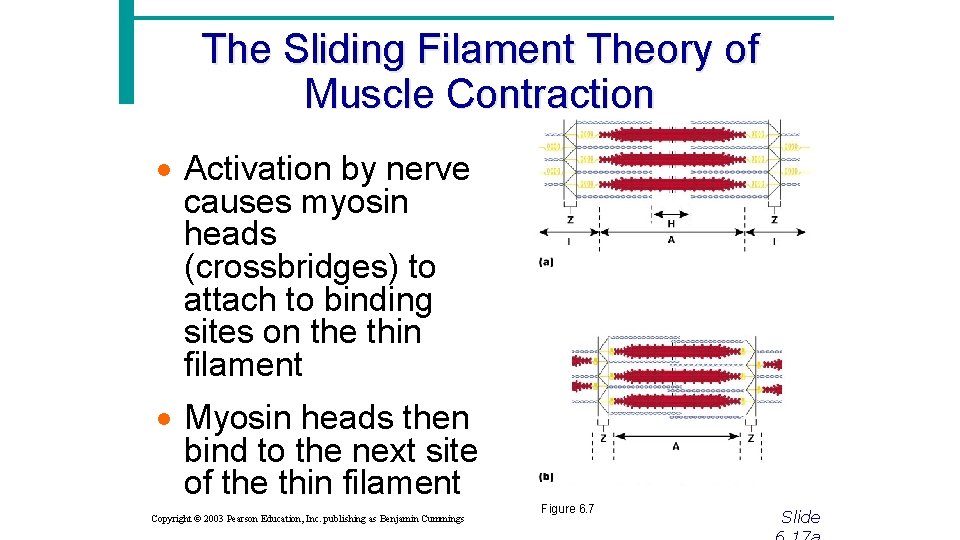
The Sliding Filament Theory of Muscle Contraction · Activation by nerve causes myosin heads (crossbridges) to attach to binding sites on the thin filament · Myosin heads then bind to the next site of the thin filament Copyright © 2003 Pearson Education, Inc. publishing as Benjamin Cummings Figure 6. 7 Slide
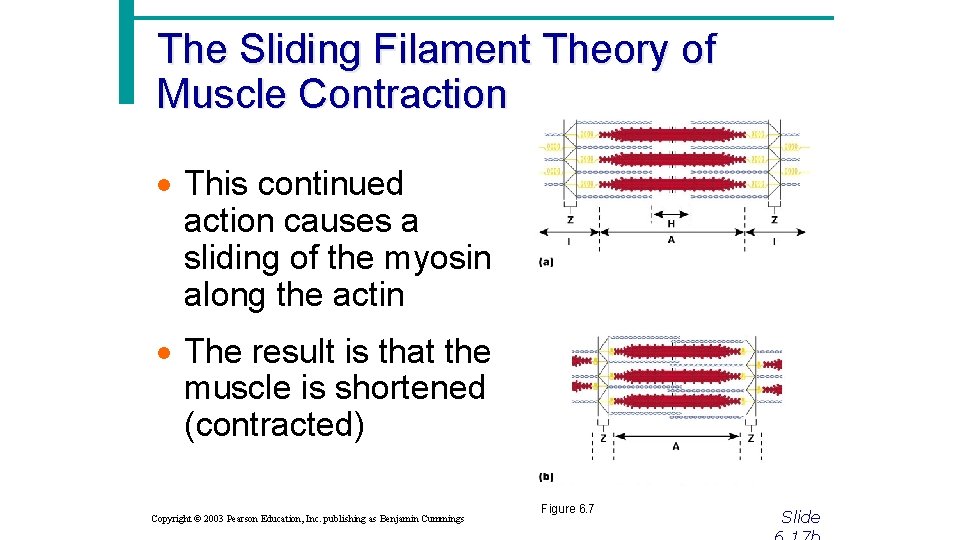
The Sliding Filament Theory of Muscle Contraction · This continued action causes a sliding of the myosin along the actin · The result is that the muscle is shortened (contracted) Copyright © 2003 Pearson Education, Inc. publishing as Benjamin Cummings Figure 6. 7 Slide
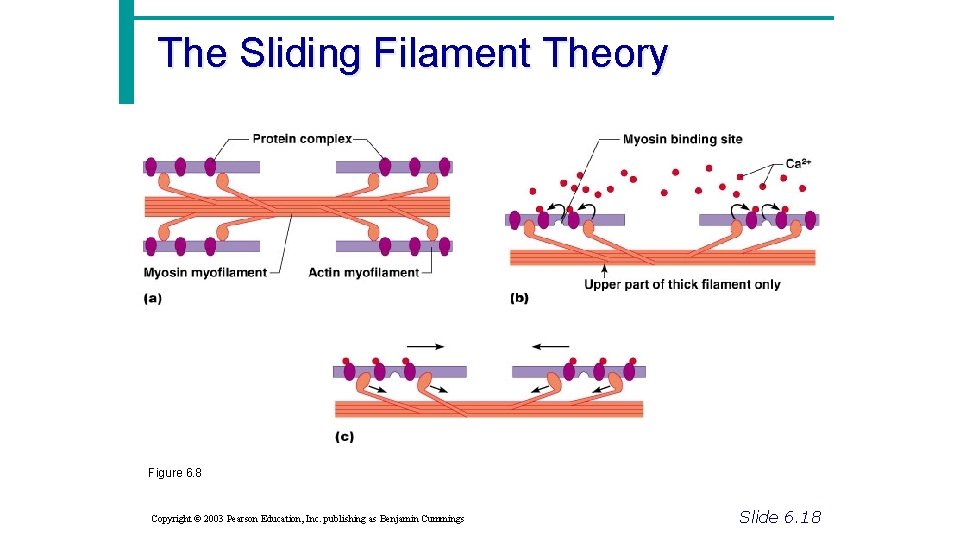
The Sliding Filament Theory Figure 6. 8 Copyright © 2003 Pearson Education, Inc. publishing as Benjamin Cummings Slide 6. 18
Muscle Response to Strong Stimuli · Muscle force depends upon the number of fibers stimulated · More fibers contracting results in greater muscle tension · Muscles can continue to contract unless they run out of energy Copyright © 2003 Pearson Education, Inc. publishing as Benjamin Cummings Slide 6. 22
Energy for Muscle Contraction · Initially, muscles used stored ____ for energy · Bonds of ____ are broken to release energy · Only 4 -6 seconds worth of ____ is stored by muscles · After this initial time, other pathways must be utilized to produce ATP Copyright © 2003 Pearson Education, Inc. publishing as Benjamin Cummings Slide 6. 23
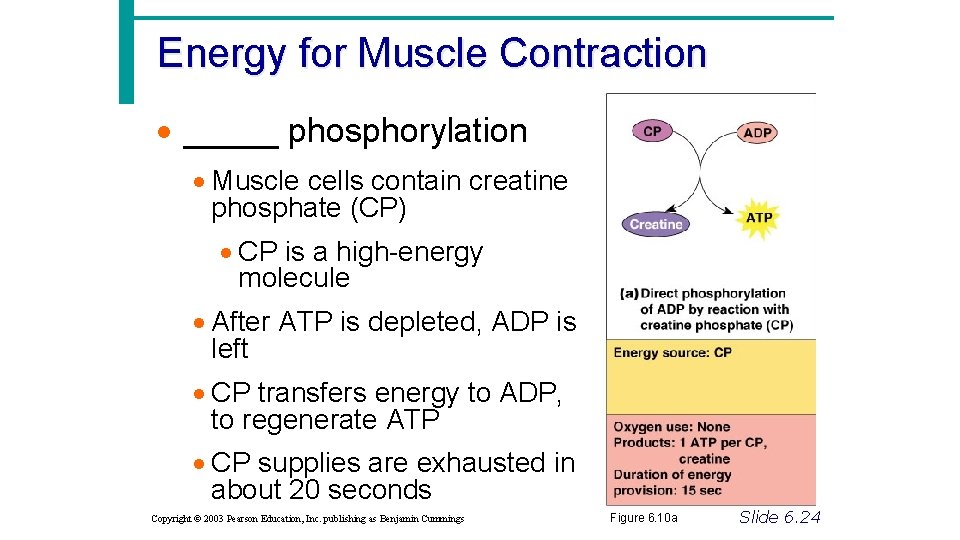
Energy for Muscle Contraction · _____ phosphorylation · Muscle cells contain creatine phosphate (CP) · CP is a high-energy molecule · After ATP is depleted, ADP is left · CP transfers energy to ADP, to regenerate ATP · CP supplies are exhausted in about 20 seconds Copyright © 2003 Pearson Education, Inc. publishing as Benjamin Cummings Figure 6. 10 a Slide 6. 24

Energy for Muscle Contraction · Anaerobic glycolysis · Reaction that breaks down glucose without oxygen · Glucose is broken down to pyruvic acid to produce some ATP · Pyruvic acid is converted to _____ Copyright © 2003 Pearson Education, Inc. publishing as Benjamin Cummings Figure 6. 10 b Slide
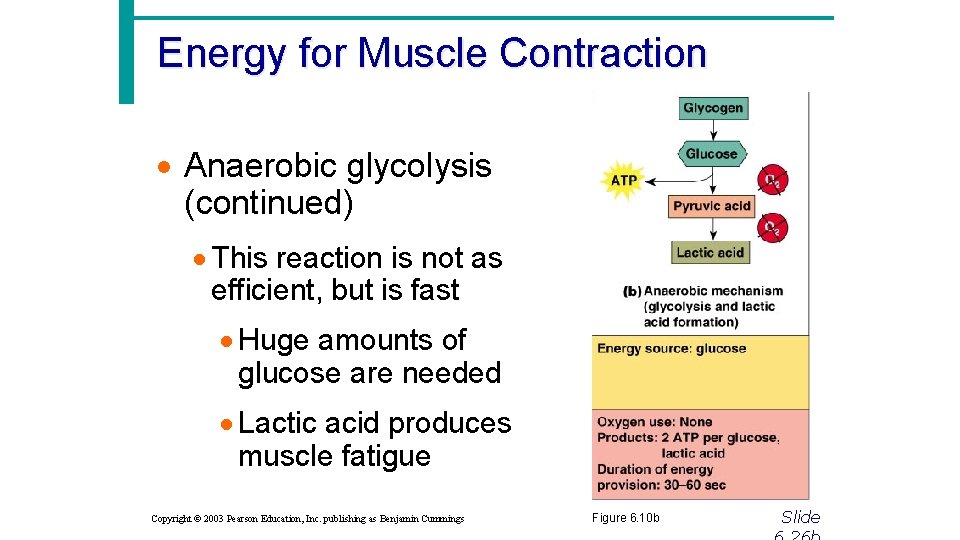
Energy for Muscle Contraction · Anaerobic glycolysis (continued) · This reaction is not as efficient, but is fast · Huge amounts of glucose are needed · Lactic acid produces muscle fatigue Copyright © 2003 Pearson Education, Inc. publishing as Benjamin Cummings Figure 6. 10 b Slide
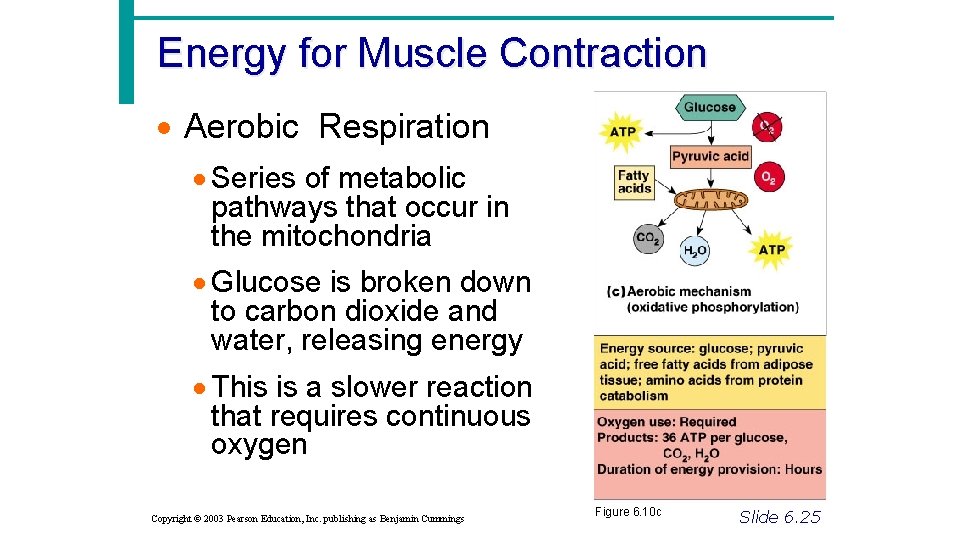
Energy for Muscle Contraction · Aerobic Respiration · Series of metabolic pathways that occur in the mitochondria · Glucose is broken down to carbon dioxide and water, releasing energy · This is a slower reaction that requires continuous oxygen Copyright © 2003 Pearson Education, Inc. publishing as Benjamin Cummings Figure 6. 10 c Slide 6. 25
Crash Course: Muscles part 2
- Slides: 18