
VOCABULARY FOR MODULE 1 Number Sense and Quantity
VOCABULARY FOR MODULE 1 “Number Sense and Quantity”
Digit • In the base ten system, the digits are 0, 1, 2, 3, 4, 5, 6, 7, 8, and 9. In numeration systems based on place value, the place the digit is written determines the actual value of the digit. For example, in the number 83, since the digit 8 is in the tens position, it represents 80.
Place Value • meaning attached to where a digit is in a number
Integer • the set of whole numbers and their negatives
Zero • the absence of things. Useful to indicate where something is not.
Opposite of a number • for exam questions, this means a number with the other sign.
Fraction • a ratio that expresses a relationship between a part and a whole.
Numerator • the top part of a fraction
Denominator • the bottom part of a fraction
Rational number • a number that can be expressed as a fraction
Irrational number • a number that cannot be expressed as a fraction
Sum • the result of addition
Difference • the result of subtraction
Product • the result of multiplication of two factors
Quotient • the result of division of two numbers
Divisor • in a division statement, the number that gets divided BY.
Dividend • in a division statement, the number that gets divided.
Factors • the numbers that are multiplied together to obtain a specific number
Array • An arrangement of objects, pictures, or numbers in columns and rows is called an array. Arrays are useful representations of multiplication concepts
Fact Family • The fact family shows the relationships between the numbers in it. All we need to create a fact family is two numbers that we can then add together and the sum of those two numbers.
Inverse Operation • operations that undo what each other does.
Compatible numbers • Compatible numbers are numbers that are close in value to the actual numbers, and which make it easy to perform mental arithmetic
Area Model • a visual representation of multiplication using the area of a quadrilateral.
Power of ten • a multiple of ten, usually expressed with exponents
Approximation • not exact, but close enough to be useful.
Decimal expansion • representation of rational numbers through long division
Line Diagram • representation of numbers using a number line
VOCABULARY FOR MODULE 2 “Proportional Reasoning”
Equivalent ratios • ratios that express the same relationship between numbers.
Proportional Relationship • When two quantities always have the same size in relation to each other. In other words they have the same ratio.
Unit Rate • A rate in which the second quantity in the comparison is one unit.
Slope • The slope is a measure of the steepness of a line, or a section of a line, connecting two points. Also described as rate of change.
VOCABULARY FOR MODULE 3 “Arithmetic to Algebra”
Equivalent Expressions: Expressions that simplify to an equal value when numbers are substituted for the variables of the expression. • For example, (a+b)2 and a 2 + 2 ab + b 2 are equivalent since whatever the numbers you substitute for a and b, you can always get the same value for both expressions. For example take a = 1 and b = 2, then (1 + 2)2 = 9 = 12 + 2*1*2 + 22.
Distributive Property: The sum of two addends multiplied by a number is the sum of the product of each addend and the number. • For example, a(b+c)= ab + ac • 7(3 + 5) = 7*3 + 7*5 = 21 + 35 = 56.
Algebraic Expression: A mathematical phrase involving at least one variable and sometimes numbers and operation symbols. • For example, suppose we wanted to write an expression to find the total cost of movie tickets for different groups of people, given that tickets cost $5 each. We can define the variable "P" to represent the number of people in a group. Then the algebraic expression 5 x P or 5 P • represents the total cost of movie tickets for a group of P people. So, if our group has 3 people in it, we can substitute into our algebraic expression to find the total cost of movie tickets is 5 x 3, or 15 dollars.
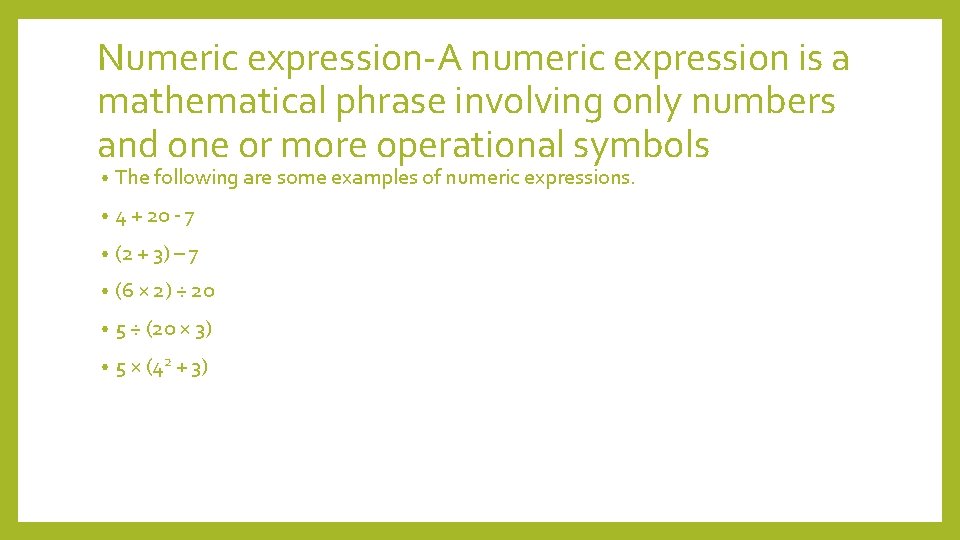
Numeric expression-A numeric expression is a mathematical phrase involving only numbers and one or more operational symbols • The following are some examples of numeric expressions. • 4 + 20 - 7 • (2 + 3) – 7 • (6 × 2) ÷ 20 • 5 ÷ (20 × 3) • 5 × (42 + 3)
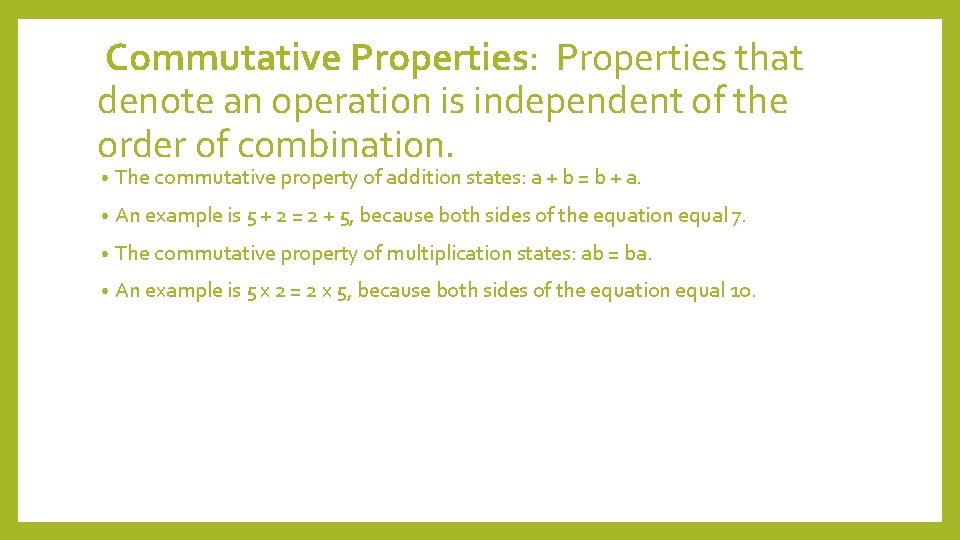
Commutative Properties: Properties that denote an operation is independent of the order of combination. • The commutative property of addition states: a + b = b + a. • An example is 5 + 2 = 2 + 5, because both sides of the equation equal 7. • The commutative property of multiplication states: ab = ba. • An example is 5 x 2 = 2 x 5, because both sides of the equation equal 10.
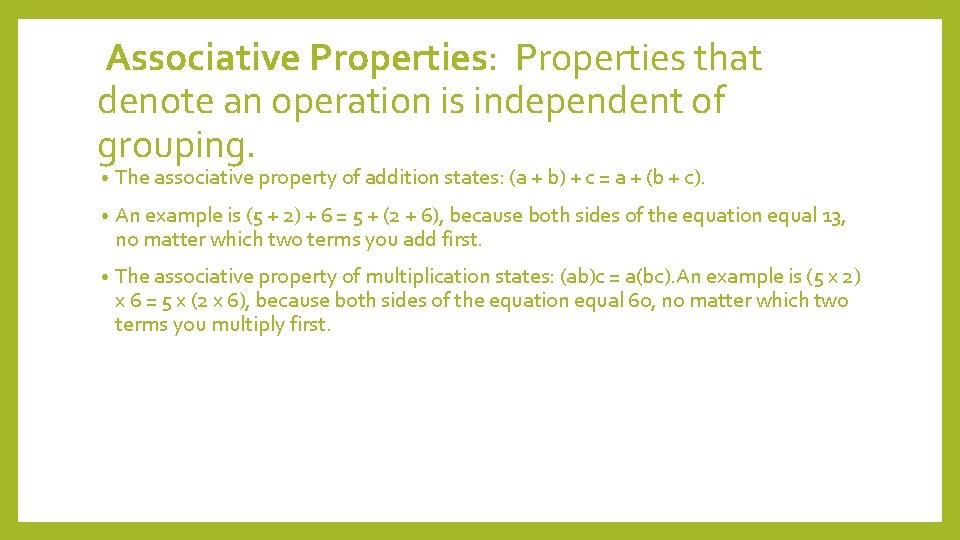
Associative Properties: Properties that denote an operation is independent of grouping. • The associative property of addition states: (a + b) + c = a + (b + c). • An example is (5 + 2) + 6 = 5 + (2 + 6), because both sides of the equation equal 13, no matter which two terms you add first. • The associative property of multiplication states: (ab)c = a(bc). An example is (5 x 2) x 6 = 5 x (2 x 6), because both sides of the equation equal 60, no matter which two terms you multiply first.
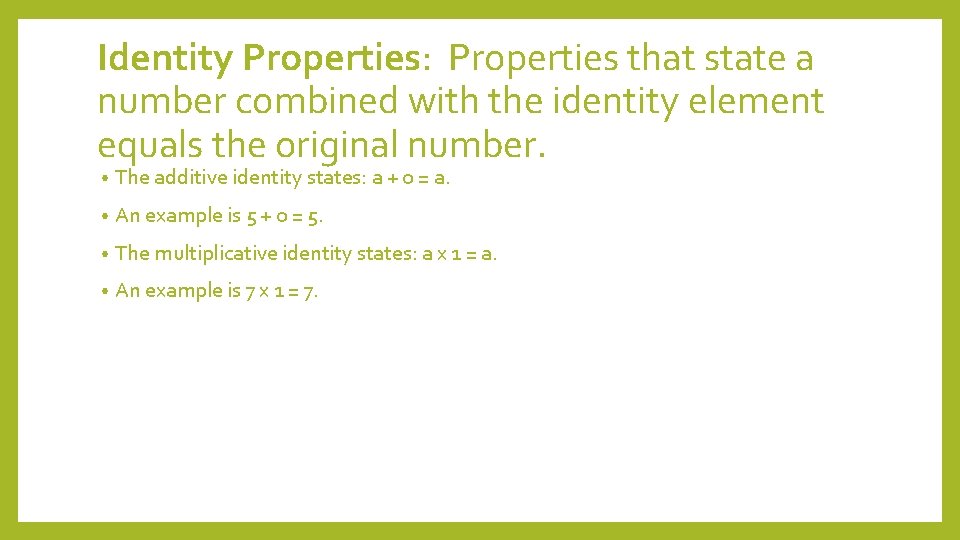
Identity Properties: Properties that state a number combined with the identity element equals the original number. • The additive identity states: a + 0 = a. • An example is 5 + 0 = 5. • The multiplicative identity states: a x 1 = a. • An example is 7 x 1 = 7.
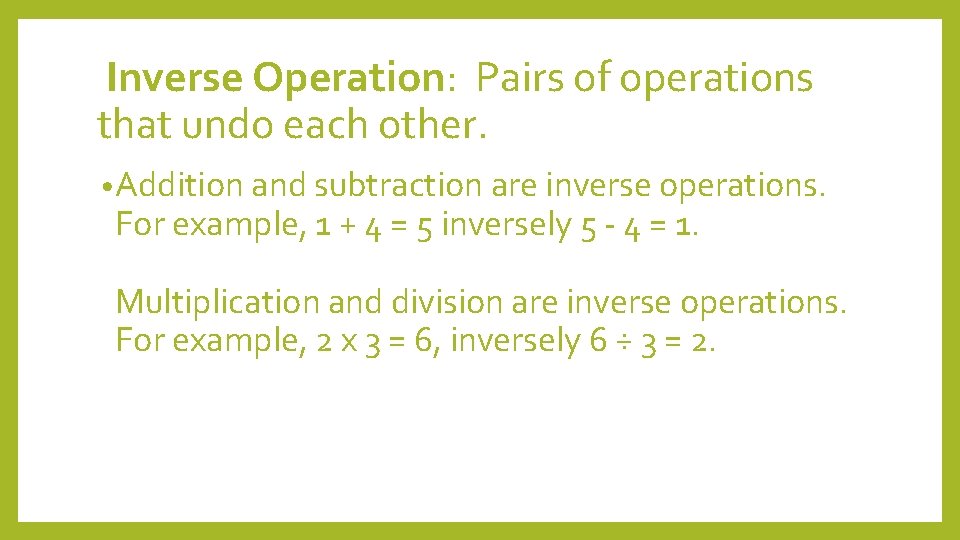
Inverse Operation: Pairs of operations that undo each other. • Addition and subtraction are inverse operations. For example, 1 + 4 = 5 inversely 5 - 4 = 1. Multiplication and division are inverse operations. For example, 2 x 3 = 6, inversely 6 ÷ 3 = 2.
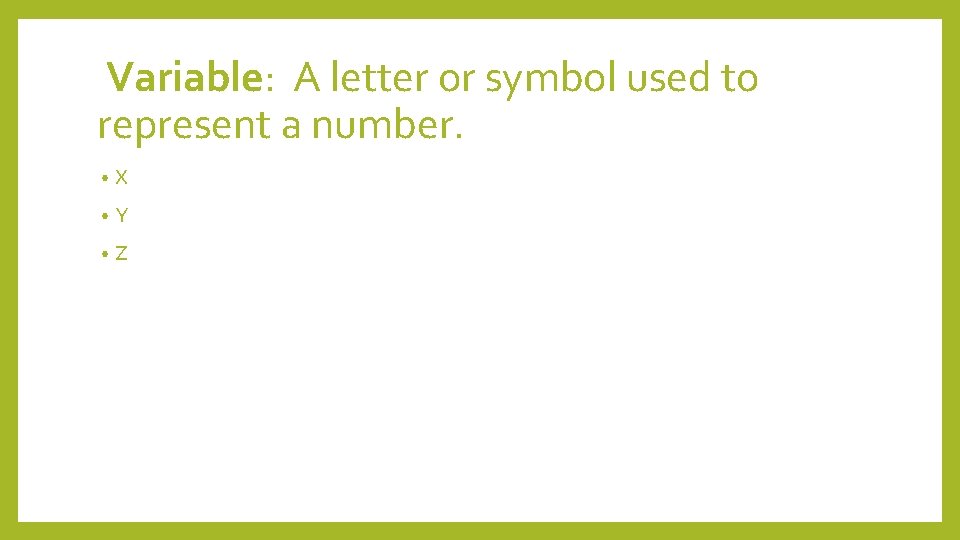
Variable: A letter or symbol used to represent a number. • X • Y • Z
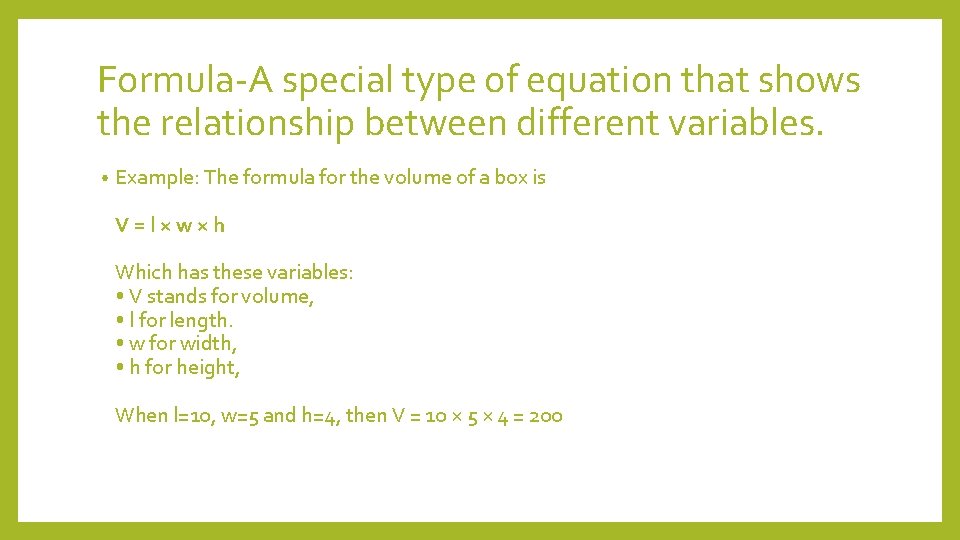
Formula-A special type of equation that shows the relationship between different variables. • Example: The formula for the volume of a box is V=l×w×h Which has these variables: • V stands for volume, • l for length. • w for width, • h for height, When l=10, w=5 and h=4, then V = 10 × 5 × 4 = 200
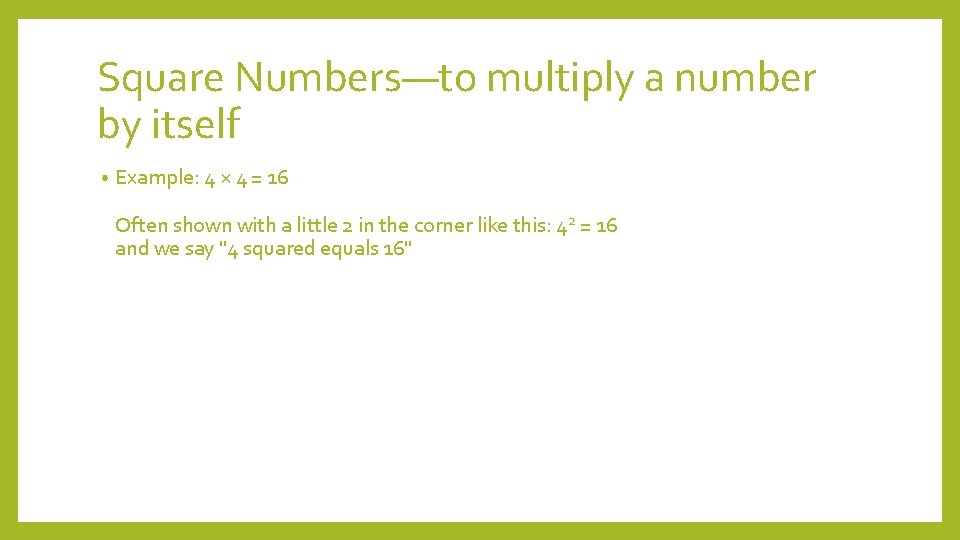
Square Numbers—to multiply a number by itself • Example: 4 × 4 = 16 Often shown with a little 2 in the corner like this: 42 = 16 and we say "4 squared equals 16"
Square Root: One of two equal factors of a given number. • For example, 5 is a square root of 25 because 5*5 = 25. Another square root of 25 is -5 because (-5)*(-5) = 25. The +5 is called the principle square root of 25.
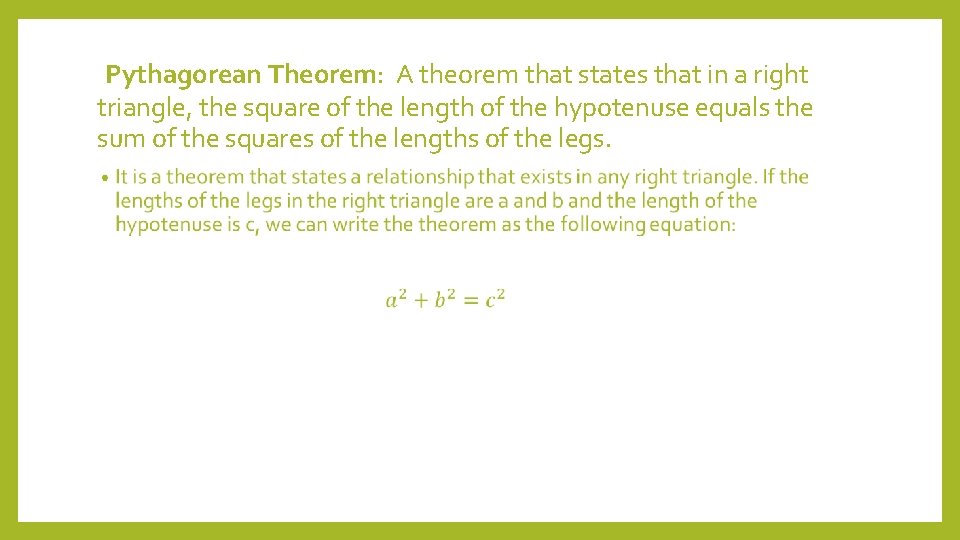
Pythagorean Theorem: A theorem that states that in a right triangle, the square of the length of the hypotenuse equals the sum of the squares of the lengths of the legs. •
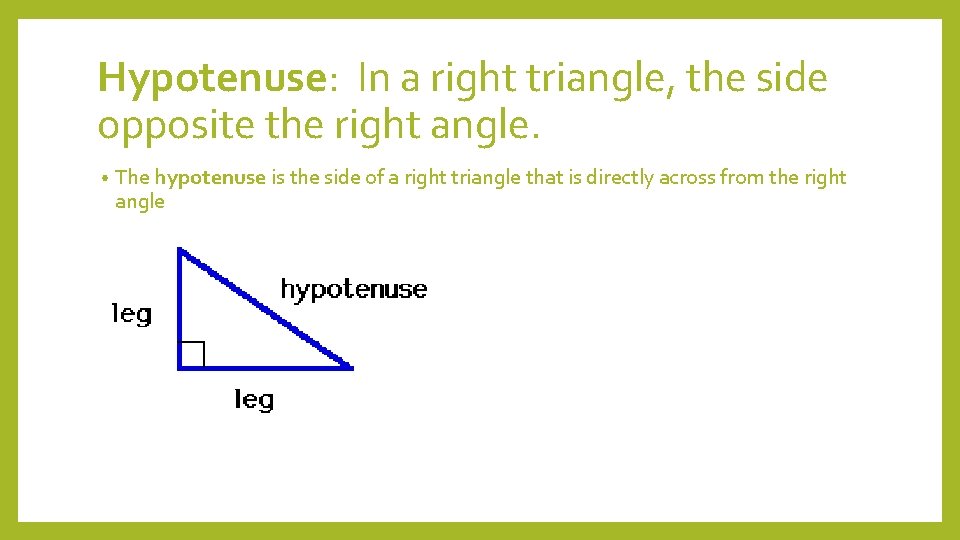
Hypotenuse: In a right triangle, the side opposite the right angle. • The hypotenuse is the side of a right triangle that is directly across from the right angle
Cubic Number—the result of using a whole number in a multiplication three times. • Example: 3 × 3 = 27, so 27 is a cube number. Here are the first few cube numbers: 1 (=1× 1× 1) 8 (=2× 2× 2) 27 (=3× 3× 3) 64 (=4× 4× 4) 125 (=5× 5× 5). . .
Cube Root: One of three equal (identical) factors of a given number. • If the cube root of a number b is a (i. e. , = a), then a 3 = b. • For example: • 4 is the cube root of 64 because 4 x 4 = 64. • -5 is the cube root of -125 because -5 x -5 = -125.
Rational Number: A number that can be written as p/q where p and q are integers, but q is not equal to 0. • The word comes from "ratio". Examples: • 1/2 is a rational number (1 divided by 2, or the ratio of 1 to 2) • 0. 75 is a rational number (3/4) • 1 is a rational number (1/1) • 2 is a rational number (2/1) • 2. 12 is a rational number (212/100) • − 6. 6 is a rational number (− 66/10)
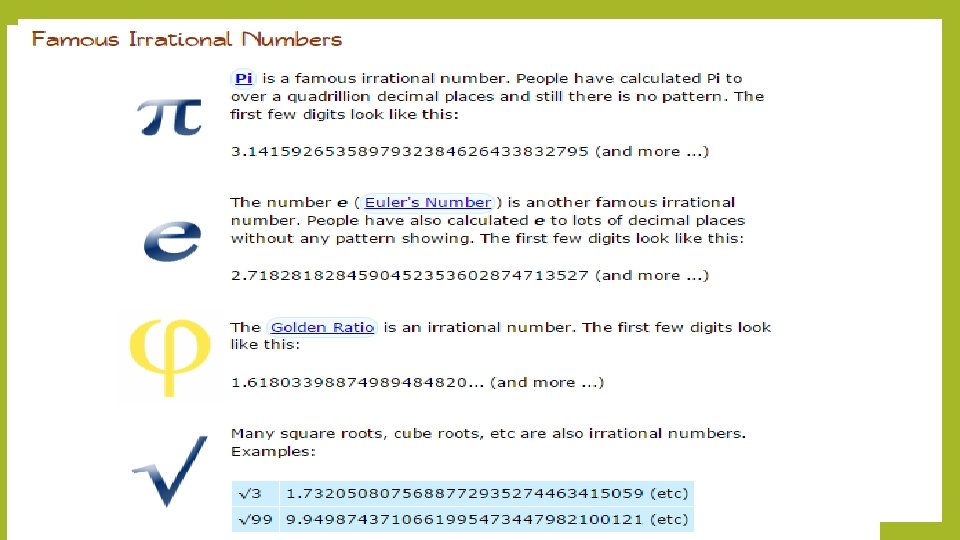
Irrational Number: A number whose decimal form is nonterminating and nonrepeating. All numbers that are not rational are irrational.
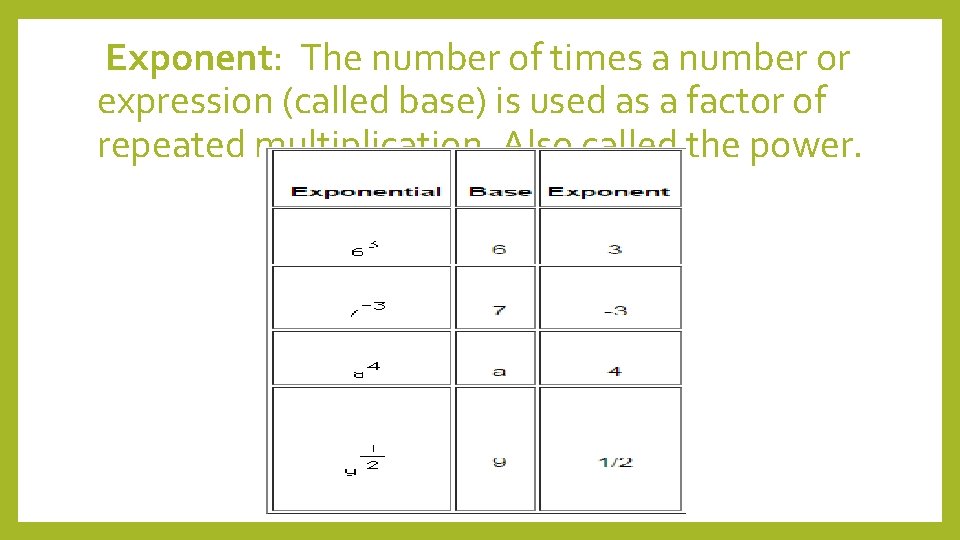
Exponent: The number of times a number or expression (called base) is used as a factor of repeated multiplication. Also called the power.
- Slides: 53