
Vocabulary Enrichment Exercises for Our Students Ms Vivian
Vocabulary Enrichment Exercises for Our Students Ms. Vivian Leon M. S. Reading Resource Teacher 1
“Every Teacher, A Teacher of Reading”: An Overview • All teachers, not just language arts teachers are contributors to our students’ literacy • Research indicates that the following should be a part of every classroom: o Connectedness is essential to learning o Context is essential to learning o Learning is social 2
Overview Continues… o Learning is best accomplished when the environment for learning is supportive and encouraging of risktaking o Knowledge is transactional (Wepner, Feeley & Strickland, 1995) 3
R= E= A= D= S= Miami High Reads! Resources Engaging Activities Assessment Dialogue Success School-Wide Goals to Improve Our Students’ Reading Comprehension (Based on the School Performance Excellence Plan -- End of the Year Evaluation): I. Frequently, and Consistently Assess students’ Independent Reading Activities- Reading & Vocabulary Logs (A) 4
Miami High Reads ! Continues… II. Offer Extra Credit for Attending FCAT Tutorial Sessions After School and on Saturdays (especially to those students requiring remediation) (R) III. Design Lessons to include all learning modalities to accommodate all types of learners (S) 5
Miami High Reads! Cont. … IV. Utilize CRISS Strategies and Reciprocal Teaching Frequently (E) V. Encourage Cooperative Activities, for small groups, such as the Socratic Questioning Technique (D) VI. Incorporate more teachermade/student designed informal testing, rather than standardized testing (A) 6
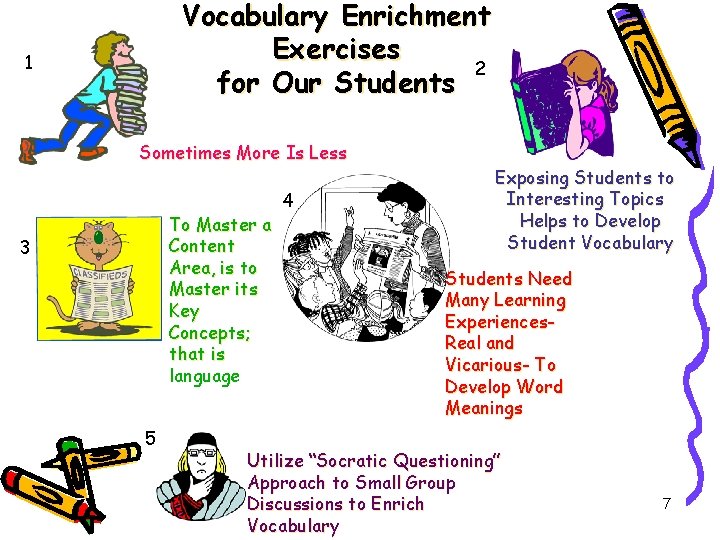
Vocabulary Enrichment Exercises 2 for Our Students 1 Sometimes More Is Less To Master a Content Area, is to Master its Key Concepts; that is language 3 5 4 Exposing Students to Interesting Topics Helps to Develop Student Vocabulary Students Need Many Learning Experiences. Real and Vicarious- To Develop Word Meanings Utilize “Socratic Questioning” Approach to Small Group Discussions to Enrich Vocabulary 7
Research on Vocabulary Development: The Do’s and Don’ts: q Don’t Teach Vocabulary From the Workbooks or In Isolation q Don’t Expect Students to Learn New Words By Simply Testing Them q Don’t Leave Vocabulary Development to the Language Arts Teacher q Do Not Reprimand Students From Completing Assignments in Small Groups *(Nilson & Nilson, 2003) 8
Don’ts Continues… q Don’t Give Students Book Work- Dictionary- related Activities to be Completed Individually“Language is a Social Phenomenon, Which Means That Students Need to Interact With Other Speakers and Hear Pronunciations and Intonations, as well as Words Used in More Variety Than Brief Dictionary Entries” (Nilson & Nilson, 2003) q Don’t Approach Vocabulary as Teaching to the Test- Test Items are not Guaranteed, But Teaching Students About Word Patterns Stands a Better Chance q Don’t Believe For One Minute that Reading for Understanding can be Separated From Reading For Pleasure- Thus, Students will not Enhance Their Vocabularies if They Do Not Read! 9
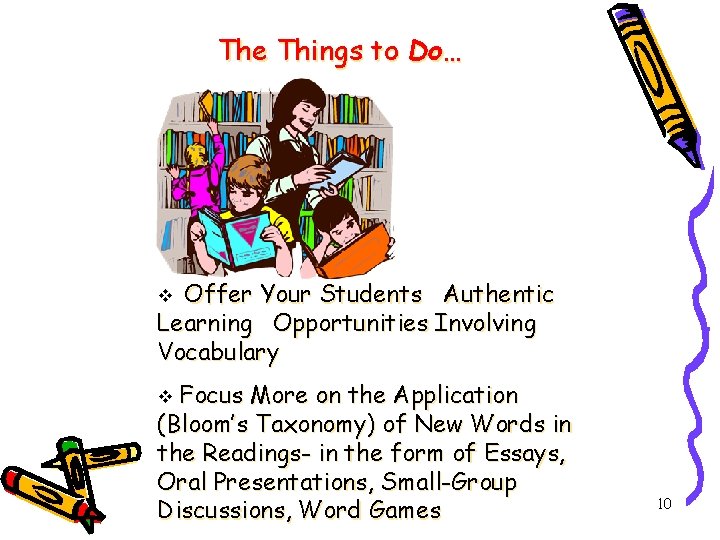
The Things to Do… Offer Your Students Authentic Learning Opportunities Involving Vocabulary v v Focus More on the Application (Bloom’s Taxonomy) of New Words in the Readings- in the form of Essays, Oral Presentations, Small-Group Discussions, Word Games 10
To Do Continued… v Know This: “If Words Form the Thread on which We String Our Experiences, then Reading Weaves those Threads in Ways that Invite Each of Us to Find Beauty in the Patterns that are Created” (Robinson, 2001) v Five Must Haves For Vocabulary Development in Any Class: 1) Guided Sharing 2) Shared Concept 3) Concept-Based Vocabulary 4) Read Alouds 5) Extensive Classroom Libraries 11
v. Read a Variety of Current Articles- Related to the Content Area- Students Keep a Reading/Vocabulary Log v. Integrate Word Histories/Etymologies into the Lessons v. Take A Process Approach to Vocabulary: Ex. : Presidential Election, Sept. 11 th v. Provide Students with Meaningful Connections to New Words v. Have Students Design Educational Games as a Review of Material and Vocabulary 12
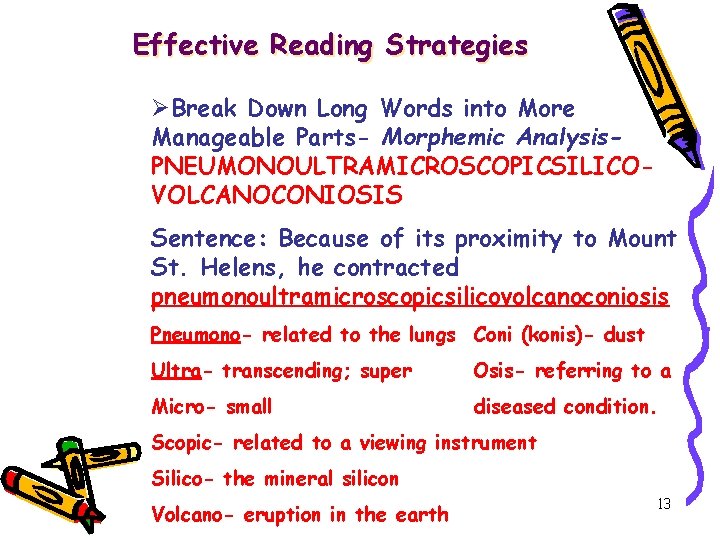
Effective Reading Strategies ØBreak Down Long Words into More Manageable Parts- Morphemic Analysis. PNEUMONOULTRAMICROSCOPICSILICOVOLCANOCONIOSIS Sentence: Because of its proximity to Mount St. Helens, he contracted pneumonoultramicroscopicsilicovolcanoconiosis Pneumono- related to the lungs Coni (konis)- dust Ultra- transcending; super Osis- referring to a Micro- small diseased condition. Scopic- related to a viewing instrument Silico- the mineral silicon Volcano- eruption in the earth 13
Ø Provide Students With Opportunities to use their new words. (Vacca, 109). Ø Reinforce New Vocabulary After Reading: Contextual Redefinition: Example: Step 1 - Define each of the following words using only your prior knowledge- 1. Carapace________ 2. Nonsectarian______ 3. Insipid_________ 14
Step 2 - Provide Your Students With Sentences, Utilizing the New Words 1) Without its carapace, the turtle would be subject to certain death from its enemies or the elements. 2) Although he was a believer in God, he had a nonsectarian attitude toward religion. 3) His teaching lacked spirit. He had presented his lesson in a dull manner, failing to challenge or stimulate his students. The teacher knew he had made an insipid presentation. 15
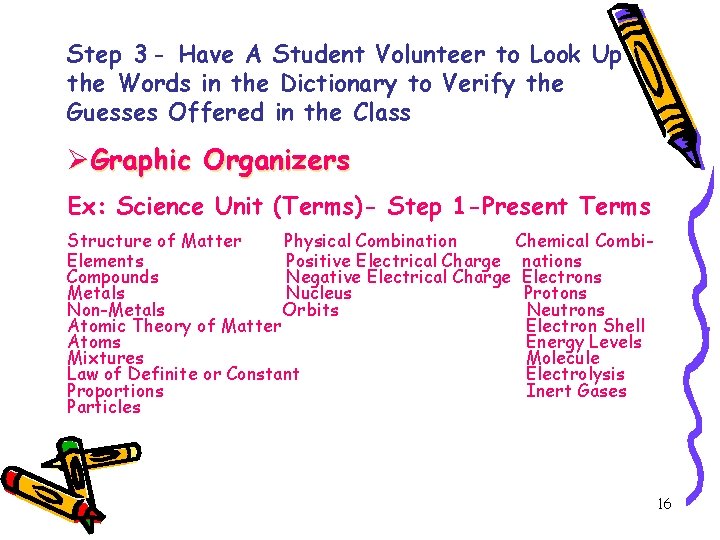
Step 3 - Have A Student Volunteer to Look Up the Words in the Dictionary to Verify the Guesses Offered in the Class ØGraphic Organizers Ex: Science Unit (Terms)- Step 1 -Present Terms Structure of Matter Physical Combination Chemical Combi. Elements Positive Electrical Charge nations Compounds Negative Electrical Charge Electrons Metals Nucleus Protons Non-Metals Orbits Neutrons Atomic Theory of Matter Electron Shell Atoms Energy Levels Mixtures Molecule Law of Definite or Constant Electrolysis Proportions Inert Gases Particles 16
Step 2 - Prune the List for Your students. Limit the Vocabulary to Only the Most Essential Terms Step 3 - Have Students Work with Partners to Sub classify the Terms in an Informal Outline Step 4 - Have the Students Then Arrange the Terms in a Tree Diagram 17
Examples of Steps 2 & 3 Step 2 - Sub-classification of Words Structure of Matter Chemical Combinations Compounds Molecules Elements Natural Elements Metals Nonmetals Physical Combos Mixtures Compounds Elements Step 3 - Tree Diagram Structure of Matter Chemical Combinations Compounds Molecules Elements Natural Elements Metals Non-Metals Physical Combinations Mixtures Compounds Elements 18
ØWord Origins: (Word Etymology Approach) The word Manager. Root Word- (Latin)- Manus= Hand Have students think of words that contain root word- manus/ mana/ mani/ man Ex. - Manuals- (handbooks) Emancipate- Being freed from the hands of someone else Manacle- A prisoner who is handcuffed Manicurist- takes care of people’s hands Manager- someone who handles the affairs of a business 19
ØProvide Students With Historical Background on Words- and Their Evolution Ex. = The word Manufacture came into being in the 1500’s. It meant made by hand. Meaning Today? ? The word Chauvinisme was a French word. Original Meaning- soldier of excessive patriotism and devotion to Napoleon In recent years… the meaning today? ? 20
ØSemantic Mapping It combines the grouping activity of the listgroup-label lesson with the structure of the Graphic Organizer Ex. - Step 1 - Write the word “volcano” on the board Step 2 - Assign students to write down as many related words as they can think of from their own experiences or from their reading of the text- 21
ØEx. Of Word List. Vesuvius Vulcanian Pompeii Mount St. Helens cataclysm lava Ash Magma plate tectonics Earthquake ring of fire vent Conduit volcanic bombs gas Blocks tsunami explosions Shield volcano plug Krakatoa Pressure hell terrifying Step 3 - Organize the words into a semantic map on the board- as students share words with the class Step 4 - Follow up with a discussion and questioning activity- Ex. - Tell what it would have been like to be on the Island of Krakatoa in 1883. 22
More Worthy Vocabulary Strategies • Analogies • Scrambled Words Matching • Puzzles • Word Competitions- Family Feud/ Bingo • Capsule Vocabulary (CRISS) • “Said is Dead” List 23
Let’s Practice The Etymology Approach 1) Latin Root word ver (veri)- means true Can you think of a few words that contain this root word? ** very- truly verity- truth- most often used in plural veracity- truthfulness veracious- truthful verdict- a true saying verisimilitude- likeness to truth or reality 24
Root Word Phobe (Phobia) Phobia- morbid dislike or an unreasonable fear Examples. Phobes – people who have phobias Russophobes Anglophobes Xenophobia Acrophobia Ailurophobia Phobophobia “The only thing we have to fear is fear itself” (President Roosevelt). 25

26
- Slides: 26