
VOCABULARY De facto segregation racial separation established by
VOCABULARY De facto segregation – racial separation established by custom or tradition 130. De jure segregation – racial separation established by the law 131. Student Non-Violent Coordinating Committee – SNCC – organization formed in 1960 to give younger blacks a role in the CR movement. They organized sit-ins and other more confrontational forms of protest. 132. Sit-in – a form of protest where protesters sit down in a segregated business and refuse to leave until they are served. 129.
VOCABULARY Freedom Riders – civil rights activists that rode busses through the South challenging segregation 134. Civil Rights Act of 1964 – prohibited discrimination based on gender, race, national origin or religion in all public facilities 135. Freedom Summer – 1964 project to register African-Americans voters in Mississippi 136. Voting Rights Act of 1965 – eliminated the literacy test requirement to vote 133.
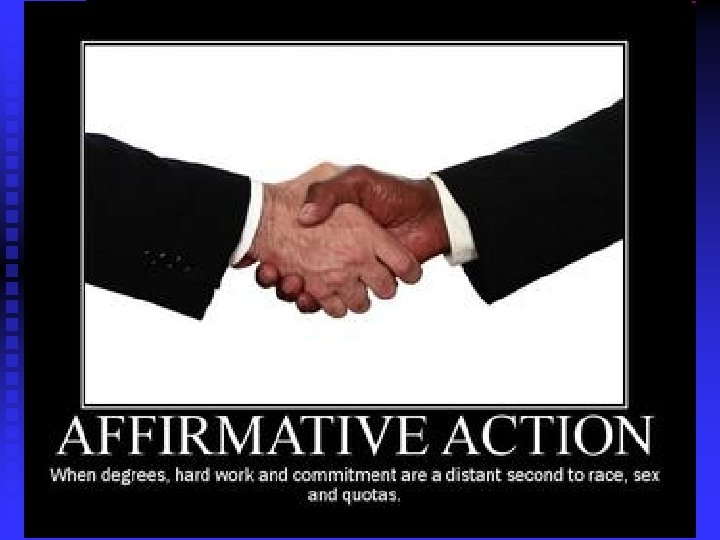
VOCABULARY Black Power – slogan used by Stokely Carmichael encouraging black pride and political and social leadership 138. Civil Rights Act of 1968 – banned discrimination in housing 139. Affirmative Action – a policy that seeks to correct the effects of past discrimination by favoring the groups who were previously discriminated against. 137.
WEEK 12 Journal 48 n Answer the questions below in your journal Plessy v Ferguson and Brown v Board of Education 1. What do they have in common? n 2. How are they different? n
THE CIVIL RIGHTS MOVEMENT SECTION 1 THE MOVEMENT BEGINS
CIVIL RIGHTS ACT OF 1875 n Outlawed segregation in public places n Ruled unconstitutional in 1883
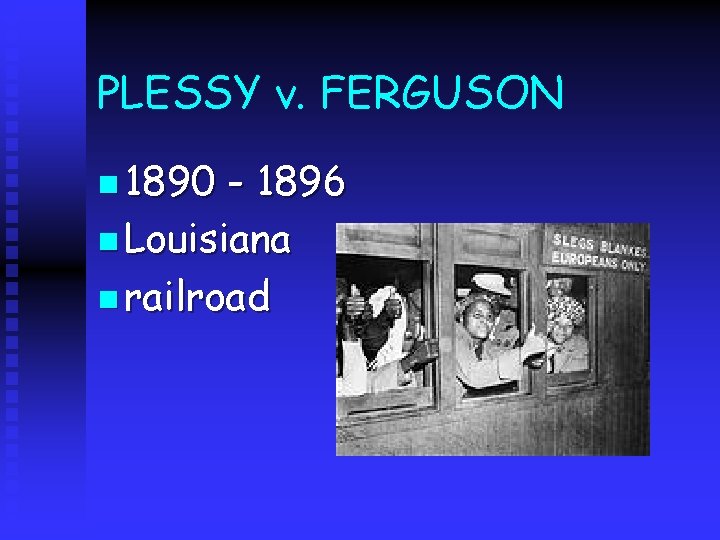
PLESSY v. FERGUSON n 1890 - 1896 n Louisiana n railroad
“ We consider the underlying fallacy of the plaintiff’s argument to consist in the assumption that the enforced separation of the two races stamps the colored race with a badge of inferiority. If this be so, it is not by reason of anything found in the act, but solely because the colored race chooses to a. put that construction upon it. ” Justice Henry B. Brown, 1896
JIM CROW LAWS n Segregation laws u Interracial marriages u Separate schools u Street cars u Waiting rooms u Elevators u Witness stands u Restrooms u Water fountains
WEEK 13 JOURNAL 49 1. What is de facto segregation? 2. What is de jure segregation?
TWO TYPES OF SEGREGATION n De Facto u Tradition n De Jure u By law n Migration north to escape discrimination u Didn’t work
NAACP n 1909 n WEB Du. Bois n Work through the court system to address civil rights issues
NEW DEAL n Brought relief
WORLD WAR II n n n n Set the stage Job openings Served in armed forces Returning veterans. . . Civil Rights organizations fought for changes FDR prohibited discrimination in federal agencies and war industries Truman integrated the entire armed forces
n Congress n Sit-ins of Racial Equality
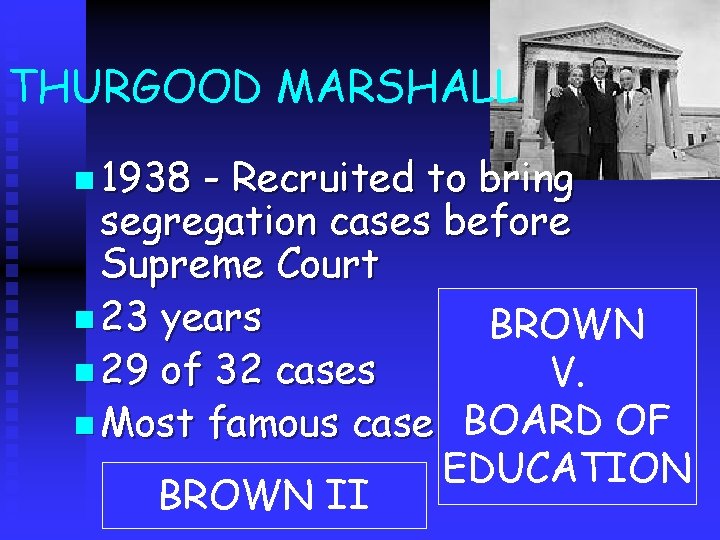
THURGOOD MARSHALL n 1938 - Recruited to bring segregation cases before Supreme Court n 23 years BROWN n 29 of 32 cases V. n Most famous case BOARD OF EDUCATION BROWN II
SOUTHERN MANIFESTO n Result of Brown cases n Southern congress members issued manifesto u. Resist integration “by all lawful means”
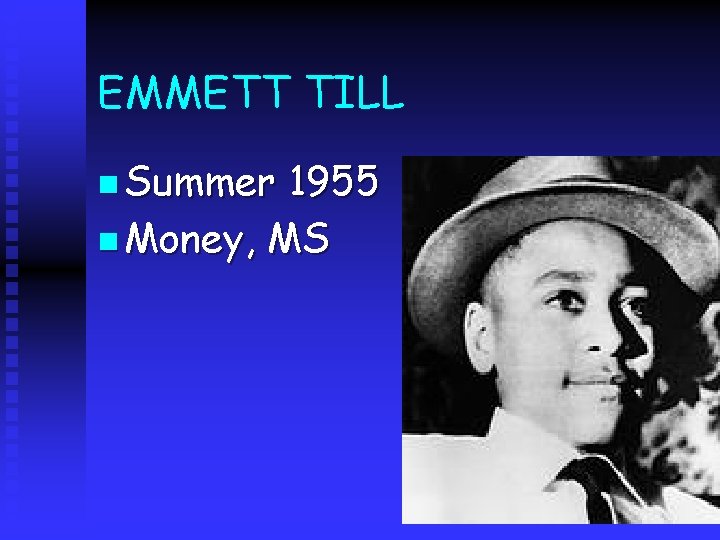
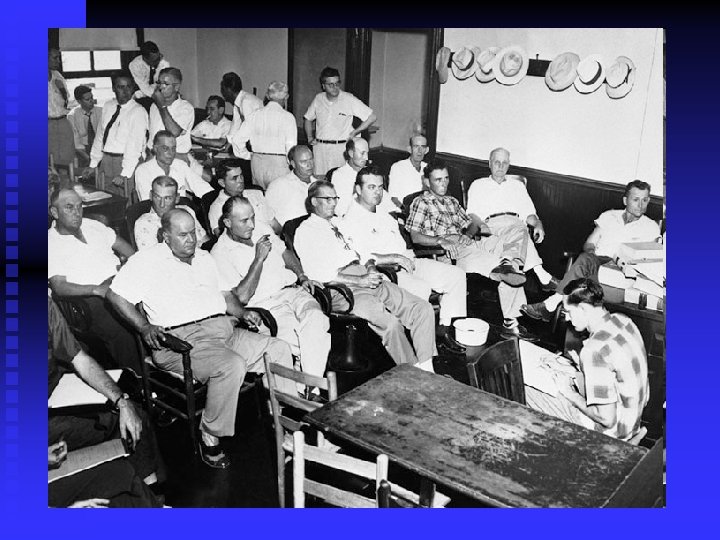
EMMETT TILL n Summer 1955 n Money, MS
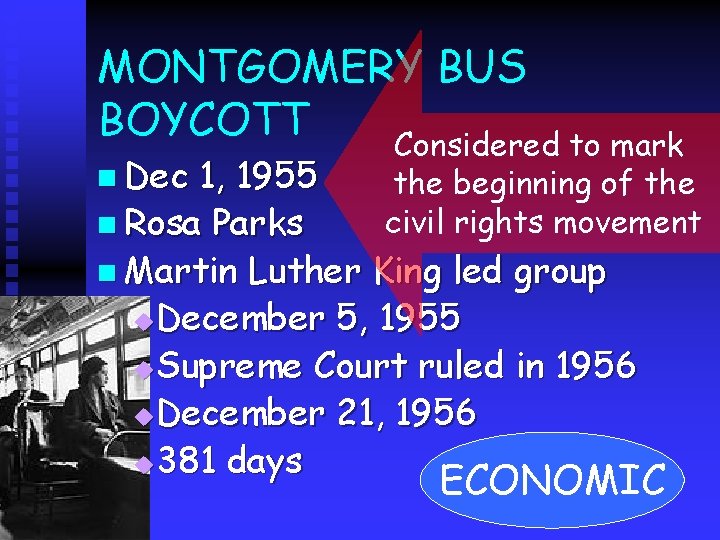
MONTGOMERY BUS BOYCOTT Considered to mark n Dec 1, 1955 the beginning of the civil rights movement n Rosa Parks n Martin Luther King led group u December 5, 1955 u Supreme Court ruled in 1956 u December 21, 1956 u 381 days ECONOMIC
MARTIN LUTHER KING’S PHILOSOPHY n SOUL FORCE n Thoreau u Civil disobedience n Randolph u Organizing techniques n Gandhi u Non violence n Jesus u Love enemies
SOUTHERN CHRISTIAN LEADERSHIP CONFERENCE n Founded by ministers and C R leaders n Ella Baker n Purpose u. Carry out non-violent crusades against the evils of second class citizenship
EISENHOWER AND CIVIL RIGHTS n Enforcer n Little Rock Nine u. Sept. 1957 u. Gov. Faubus u. Elizabeth Eckford
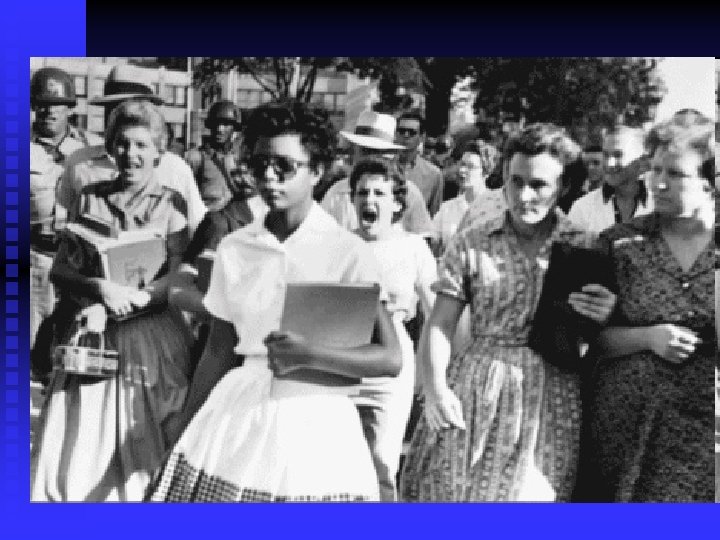
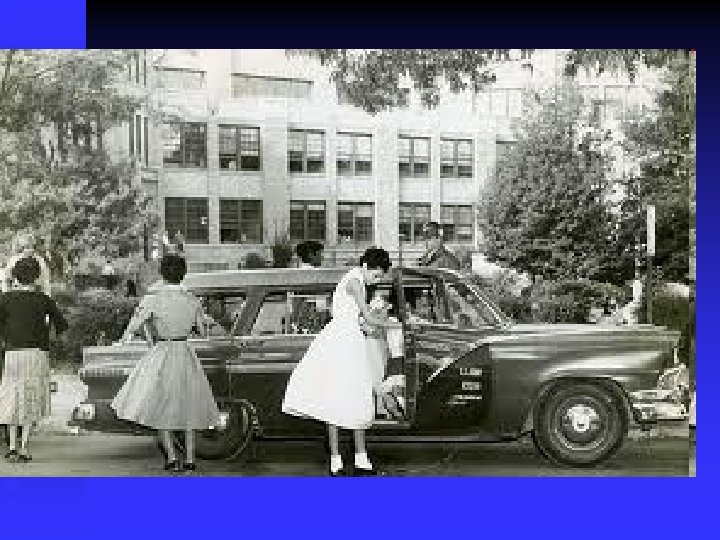
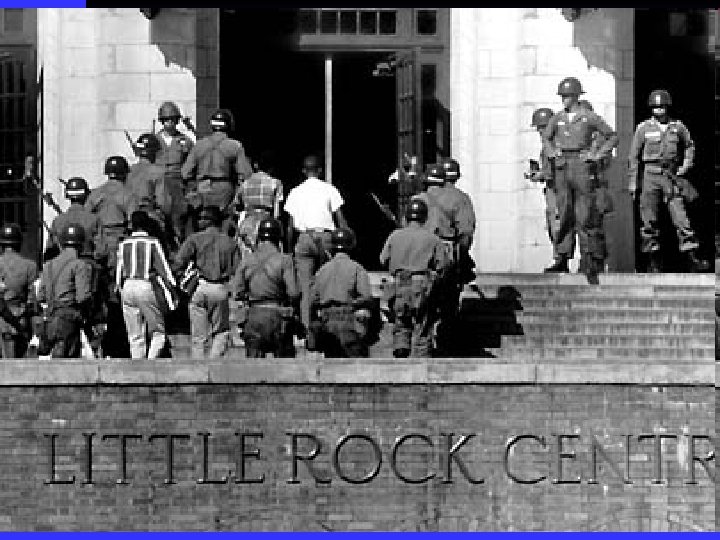
CIVIL RIGHTS ACT OF 1957 n First since reconstruction n Gave Federal Government authority over violations of African American voting rights
SECTION 2 CHALLENGING SEGREGATION
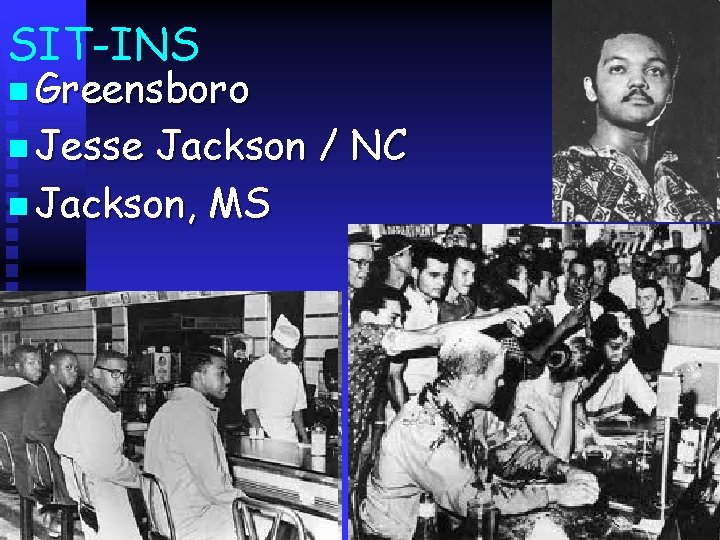
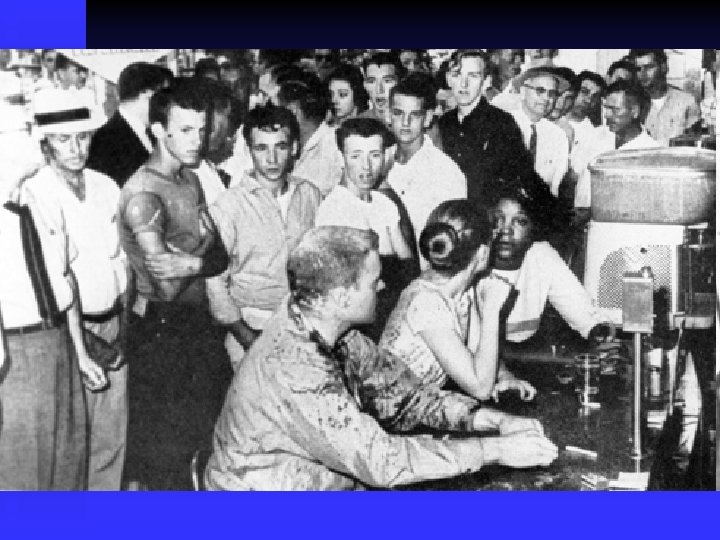
SIT-INS n Greensboro n Jesse Jackson / NC n Jackson, MS
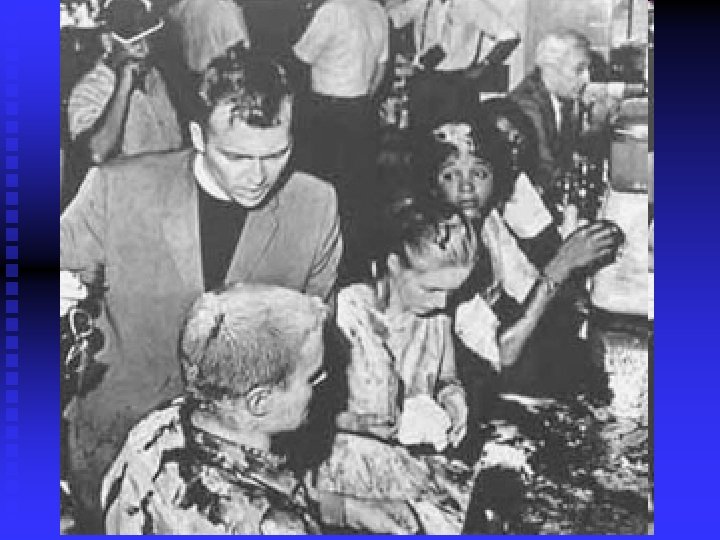
STUDENT NON-VIOLENT COORDINATING COMMITTEE n Wanted things to happen quicker n More confrontational n Ella Baker and Marion Barry
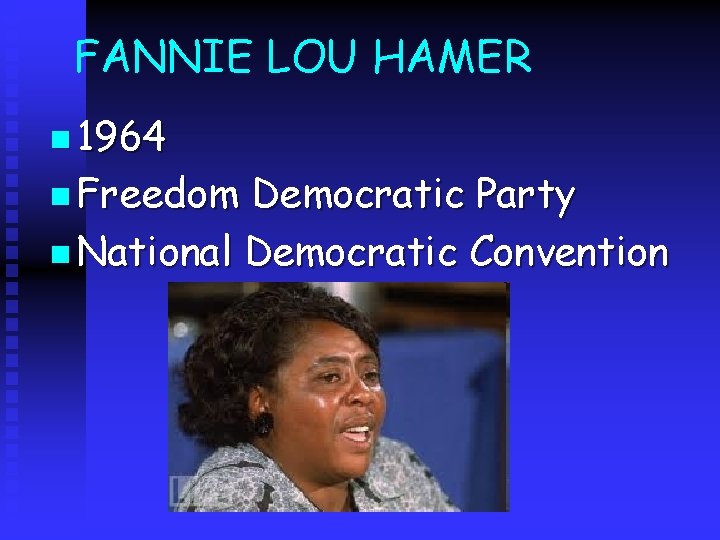
FANNIE LOU HAMER n 1964 n Freedom Democratic Party n National Democratic Convention
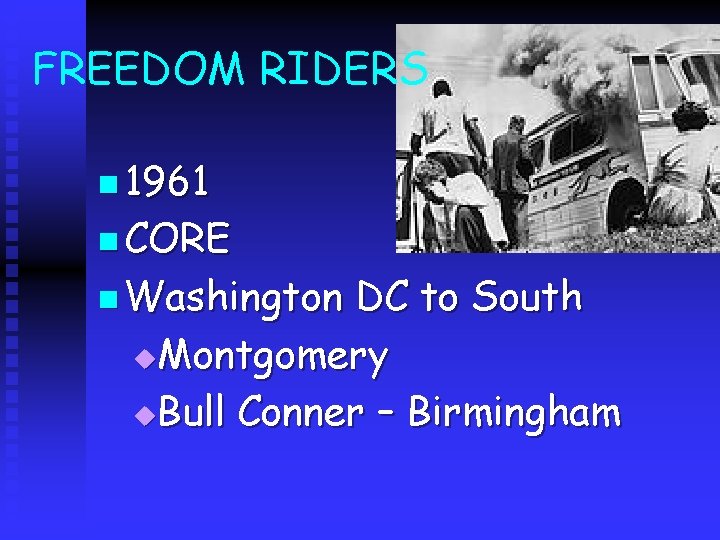
FREEDOM RIDERS n 1961 n CORE n Washington DC to South u. Montgomery u. Bull Conner – Birmingham
JFK AND CIVIL RIGHTS n Campaigned to support Civil Rights u Martin Luther King – jail n However - once in office… u Did not push n Committee on Equal Employment Opportunity u Stop federal bureaucracy from discriminating in hiring and promoting
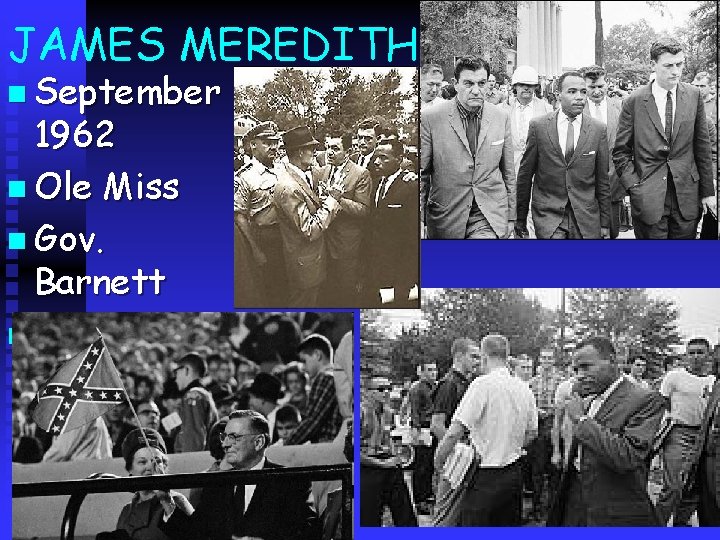
JAMES MEREDITH n September 1962 n Ole Miss n Gov. Barnett n JFK
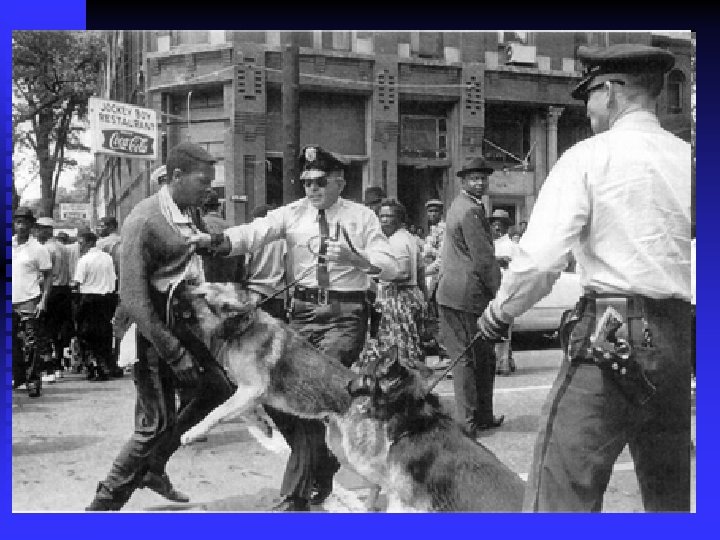
BIRMINGHAM, ALABAMA APRIL 3, 1963 n Cuban Missile Crisis – Oct. 1962 n King meets with leaders u How to desegregate city n April 12 Convinced JFK n May 2 a Civil Rights u Bull Connor bill was needed n May 3 n TV cameras June 11
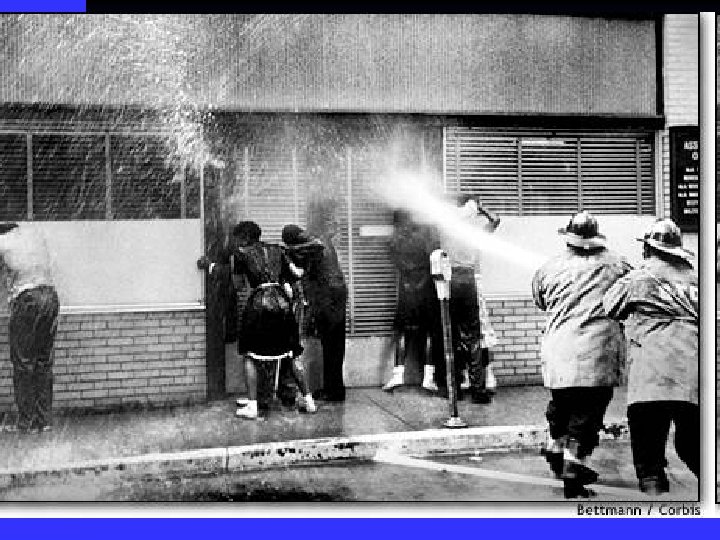
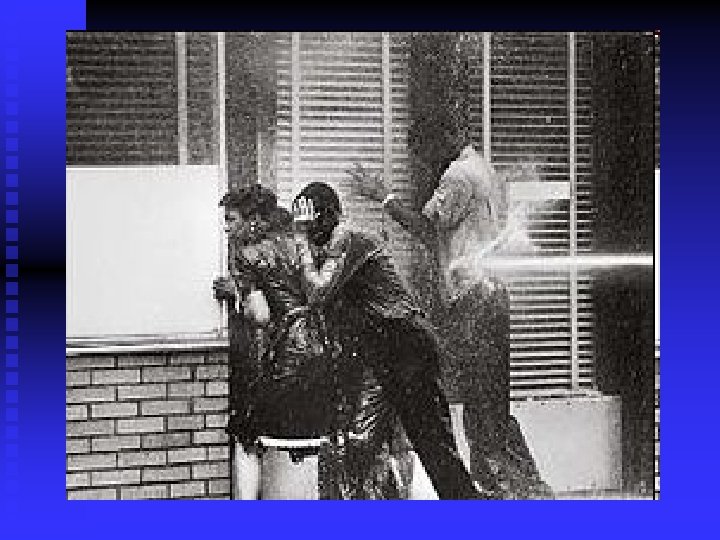
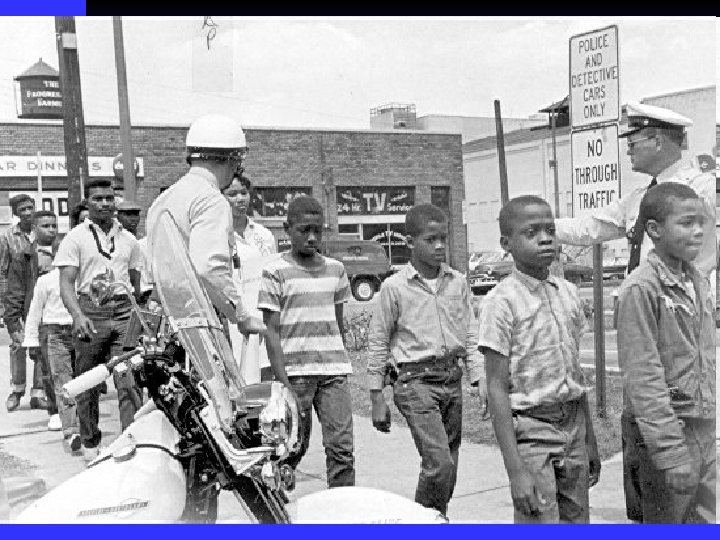
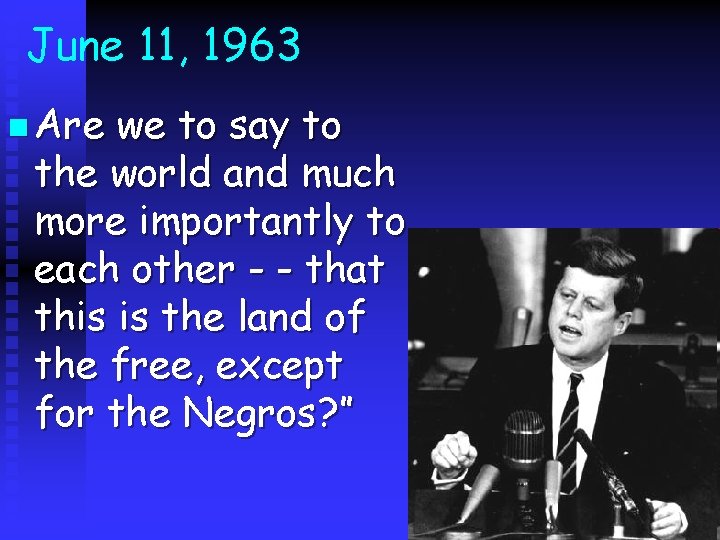
June 11, 1963 n Are we to say to the world and much more importantly to each other - - that this is the land of the free, except for the Negros? ”
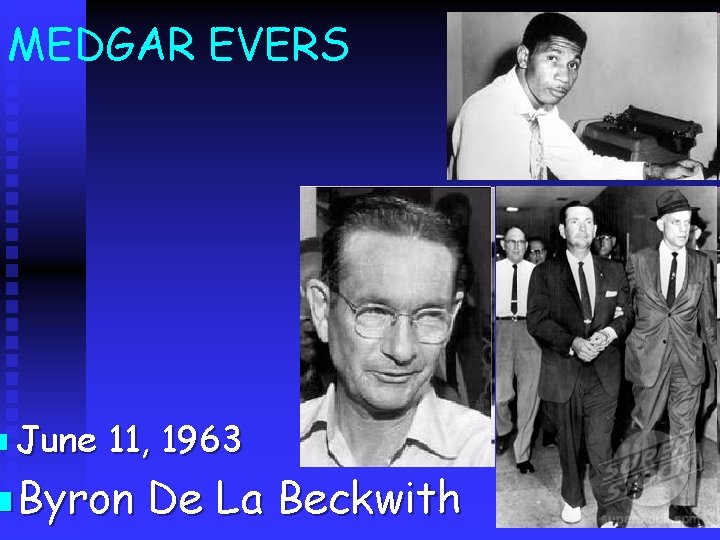
MEDGAR EVERS n June 11, 1963 n Byron De La Beckwith
WEEK 13 n Explain JOURNAL 50 the importance of each of the following: 1. Plessy v Ferguson 2. Brown v Board of Education 3. Civil Rights Act of 1964
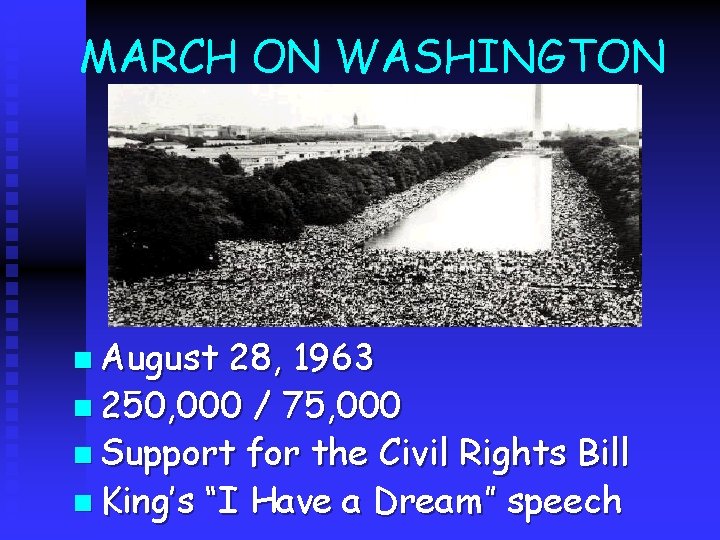
MARCH ON WASHINGTON n August 28, 1963 n 250, 000 / 75, 000 n Support for the Civil Rights Bill n King’s “I Have a Dream” speech
JFK’S ASSASSINATION n November 22, 1963
CIVIL RIGHTS ACT OF 1964 n Filibuster cloture n July 2, 1964 n Signed by LBJ n Prohibited segregation in public places because of race, religion, national origin, or gender u
STRUGGLE FOR VOTING RIGHTS n SNCC focused on this issue n 24 th Amendment
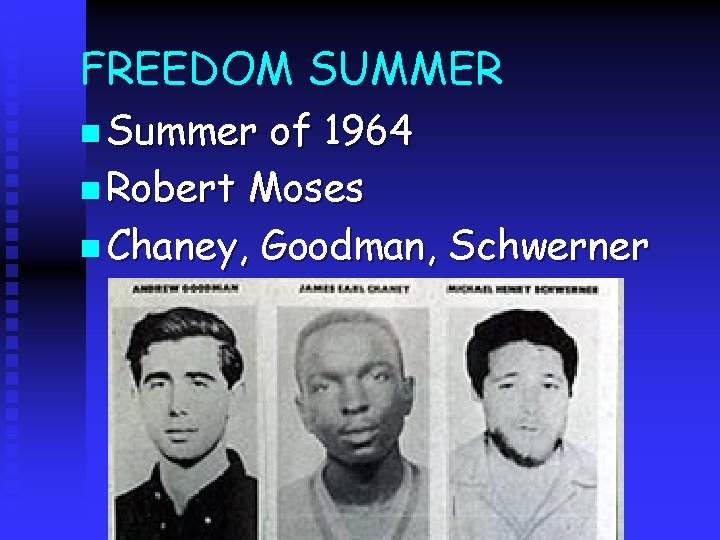
FREEDOM SUMMER n Summer of 1964 n Robert Moses n Chaney, Goodman, Schwerner
SELMA MARCH n 1965 n½ Of population n 3% of voters n King’s plan n By end of January >2000 arrested
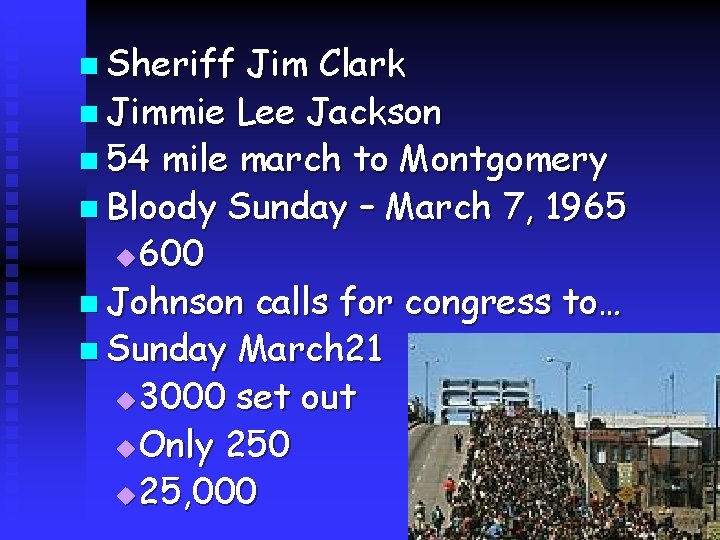
n Sheriff Jim Clark n Jimmie Lee Jackson n 54 mile march to Montgomery n Bloody Sunday – March 7, 1965 u 600 n Johnson calls for congress to… n Sunday March 21 u 3000 set out u Only 250 u 25, 000
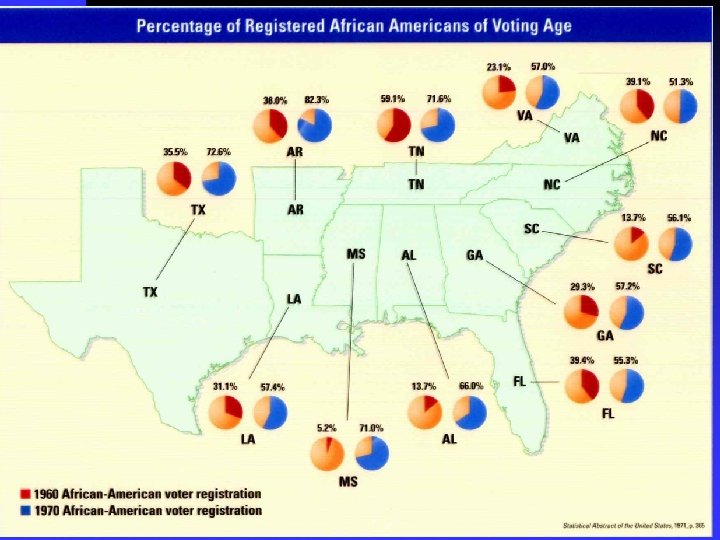
VOTING RIGHTS ACT OF 1965 n Eliminated literacy test to vote n Voting population changed – 1964 1968 10% 60% n Selma n Mississippi 7% 67%
SECTION 3 NEW ISSUES
FOCUS OF THE MOVEMENT n De jure segregation n De facto segregation
WATTS RIOT n Aug 11, 1965 n Los Angeles n Drunk driver n 6 days n 34 killed n $30 million
DETROIT RIOT n 1967 n Burning, n 43 looting, skirmishes dead n 1000 wounded n 4000 fires – 1300 buildings n $250 million in damages
KERNER COMMISSION n Study. Never causesendorsed of urbanby violence Johnson - - -cause racism is the Great Society and n 1 - nation moving to 2 societies Vietnam War n 2 - called for creation of new jobs and housing n 3 - called for an end to de facto n White
CHICAGO MOVEMENT n King and his wife
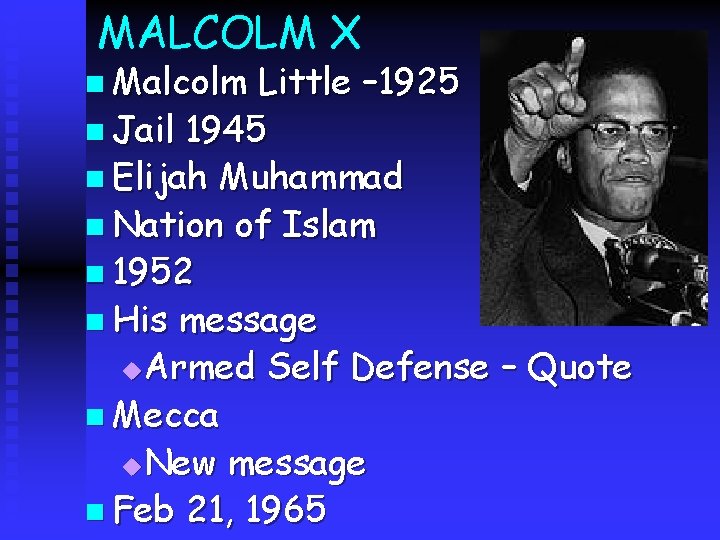
MALCOLM X n Malcolm Little – 1925 n Jail 1945 n Elijah Muhammad n Nation of Islam n 1952 n His message u Armed Self Defense – Quote n Mecca u New message n Feb 21, 1965
BULLETS FOR BALLOTS n Give us ballots or you will get bullets
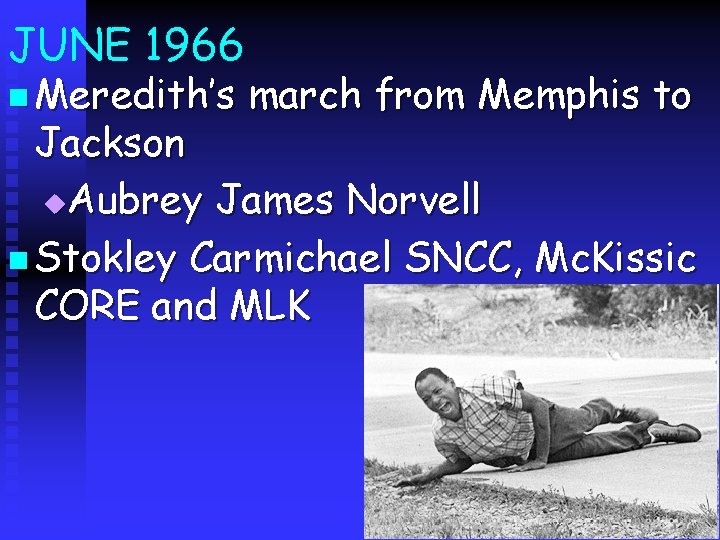
JUNE 1966 n Meredith’s march from Memphis to Jackson u. Aubrey James Norvell n Stokley Carmichael SNCC, Mc. Kissic CORE and MLK
BLACK POWER n Greenwood, MS n Carmichael’s rhetoric n SNCC would not recruit…
BLACK PANTHERS n Political party to fight police brutality in the ghetto n They wanted – u Control of African Am communities u Full employment u Decent housing u Black military exemption
n Raised money by u Selling Mao Zedong’s writings n Taught armed revolt n Tactics were questioned n Good things…. . n Carmichael changed support from SNCC
AIM – American Indian Movement Compared to the Black Panthers n Occupied Alcatraz and Wounded Knee n More militant approach to push for rights n
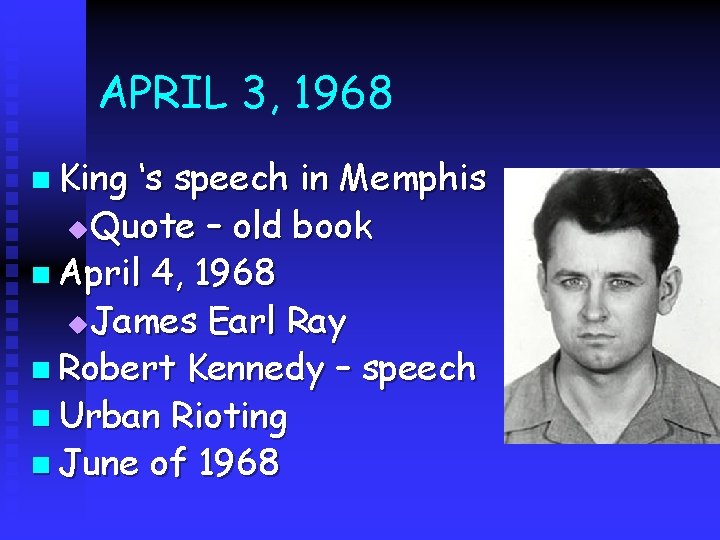
APRIL 3, 1968 n King ‘s speech in Memphis u Quote – old book n April 4, 1968 u James Earl Ray n Robert Kennedy – speech n Urban Rioting n June of 1968
CIVIL RIGHTS ACT OF 1968 n Banned housing discrimination in
WHAT HAPPENED TO THE CIVIL RIGHTS MOVEMENT n De jure segregation n De facto segregation n African American education n African American pride n TV shows n Elected officials n Affirmative Action u Reverse discrimination
- Slides: 72