
Vocabulary Concentration Gradient When you have an area
Vocabulary • Concentration Gradient: When you have an area of greater concentration and an area of lesser concentration. • Equilibrium: When the concentration is the same throughout. – Solvent – Dissolving agent (ex. Water) – Solute – Substance that is dissolved (ex. Kool aid mix)
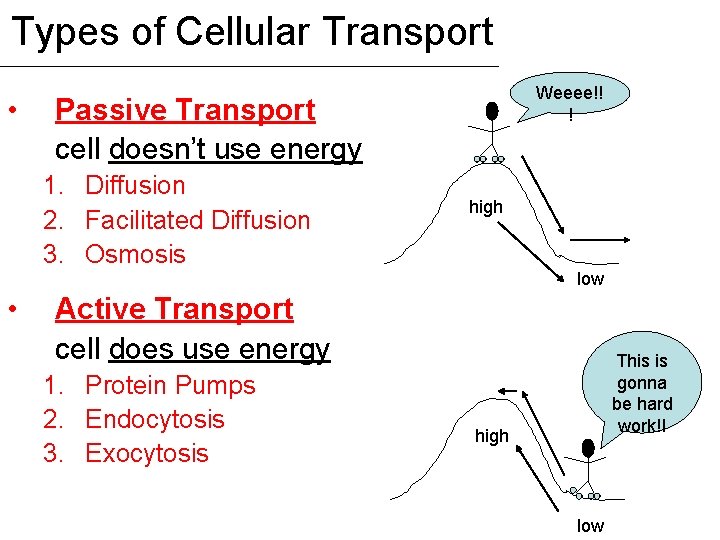
Types of Cellular Transport • Weeee!! ! Passive Transport cell doesn’t use energy 1. Diffusion 2. Facilitated Diffusion 3. Osmosis high low • Active Transport cell does use energy 1. Protein Pumps 2. Endocytosis 3. Exocytosis This is gonna be hard work!! high low
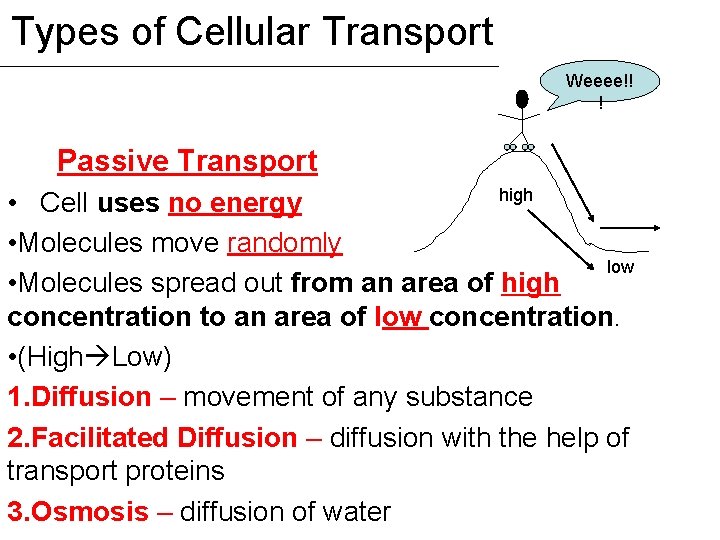
Types of Cellular Transport Weeee!! ! Passive Transport high • Cell uses no energy • Molecules move randomly low • Molecules spread out from an area of high concentration to an area of low concentration. • (High Low) 1. Diffusion – movement of any substance 2. Facilitated Diffusion – diffusion with the help of transport proteins 3. Osmosis – diffusion of water
7 -3 Cell Boundaries Diffusion Through Cell Boundaries What happens during diffusion? - Molecules MOVE!!!! - Molecules are always in motion. They move around and bump into each other. Slide 4 of 47 Copyright Pearson Prentice Hall End Show
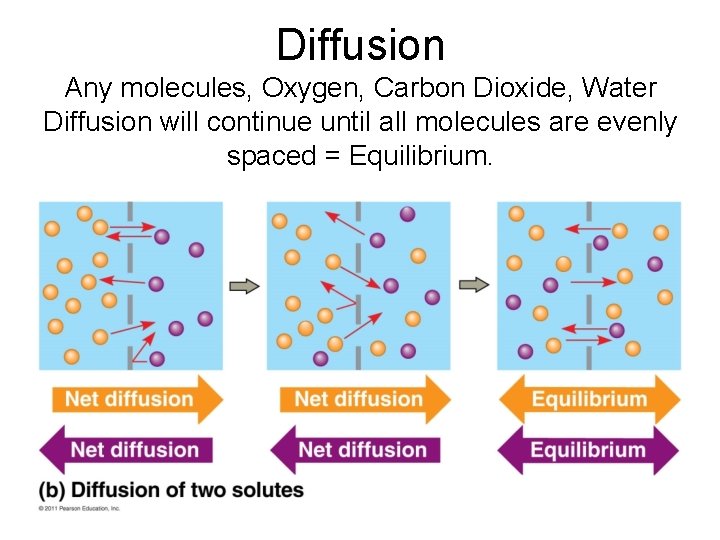
Diffusion Any molecules, Oxygen, Carbon Dioxide, Water Diffusion will continue until all molecules are evenly spaced = Equilibrium.

7 -3 Cell Boundaries Diffusion Through Cell Boundaries Slide 6 of 47 Copyright Pearson Prentice Hall End Show
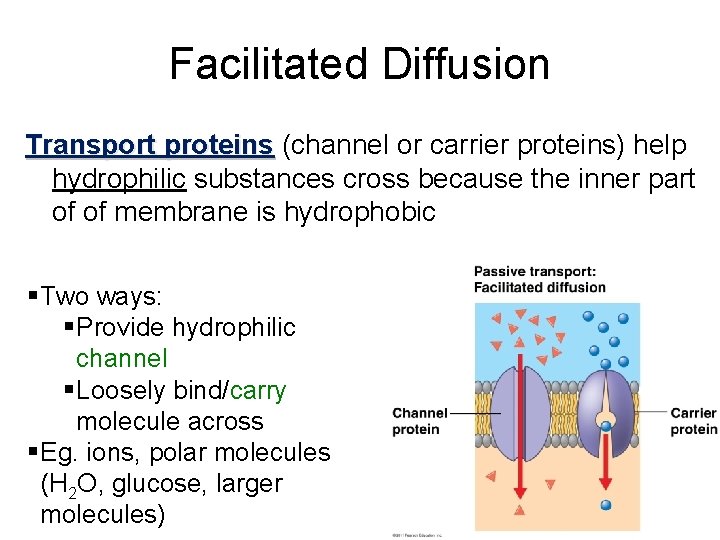
Facilitated Diffusion Transport proteins (channel or carrier proteins) help hydrophilic substances cross because the inner part of of membrane is hydrophobic § Two ways: § Provide hydrophilic channel § Loosely bind/carry molecule across § Eg. ions, polar molecules (H 2 O, glucose, larger molecules)
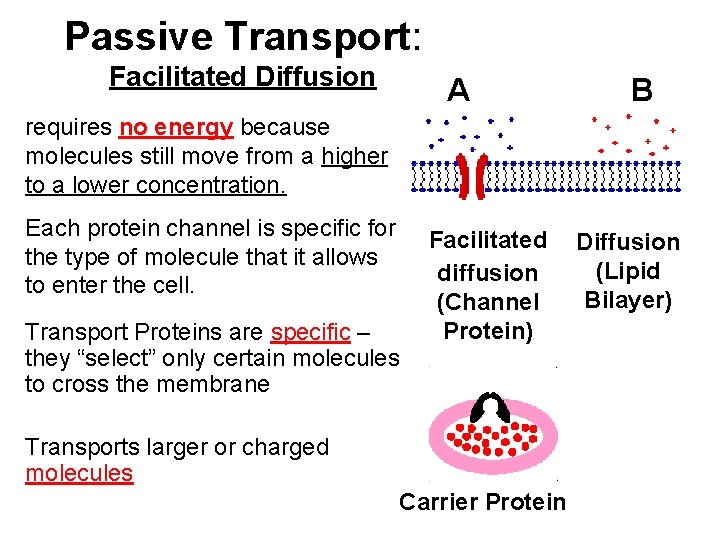
Passive Transport: Facilitated Diffusion A B requires no energy because molecules still move from a higher to a lower concentration. Each protein channel is specific for the type of molecule that it allows to enter the cell. Transport Proteins are specific – they “select” only certain molecules to cross the membrane Facilitated diffusion (Channel Protein) Transports larger or charged molecules Carrier Protein Diffusion (Lipid Bilayer)
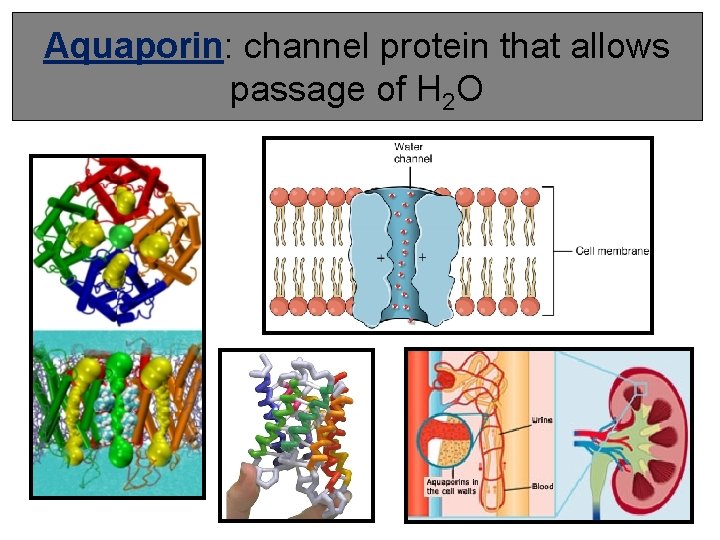
Aquaporin: channel protein that allows passage of H 2 O
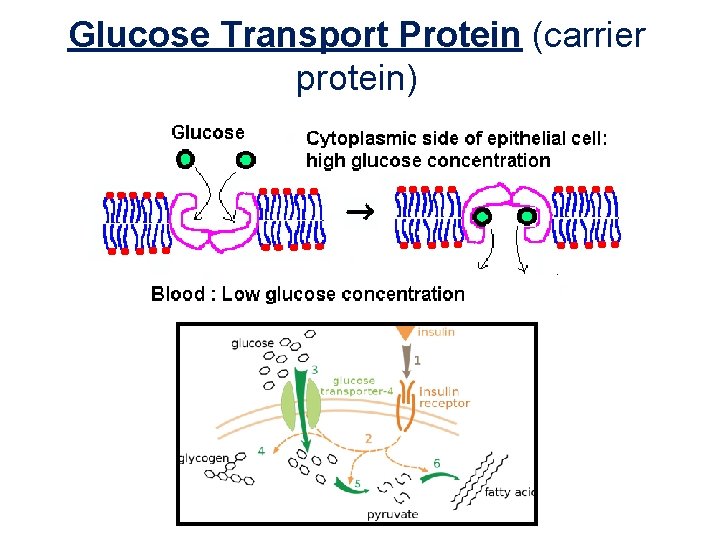
Glucose Transport Protein (carrier protein)
7 -3 Cell Boundaries Osmosis is the diffusion of water through a selectively permeable membrane. Whenever water moves, into or out of the cell, we call it osmosis. Slide 11 of 47 Copyright Pearson Prentice Hall End Show
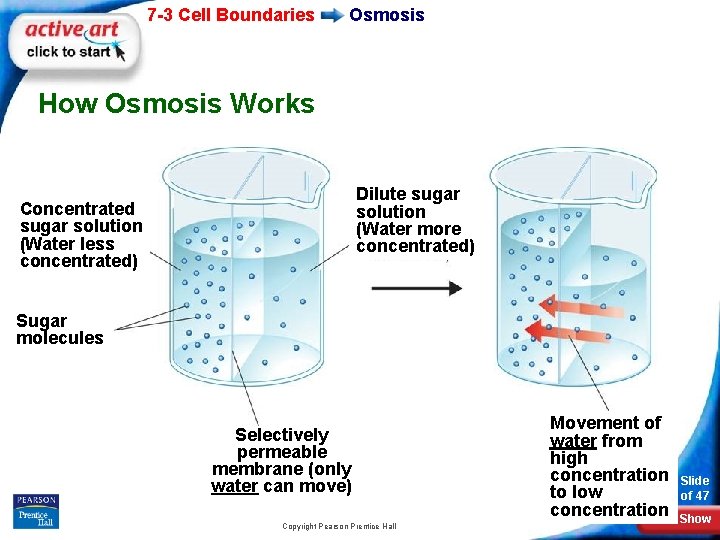
7 -3 Cell Boundaries Osmosis How Osmosis Works Dilute sugar solution (Water more concentrated) Concentrated sugar solution (Water less concentrated) Sugar molecules Selectively permeable membrane (only water can move) Copyright Pearson Prentice Hall Movement of water from high concentration Slide to low 12 of 47 concentration End Show
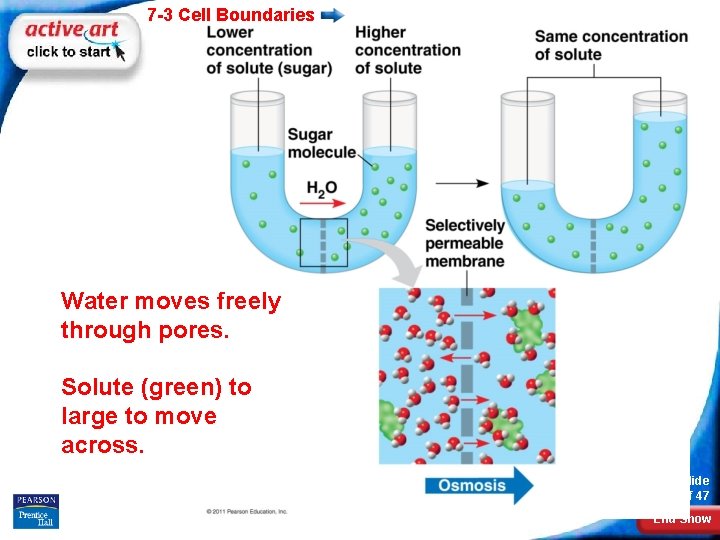
7 -3 Cell Boundaries Water moves freely through pores. Solute (green) to large to move across. Slide 13 of 47 End Show
7 -3 Cell Boundaries Osmosis In osmosis, water tends to diffuse from a highly concentrated region to a less concentrated region through a selectively permeable membrane. If you compare solutions, three terms can be used to describe the concentrations of the solution due to the amount of solute dissolved in the water: - hypertonic (“above strength”)more solute/less water. - hypotonic (“below strength”)less solute/more water. - isotonic (”same strength”)same amount of solute Slide 14 of 47 Copyright Pearson Prentice Hall End Show
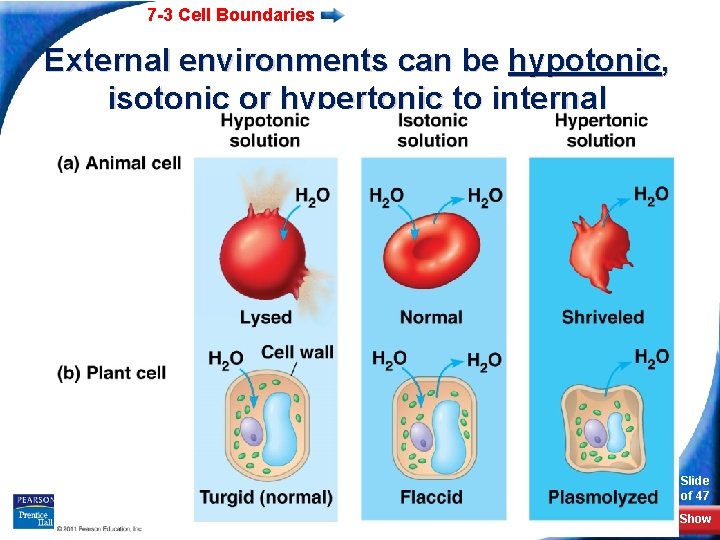
7 -3 Cell Boundaries External environments can be hypotonic, isotonic or hypertonic to internal environments of cell Slide 15 of 47 End Show
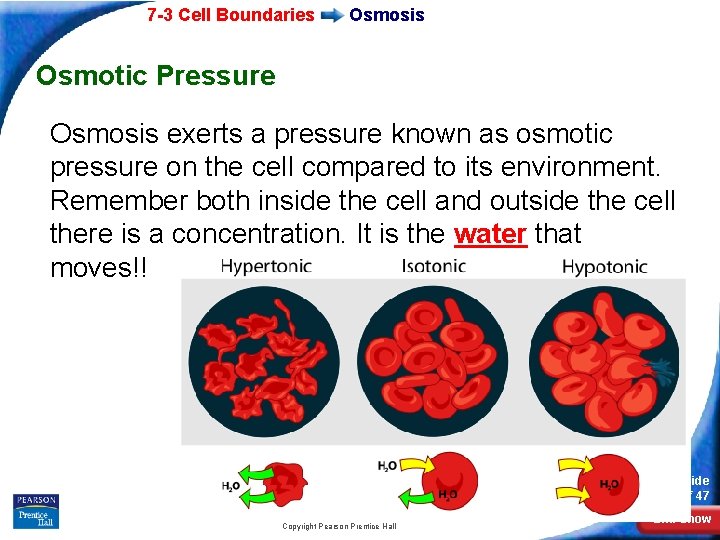
7 -3 Cell Boundaries Osmosis Osmotic Pressure Osmosis exerts a pressure known as osmotic pressure on the cell compared to its environment. Remember both inside the cell and outside the cell there is a concentration. It is the water that moves!! Slide 16 of 47 Copyright Pearson Prentice Hall End Show
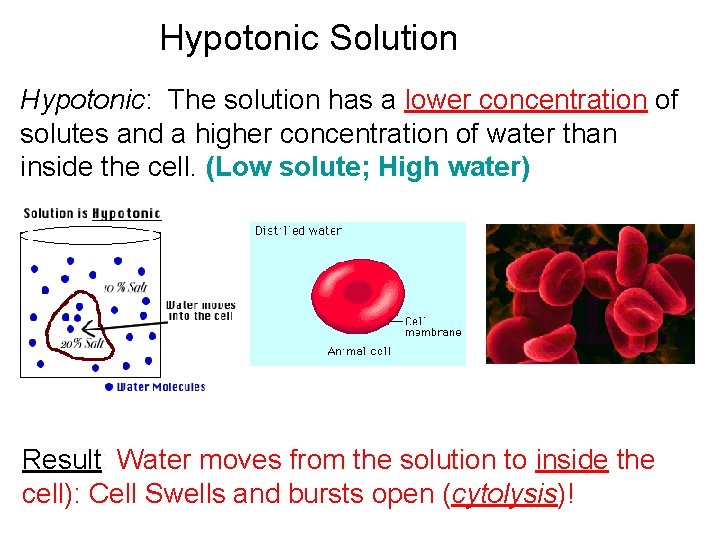
Hypotonic Solution Hypotonic: The solution has a lower concentration of solutes and a higher concentration of water than inside the cell. (Low solute; High water) Result: Water moves from the solution to inside the cell): Cell Swells and bursts open (cytolysis)!
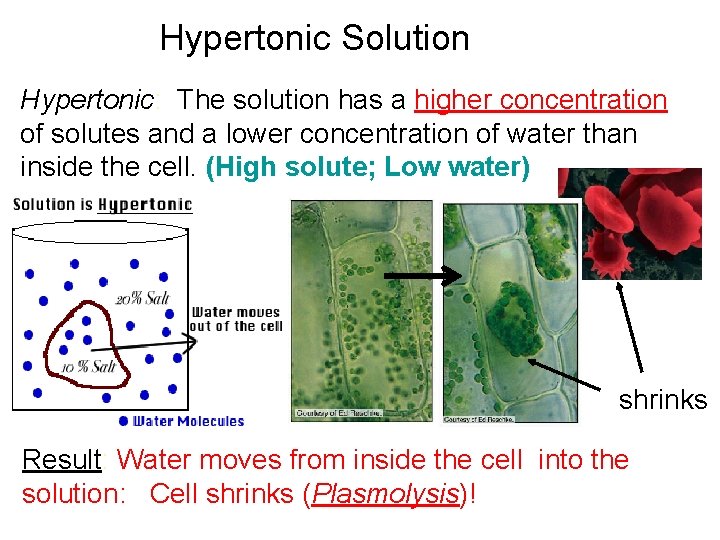
Hypertonic Solution Hypertonic: The solution has a higher concentration of solutes and a lower concentration of water than inside the cell. (High solute; Low water) shrinks Result: Water moves from inside the cell into the solution: Cell shrinks (Plasmolysis)!
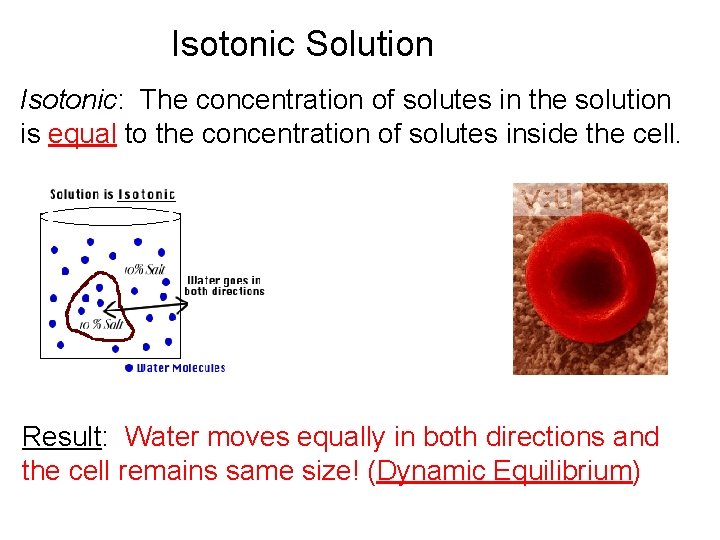
Isotonic Solution Isotonic: The concentration of solutes in the solution is equal to the concentration of solutes inside the cell. Result: Water moves equally in both directions and the cell remains same size! (Dynamic Equilibrium)
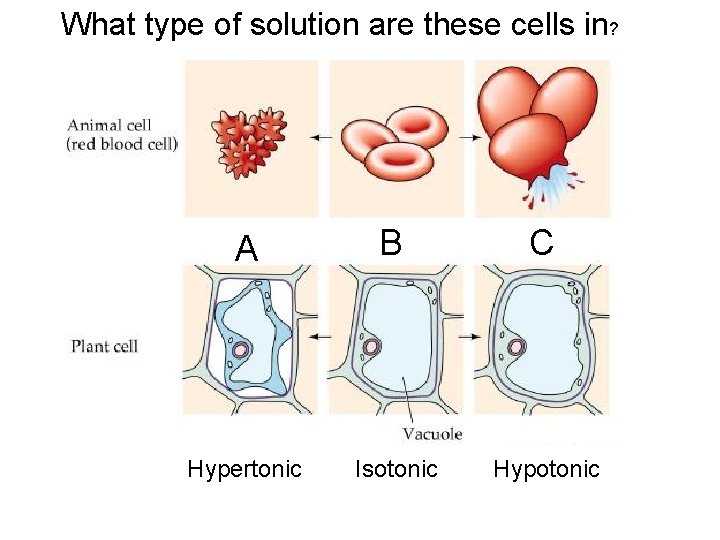
What type of solution are these cells in? A B C Hypertonic Isotonic Hypotonic
How Organisms Deal with Osmotic Pressure • Salt water fish pump salt out of their specialized gills so they do not dehydrate. • Animal cells are bathed in blood. Kidneys keep the blood isotonic by remove excess salt and water.
- Slides: 21