
Vocabulary and Spelling Danielle Dee Saucier Elementary Literacy
Vocabulary and Spelling Danielle “Dee” Saucier Elementary Literacy Specialist Maine Department of Education danielle. m. saucier@maine. gov
• Welcome or Welcome Back • Last session – Overview Phonological Awareness and Phonics (recording available) • Today – Overview Vocabulary & Spelling • Next Thursday – Overview Comprehension & Fluency • Final Session – Overview Writing
Large Group Zoom Norms Everyone will be muted. You may keep your video on or off, that is up to you – if your connection is unstable, it often helps to turn off video. If you have questions, concerns or comments, post them in the comment box with your full name. We will do our best to answer in the presentation or in a follow up email. There will be a recording available. There will be a survey with a link to a at the end of the session. certificate
Importance of Vocabulary Instruction A rich understanding and knowledge of words allows students to more fully understand others, express themselves clearly and significantly increases the ability to comprehend text.
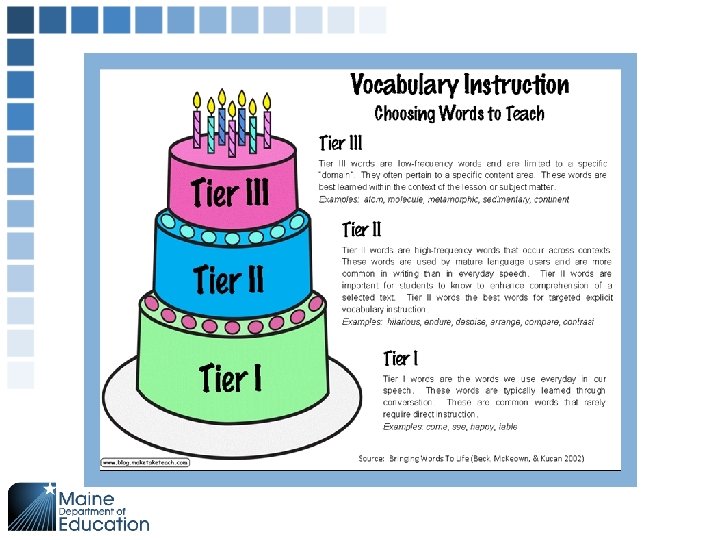
Vocabulary Terms • Vocabulary • Listening – Speaking – Reading – Writing • Vocabulary learning – Indirect vs. Direct Instruction • Academic Words and Phrases • Morpheme • Tiered Vocabulary
Teaching Vocabulary Is Not Easy • Involves critical understanding • 5 -7 times to be meaningfully exposed to the word and its meaning • More powerful when authentic connections are made • Nearly endless amount of vocabulary to choose from • Sometimes challenging to keep students interested and motivated
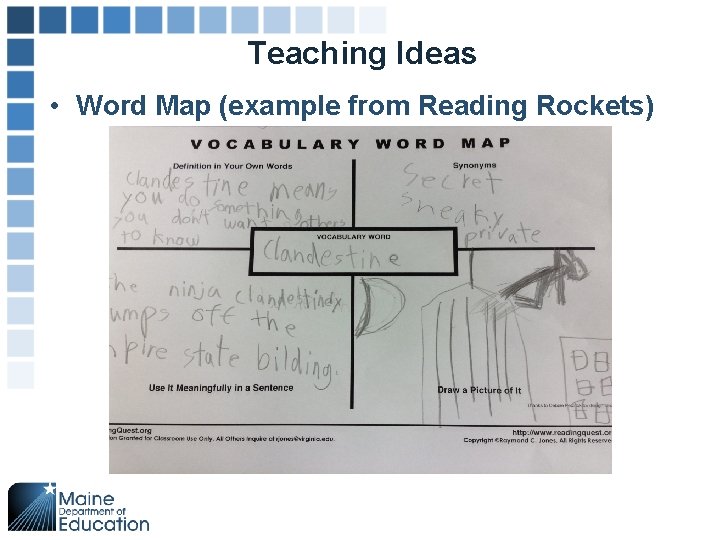
Teaching Ideas • Word Map (example from Reading Rockets)

• Root Words (Morphology) – Teach students basic roots and have them try to figure out what the definition of a related word might be: • • • Struct – build Construct Destruction Construction Instruct Structure Obstruct Infrastructure Restructure Image from Katy Huller, 2015 TPT *The Free Dictionary, commonly used for Scrabble and Words With Friends lists 268 words with the root word “struct”
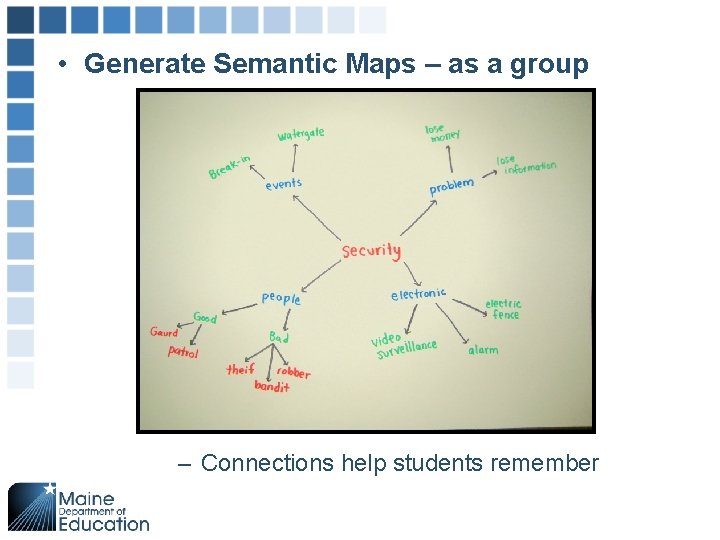
• Generate Semantic Maps – as a group – Connections help students remember
• Create “Indirect” Vocabulary Learning Experiences – “Think aloud” about a word when you use it in conversation – “Think aloud” about a word when you read it in a read aloud. “My dog had an unfortunate encounter with a skunk last night. Hmmm…did anyone wonder what I meant by encounter? What other words could I have used? What do you think happened to my dog? I thought about using the word “meeting”… would that have worked? ”
Choosing Words • When choosing words from a story – consider if they help build meaning in the story and connections to other learning. • When choosing words from content – consider the most essential words for learning and building background knowledge to connect to other learning. • Avoid words that are learned in everyday experiences – clock, happy, big…
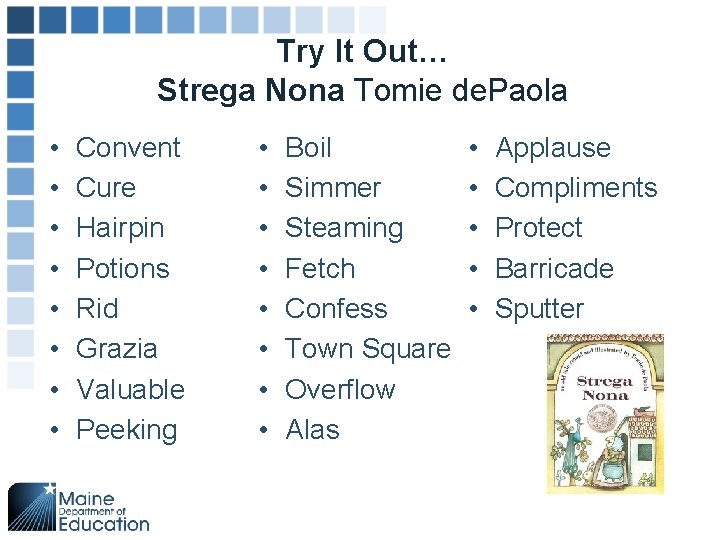
Try It Out… Strega Nona Tomie de. Paola • • Convent Cure Hairpin Potions Rid Grazia Valuable Peeking • • Boil Simmer Steaming Fetch Confess Town Square Overflow Alas • • • Applause Compliments Protect Barricade Sputter
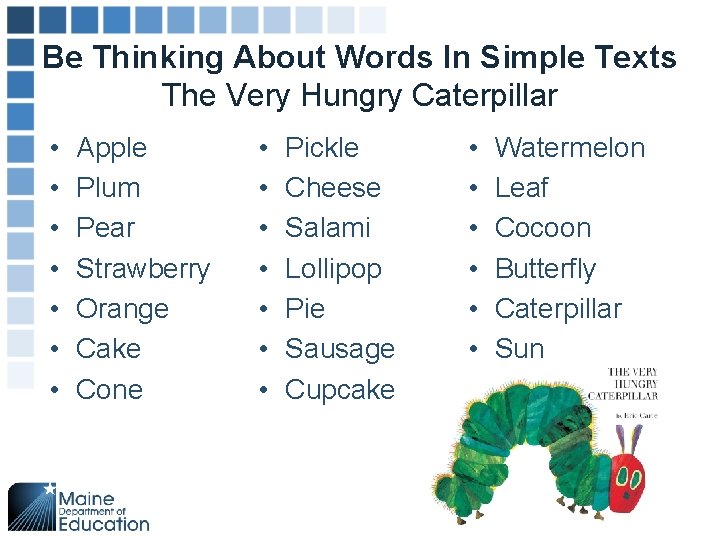
Be Thinking About Words In Simple Texts The Very Hungry Caterpillar • • Apple Plum Pear Strawberry Orange Cake Cone • • Pickle Cheese Salami Lollipop Pie Sausage Cupcake • • • Watermelon Leaf Cocoon Butterfly Caterpillar Sun

Reading Rockets Summary of The National Reading Panel Vocabulary Findings • Intentional instruction of vocabulary items is required for some texts. • Repetition and multiple exposures to vocabulary words is important. • Learning in rich contexts is valuable for vocabulary learning. Vocabulary tasks should be restructured as necessary. • Vocabulary learning should build active engagement. • Computer technology can be used effectively to help teach vocabulary. • Vocabulary can be acquired through incidental learning. • Vocabulary is assessed and evaluated and should drive instructional decisions. • A variety of methods of instruction is most effective and engaging to help all learners grow.
Spelling - Word Study • Word Study approach to spelling connects phonics and vocabulary by combining graphemes, morphemes, word meanings and patterns of print to learn words. • Word study is designed to make decisions about spelling needs based on the students’ stage of spelling development. • Like synthetic phonics, instruction must be intentional with ample opportunity to make connections and authentic practice.
Stages of Spelling Development • • • Precommunicative Emergent Letter Name Within-Word Pattern Syllables Derivational
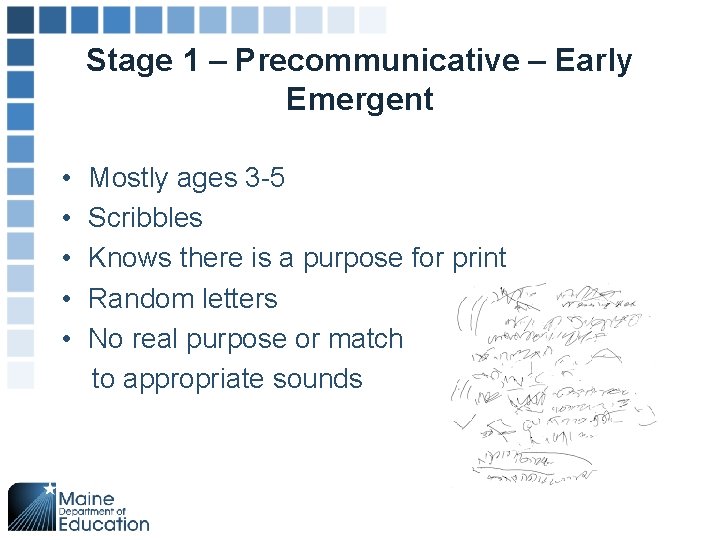
Stage 1 – Precommunicative – Early Emergent • • • Mostly ages 3 -5 Scribbles Knows there is a purpose for print Random letters No real purpose or match to appropriate sounds
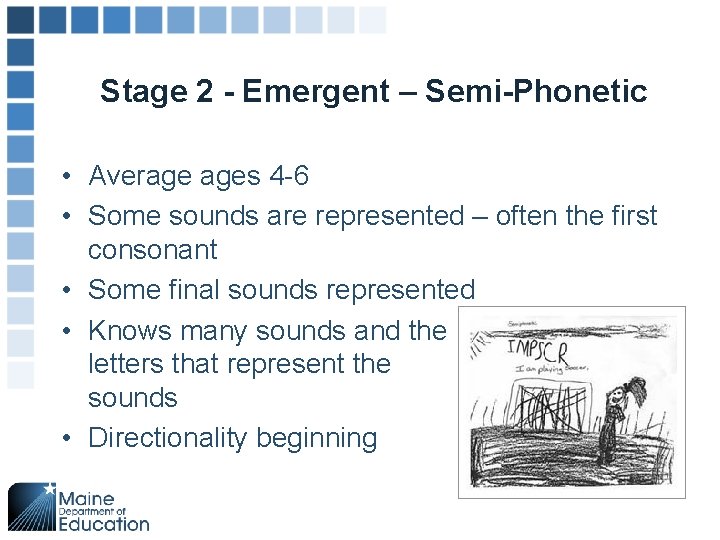
Stage 2 - Emergent – Semi-Phonetic • Average ages 4 -6 • Some sounds are represented – often the first consonant • Some final sounds represented • Knows many sounds and the letters that represent the sounds • Directionality beginning
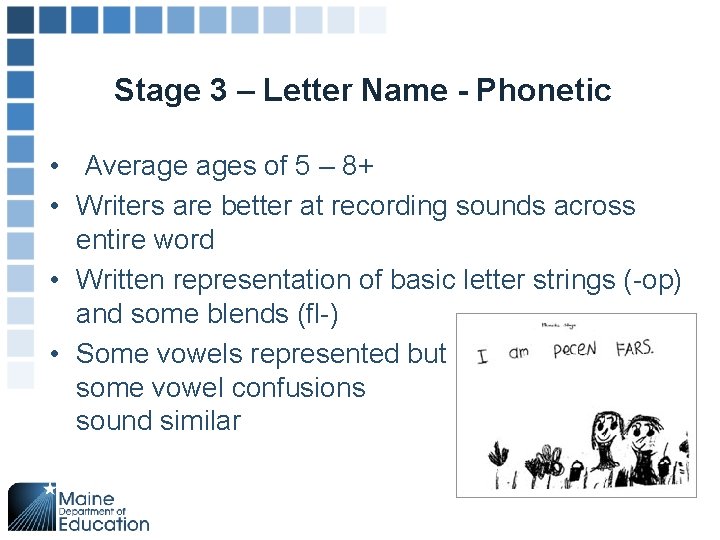
Stage 3 – Letter Name - Phonetic • Average ages of 5 – 8+ • Writers are better at recording sounds across entire word • Written representation of basic letter strings (-op) and some blends (fl-) • Some vowels represented but still some vowel confusions that sound similar
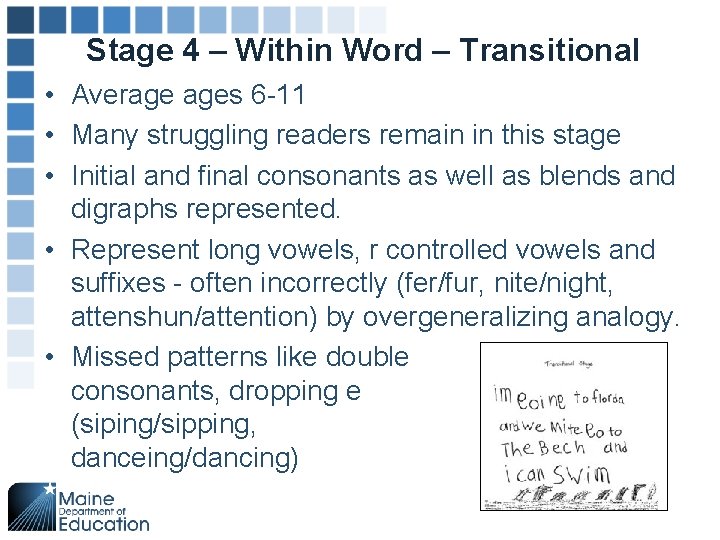
Stage 4 – Within Word – Transitional • Average ages 6 -11 • Many struggling readers remain in this stage • Initial and final consonants as well as blends and digraphs represented. • Represent long vowels, r controlled vowels and suffixes - often incorrectly (fer/fur, nite/night, attenshun/attention) by overgeneralizing analogy. • Missed patterns like double consonants, dropping e (siping/sipping, danceing/dancing)
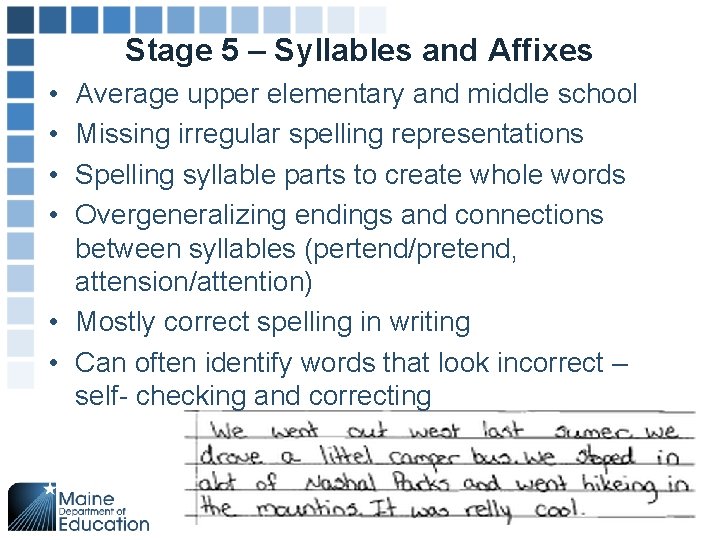
Stage 5 – Syllables and Affixes • • Average upper elementary and middle school Missing irregular spelling representations Spelling syllable parts to create whole words Overgeneralizing endings and connections between syllables (pertend/pretend, attension/attention) • Mostly correct spelling in writing • Can often identify words that look incorrect – self- checking and correcting
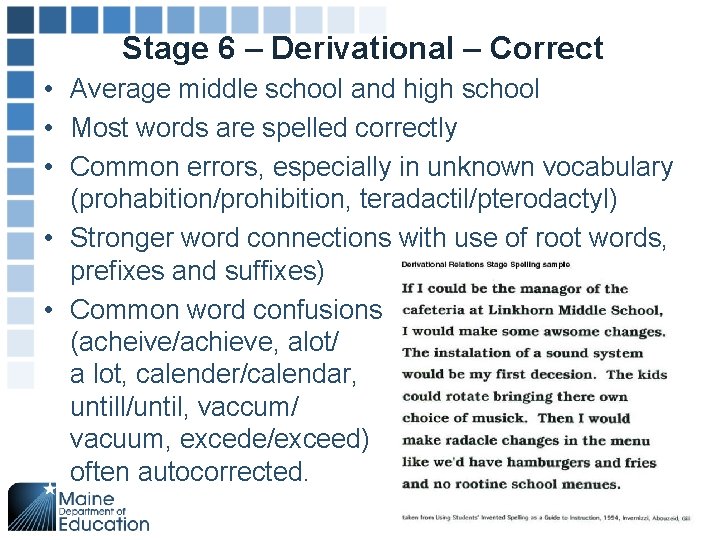
Stage 6 – Derivational – Correct • Average middle school and high school • Most words are spelled correctly • Common errors, especially in unknown vocabulary (prohabition/prohibition, teradactil/pterodactyl) • Stronger word connections with use of root words, prefixes and suffixes) • Common word confusions (acheive/achieve, alot/ a lot, calender/calendar, untill/until, vaccum/ vacuum, excede/exceed) often autocorrected.
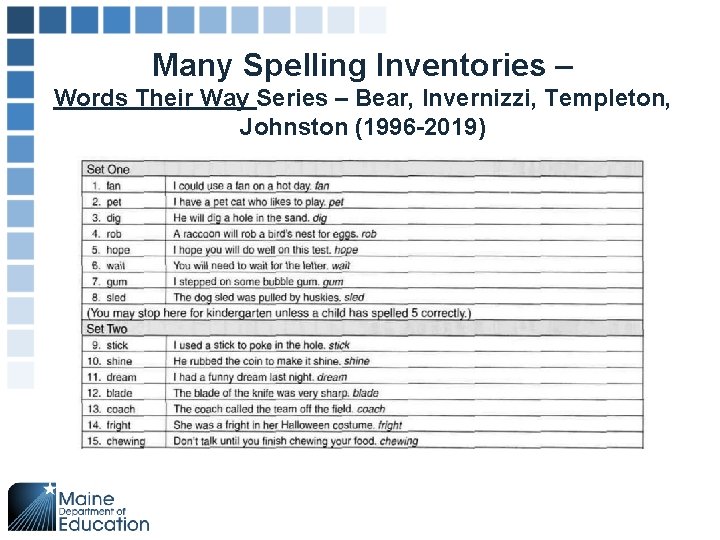
Many Spelling Inventories – Words Their Way Series – Bear, Invernizzi, Templeton, Johnston (1996 -2019)
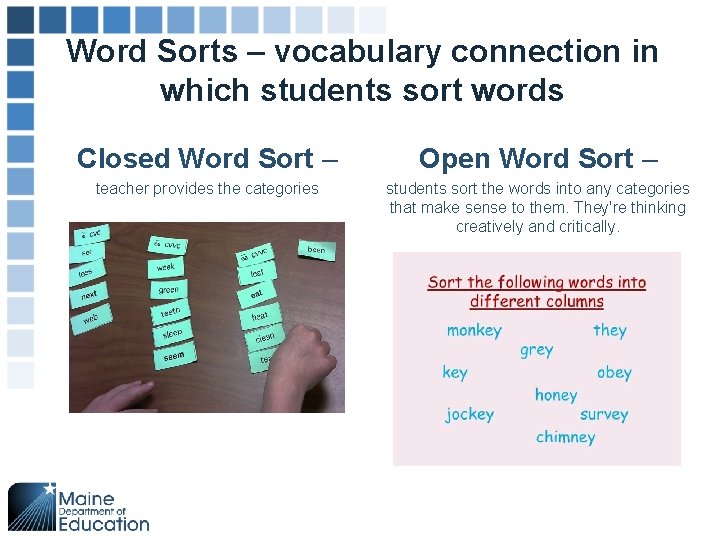
Word Sorts – vocabulary connection in which students sort words Closed Word Sort – Open Word Sort – teacher provides the categories students sort the words into any categories that make sense to them. They're thinking creatively and critically.
Spelling Considerations • Make connections to meaningful vocabulary in reading, writing and speaking • Look at spelling in context of writing • Revisit phonemic awareness and phonics as indicated by developmental need • Don’t spend an exorbitant amount of time on teaching spelling • Practice spelling but don’t drill and kill • Spaced practice is important
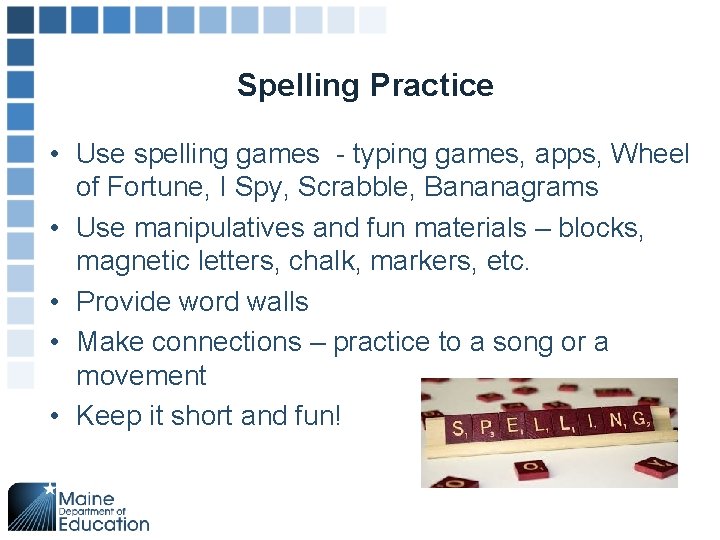
Spelling Practice • Use spelling games - typing games, apps, Wheel of Fortune, I Spy, Scrabble, Bananagrams • Use manipulatives and fun materials – blocks, magnetic letters, chalk, markers, etc. • Provide word walls • Make connections – practice to a song or a movement • Keep it short and fun!
Thank You For Your Time! Please Complete Short Survey https: //bit. ly/3 f. Xn. Ms. O Questions email: danielle. m. saucier@maine. gov
- Slides: 29