
VOCABULARY AND GRAMMAR FOR ACADEMIC WRITING How to
VOCABULARY AND GRAMMAR FOR ACADEMIC WRITING
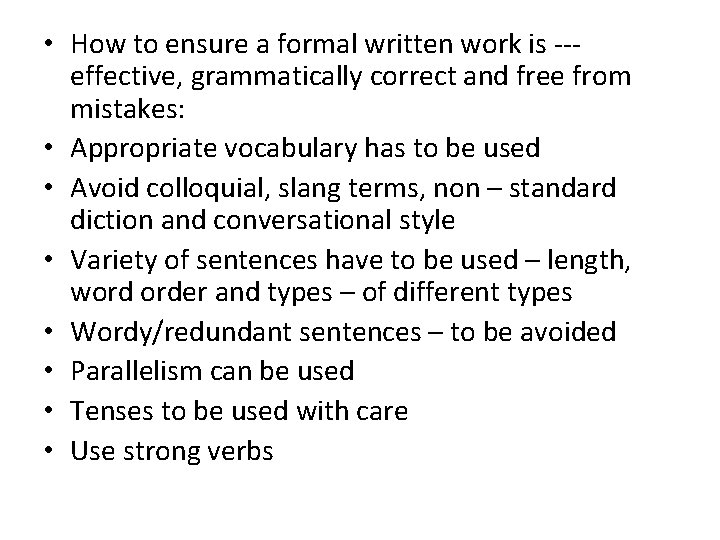
• How to ensure a formal written work is --effective, grammatically correct and free from mistakes: • Appropriate vocabulary has to be used • Avoid colloquial, slang terms, non – standard diction and conversational style • Variety of sentences have to be used – length, word order and types – of different types • Wordy/redundant sentences – to be avoided • Parallelism can be used • Tenses to be used with care • Use strong verbs
VOCABULARY Academic word list to be referred Informal words/expressions to be avoided Discourse markers – to link ideas and signal transition • Writing- less wordy • •

• Academic word list • Averil Coxhead (Victoria Univ) – first to compile such a list. Her list has 570 words • Some of the frequently used words are • Analysis, assessment, benefit, consistent, create, data, derived, environment, function, indicate, involved, legal, method, response, section, significant, theory …. . • Other AWL- West’s General Service List, Oxford 3000
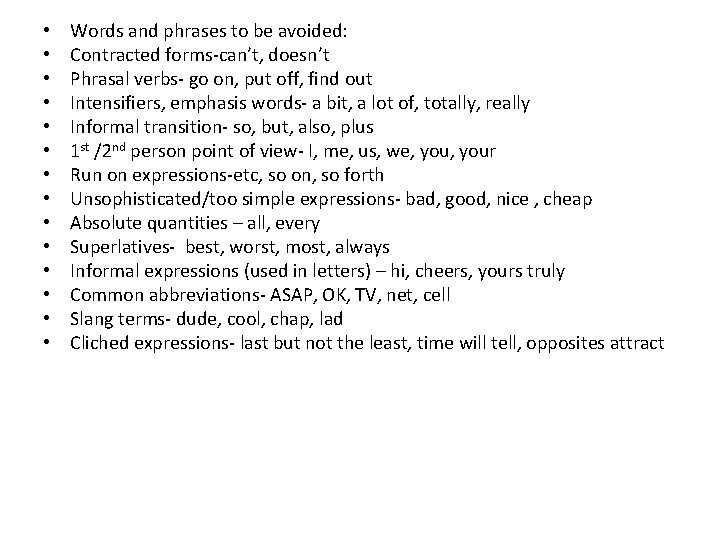
• • • • Words and phrases to be avoided: Contracted forms-can’t, doesn’t Phrasal verbs- go on, put off, find out Intensifiers, emphasis words- a bit, a lot of, totally, really Informal transition- so, but, also, plus 1 st /2 nd person point of view- I, me, us, we, your Run on expressions-etc, so on, so forth Unsophisticated/too simple expressions- bad, good, nice , cheap Absolute quantities – all, every Superlatives- best, worst, most, always Informal expressions (used in letters) – hi, cheers, yours truly Common abbreviations- ASAP, OK, TV, net, cell Slang terms- dude, cool, chap, lad Cliched expressions- last but not the least, time will tell, opposites attract
• Subjective expressions- beautiful, ugly, wonderful, horrible, awesome • Vague/impolite expresions- thing, stuff, sort of, more or less • Ethnic slurs/racist expressions- nigger, Paki, ABCD, coloured, Madrassi • Discriminatory words ( handicapped, crippled, autistic, imbecile, retard • Words that are not gender specific- mankind, actress, female pilot, waitress, layman • Approximations- nearly, almost, about, around, • Texting language- asap, b 4, btw • Non standard language – ain’t, theirselves, hisself,
• Filler words/ empty phrases – just so, really, the fact that, at all times • Redundant phrases-absolutely essential, each and every, advance warning, assemble together, completely destroy, future plans • Excessive use of qualifiers – appears, seems, indicates, might have been, probably, possibly, unlikely • Absolutes- will, is, are, was, were, never • Expressions showing personal judgement- I agree, I am convinced, I am sure that

Avoid Use instead Contacted forms full words Don’t, won’t, shouldn’t do not, will not, Personal pronouns as in In this essay, I have argued ……. In this essay it is argued • From the evidence, we can perceive some visible changes…. . From the evidence, some visible changes can be noted • Informal verbs/phrasal verbs……. . formal verbs • Bad, good, go on………. . inferior, acceptable, • • •
Colloquial expressions Formal words Sooner or later ……. inevitably part and parcel of …… intrinsic Run on expressions use conjunctions etc. ……. . And Redundant expressions remove unnecessary part ……. absolutely essential (essential), actual facts( facts), • Vague expressions use clearer words • Thing, stuff………. . • •
• Superlative expressions tone down phraseology ……perfect, best, worst, most (ideal, unfavourable, practically, consistently) • Subjective expressions…. . use alternatives • Of course, obviously, beautiful (perceptibly, vividly, reasonable) • Gendered expressions…………. . gender inclusive expressions( fireman, chairman…. . firefighter, chairperson) • Personal usage( I think, I believe……. as shown in the table, it is evident from the text)
• Use formal discourse markers instead of informal ones ( page 80, 81) • Types of sentences (clause structure) • Independent( main) and dependent(subordinate) • Main clause can stand alone but subordinate clause cannot( page 83) • Avoid use of fragments (84) • Subject-verb agreement(85, 86) • Consistent use of tenses(87) • Parallelism(88) • Avoiding wordiness(89, 90, 91)
- Slides: 11