
Vocabulary Acquisition for Young Children Research on Vocabulary
Vocabulary Acquisition for Young Children
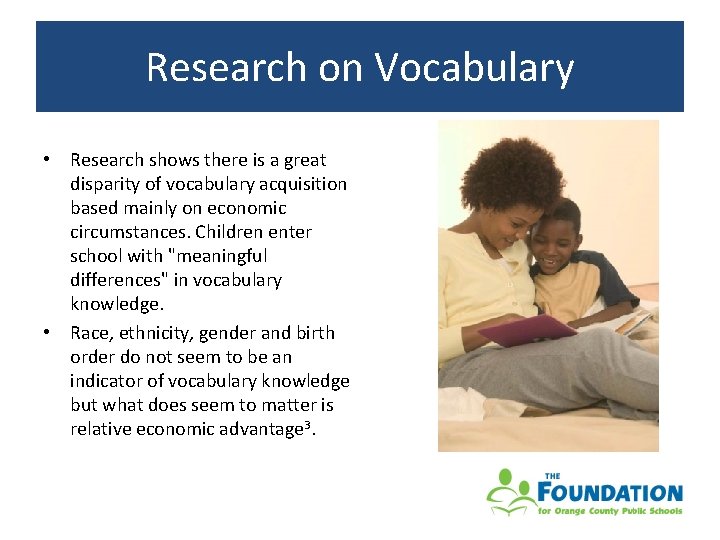
Research on Vocabulary • Research shows there is a great disparity of vocabulary acquisition based mainly on economic circumstances. Children enter school with "meaningful differences" in vocabulary knowledge. • Race, ethnicity, gender and birth order do not seem to be an indicator of vocabulary knowledge but what does seem to matter is relative economic advantage 3.
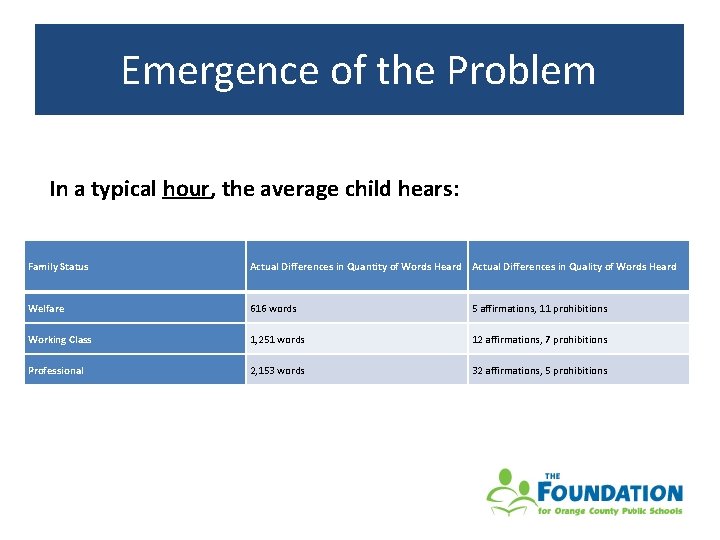
Emergence of the Problem In a typical hour, the average child hears: Family Status Actual Differences in Quantity of Words Heard Actual Differences in Quality of Words Heard Welfare 616 words 5 affirmations, 11 prohibitions Working Class 1, 251 words 12 affirmations, 7 prohibitions Professional 2, 153 words 32 affirmations, 5 prohibitions
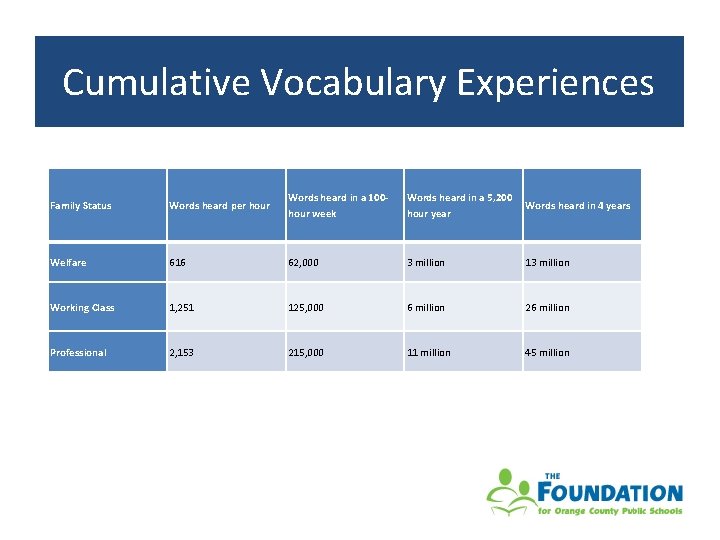
Cumulative Vocabulary Experiences Family Status Words heard per hour Words heard in a 100 hour week Words heard in a 5, 200 Words heard in 4 years hour year Welfare 616 62, 000 3 million 13 million Working Class 1, 251 125, 000 6 million 26 million Professional 2, 153 215, 000 11 million 45 million
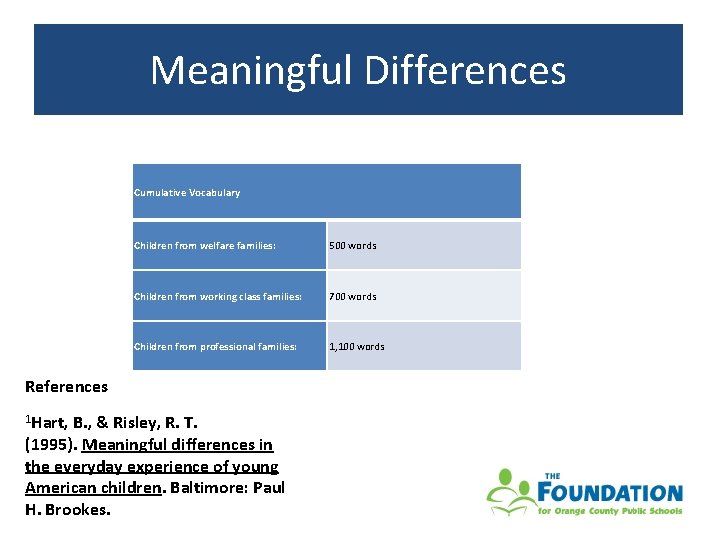
Meaningful Differences Cumulative Vocabulary Children from welfare families: 500 words Children from working class families: 700 words Children from professional families: 1, 100 words References 1 Hart, B. , & Risley, R. T. (1995). Meaningful differences in the everyday experience of young American children. Baltimore: Paul H. Brookes.
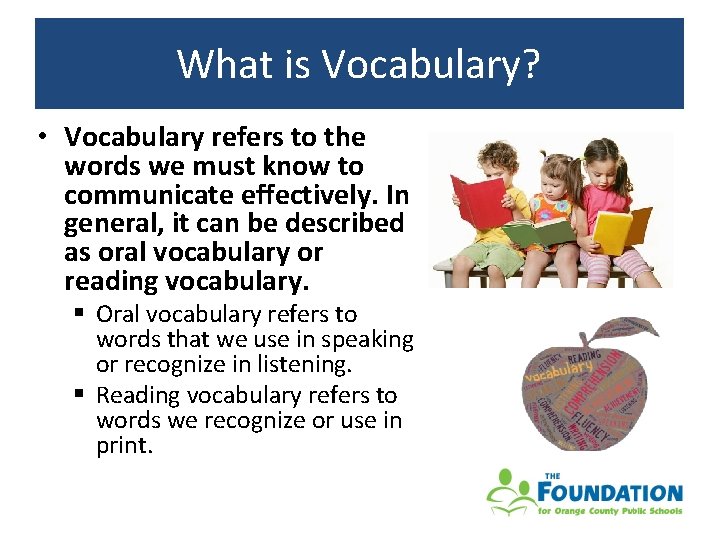
What is Vocabulary? • Vocabulary refers to the words we must know to communicate effectively. In general, it can be described as oral vocabulary or reading vocabulary. § Oral vocabulary refers to words that we use in speaking or recognize in listening. § Reading vocabulary refers to words we recognize or use in print.
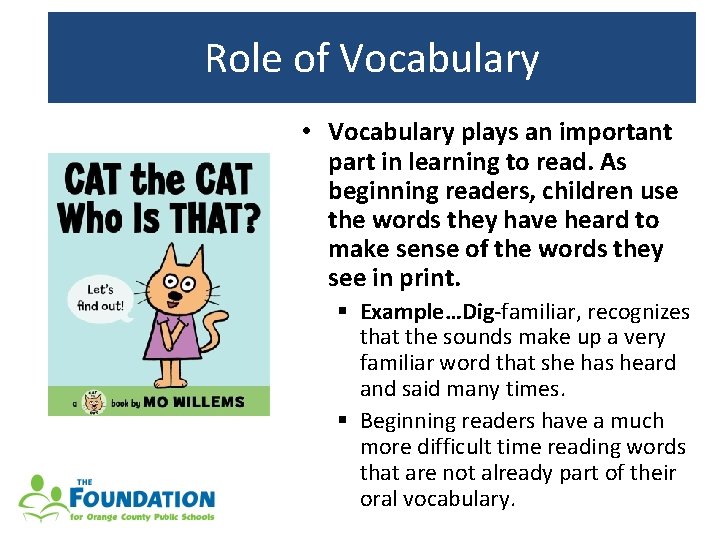
Roleof of. Vocabulary Role • Vocabulary plays an important part in learning to read. As beginning readers, children use the words they have heard to make sense of the words they see in print. § Example…Dig-familiar, recognizes that the sounds make up a very familiar word that she has heard and said many times. § Beginning readers have a much more difficult time reading words that are not already part of their oral vocabulary.
Vocabulary(continued) • Vocabulary also is very important to reading comprehension. – Readers cannot understand what they are reading without knowing what most of the words mean. – As children learn to read more advanced texts, they must learn the meaning of new words that are not part of their oral vocabulary.
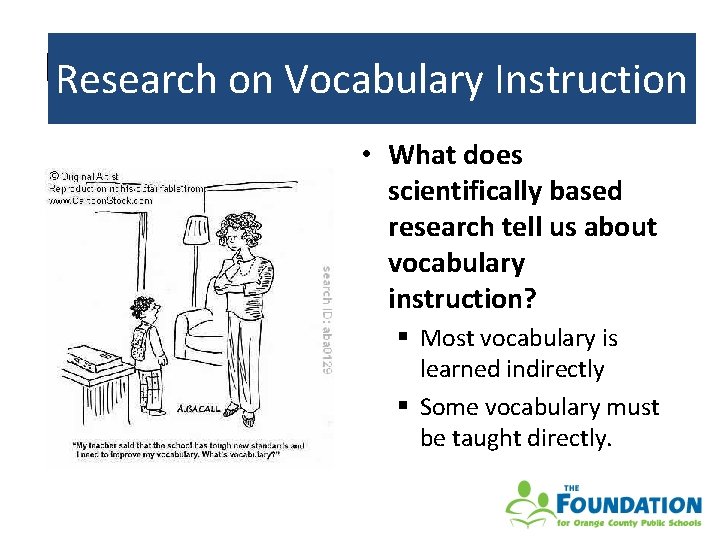
Researchon on. Vocabulary. Instruction • What does scientifically based research tell us about vocabulary instruction? § Most vocabulary is learned indirectly § Some vocabulary must be taught directly.
Four Types of of Vocabulary Four Researchers often refer to four types of vocabulary • listening vocabulary—the words we need to know to understand what we hear. • speaking vocabulary—the words we use when we speak. • reading vocabulary—the words we need to know to understand what we read. • writing vocabulary—the words we use in writing.
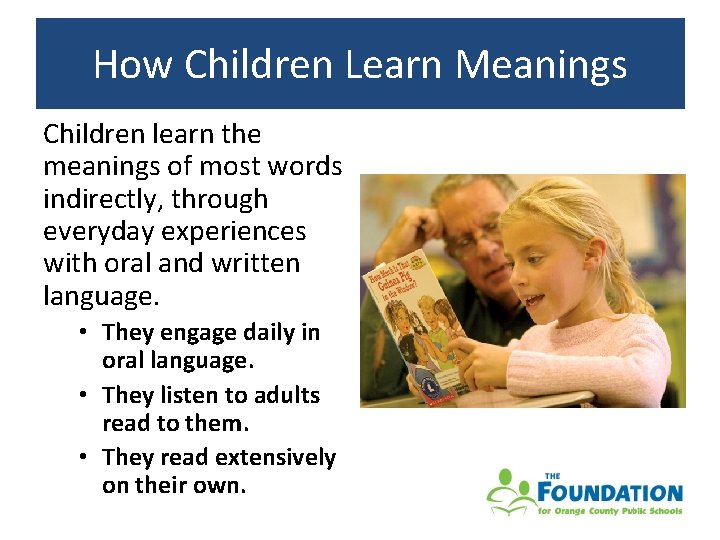
How Children Learn Meanings Children learn the meanings of most words indirectly, through everyday experiences with oral and written language. • They engage daily in oral language. • They listen to adults read to them. • They read extensively on their own.
Learned Vocabulary: Direct vs. Indirect • Direct instruction helps students learn difficult words, such as words that represent complex concepts that are not part of the students’ everyday experiences. Direct instruction of vocabulary relevant to a given text leads to better reading comprehension. • Direct instruction includes: – providing students with specific word instruction; and – teaching students word-learning strategies.
How Children Can Learn Indirectly How Question: How can I help children learn words indirectly? § Read to children out loud § Have children read independently outside the classroom Question: What words should I teach? § Important words. § Useful words. § Difficult words. – Words with multiple meanings are particularly challenging for students.
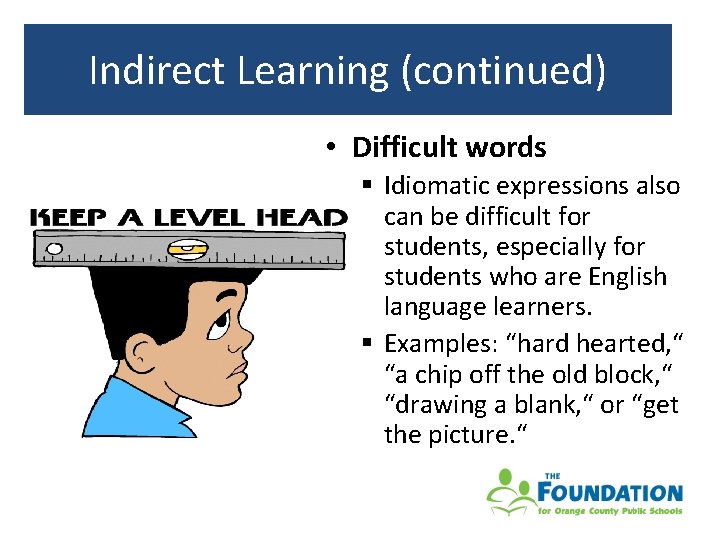
Indirect. Learning(continued) Indirect • Difficult words § Idiomatic expressions also can be difficult for students, especially for students who are English language learners. § Examples: “hard hearted, “ “a chip off the old block, “ “drawing a blank, “ or “get the picture. “
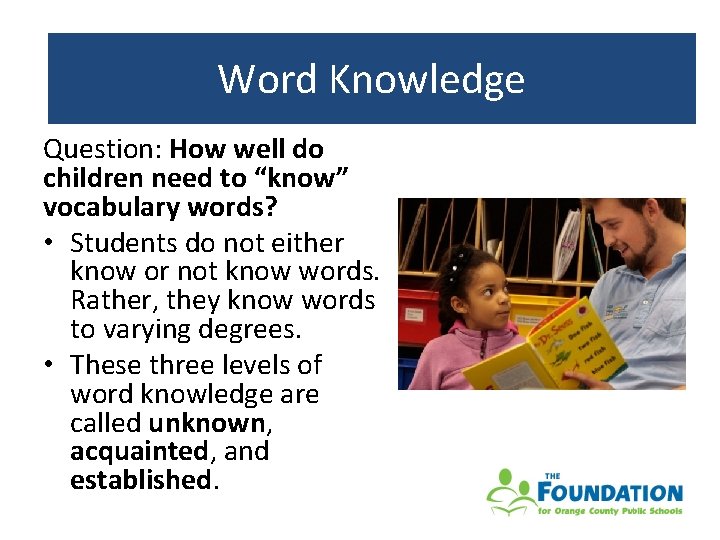
Word. Knowledge Question: How well do children need to “know” vocabulary words? • Students do not either know or not know words. Rather, they know words to varying degrees. • These three levels of word knowledge are called unknown, acquainted, and established.
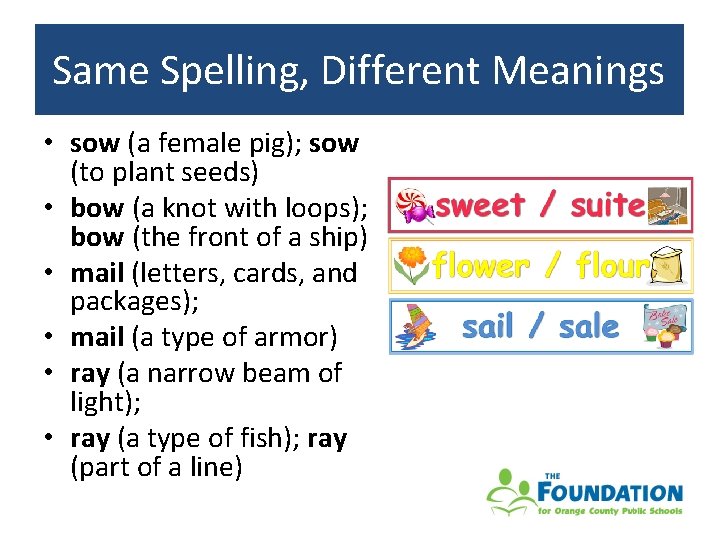
Same Spelling, spelling, Different Meanings • sow (a female pig); sow (to plant seeds) • bow (a knot with loops); bow (the front of a ship) • mail (letters, cards, and packages); • mail (a type of armor) • ray (a narrow beam of light); • ray (a type of fish); ray (part of a line)
Learning. Words words in in Other other Subjects subjects Learning • Learning words and concepts in science, social studies, and mathematics is even more challenging because each major concept often is associated with many other new concepts. § Example: the concept of deserts is often associated with other concepts that may be unfamiliar, such as cactus, plateau, and mesa.
Word. Consciousness • Help students foster word consciousness—an awareness of and interest in words, their meanings, and their power. • Word-conscious students know many words and use them well. They enjoy words and are eager to learn new words—and they know how to learn them.
Ways to Foster Word Consciousness • You can help your students develop word consciousness in several ways. § Call their attention to the way authors choose words to convey particular meanings. § Encourage students to play with words by engaging in word play, such as puns or palindromes. § Help them research a word’s origin or history. § You can also encourage them to search for examples of a word’s usage in their everyday lives.
Thank you for all you do! Our students are so fortunate to have you in their lives.
- Slides: 20