
Vocab Selection Symbols Layout Organization Unaided and Aided
Vocab Selection, Symbols, Layout Organization
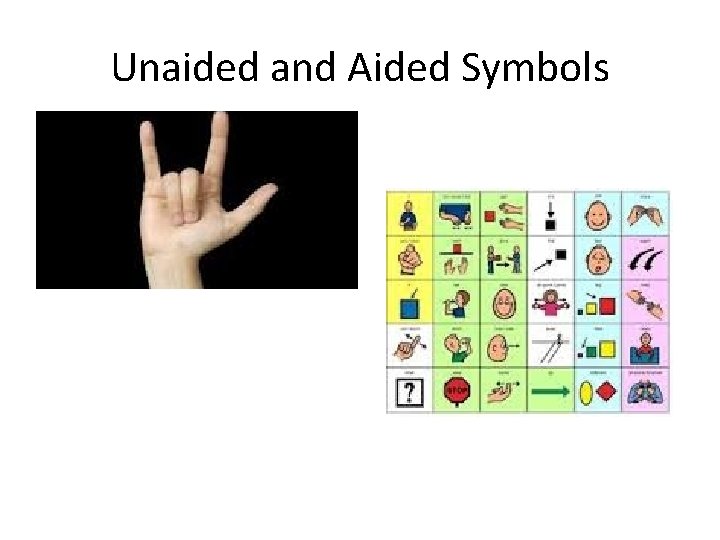
Unaided and Aided Symbols
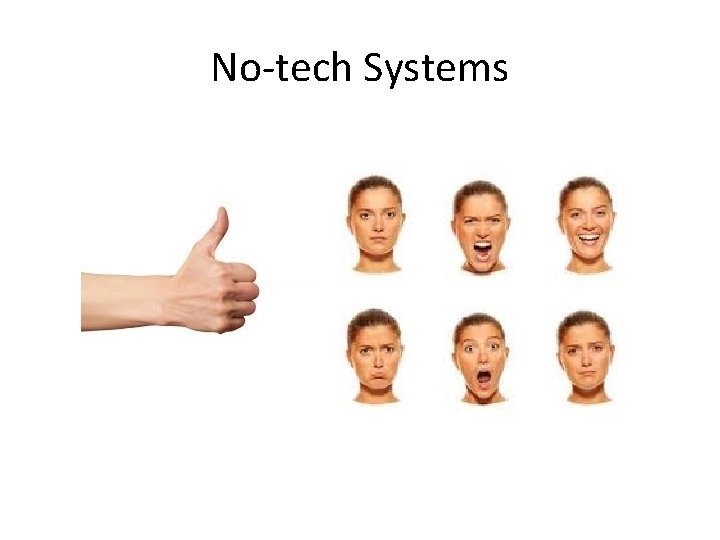
No‐tech Systems
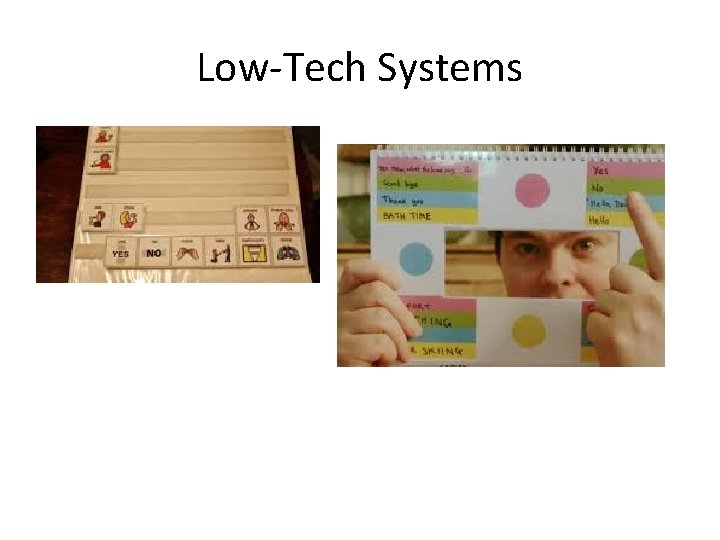
Low‐Tech Systems
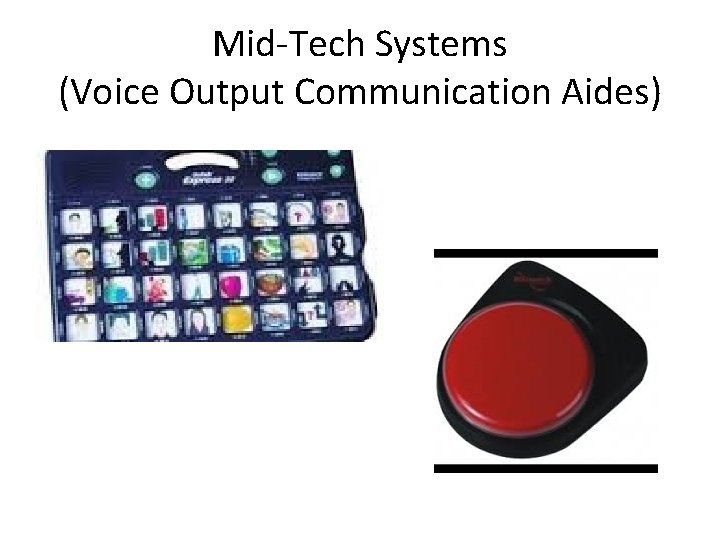
Mid‐Tech Systems (Voice Output Communication Aides)
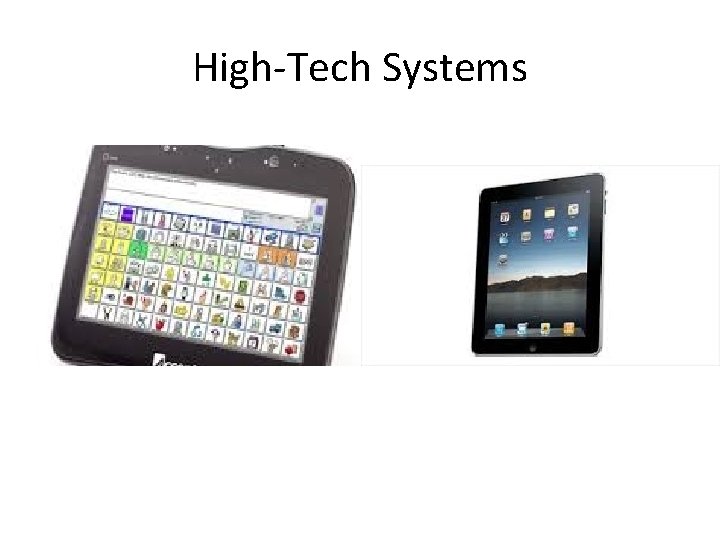
High‐Tech Systems
Do I need to follow this symbol hierarchy? • Should I start with no tech, then progress to low tech, then mid tech, then high tech as my client becomes more “competent”? ? ? • NO! This is a MYTH. There is NO evidence that we need to use a symbol hierarchy! (Romski and Sevcik, 2005) • We should not be “testing” our clients before providing them access to a robust system of communication! • We need to IMPLEMENT AAC in order to TEACH AAC (AND language, communication, social skills, etc)!
More “Myths” of AAC… • But doesn’t my client need to demonstrate pre‐requisite skills to use AAC? ! • NO!!! This is a myth! (Romski and Sevcik, 2005) • But what if my client has low cognition, negative behaviors, no “desire” to communicate, poor motor control, is too young? ! • Your client is a candidate for AAC! With AAC your client can express cognition, replace behaviors with communication, and initiate conversations about self‐selected topics. There is NO age requirement! • Communication is a basic HUMAN RIGHT. There are NO prerequisites that justify withholding or delaying access to that right. • You are the GATEKEEPER of the language your client has access to!
Mobile Technology ‐ Pros • i. OS and Android platforms have changed the way people communicate, including those with communication disorders. • These devices/platforms offer many affordances that traditional AAC devices lack: – Less expensive – Less stigmatizing • Can be implemented for two distinct uses: – Therapeutic tool to teach new skills – As an AAC device • Clinicians can use a similar framework for determining appropriateness of a traditional AAC device when making a determination on a piece of mobile technology for a client.
Mobile Technology ‐ Cons • Clinicians should be well‐informed consumers of technology. – Need to be aware of the benefits and downfalls of new technology • Unlike traditional AAC devices, mobile technology is not covered by Medicare or Medicaid. • Durability of these devices is not well known when using them with individuals with CCNs. • Limited tech support available, especially when using third party “apps. ” • Issues with service delivery (e. g. , a caregiver purchases an i. Pad and wants the clinician to use it with their family member)
What Do You Think? If you could pick a few people to select your messages for you, who would they be – people who know a lot about language or people who a lot about YOU?
Vocab selection • http: //praacticalaac. org/praactical/aac‐ vocabulary‐lists/
• “WE USED TO THINK: Start with just a few (4‐ 6) picture symbols and add a few more at a time, as the (student with ASD) shows that he or she can communicate appropriately with them usually by requesting. • Now we think: REALLY? !? Where is the research that defends this practice? • This is certainly not how other kids learn new words and acquire language. ” ‐Pat Mirenda, 2014 at the ISAAC Conference
Teaching Vocabulary • Teach vocabulary that is powerful to your client – – – Motivating and meaningful to your client Age appropriate Vocabulary your client needs to be successful Appropriate to use across environments Enables him/her to communicate for a variety of communicative functions (i. e. , comment, provide information, express opinions)
Pre‐stored phrases & sentences • We must always consider the client’s understanding and his/her language level • I think most people need a combination – Focus on functional communication—what is efficient and effective for the individual
Pre‐stored phrases & sentences • Emergency situations • Partner instructions and communication transaction messages • Discourse Functions • Questions • Predictable Routines
Core vs Fringe • Core vocabulary includes high frequency words that can be used in a variety of situations. • Fringe vocabulary is more situation specific. Importance depends on the context and the individual
Vocabulary Organization “Professionals often spend a great deal of time concerning themselves with which box they should get their AAC user. Should I pick a Prentke Romich or a Tobii Dynavox? But what about the i. Pad? And what about the money? Should I pick a Cheap. Talk or a Go. Talk instead? The box is not the issue…Let’s forget the communication box for a few minutes and focus on what’s inside to help us make our decision. ” Vicki Clarke, 2016
Organizing Vocab • Simple Pragmatic Organization (Functional Language) • Grammatical and Noun Categorical Organization • Context Based Messaging (Visual Scenes or Grids) • Single Message Core Vocabulary • Multi‐Meaning Core Vocabulary “All have research supporting their efficacy as tools to assist non-verbal communicators in developing and using language. ” Clarke, 2016
Organizing Vocab • Many SGDs and AAC apps lean towards a specific type of organization • Most GOOD systems have some of all of these. • The challenge is matching the patient’s specific skills and needs to the vocabulary system that best supports him. Clarke, 2016
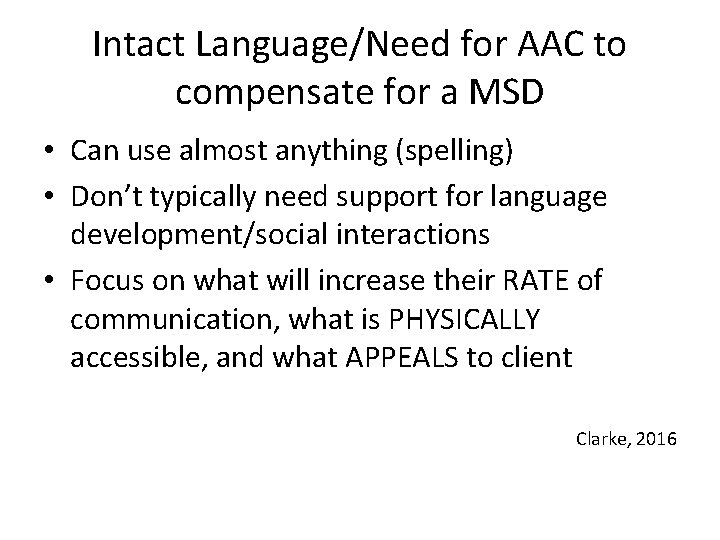
Intact Language/Need for AAC to compensate for a MSD • Can use almost anything (spelling) • Don’t typically need support for language development/social interactions • Focus on what will increase their RATE of communication, what is PHYSICALLY accessible, and what APPEALS to client Clarke, 2016
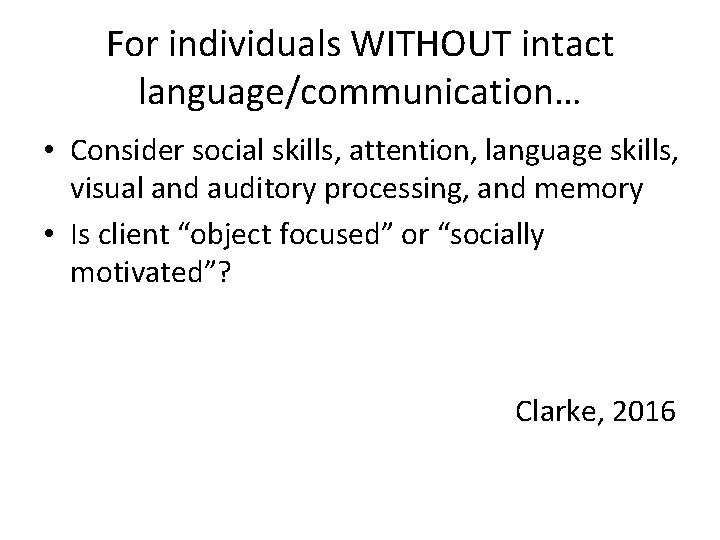
For individuals WITHOUT intact language/communication… • Consider social skills, attention, language skills, visual and auditory processing, and memory • Is client “object focused” or “socially motivated”? Clarke, 2016
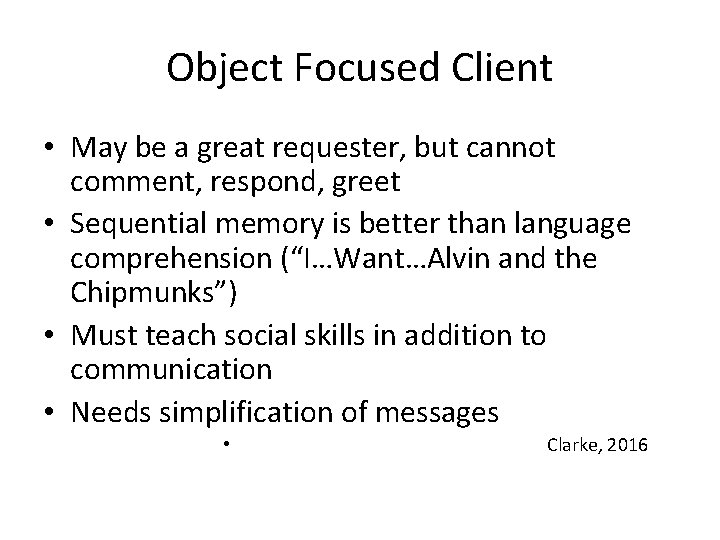
Object Focused Client • May be a great requester, but cannot comment, respond, greet • Sequential memory is better than language comprehension (“I…Want…Alvin and the Chipmunks”) • Must teach social skills in addition to communication • Needs simplification of messages • Clarke, 2016
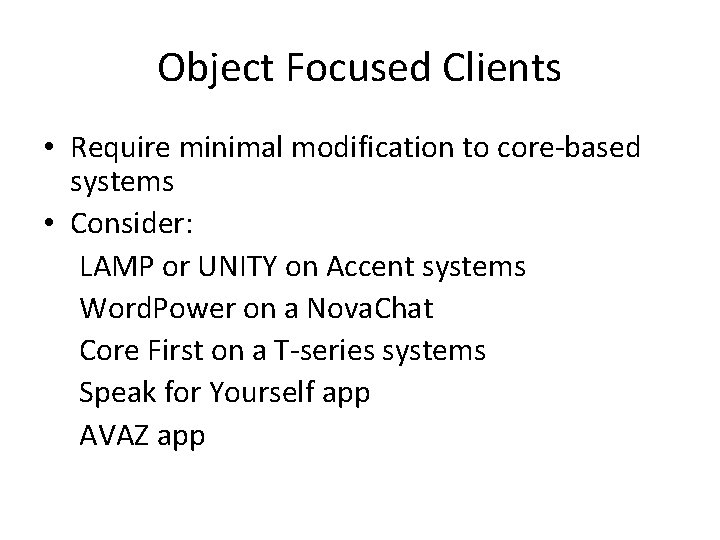
Object Focused Clients • Require minimal modification to core‐based systems • Consider: LAMP or UNITY on Accent systems Word. Power on a Nova. Chat Core First on a T‐series systems Speak for Yourself app AVAZ app
Socially Motivated Client • Good social skills but struggles with symbolic representation and STM for sentence construction • Need for language that is complex, specific, and easy to access • Phrase‐based vocab allows for communication of variety of functions without taxing STM or attention skills Clarke, 2016
Socially Motivated Client • Need heavy emphasis on context based communication • Consider: Compass (Masterpage or Nav. Bar) on T‐series Sono. Primo on I‐series Autismate App Go. Talk Now
Managing Context‐Based Concerns • Lack of core ‐Provide access and instruction to core in addition to context‐ based instruction • Lack of consistent placement of words ‐Use placement of words on core vocab page to drive location of semantically similar messages in context‐based pages • Need for extensive modifications ‐Use systematic collection of messaging needs in environment ‐Train caregivers to make modifications Clarke, 2015
Remember… • There is no one or “best” vocabulary system that works for everyone. • One size does NOT fit all! • NEED to consider individual strengths and needs and match our tools and teaching to individual differences. • “Most high quality apps and devices have a little of all of these types of vocabulary organization, so as long as you choose a high quality, comprehensive system, you can adapt it to meet the needs of most of your clients” Clarke, 2016
Lessons learned • The client’s personality and preferences must be considered AT ALL TIMES!!! • Have quick ‘on the fly’ strategies to use when things don’t work • Training, follow up, and ongoing support are essential for success • Communication is about people. Technology is only a tool.
References • • Augmentative Communication News newsletter, Augmentative Communication Inc, www. augcominc. com Augmentative and Alternative Communication: Knowledge and Skills for Service Delivery, ASHA 2001 Roles and Responsibilities of Speech‐Language Pathologists with Respect to AAC: Technical Report, ASHA, 2004 Beukelman, D. , & Mirenda, P. (2005). Supporting Children & Adults with Complex Communication Needs (3 rd ed. ). Baltimore: Paul H. Brookes Publishing Co. • Light, J. & Binger, C. Building Communicative Competence with Individuals Who Use Augmentative and Alternative Communication. Baltimore: Paul H. Brookes Publishing Co. • Van. Tatenhove, Gail. (2005). Personal Communication. • • Content shared with permission from Children’s CO, AAC Team Romski, M. and Sevcik, R. (2005) Augmentative communication and early intervention: Myths and realities. Infants and Young Children, 18(3), 174‐ 185. • Clarke, Vicki (2016). “AAC Assessment Corner: Thinking Inside the Box” http: //praacticalaac. org/praactical/aac‐assessment‐corner‐by‐vicki‐clarke‐thinking‐inside‐the‐box‐ for‐aac‐evaluations/ • Clarke, Vicki (2015). “Context Based Communication: Using High‐Tech Solutions to Increase Communication” http: //www. slideshare. net/100001460658994/context‐based‐communication‐for ‐aac‐users
- Slides: 30