
VOCAB SELECTION SYMBOLS LAYOUT ORGANIZATION Unaided and Aided
VOCAB SELECTION, SYMBOLS, LAYOUT ORGANIZATION

Unaided and Aided Symbols
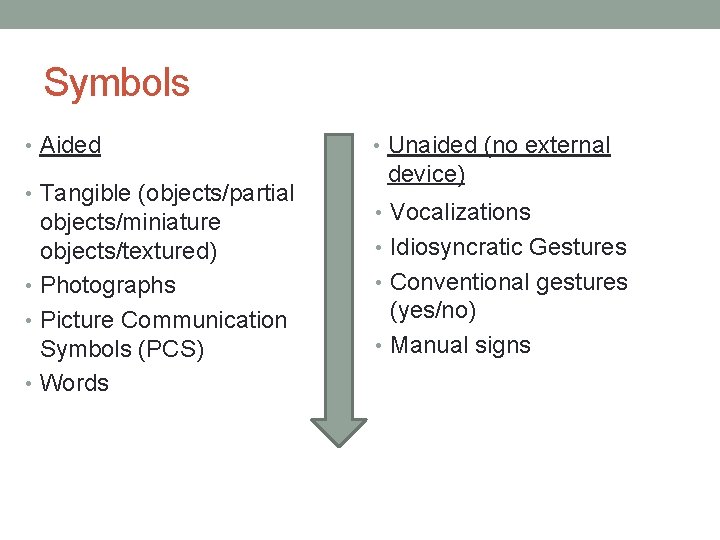
Symbols • Aided • Tangible (objects/partial objects/miniature objects/textured) • Photographs • Picture Communication Symbols (PCS) • Words • Unaided (no external device) • Vocalizations • Idiosyncratic Gestures • Conventional gestures (yes/no) • Manual signs
Do I need to follow this symbol hierarchy? • Should I start with objects then progress to pictures or words as my client becomes more “competent”? • No, this is a myth! There is no evidence that we need to use a symbol hierarchy (Romski and Sevcik, 2005) • However…. “One can never assume that young children will detect a given symbol-referent relation, no matter how transparent that relation seems to adults or older children” (De. Loache, Miller, & Rosengren, 1997 p. 312). i. e. , Symbols must be TAUGHT!

Guess the symbol!
1: 1 correspondence or semantic compaction? • 1: 1 • Semantic compaction • Sun and Son • Son
How do we teach symbols? • Talk about the symbol! • Point out relationship between symbol and referent • Make it personal • Keep words (represented by symbols) in same place • Create a teaching activity with an emotional experience • Create lots of practice opportunities Zangari, 2013

No-tech Systems
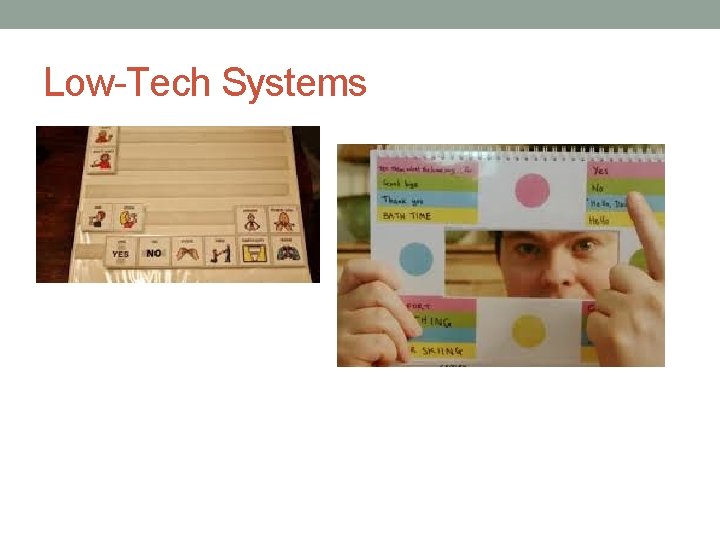
Low-Tech Systems
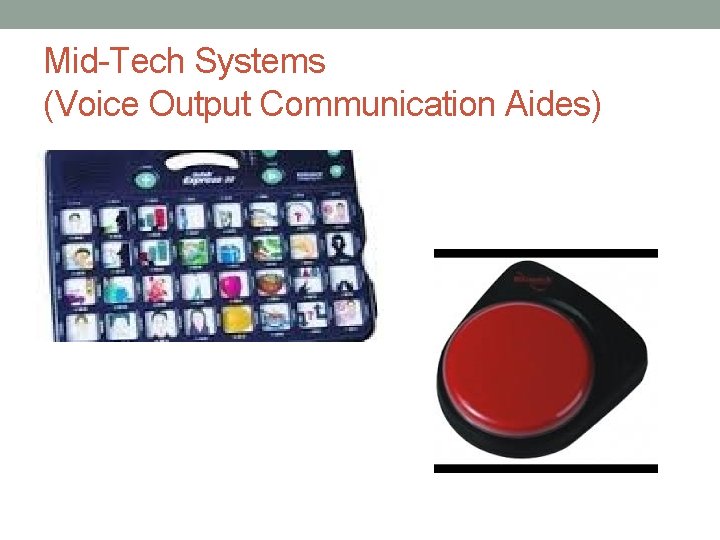
Mid-Tech Systems (Voice Output Communication Aides)
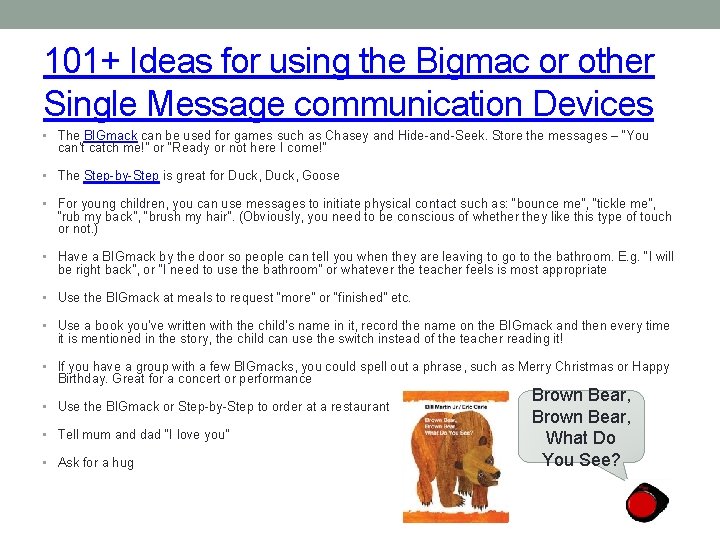
101+ Ideas for using the Bigmac or other Single Message communication Devices • The BIGmack can be used for games such as Chasey and Hide-and-Seek. Store the messages – “You can’t catch me!” or “Ready or not here I come!” • The Step-by-Step is great for Duck, Goose • For young children, you can use messages to initiate physical contact such as: “bounce me”, “tickle me”, “rub my back”, “brush my hair”. (Obviously, you need to be conscious of whether they like this type of touch or not. ) • Have a BIGmack by the door so people can tell you when they are leaving to go to the bathroom. E. g. “I will be right back”, or “I need to use the bathroom” or whatever the teacher feels is most appropriate • Use the BIGmack at meals to request “more” or “finished” etc. • Use a book you’ve written with the child’s name in it, record the name on the BIGmack and then every time it is mentioned in the story, the child can use the switch instead of the teacher reading it! • If you have a group with a few BIGmacks, you could spell out a phrase, such as Merry Christmas or Happy Birthday. Great for a concert or performance • Use the BIGmack or Step-by-Step to order at a restaurant • Tell mum and dad “I love you” • Ask for a hug Brown Bear, What Do You See?
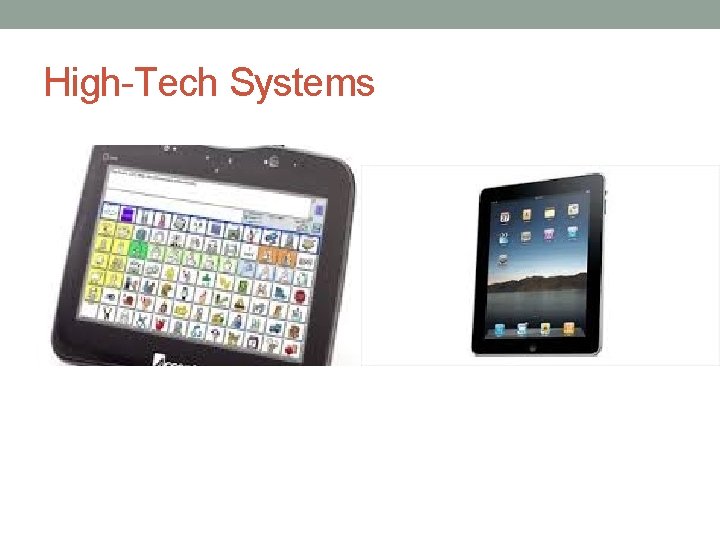
High-Tech Systems

Mobile Technology - Pros • i. OS and Android platforms have changed the way people communicate, including those with communication disorders. • These devices/platforms offer many affordances that traditional AAC devices lack: • Less expensive • Less stigmatizing • Can be implemented for two distinct uses: • Therapeutic tool to teach new skills • As an AAC device • Clinicians can use a similar framework for determining appropriateness of a traditional AAC device when making a determination on a piece of mobile technology for a client.
Mobile Technology - Cons • Clinicians should be well-informed consumers of technology. • Need to be aware of the benefits and downfalls of new technology • Unlike traditional AAC devices, mobile technology is not covered by Medicare or Medicaid. • Durability of these devices is not well known when using them with individuals with CCNs. • Limited tech support available, especially when using third party “apps. ” • Issues with service delivery (e. g. , a caregiver purchases an i. Pad and wants the clinician to use it with their family member)
What Do You Think? If you could pick a few people to select your messages for you, who would they be – people who know a lot about language or people who a lot about YOU?
Vocabulary Selection • Age – children vs adults/developmental vocabulary • Gender • Social use • Environments – school, home, work, recreational, hospital • Greetings • Small talk (50% of utterances for kids aged 3 -5 – generic small talk; 39% for ages 20 -30) • Storytelling • Procedural descriptions • Content-specific conversations • Wrap-up remarks and farewell statements

Developmental Vocabulary (Lahey & Bloom, 1977) • Substantive words (people, places and things) • Relational words (big/little) • Generic verbs (give, get, make) • Specific verbs (eat, drink, sleep) • Emotional state words (happy, scared) • Affirmation/negation (yes, not) • Recurrence/discontinuation (more, all gone) • Proper names • Relevant colors • Relevant prepositions

Core and Fringe Vocabulary • Core vocabulary includes high frequency words that can be used in a variety of situations. • Fringe vocabulary is more situation specific. Importance depends on the context and the individual.

Core word myths • Core words are all that are needed in an AAC system • It’s a developmental word list • People must be able to match pictures or receptively identify them in order to learn core words • They are the first words that should be taught to people with complex communication needs • They are too abstract for learners with intellectual disabilities Zangari, 2017
Vocabulary • “WE USED TO THINK: Start with just a few (4 -6) picture symbols and add a few more at a time, as the (student with ASD) shows that he or she can communicate appropriately with them usually by requesting. • Now we think: REALLY? !? Where is the research that defends this practice? • This is certainly not how other kids learn new words and acquire language. ” -Pat Mirenda, 2014 at the ISAAC Conference

Teaching Vocabulary • Teach vocabulary that is powerful to your client • Motivating and meaningful to your client • Age appropriate • Vocabulary your client needs to be successful • Appropriate to use across environments • Enables him/her to communicate for a variety of communicative functions (i. e. , comment, provide information, express opinions)
Pre-stored phrases and sentences • We must always consider the client’s understanding and his/her language level • I think most people need a combination • Focus on functional communication—what is efficient and effective for the individual

Pre-stored phrases and sentences • Emergency situations • Partner instructions and communication transaction messages • Discourse Functions • Questions • Predictable Routines

Organizing Vocab • Simple Pragmatic Organization (Functional Language) • Grammatical and Noun Categorical Organization • Context Based Messaging (Visual Scenes or Grids) • Single Message Core Vocabulary • Multi-Meaning Core Vocabulary “All have research supporting their efficacy as tools to assist non-verbal communicators in developing and using language. ” Clarke, 2016

Visual Scene Displays
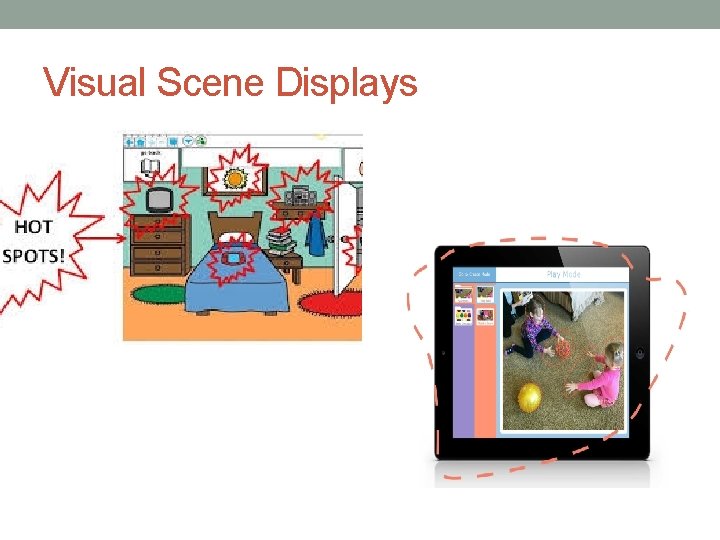
Visual Scene Displays

Grid Displays
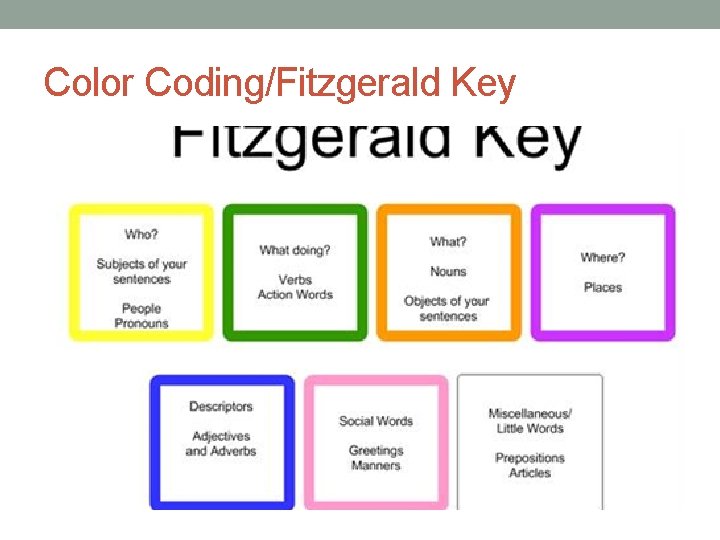
Color Coding/Fitzgerald Key
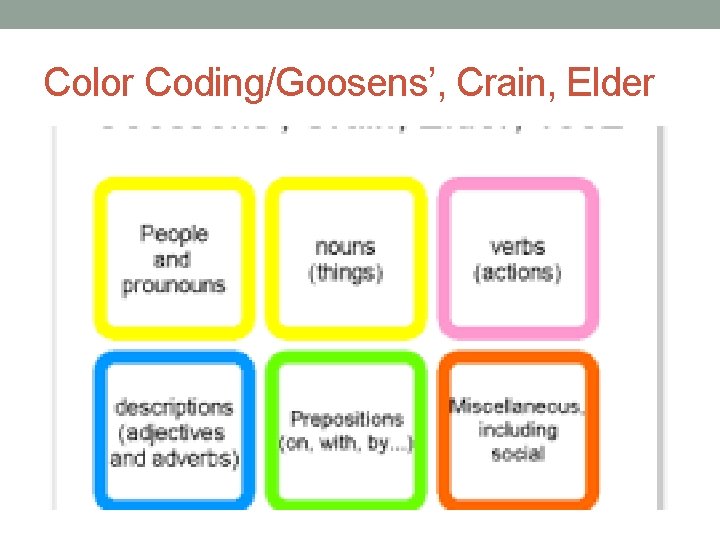
Color Coding/Goosens’, Crain, Elder
Organizing Vocab • Many SGDs and AAC apps lean towards a specific type of organization • Most good systems have some of all of these. • The challenge is matching the patient’s specific skills and needs to the vocabulary system that best supports him/her! Clarke, 2016

Intact Language/Need for AAC to compensate for a MSD • Can use almost anything (spelling) • Don’t typically need support for language development or social interactions • Focus on: • what will increase their RATE of communication, • what is PHYSICALLY accessible, • and what APPEALS to client Clarke, 2016
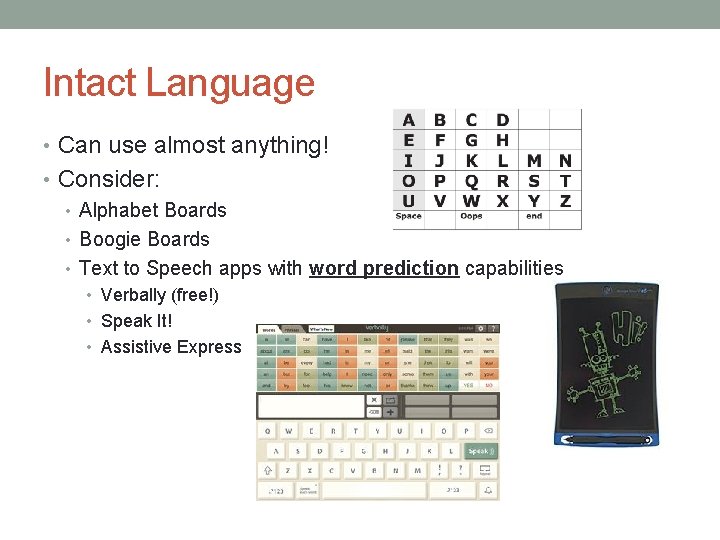
Intact Language • Can use almost anything! • Consider: • Alphabet Boards • Boogie Boards • Text to Speech apps with word prediction capabilities • Verbally (free!) • Speak It! • Assistive Express

For individuals WITHOUT intact language/communication… • Consider social skills, attention, language skills, visual and auditory processing, and memory! • Must obtain this information during assessment process • Consider is client “object focused” or “socially motivated”? Clarke, 2016
Object Focused Client • May be a great requester, but cannot comment, respond, greet • Sequential memory is better than language comprehension (“I…Want…Alvin and the Chipmunks”) • Must teach social skills in addition to communication • Needs simplification of messages Clarke, 2016
Object Focused Clients • Require minimal modification to core-based systems • Consider: LAMP or UNITY on Accent systems Word. Power on Nova. Chat or Touch. Chat app Snap+Core on an Indi or I-series system Speak for Yourself app AVAZ app Proloquo 2 go app (with CORE update)
Socially Motivated Client • Good social skills but struggles with symbolic representation and STM for sentence construction • Need for language that is complex, specific, and easy to access • Phrase-based vocab allows for communication of variety of functions without taxing STM or attention skills Clarke, 2016
Socially Motivated Client • Need heavy emphasis on context based communication (grid or visual scene) • Consider: Snap+Core “topics” on I-series Sono. Primo on I-series Snap. Scene App Autismate App Go. Talk Now App Lingraphica (Aphasia) Communication Journey on Nova. Chat or Touch. Chat app (Aphasia)

Managing Context-Based Concerns • Lack of core -Provide access and instruction to core in addition to context-based instruction • Lack of consistent placement of words -Use placement of words on core vocab page to drive location of semantically similar messages in contextbased pages • Need for extensive modifications -Use systematic collection of messaging needs in environment -Train caregivers to make modifications Clarke, 2015
Remember… • There is no one or “best” vocabulary system that works for everyone. • One size does NOT fit all! • Need to consider individual strengths and needs and match our tools and teaching to individual differences.
Lessons learned • The client’s personality and preferences must be considered AT ALL TIMES!!! • Have quick ‘on the fly’ strategies to use when things don’t work • Training, follow up, and ongoing support are essential for success
References • Augmentative Communication News newsletter, Augmentative Communication Inc, www. augcominc. com • Augmentative and Alternative Communication: Knowledge and Skills for Service Delivery, ASHA 2001 • Roles and Responsibilities of Speech-Language Pathologists with Respect to AAC: Technical Report, ASHA, 2004 • Beukelman, D. , & Mirenda, P. (2005). Supporting Children & Adults with Complex Communication Needs (3 rd ed. ). Baltimore: Paul H. Brookes Publishing Co. • Light, J. & Binger, C. Building Communicative Competence with Individuals Who Use Augmentative and Alternative Communication. Baltimore: Paul H. Brookes Publishing Co. • Van. Tatenhove, Gail. (2005). Personal Communication. • Content shared with permission from Children’s CO, AAC Team • Romski, M. and Sevcik, R. (2005) Augmentative communication and early intervention: Myths and realities. Infants and Young Children, 18(3), 174‐ 185. • Clarke, Vicki (2016). “AAC Assessment Corner: Thinking Inside the Box” http: //praacticalaac. org/praactical/aac-assessment-corner-by-vicki-clarke-thinking-inside-the-box-for-aacevaluations/ • Clarke, Vicki (2015). “Context Based Communication: Using High-Tech Solutions to Increase Communication” http: //www. slideshare. net/100001460658994/context-based-communication-for-aac-users • Zangari, Carole (2013). Core vocabulary: Making sense of symbols http: //praacticalaac. org/praactical/core- vocabulary-making-sense-of-symbols/ • Zangari, Carole (2017). 5 Misconceptions about Core Vocabulary in AAC http: //praacticalaac. org/praactical/5 -misconceptions-about-core-vocabulary-in-aac /
- Slides: 41