
VO 2 NANOSTRUCTURES BASED CHEMORESISTOR FOR LOW POWER

VO 2 NANOSTRUCTURES BASED CHEMORESISTOR FOR LOW POWER ENERGY CONSUMPTION HYDROGEN SENSING Ms. Aline SIMO Supervisor: Prof Malik Maaza Co-Supervisor: Prof Reginaldt Madjoe i. Themba LABS/University of Western Cape Energy Postgraduate Conference 2013
OUTLINE 1 - H 2 Gas sensing foresight, Safety & Oxides 2 - Gas Sensing Principle 4 - VO 2 : Mott oxide and Room temperature H 2 sensing 5 - Conclusions and follow up
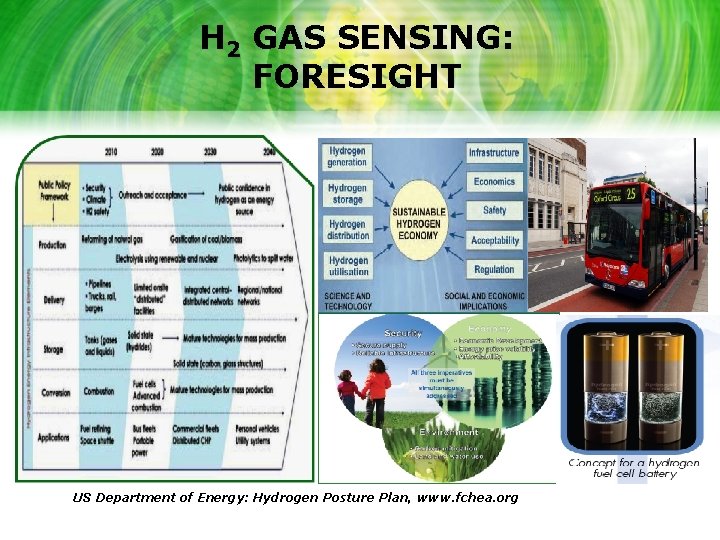
H 2 GAS SENSING: FORESIGHT US Department of Energy: Hydrogen Posture Plan, www. fchea. org
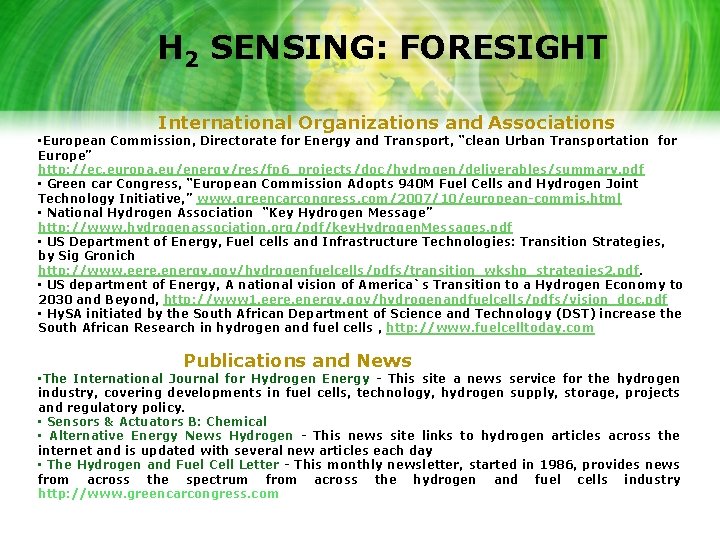
H 2 SENSING: FORESIGHT International Organizations and Associations • European Commission, Directorate for Energy and Transport, “clean Urban Transportation for Europe” http: //ec. europa. eu/energy/res/fp 6_projects/doc/hydrogen/deliverables/summary. pdf • Green car Congress, “European Commission Adopts 940 M Fuel Cells and Hydrogen Joint Technology Initiative, ” www. greencarcongress. com/2007/10/european-commis. html • National Hydrogen Association “Key Hydrogen Message” http: //www. hydrogenassociation. org/pdf/key. Hydrogen. Messages. pdf • US Department of Energy, Fuel cells and Infrastructure Technologies: Transition Strategies, by Sig Gronich http: //www. eere. energy. gov/hydrogenfuelcells/pdfs/transition_wkshp_strategies 2. pdf. • US department of Energy, A national vision of America`s Transition to a Hydrogen Economy to 2030 and Beyond, http: //www 1. eere. energy. gov/hydrogenandfuelcells/pdfs/vision_doc. pdf • Hy. SA initiated by the South African Department of Science and Technology (DST) increase the South African Research in hydrogen and fuel cells , http: //www. fuelcelltoday. com Publications and News • The International Journal for Hydrogen Energy - This site a news service for the hydrogen industry, covering developments in fuel cells, technology, hydrogen supply, storage, projects and regulatory policy. • Sensors & Actuators B: Chemical • Alternative Energy News Hydrogen - This news site links to hydrogen articles across the internet and is updated with several new articles each day • The Hydrogen and Fuel Cell Letter - This monthly newsletter, started in 1986, provides news from across the spectrum from across the hydrogen and fuel cells industry http: //www. greencarcongress. com
H 2 GAS SAFETY Risk /Safety codes • • • H 2: Wide concentration range of flammability with 4 -75% volume compared to gasoline 1 -7. 6% and wide detonation range (18. 3 -59% volume vs. 1. 1 -3. 3% for gasoline) H 2: Odorless and leaks not detectable by smell Ignition of a flammable mixture at small quantity and high diffusivity H 2: reducing dependence on petroleum imports, pollution and greenhouse gas emissions H 2 : is amongst cleanest carrier energy with the highest specific energy offering long term solution being produced from Renewables Energies such as wind-powered electrolysis or solar. Requirements for an Effective Gas Sensor • • • Sensitivity: Chemical Surface activity Selectivity: Gas identification Energy consumption
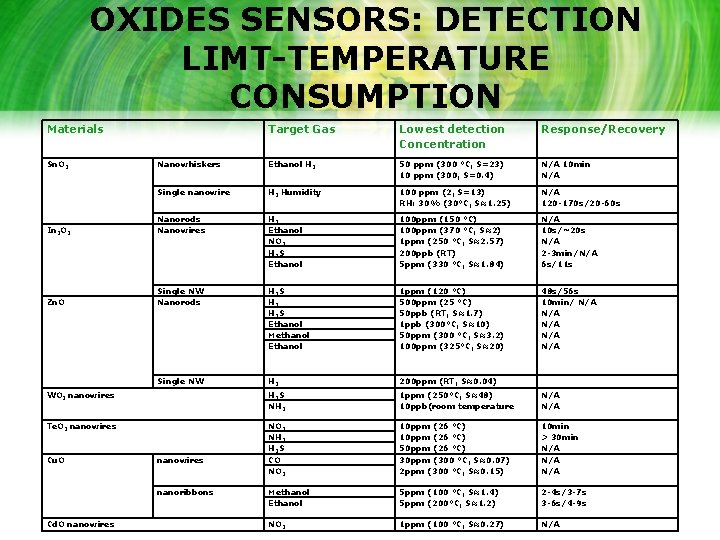
OXIDES SENSORS: DETECTION LIMT-TEMPERATURE CONSUMPTION Materials Target Gas Lowest detection Concentration Response/Recovery Nanowhiskers Ethanol H 2 50 ppm (300 °C, S=23) 10 ppm (300, S=0. 4) N/A 10 min N/A Single nanowire H 2 Humidity 100 ppm (2, S=13) RH: 30% (30°C, S≈1. 25) N/A 120 -170 s/20 -60 s In 2 O 3 Nanorods Nanowires H 2 Ethanol NO 2 H 2 S Ethanol 100 ppm (150 °C) 100 ppm (370 °C, S≈2) 1 ppm (250 °C, S≈2. 57) 200 ppb (RT) 5 ppm (330 °C, S≈1. 84) N/A 10 s/~20 s N/A 2 -3 min/N/A 6 s/11 s Zn. O Single NW Nanorods H 2 S Ethanol Methanol Ethanol 1 ppm (120 °C) 500 ppm (25 °C) 50 ppb (RT, S≈1. 7) 1 ppb (300°C, S≈10) 50 ppm (300 °C, S≈3. 2) 100 ppm (325°C, S≈20) 48 s/56 s 10 min/ N/A N/A N/A Single NW H 2 200 ppm (RT, S≈0. 04) WO 3 nanowires H 2 S NH 3 1 ppm (250°C, S≈48) 10 ppb(room temperature N/A Te. O 2 nanowires NO 2 NH 3 H 2 S CO NO 2 10 ppm (26 °C) 50 ppm (26 °C) 30 ppm (300 °C, S≈0. 07) 2 ppm (300 °C, S≈0. 15) 10 min > 30 min N/A N/A Methanol Ethanol 5 ppm (100 °C, S≈1. 4) 5 ppm (200°C, S≈1. 2) 2 -4 s/3 -7 s 3 -6 s/4 -9 s NO 2 1 ppm (100 °C, S≈0. 27) N/A Sn. O 2 Cu. O nanowires nanoribbons Cd. O nanowires
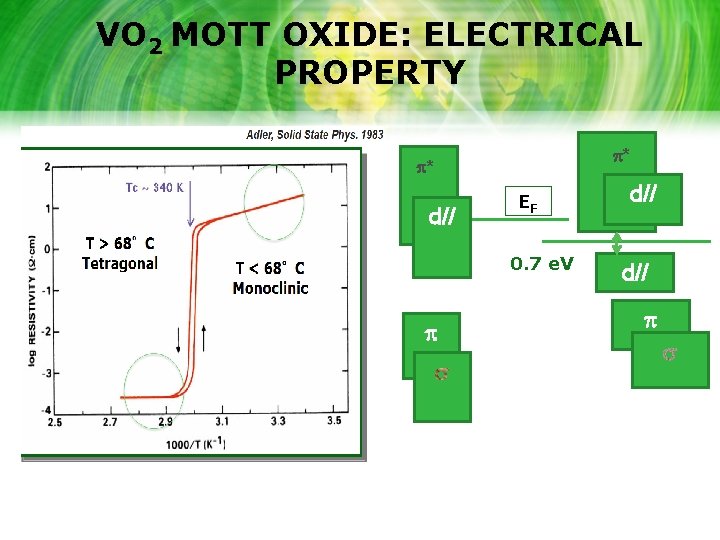
VO 2 MOTT OXIDE: ELECTRICAL PROPERTY p* p* d// EF 0. 7 e. V p d// p
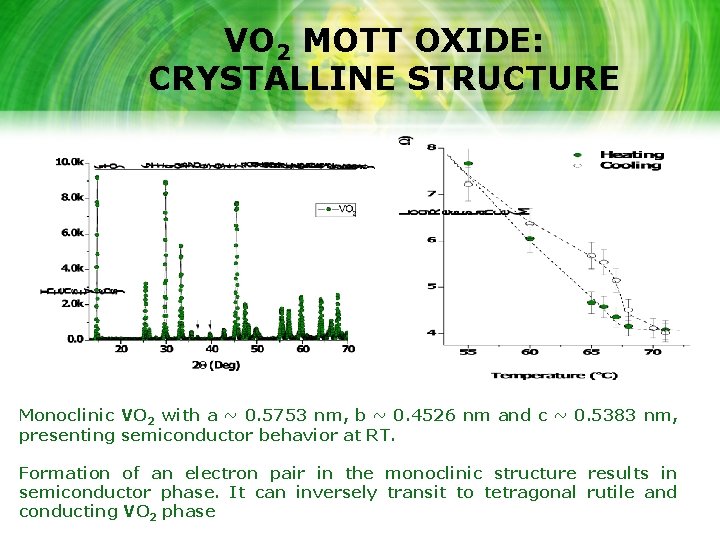
VO 2 MOTT OXIDE: CRYSTALLINE STRUCTURE Monoclinic VO 2 with a ~ 0. 5753 nm, b ~ 0. 4526 nm and c ~ 0. 5383 nm, presenting semiconductor behavior at RT. Formation of an electron pair in the monoclinic structure results in semiconductor phase. It can inversely transit to tetragonal rutile and conducting VO 2 phase
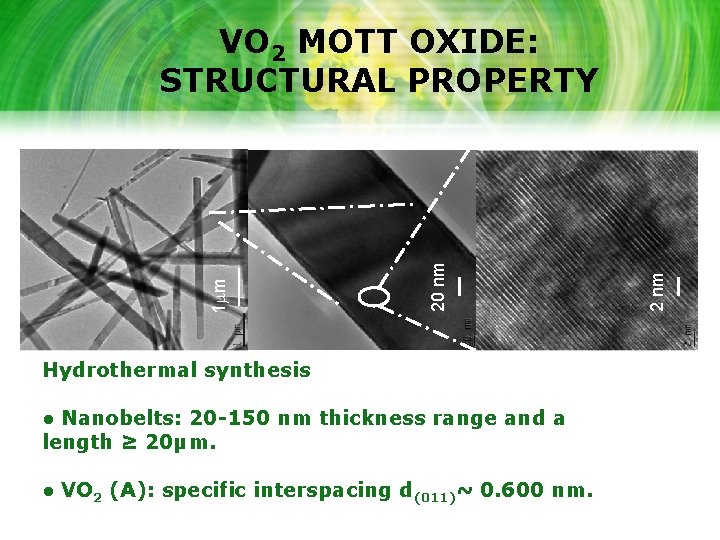
Hydrothermal synthesis ● Nanobelts: 20 -150 nm thickness range and a length ≥ 20μm. ● VO 2 (A): specific interspacing d(011)~ 0. 600 nm. 2 nm 20 nm 1 m VO 2 MOTT OXIDE: STRUCTURAL PROPERTY
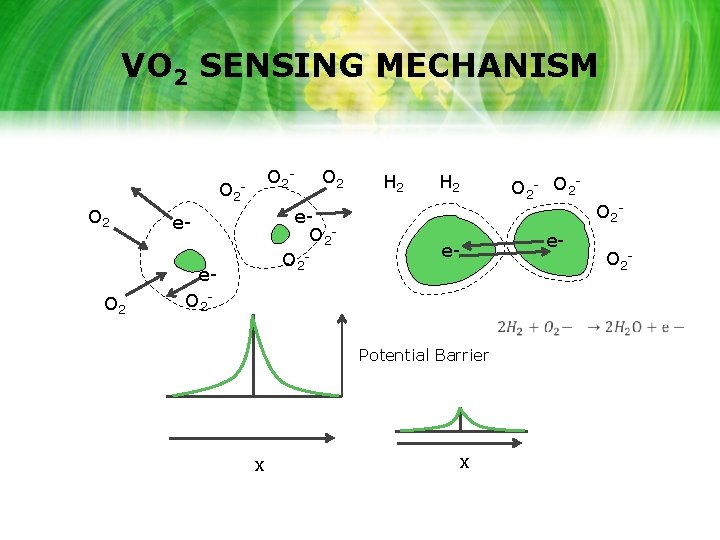
VO 2 SENSING MECHANISM O 2 - O 2 O 2 O 2 e. O 2 O 2 - ee. O 2 - H 2 e- Potential Barrier x x O 2 - O 2 e- O 2 O 2 -
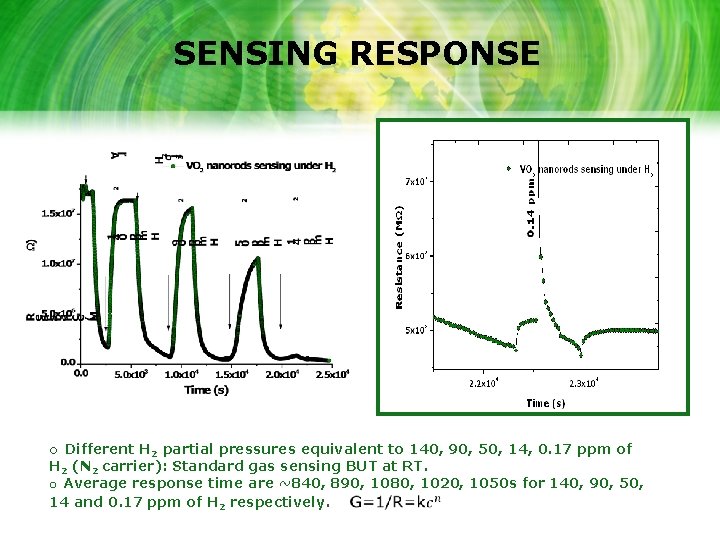
SENSING RESPONSE o Different H 2 partial pressures equivalent to 140, 90, 50, 14, 0. 17 ppm of H 2 (N 2 carrier): Standard gas sensing BUT at RT. o Average response time are ~840, 890, 1080, 1020, 1050 s for 140, 90, 50, 14 and 0. 17 ppm of H 2 respectively.
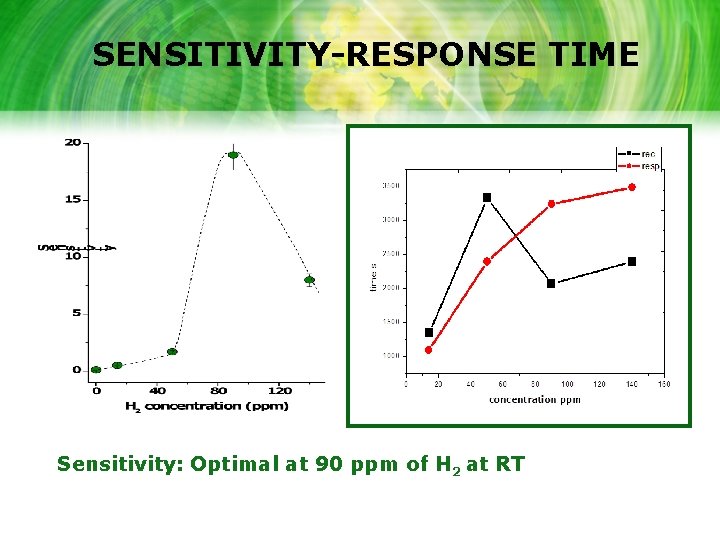
SENSITIVITY-RESPONSE TIME Sensitivity: Optimal at 90 ppm of H 2 at RT
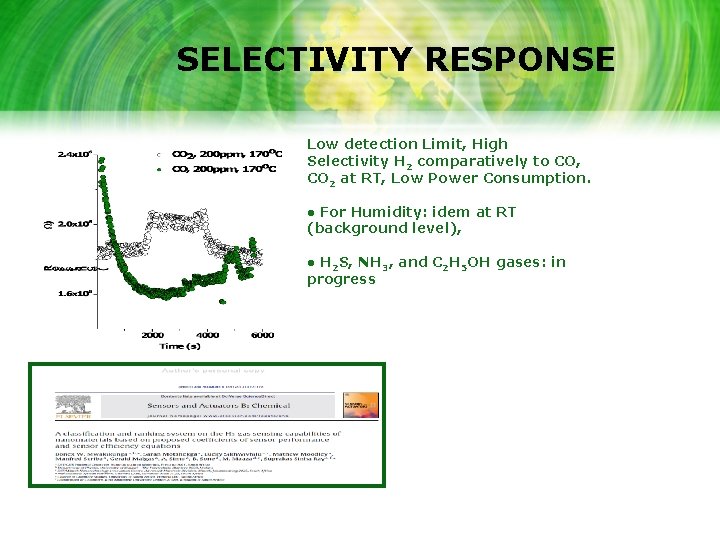
SELECTIVITY RESPONSE Low detection Limit, High Selectivity H 2 comparatively to CO, CO 2 at RT, Low Power Consumption. ● For Humidity: idem at RT (background level), ● H 2 S, NH 3, and C 2 H 5 OH gases: in progress
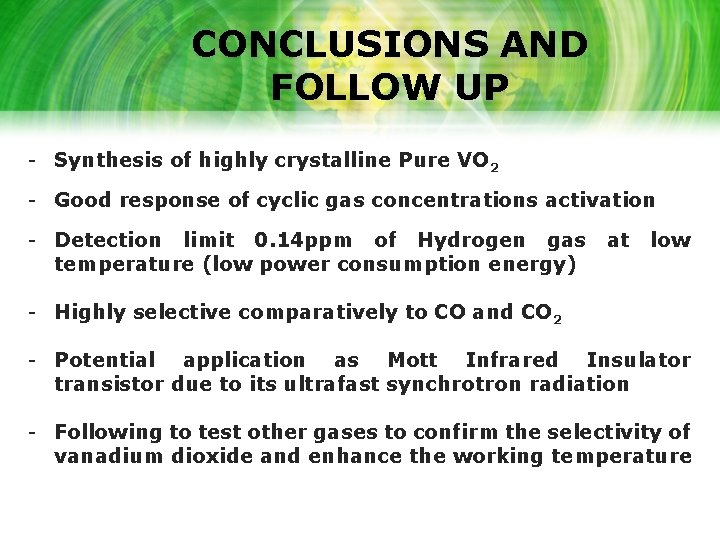
CONCLUSIONS AND FOLLOW UP - Synthesis of highly crystalline Pure VO 2 - Good response of cyclic gas concentrations activation - Detection limit 0. 14 ppm of Hydrogen gas temperature (low power consumption energy) at low - Highly selective comparatively to CO and CO 2 - Potential application as Mott Infrared Insulator transistor due to its ultrafast synchrotron radiation - Following to test other gases to confirm the selectivity of vanadium dioxide and enhance the working temperature

THANK YOU
- Slides: 15