
VM Building Blocks Building Blocks n Generally difficult
VM Building Blocks
Building Blocks n Generally difficult to provide an exact duplicate of underlying machine l Especially if only dual-mode operation available on CPU l But getting easier over time as CPU features and support for VMM improves l Most VMMs implement virtual CPU (VCPU) to represent state of CPU per guest as guest believes it to be 4 When guest context switched onto CPU by VMM, information from VCPU loaded and stored l Several techniques, as described in next slides
Building Block – Trap and Emulate � Dual mode CPU means guest executes in user mode � Kernel runs in kernel mode � Not safe to let guest kernel run in kernel mode too � So VM needs two modes – virtual user mode and virtual kernel mode � Both of which run in real user mode � Actions in guest that usually cause switch to kernel mode must cause switch to virtual kernel mode
Trap-and-Emulate (cont. ) � How does switch from virtual user mode to virtual kernel mode occur? � Attempting a privileged instruction in user mode causes an error -> trap � VMM gains control, analyzes error, executes operation as attempted by guest � Returns control to guest in user mode � Known as trap-and-emulate � Most virtualization products use this at least in part
Trap-and-Emulate (cont. ) � User mode code in guest runs at same speed as if not a guest � But kernel mode privilege mode code runs slower due to trap-andemulate � � Especially a problem when multiple guests running, each needing trapand-emulate CPUs adding hardware support, mode CPU modes to improve virtualization performance
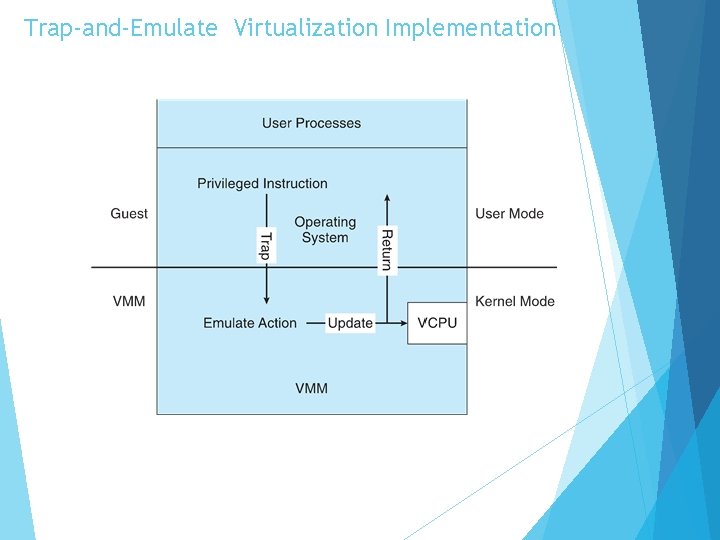
Trap-and-Emulate Virtualization Implementation
Building Block – Binary Translation � Some CPUs don’t have clean separation between privileged and nonprivileged instructions � Earlier Intel x 86 CPUs are among them � Earliest Intel CPU designed for a calculator � Backward compatibility means difficult to improve � Consider Intel x 86 popf instruction � Loads CPU flags register from contents of the stack � If CPU in privileged mode -> all flags replaced � If CPU in user mode -> on some flags replaced � No trap is generated
Binary Translation (cont. ) n Other similar problem instructions we will call special instructions l n Caused trap-and-emulate method considered impossible until 1998 Binary translation solves the problem l Basics are simple, but implementation very complex 1. If guest VCPU is in user mode, guest can run instructions natively 2. If guest VCPU in kernel mode (guest believes it is in kernel mode) 1. VMM examines every instruction guest is about to execute by reading a few instructions ahead of program counter 2. Non-special-instructions run natively 3. Special instructions translated into new set of instructions that perform equivalent task (for example changing the flags in the VCPU)
Binary Translation (cont. ) n Implemented by translation of code within VMM n Code reads native instructions dynamically from guest, on demand, generates native binary code that executes in place of original code n Performance of this method would be poor without optimizations l Products like VMware use caching 4 Translate once, and when guest executes code containing special instruction cached translation used instead of translating again 4 Testing showed booting Windows XP as guest caused 950, 000 translations, at 3 microseconds each, or 3 second (5 %) slowdown over native
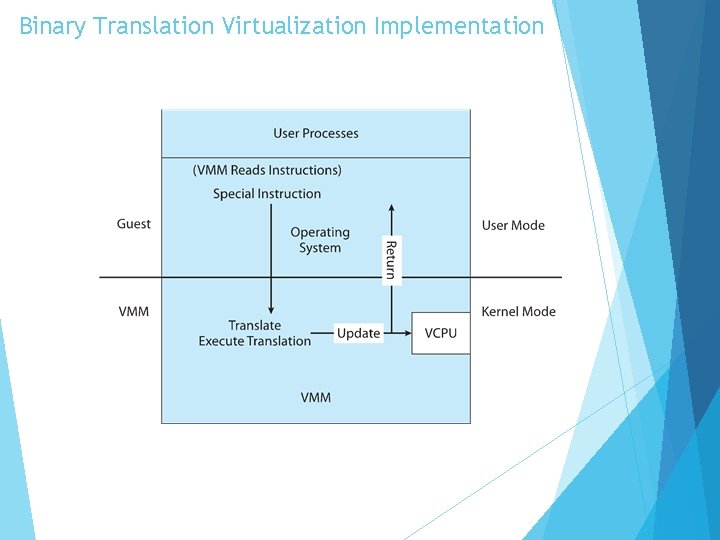
Binary Translation Virtualization Implementation
Nested Page Tables � Memory management another general challenge to VMM implementations � How can VMM keep page-table state for both guests believing they control the page tables and VMM that does control the tables? � Common method (for trap-and-emulate and binary translation) is nested page tables (NPTs) � Each guest maintains page tables to translate virtual to physical addresses � VMM maintains per guest NPTs to represent guest’s page-table state � Just as VCPU stores guest CPU state � When guest on CPU -> VMM makes that guest’s NPTs the active system page tables � Guest tries to change page table -> VMM makes equivalent change to NPTs and its own page tables � Can cause many more TLB misses -> much slower performance
Building Blocks – Hardware Assistance � All virtualization needs some HW support � More support -> more feature rich, stable, better performance of guests � Intel added new VT-x instructions in 2005 and AMD the AMD-V instructions in 2006 � � CPUs with these instructions remove need for binary translation � Generally define more CPU modes – “guest” and “host” � VMM can enable host mode, define characteristics of each guest VM, switch to guest mode and guest(s) on CPU(s) � In guest mode, guest OS thinks it is running natively, sees devices (as defined by VMM for that guest) � Access to virtualized device, priv instructions cause trap to VMM � CPU maintains VCPU, context switches it as needed HW support for Nested Page Tables, DMA, interrupts as well over time
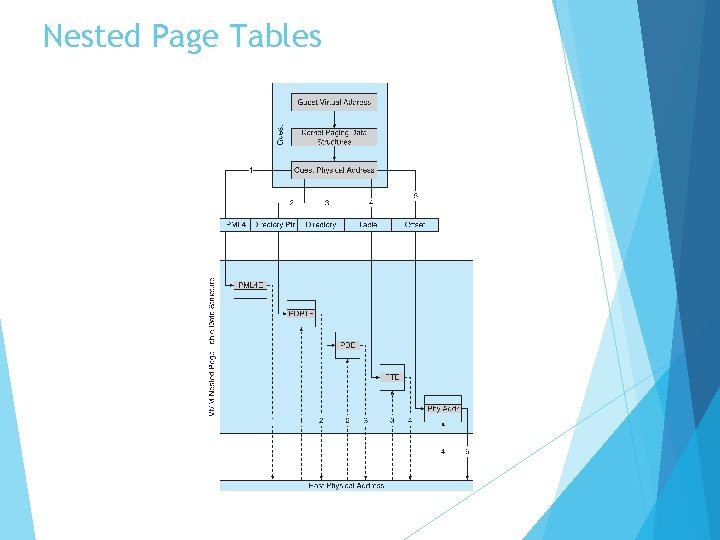
Nested Page Tables
References � “Operating System Concepts, " by Abraham Silberschatz, et al, 9 th Edition, 2012, John Wiley & Sons Inc. � Operating Systems: A Spiral Approach 1 st Edition by Ramez Elmasri , A Carrick , David Levine
- Slides: 14