
VLSI Trends A Brief History u u 1958
VLSI Trends
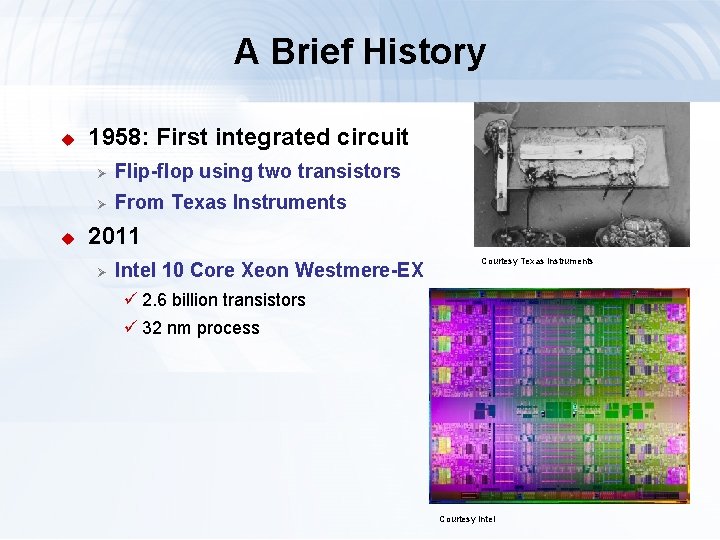
A Brief History u u 1958: First integrated circuit Ø Flip-flop using two transistors Ø From Texas Instruments 2011 Ø Intel 10 Core Xeon Westmere-EX Courtesy Texas Instruments ü 2. 6 billion transistors ü 32 nm process Courtesy Intel
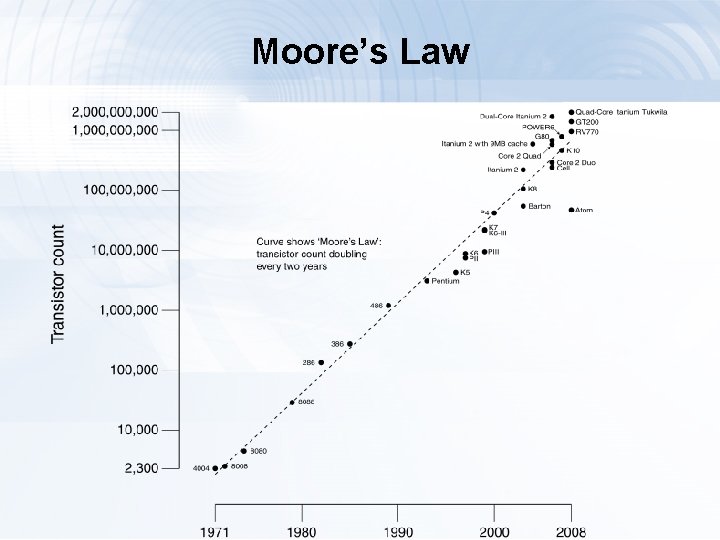
Moore’s Law u u Growth rate Ø 2 x transistors & clock speeds every 2 years over 50 years Ø 10 x every 6 -7 years Dramatically more complex algorithms previously not feasible Ø Dramatically more realistic video games and graphics animation (e. g. Playstation 4, Xbox 360 Kinect, Nintendo Wii) Ø 1 Mb/s DSL to 10 Mb/s Cable to 2. 4 Gb/s Fiber to Homes Ø 2 G to 3 G to 4 G wireless communications Ø MPEG-1 to MPEG-2 to MPEG-4 to H. 264 video compression Ø 480 x 270 (0. 13 million pixels) NTSC to 1920 x 1080 (2 million pixels) HDTV resolution
Moore’s Law
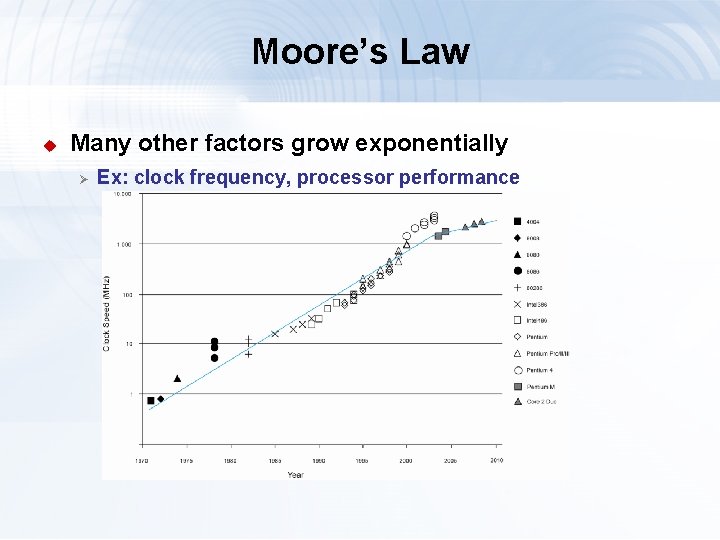
Moore’s Law u Many other factors grow exponentially Ø Ex: clock frequency, processor performance

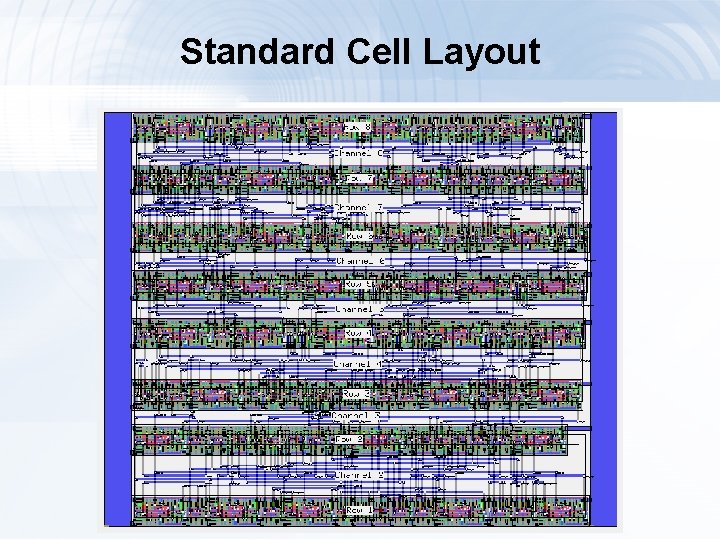
Standard Cells NOR-3 XOR-2
Standard Cell Layout
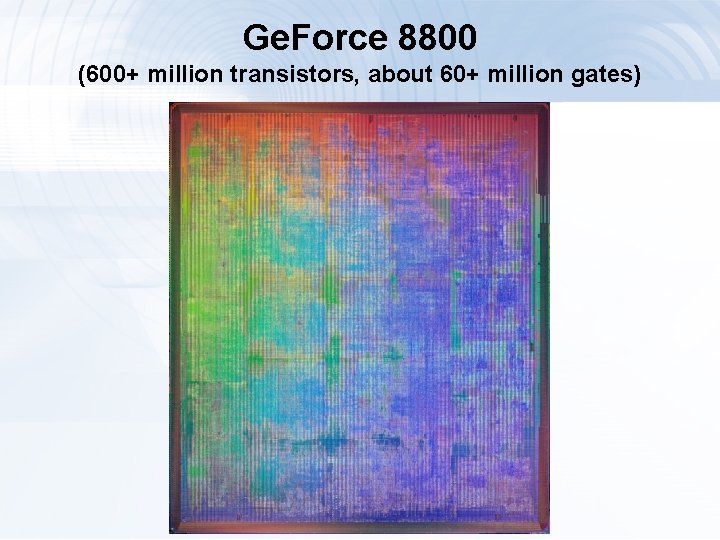
Ge. Force 8800 (600+ million transistors, about 60+ million gates)
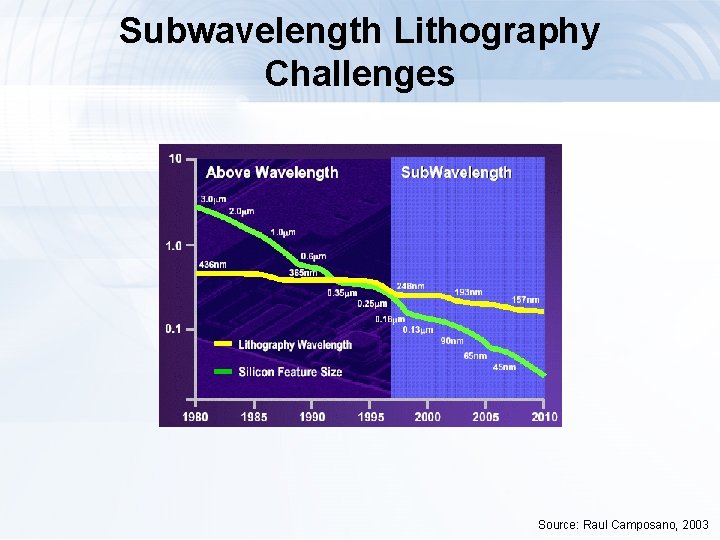
Subwavelength Lithography Challenges Source: Raul Camposano, 2003
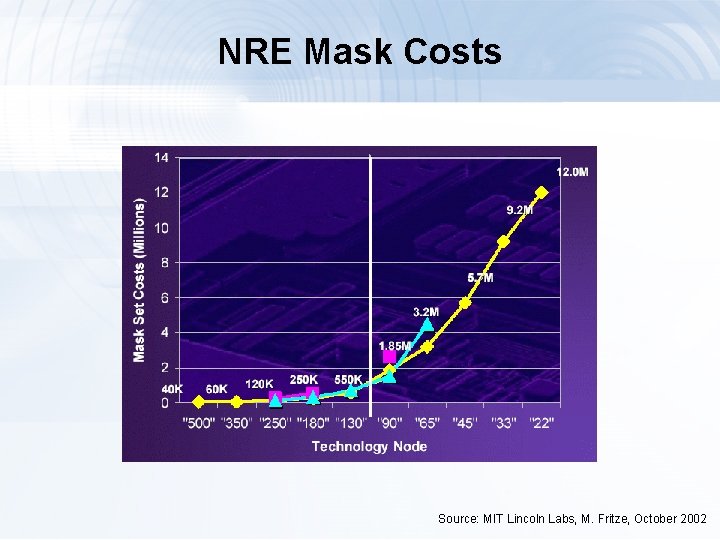
NRE Mask Costs Source: MIT Lincoln Labs, M. Fritze, October 2002
ASIC NRE Costs Not Justified for Many Applications u u u Forecast: By 2010, a complex ASIC will have an NRE Cost of over $40 M = $28 M (NRE Design Cost) + $12 M (NRE Mask Cost) Many “ASIC” applications will not have the volume to justify a $40 M NRE cost e. g. a $30 IC with a 33% margin would require sales of 4 M units (x $10 profit/IC) just to recoup $40 M NRE Cost
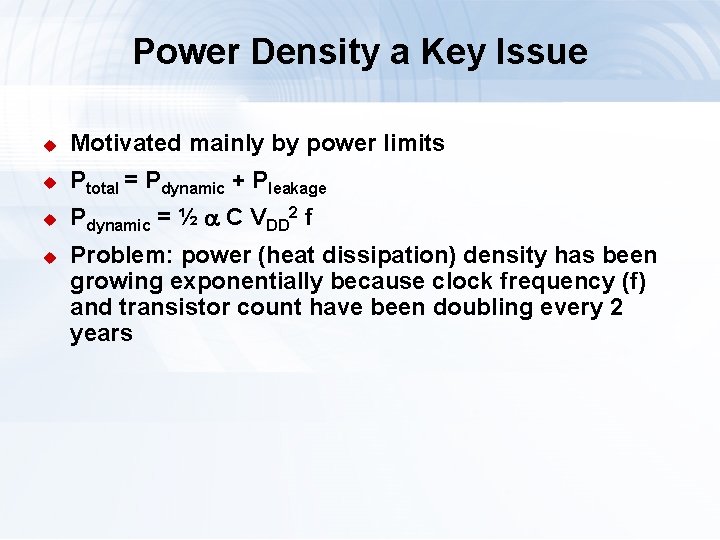
Power Density a Key Issue u Motivated mainly by power limits u Ptotal = Pdynamic + Pleakage u Pdynamic = ½ a C VDD 2 f u Problem: power (heat dissipation) density has been growing exponentially because clock frequency (f) and transistor count have been doubling every 2 years
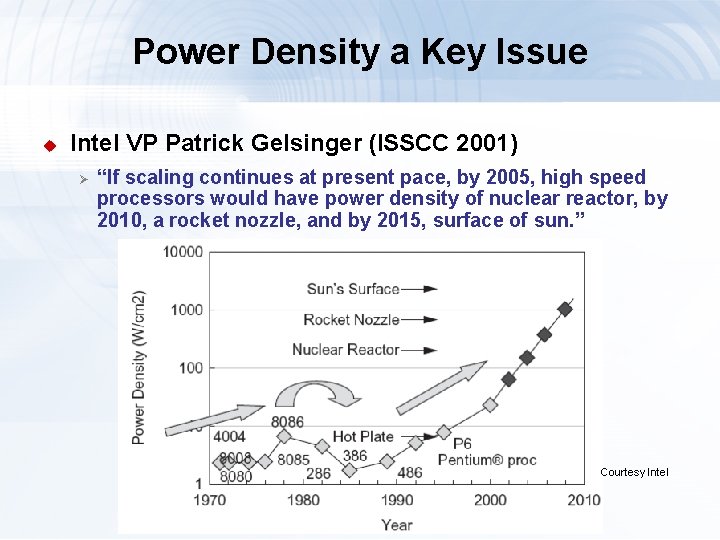
Power Density a Key Issue u Intel VP Patrick Gelsinger (ISSCC 2001) Ø “If scaling continues at present pace, by 2005, high speed processors would have power density of nuclear reactor, by 2010, a rocket nozzle, and by 2015, surface of sun. ” Courtesy Intel
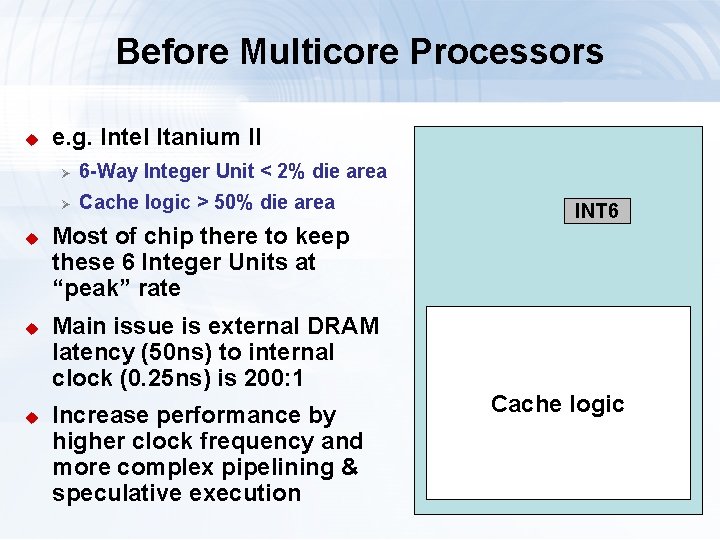
Before Multicore Processors u u e. g. Intel Itanium II Ø 6 -Way Integer Unit < 2% die area Ø Cache logic > 50% die area INT 6 Most of chip there to keep these 6 Integer Units at “peak” rate Main issue is external DRAM latency (50 ns) to internal clock (0. 25 ns) is 200: 1 Increase performance by higher clock frequency and more complex pipelining & speculative execution Cache logic
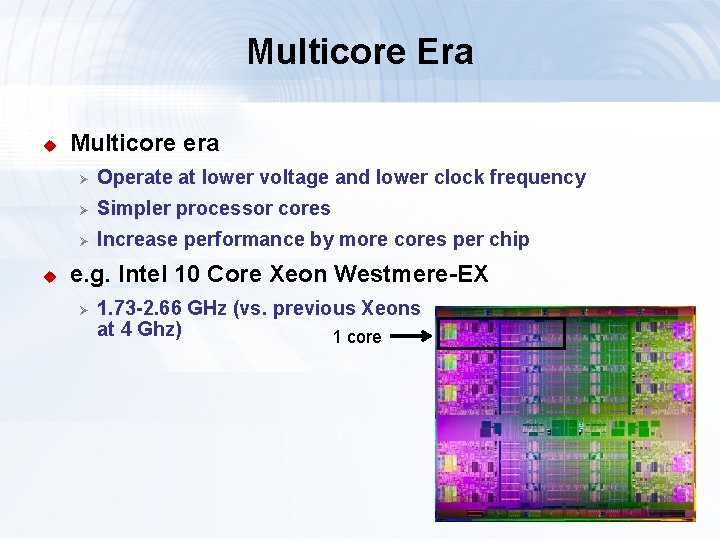
Multicore Era u u Multicore era Ø Operate at lower voltage and lower clock frequency Ø Simpler processor cores Ø Increase performance by more cores per chip e. g. Intel 10 Core Xeon Westmere-EX Ø 1. 73 -2. 66 GHz (vs. previous Xeons at 4 Ghz) 1 core
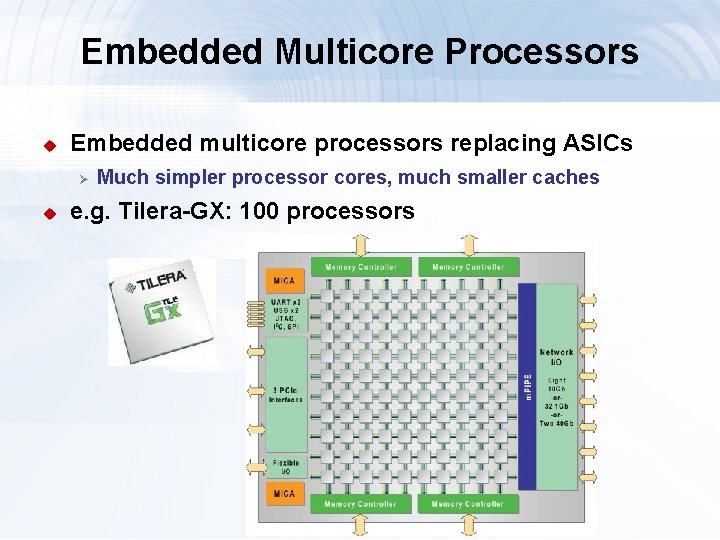
Embedded Multicore Processors u Embedded multicore processors replacing ASICs Ø u Much simpler processor cores, much smaller caches e. g. Tilera-GX: 100 processors
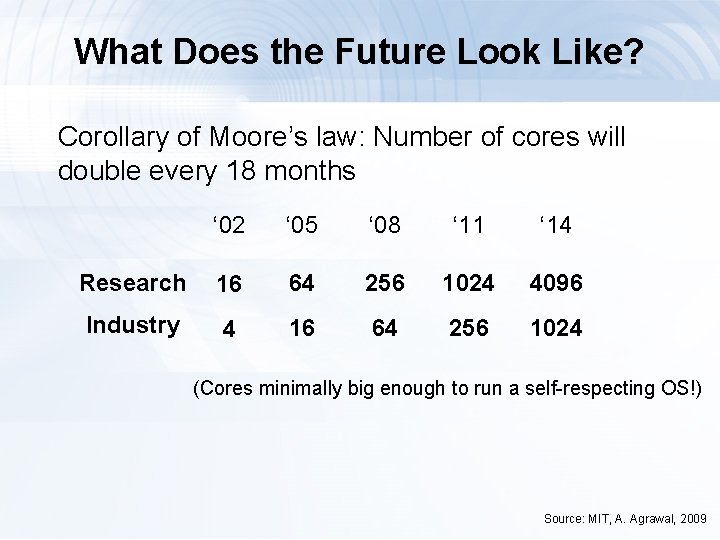
What Does the Future Look Like? Corollary of Moore’s law: Number of cores will double every 18 months ‘ 02 ‘ 05 ‘ 08 ‘ 11 ‘ 14 Research 16 64 256 1024 4096 Industry 4 16 64 256 1024 (Cores minimally big enough to run a self-respecting OS!) Source: MIT, A. Agrawal, 2009
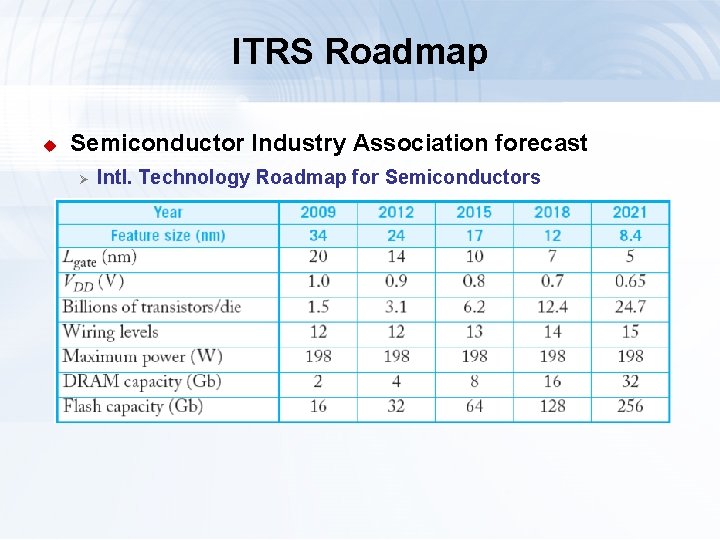
ITRS Roadmap u Semiconductor Industry Association forecast Ø Intl. Technology Roadmap for Semiconductors
- Slides: 18