
VLSI Testing Lecture 2 Yield Quality Dr Vishwani

- Slides: 19
VLSI Testing Lecture 2: Yield & Quality Dr. Vishwani D. Agrawal James J. Danaher Professor of Electrical and Computer Engineering Auburn University, Alabama 36849, USA vagrawal@eng. auburn. edu http: //www. eng. auburn. edu/~vagrawal IIT Delhi, July 24, 2012, 4: 00 -5: 00 PM Copyright 2001, Agrawal & Bushnell Lecture 2 Yield & Quality 1
Contents n n n n Yield and manufacturing cost Clustered defect yield formula Defect level Test data analysis Example: SEMATECH chip Summary Problems to solve Copyright 2001, Agrawal & Bushnell Lecture 2 Yield & Quality 2
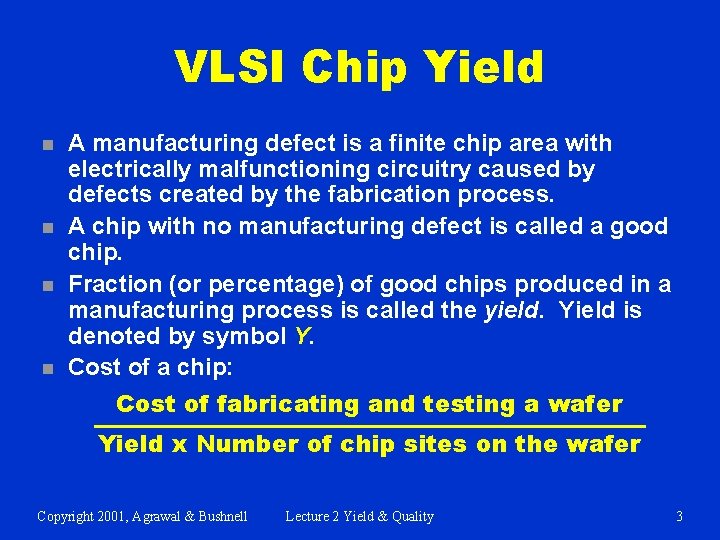
VLSI Chip Yield n n A manufacturing defect is a finite chip area with electrically malfunctioning circuitry caused by defects created by the fabrication process. A chip with no manufacturing defect is called a good chip. Fraction (or percentage) of good chips produced in a manufacturing process is called the yield. Yield is denoted by symbol Y. Cost of a chip: Cost of fabricating and testing a wafer ———————————— Yield x Number of chip sites on the wafer Copyright 2001, Agrawal & Bushnell Lecture 2 Yield & Quality 3
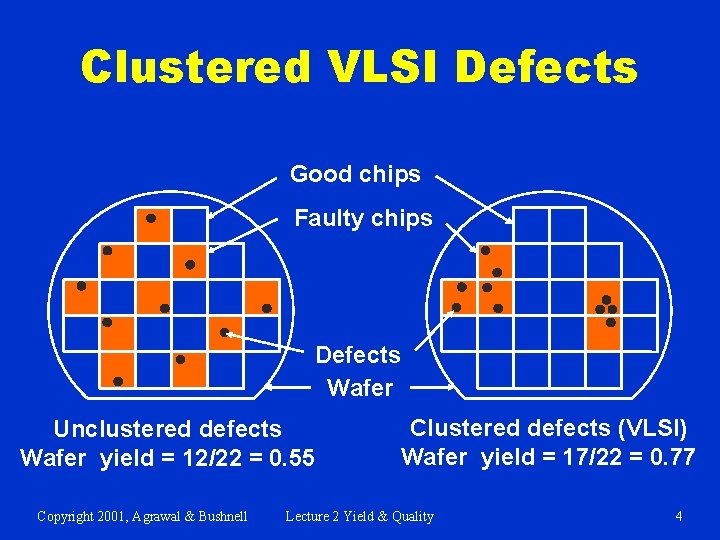
Clustered VLSI Defects Good chips Faulty chips Defects Wafer Unclustered defects Wafer yield = 12/22 = 0. 55 Copyright 2001, Agrawal & Bushnell Clustered defects (VLSI) Wafer yield = 17/22 = 0. 77 Lecture 2 Yield & Quality 4
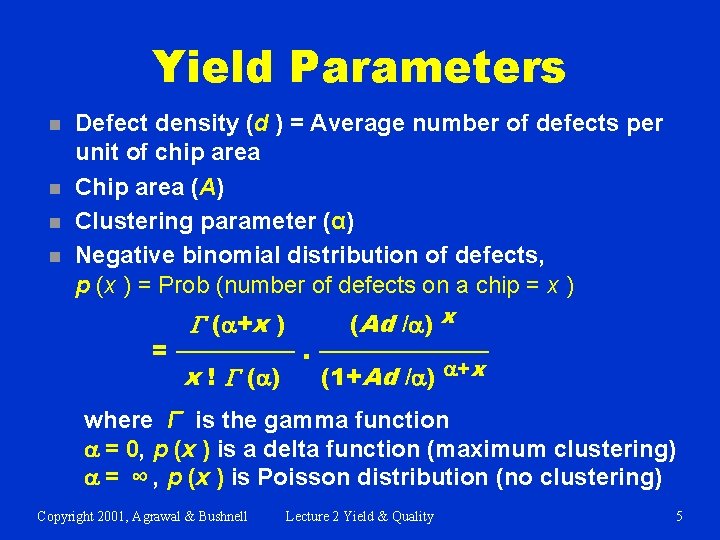
Yield Parameters n n Defect density (d ) = Average number of defects per unit of chip area Chip area (A) Clustering parameter (α) Negative binomial distribution of defects, p (x ) = Prob (number of defects on a chip = x ) (Ad /a) x = ─────── x ! G (a) (1+Ad /a) a+x G (a+x ) where Γ is the gamma function a = 0, p (x ) is a delta function (maximum clustering) a = ∞ , p (x ) is Poisson distribution (no clustering) Copyright 2001, Agrawal & Bushnell Lecture 2 Yield & Quality 5
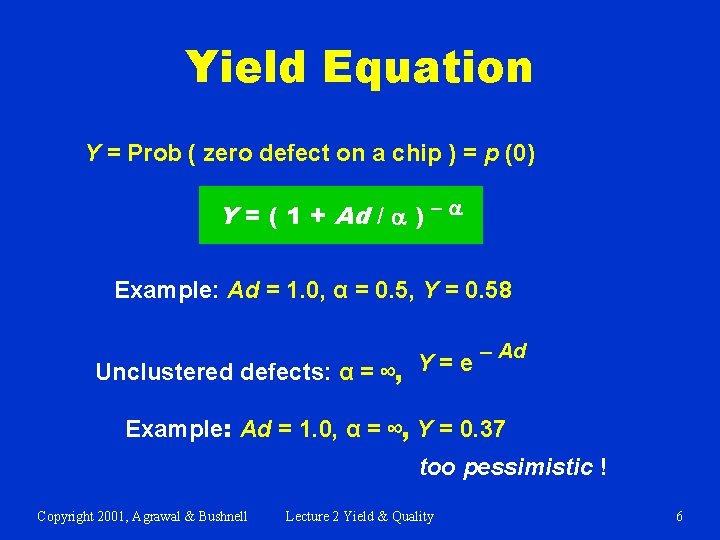
Yield Equation Y = Prob ( zero defect on a chip ) = p (0) Y = ( 1 + Ad / a ) - a Example: Ad = 1. 0, α = 0. 5, Y = 0. 58 Unclustered defects: α = ∞, Y = e – Ad Example: Ad = 1. 0, α = ∞, Y = 0. 37 too pessimistic ! Copyright 2001, Agrawal & Bushnell Lecture 2 Yield & Quality 6
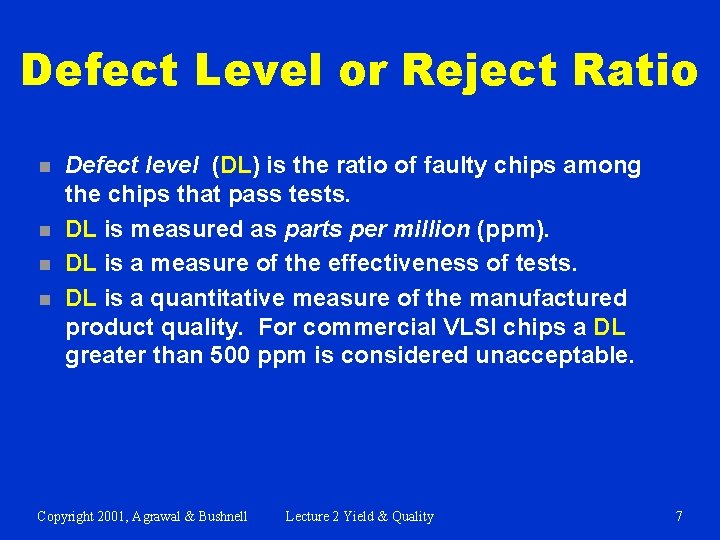
Defect Level or Reject Ratio n n Defect level (DL) is the ratio of faulty chips among the chips that pass tests. DL is measured as parts per million (ppm). DL is a measure of the effectiveness of tests. DL is a quantitative measure of the manufactured product quality. For commercial VLSI chips a DL greater than 500 ppm is considered unacceptable. Copyright 2001, Agrawal & Bushnell Lecture 2 Yield & Quality 7
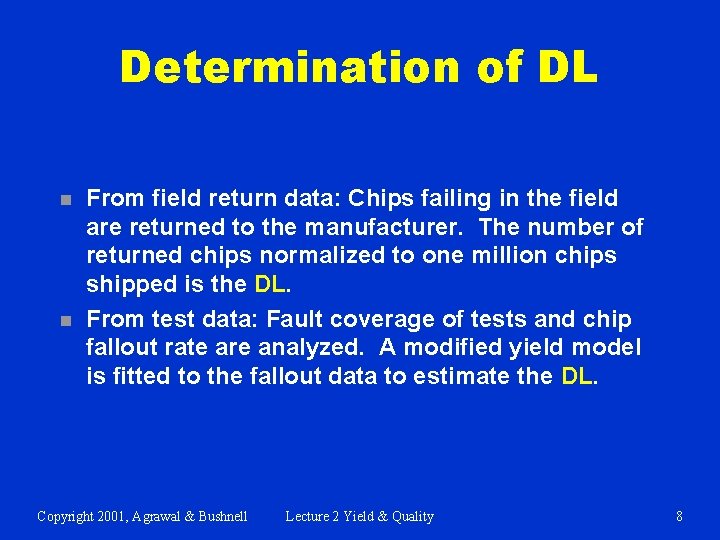
Determination of DL n n From field return data: Chips failing in the field are returned to the manufacturer. The number of returned chips normalized to one million chips shipped is the DL. From test data: Fault coverage of tests and chip fallout rate are analyzed. A modified yield model is fitted to the fallout data to estimate the DL. Copyright 2001, Agrawal & Bushnell Lecture 2 Yield & Quality 8
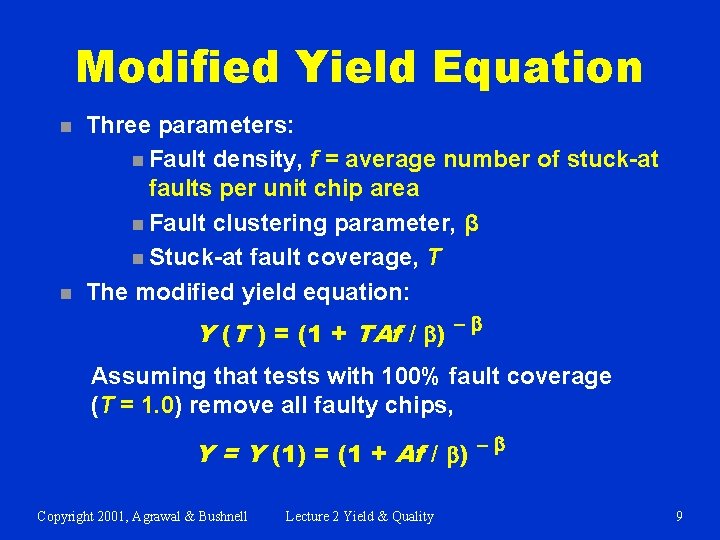
Modified Yield Equation n n Three parameters: n Fault density, f = average number of stuck-at faults per unit chip area n Fault clustering parameter, β n Stuck-at fault coverage, T The modified yield equation: Y (T ) = (1 + TAf / b) – b Assuming that tests with 100% fault coverage (T = 1. 0) remove all faulty chips, Y = Y (1) = (1 + Af / b) – b Copyright 2001, Agrawal & Bushnell Lecture 2 Yield & Quality 9
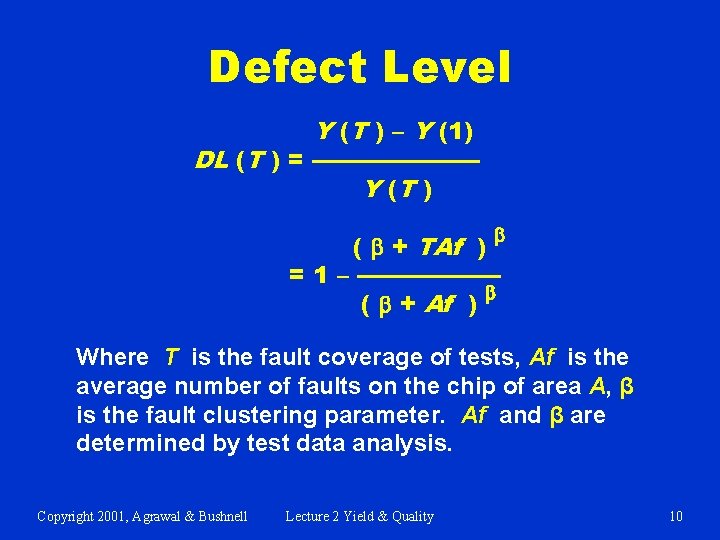
Defect Level Y (T ) – Y (1) DL (T ) = ——————— Y (T ) b ( b + TAf ) = 1 – —————— b ( b + Af ) Where T is the fault coverage of tests, Af is the average number of faults on the chip of area A, β is the fault clustering parameter. Af and β are determined by test data analysis. Copyright 2001, Agrawal & Bushnell Lecture 2 Yield & Quality 10
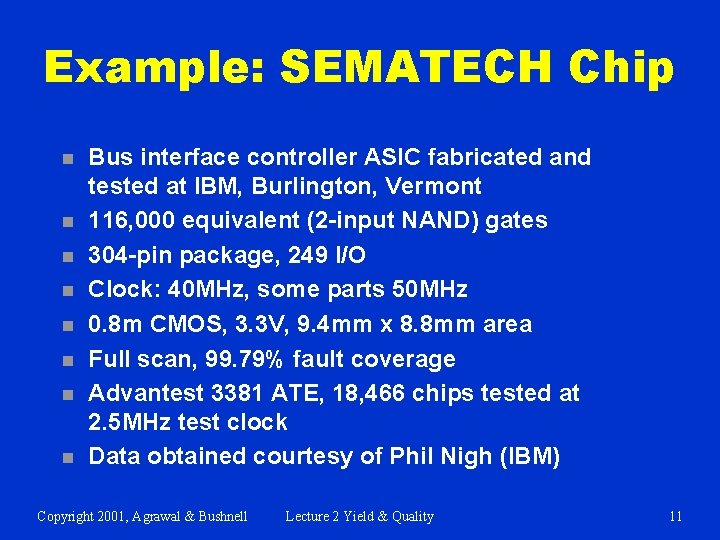
Example: SEMATECH Chip n n n n Bus interface controller ASIC fabricated and tested at IBM, Burlington, Vermont 116, 000 equivalent (2 -input NAND) gates 304 -pin package, 249 I/O Clock: 40 MHz, some parts 50 MHz 0. 8 m CMOS, 3. 3 V, 9. 4 mm x 8. 8 mm area Full scan, 99. 79% fault coverage Advantest 3381 ATE, 18, 466 chips tested at 2. 5 MHz test clock Data obtained courtesy of Phil Nigh (IBM) Copyright 2001, Agrawal & Bushnell Lecture 2 Yield & Quality 11
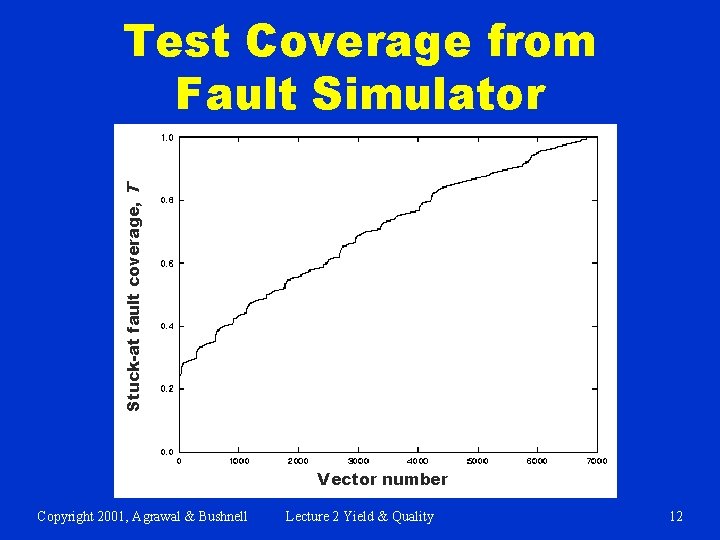
Stuck-at fault coverage, T Test Coverage from Fault Simulator Vector number Copyright 2001, Agrawal & Bushnell Lecture 2 Yield & Quality 12
Measured chip fallout, 1 – Y (T ) Measured Chip Fallout Vector number Copyright 2001, Agrawal & Bushnell Lecture 2 Yield & Quality 13
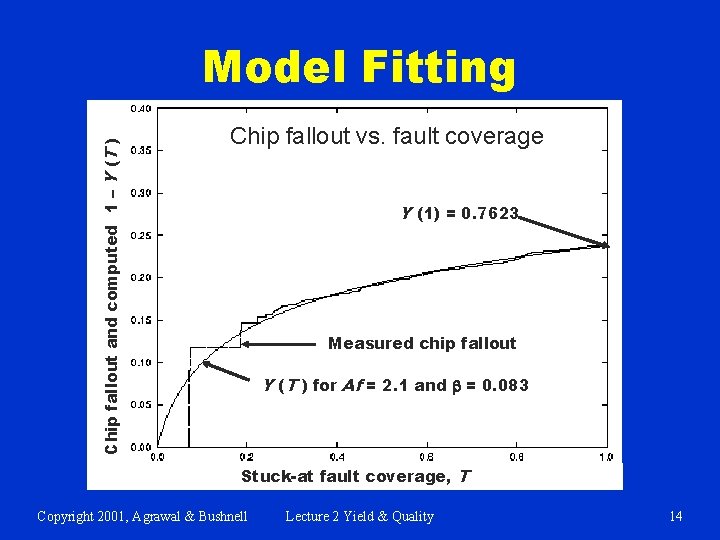
Chip fallout and computed 1 – Y (T ) Model Fitting Chip fallout vs. fault coverage Y (1) = 0. 7623 Measured chip fallout Y (T ) for Af = 2. 1 and b = 0. 083 Stuck-at fault coverage, T Copyright 2001, Agrawal & Bushnell Lecture 2 Yield & Quality 14
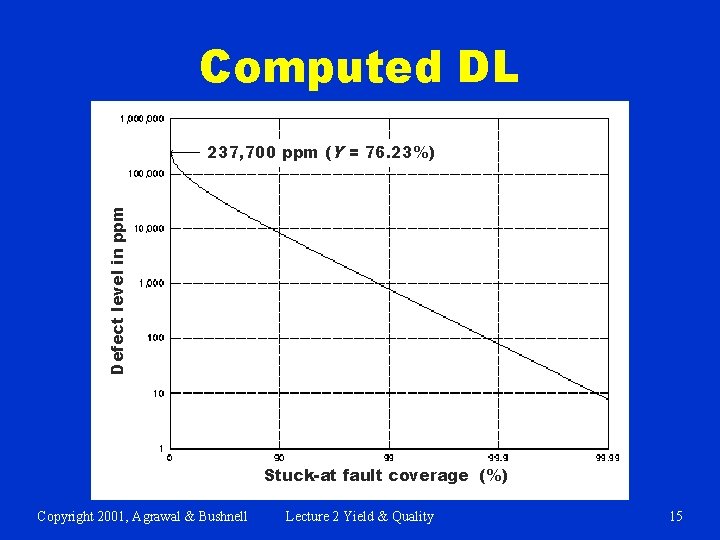
Computed DL Defect level in ppm 237, 700 ppm (Y = 76. 23%) Stuck-at fault coverage (%) Copyright 2001, Agrawal & Bushnell Lecture 2 Yield & Quality 15
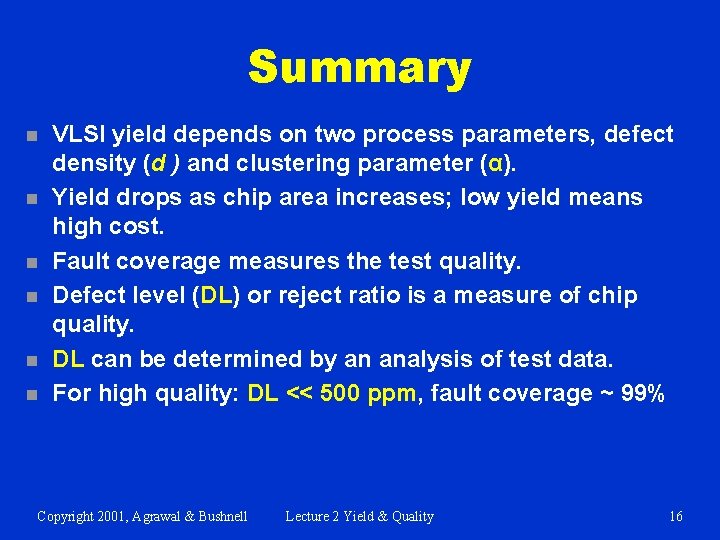
Summary n n n VLSI yield depends on two process parameters, defect density (d ) and clustering parameter (α). Yield drops as chip area increases; low yield means high cost. Fault coverage measures the test quality. Defect level (DL) or reject ratio is a measure of chip quality. DL can be determined by an analysis of test data. For high quality: DL << 500 ppm, fault coverage ~ 99% Copyright 2001, Agrawal & Bushnell Lecture 2 Yield & Quality 16
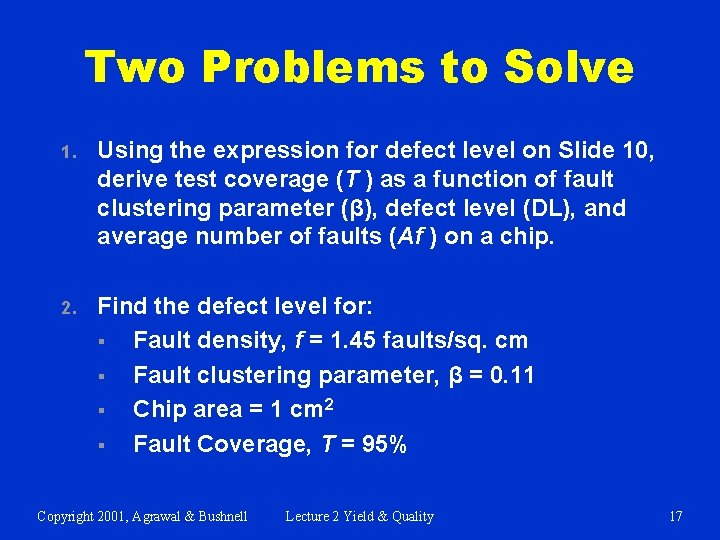
Two Problems to Solve 1. Using the expression for defect level on Slide 10, derive test coverage (T ) as a function of fault clustering parameter (β), defect level (DL), and average number of faults (Af ) on a chip. 2. Find the defect level for: § Fault density, f = 1. 45 faults/sq. cm § Fault clustering parameter, β = 0. 11 § Chip area = 1 cm 2 § Fault Coverage, T = 95% Copyright 2001, Agrawal & Bushnell Lecture 2 Yield & Quality 17
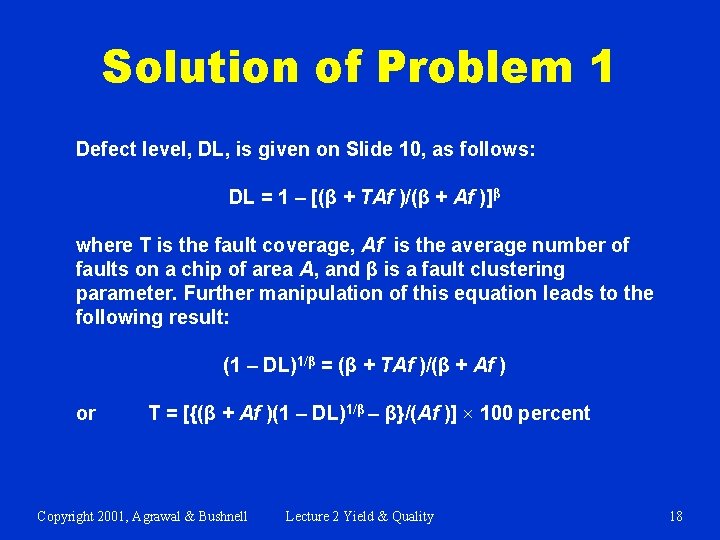
Solution of Problem 1 Defect level, DL, is given on Slide 10, as follows: DL = 1 – [(β + TAf )/(β + Af )]β where T is the fault coverage, Af is the average number of faults on a chip of area A, and β is a fault clustering parameter. Further manipulation of this equation leads to the following result: (1 – DL)1/β = (β + TAf )/(β + Af ) or T = [{(β + Af )(1 – DL)1/β – β}/(Af )] × 100 percent Copyright 2001, Agrawal & Bushnell Lecture 2 Yield & Quality 18
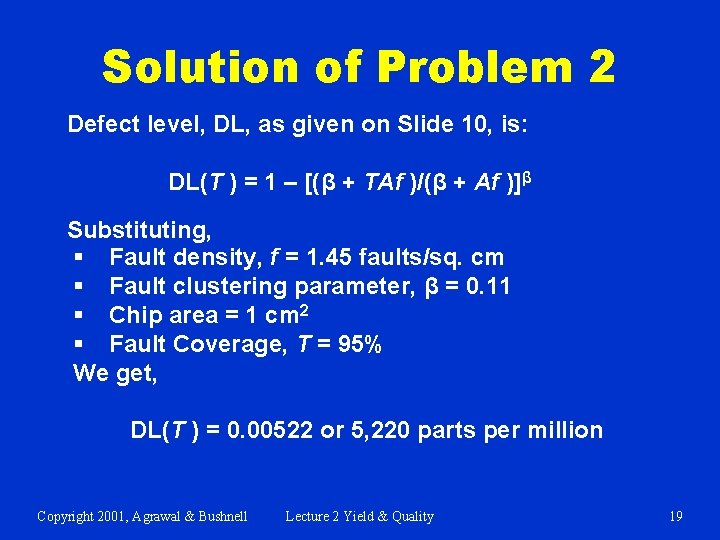
Solution of Problem 2 Defect level, DL, as given on Slide 10, is: DL(T ) = 1 – [(β + TAf )/(β + Af )]β Substituting, § Fault density, f = 1. 45 faults/sq. cm § Fault clustering parameter, β = 0. 11 § Chip area = 1 cm 2 § Fault Coverage, T = 95% We get, DL(T ) = 0. 00522 or 5, 220 parts per million Copyright 2001, Agrawal & Bushnell Lecture 2 Yield & Quality 19