
VLSI Testing Lecture 10 DFT and Scan n
- Slides: 24
VLSI Testing Lecture 10: DFT and Scan n Definitions Ad-hoc methods Scan design § § § n n Design rules Scan register Scan flip-flops Scan test sequences Overheads Boundary scan Summary Copyright 2001, Agrawal & Bushnell Lecture 12: DFT and Scan 1
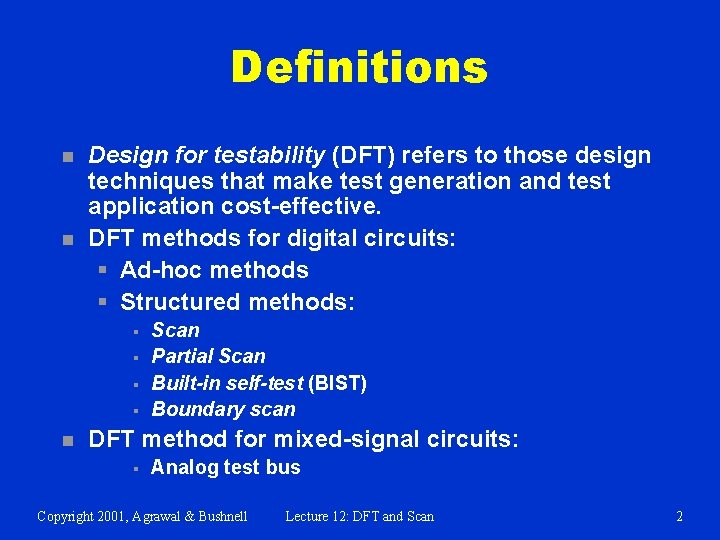
Definitions n n Design for testability (DFT) refers to those design techniques that make test generation and test application cost-effective. DFT methods for digital circuits: § Ad-hoc methods § Structured methods: § § n Scan Partial Scan Built-in self-test (BIST) Boundary scan DFT method for mixed-signal circuits: § Analog test bus Copyright 2001, Agrawal & Bushnell Lecture 12: DFT and Scan 2
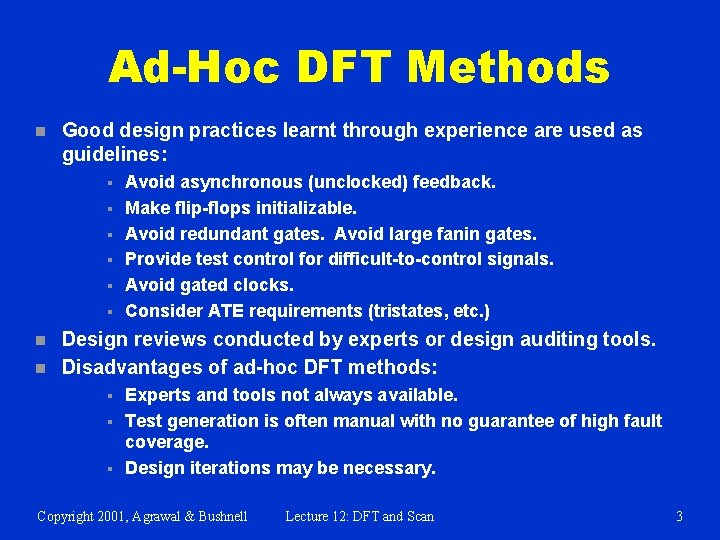
Ad-Hoc DFT Methods n Good design practices learnt through experience are used as guidelines: § § § n n Avoid asynchronous (unclocked) feedback. Make flip-flops initializable. Avoid redundant gates. Avoid large fanin gates. Provide test control for difficult-to-control signals. Avoid gated clocks. Consider ATE requirements (tristates, etc. ) Design reviews conducted by experts or design auditing tools. Disadvantages of ad-hoc DFT methods: § § § Experts and tools not always available. Test generation is often manual with no guarantee of high fault coverage. Design iterations may be necessary. Copyright 2001, Agrawal & Bushnell Lecture 12: DFT and Scan 3
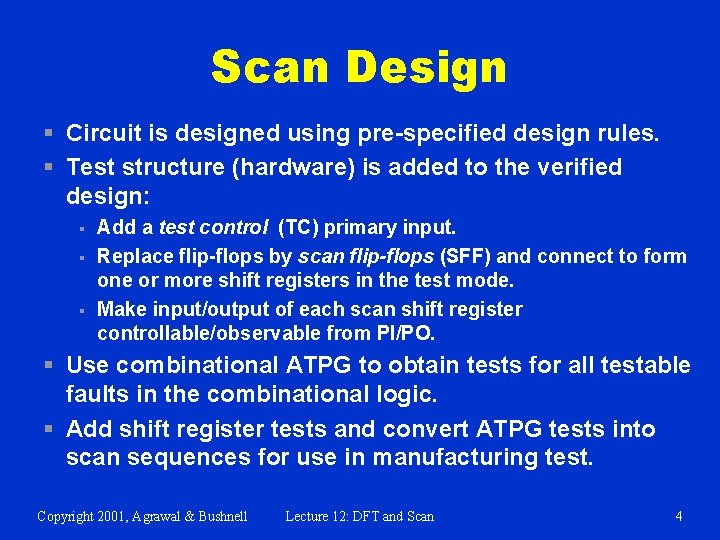
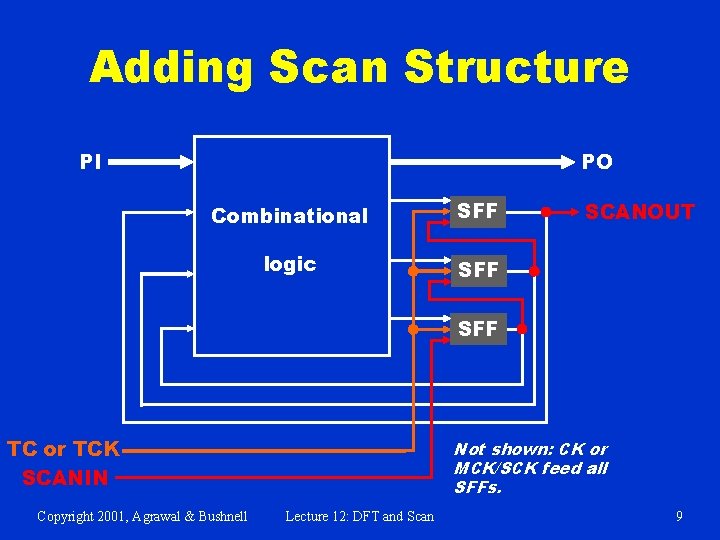
Scan Design § Circuit is designed using pre-specified design rules. § Test structure (hardware) is added to the verified design: § § § Add a test control (TC) primary input. Replace flip-flops by scan flip-flops (SFF) and connect to form one or more shift registers in the test mode. Make input/output of each scan shift register controllable/observable from PI/PO. § Use combinational ATPG to obtain tests for all testable faults in the combinational logic. § Add shift register tests and convert ATPG tests into scan sequences for use in manufacturing test. Copyright 2001, Agrawal & Bushnell Lecture 12: DFT and Scan 4
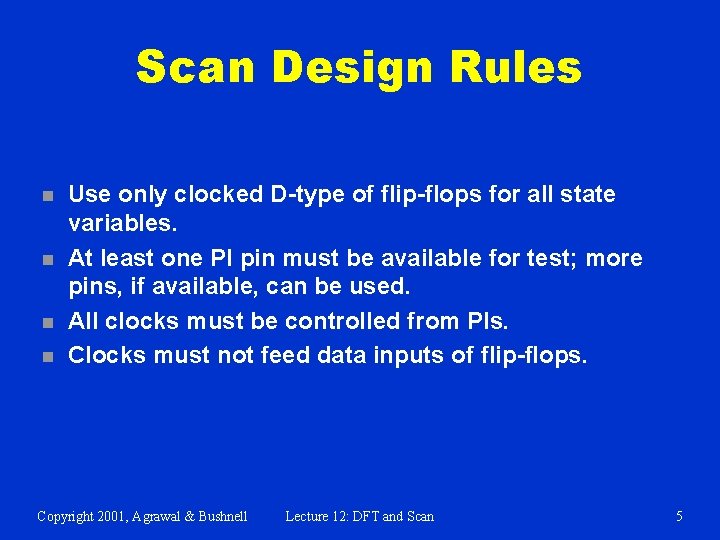
Scan Design Rules n n Use only clocked D-type of flip-flops for all state variables. At least one PI pin must be available for test; more pins, if available, can be used. All clocks must be controlled from PIs. Clocks must not feed data inputs of flip-flops. Copyright 2001, Agrawal & Bushnell Lecture 12: DFT and Scan 5
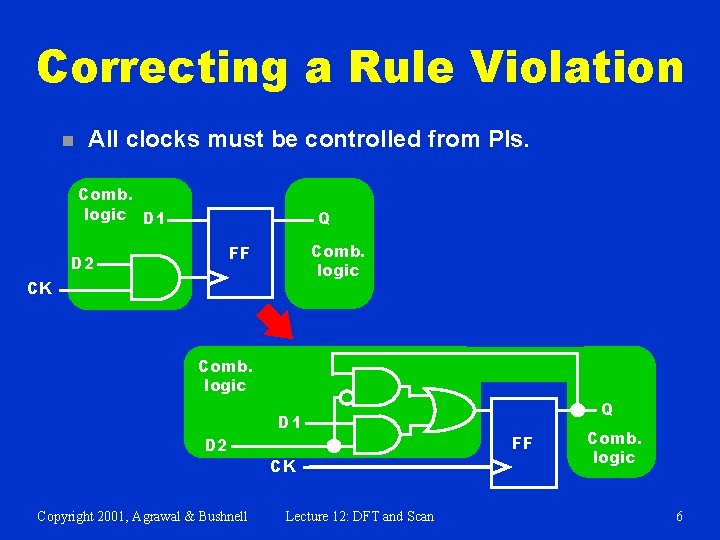
Correcting a Rule Violation n All clocks must be controlled from PIs. Comb. logic D 1 Q Comb. logic FF D 2 CK Comb. logic D 1 D 2 Copyright 2001, Agrawal & Bushnell CK Lecture 12: DFT and Scan Q FF Comb. logic 6
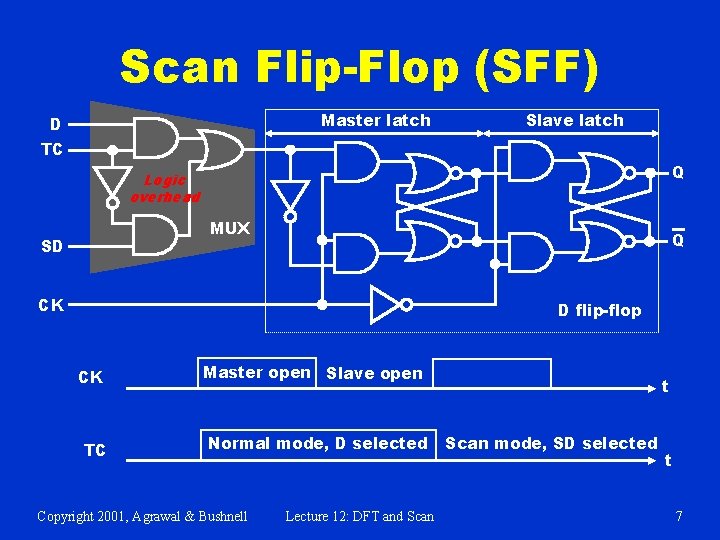
Scan Flip-Flop (SFF) Master latch D Slave latch TC Q Logic overhead MUX SD Q CK D flip-flop CK TC Master open Slave open Normal mode, D selected Copyright 2001, Agrawal & Bushnell Lecture 12: DFT and Scan t Scan mode, SD selected t 7
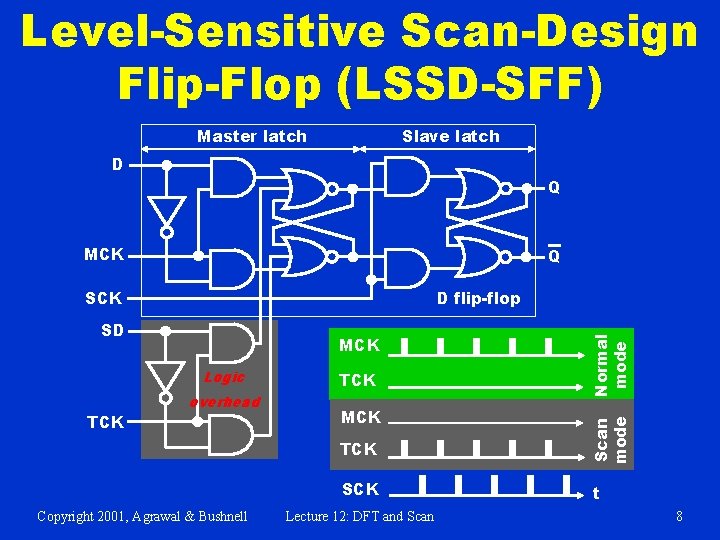
Level-Sensitive Scan-Design Flip-Flop (LSSD-SFF) Master latch Slave latch D Q MCK Q D flip-flop SD MCK TCK overhead Copyright 2001, Agrawal & Bushnell TCK MCK TCK Scan mode Logic Normal mode SCK t Lecture 12: DFT and Scan 8
Adding Scan Structure PI PO Combinational SFF logic SFF SCANOUT SFF TC or TCK SCANIN Copyright 2001, Agrawal & Bushnell Not shown: CK or MCK/SCK feed all SFFs. Lecture 12: DFT and Scan 9
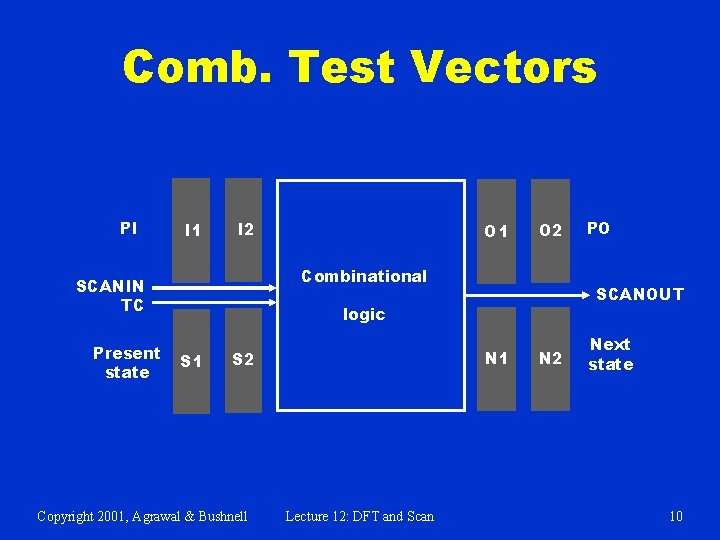
Comb. Test Vectors PI I 1 I 2 O 2 Combinational SCANIN TC Present state O 1 SCANOUT logic S 1 N 1 S 2 Copyright 2001, Agrawal & Bushnell Lecture 12: DFT and Scan PO N 2 Next state 10
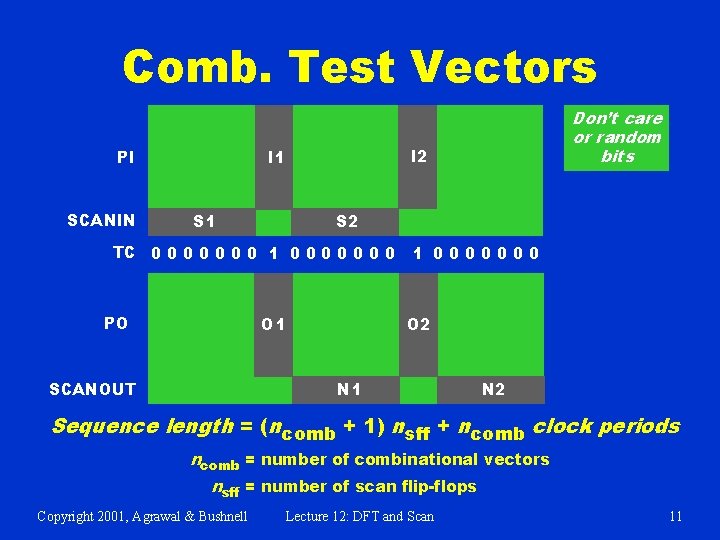
Comb. Test Vectors SCANIN I 2 I 1 PI S 1 Don’t care or random bits S 2 TC 0 0 0 0 1 0 0 0 0 PO O 2 O 1 SCANOUT N 1 N 2 Sequence length = (ncomb + 1) nsff + ncomb clock periods ncomb = number of combinational vectors nsff = number of scan flip-flops Copyright 2001, Agrawal & Bushnell Lecture 12: DFT and Scan 11
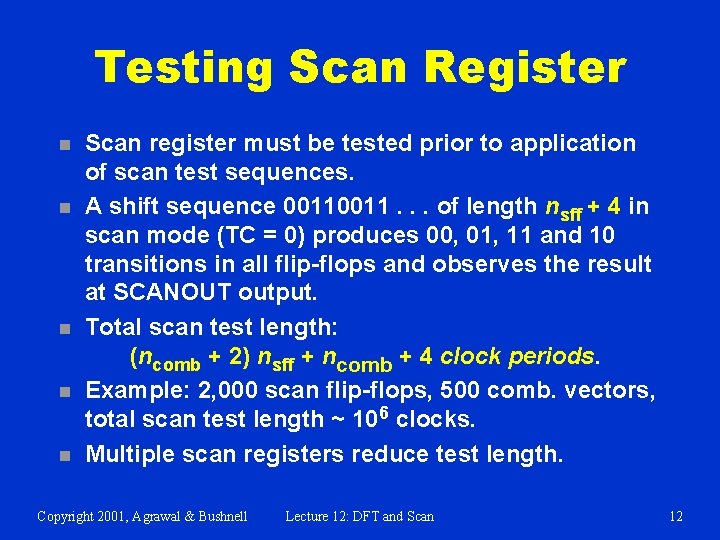
Testing Scan Register n n n Scan register must be tested prior to application of scan test sequences. A shift sequence 0011. . . of length nsff + 4 in scan mode (TC = 0) produces 00, 01, 11 and 10 transitions in all flip-flops and observes the result at SCANOUT output. Total scan test length: (ncomb + 2) nsff + ncomb + 4 clock periods. Example: 2, 000 scan flip-flops, 500 comb. vectors, total scan test length ~ 106 clocks. Multiple scan registers reduce test length. Copyright 2001, Agrawal & Bushnell Lecture 12: DFT and Scan 12
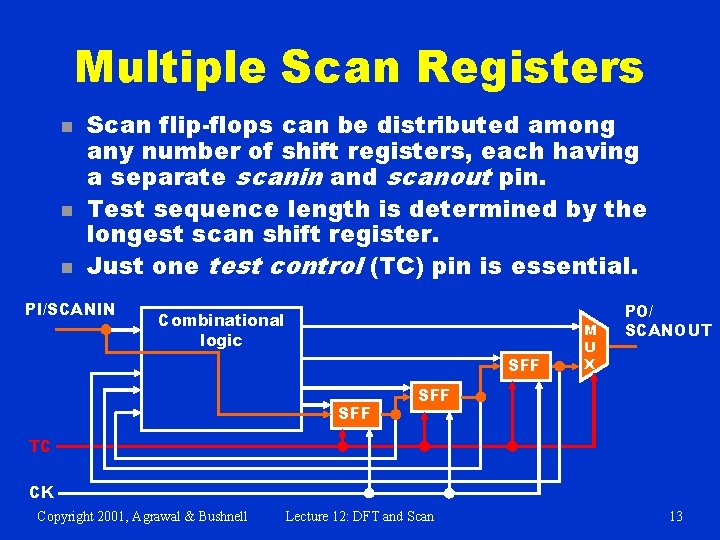
Multiple Scan Registers n n n Scan flip-flops can be distributed among any number of shift registers, each having a separate scanin and scanout pin. Test sequence length is determined by the longest scan shift register. Just one test control (TC) pin is essential. PI/SCANIN Combinational logic SFF M U X PO/ SCANOUT SFF TC CK Copyright 2001, Agrawal & Bushnell Lecture 12: DFT and Scan 13
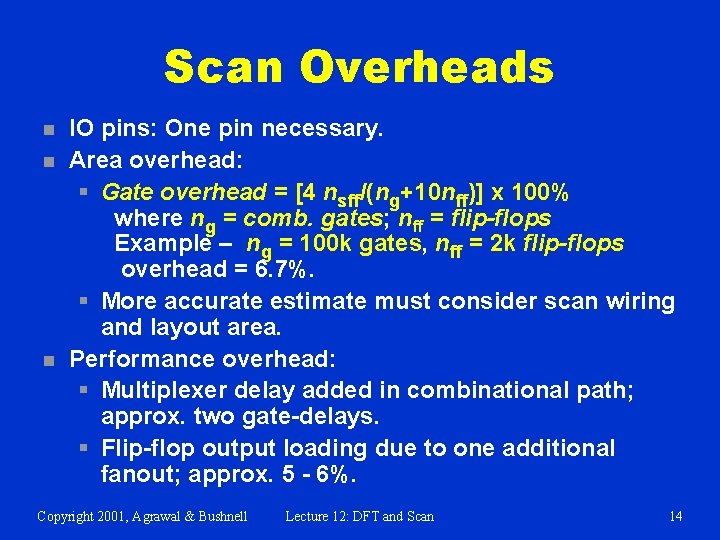
Scan Overheads n n n IO pins: One pin necessary. Area overhead: § Gate overhead = [4 nsff/(ng+10 nff)] x 100% where ng = comb. gates; nff = flip-flops Example – ng = 100 k gates, nff = 2 k flip-flops overhead = 6. 7%. § More accurate estimate must consider scan wiring and layout area. Performance overhead: § Multiplexer delay added in combinational path; approx. two gate-delays. § Flip-flop output loading due to one additional fanout; approx. 5 - 6%. Copyright 2001, Agrawal & Bushnell Lecture 12: DFT and Scan 14
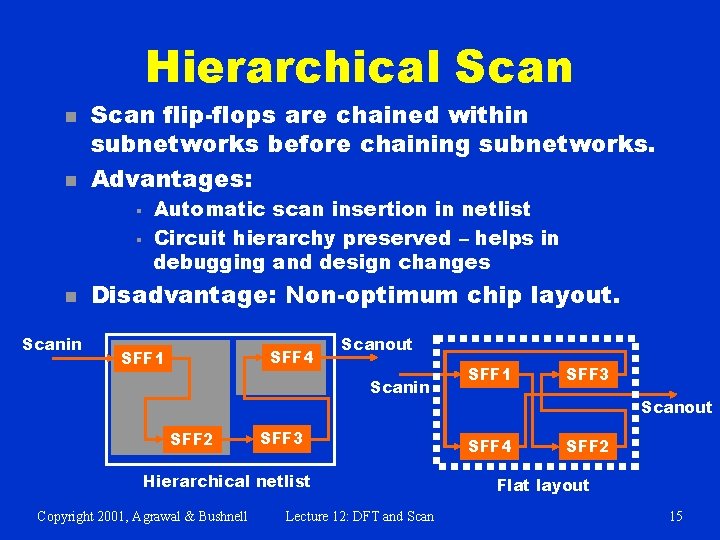
Hierarchical Scan n n Scan flip-flops are chained within subnetworks before chaining subnetworks. Advantages: § § n Scanin Automatic scan insertion in netlist Circuit hierarchy preserved – helps in debugging and design changes Disadvantage: Non-optimum chip layout. SFF 4 SFF 1 Scanout Scanin SFF 2 SFF 3 Hierarchical netlist Copyright 2001, Agrawal & Bushnell Lecture 12: DFT and Scan SFF 1 SFF 3 Scanout SFF 4 SFF 2 Flat layout 15
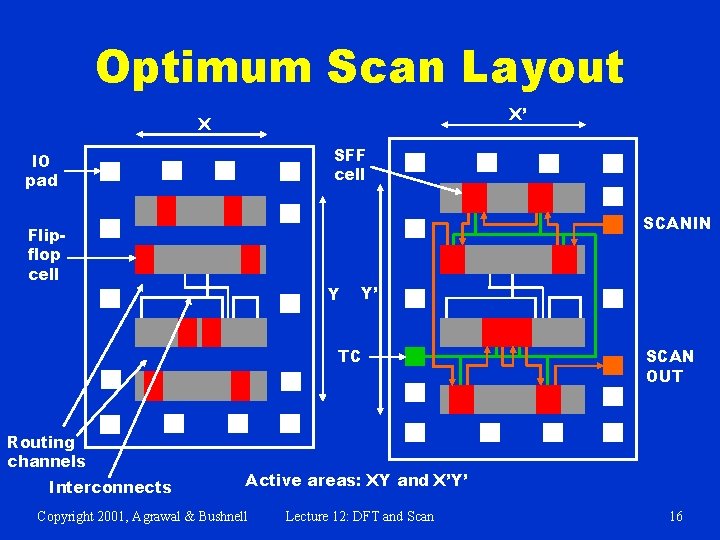
Optimum Scan Layout X’ X SFF cell IO pad SCANIN Flipflop cell Y Y’ TC Routing channels Interconnects SCAN OUT Active areas: XY and X’Y’ Copyright 2001, Agrawal & Bushnell Lecture 12: DFT and Scan 16
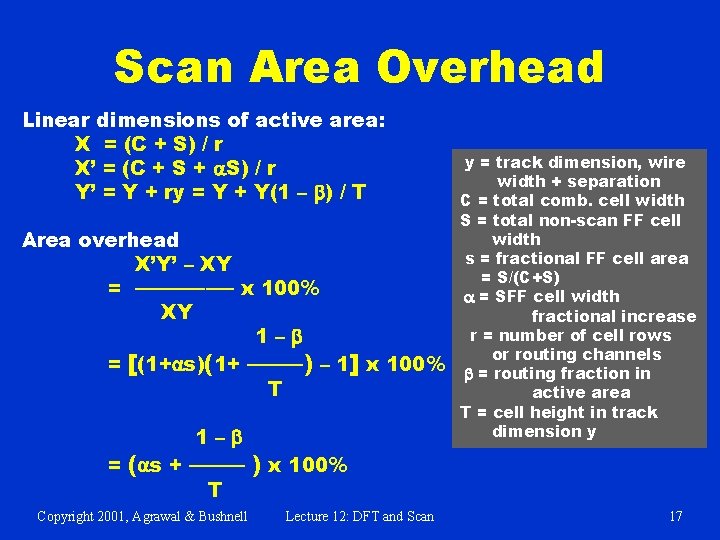
Scan Area Overhead Linear dimensions of active area: X = (C + S) / r X’ = (C + S + a. S) / r Y’ = Y + ry = Y + Y(1 – b) / T Area overhead X’Y’ – XY = ─────── x 100% XY 1–b = [(1+as)(1+ ────) – 1] x 100% T 1–b = (as + ──── T Copyright 2001, Agrawal & Bushnell y = track dimension, wire width + separation C = total comb. cell width S = total non-scan FF cell width s = fractional FF cell area = S/(C+S) a = SFF cell width fractional increase r = number of cell rows or routing channels b = routing fraction in active area T = cell height in track dimension y ) x 100% Lecture 12: DFT and Scan 17
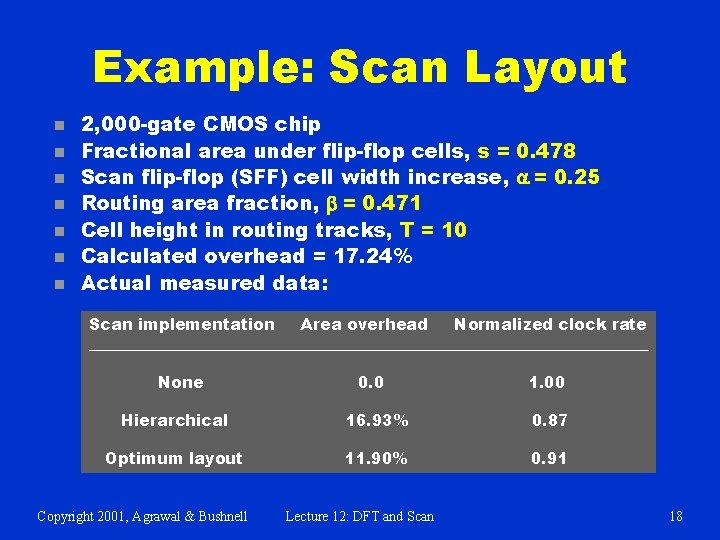
Example: Scan Layout n n n n 2, 000 -gate CMOS chip Fractional area under flip-flop cells, s = 0. 478 Scan flip-flop (SFF) cell width increase, a = 0. 25 Routing area fraction, b = 0. 471 Cell height in routing tracks, T = 10 Calculated overhead = 17. 24% Actual measured data: Scan implementation Area overhead Normalized clock rate ___________________________________ None 0. 0 1. 00 Hierarchical 16. 93% 0. 87 Optimum layout 11. 90% 0. 91 Copyright 2001, Agrawal & Bushnell Lecture 12: DFT and Scan 18
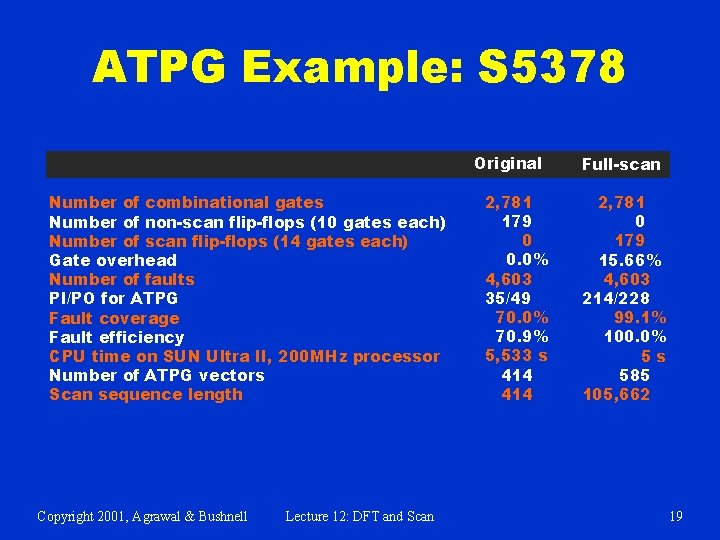
ATPG Example: S 5378 Original Number of combinational gates Number of non-scan flip-flops (10 gates each) Number of scan flip-flops (14 gates each) Gate overhead Number of faults PI/PO for ATPG Fault coverage Fault efficiency CPU time on SUN Ultra II, 200 MHz processor Number of ATPG vectors Scan sequence length Copyright 2001, Agrawal & Bushnell Lecture 12: DFT and Scan 2, 781 179 0 0. 0% 4, 603 35/49 70. 0% 70. 9% 5, 533 s 414 Full-scan 2, 781 0 179 15. 66% 4, 603 214/228 99. 1% 100. 0% 5 s 585 105, 662 19
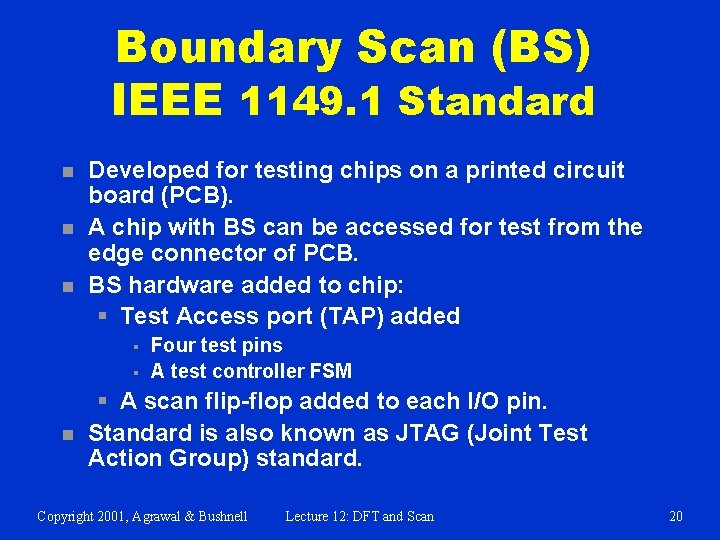
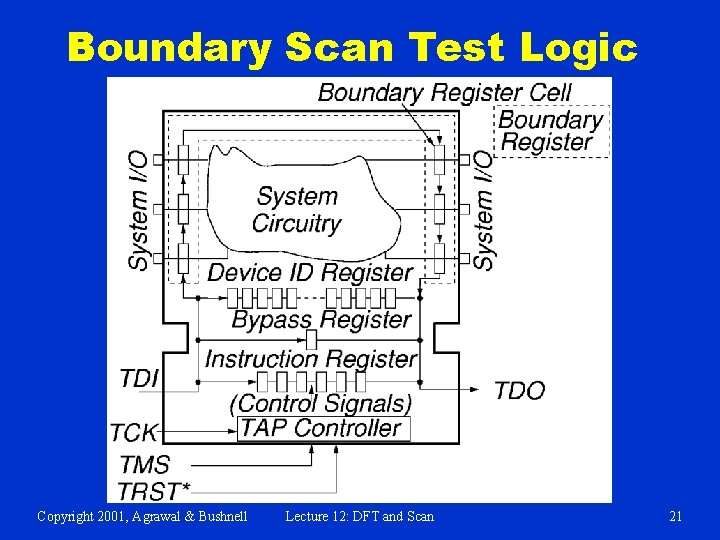
Boundary Scan (BS) IEEE 1149. 1 Standard n n n Developed for testing chips on a printed circuit board (PCB). A chip with BS can be accessed for test from the edge connector of PCB. BS hardware added to chip: § Test Access port (TAP) added § § n Four test pins A test controller FSM § A scan flip-flop added to each I/O pin. Standard is also known as JTAG (Joint Test Action Group) standard. Copyright 2001, Agrawal & Bushnell Lecture 12: DFT and Scan 20
Boundary Scan Test Logic Copyright 2001, Agrawal & Bushnell Lecture 12: DFT and Scan 21
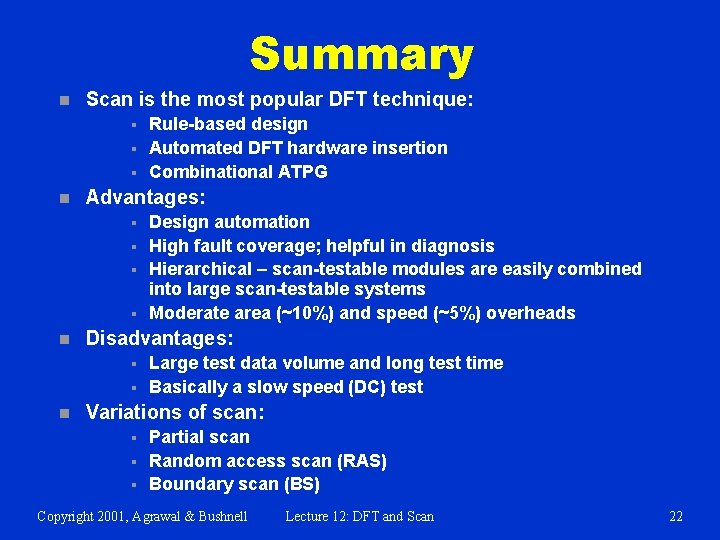
Summary n Scan is the most popular DFT technique: § § § n Advantages: § § n Design automation High fault coverage; helpful in diagnosis Hierarchical – scan-testable modules are easily combined into large scan-testable systems Moderate area (~10%) and speed (~5%) overheads Disadvantages: § § n Rule-based design Automated DFT hardware insertion Combinational ATPG Large test data volume and long test time Basically a slow speed (DC) test Variations of scan: § § § Partial scan Random access scan (RAS) Boundary scan (BS) Copyright 2001, Agrawal & Bushnell Lecture 12: DFT and Scan 22
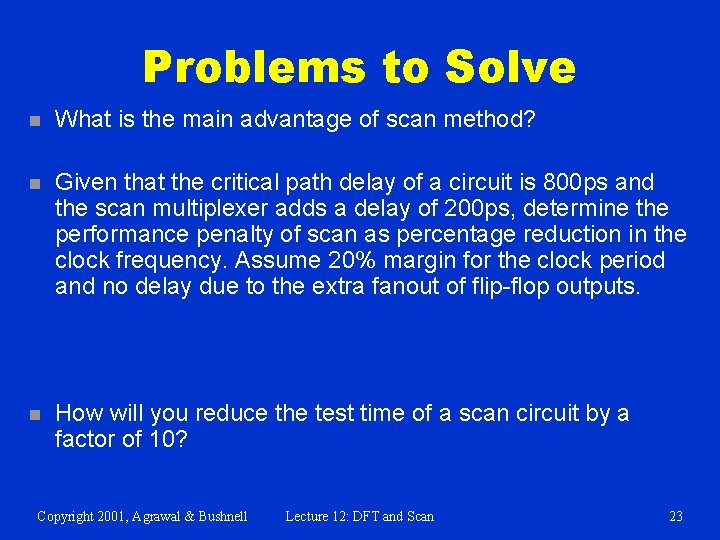
Problems to Solve n What is the main advantage of scan method? n Given that the critical path delay of a circuit is 800 ps and the scan multiplexer adds a delay of 200 ps, determine the performance penalty of scan as percentage reduction in the clock frequency. Assume 20% margin for the clock period and no delay due to the extra fanout of flip-flop outputs. n How will you reduce the test time of a scan circuit by a factor of 10? Copyright 2001, Agrawal & Bushnell Lecture 12: DFT and Scan 23
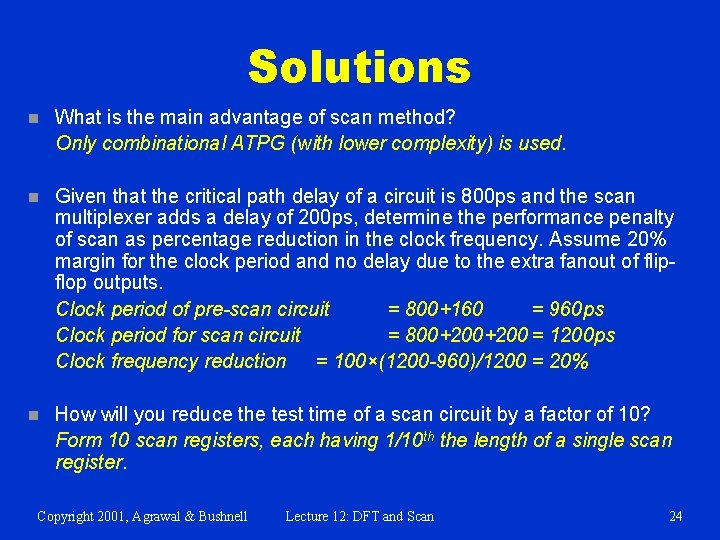
Solutions n What is the main advantage of scan method? Only combinational ATPG (with lower complexity) is used. n Given that the critical path delay of a circuit is 800 ps and the scan multiplexer adds a delay of 200 ps, determine the performance penalty of scan as percentage reduction in the clock frequency. Assume 20% margin for the clock period and no delay due to the extra fanout of flipflop outputs. Clock period of pre-scan circuit = 800+160 = 960 ps Clock period for scan circuit = 800+200 = 1200 ps Clock frequency reduction = 100×(1200 -960)/1200 = 20% n How will you reduce the test time of a scan circuit by a factor of 10? Form 10 scan registers, each having 1/10 th the length of a single scan register. Copyright 2001, Agrawal & Bushnell Lecture 12: DFT and Scan 24