
VLIW Architectures Very Long Instruction Word Architecture One
- Slides: 28
VLIW Architectures • Very Long Instruction Word Architecture ÞOne instruction specifies multiple operations ÞAll scheduling of execution units is static ®Done by compiler ÞStatic scheduling should mean less control, higher clock speed. Less control means more room for execution units. • Currently very popular architecture in embedded applications ÞDSP, Multimedia applications ÞNo compiled legacy code to support, all code libraries in some form of high level language 11/4/2020
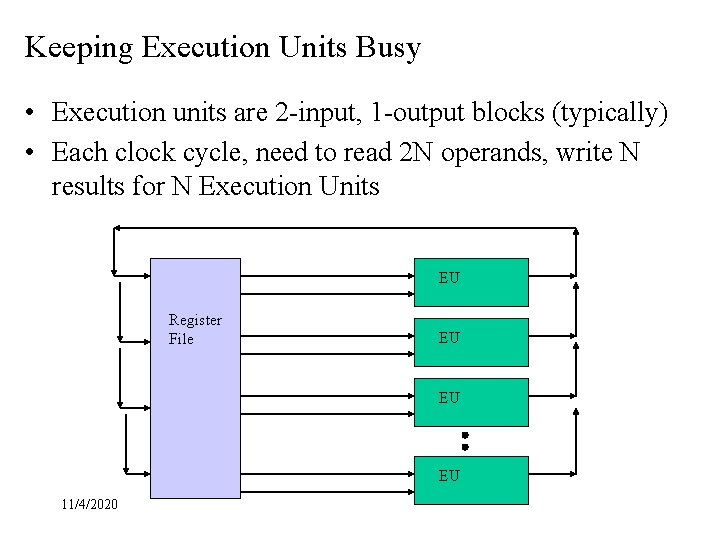
Keeping Execution Units Busy • Execution units are 2 -input, 1 -output blocks (typically) • Each clock cycle, need to read 2 N operands, write N results for N Execution Units EU Register File EU EU EU 11/4/2020
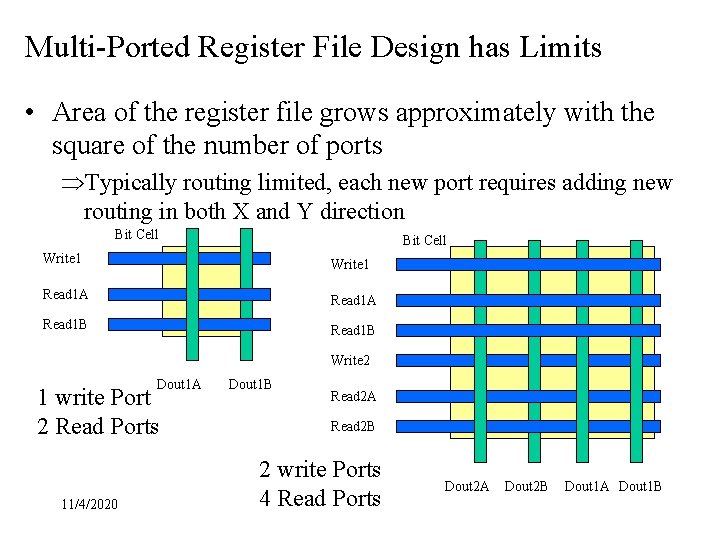
Multi-Ported Register File Design has Limits • Area of the register file grows approximately with the square of the number of ports ÞTypically routing limited, each new port requires adding new routing in both X and Y direction Bit Cell Write 1 Read 1 A Read 1 B Write 2 Dout 1 A 1 write Port 2 Read Ports 11/4/2020 Dout 1 B Read 2 A Read 2 B 2 write Ports 4 Read Ports Dout 2 A Dout 2 B Dout 1 A Dout 1 B
Multiported Register Files (cont) • Read Access time of a register file grows approximately linearly with the number of ports ÞInternal Bit Cell loading becomes larger ÞLarger area of register file causes longer wire delays • What is reasonable today in terms of number of ports? ÞChanges with technology, 15 -20 ports is currently about the maximum (read ports + write ports) ÞWill support 5 -7 execution units simultaneous operand accesses from register file 11/4/2020
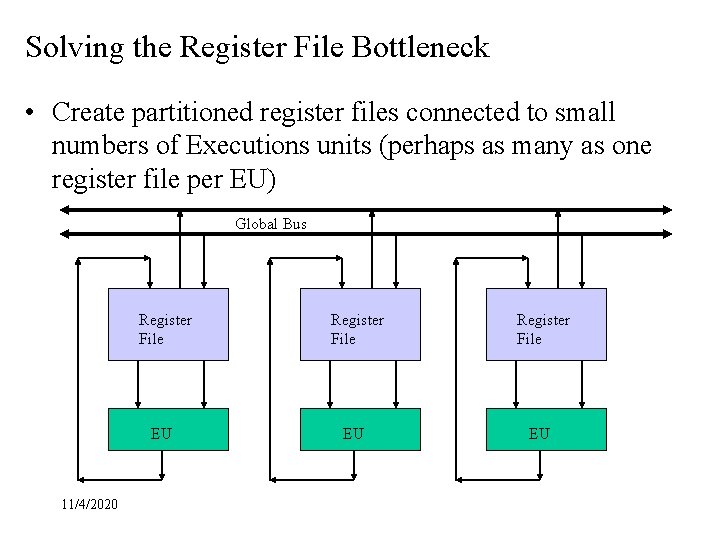
Solving the Register File Bottleneck • Create partitioned register files connected to small numbers of Executions units (perhaps as many as one register file per EU) Global Bus 11/4/2020 Register File EU EU EU
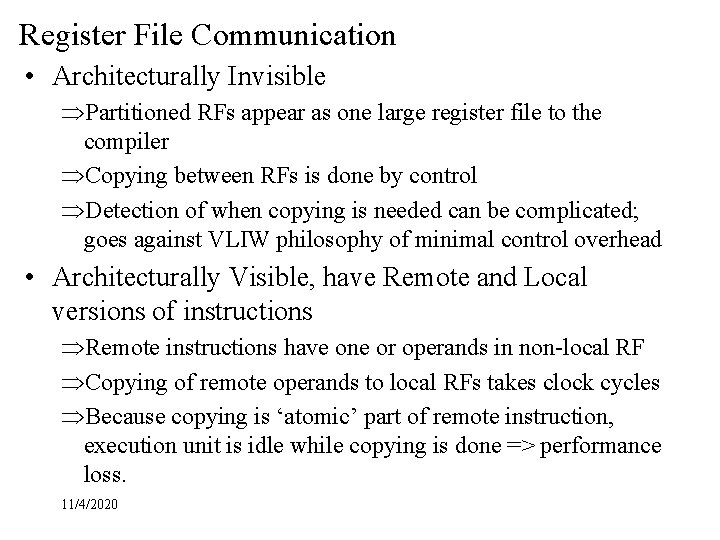
Register File Communication • Architecturally Invisible ÞPartitioned RFs appear as one large register file to the compiler ÞCopying between RFs is done by control ÞDetection of when copying is needed can be complicated; goes against VLIW philosophy of minimal control overhead • Architecturally Visible, have Remote and Local versions of instructions ÞRemote instructions have one or operands in non-local RF ÞCopying of remote operands to local RFs takes clock cycles ÞBecause copying is ‘atomic’ part of remote instruction, execution unit is idle while copying is done => performance loss. 11/4/2020
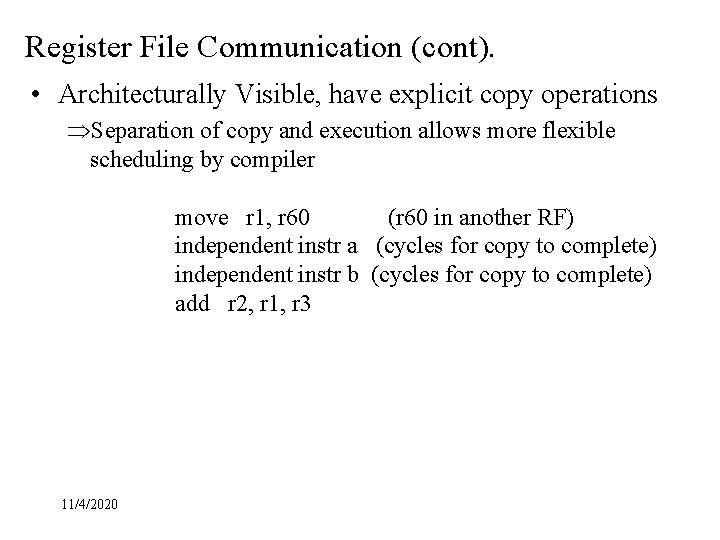
Register File Communication (cont). • Architecturally Visible, have explicit copy operations ÞSeparation of copy and execution allows more flexible scheduling by compiler move r 1, r 60 (r 60 in another RF) independent instr a (cycles for copy to complete) independent instr b (cycles for copy to complete) add r 2, r 1, r 3 11/4/2020
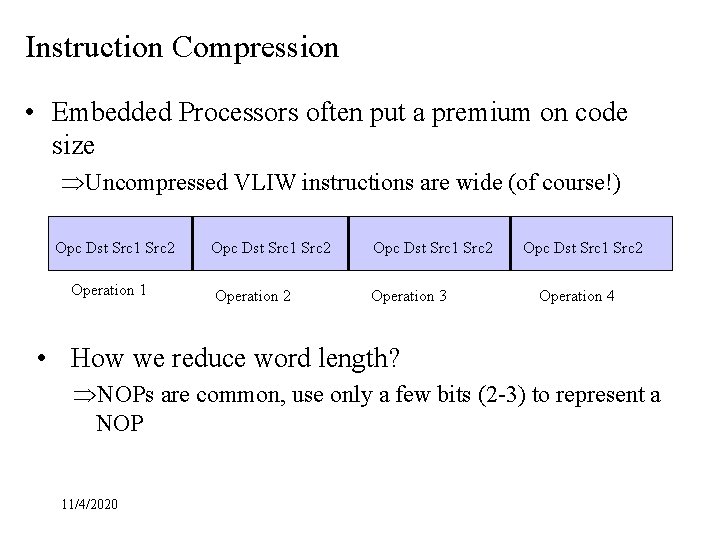
Instruction Compression • Embedded Processors often put a premium on code size ÞUncompressed VLIW instructions are wide (of course!) Opc Dst Src 1 Src 2 Operation 1 Opc Dst Src 1 Src 2 Operation 3 Opc Dst Src 1 Src 2 Operation 4 • How we reduce word length? ÞNOPs are common, use only a few bits (2 -3) to represent a NOP 11/4/2020
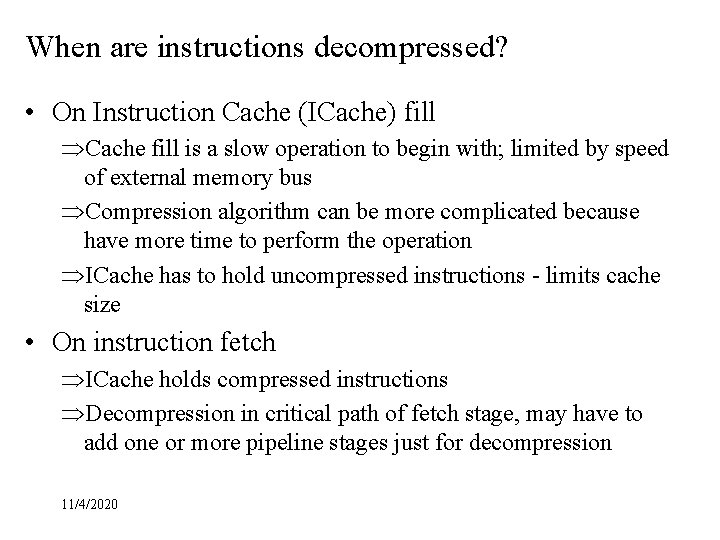
When are instructions decompressed? • On Instruction Cache (ICache) fill ÞCache fill is a slow operation to begin with; limited by speed of external memory bus ÞCompression algorithm can be more complicated because have more time to perform the operation ÞICache has to hold uncompressed instructions - limits cache size • On instruction fetch ÞICache holds compressed instructions ÞDecompression in critical path of fetch stage, may have to add one or more pipeline stages just for decompression 11/4/2020
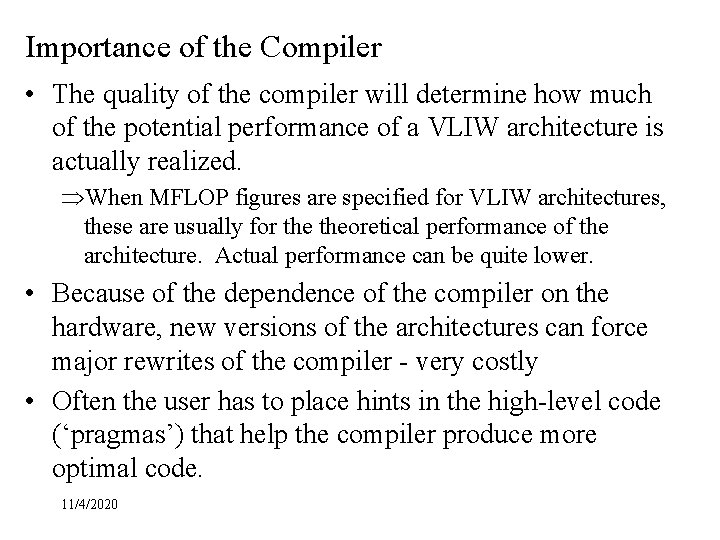
Importance of the Compiler • The quality of the compiler will determine how much of the potential performance of a VLIW architecture is actually realized. ÞWhen MFLOP figures are specified for VLIW architectures, these are usually for theoretical performance of the architecture. Actual performance can be quite lower. • Because of the dependence of the compiler on the hardware, new versions of the architectures can force major rewrites of the compiler - very costly • Often the user has to place hints in the high-level code (‘pragmas’) that help the compiler produce more optimal code. 11/4/2020
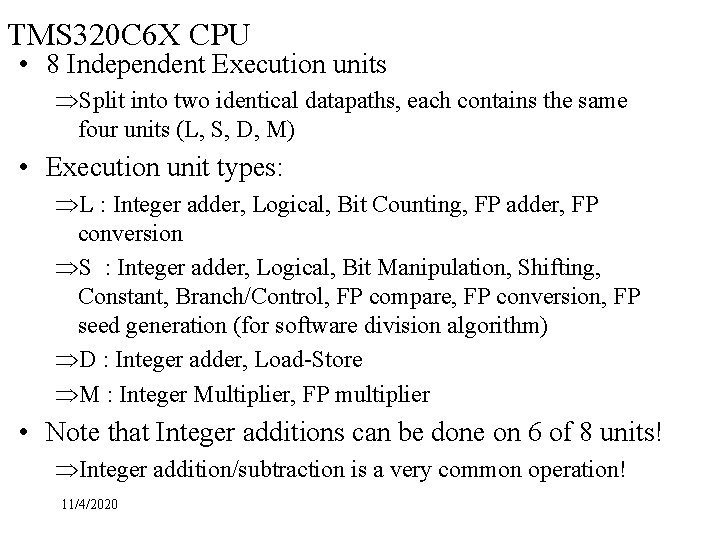
TMS 320 C 6 X CPU • 8 Independent Execution units ÞSplit into two identical datapaths, each contains the same four units (L, S, D, M) • Execution unit types: ÞL : Integer adder, Logical, Bit Counting, FP adder, FP conversion ÞS : Integer adder, Logical, Bit Manipulation, Shifting, Constant, Branch/Control, FP compare, FP conversion, FP seed generation (for software division algorithm) ÞD : Integer adder, Load-Store ÞM : Integer Multiplier, FP multiplier • Note that Integer additions can be done on 6 of 8 units! ÞInteger addition/subtraction is a very common operation! 11/4/2020
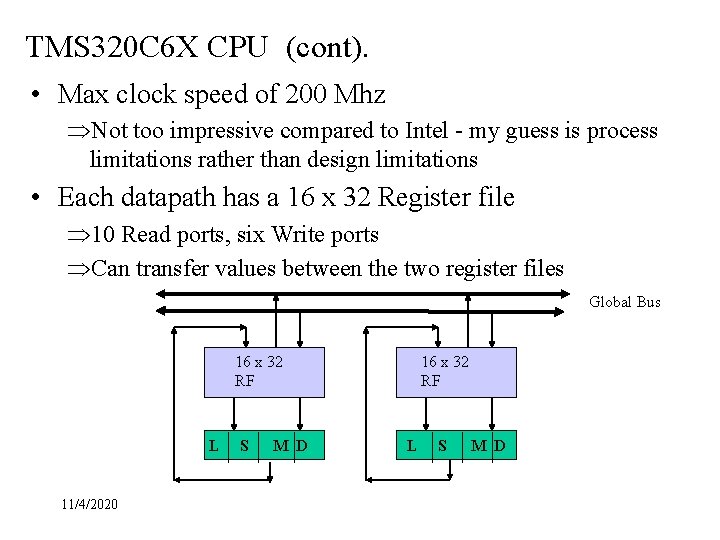
TMS 320 C 6 X CPU (cont). • Max clock speed of 200 Mhz ÞNot too impressive compared to Intel - my guess is process limitations rather than design limitations • Each datapath has a 16 x 32 Register file Þ 10 Read ports, six Write ports ÞCan transfer values between the two register files Global Bus 16 x 32 RF L 11/4/2020 S M D 16 x 32 RF L S M D
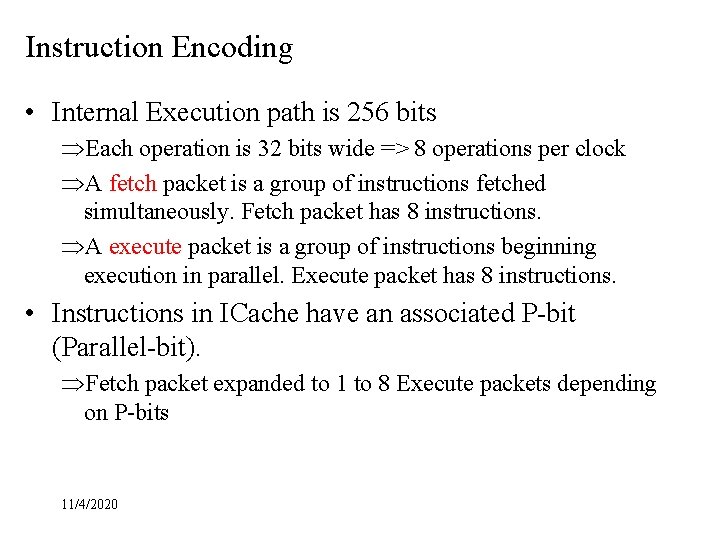
Instruction Encoding • Internal Execution path is 256 bits ÞEach operation is 32 bits wide => 8 operations per clock ÞA fetch packet is a group of instructions fetched simultaneously. Fetch packet has 8 instructions. ÞA execute packet is a group of instructions beginning execution in parallel. Execute packet has 8 instructions. • Instructions in ICache have an associated P-bit (Parallel-bit). ÞFetch packet expanded to 1 to 8 Execute packets depending on P-bits 11/4/2020
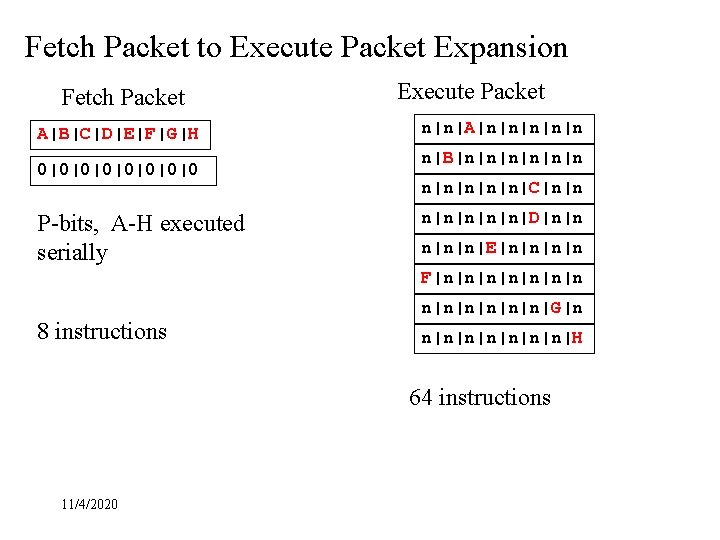
Fetch Packet to Execute Packet Expansion Fetch Packet A|B|C|D|E|F|G|H 0|0|0|0|0 P-bits, A-H executed serially Execute Packet n|n|A|n|n|n n|B|n|n|n|C|n|n n|n|n|D|n|n n|n|n|E|n|n F|n|n|n|n 8 instructions n|n|n|G|n n|n|n|n|H 64 instructions 11/4/2020
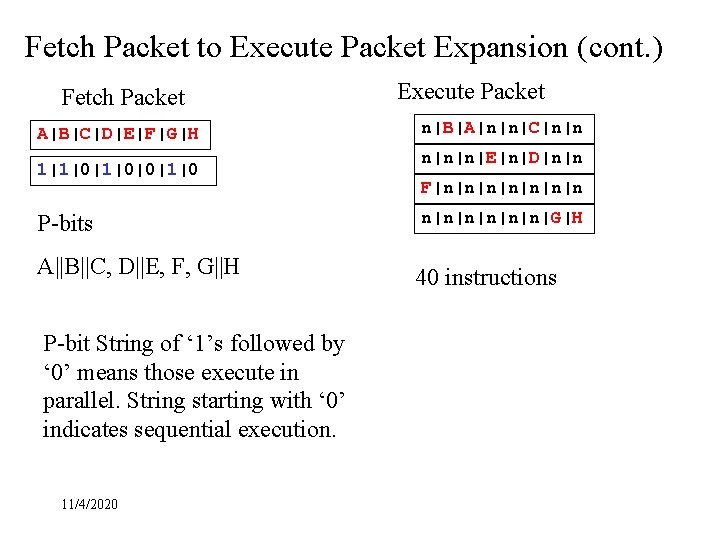
Fetch Packet to Execute Packet Expansion (cont. ) Fetch Packet A|B|C|D|E|F|G|H 1|1|0|0|1|0 P-bits A||B||C, D||E, F, G||H P-bit String of ‘ 1’s followed by ‘ 0’ means those execute in parallel. String starting with ‘ 0’ indicates sequential execution. 11/4/2020 Execute Packet n|B|A|n|n|C|n|n n|n|n|E|n|D|n|n F|n|n|n|n|G|H 40 instructions
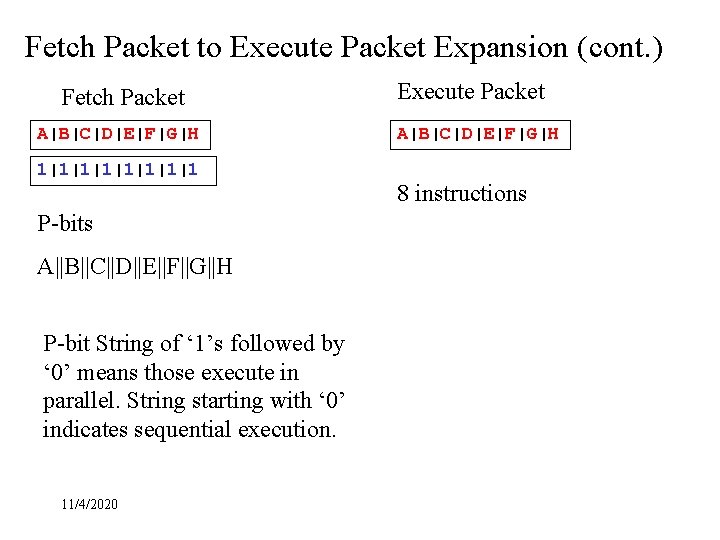
Fetch Packet to Execute Packet Expansion (cont. ) Fetch Packet A|B|C|D|E|F|G|H 1|1|1|1|1 P-bits A||B||C||D||E||F||G||H P-bit String of ‘ 1’s followed by ‘ 0’ means those execute in parallel. String starting with ‘ 0’ indicates sequential execution. 11/4/2020 Execute Packet A|B|C|D|E|F|G|H 8 instructions
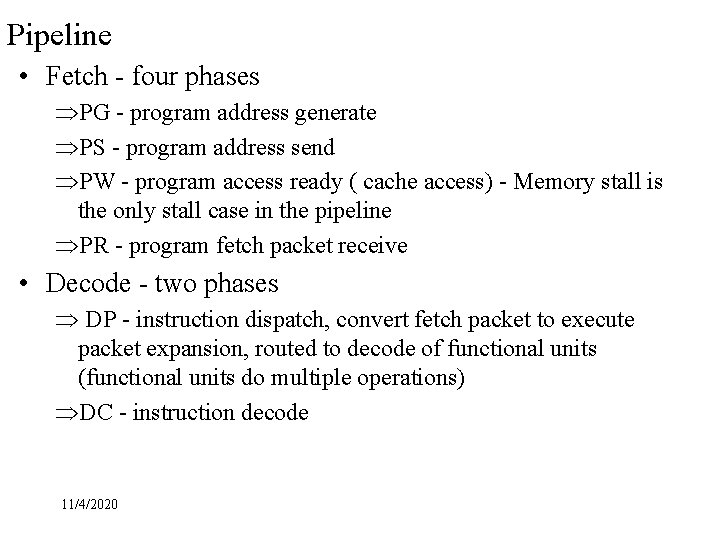
Pipeline • Fetch - four phases ÞPG - program address generate ÞPS - program address send ÞPW - program access ready ( cache access) - Memory stall is the only stall case in the pipeline ÞPR - program fetch packet receive • Decode - two phases Þ DP - instruction dispatch, convert fetch packet to execute packet expansion, routed to decode of functional units (functional units do multiple operations) ÞDC - instruction decode 11/4/2020
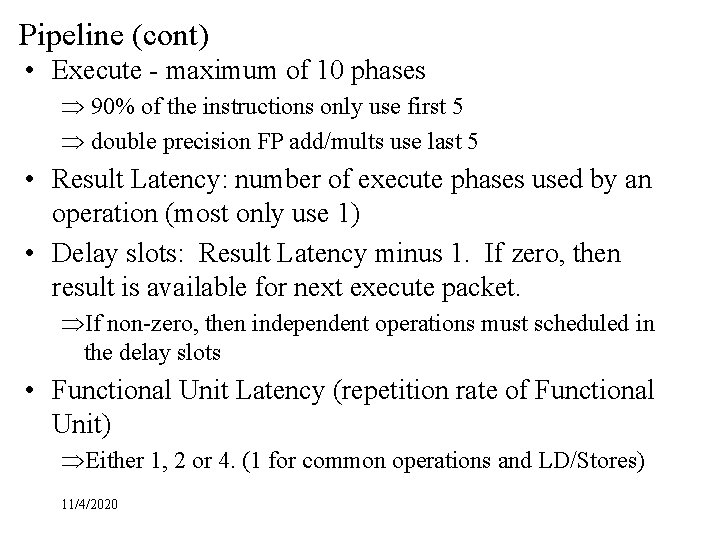
Pipeline (cont) • Execute - maximum of 10 phases Þ 90% of the instructions only use first 5 Þ double precision FP add/mults use last 5 • Result Latency: number of execute phases used by an operation (most only use 1) • Delay slots: Result Latency minus 1. If zero, then result is available for next execute packet. ÞIf non-zero, then independent operations must scheduled in the delay slots • Functional Unit Latency (repetition rate of Functional Unit) ÞEither 1, 2 or 4. (1 for common operations and LD/Stores) 11/4/2020
11/4/2020
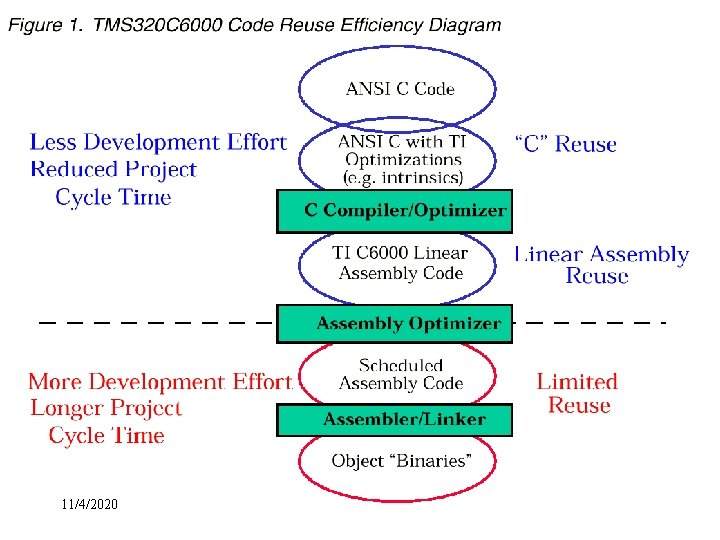
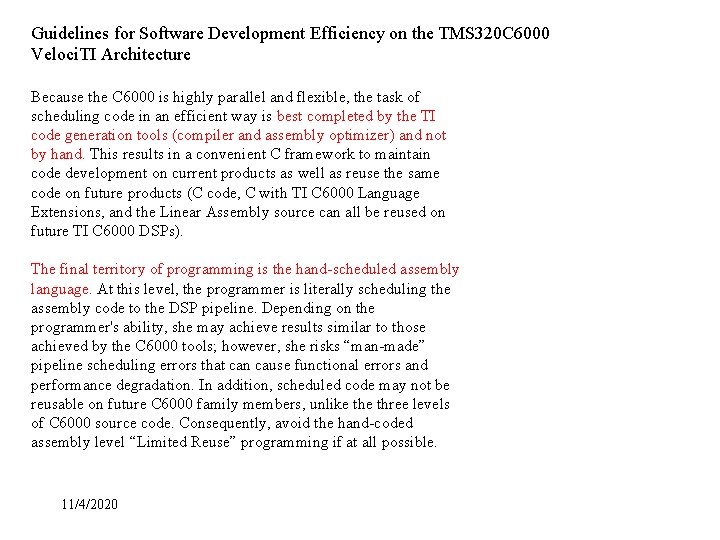
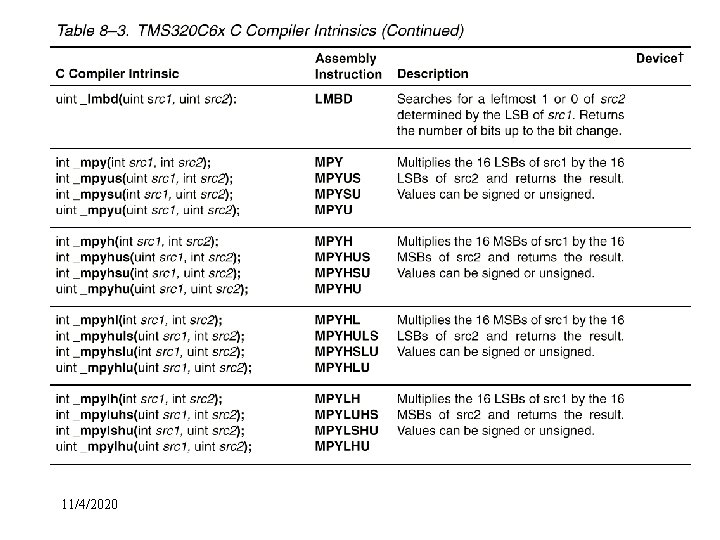
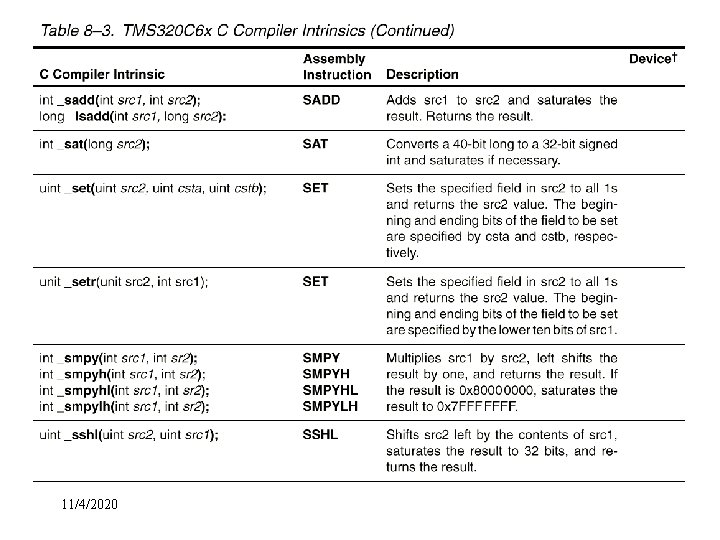
Guidelines for Software Development Efficiency on the TMS 320 C 6000 Veloci. TI Architecture Because the C 6000 is highly parallel and flexible, the task of scheduling code in an efficient way is best completed by the TI code generation tools (compiler and assembly optimizer) and not by hand. This results in a convenient C framework to maintain code development on current products as well as reuse the same code on future products (C code, C with TI C 6000 Language Extensions, and the Linear Assembly source can all be reused on future TI C 6000 DSPs). The final territory of programming is the hand-scheduled assembly language. At this level, the programmer is literally scheduling the assembly code to the DSP pipeline. Depending on the programmer's ability, she may achieve results similar to those achieved by the C 6000 tools; however, she risks “man-made” pipeline scheduling errors that can cause functional errors and performance degradation. In addition, scheduled code may not be reusable on future C 6000 family members, unlike three levels of C 6000 source code. Consequently, avoid the hand-coded assembly level “Limited Reuse” programming if at all possible. 11/4/2020
11/4/2020
11/4/2020
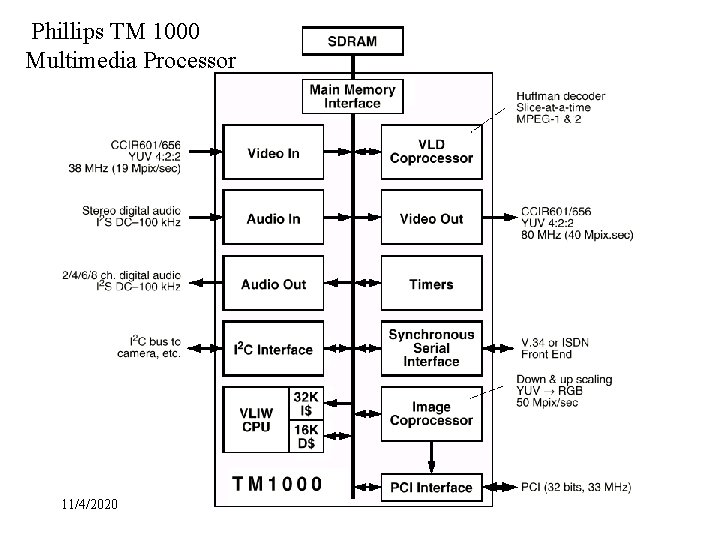
Phillips TM 1000 Multimedia Processor 11/4/2020
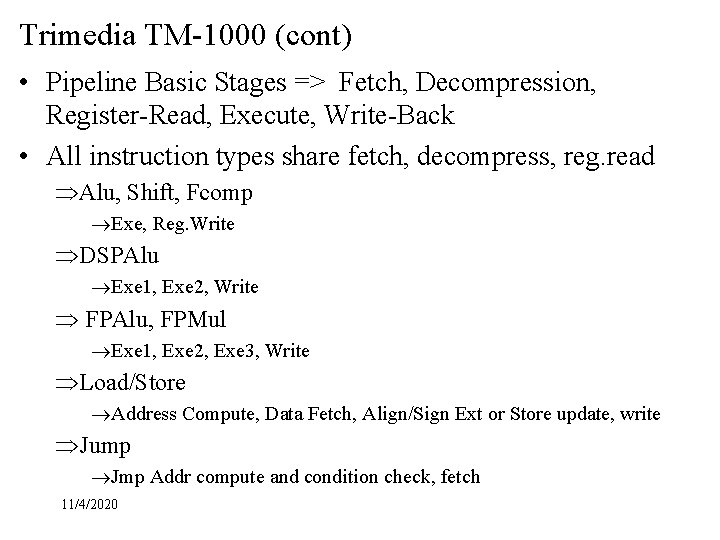
Trimedia TM-1000 (cont) • Pipeline Basic Stages => Fetch, Decompression, Register-Read, Execute, Write-Back • All instruction types share fetch, decompress, reg. read ÞAlu, Shift, Fcomp ®Exe, Reg. Write ÞDSPAlu ®Exe 1, Exe 2, Write Þ FPAlu, FPMul ®Exe 1, Exe 2, Exe 3, Write ÞLoad/Store ®Address Compute, Data Fetch, Align/Sign Ext or Store update, write ÞJump ®Jmp Addr compute and condition check, fetch 11/4/2020
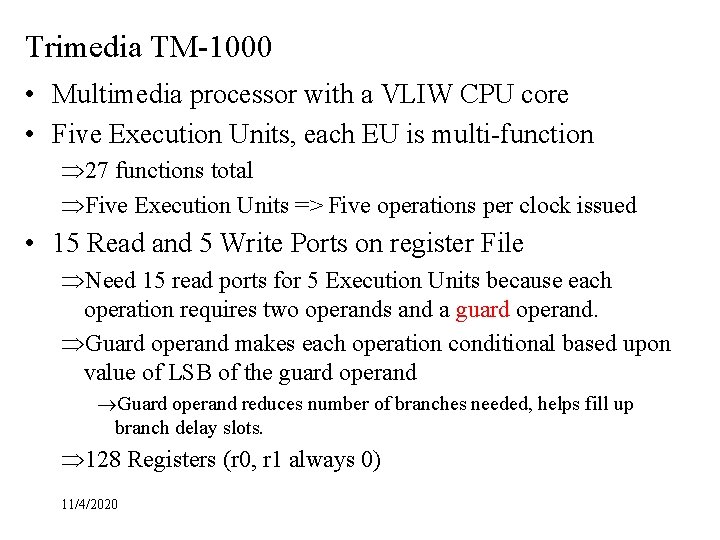
Trimedia TM-1000 • Multimedia processor with a VLIW CPU core • Five Execution Units, each EU is multi-function Þ 27 functions total ÞFive Execution Units => Five operations per clock issued • 15 Read and 5 Write Ports on register File ÞNeed 15 read ports for 5 Execution Units because each operation requires two operands and a guard operand. ÞGuard operand makes each operation conditional based upon value of LSB of the guard operand ®Guard operand reduces number of branches needed, helps fill up branch delay slots. Þ 128 Registers (r 0, r 1 always 0) 11/4/2020
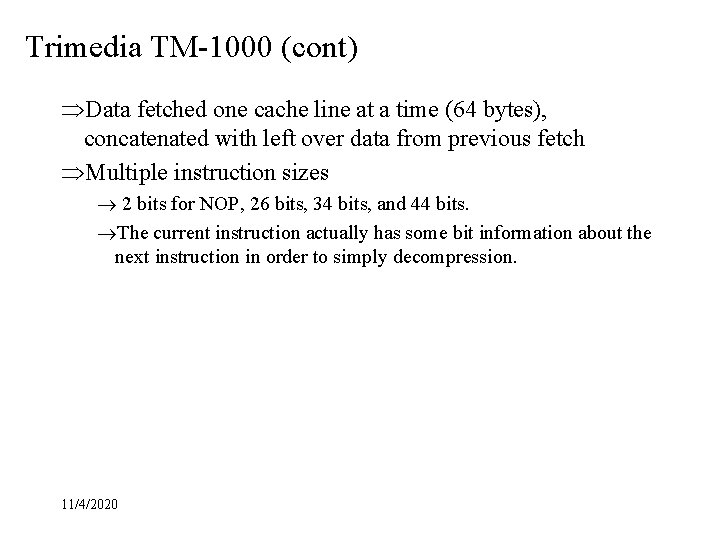
Trimedia TM-1000 (cont) ÞData fetched one cache line at a time (64 bytes), concatenated with left over data from previous fetch ÞMultiple instruction sizes ® 2 bits for NOP, 26 bits, 34 bits, and 44 bits. ®The current instruction actually has some bit information about the next instruction in order to simply decompression. 11/4/2020
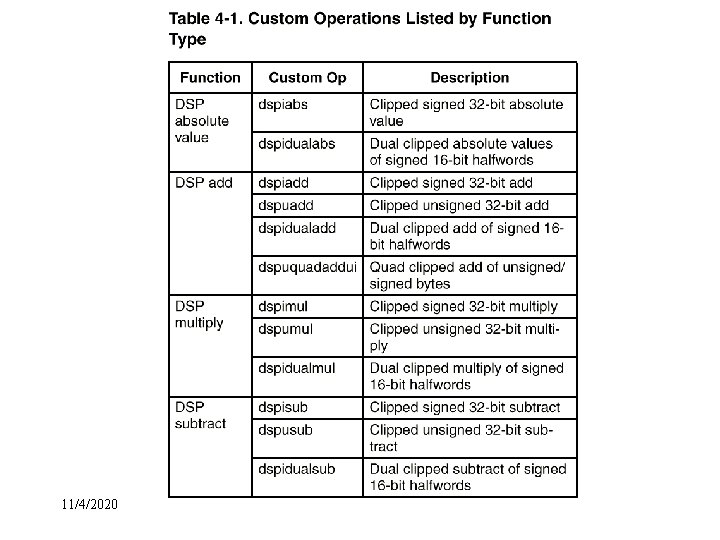
11/4/2020
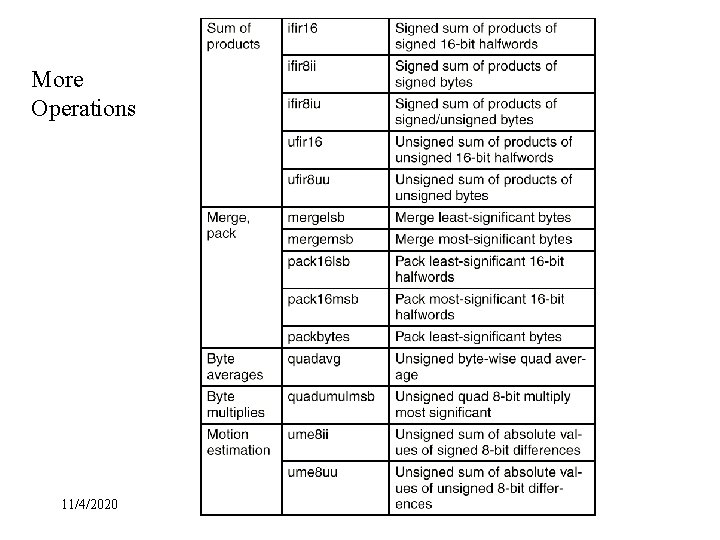
More Operations 11/4/2020