
VLF LF MF and HF ANTENNAS CLASSIFICATION ACCORDING
- Slides: 52
VLF LF MF and HF ANTENNAS CLASSIFICATION ACCORDING TO FREQUENCY BANDS
VLF/LF Antennas and Antenna Systems
VLF Band üEM waves penetrate well into the sea water. (Communications with submerged submarines) üLow atmospheric attenuation. üAppropriate for long range communication.
VLF Antennas • Ground and Sky waves • Frequeny range: 3 -30 KHz • Antennas : very large • Power: k. W levels and even more
Some Problems Associated with VLF Antenna Systems • Small Bandwidth (usually less than 200 Hz) • Small radiation resistance. • High cost. • Antenna system covers a large area. • Need for very high power levels for transmission.
LF Antennas § Ground and Sky waves § Frequeny range: 30 -300 KHz § Antennas: large § Power: k. W levels and even more
Some Disadvantages Ø High cost Ø Large Dimensions Ø Trouble with efficiency, power capacity, bandwidth
VLF and LF antennas are “electrically small” antennas : § problem: high capacitive reactance and small antenna radiation resistance § remedy: top loading
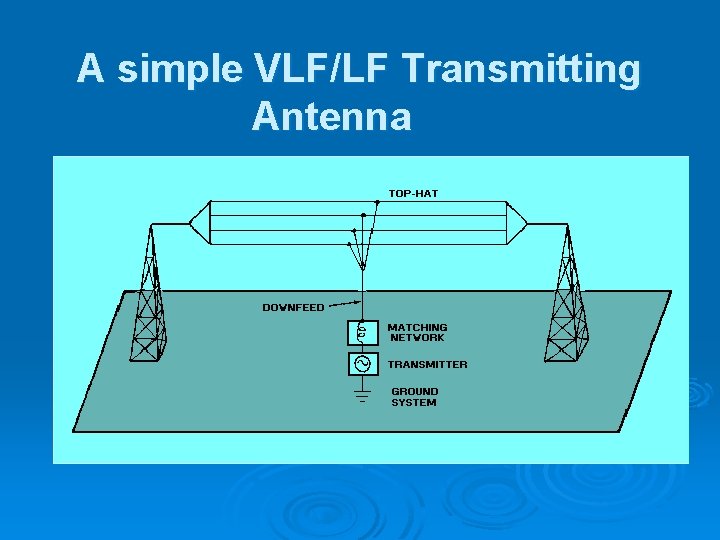
Top-loading Ø Top-loading increases gain bandwidth (by decreasing reactance) Ø In VLF large top-loading supported by towers
A simple VLF/LF Transmitting Antenna
VLF / LF Ground Systems Radial-wire: radial wires buried in the ground Ø Multiple-star: small radial-wire systems forming a star topology Ø
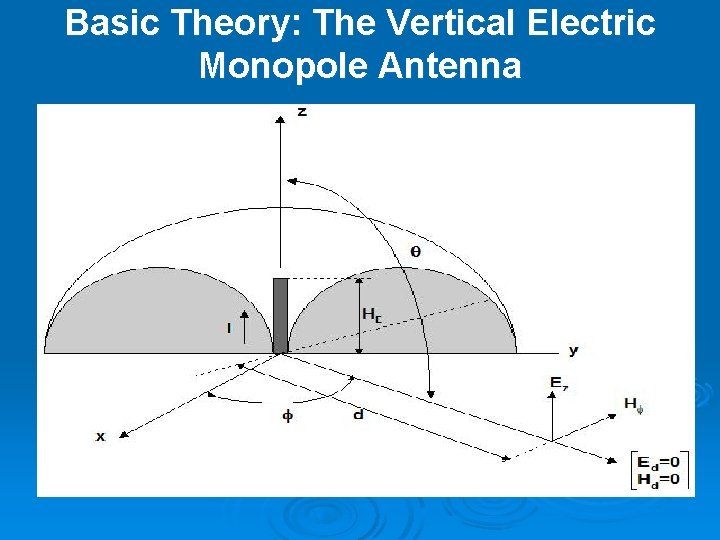
Basic Theory: The Vertical Electric Monopole Antenna
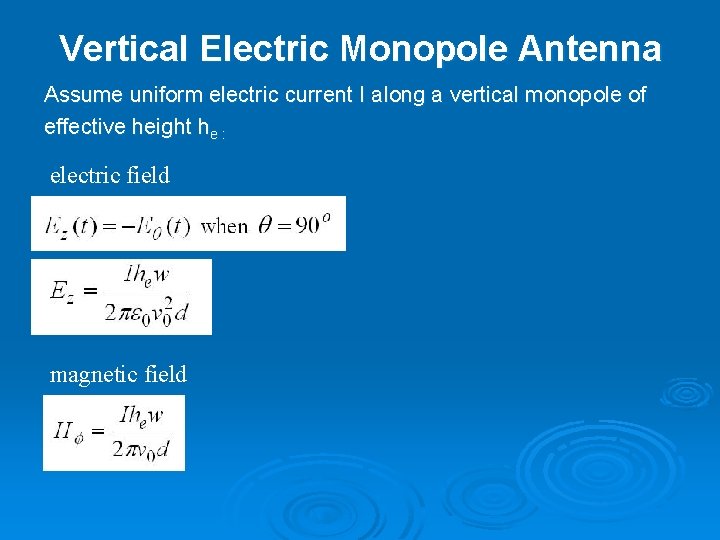
Vertical Electric Monopole Antenna Assume uniform electric current I along a vertical monopole of effective height he : electric field magnetic field
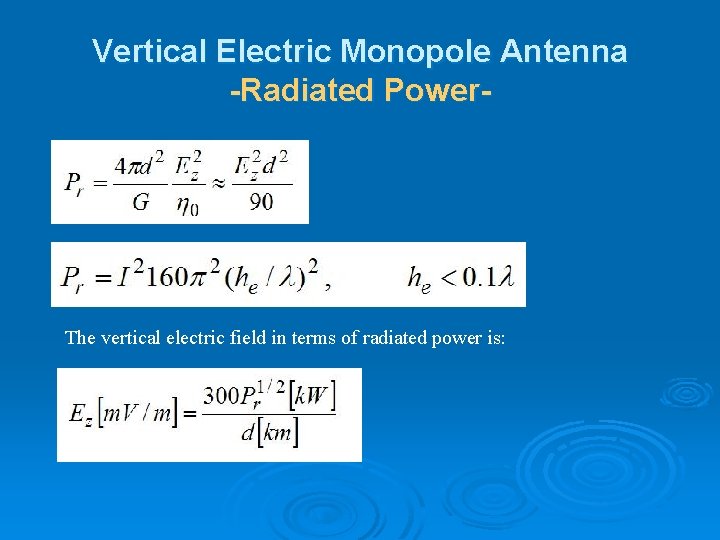
Vertical Electric Monopole Antenna -Radiated Power- The vertical electric field in terms of radiated power is:
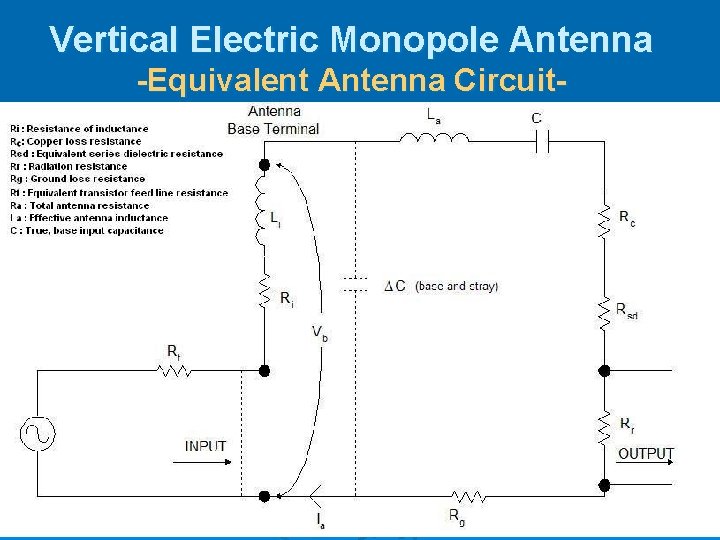
Vertical Electric Monopole Antenna -Equivalent Antenna Circuit-
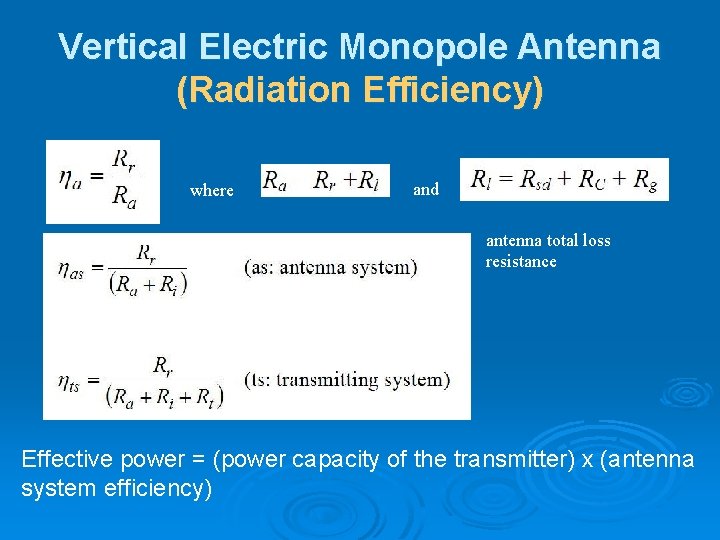
Vertical Electric Monopole Antenna (Radiation Efficiency) where and antenna total loss resistance Effective power = (power capacity of the transmitter) x (antenna system efficiency)
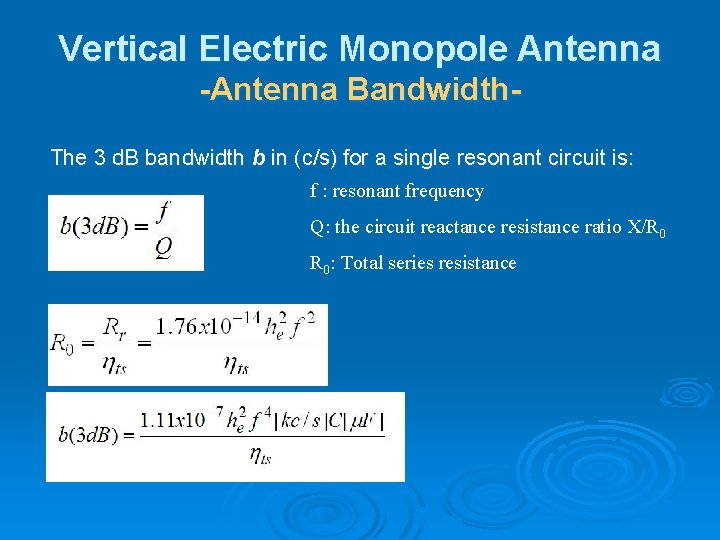
Vertical Electric Monopole Antenna -Antenna Bandwidth. The 3 d. B bandwidth b in (c/s) for a single resonant circuit is: f : resonant frequency Q: the circuit reactance resistance ratio X/R 0 R 0: Total series resistance
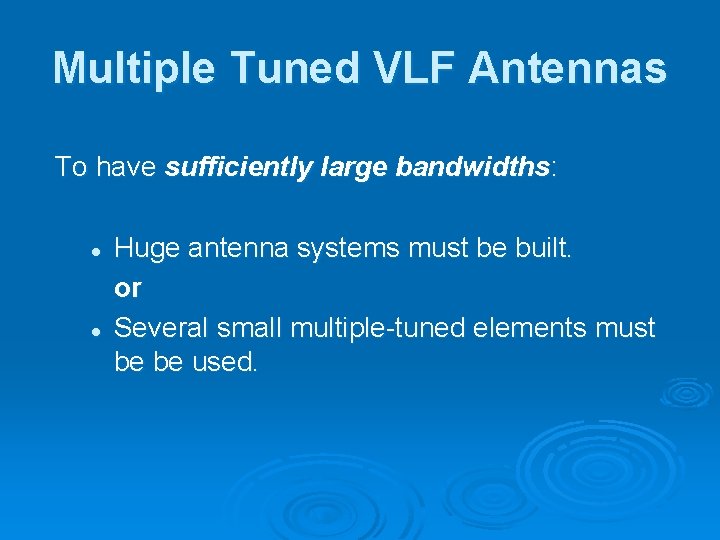
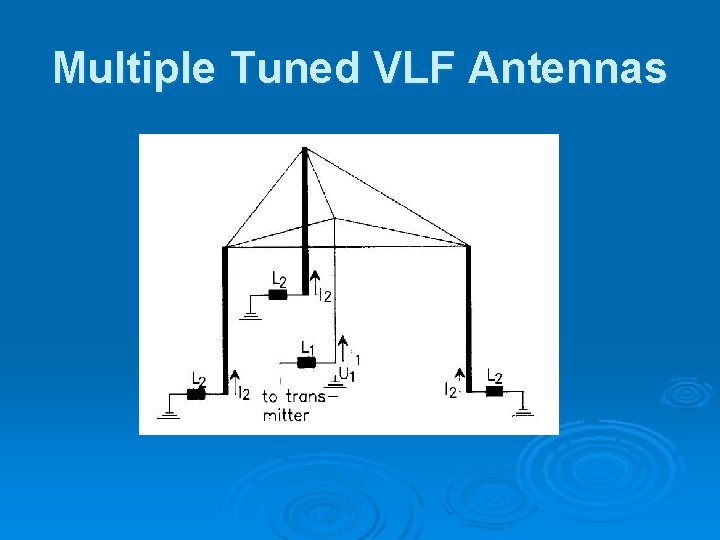
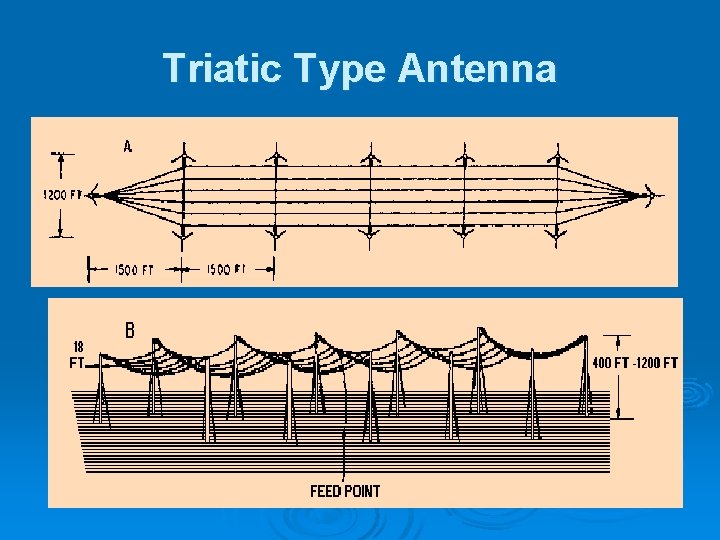
Multiple Tuned VLF Antennas To have sufficiently large bandwidths: Huge antenna systems must be built. or Several small multiple-tuned elements must be be used.
Multiple Tuned VLF Antennas
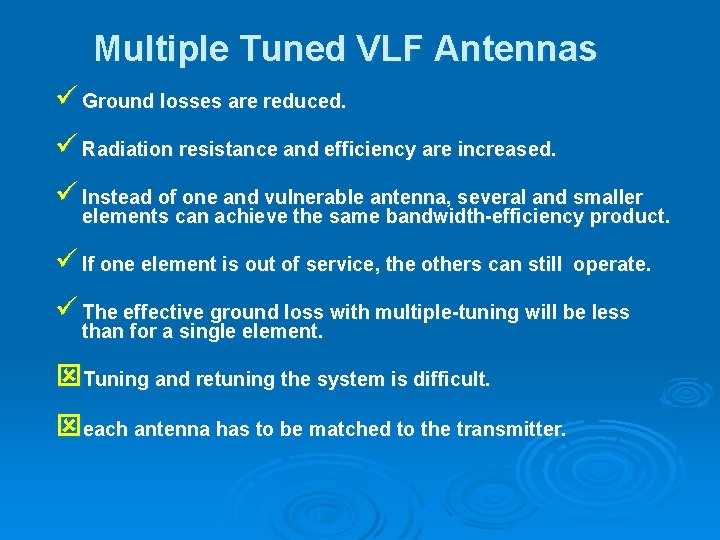
Multiple Tuned VLF Antennas ü Ground losses are reduced. ü Radiation resistance and efficiency are increased. ü Instead of one and vulnerable antenna, several and smaller elements can achieve the same bandwidth-efficiency product. ü If one element is out of service, the others can still operate. ü The effective ground loss with multiple-tuning will be less than for a single element. ýTuning and retuning the system is difficult. ýeach antenna has to be matched to the transmitter.
Triatic Type Antenna
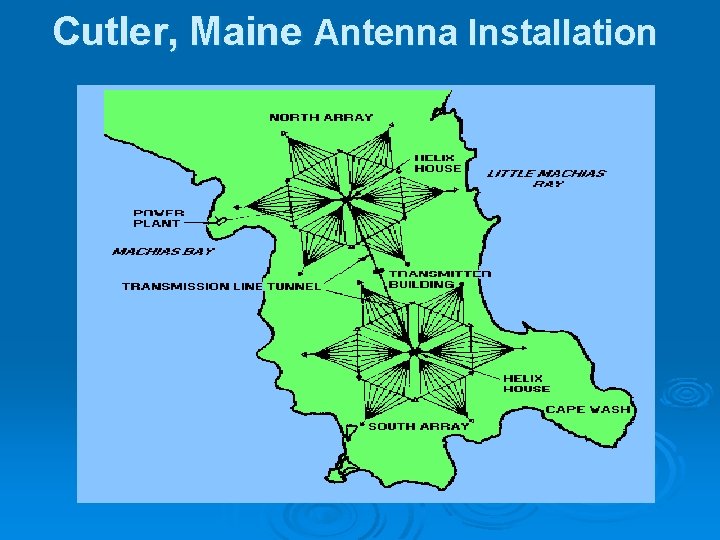
Cutler, Maine Antenna Installation
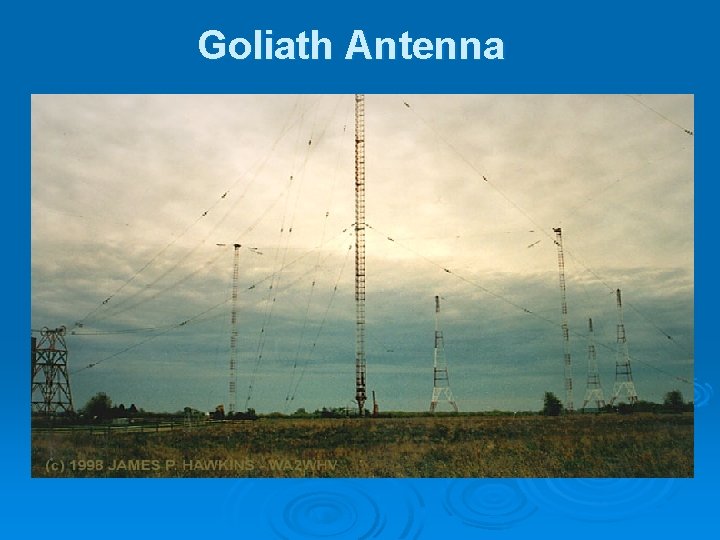
Goliath Antenna
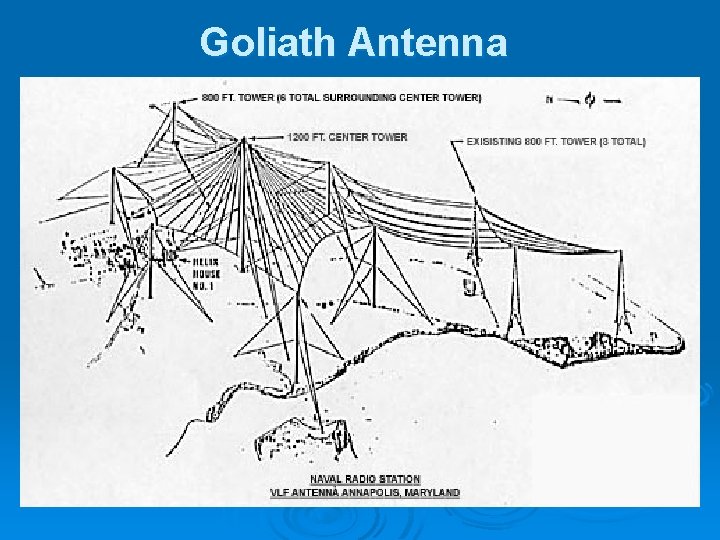
Goliath Antenna
References (1) “VLF Radio Engineering”, A. D. Watt, Perg. Press, 1967 (2) “High Power Very Low Frequency/Low Frequency Transmitting Antennas”, P Hansen, Military Communications Conf. , 1990. MILCOM '90, Conference Record, 'A New Era'. 1990 IEEE, 30 Sept. -3 Oct. 1990 Pages: 1091 - 1096 vol. 3 (3) Technology Conference, 1991. IMTC-91. Conference Record. , 8 th IEEE , 14 -16 May 1991 Pages: 330 - 334 (4) “Multiple Tuned VLF Antennas”, Manfred Schopp, IEEE Transactions on Broadcasting, Vol. 39, No. 4, Dec. 1993. References for the photos & figures: [1] http: //hawkins. pair. com/nss. shtml [2] http: //www. tpub. com/neets/book 17/77. htm
MF ANTENNAS & ANTENNA SYSTEMS 2/27/2021 26
INTRODUCTION • Usually: Vertical radiators operating in the MF band (300 -3000 k. Hz). • The towers may be guyed or selfsupporting.
APPLICATION AREAS • AM Broadcasting • Maritime Radio • Coast Guard Communication • Direction Finding
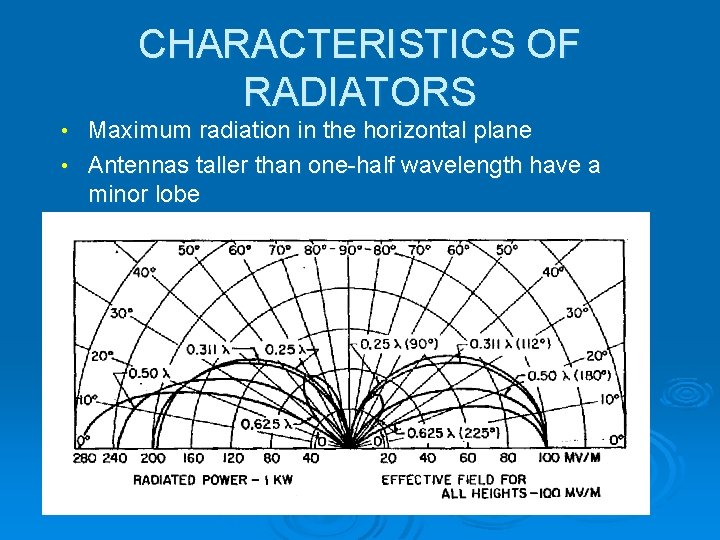
CHARACTERISTICS OF RADIATORS Maximum radiation in the horizontal plane • Antennas taller than one-half wavelength have a minor lobe •
Characteristics of the Radiators § Requirement for metallic ground plane to minimize losses § Vertical polarization is preferred due to superior propagation characteristics
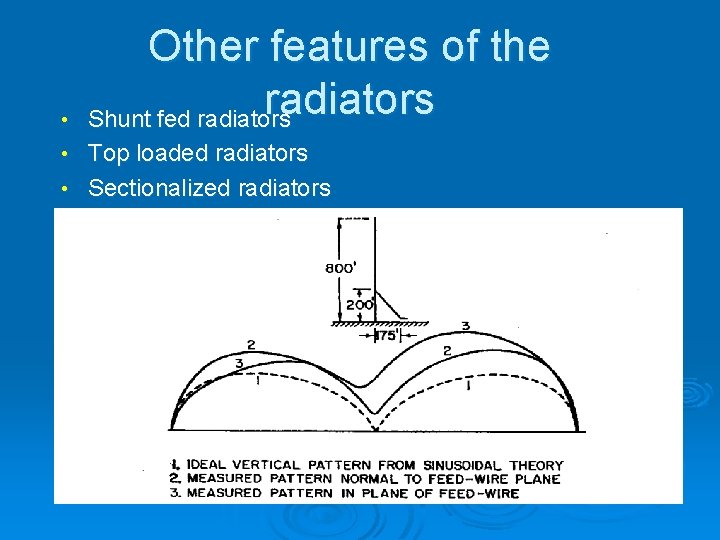
• Other features of the radiators Shunt fed radiators Top loaded radiators • Sectionalized radiators •
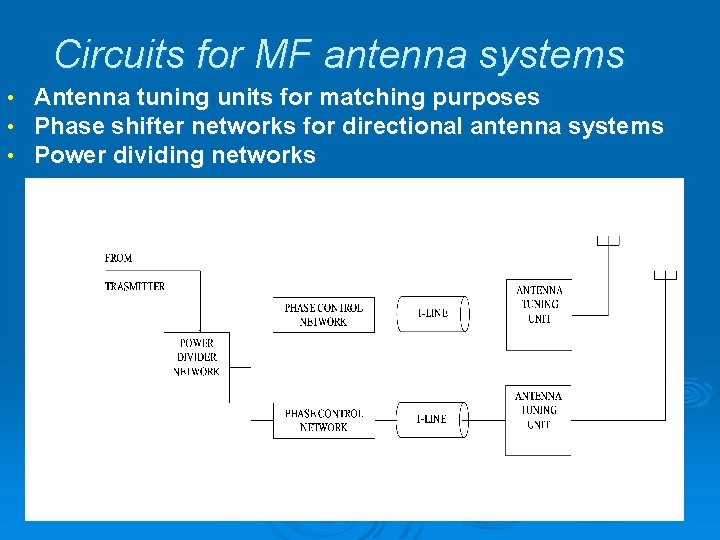
Circuits for MF antenna systems • • • Antenna tuning units for matching purposes Phase shifter networks for directional antenna systems Power dividing networks
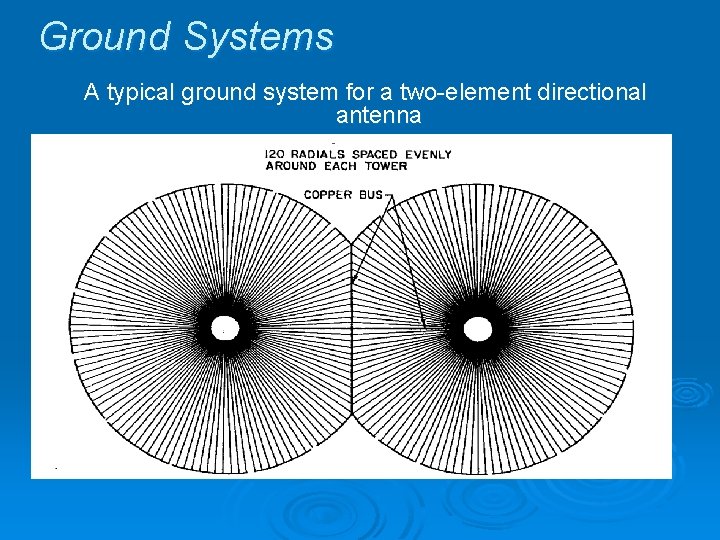
Ground Systems • • • 120 buried ( /4 length) copper wires Extending radially outward 120 -180 cm depth is sufficient Individual ground systems are required for each tower of the array. Copper-mesh ground system may also be used.
Ground Systems A typical ground system for a two-element directional antenna
HF Antennas & Antenna Systems
HF Antennas and Antenna Systems v Frequency Range: 3 to 30 MHz ( 10 to 100 meters; in wavelength) v For medium- and long- distance communications and broadcoasting
Characteristics of HF Antennas: Ø Signals are distorted as the ionosphere is neither regular nor smooth. Ø High powers and high antenna gains may be needed for communication.
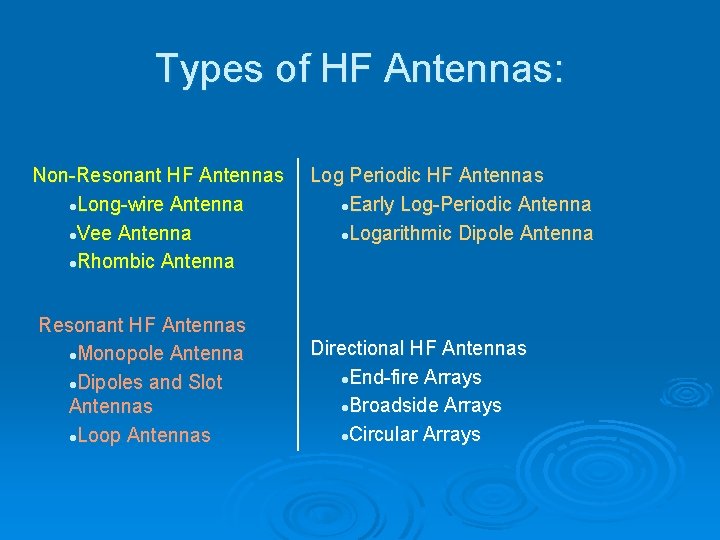
Types of HF Antennas: Non-Resonant HF Antennas Long-wire Antenna Vee Antenna Rhombic Antenna Resonant HF Antennas Monopole Antenna Dipoles and Slot Antennas Loop Antennas Log Periodic HF Antennas Early Log-Periodic Antenna Logarithmic Dipole Antenna Directional HF Antennas End-fire Arrays Broadside Arrays Circular Arrays
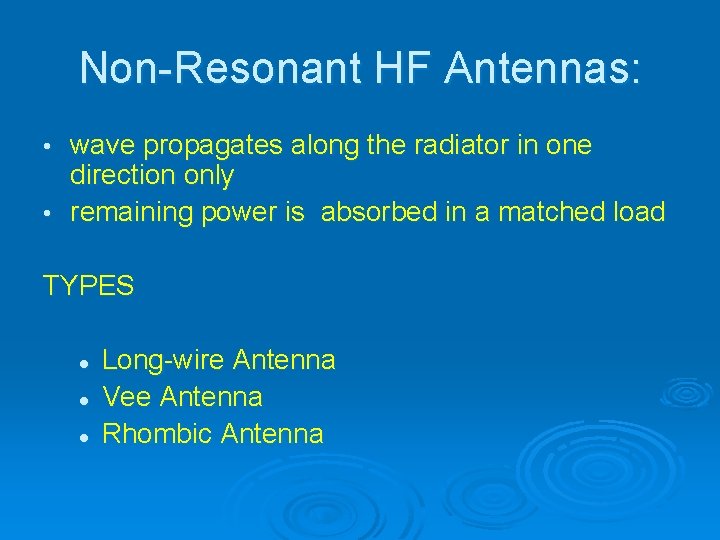
Non-Resonant HF Antennas: wave propagates along the radiator in one direction only • remaining power is absorbed in a matched load • TYPES Long-wire Antenna Vee Antenna Rhombic Antenna
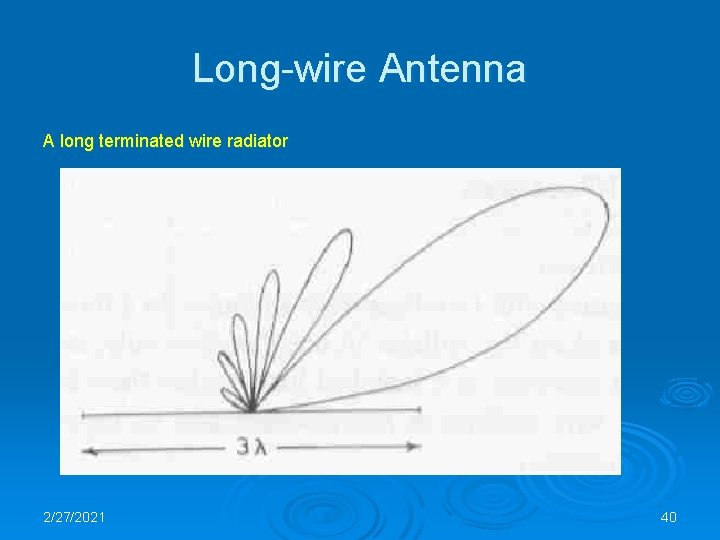
Long-wire Antenna A long terminated wire radiator 2/27/2021 40
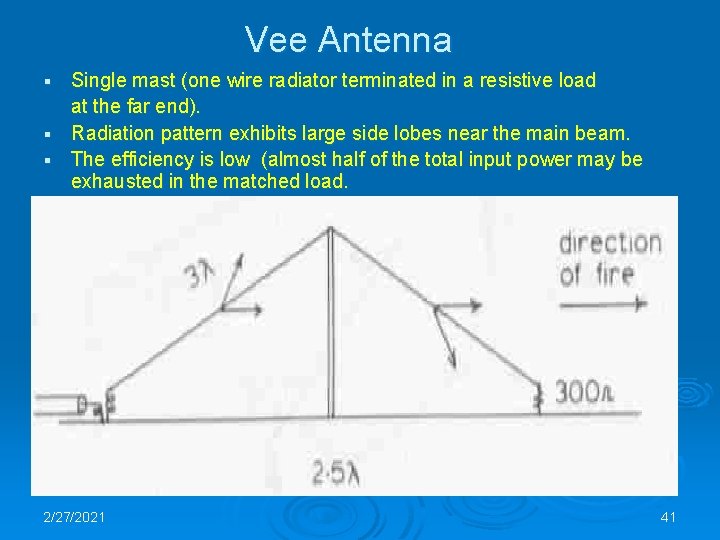
Vee Antenna Single mast (one wire radiator terminated in a resistive load at the far end). § Radiation pattern exhibits large side lobes near the main beam. § The efficiency is low (almost half of the total input power may be exhausted in the matched load. § 2/27/2021 41
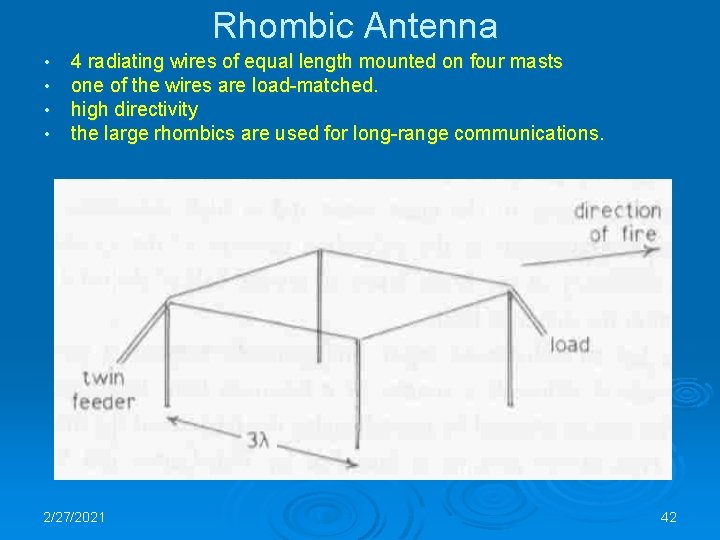
Rhombic Antenna • • 4 radiating wires of equal length mounted on four masts one of the wires are load-matched. high directivity the large rhombics are used for long-range communications. 2/27/2021 42
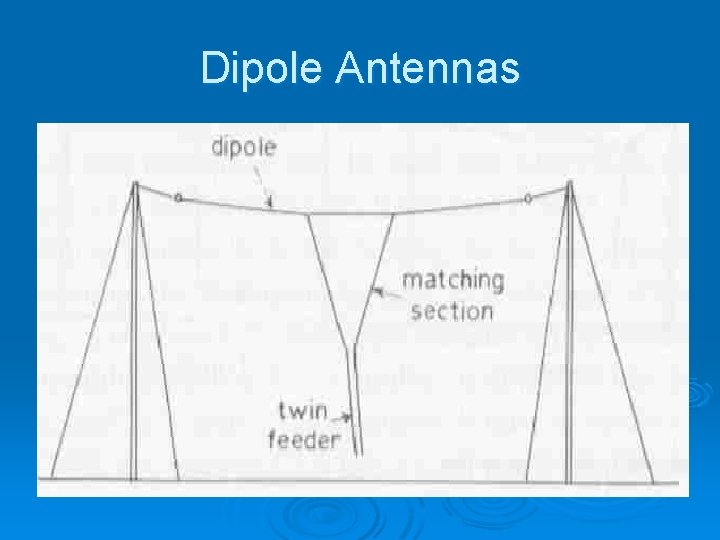
Resonant HF Antennas: Monopole Antenna • Elevated-feed Monopole • Double-cone Monopole • Inverted-L and –T Antenna Dipoles and Slot Antennas Loop Antennas 2/27/2021 43
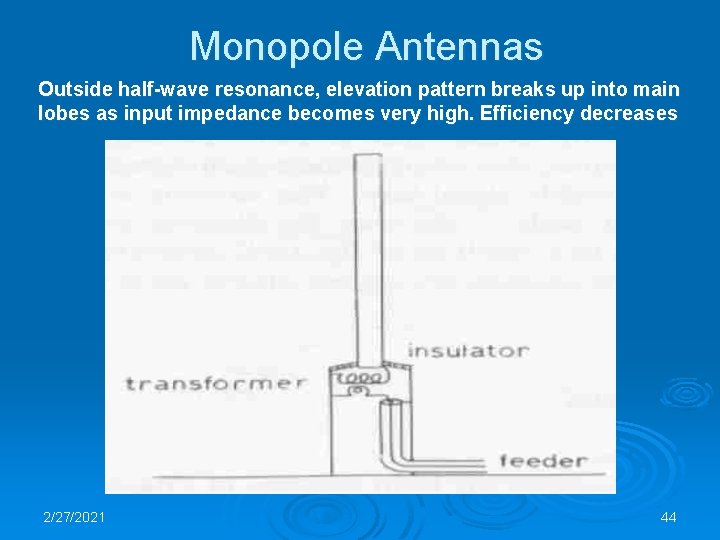
Monopole Antennas Outside half-wave resonance, elevation pattern breaks up into main lobes as input impedance becomes very high. Efficiency decreases 2/27/2021 44
Dipole Antennas
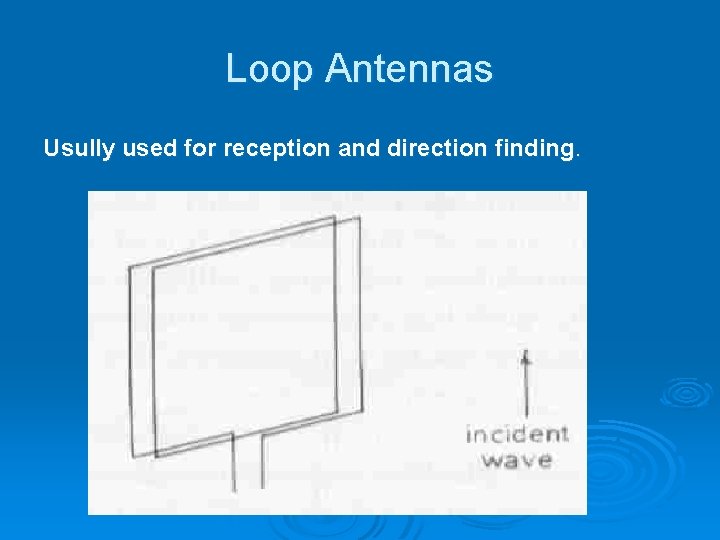
Loop Antennas Usully used for reception and direction finding.
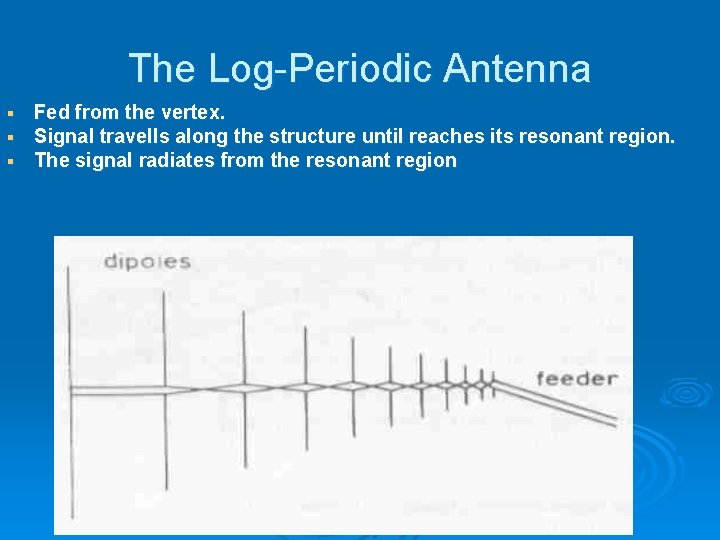
The Log-Periodic Antenna § § § Fed from the vertex. Signal travells along the structure until reaches its resonant region. The signal radiates from the resonant region
Directional HF Antennas: End-fire Arrays • • • Horizontal Array of Dipoles RCA Fishborne Antenna Series Phase Array Broadside Arrays • Broadside Dipole Array • Wide-Band Curtain Array Circular Arrays
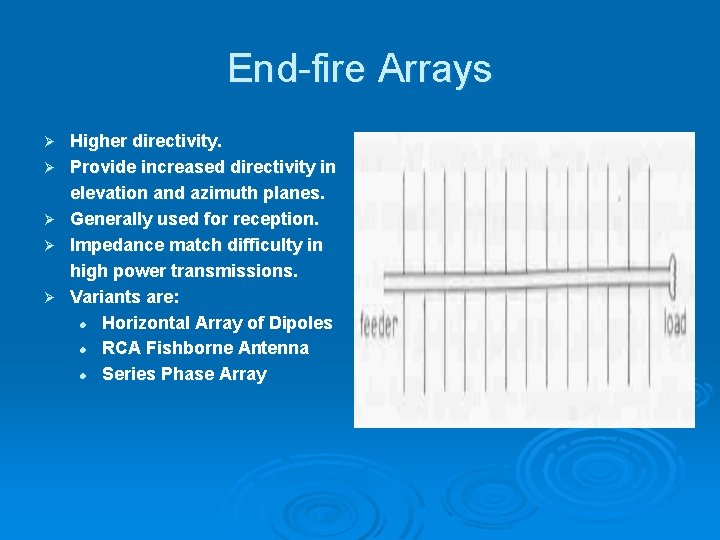
End-fire Arrays Ø Ø Ø Higher directivity. Provide increased directivity in elevation and azimuth planes. Generally used for reception. Impedance match difficulty in high power transmissions. Variants are: Horizontal Array of Dipoles RCA Fishborne Antenna Series Phase Array
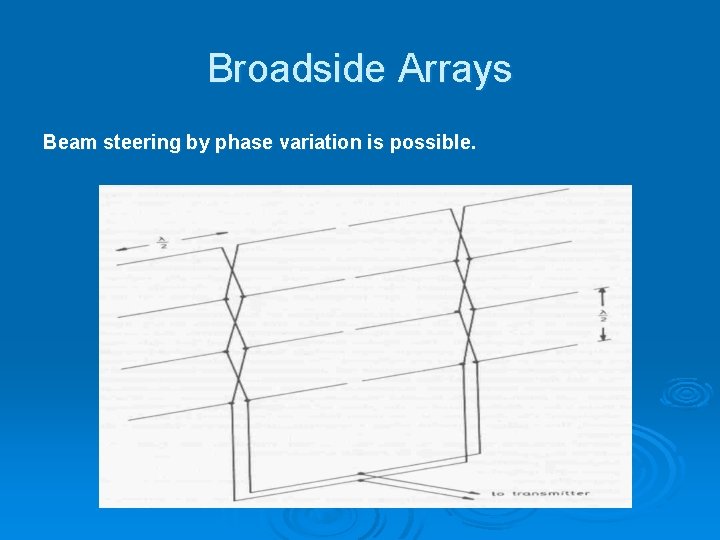
Broadside Arrays Beam steering by phase variation is possible.
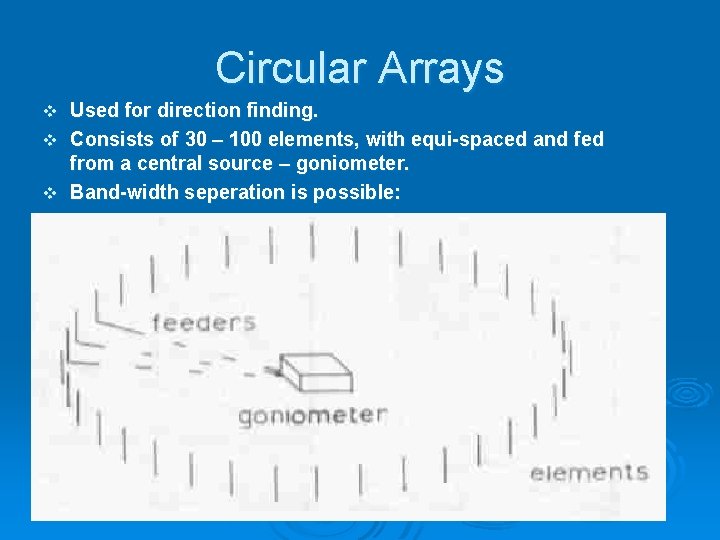
Circular Arrays Used for direction finding. v Consists of 30 – 100 elements, with equi-spaced and fed from a central source – goniometer. v Band-width seperation is possible: v
References Ø JASIK, H. : Antenna Engineering Handbook; Mc Graw Hill, 1961 Ø Y. T. , LEE S. W. : Antenna Handbook; Van Nostrand Reinhold, 1988. Ø RUDGE, A. W. , MILNE K. , OLVER A. D. , KNIGHT P. : Handbook of Antenna Design (Volume 2); Peter Peregrinus, 1983.