
VLBI Observation for Spacecraft Navigation NOZOMI Data Processing
VLBI Observation for Spacecraft Navigation (NOZOMI) – Data Processing and Analysis Status Repot M. Sekido, R. Ichikawa, H. Osaki, T. Kondo, Y. Koyama(CRL) M. Yoshikawa, T. Ohnishi(ISAS), W. Cannon, A. Novikov (SGL), M. Berube(NRCan), NOZOMI VLBI group(CRL, ISAS, NAOJ, GSI, …)
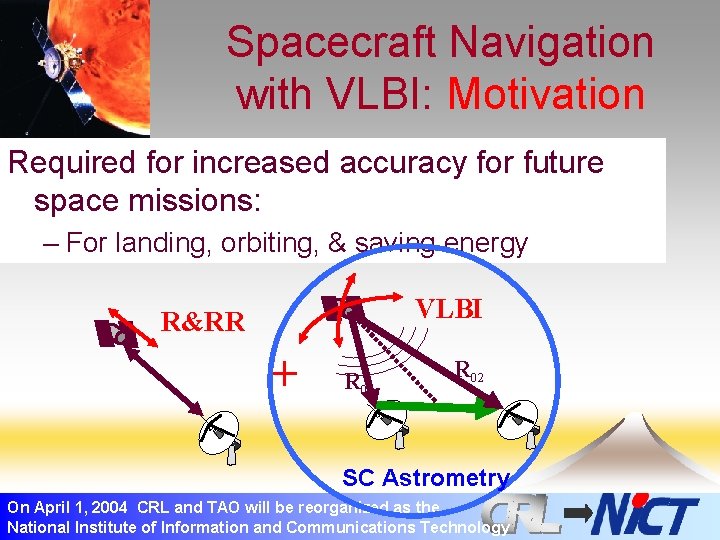
Spacecraft Navigation with VLBI: Motivation Required for increased accuracy for future space missions: – For landing, orbiting, & saving energy VLBI R&RR + R 01 R 02 SC Astrometry On April 1, 2004 CRL and TAO will be reorganized as the National Institute of Information and Communications Technology
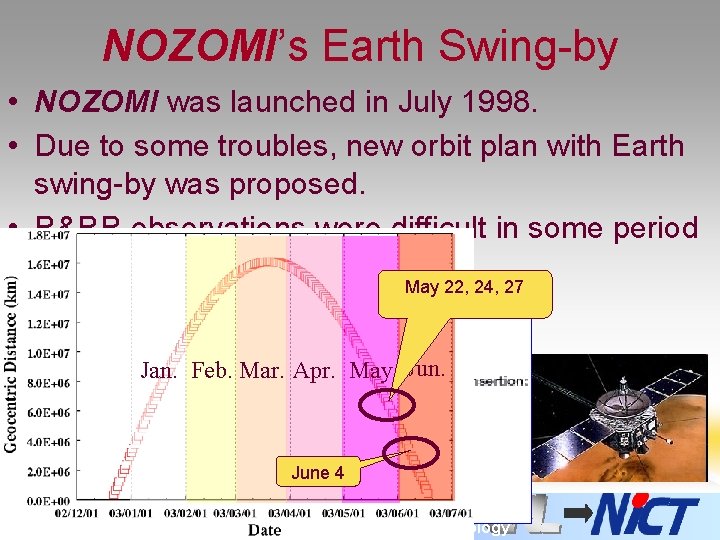
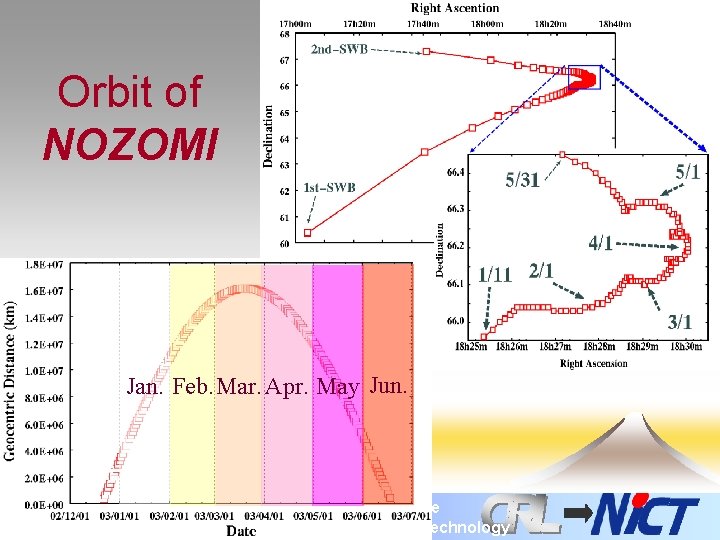
NOZOMI’s Earth Swing-by • NOZOMI was launched in July 1998. • Due to some troubles, new orbit plan with Earth swing-by was proposed. • R&RR observations were difficult in some period May 22, 24, 27 VL BI s Ob ns tio va er Jan. Feb. Mar. Apr. May June 4 On April 1, 2004 CRL and TAO will be reorganized as the National Institute of Information and Communications Technology
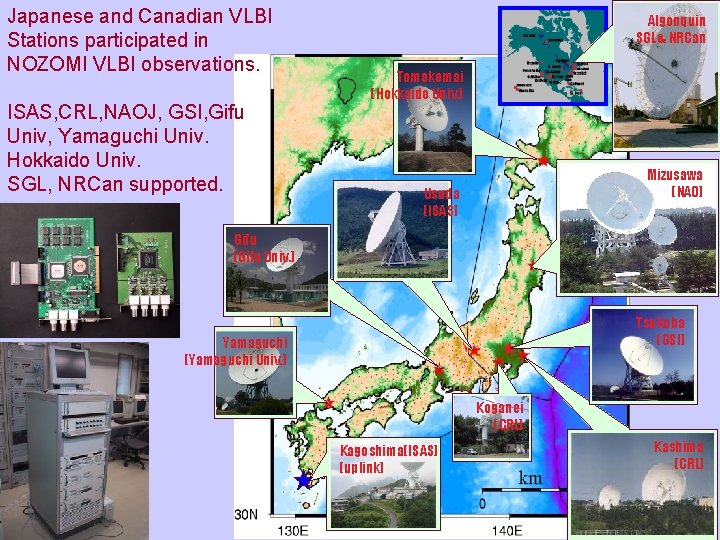
Japanese and Canadian VLBI Stations participated in NOZOMI VLBI observations. ISAS, CRL, NAOJ, GSI, Gifu Univ, Yamaguchi Univ. Hokkaido Univ. SGL, NRCan supported. Algonquin SGL & NRCan Tomakomai (Hokkaido Univ. ) Mizusawa (NAO) Usuda (ISAS) Gifu (Gifu Univ. ) Tsukuba (GSI) Yamaguchi (Yamaguchi Univ. ) Koganei (CRL) Kagoshima(ISAS) (uplink) Kashima (CRL)
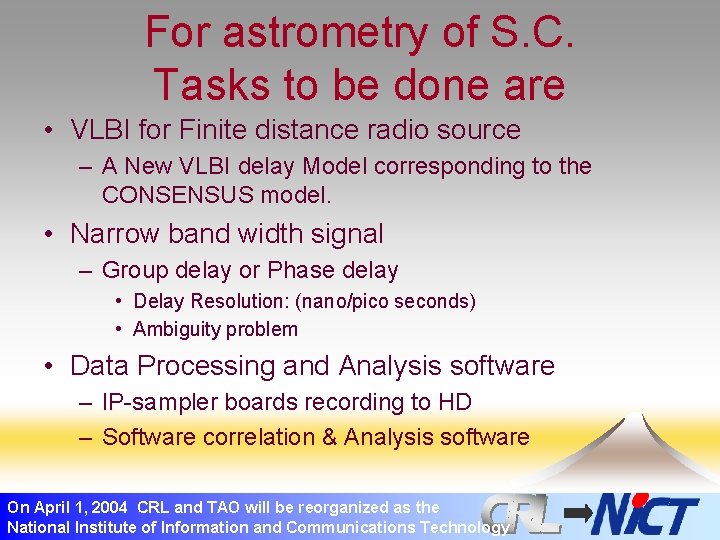
For astrometry of S. C. Tasks to be done are • VLBI for Finite distance radio source – A New VLBI delay Model corresponding to the CONSENSUS model. • Narrow band width signal – Group delay or Phase delay • Delay Resolution: (nano/pico seconds) • Ambiguity problem • Data Processing and Analysis software – IP-sampler boards recording to HD – Software correlation & Analysis software On April 1, 2004 CRL and TAO will be reorganized as the National Institute of Information and Communications Technology
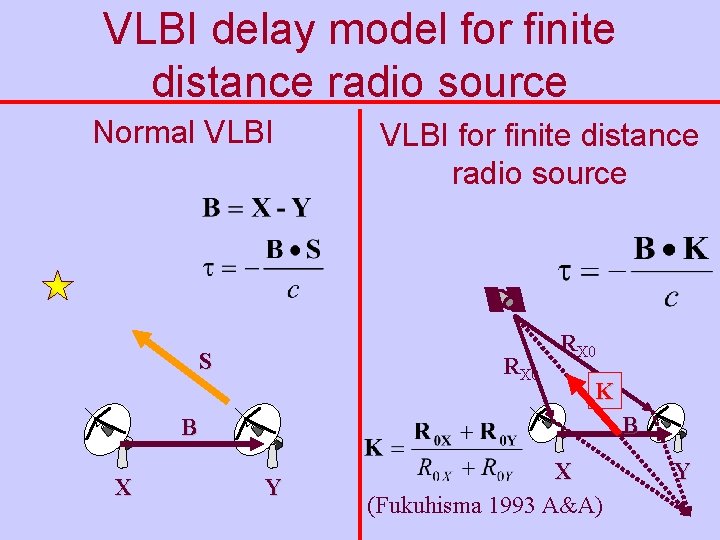
VLBI delay model for finite distance radio source Normal VLBI S VLBI for finite distance radio source RX 0 K B B X Y X (Fukuhisma 1993 A&A) Y
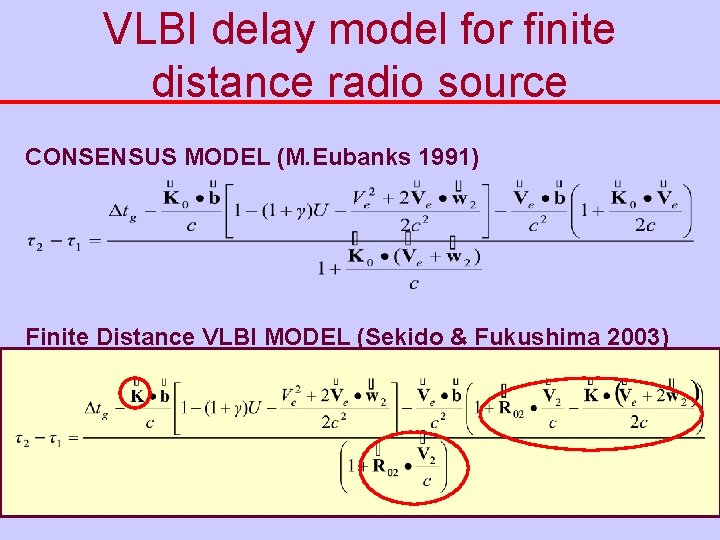
VLBI delay model for finite distance radio source CONSENSUS MODEL (M. Eubanks 1991) Finite Distance VLBI MODEL (Sekido & Fukushima 2003)
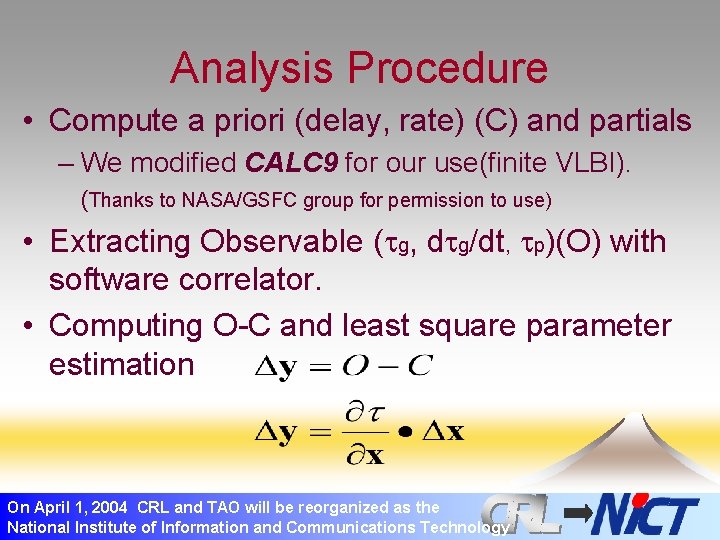
Analysis Procedure • Compute a priori (delay, rate) (C) and partials – We modified CALC 9 for our use(finite VLBI). (Thanks to NASA/GSFC group for permission to use) • Extracting Observable (tg, dtg/dt, tp)(O) with software correlator. • Computing O-C and least square parameter estimation On April 1, 2004 CRL and TAO will be reorganized as the National Institute of Information and Communications Technology
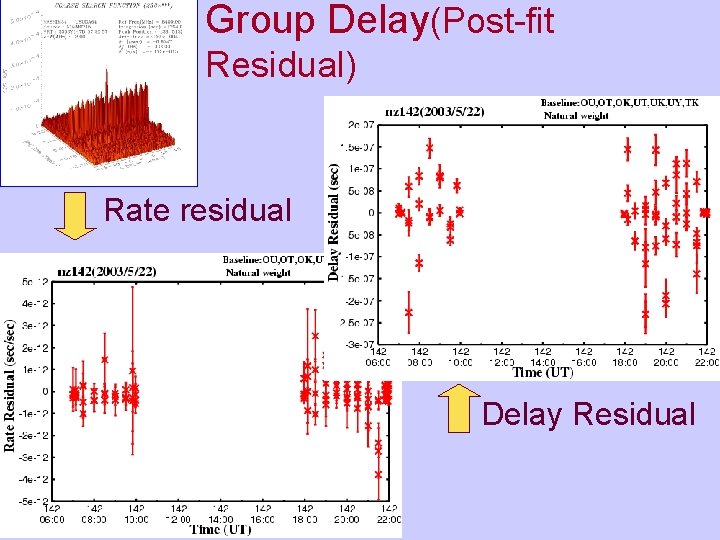
Group Delay(Post-fit Residual) Rate residual Delay Residual
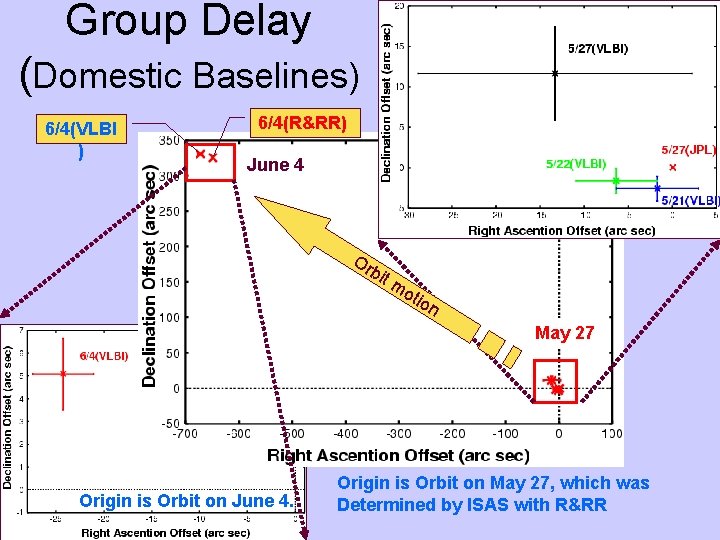
Group Delay (Domestic Baselines) 6/4(VLBI ) 6/4(R&RR) June 4 Or bi tm oti on May 27 Origin is Orbit on June 4. Origin is Orbit on May 27, which was Determined by ISAS with R&RR
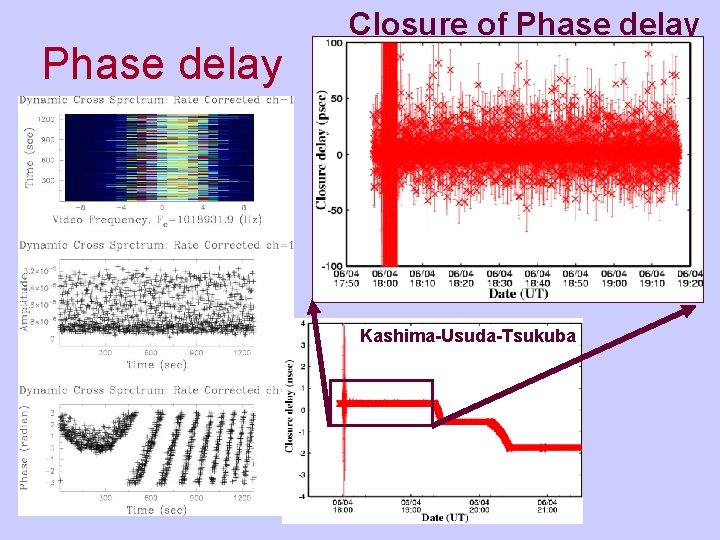
Phase delay Closure of Phase delay (Kashima-Usuda-Tsukuba) Kashima-Usuda-Tsukuba
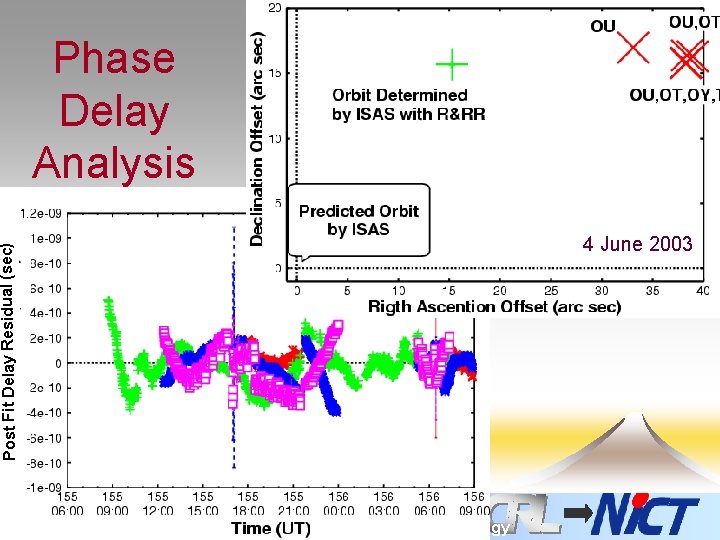
Post Fit Delay Residual (sec) Phase Delay Analysis On April 1, 2004 CRL and TAO will be reorganized as the National Institute of Information and Communications Technology 4 June 2003
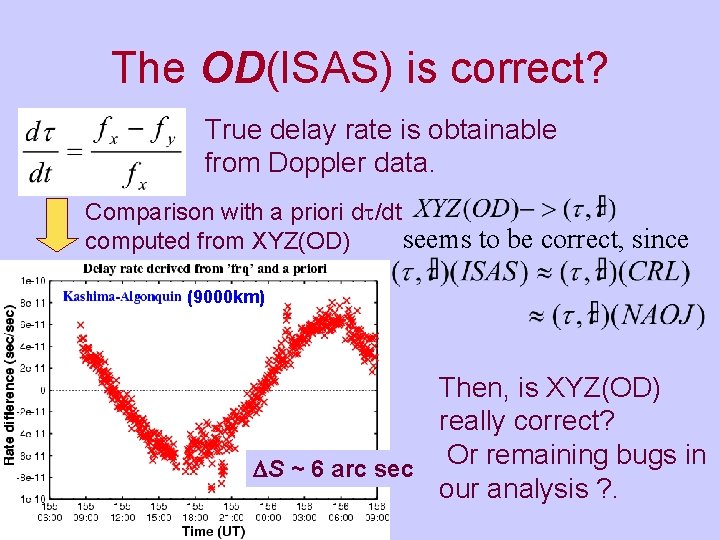
The OD(ISAS) is correct? True delay rate is obtainable from Doppler data. Comparison with a priori dt/dt seems to be correct, since computed from XYZ(OD) (9000 km) Then, is XYZ(OD) really correct? Or remaining bugs in DS ~ 6 arc sec our analysis ? .
Summary • NOZOMI VLBI observations were performed with domestic and intercontinental baselines. • Finite VLBI delay model was derived. • An analysis software is developed with that delay model based on CALC 9. • Preliminary astrometric SC coordinates were obtained with Group/Phase delay observables. • Problem of inconsistency in the coordinates need to be solved. • Solution with full baselines have to be obtained. • Next step: SC Astrometry-> Orbit estimation On April 1, 2004 CRL and TAO will be reorganized as the National Institute of Information and Communications Technology
Space Orbit of NOZOMI Jan. Feb. Mar. Apr. May Jun. On April 1, 2004 CRL and TAO will be reorganized as the National Institute of Information and Communications Technology
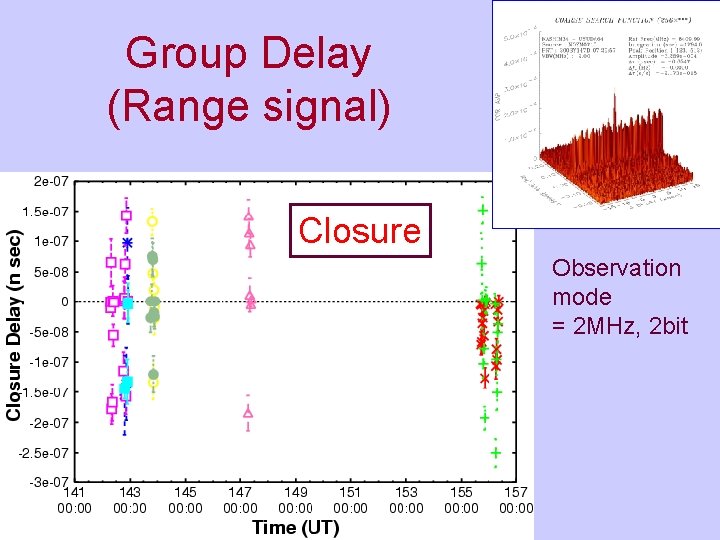
Group Delay (Range signal) Closure Observation mode = 2 MHz, 2 bit
Spacecraft Navigation with VLBI : Motivation Required for increased accuracy for future space missions: – For landing, orbiting, & saving energy • JPL/NASA has been employed – Japanese Space Agency (ISAS+NASDA=JAXA) • NOZOMI(Japanese Mars Explorer) – Needs to support orbit determination with VLBI. • Mission as our own Project On April 1, 2004 CRL and TAO will be reorganized as the National Institute of Information and Communications Technology
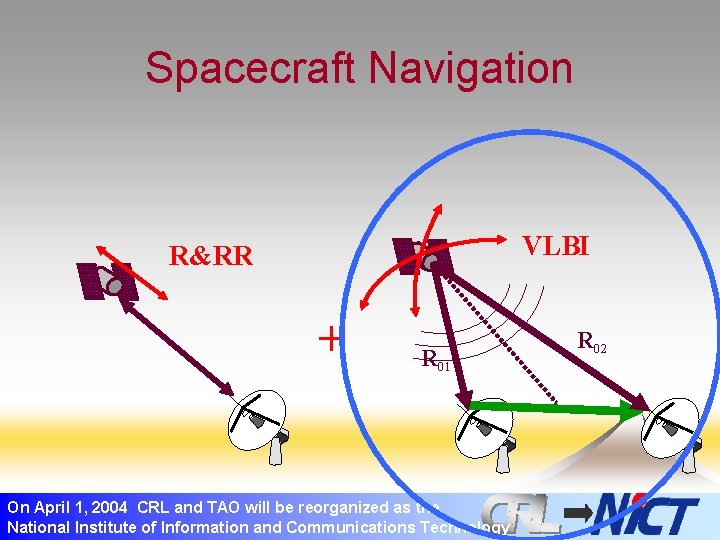
Spacecraft Navigation VLBI R&RR + R 01 On April 1, 2004 CRL and TAO will be reorganized as the National Institute of Information and Communications Technology R 02
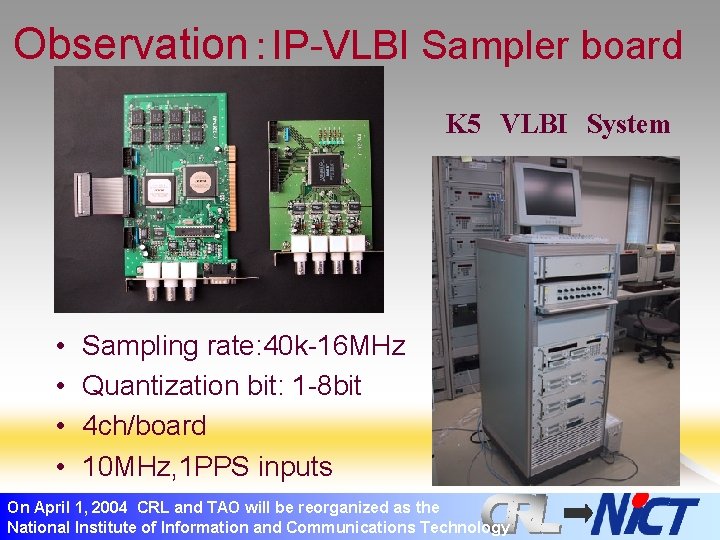
Observation:IP-VLBI Sampler board K 5 VLBI System • • Sampling rate: 40 k-16 MHz Quantization bit: 1 -8 bit 4 ch/board 10 MHz, 1 PPS inputs On April 1, 2004 CRL and TAO will be reorganized as the National Institute of Information and Communications Technology
- Slides: 19