
VITAMINS STABILITY AND THERMAL TRANSFORMATIONS OBJECTIVES 1 Stability

VITAMINS – STABILITY AND THERMAL TRANSFORMATIONS OBJECTIVES 1. Stability of vitamins; 2. Changes during food storage and treatment; 3. Chemical reactions of vitamins - examples; 4. Ascorbic acid in Maillard reaction.

! VITAMINS – STABILITY AND THERMAL TRANSFORMATIONS 1. Roles of the vitamins 1. 1. As coenzymes or their precursors; 1. 2. As a components of the defensive antioxidant systems; 1. 3. As a factors of the genetic regulation; 1. 4. Special functions (vitamin A – vision, ascorbate anion participates In reactions of hydroxylation). 1

VITAMINS – STABILITY AND THERMAL TRANSFORMATIONS 2. Stability 2

VITAMINS – STABILITY AND THERMAL TRANSFORMATIONS 2. Stability of vitamins added to breakfast cereal products 3

VITAMINS – STABILITY AND THERMAL TRANSFORMATIONS 3. General factors influencing availability, loss and stability of vitamins 3. 2. Changes after harvesting -enzymatic -chemical – in results of treatment with chemical reagents (pineapple, banana – augmentation of polyphenols; tomato – increase of carotenoids (lycopene, β-carotene) 3. 3. Influence of the initial treatment – chopping, peeling, washing, milling etc. -peeling (industrially) – often accompanied with alkaline treatment; loss of folic acid (vitamin B 9, vitamin С, thiamin; negligible losses; -washing– loss of water soluble vitamins; 5
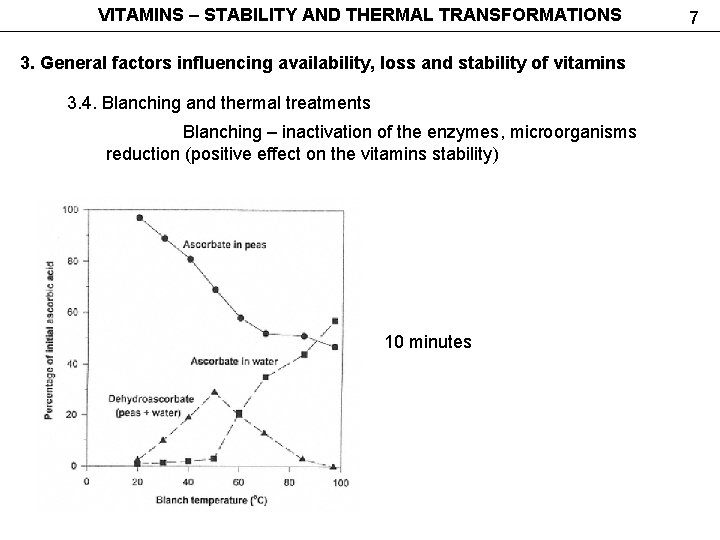
VITAMINS – STABILITY AND THERMAL TRANSFORMATIONS 3. General factors influencing availability, loss and stability of vitamins 3. 4. Blanching and thermal treatments Blanching – inactivation of the enzymes, microorganisms reduction (positive effect on the vitamins stability) 10 minutes 7

VITAMINS – STABILITY AND THERMAL TRANSFORMATIONS 3. General factors influencing availability, loss and stability of vitamins 3. 4. Blanching and thermal treatments Thermal treatment – influence of lot of parameters on the vitamins stability (р. Н, aw (moisture content), cations, oxygen, type of the raw material, presence of other compounds, etc. ) 8

VITAMINS – STABILITY AND THERMAL TRANSFORMATIONS 3. General factors influencing availability, loss and stability of vitamins 3. 5. Storage – compared to thermal treatment, less losses of vitamins 9

VITAMINS – STABILITY AND THERMAL TRANSFORMATIONS 3. General factors influencing availability, loss and stability of vitamins 3. 6. Influence of other compounds added - oxidants – hypochlorite, ozone (degradation of vitamins С, В 1) - SO 2 – protective effect on vitamin С, but destructive for thiamin, vitamin В 6 - nitrites – used as preservatives and for better look of meat; to avoid formation of nitrosamines vitamins C and E is added (due to the oxidation of vitamins is formed NO, but not a N 2 O 3 – the primary nitrosating agent) - acidity regulators (acidulants) – improving stability of vitamin C, thiamin etc. 10

VITAMINS – STABILITY AND THERMAL TRANSFORMATIONS 4. Thermal transformations 4. 1. Vitamin A: 11

VITAMINS – STABILITY AND THERMAL TRANSFORMATIONS 4. Thermal transformations 4. 2. Vitamin В 6 – anemia; reactions of decarboxylation, transamination, racemization, С-С split etc. ) 12

VITAMINS – STABILITY AND THERMAL TRANSFORMATIONS 4. Thermal transformations 4. 2. Vitamin В 6 Case study: Influence of the chemical structure of the vitamin on thermal stability and availability (50 ths of the XIX century in USA) – milk products consumed by children; Observation – part of the kids suffer from convulsive seizures; Solution: changing the pyridoxal with pyridoxine (reason – thermal treatment of the milk during sterilization about 60% of the B 6 (pyridoxal form) is destroyed but the pyridoxine is stable). 13

VITAMINS – STABILITY AND THERMAL TRANSFORMATIONS 4. Thermal transformations Other possibility – binding to proteins (formation of amide bonds) Interaction with free radicals (obtained during degradation of vitamin C, lipid peroxidation, light absorption etc. ) – degradation and loss of vitamin activity. 14

VITAMINS – STABILITY AND THERMAL TRANSFORMATIONS 4. Thermal transformations 4. 3. Vitamin C (E 300) Biological activity Antioxidant in foodstuffs Reducing agent in foodstuffs L-ascorbic acid Inhibitor of the enzymatic browning Inhibitor of the non-enzymatic browning Carbonyl component in Maillard reaction Role of the L-ascorbic acid in foods 15

! VITAMINS – STABILITY AND THERMAL TRANSFORMATIONS 16 4. Thermal transformations 4. 3. Vitamin C (E 300) L-ascorbic acid D-ascorbic acid Lactone of 2 -keto-L-gulonic acid L-isoascorbic acid D-isoascorbic acid - Easily oxidized – formation of ascorbate anion and dehydroascorbic acid

VITAMINS – STABILITY AND THERMAL TRANSFORMATIONS 4. Thermal transformations 4. 3. Vitamin C (E 300) Transformations and degradation of vitamin C Tree major type products are formed: - polymeric products; - unsaturated carboxylic acids with 5 or 6 C atoms; - products of fragmentation with 5 or less C atoms. 17

VITAMINS – STABILITY AND THERMAL TRANSFORMATIONS 4. Thermal transformations 4. 3. Vitamin C (E 300) - Carbonyl component in the Maillard reaction; 19
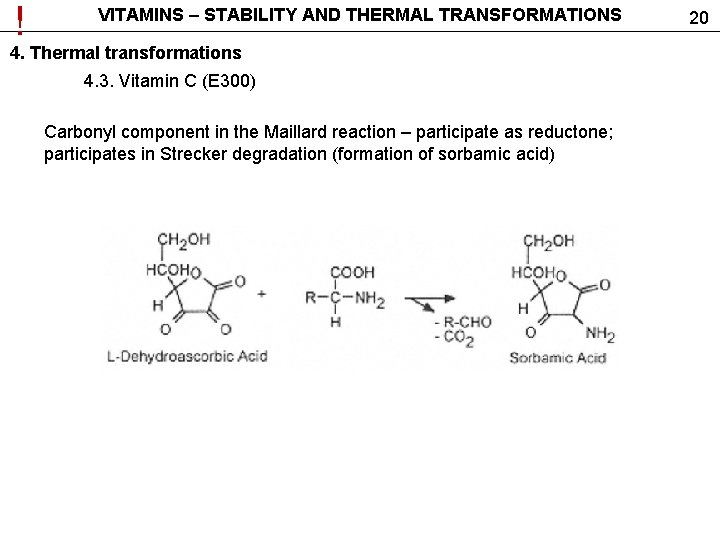
! VITAMINS – STABILITY AND THERMAL TRANSFORMATIONS 4. Thermal transformations 4. 3. Vitamin C (E 300) Carbonyl component in the Maillard reaction – participate as reductone; participates in Strecker degradation (formation of sorbamic acid) 20

VITAMINS – STABILITY AND THERMAL TRANSFORMATIONS 4. Thermal transformations 4. 3. Vitamin C (E 300) Carbonyl component in the Maillard reaction – participate as reductone; participates in Strecker degradation (formation of sorbamic acid) Sorbamic acid DHA – dehydroascorbic acid 21
- Slides: 19