
Vitamin D or Calcium and Prevention of Fracture

- Slides: 26
Vitamin D or Calcium and Prevention of Fracture Tuan V. Nguyen Garvan Institute of Medical Research Sydney, Australia
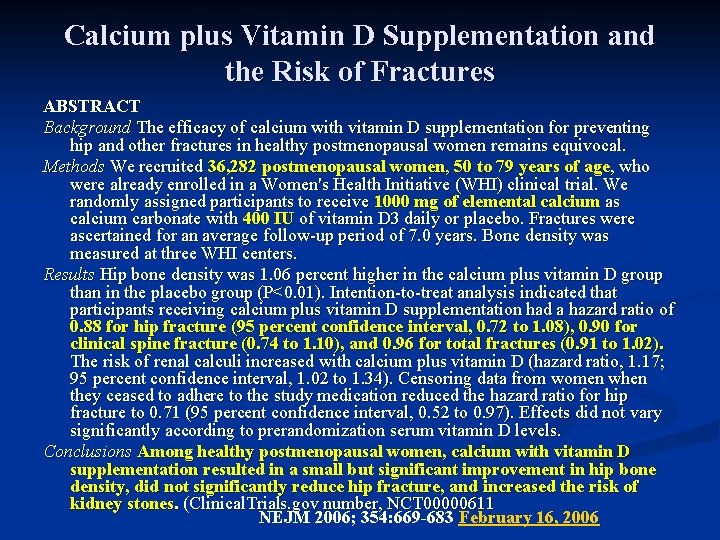
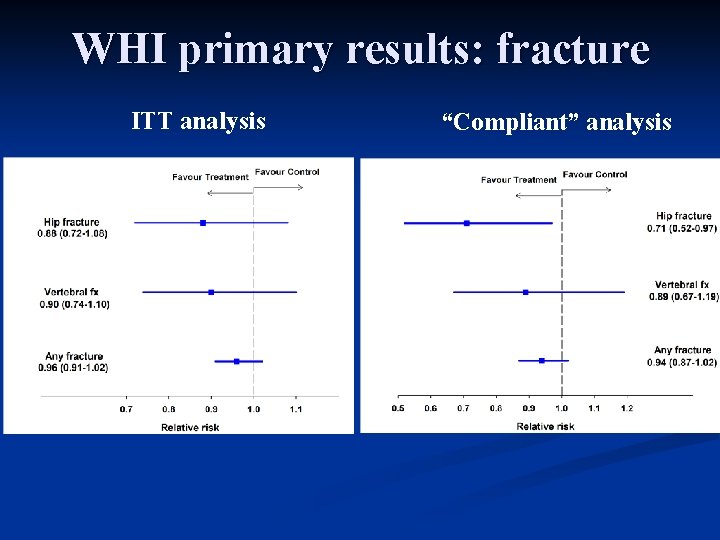
Calcium plus Vitamin D Supplementation and the Risk of Fractures ABSTRACT Background The efficacy of calcium with vitamin D supplementation for preventing hip and other fractures in healthy postmenopausal women remains equivocal. Methods We recruited 36, 282 postmenopausal women, 50 to 79 years of age, who were already enrolled in a Women's Health Initiative (WHI) clinical trial. We randomly assigned participants to receive 1000 mg of elemental calcium as calcium carbonate with 400 IU of vitamin D 3 daily or placebo. Fractures were ascertained for an average follow-up period of 7. 0 years. Bone density was measured at three WHI centers. Results Hip bone density was 1. 06 percent higher in the calcium plus vitamin D group than in the placebo group (P<0. 01). Intention-to-treat analysis indicated that participants receiving calcium plus vitamin D supplementation had a hazard ratio of 0. 88 for hip fracture (95 percent confidence interval, 0. 72 to 1. 08), 0. 90 for clinical spine fracture (0. 74 to 1. 10), and 0. 96 for total fractures (0. 91 to 1. 02). The risk of renal calculi increased with calcium plus vitamin D (hazard ratio, 1. 17; 95 percent confidence interval, 1. 02 to 1. 34). Censoring data from women when they ceased to adhere to the study medication reduced the hazard ratio for hip fracture to 0. 71 (95 percent confidence interval, 0. 52 to 0. 97). Effects did not vary significantly according to prerandomization serum vitamin D levels. Conclusions Among healthy postmenopausal women, calcium with vitamin D supplementation resulted in a small but significant improvement in hip bone density, did not significantly reduce hip fracture, and increased the risk of kidney stones. (Clinical. Trials. gov number, NCT 00000611 NEJM 2006; 354: 669 -683 February 16, 2006
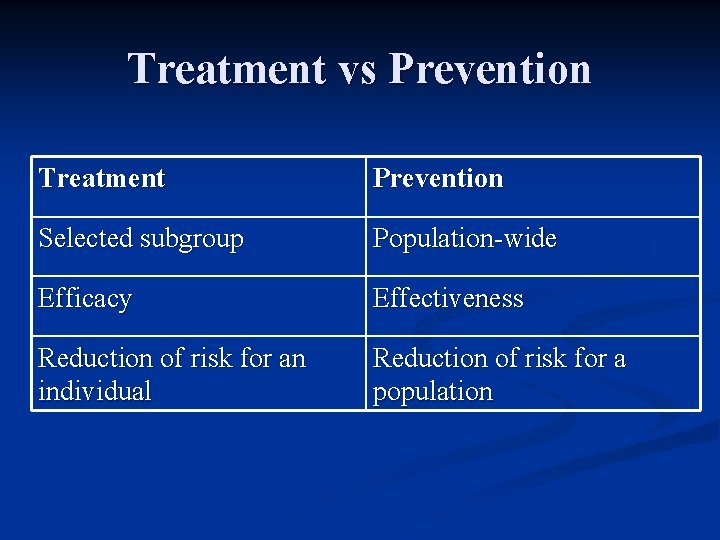
Treatment vs Prevention Treatment Prevention Selected subgroup Population-wide Efficacy Effectiveness Reduction of risk for an individual Reduction of risk for a population
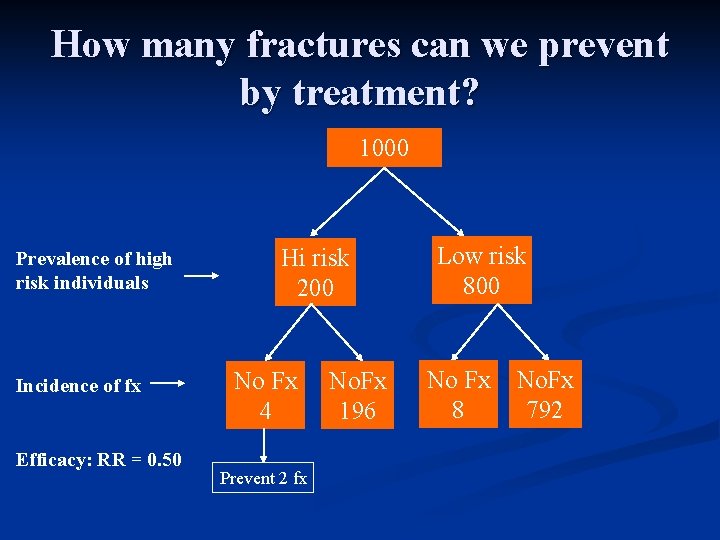
How many fractures can we prevent by treatment? 1000 Prevalence of high risk individuals Incidence of fx Efficacy: RR = 0. 50 Hi risk 200 No Fx 4 Prevent 2 fx No. Fx 196 Low risk 800 No Fx 8 No. Fx 792
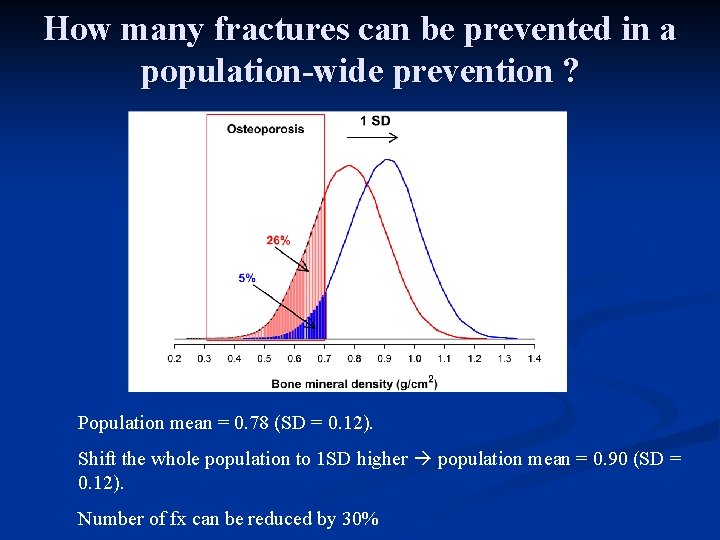
How many fractures can be prevented in a population-wide prevention ? Population mean = 0. 78 (SD = 0. 12). Shift the whole population to 1 SD higher population mean = 0. 90 (SD = 0. 12). Number of fx can be reduced by 30%
Calcium, vitamin D and bone n 99% of total body calcium is in bones and teeth n Calcium absorption ? n Regulation of calcium absorption: Vitamin D
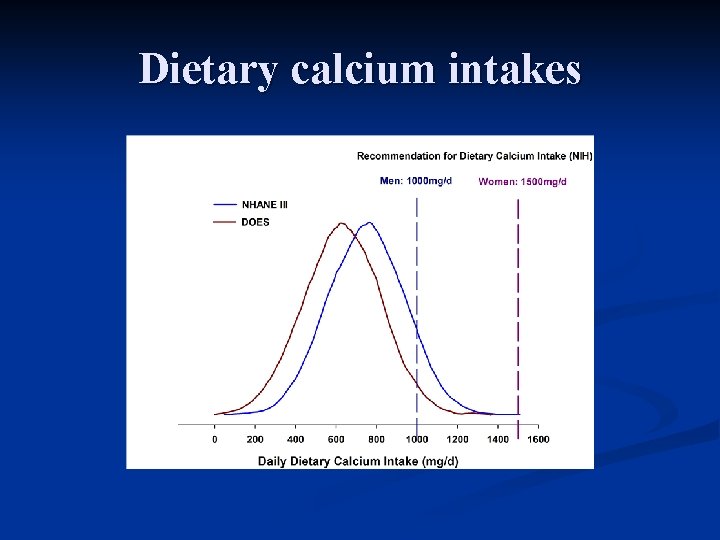
Dietary calcium intakes
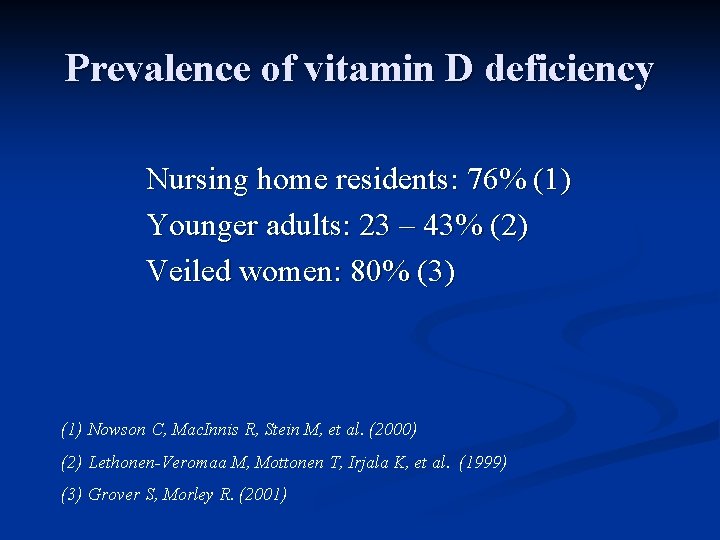
Prevalence of vitamin D deficiency Nursing home residents: 76% (1) Younger adults: 23 – 43% (2) Veiled women: 80% (3) (1) Nowson C, Mac. Innis R, Stein M, et al. (2000) (2) Lethonen-Veromaa M, Mottonen T, Irjala K, et al. (1999) (3) Grover S, Morley R. (2001)
Calcium and vitamin D as preventive means Inexpensive n Relatively safe n Effectiveness? n
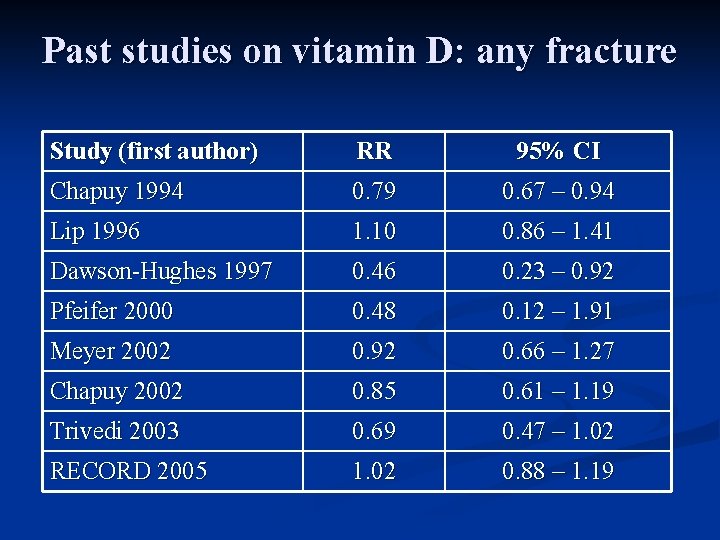
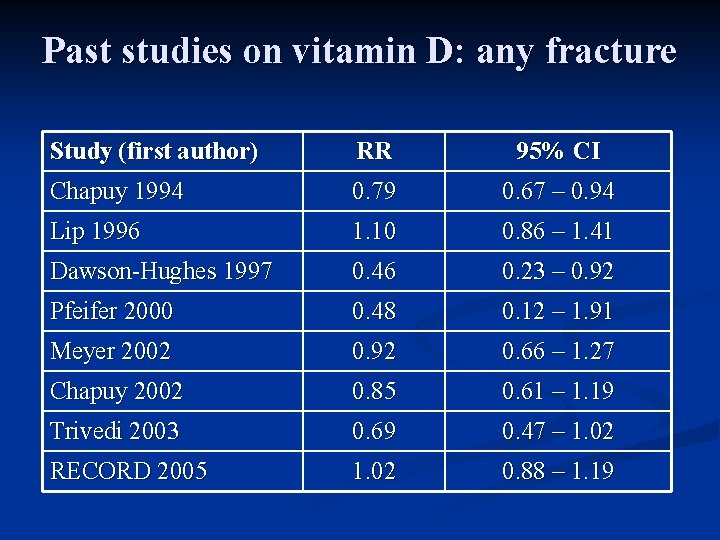
Past studies on vitamin D: any fracture Study (first author) RR 95% CI Chapuy 1994 0. 79 0. 67 – 0. 94 Lip 1996 1. 10 0. 86 – 1. 41 Dawson-Hughes 1997 0. 46 0. 23 – 0. 92 Pfeifer 2000 0. 48 0. 12 – 1. 91 Meyer 2002 0. 92 0. 66 – 1. 27 Chapuy 2002 0. 85 0. 61 – 1. 19 Trivedi 2003 0. 69 0. 47 – 1. 02 RECORD 2005 1. 02 0. 88 – 1. 19
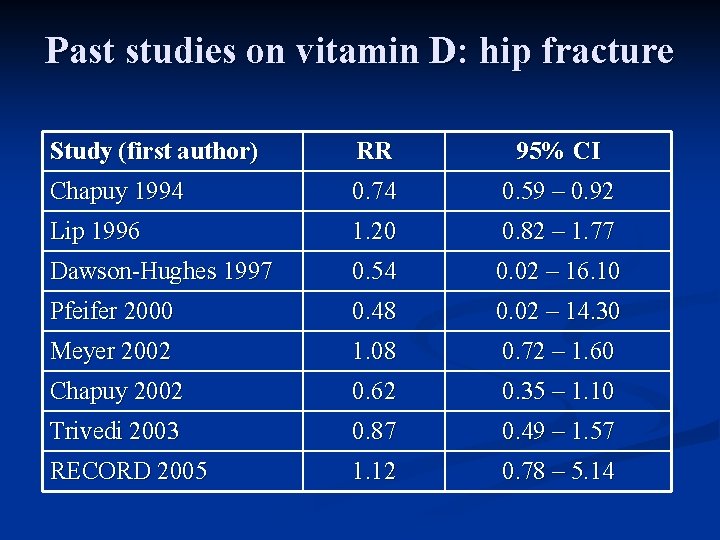
Past studies on vitamin D: hip fracture Study (first author) RR 95% CI Chapuy 1994 0. 74 0. 59 – 0. 92 Lip 1996 1. 20 0. 82 – 1. 77 Dawson-Hughes 1997 0. 54 0. 02 – 16. 10 Pfeifer 2000 0. 48 0. 02 – 14. 30 Meyer 2002 1. 08 0. 72 – 1. 60 Chapuy 2002 0. 62 0. 35 – 1. 10 Trivedi 2003 0. 87 0. 49 – 1. 57 RECORD 2005 1. 12 0. 78 – 5. 14
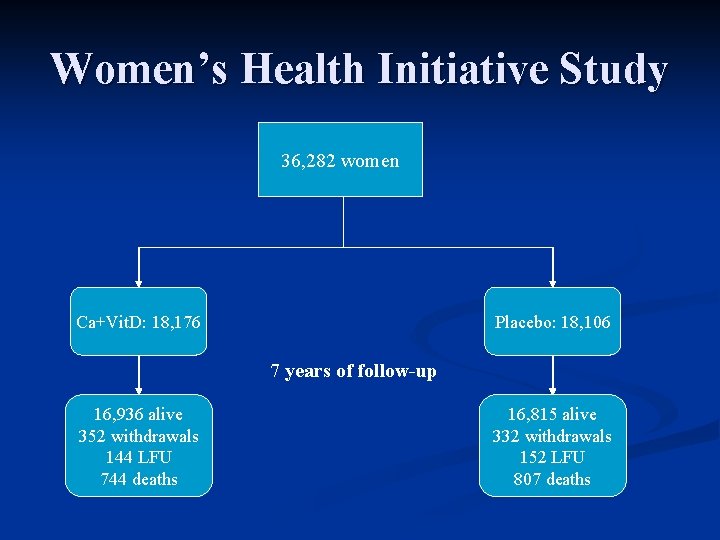
Women’s Health Initiative Study 36, 282 women Ca+Vit. D: 18, 176 Placebo: 18, 106 7 years of follow-up 16, 936 alive 352 withdrawals 144 LFU 744 deaths 16, 815 alive 332 withdrawals 152 LFU 807 deaths
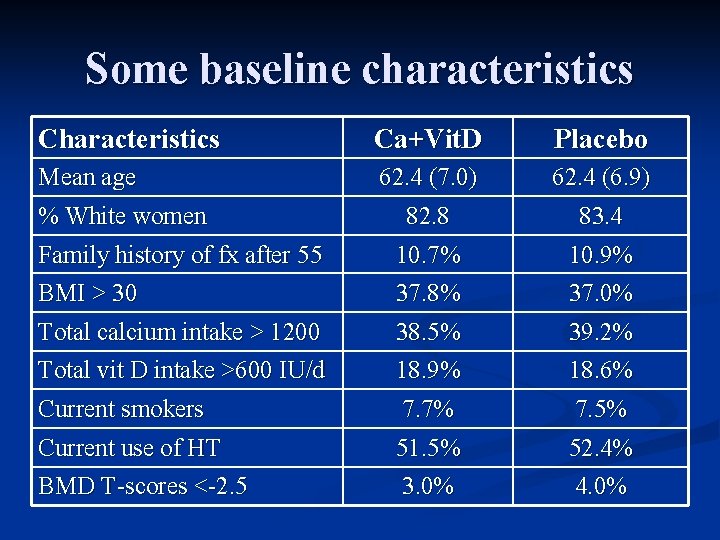
Some baseline characteristics Ca+Vit. D Placebo Mean age 62. 4 (7. 0) 62. 4 (6. 9) % White women Family history of fx after 55 82. 8 10. 7% 83. 4 10. 9% BMI > 30 37. 8% 37. 0% Total calcium intake > 1200 38. 5% 39. 2% Total vit D intake >600 IU/d 18. 9% 18. 6% Current smokers 7. 7% 7. 5% Current use of HT 51. 5% 52. 4% BMD T-scores <-2. 5 3. 0% 4. 0%
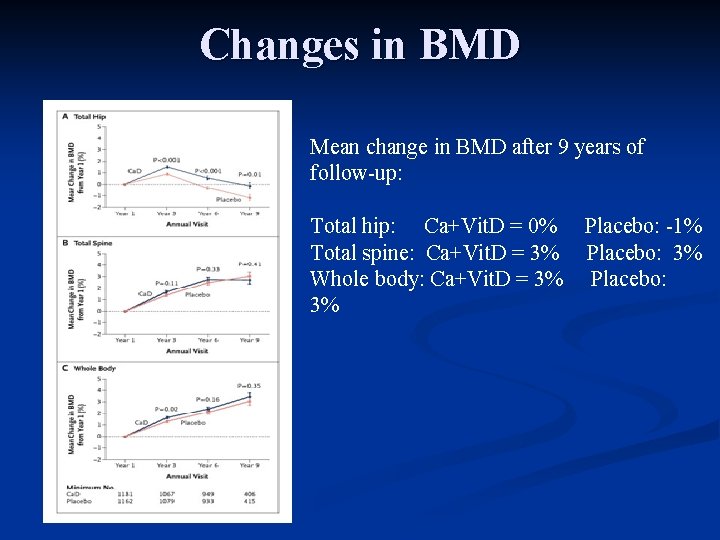
Changes in BMD Mean change in BMD after 9 years of follow-up: Total hip: Ca+Vit. D = 0% Placebo: -1% Total spine: Ca+Vit. D = 3% Placebo: 3% Whole body: Ca+Vit. D = 3% Placebo: 3%
WHI primary results: fracture ITT analysis “Compliant” analysis
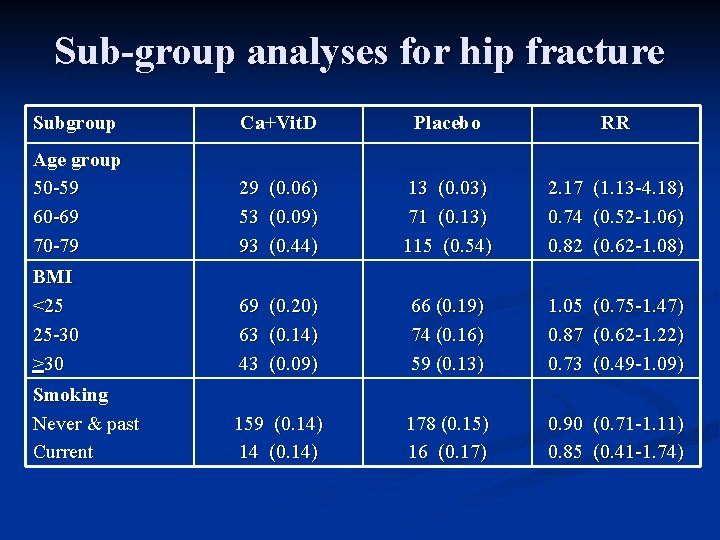
Sub-group analyses for hip fracture Subgroup Ca+Vit. D Age group 50 -59 60 -69 70 -79 29 53 93 BMI <25 25 -30 >30 69 (0. 20) 63 (0. 14) 43 (0. 09) 66 (0. 19) 74 (0. 16) 59 (0. 13) 1. 05 (0. 75 -1. 47) 0. 87 (0. 62 -1. 22) 0. 73 (0. 49 -1. 09) Smoking Never & past Current 159 (0. 14) 14 (0. 14) 178 (0. 15) 16 (0. 17) 0. 90 (0. 71 -1. 11) 0. 85 (0. 41 -1. 74) (0. 06) (0. 09) (0. 44) Placebo 13 (0. 03) 71 (0. 13) 115 (0. 54) RR 2. 17 0. 74 0. 82 (1. 13 -4. 18) (0. 52 -1. 06) (0. 62 -1. 08)
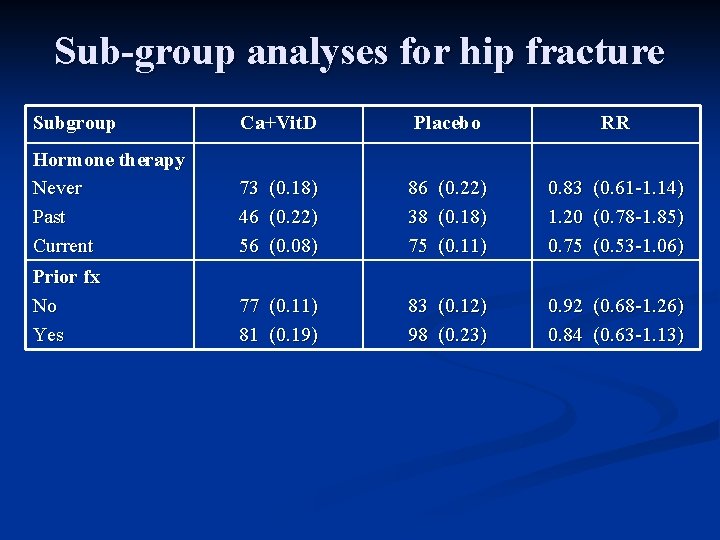
Sub-group analyses for hip fracture Subgroup Ca+Vit. D Placebo Hormone therapy Never Past Current 73 46 56 86 38 75 Prior fx No Yes 77 (0. 11) 81 (0. 19) (0. 18) (0. 22) (0. 08) (0. 22) (0. 18) (0. 11) 83 (0. 12) 98 (0. 23) RR 0. 83 1. 20 0. 75 (0. 61 -1. 14) (0. 78 -1. 85) (0. 53 -1. 06) 0. 92 (0. 68 -1. 26) 0. 84 (0. 63 -1. 13)
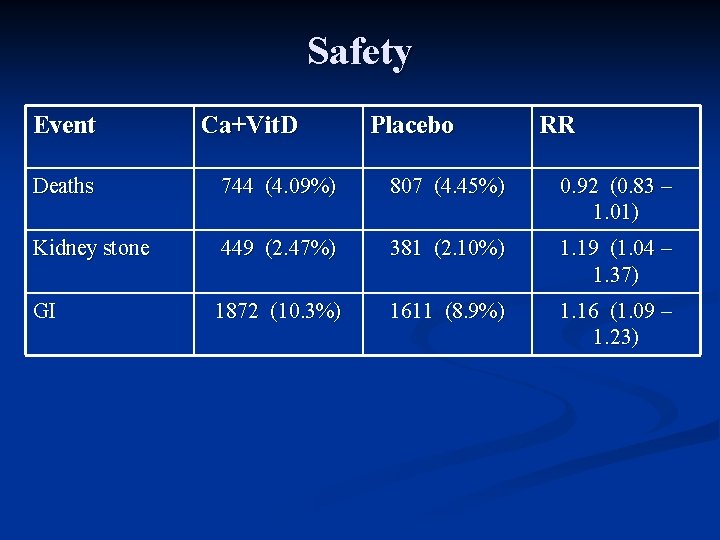
Safety Event Ca+Vit. D Placebo RR Deaths 744 (4. 09%) 807 (4. 45%) 0. 92 (0. 83 – 1. 01) Kidney stone 449 (2. 47%) 381 (2. 10%) 1. 19 (1. 04 – 1. 37) GI 1872 (10. 3%) 1611 (8. 9%) 1. 16 (1. 09 – 1. 23)
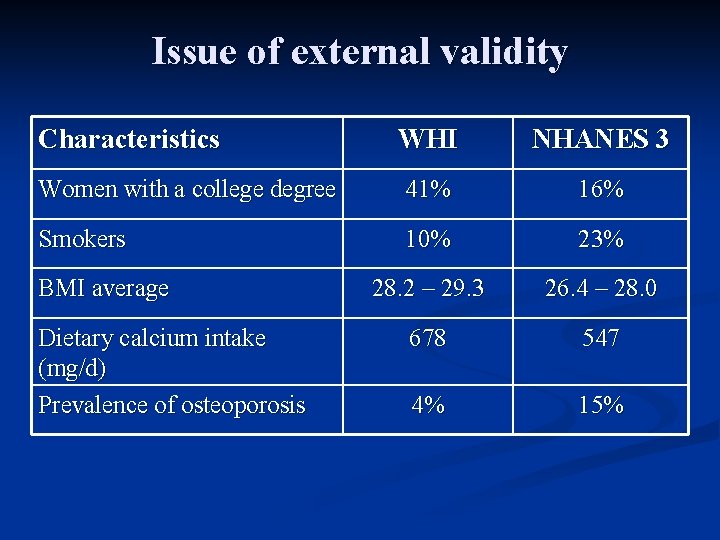
Issue of external validity Characteristics WHI NHANES 3 Women with a college degree 41% 16% Smokers 10% 23% 28. 2 – 29. 3 26. 4 – 28. 0 678 547 4% 15% BMI average Dietary calcium intake (mg/d) Prevalence of osteoporosis
Bayesian updating
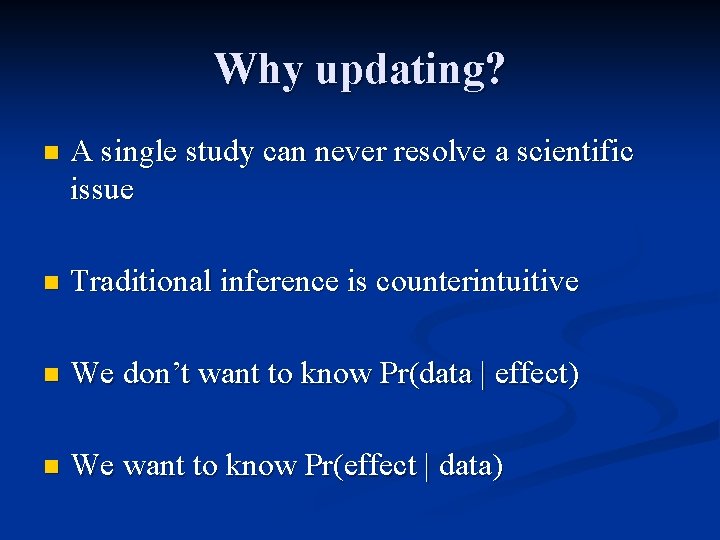
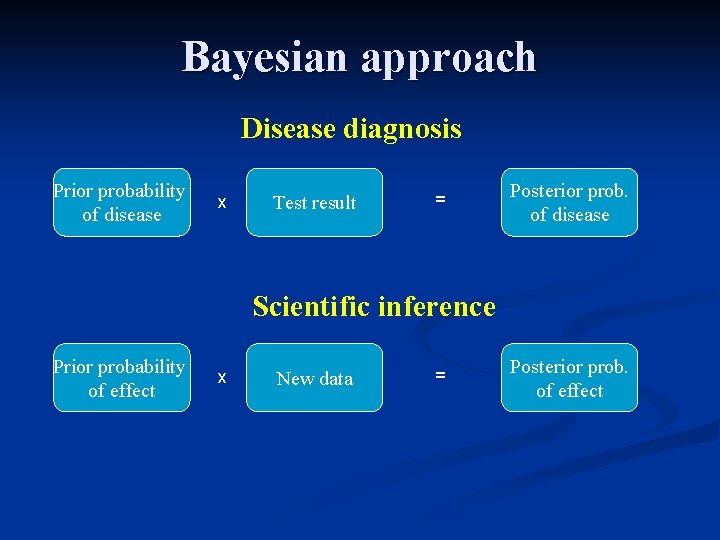
Why updating? n A single study can never resolve a scientific issue n Traditional inference is counterintuitive n We don’t want to know Pr(data | effect) n We want to know Pr(effect | data)
Bayesian approach Disease diagnosis Prior probability of disease x Test result = Posterior prob. of disease Scientific inference Prior probability of effect x New data = Posterior prob. of effect
Past studies on vitamin D: any fracture Study (first author) RR 95% CI Chapuy 1994 0. 79 0. 67 – 0. 94 Lip 1996 1. 10 0. 86 – 1. 41 Dawson-Hughes 1997 0. 46 0. 23 – 0. 92 Pfeifer 2000 0. 48 0. 12 – 1. 91 Meyer 2002 0. 92 0. 66 – 1. 27 Chapuy 2002 0. 85 0. 61 – 1. 19 Trivedi 2003 0. 69 0. 47 – 1. 02 RECORD 2005 1. 02 0. 88 – 1. 19
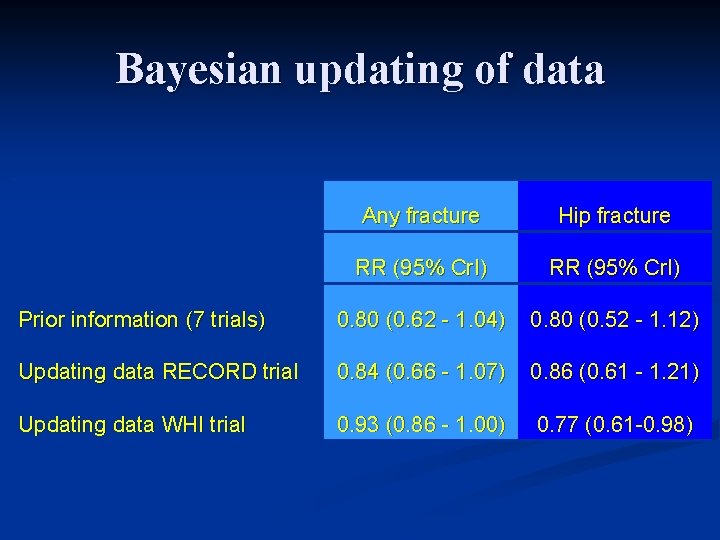
Bayesian updating of data Any fracture Hip fracture RR (95% Cr. I) Prior information (7 trials) 0. 80 (0. 62 - 1. 04) 0. 80 (0. 52 - 1. 12) Updating data RECORD trial 0. 84 (0. 66 - 1. 07) 0. 86 (0. 61 - 1. 21) Updating data WHI trial 0. 93 (0. 86 - 1. 00) 0. 77 (0. 61 -0. 98)
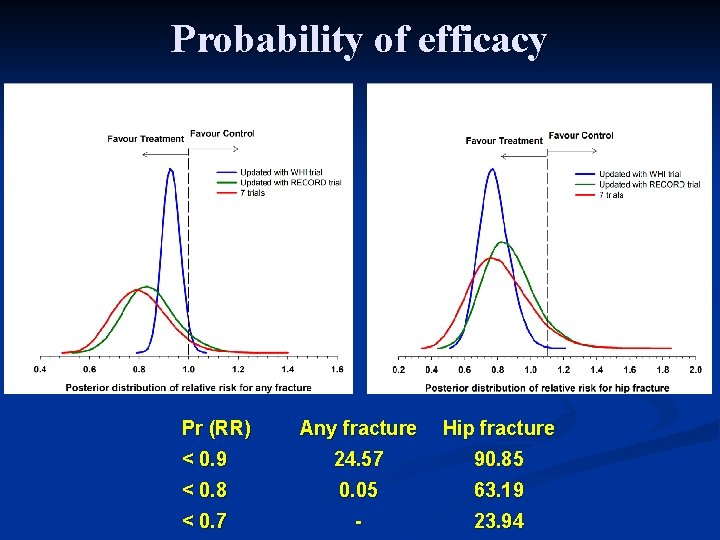
Probability of efficacy Pr (RR) Any fracture Hip fracture < 0. 9 24. 57 90. 85 < 0. 8 0. 05 63. 19 < 0. 7 - 23. 94
Conclusions n WHI data: difficult to interpret n Accumulative data: evidence of modest effect of Ca or vit D on hip fx