
Vitality Assessment 101 Adapted from SOA Governance Thomas
- Slides: 19
Vitality Assessment 101 Adapted from SOA Governance, Thomas Erl, Prentice Hall, 2011 © 2013 Health Level Seven ® International. All Rights Reserved. HL 7 and Health Level Seven are registered trademarks of Health Level Seven International. Reg. U. S. TM Office.
Concept of Product Vitality n n A governance program must provide a means by which organizational assets are routinely reviewed, kept current and accurate and, most importantly, relevant to (often changing) business needs The notion of Vitality needs to be part of the Governance system It is a proactive approach rather than reactive Focused on ensuring relevancy of a governance system, its precepts, and processes and verifying the relevancy of the product © 2013 Health Level Seven ® International. All Rights Reserved. HL 7 and Health Level Seven are registered trademarks of Health Level Seven International. Reg. U. S. TM Office.
Summary of Key Points n n n Vitality is a quality measured by an initiative’s ability to maintain a desired direction and attain desired goals in the face of on-going change Vitality is a subset of governance that is focused on extending those practices to an initiative Comprised of one or more pre-defined vitality activities executed by pre-defined triggers © 2013 Health Level Seven ® International. All Rights Reserved. HL 7 and Health Level Seven are registered trademarks of Health Level Seven International. Reg. U. S. TM Office.
Vitality Fundamentals Create an IT environment inherently capable of accommodating change n A system of governance that is fully prepared for business change and will react… with unwavering support for the strategic goals of the business n Requires a vitality framework that uses vitality triggers that result in one or more vitality activities n © 2013 Health Level Seven ® International. All Rights Reserved. HL 7 and Health Level Seven are registered trademarks of Health Level Seven International. Reg. U. S. TM Office.
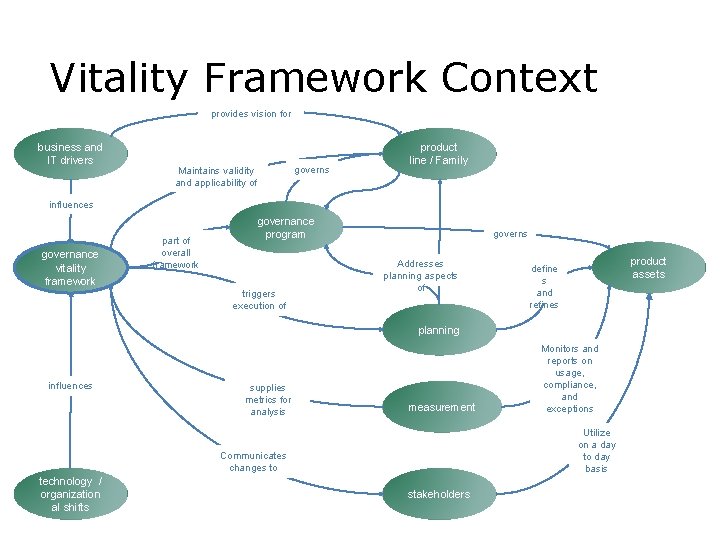
Vitality Framework Context provides vision for business and IT drivers governs Maintains validity and applicability of product line / Family influences governance vitality framework part of overall framework governance program triggers execution of governs Addresses planning aspects of product assets define s and refines planning influences supplies metrics for analysis measurement Utilize on a day to day basis Communicates changes to technology / organization al shifts Monitors and reports on usage, compliance, and exceptions stakeholders
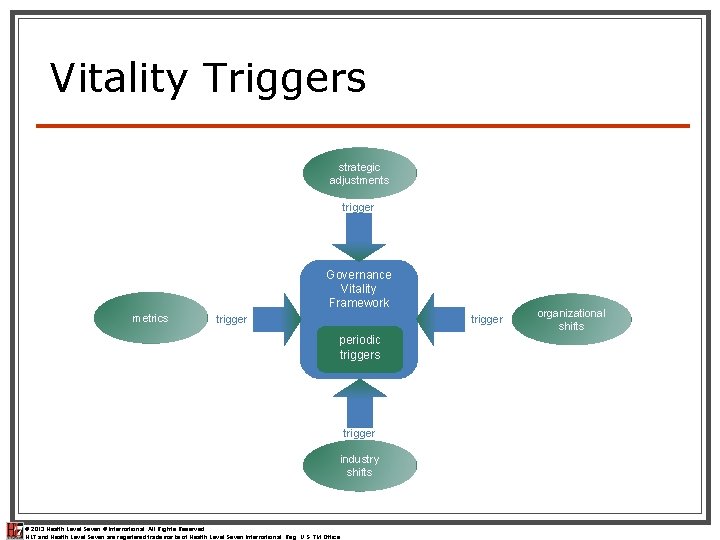
Vitality Triggers strategic adjustments trigger Governance Vitality Framework metrics trigger periodic triggers trigger industry shifts © 2013 Health Level Seven ® International. All Rights Reserved. HL 7 and Health Level Seven are registered trademarks of Health Level Seven International. Reg. U. S. TM Office. organizational shifts
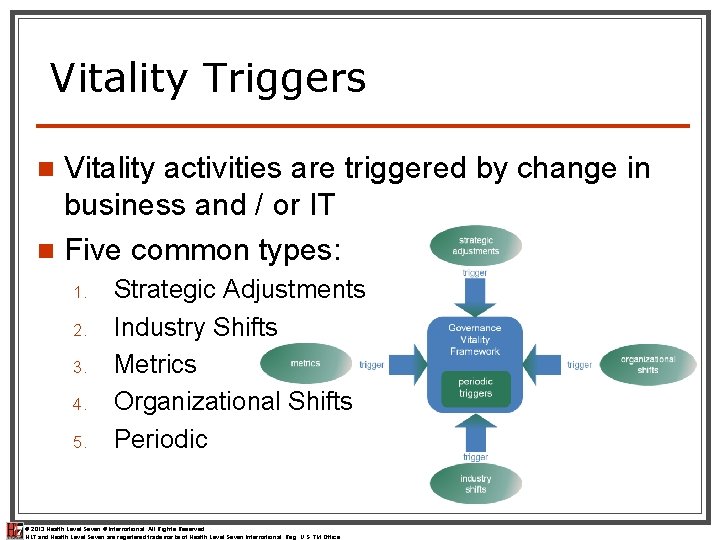
Vitality Triggers Vitality activities are triggered by change in business and / or IT n Five common types: n 1. 2. 3. 4. 5. Strategic Adjustments Industry Shifts Metrics Organizational Shifts Periodic © 2013 Health Level Seven ® International. All Rights Reserved. HL 7 and Health Level Seven are registered trademarks of Health Level Seven International. Reg. U. S. TM Office.
Strategic Adjustment Triggers n n Usually significant, almost always acting as a trigger Strategic Business Adjustment Ø Ø n Driven by changes in organizational direction or vision Effects can be far-reaching, affecting delivery processes, tooling, governance itself Strategic IT Adjustment Ø Ø Ø Change in technology and resources (including people+skills) Can be enabling or constraining Can affect one or more product grouping © 2013 Health Level Seven ® International. All Rights Reserved. HL 7 and Health Level Seven are registered trademarks of Health Level Seven International. Reg. U. S. TM Office.
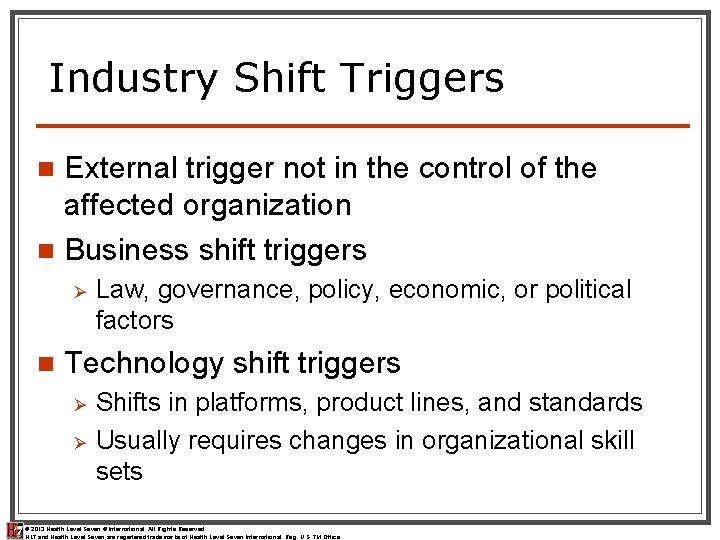
Industry Shift Triggers External trigger not in the control of the affected organization n Business shift triggers n Ø n Law, governance, policy, economic, or political factors Technology shift triggers Ø Ø Shifts in platforms, product lines, and standards Usually requires changes in organizational skill sets © 2013 Health Level Seven ® International. All Rights Reserved. HL 7 and Health Level Seven are registered trademarks of Health Level Seven International. Reg. U. S. TM Office.
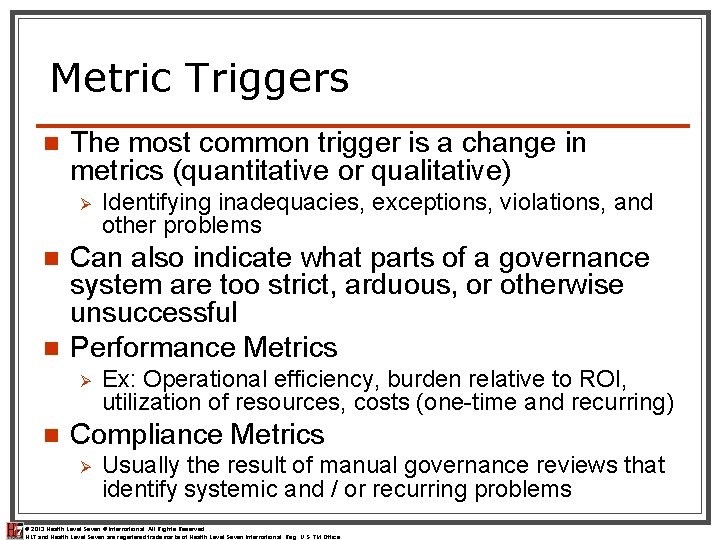
Metric Triggers n The most common trigger is a change in metrics (quantitative or qualitative) Ø n n Can also indicate what parts of a governance system are too strict, arduous, or otherwise unsuccessful Performance Metrics Ø n Identifying inadequacies, exceptions, violations, and other problems Ex: Operational efficiency, burden relative to ROI, utilization of resources, costs (one-time and recurring) Compliance Metrics Ø Usually the result of manual governance reviews that identify systemic and / or recurring problems © 2013 Health Level Seven ® International. All Rights Reserved. HL 7 and Health Level Seven are registered trademarks of Health Level Seven International. Reg. U. S. TM Office.
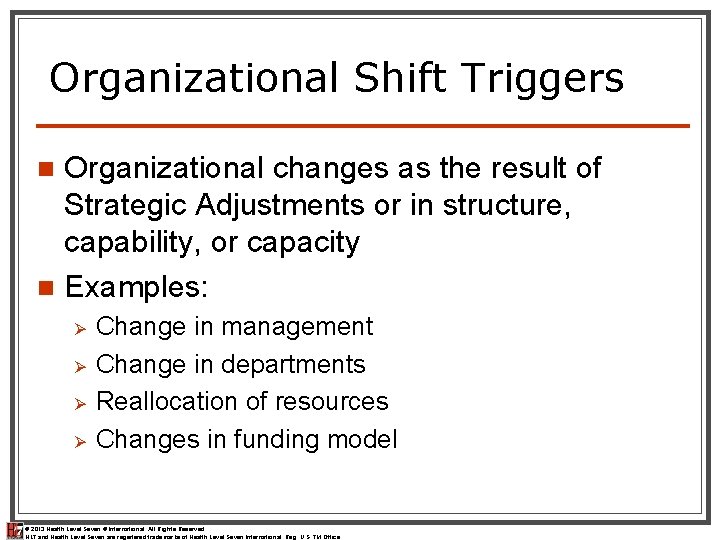
Organizational Shift Triggers Organizational changes as the result of Strategic Adjustments or in structure, capability, or capacity n Examples: n Ø Ø Change in management Change in departments Reallocation of resources Changes in funding model © 2013 Health Level Seven ® International. All Rights Reserved. HL 7 and Health Level Seven are registered trademarks of Health Level Seven International. Reg. U. S. TM Office.
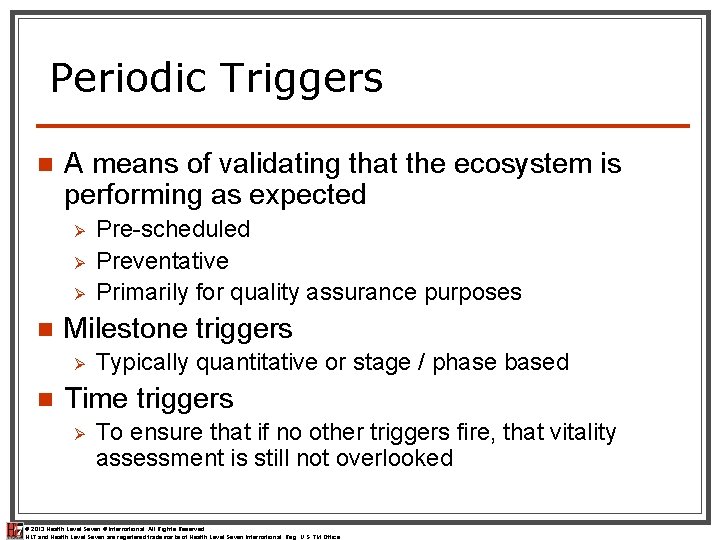
Periodic Triggers n A means of validating that the ecosystem is performing as expected Ø Ø Ø n Milestone triggers Ø n Pre-scheduled Preventative Primarily for quality assurance purposes Typically quantitative or stage / phase based Time triggers Ø To ensure that if no other triggers fire, that vitality assessment is still not overlooked © 2013 Health Level Seven ® International. All Rights Reserved. HL 7 and Health Level Seven are registered trademarks of Health Level Seven International. Reg. U. S. TM Office.
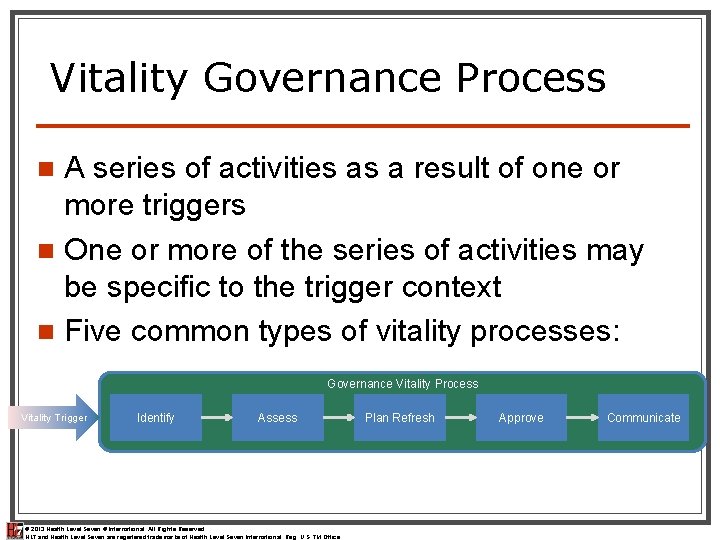
Vitality Governance Process A series of activities as a result of one or more triggers n One or more of the series of activities may be specific to the trigger context n Five common types of vitality processes: n Governance Vitality Process Vitality Trigger Identify Assess © 2013 Health Level Seven ® International. All Rights Reserved. HL 7 and Health Level Seven are registered trademarks of Health Level Seven International. Reg. U. S. TM Office. Plan Refresh Approve Communicate
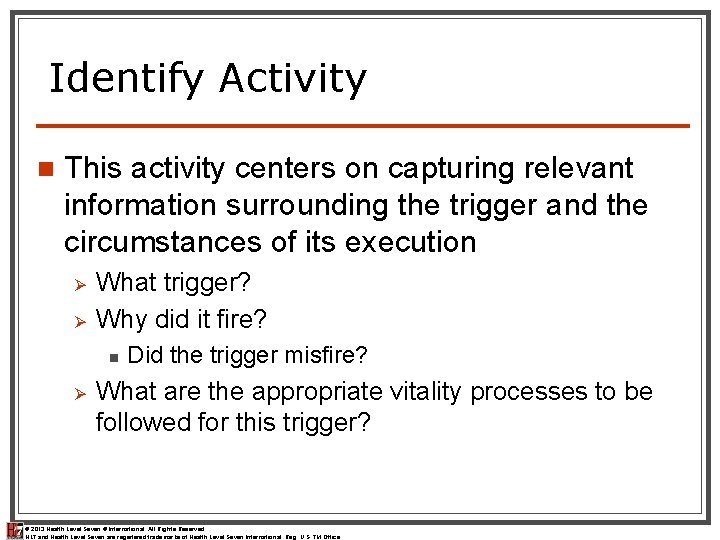
Identify Activity n This activity centers on capturing relevant information surrounding the trigger and the circumstances of its execution Ø Ø What trigger? Why did it fire? n Ø Did the trigger misfire? What are the appropriate vitality processes to be followed for this trigger? © 2013 Health Level Seven ® International. All Rights Reserved. HL 7 and Health Level Seven are registered trademarks of Health Level Seven International. Reg. U. S. TM Office.
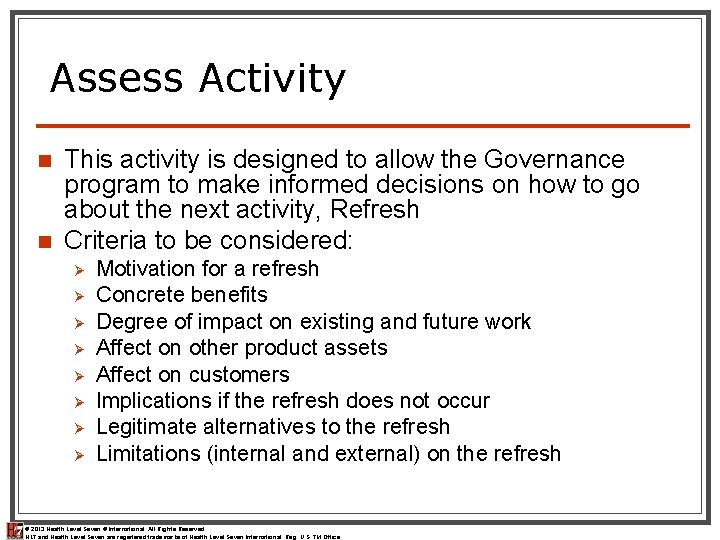
Assess Activity n n This activity is designed to allow the Governance program to make informed decisions on how to go about the next activity, Refresh Criteria to be considered: Ø Ø Ø Ø Motivation for a refresh Concrete benefits Degree of impact on existing and future work Affect on other product assets Affect on customers Implications if the refresh does not occur Legitimate alternatives to the refresh Limitations (internal and external) on the refresh © 2013 Health Level Seven ® International. All Rights Reserved. HL 7 and Health Level Seven are registered trademarks of Health Level Seven International. Reg. U. S. TM Office.
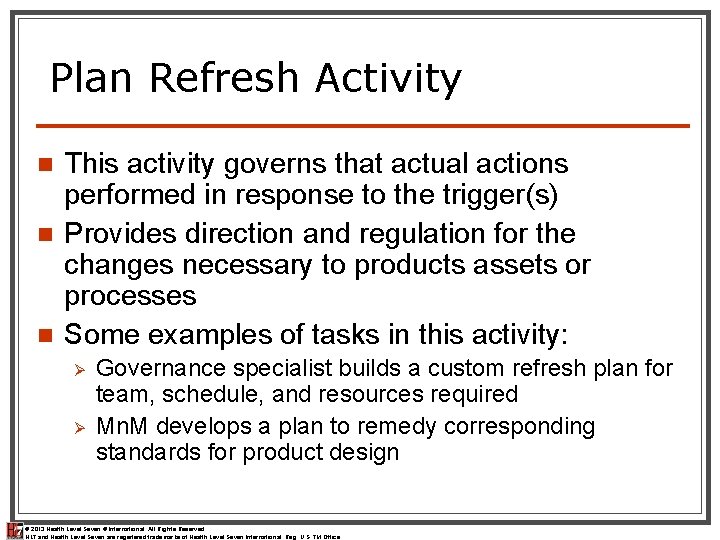
Plan Refresh Activity n n n This activity governs that actual actions performed in response to the trigger(s) Provides direction and regulation for the changes necessary to products assets or processes Some examples of tasks in this activity: Ø Ø Governance specialist builds a custom refresh plan for team, schedule, and resources required Mn. M develops a plan to remedy corresponding standards for product design © 2013 Health Level Seven ® International. All Rights Reserved. HL 7 and Health Level Seven are registered trademarks of Health Level Seven International. Reg. U. S. TM Office.
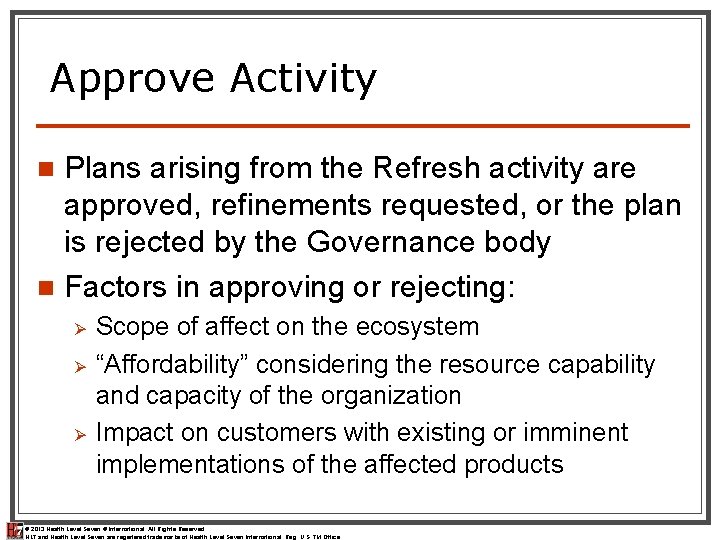
Approve Activity Plans arising from the Refresh activity are approved, refinements requested, or the plan is rejected by the Governance body n Factors in approving or rejecting: n Ø Ø Ø Scope of affect on the ecosystem “Affordability” considering the resource capability and capacity of the organization Impact on customers with existing or imminent implementations of the affected products © 2013 Health Level Seven ® International. All Rights Reserved. HL 7 and Health Level Seven are registered trademarks of Health Level Seven International. Reg. U. S. TM Office.
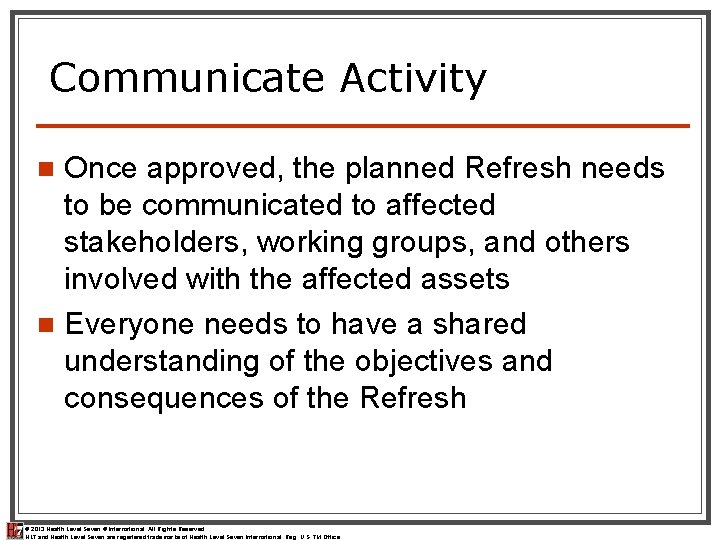
Communicate Activity Once approved, the planned Refresh needs to be communicated to affected stakeholders, working groups, and others involved with the affected assets n Everyone needs to have a shared understanding of the objectives and consequences of the Refresh n © 2013 Health Level Seven ® International. All Rights Reserved. HL 7 and Health Level Seven are registered trademarks of Health Level Seven International. Reg. U. S. TM Office.
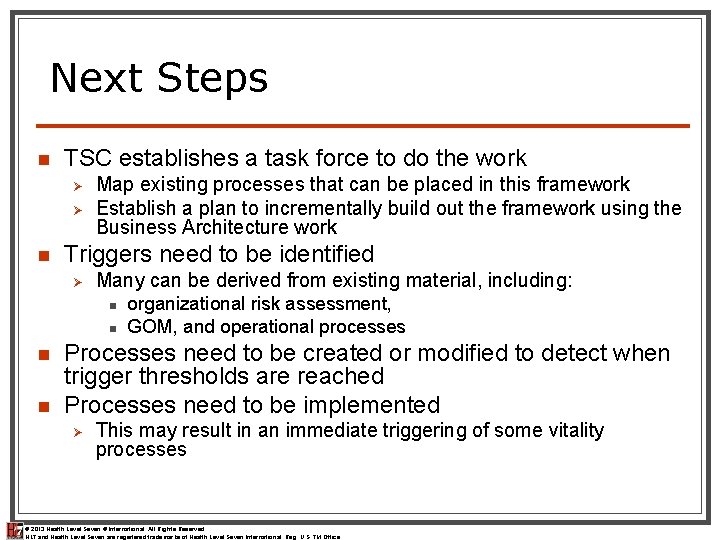
Next Steps n TSC establishes a task force to do the work Ø Ø n Map existing processes that can be placed in this framework Establish a plan to incrementally build out the framework using the Business Architecture work Triggers need to be identified Ø Many can be derived from existing material, including: n n organizational risk assessment, GOM, and operational processes Processes need to be created or modified to detect when trigger thresholds are reached Processes need to be implemented Ø This may result in an immediate triggering of some vitality processes © 2013 Health Level Seven ® International. All Rights Reserved. HL 7 and Health Level Seven are registered trademarks of Health Level Seven International. Reg. U. S. TM Office.