
Visuddhimagga Ven Buddhaghosa The path to purification April
Visuddhimagga -- 清淨道論 Ven Buddhaghosa -- �音尊者著 The path to purification April , 2008
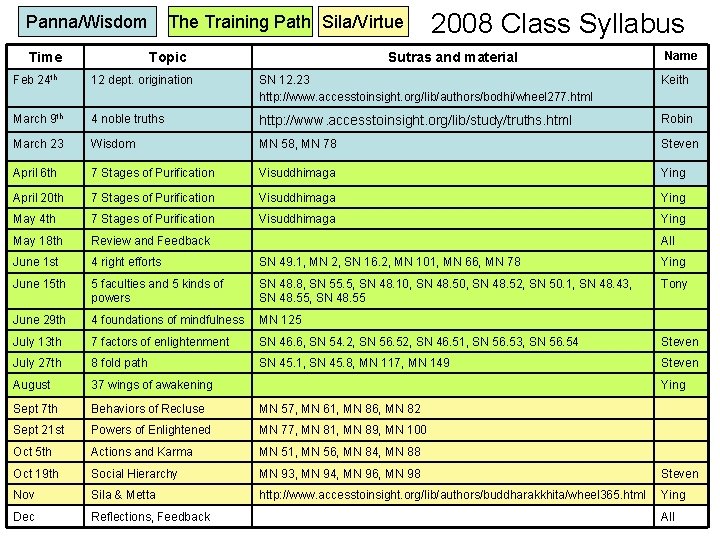
Panna/Wisdom Time The Training Path Sila/Virtue Topic 2008 Class Syllabus Sutras and material Name Feb 24 th 12 dept. origination SN 12. 23 http: //www. accesstoinsight. org/lib/authors/bodhi/wheel 277. html Keith March 9 th 4 noble truths http: //www. accesstoinsight. org/lib/study/truths. html Robin March 23 Wisdom MN 58, MN 78 Steven April 6 th 7 Stages of Purification Visuddhimaga Ying April 20 th 7 Stages of Purification Visuddhimaga Ying May 4 th 7 Stages of Purification Visuddhimaga Ying May 18 th Review and Feedback June 1 st 4 right efforts SN 49. 1, MN 2, SN 16. 2, MN 101, MN 66, MN 78 Ying June 15 th 5 faculties and 5 kinds of powers SN 48. 8, SN 55. 5, SN 48. 10, SN 48. 52, SN 50. 1, SN 48. 43, SN 48. 55 Tony June 29 th 4 foundations of mindfulness MN 125 July 13 th 7 factors of enlightenment SN 46. 6, SN 54. 2, SN 56. 52, SN 46. 51, SN 56. 53, SN 56. 54 Steven July 27 th 8 fold path SN 45. 1, SN 45. 8, MN 117, MN 149 Steven August 37 wings of awakening Sept 7 th Behaviors of Recluse MN 57, MN 61, MN 86, MN 82 Sept 21 st Powers of Enlightened MN 77, MN 81, MN 89, MN 100 Oct 5 th Actions and Karma MN 51, MN 56, MN 84, MN 88 Oct 19 th Social Hierarchy MN 93, MN 94, MN 96, MN 98 Steven Nov Sila & Metta http: //www. accesstoinsight. org/lib/authors/buddharakkhita/wheel 365. html Ying Dec Reflections, Feedback All Ying All
Visuddhi magga • Visuddhi Magga – – – • Visuddhi: Stages of purification Magga: The path to purification Author: Ven. Buddaghosa (Bhadantācariya Buddhaghosa) – A 5 th century Indian Theravada Buddhist commentator and scholar. His name means "Voice of the Buddha" in Pāli (�音 ). His best-known work is the Visuddhimagga, or Path of Purification, a comprehensive summary and analysis of the Theravada understanding of the Buddha's path to liberation.
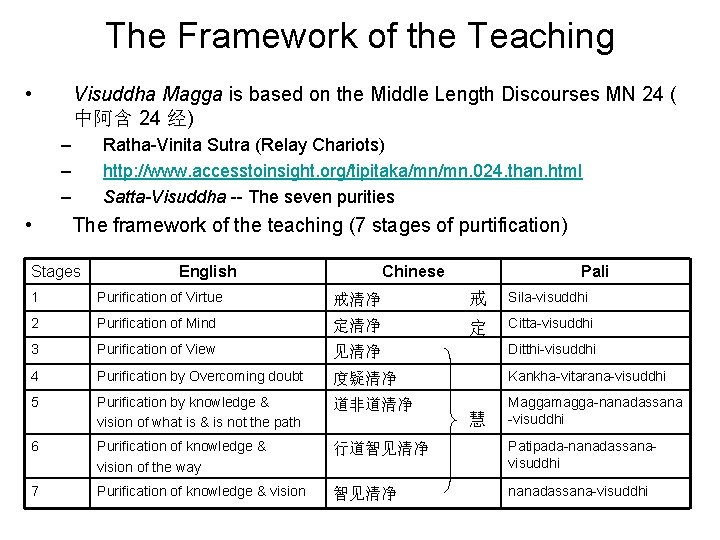
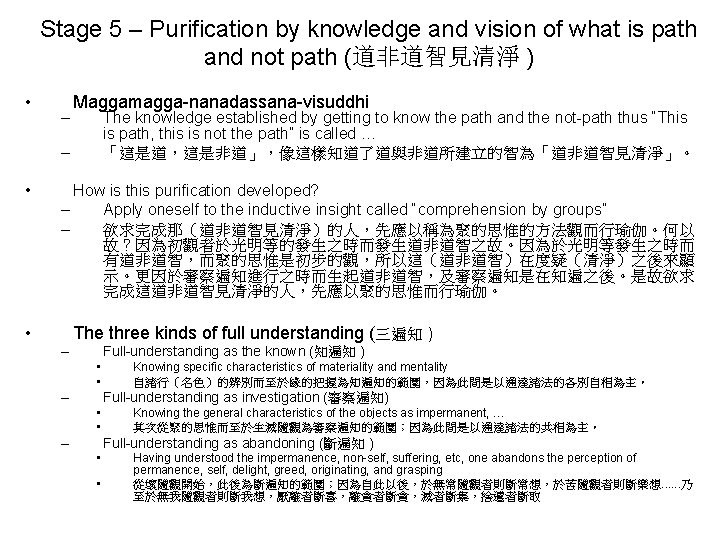
The Framework of the Teaching • Visuddha Magga is based on the Middle Length Discourses MN 24 ( 中阿含 24 经) – – – • Ratha-Vinita Sutra (Relay Chariots) http: //www. accesstoinsight. org/tipitaka/mn/mn. 024. than. html Satta-Visuddha -- The seven purities The framework of the teaching (7 stages of purtification) Stages English Chinese Pali 1 Purification of Virtue 戒清净 戒 Sila-visuddhi 2 Purification of Mind 定清净 定 Citta-visuddhi 3 Purification of View 见清净 Ditthi-visuddhi 4 Purification by Overcoming doubt 度疑清净 Kankha-vitarana-visuddhi 5 Purification by knowledge & vision of what is & is not the path 道非道清净 Maggamagga-nanadassana -visuddhi 6 Purification of knowledge & vision of the way 行道智见清净 Patipada-nanadassanavisuddhi 7 Purification of knowledge & vision 智见清净 nanadassana-visuddhi 慧
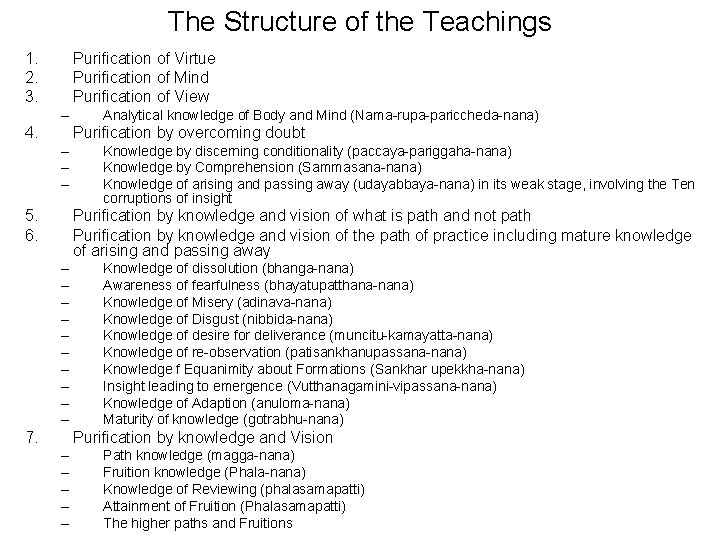
The Structure of the Teachings 1. 2. 3. Purification of Virtue Purification of Mind Purification of View – 4. Analytical knowledge of Body and Mind (Nama-rupa-pariccheda-nana) Purification by overcoming doubt – – – 5. 6. Knowledge by discerning conditionality (paccaya-pariggaha-nana) Knowledge by Comprehension (Sammasana-nana) Knowledge of arising and passing away (udayabbaya-nana) in its weak stage, involving the Ten corruptions of insight Purification by knowledge and vision of what is path and not path Purification by knowledge and vision of the path of practice including mature knowledge of arising and passing away – – – – – 7. Knowledge of dissolution (bhanga-nana) Awareness of fearfulness (bhayatupatthana-nana) Knowledge of Misery (adinava-nana) Knowledge of Disgust (nibbida-nana) Knowledge of desire for deliverance (muncitu-kamayatta-nana) Knowledge of re-observation (patisankhanupassana-nana) Knowledge f Equanimity about Formations (Sankhar upekkha-nana) Insight leading to emergence (Vutthanagamini-vipassana-nana) Knowledge of Adaption (anuloma-nana) Maturity of knowledge (gotrabhu-nana) Purification by knowledge and Vision – – – Path knowledge (magga-nana) Fruition knowledge (Phala-nana) Knowledge of Reviewing (phalasamapatti) Attainment of Fruition (Phalasamapatti) The higher paths and Fruitions
MN 24: Ratha-vinita Sutta, Relay Chariots • … a number of monks from the [Blessed One's] native land, having completed the Rains Retreat in the native land, went to the Blessed One and, …. the Blessed One said to them, "Monks, whom in our native land do the native-land monks — his companions in the holy life — esteem in this way: 'Having few wants himself, he gives talks to the monks on fewness of wants. Contented himself, he gives talks to the monks on contentment. Secluded himself, he gives talks to the monks on seclusion. Unentangled himself, he gives talks to the monks on non-entanglement. Having aroused persistence in himself, he gives talks to the monks on arousing persistence. Consummate in his own virtue, he gives talks to the monks on becoming consummate in virtue. Consummate in his own concentration, he gives talks to the monks on becoming consummate in concentration. Consummate in his own discernment, he gives talks to the monks on becoming consummate in discernment. Consummate in his own release, he gives talks to the monks on becoming consummate in release. Consummate in his own knowledge & vision of release, he gives talks to the monks on becoming consummate in the knowledge & vision of release. He is one who exhorts, informs, instructs, urges, rouses, & encourages his companions in the holy life. '" • "Lord, the monk named Punna Mantaniputta (Mantani's son) is esteemed by the nativeland monks — his companions in the holy life — in this way: 'Having few wants himself, he gives talks to the monks on fewness of wants. … He is one who exhorts, informs, instructs, urges, rouses, & encourages his companions in the holy life. '"
MN 24: Ratha-vinita Sutta, Relay Chariots (2) • Now at that time Ven. Sariputta was sitting not far from the Blessed One. The thought occurred to him: "It's a gain, a great gain for Ven. Punna Mantaniputta that his knowledgeable companions in the holy life speak his praise point by point in the presence of the Teacher, and that the Teacher seconds that praise. Maybe sometime or other I, too, will go to meet with Ven. Punna Mantaniputta; maybe I'll have some conversation with him. " • Then the Blessed One, having stayed at Rajagaha as long as he liked, set out wandering to Savatthi. Wandering by stages, he arrived there and stayed in Jeta's Grove, Anathapindika's monastery. Ven. Punna Mantaniputta heard, "The Blessed One has arrived at Savatthi and is staying near Savatthi in Jeta's Grove, Anathapindika's monastery. " Setting his lodgings in order and taking his robes & bowl, he set out wandering to Savatthi. Wandering by stages, he went to where the Blessed One was staying in Jeta's Grove, Anathapindika's monastery. On arrival, having bowed down to the Blessed One, he sat to one side. As he was sitting there, the Blessed One instructed, urged, roused, & encouraged him with a Dhamma talk. Then Ven. Punna — instructed, urged, roused, & encouraged with the Blessed One's Dhamma talk; delighting & approving of the Blessed One's words — got up from his seat, bowed down to the Blessed One, circumambulated him, and went to the Grove of the Blind for the day's abiding. • Then a certain monk went to Ven. Sariputta and, on arrival, said to him: "Friend Sariputta, the monk named Punna Mantaniputta whom you have so often praised — instructed, urged, roused, & encouraged with the Blessed One's Dhamma talk; delighting & approving of the Blessed One's words — has gotten up from his seat, bowed down to the Blessed One, circumambulated him, and has gone to the Grove of the Blind for the day's abiding. " So Ven. Sariputta quickly picked up a sitting cloth and followed right behind Ven. Punna, keeping his head in sight. Ven. Punna plunged into the Grove of the Blind and sat down in the shade of a tree for the day's abiding. Ven. Sariputta also plunged into the Grove of the Blind and sat down in the shade of a tree for the day's abiding.
• • • • • MN 24: Ratha-vinita Sutta, Relay Chariots (3) Then a certain monk went to Ven. Sariputta and, on arrival, said to him: "Friend Sariputta, the monk named Punna Mantaniputta whom you have so often praised … for the day's abiding. " So Ven. Sariputta quickly picked up a sitting cloth and followed right behind Ven. Punna, keeping his head in sight. Ven. Punna plunged into the Grove of the Blind and sat down in the shade of a tree for the day's abiding. Ven. Sariputta also plunged into the Grove of the Blind and sat down in the shade of a tree for the day's abiding. Then in the evening, Ven. Sariputta arose from his seclusion and went to Ven. Punna. On arrival, he exchanged courteous greetings with him. After an exchange of friendly greetings & courtesies, he sat to one side. As he was sitting there, he said to Ven. Punna, "My friend, is the holy life lived under the Blessed One? " "Yes, my friend. " "And is the holy life lived under the Blessed One for the sake of purity in terms of virtue? " "No, my friend. " "Then is the holy life lived under the Blessed One for the sake of purity in terms of mind [concentration]? " "No, my friend. " "Then is the holy life lived under the Blessed One for the sake of purity in terms of view? " "No, my friend. " "Then is the holy life lived under the Blessed One for the sake of purity in terms of the overcoming of perplexity / doubt? " "No, my friend. " "Then is the holy life lived under the Blessed One for the sake of purity in terms of knowledge & vision of what is & is not the path? " "No, my friend. " "Then is the holy life lived under the Blessed One for the sake of purity in terms of knowledge & vision of the way? " "No, my friend. " "Then is the holy life lived under the Blessed One for the sake of purity in terms of knowledge & vision? " "No, my friend. "
• • • MN 24: Ratha-vinita Sutta, Relay Chariots (4) "When asked if the holy life is lived under the Blessed One for the sake of purity in terms of virtue, you say, 'No, my friend. ' When asked if the holy life is lived under the Blessed One for the sake of purity in terms of mind. . . knowledge & vision, you say, 'No, my friend. ' For the sake of what, then, my friend, is the holy life lived under the Blessed One? " "The holy life is lived under the Blessed One, my friend, for the sake of total Unbinding through lack of clinging. " "But is purity in terms of virtue total Unbinding through lack of clinging? " "No, my friend. " "Then is purity in terms of mind. . . knowledge & vision total Unbinding through lack of clinging? " "No, my friend. " "Then is total Unbinding through lack of clinging something apart from these qualities? " "No, my friend. " "When asked if purity in terms of virtue. . . knowledge & vision is total Unbinding through lack of clinging, you say, 'No, my friend. ' But when asked if total Unbinding through lack of clinging is something apart from these qualities, you say, 'No, my friend. ' Now how, my friend, is the meaning of these statements to be understood? “ "If the Blessed One had described purity in terms of virtue as total Unbinding through lack of clinging, my friend, then he would have defined something still accompanied by clinging as total Unbinding through lack of clinging. If he had described purity in terms of mind. . . knowledge & vision as total Unbinding through lack of clinging, then he would have defined something still accompanied by clinging as total Unbinding through lack of clinging. But if total Unbinding through lack of clinging were apart from these qualities, then a run-of-themill person would be totally unbound, inasmuch as a run-of-the-mill person is apart from these qualities.
• • • MN 24: Ratha-vinita Sutta, Relay Chariots (5) "So, my friend, I will give you an analogy, for there are cases where it's through analogies that knowledgeable people can understand the meaning of what is being said. Suppose that while King Pasenadi Kosala was staying at Savatthi, some urgent business were to arise at Saketa; and that between Savatthi and Saketa seven relay chariots were made ready for him. Coming out the door of the inner palace in Savatthi, he would get in the first relay chariot. By means of the first relay chariot he would reach the second relay chariot. Getting out of the first relay chariot he would get in the second relay chariot. By means of the second relay chariot he would reach the third. . . By means of the seventh relay chariot he would finally arrive at the door of the inner palace at Saketa. As he arrived there, his friends & companions, relatives & kin would ask him, 'Great king, did you come from Savatthi to the door of the inner palace in Saketa by means of this chariot? ' Answering in what way, my friend, would King Pasenadi Kosala answer them correctly? " "Answering in this way, my friend, he would answer them correctly: 'Just now, as I was staying at Savatthi, some urgent business arose at Saketa; and between Savatthi and Saketa seven relay chariots were made ready for me. Coming out the door of the inner palace in Savatthi, I got in the first relay chariot. By means of the first relay chariot I reached the second relay chariot… By means of the seventh relay chariot I finally arrived at the door of the inner palace at Saketa. ' Answering in this way, he would answer them correctly. " "In the same way, my friend, purity in terms of virtue is simply for the sake of purity in terms of mind. Purity in terms of mind is simply for the sake of purity in terms of view. Purity in terms of view is simply for the sake of purity in terms of the overcoming of perplexity. Purity in terms of the overcoming of perplexity is simply for the sake of purity in terms of knowledge & vision of what is & is not the path. Purity in terms of knowledge & vision of what is & is not the path is simply for the sake of purity in terms of knowledge & vision of the way. Purity in terms of knowledge & vision of the way is simply for the sake of purity in terms of knowledge & vision. Purity in terms of knowledge & vision is simply for the sake of total Unbinding through lack of clinging. And it's for the sake of total Unbinding through lack of clinging that the holy life is lived under the Blessed One. "
• • MN 24: Ratha-vinita Sutta, Relay Chariots (6) When this was said, Ven. Sariputta said to Ven. Punna Mantaniputta: "What is your name, friend, and how do your companions in the holy life know you? " "My name is Punna, friend, and my companions in the holy life know me as Mantaniputta. " "How amazing, my friend, how astounding, that Ven. Punna Mantaniputta has answered point by point with profound, profound discernment in the manner of a learned disciple who has rightly understood the Teacher's message! It's a gain, a great gain, for any of his companions in the holy life who get to see him and visit with him. Even if they had to carry him around on a cushion placed on top of their heads in order to see him and visit with him, it would be a gain for them, a great gain. And the fact that I have gotten to see him and visit with him has been a gain, a great gain for me. “ When this was said, Ven. Punna said to Ven. Sariputta: "And what is your name, friend, and how do your companions in the holy life know you? " "My name is Upatissa, friend, and my companions in the holy life know me as Sariputta. " "What? I've been talking with the disciple who is like the Teacher himself without knowing that it is Ven. Sariputta? Had I known it was Ven. Sariputta, I wouldn't have answered at such length. How amazing, my friend, how astounding, that Ven. Sariputta has questioned point by point with profound, profound discernment in the manner of a learned disciple who has rightly understood the Teacher's message! It's a gain, a great gain, for any of his companions in the holy life who get to see him and visit with him. Even if they had to carry him around on a cushion placed on top of their heads in order to see him and visit with him, it would be a gain for them, a great gain. And the fact that I have gotten to see him and visit with him has been a gain, a great gain for me. " In this way did both great beings rejoice in each other's good words.

Stage 2 -- Purification of Mind (Citta) (Concentration) • What is Concerntration? (定清净) – • Profitable unification of the mind In what sense is it concentration? – • The ability to stay on the single object undistracted, un-scattered The characteristics, function, manifestation, and proximity – – • Characteristics: Non-distraction Function: To remove distraction Manifestation: Non-wavering Proximity: Bliss Development of concentration – – – 10 impediments of insights: Dwelling, family, Gain/possessions, Classes/Dharma classes, Building/house, Travel, kin/family, afflictions/illness, books/readings/studies, super powers Good Friends Meditation Subjects: Ten Kasinas, Ten kinds of foulness, recollections, four divine abidings, four immaterial states, one perception, one defining Temperaments (性格) Self-dedications
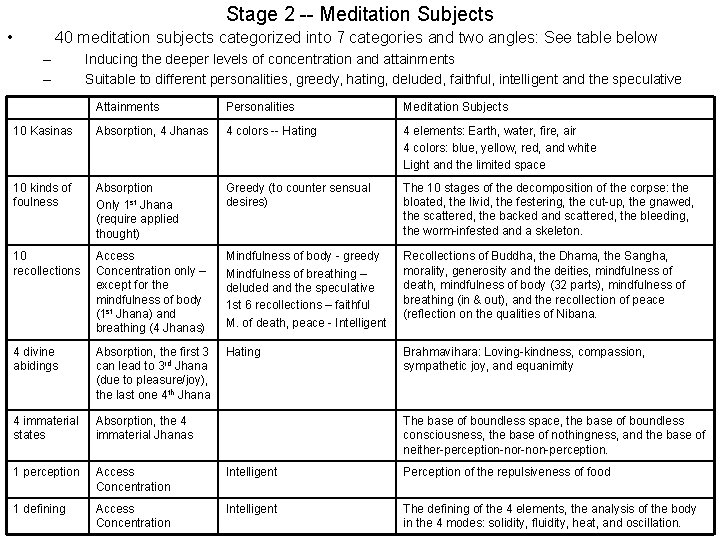
Stage 2 -- Meditation Subjects • 40 meditation subjects categorized into 7 categories and two angles: See table below – – Inducing the deeper levels of concentration and attainments Suitable to different personalities, greedy, hating, deluded, faithful, intelligent and the speculative Attainments Personalities Meditation Subjects 10 Kasinas Absorption, 4 Jhanas 4 colors -- Hating 4 elements: Earth, water, fire, air 4 colors: blue, yellow, red, and white Light and the limited space 10 kinds of foulness Absorption Only 1 st Jhana (require applied thought) Greedy (to counter sensual desires) The 10 stages of the decomposition of the corpse: the bloated, the livid, the festering, the cut-up, the gnawed, the scattered, the backed and scattered, the bleeding, the worm-infested and a skeleton. 10 recollections Access Concentration only – except for the mindfulness of body (1 st Jhana) and breathing (4 Jhanas) Mindfulness of body - greedy Mindfulness of breathing – deluded and the speculative 1 st 6 recollections – faithful M. of death, peace - Intelligent Recollections of Buddha, the Dhama, the Sangha, morality, generosity and the deities, mindfulness of death, mindfulness of body (32 parts), mindfulness of breathing (in & out), and the recollection of peace (reflection on the qualities of Nibana. 4 divine abidings Absorption, the first 3 can lead to 3 rd Jhana (due to pleasure/joy), the last one 4 th Jhana Hating Brahmavihara: Loving-kindness, compassion, sympathetic joy, and equanimity 4 immaterial states Absorption, the 4 immaterial Jhanas 1 perception Access Concentration Intelligent Perception of the repulsiveness of food 1 defining Access Concentration Intelligent The defining of the 4 elements, the analysis of the body in the 4 modes: solidity, fluidity, heat, and oscillation. The base of boundless space, the base of boundless consciousness, the base of nothingness, and the base of neither-perception-nor-non-perception.
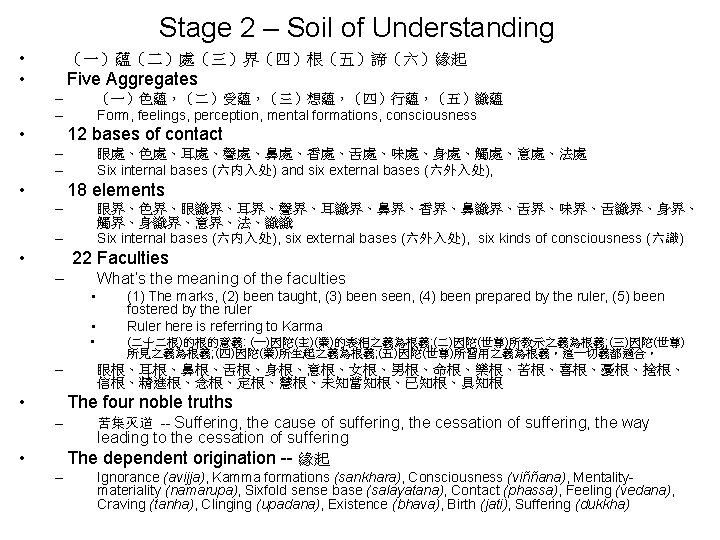
Stage 2 – Soil of Understanding • (一)蘊(二)處(三)界(四)根(五)諦(六)緣起 • Five Aggregates – – • (一)色蘊,(二)受蘊,(三)想蘊,(四)行蘊,(五)識蘊 Form, feelings, perception, mental formations, consciousness 12 bases of contact – – • 眼處、色處、耳處、聲處、鼻處、香處、舌處、味處、身處、觸處、意處、法處 Six internal bases (六内入处) and six external bases (六外入处), 18 elements – 眼界、色界、眼識界、耳界、聲界、耳識界、鼻界、香界、鼻識界、舌界、味界、舌識界、身界、 觸界、身識界、意界、法、識識 Six internal bases (六内入处), six external bases (六外入处), six kinds of consciousness (六識) – • 22 Faculties – What’s the meaning of the faculties • • • – • (1) The marks, (2) been taught, (3) been seen, (4) been prepared by the ruler, (5) been fostered by the ruler Ruler here is referring to Karma (二十二根)的根的意義: (一)因陀(主)(業)的表相之義為根義; (二)因陀(世尊)所教示之義為根義; (三)因陀(世尊) 所見之義為根義; (四)因陀(業)所生起之義為根義; (五)因陀(世尊)所習用之義為根義。這一切義都適合。 眼根、耳根、鼻根、舌根、身根、意根、女根、男根、命根、樂根、苦根、喜根、憂根、捨根、 信根、精進根、念根、定根、慧根、未知當知根、已知根、具知根 The four noble truths – • – 苦集灭道 -- Suffering, the cause of suffering, the cessation of suffering, the way leading to the cessation of suffering The dependent origination -- 緣起 Ignorance (avijja), Kamma formations (sankhara), Consciousness (viññana), Mentalitymateriality (namarupa), Sixfold sense base (salayatana), Contact (phassa), Feeling (vedana), Craving (tanha), Clinging (upadana), Existence (bhava), Birth (jati), Suffering (dukkha)
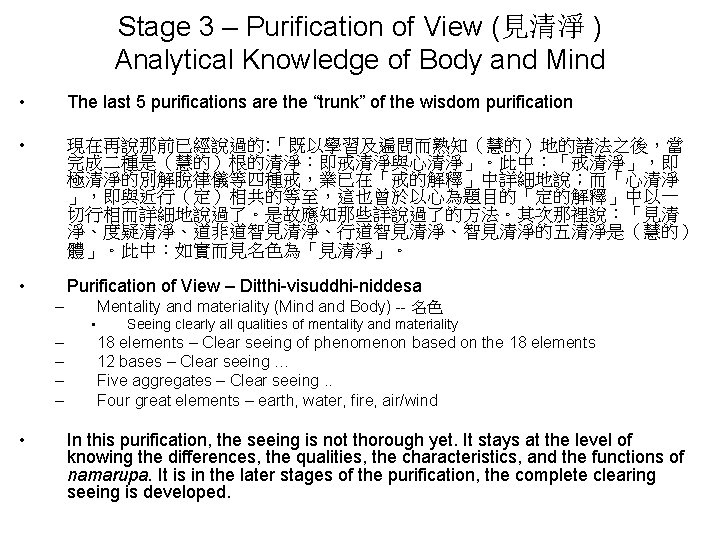
Stage 3 – Purification of View (見清淨 ) Analytical Knowledge of Body and Mind • The last 5 purifications are the “trunk” of the wisdom purification • 現在再說那前已經說過的: 「既以學習及遍問而熟知(慧的)地的諸法之後,當 完成二種是(慧的)根的清淨:即戒清淨與心清淨」。此中:「戒清淨」,即 極清淨的別解脫律儀等四種戒,業已在「戒的解釋」中詳細地說;而「心清淨 」,即與近行(定)相共的等至,這也曾於以心為題目的「定的解釋」中以一 切行相而詳細地說過了。是故應知那些詳說過了的方法。其次那裡說:「見清 淨、度疑清淨、道非道智見清淨、行道智見清淨、智見清淨的五清淨是(慧的) 體」。此中:如實而見名色為「見清淨」。 • Purification of View – Ditthi-visuddhi-niddesa – Mentality and materiality (Mind and Body) -- 名色 • – – • Seeing clearly all qualities of mentality and materiality 18 elements – Clear seeing of phenomenon based on the 18 elements 12 bases – Clear seeing … Five aggregates – Clear seeing. . Four great elements – earth, water, fire, air/wind In this purification, the seeing is not thorough yet. It stays at the level of knowing the differences, the qualities, the characteristics, and the functions of namarupa. It is in the later stages of the purification, the complete clearing seeing is developed.
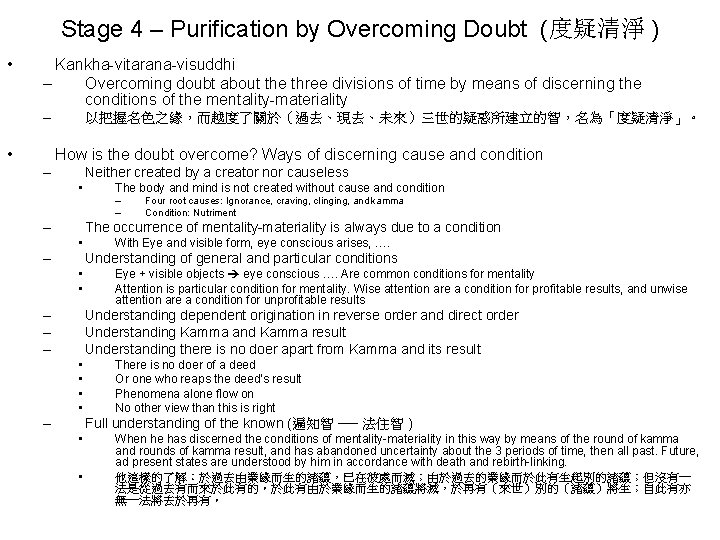
Stage 4 – Purification by Overcoming Doubt (度疑清淨 ) • Kankha-vitarana-visuddhi – Overcoming doubt about the three divisions of time by means of discerning the conditions of the mentality-materiality – • 以把握名色之緣,而越度了關於(過去、現去、未來)三世的疑惑所建立的智,名為「度疑清淨」。 How is the doubt overcome? Ways of discerning cause and condition – Neither created by a creator nor causeless • The body and mind is not created without cause and condition – – – Four root causes: Ignorance, craving, clinging, and kamma Condition: Nutriment The occurrence of mentality-materiality is always due to a condition • – With Eye and visible form, eye conscious arises, …. Understanding of general and particular conditions • • – – – Eye + visible objects eye conscious …. Are common conditions for mentality Attention is particular condition for mentality. Wise attention are a condition for profitable results, and unwise attention are a condition for unprofitable results Understanding dependent origination in reverse order and direct order Understanding Kamma and Kamma result Understanding there is no doer apart from Kamma and its result • • – There is no doer of a deed Or one who reaps the deed’s result Phenomena alone flow on No other view than this is right Full understanding of the known (遍知智 ── 法住智 ) • • When he has discerned the conditions of mentality-materiality in this way by means of the round of kamma and rounds of kamma result, and has abandoned uncertainty about the 3 periods of time, then all past. Future, ad present states are understood by him in accordance with death and rebirth-linking. 他這樣的了解:於過去由業緣而生的諸蘊,已在彼處而滅;由於過去的業緣而於此有生起別的諸蘊;但沒有一 法是從過去有而來於此有的。於此有由於業緣而生的諸蘊將滅,於再有(來世)別的(諸蘊)將生;自此有亦 無一法將去於再有。
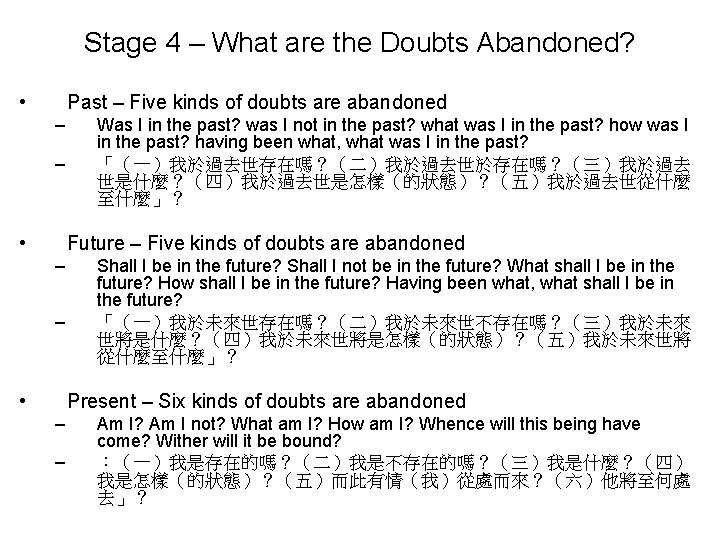
Stage 4 – What are the Doubts Abandoned? • Past – Five kinds of doubts are abandoned – – • Was I in the past? was I not in the past? what was I in the past? how was I in the past? having been what, what was I in the past? 「(一)我於過去世存在嗎?(二)我於過去世於存在嗎?(三)我於過去 世是什麼?(四)我於過去世是怎樣(的狀態)?(五)我於過去世從什麼 至什麼」? Future – Five kinds of doubts are abandoned – – • Shall I be in the future? Shall I not be in the future? What shall I be in the future? How shall I be in the future? Having been what, what shall I be in the future? 「(一)我於未來世存在嗎?(二)我於未來世不存在嗎?(三)我於未來 世將是什麼?(四)我於未來世將是怎樣(的狀態)?(五)我於未來世將 從什麼至什麼」? Present – Six kinds of doubts are abandoned – – Am I? Am I not? What am I? How am I? Whence will this being have come? Wither will it be bound? :(一)我是存在的嗎?(二)我是不存在的嗎?(三)我是什麼?(四) 我是怎樣(的狀態)?(五)而此有情(我)從處而來?(六)他將至何處 去」?
- Slides: 20