
Visualization of Petascale Molecular Dynamics Simulations John Stone
- Slides: 23
Visualization of Petascale Molecular Dynamics Simulations John Stone Theoretical and Computational Biophysics Group Beckman Institute for Advanced Science and Technology University of Illinois at Urbana-Champaign http: //www. ks. uiuc. edu/Research/vmd/ Imaging at Illinois: Computational Imaging and Visualization Beckman Institute, University of Illinois, June 1, 2012 NIH BTRC for Macromolecular Modeling and Bioinformatics http: //www. ks. uiuc. edu/ Beckman Institute, U. Illinois at Urbana-Champaign
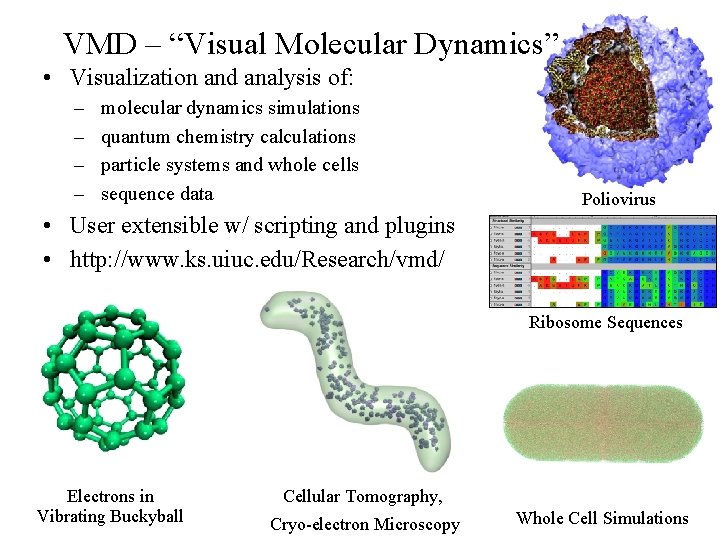
VMD – “Visual Molecular Dynamics” • Visualization and analysis of: – – molecular dynamics simulations quantum chemistry calculations particle systems and whole cells sequence data Poliovirus • User extensible w/ scripting and plugins • http: //www. ks. uiuc. edu/Research/vmd/ Ribosome Sequences Electrons in Vibrating Buckyball Cellular Tomography, NIH BTRC for Macromolecular Modeling and Bioinformatics http: //www. ks. uiuc. edu/ Cryo-electron Microscopy Beckman Institute, Whole Cell Simulations U. Illinois at Urbana-Champaign
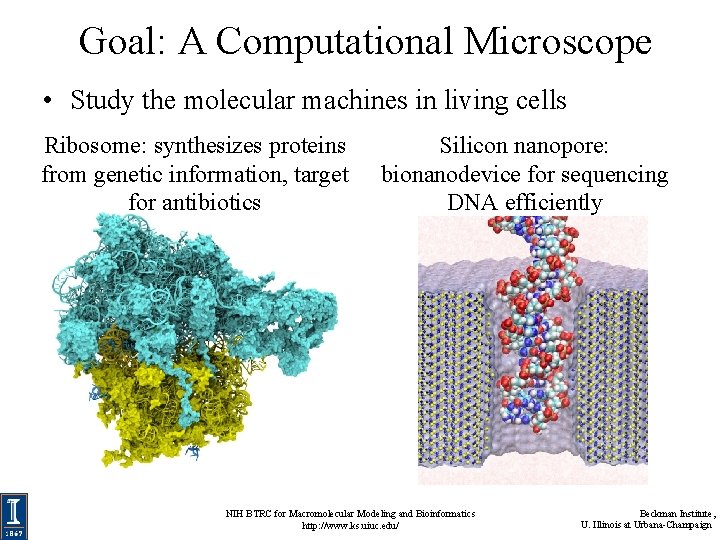
Goal: A Computational Microscope • Study the molecular machines in living cells Ribosome: synthesizes proteins from genetic information, target for antibiotics Silicon nanopore: bionanodevice for sequencing DNA efficiently NIH BTRC for Macromolecular Modeling and Bioinformatics http: //www. ks. uiuc. edu/ Beckman Institute, U. Illinois at Urbana-Champaign
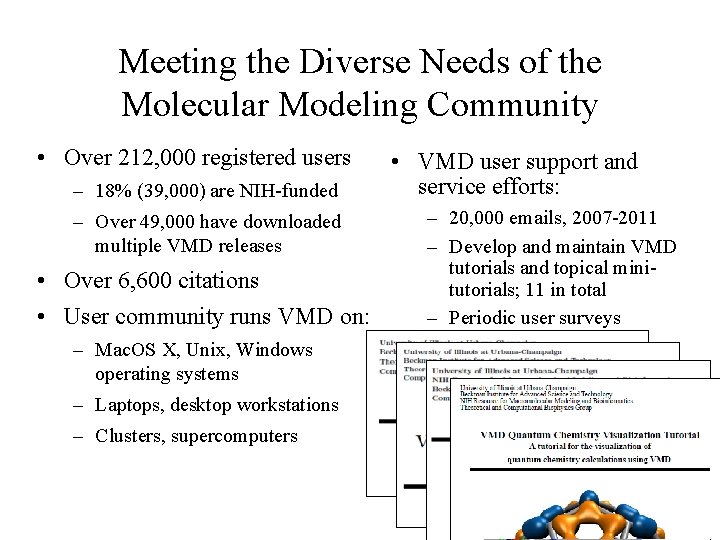
Meeting the Diverse Needs of the Molecular Modeling Community • Over 212, 000 registered users – 18% (39, 000) are NIH-funded – Over 49, 000 have downloaded multiple VMD releases • Over 6, 600 citations • User community runs VMD on: • VMD user support and service efforts: – 20, 000 emails, 2007 -2011 – Develop and maintain VMD tutorials and topical minitutorials; 11 in total – Periodic user surveys – Mac. OS X, Unix, Windows operating systems – Laptops, desktop workstations – Clusters, supercomputers NIH BTRC for Macromolecular Modeling and Bioinformatics http: //www. ks. uiuc. edu/ Beckman Institute, U. Illinois at Urbana-Champaign
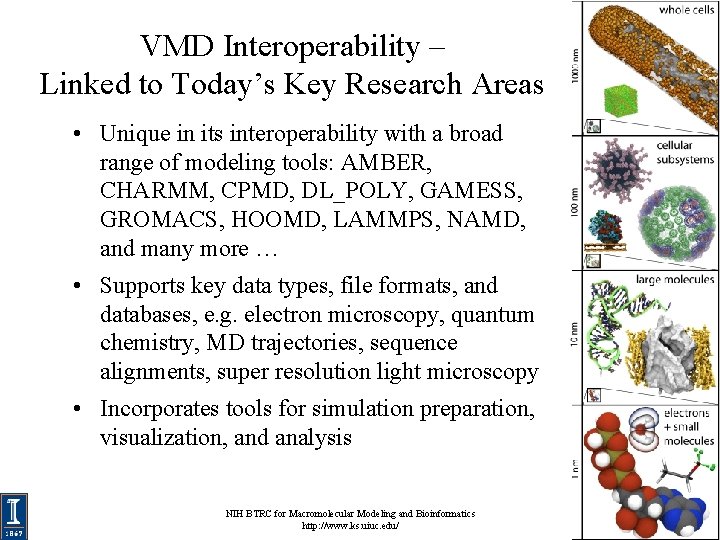
VMD Interoperability – Linked to Today’s Key Research Areas • Unique in its interoperability with a broad range of modeling tools: AMBER, CHARMM, CPMD, DL_POLY, GAMESS, GROMACS, HOOMD, LAMMPS, NAMD, and many more … • Supports key data types, file formats, and databases, e. g. electron microscopy, quantum chemistry, MD trajectories, sequence alignments, super resolution light microscopy • Incorporates tools for simulation preparation, visualization, and analysis NIH BTRC for Macromolecular Modeling and Bioinformatics http: //www. ks. uiuc. edu/ Beckman Institute, U. Illinois at Urbana-Champaign
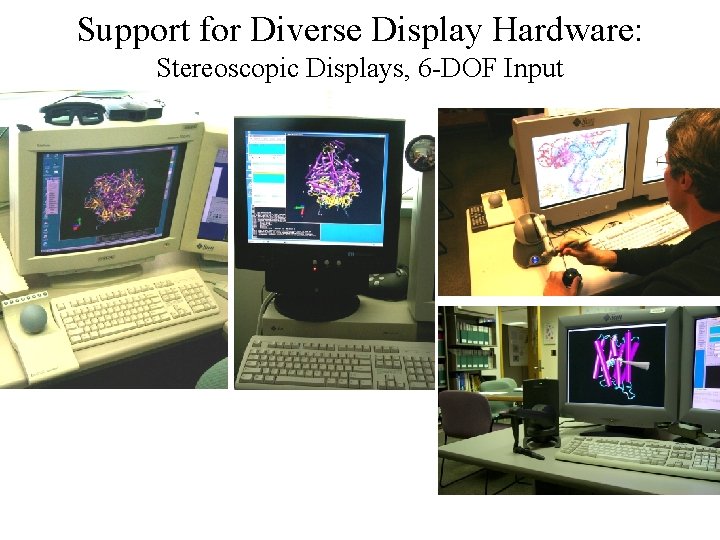
Support for Diverse Display Hardware: Stereoscopic Displays, 6 -DOF Input NIH BTRC for Macromolecular Modeling and Bioinformatics http: //www. ks. uiuc. edu/ Beckman Institute, U. Illinois at Urbana-Champaign
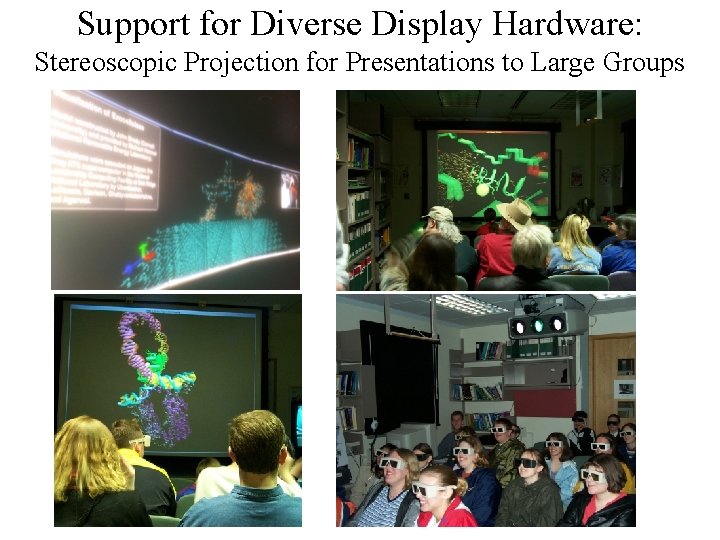
Support for Diverse Display Hardware: Stereoscopic Projection for Presentations to Large Groups NIH BTRC for Macromolecular Modeling and Bioinformatics http: //www. ks. uiuc. edu/ Beckman Institute, U. Illinois at Urbana-Champaign
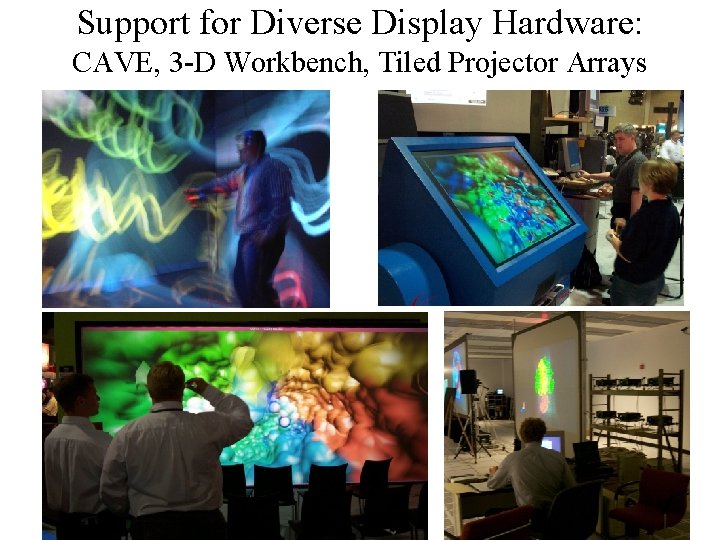
Support for Diverse Display Hardware: CAVE, 3 -D Workbench, Tiled Projector Arrays NIH BTRC for Macromolecular Modeling and Bioinformatics http: //www. ks. uiuc. edu/ Beckman Institute, U. Illinois at Urbana-Champaign
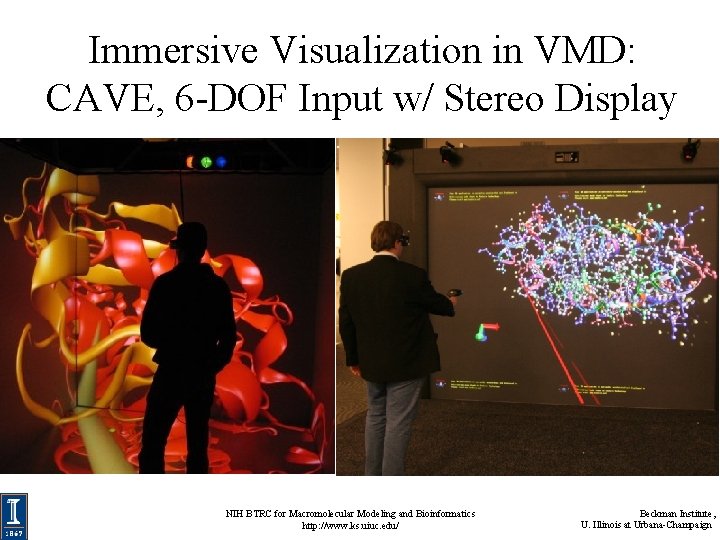
Immersive Visualization in VMD: CAVE, 6 -DOF Input w/ Stereo Display NIH BTRC for Macromolecular Modeling and Bioinformatics http: //www. ks. uiuc. edu/ Beckman Institute, U. Illinois at Urbana-Champaign
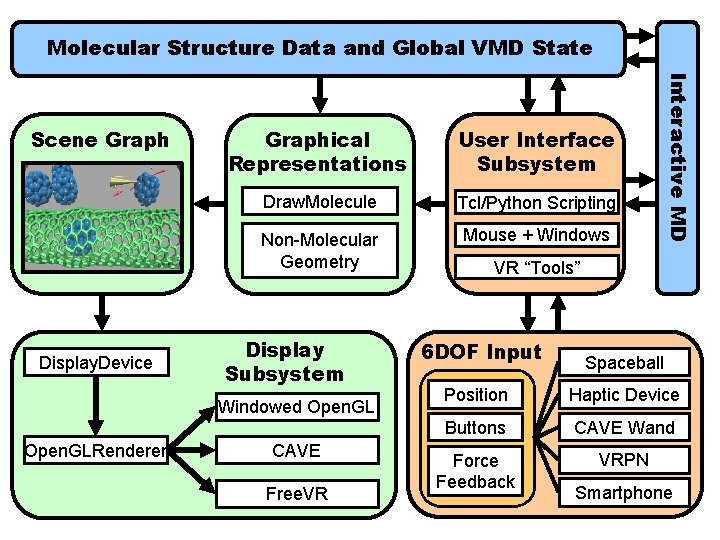
Molecular Structure Data and Global VMD State Display. Device Graphical Representations User Interface Subsystem Draw. Molecule Tcl/Python Scripting Non-Molecular Geometry Mouse + Windows Display Subsystem Windowed Open. GLRenderer CAVE Free. VR Interactive MD Scene Graph VR “Tools” 6 DOF Input Spaceball Position Haptic Device Buttons CAVE Wand Force Feedback VRPN NIH BTRC for Macromolecular Modeling and Bioinformatics http: //www. ks. uiuc. edu/ Smartphone Beckman Institute, U. Illinois at Urbana-Champaign
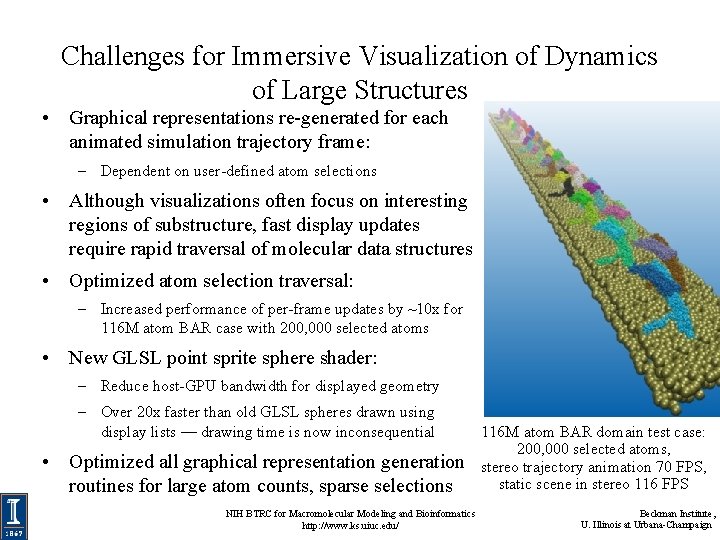
Challenges for Immersive Visualization of Dynamics of Large Structures • Graphical representations re-generated for each animated simulation trajectory frame: – Dependent on user-defined atom selections • Although visualizations often focus on interesting regions of substructure, fast display updates require rapid traversal of molecular data structures • Optimized atom selection traversal: – Increased performance of per-frame updates by ~10 x for 116 M atom BAR case with 200, 000 selected atoms • New GLSL point sprite sphere shader: – Reduce host-GPU bandwidth for displayed geometry – Over 20 x faster than old GLSL spheres drawn using display lists — drawing time is now inconsequential • Optimized all graphical representation generation routines for large atom counts, sparse selections NIH BTRC for Macromolecular Modeling and Bioinformatics http: //www. ks. uiuc. edu/ 116 M atom BAR domain test case: 200, 000 selected atoms, stereo trajectory animation 70 FPS, static scene in stereo 116 FPS Beckman Institute, U. Illinois at Urbana-Champaign
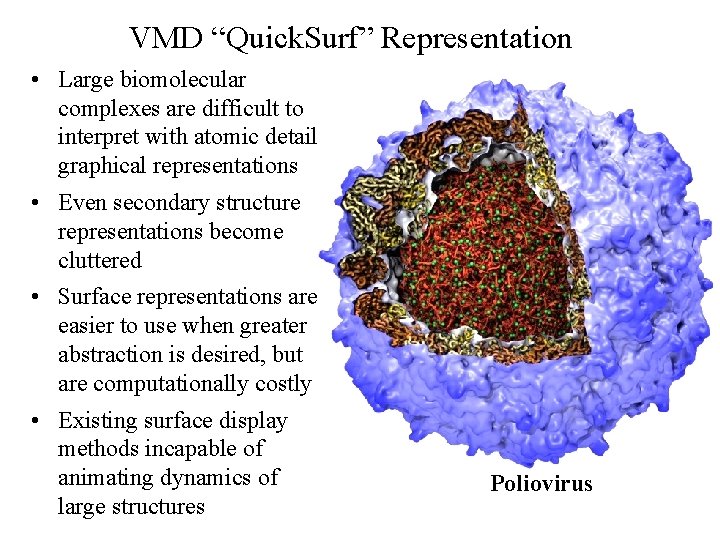
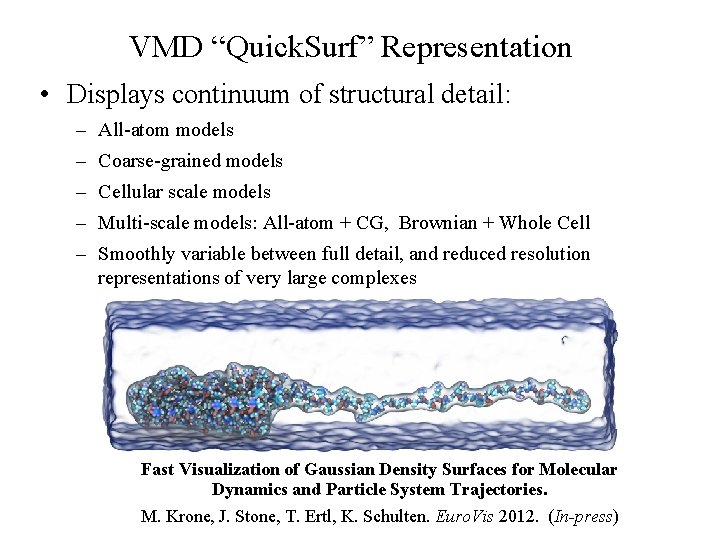
VMD “Quick. Surf” Representation • Large biomolecular complexes are difficult to interpret with atomic detail graphical representations • Even secondary structure representations become cluttered • Surface representations are easier to use when greater abstraction is desired, but are computationally costly • Existing surface display methods incapable of animating dynamics of Poliovirus large structures NIH BTRC for Macromolecular Modeling and Bioinformatics http: //www. ks. uiuc. edu/ Beckman Institute, U. Illinois at Urbana-Champaign
VMD “Quick. Surf” Representation • Displays continuum of structural detail: – All-atom models – Coarse-grained models – Cellular scale models – Multi-scale models: All-atom + CG, Brownian + Whole Cell – Smoothly variable between full detail, and reduced resolution representations of very large complexes Fast Visualization of Gaussian Density Surfaces for Molecular Dynamics and Particle System Trajectories. NIH BTRC for Macromolecular Modeling and Bioinformatics Beckman Institute, M. Krone, J. Stone, T. Ertl, K. Schulten. Euro. Vis 2012. (In-press) U. Illinois at Urbana-Champaign http: //www. ks. uiuc. edu/
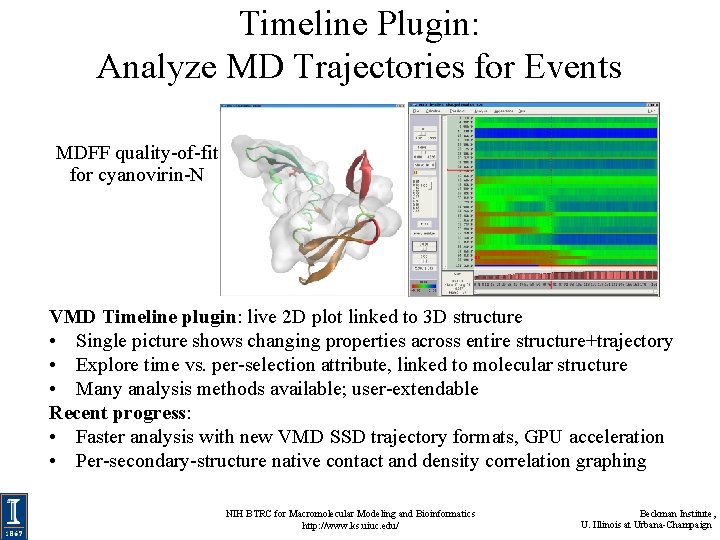
Timeline Plugin: Analyze MD Trajectories for Events MDFF quality-of-fit for cyanovirin-N VMD Timeline plugin: live 2 D plot linked to 3 D structure • Single picture shows changing properties across entire structure+trajectory • Explore time vs. per-selection attribute, linked to molecular structure • Many analysis methods available; user-extendable Recent progress: • Faster analysis with new VMD SSD trajectory formats, GPU acceleration • Per-secondary-structure native contact and density correlation graphing NIH BTRC for Macromolecular Modeling and Bioinformatics http: //www. ks. uiuc. edu/ Beckman Institute, U. Illinois at Urbana-Champaign
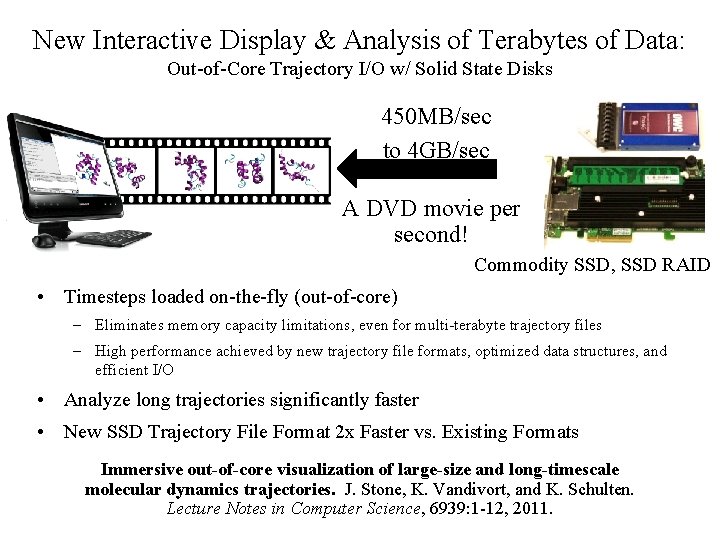
New Interactive Display & Analysis of Terabytes of Data: Out-of-Core Trajectory I/O w/ Solid State Disks 450 MB/sec to 4 GB/sec A DVD movie per second! Commodity SSD, SSD RAID • Timesteps loaded on-the-fly (out-of-core) – Eliminates memory capacity limitations, even for multi-terabyte trajectory files – High performance achieved by new trajectory file formats, optimized data structures, and efficient I/O • Analyze long trajectories significantly faster • New SSD Trajectory File Format 2 x Faster vs. Existing Formats Immersive out-of-core visualization of large-size and long-timescale molecular dynamics trajectories. J. Stone, K. Vandivort, and K. Schulten. Lecture Notes in Computer Science, 6939: 1 -12, 2011. NIH BTRC for Macromolecular Modeling and Bioinformatics Beckman Institute, http: //www. ks. uiuc. edu/ U. Illinois at Urbana-Champaign
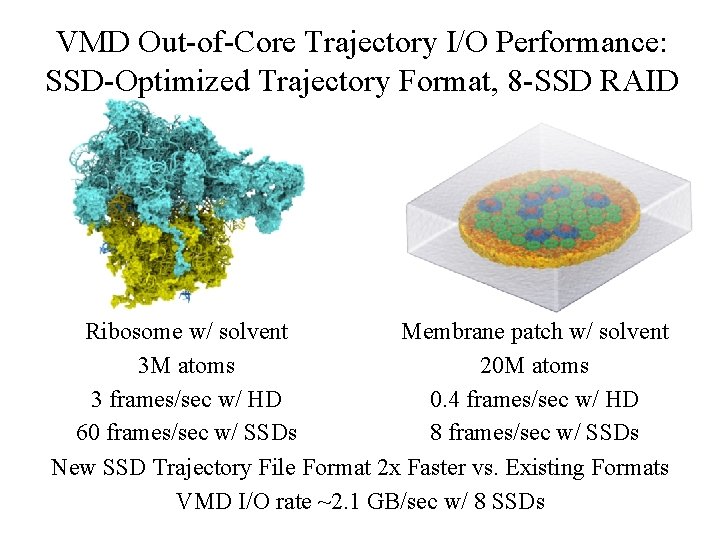
VMD Out-of-Core Trajectory I/O Performance: SSD-Optimized Trajectory Format, 8 -SSD RAID Ribosome w/ solvent Membrane patch w/ solvent 3 M atoms 20 M atoms 3 frames/sec w/ HD 0. 4 frames/sec w/ HD 60 frames/sec w/ SSDs 8 frames/sec w/ SSDs New SSD Trajectory File Format 2 x Faster vs. Existing Formats VMD I/O rate ~2. 1 GB/sec w/ 8 SSDs NIH BTRC for Macromolecular Modeling and Bioinformatics Beckman Institute, http: //www. ks. uiuc. edu/ U. Illinois at Urbana-Champaign
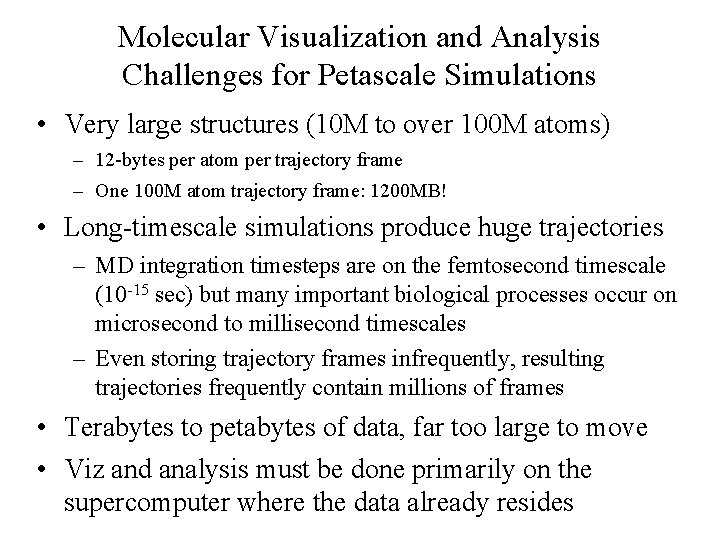
Molecular Visualization and Analysis Challenges for Petascale Simulations • Very large structures (10 M to over 100 M atoms) – 12 -bytes per atom per trajectory frame – One 100 M atom trajectory frame: 1200 MB! • Long-timescale simulations produce huge trajectories – MD integration timesteps are on the femtosecond timescale (10 -15 sec) but many important biological processes occur on microsecond to millisecond timescales – Even storing trajectory frames infrequently, resulting trajectories frequently contain millions of frames • Terabytes to petabytes of data, far too large to move • Viz and analysis must be done primarily on the supercomputer where the data already resides NIH BTRC for Macromolecular Modeling and Bioinformatics http: //www. ks. uiuc. edu/ Beckman Institute, U. Illinois at Urbana-Champaign
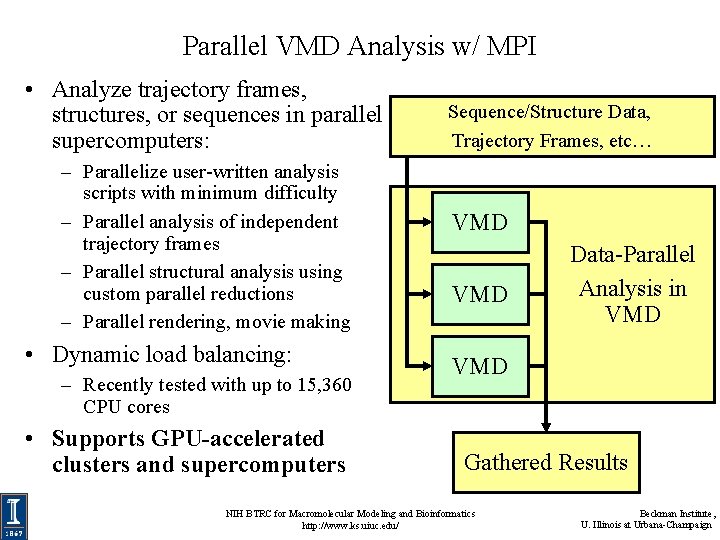
Parallel VMD Analysis w/ MPI • Analyze trajectory frames, structures, or sequences in parallel supercomputers: – Parallelize user-written analysis scripts with minimum difficulty – Parallel analysis of independent trajectory frames – Parallel structural analysis using custom parallel reductions – Parallel rendering, movie making • Dynamic load balancing: – Recently tested with up to 15, 360 CPU cores • Supports GPU-accelerated clusters and supercomputers Sequence/Structure Data, Trajectory Frames, etc… VMD Data-Parallel Analysis in VMD Gathered Results NIH BTRC for Macromolecular Modeling and Bioinformatics http: //www. ks. uiuc. edu/ Beckman Institute, U. Illinois at Urbana-Champaign
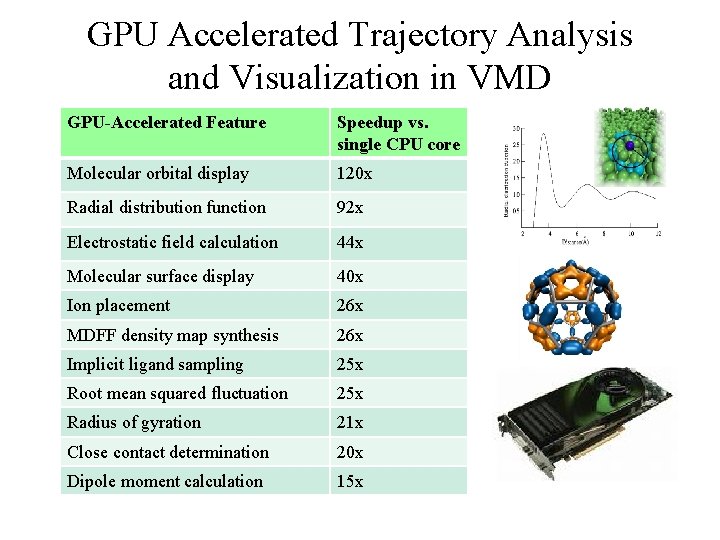
GPU Accelerated Trajectory Analysis and Visualization in VMD GPU-Accelerated Feature Speedup vs. single CPU core Molecular orbital display 120 x Radial distribution function 92 x Electrostatic field calculation 44 x Molecular surface display 40 x Ion placement 26 x MDFF density map synthesis 26 x Implicit ligand sampling 25 x Root mean squared fluctuation 25 x Radius of gyration 21 x Close contact determination 20 x Dipole moment calculation 15 x NIH BTRC for Macromolecular Modeling and Bioinformatics http: //www. ks. uiuc. edu/ Beckman Institute, U. Illinois at Urbana-Champaign
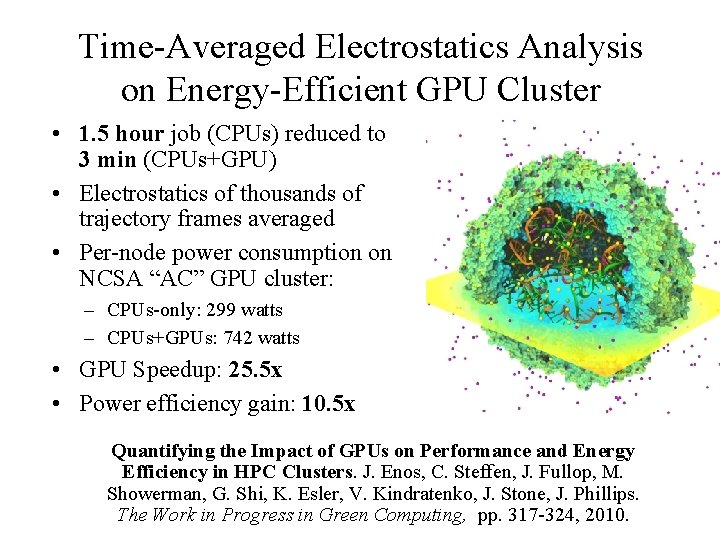
Time-Averaged Electrostatics Analysis on Energy-Efficient GPU Cluster • 1. 5 hour job (CPUs) reduced to 3 min (CPUs+GPU) • Electrostatics of thousands of trajectory frames averaged • Per-node power consumption on NCSA “AC” GPU cluster: – CPUs-only: 299 watts – CPUs+GPUs: 742 watts • GPU Speedup: 25. 5 x • Power efficiency gain: 10. 5 x Quantifying the Impact of GPUs on Performance and Energy Efficiency in HPC Clusters. J. Enos, C. Steffen, J. Fullop, M. Showerman, G. Shi, K. Esler, V. Kindratenko, J. Stone, J. Phillips. NIH BTRC for Macromolecular Modeling and Bioinformatics Beckman Institute, The Work in Progress in Green Computing, pp. 317 -324, 2010. U. Illinois at Urbana-Champaign http: //www. ks. uiuc. edu/
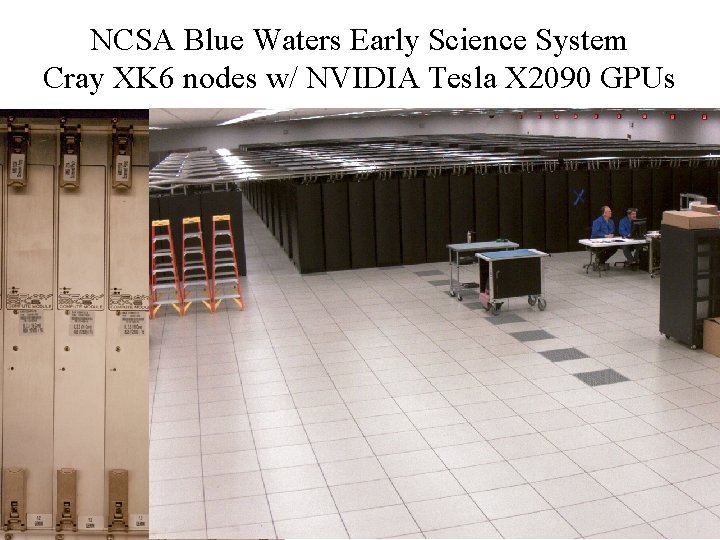
NCSA Blue Waters Early Science System Cray XK 6 nodes w/ NVIDIA Tesla X 2090 GPUs NIH BTRC for Macromolecular Modeling and Bioinformatics http: //www. ks. uiuc. edu/ Beckman Institute, U. Illinois at Urbana-Champaign
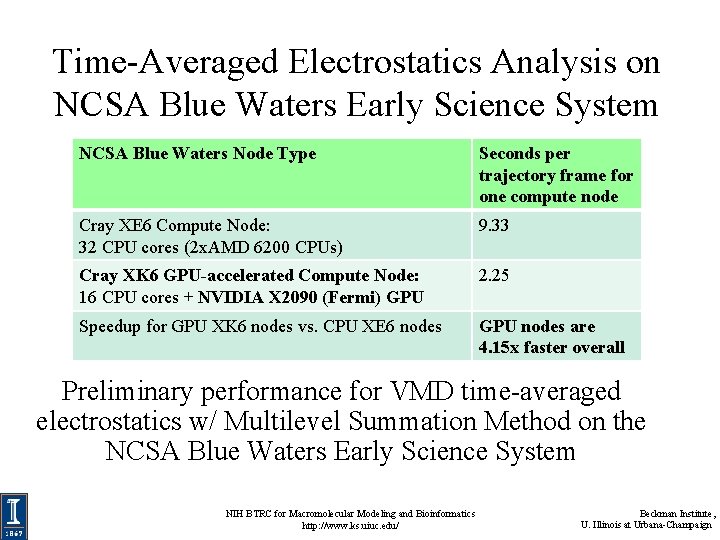
Time-Averaged Electrostatics Analysis on NCSA Blue Waters Early Science System NCSA Blue Waters Node Type Seconds per trajectory frame for one compute node Cray XE 6 Compute Node: 32 CPU cores (2 x. AMD 6200 CPUs) 9. 33 Cray XK 6 GPU-accelerated Compute Node: 16 CPU cores + NVIDIA X 2090 (Fermi) GPU 2. 25 Speedup for GPU XK 6 nodes vs. CPU XE 6 nodes GPU nodes are 4. 15 x faster overall Preliminary performance for VMD time-averaged electrostatics w/ Multilevel Summation Method on the NCSA Blue Waters Early Science System NIH BTRC for Macromolecular Modeling and Bioinformatics http: //www. ks. uiuc. edu/ Beckman Institute, U. Illinois at Urbana-Champaign
Acknowledgements • Theoretical and Computational Biophysics Group, University of Illinois at Urbana. Champaign • NCSA Blue Waters Team • NCSA Innovative Systems Lab • NVIDIA CUDA Center of Excellence, University of Illinois at Urbana-Champaign • The CUDA team at NVIDIA • NIH support: P 41 -RR 005969 NIH BTRC for Macromolecular Modeling and Bioinformatics http: //www. ks. uiuc. edu/ Beckman Institute, U. Illinois at Urbana-Champaign