
Visual Timeline of Events USER GUIDE TEMPLATE A
![PHAC-CFEZID Timeline of Events [20## - ###] Multi-provincial outbreak investigation of Pathogen X in](https://slidetodoc.com/presentation_image_h2/ed89173d71e180c4d8137496701e6271/image-2.jpg "PHAC-CFEZID Timeline of Events [20## - ###] Multi-provincial outbreak investigation of Pathogen X in")
![PHAC-CFEZID Timeline of Events EXAMPLE -175] Multi-provincial outbreak investigation of E. coli O 157:](https://slidetodoc.com/presentation_image_h2/ed89173d71e180c4d8137496701e6271/image-3.jpg "PHAC-CFEZID Timeline of Events EXAMPLE -175] Multi-provincial outbreak investigation of E. coli O 157:")
- Slides: 3
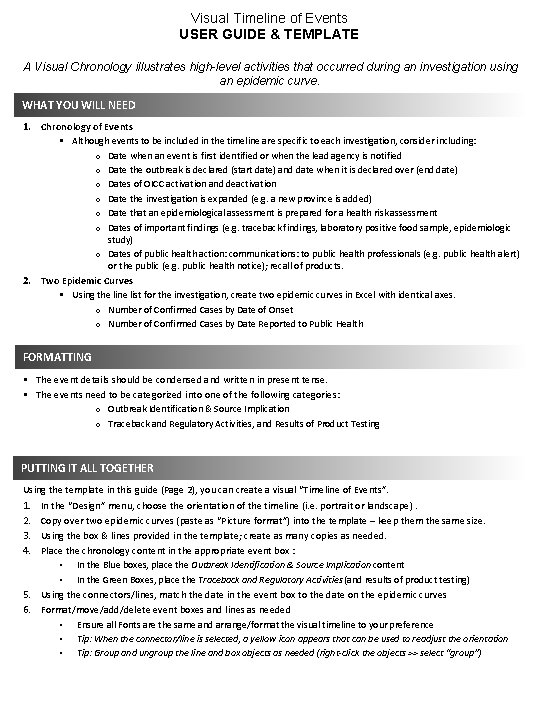
Visual Timeline of Events USER GUIDE & TEMPLATE A Visual Chronology illustrates high-level activities that occurred during an investigation using an epidemic curve. WHAT YOU WILL NEED 1. Chronology of Events § Although events to be included in the timeline are specific to each investigation, consider including: o Date when an event is first identified or when the lead agency is notified o Date the outbreak is declared (start date) and date when it is declared over (end date) o Dates of OICC activation and deactivation o Date the investigation is expanded (e. g. a new province is added) o Date that an epidemiological assessment is prepared for a health risk assessment o Dates of important findings (e. g. traceback findings, laboratory positive food sample, epidemiologic study) o Dates of public health action: communications: to public health professionals (e. g. public health alert) or the public (e. g. public health notice); recall of products. 2. Two Epidemic Curves § Using the line list for the investigation, create two epidemic curves in Excel with identical axes. o Number of Confirmed Cases by Date of Onset o Number of Confirmed Cases by Date Reported to Public Health FORMATTING § The event details should be condensed and written in present tense. § The events need to be categorized into one of the following categories: o Outbreak Identification & Source Implication o Traceback and Regulatory Activities, and Results of Product Testing PUTTING IT ALL TOGETHER Using the template in this guide (Page 2), you can create a visual “Timeline of Events”. 1. In the “Design” menu, choose the orientation of the timeline (i. e. portrait or landscape). 2. Copy over two epidemic curves (paste as “Picture format”) into the template – keep them the same size. 3. Using the box & lines provided in the template; create as many copies as needed. 4. Place the chronology content in the appropriate event box : • In the Blue boxes, place the Outbreak Identification & Source Implication content • In the Green Boxes, place the Traceback and Regulatory Activities (and results of product testing) 5. Using the connectors/lines, match the date in the event box to the date on the epidemic curves 6. Format/move/add/delete event boxes and lines as needed • Ensure all Fonts are the same and arrange/format the visual timeline to your preference • Tip: When the connector/line is selected, a yellow icon appears that can be used to readjust the orientation • Tip: Group and ungroup the line and box objects as needed (right-click the objects >> select “group”)
PHAC-CFEZID Timeline of Events [20## - ###] Multi-provincial outbreak investigation of Pathogen X in Area Y Outbreak Identification & Source Implication E T A L P M E T Traceback and Regulatory Activities, and Results of Product Testing
PHAC-CFEZID Timeline of Events EXAMPLE -175] Multi-provincial outbreak investigation of E. coli O 157: H 7 in MB, SK, AB, an Outbreak Identification & Source Implication Jul 22: OICC Assessment call is held with CFIA, HC, NML, and provincial public health partners in MB, SK, and AB. A national OICC is activated. Jul 21: NESP) reports that E. coli is flagging nationally, as well as in SK and MB for the week of July 13 -19, 2014. PNC reports a multi-provincial cluster of 6 E. coli O 157: H 7 isolates with the same PFGE patterns in MB (2), SK (3) and AB (1). Jul 31: 3 rd OICC call is held. There is 1 new case in AB with a similar PFGE pattern. The case definition is expanded to include this PFGE pattern. NML will conduct additional subtyping (MLVA) on all clinical isolates sent from the provinces. Jul 23 (n=12): Technical epidemiology call is held. P/Ts agree to interview cases using a standardized E. coli hypothesis generating questionnaire. Jul 28: 2 nd OICC call is held. Provinces agree to re-interview cases with a focused questionnaire. Aug 2: 4 th OICC Call is held. Aug 6 (n=17): 5 th OICC Call is held. NML reports that MLVA results are available for 11 cases. All isolates have matching MLVA, including the case with a different Bln pattern. Aug 8: Open hamburger samples from two case homes (MB, SK) test positive for E. coli. Aug 11: The PFGE pattern of the hamburger samples match the outbreak strain. Jul 22: CFIA begins traceback on lettuce. Jul 28: CFIA reports that the lettuce traceback indicates that the distributor of interest does not distribute outside SK. They will initiate traceback on hamburgers, but require more information. Traceback and Regulatory Activities, and Results of Product Testing Aug 2: Focused questionnaires and CFIA traceback reveal that 2 brands of frozen burgers reported by 3 cases were produced at the same facility. CFIA requests and epidemiological assessment in preparation for a recall. Communication departments agree to coordinate media lines and post at the same time. Aug 3: Health Risk Assessment completed by HC. CFIA recalls 2 brands of frozen hamburgers. Aug 7: Four samples from the recalled lots (unopened boxes of product) tested positive for E. coli O 157: H 7, E. coli was not detected in the samples from the previous and subsequent lots of burgers, or from the environmental samples. Aug 11: The PFGE patterns for 4 samples from the recalled lots (unopened boxes of product) match the outbreak strain (these products tested positive for E. coli O 157: H 7 on Aug 7). Sep 2: Outbreak is declared over.