
Visual Speed Sensitivity in the Drum Corp Color
- Slides: 1
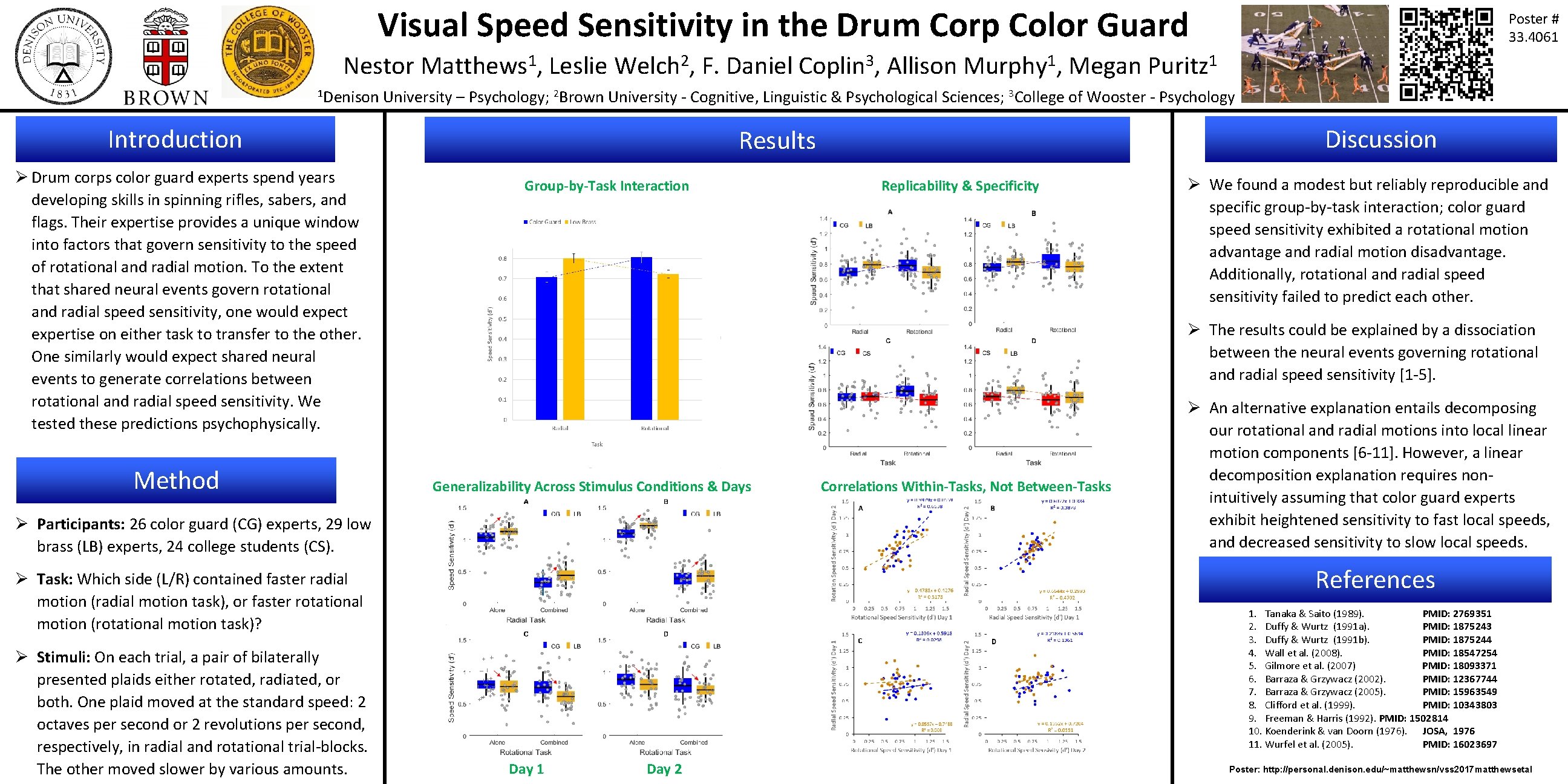
Visual Speed Sensitivity in the Drum Corp Color Guard Poster # 33. 4061 Nestor Matthews 1, Leslie Welch 2, F. Daniel Coplin 3, Allison Murphy 1, Megan Puritz 1 1 Denison University – Psychology; 2 Brown University - Cognitive, Linguistic & Psychological Sciences; 3 College of Wooster - Psychology Introduction Ø Drum corps color guard experts spend years developing skills in spinning rifles, sabers, and flags. Their expertise provides a unique window into factors that govern sensitivity to the speed of rotational and radial motion. To the extent that shared neural events govern rotational and radial speed sensitivity, one would expect expertise on either task to transfer to the other. One similarly would expect shared neural events to generate correlations between rotational and radial speed sensitivity. We tested these predictions psychophysically. Method Group-by-Task Interaction Replicability & Specificity Ø We found a modest but reliably reproducible and specific group-by-task interaction; color guard speed sensitivity exhibited a rotational motion advantage and radial motion disadvantage. Additionally, rotational and radial speed sensitivity failed to predict each other. Ø The results could be explained by a dissociation between the neural events governing rotational and radial speed sensitivity [1 -5]. Generalizability Across Stimulus Conditions & Days Ø Participants: 26 color guard (CG) experts, 29 low brass (LB) experts, 24 college students (CS). Correlations Within-Tasks, Not Between-Tasks Ø An alternative explanation entails decomposing our rotational and radial motions into local linear motion components [6 -11]. However, a linear decomposition explanation requires nonintuitively assuming that color guard experts exhibit heightened sensitivity to fast local speeds, and decreased sensitivity to slow local speeds. References Ø Task: Which side (L/R) contained faster radial motion (radial motion task), or faster rotational motion (rotational motion task)? Ø Stimuli: On each trial, a pair of bilaterally presented plaids either rotated, radiated, or both. One plaid moved at the standard speed: 2 octaves per second or 2 revolutions per second, respectively, in radial and rotational trial-blocks. The other moved slower by various amounts. Discussion Results 1. Tanaka & Saito (1989). PMID: 2769351 2. Duffy & Wurtz (1991 a). PMID: 1875243 3. Duffy & Wurtz (1991 b). PMID: 1875244 4. Wall et al. (2008). PMID: 18547254 5. Gilmore et al. (2007) PMID: 18093371 6. Barraza & Grzywacz (2002). PMID: 12367744 7. Barraza & Grzywacz (2005). PMID: 15963549 8. Clifford et al. (1999). PMID: 10343803 9. Freeman & Harris (1992). PMID: 1502814 10. Koenderink & van Doorn (1976). JOSA, 1976 11. Wurfel et al. (2005). PMID: 16023697 Day 1 Day 2 Poster: http: //personal. denison. edu/~matthewsn/vss 2017 matthewsetal