
Visual Spatial Learners in the Gifted Classroom Dont







- Slides: 70
Visual Spatial Learners in the Gifted Classroom Don’t Tell Me. Show Me!
Underachievement in Gifted Children Learning styles Traditional Teaching Methods
Are you Visual Spatial? Take the Quiz!
1. Do you think mainly in pictures or words? Geography, globe, continents, countries, oceans, lakes, rivers,
2. Are you good at solving puzzles or mazes?
3. Do you like to build with TM TM Legos , K’NEX , blocks, etc?
4. Do you often lose track of time?
5. Do you know things without being able to tell how or why?
6. Do you remember how to get to places you have only visited once?
7. Can you feel what others are feeling?
8. Do you remember what you see and forget what you hear?
9. Do you solve problems in unusual ways?
10. Do you have a wild imagination?
11. Do you love music, dance, art, or drama?
12. Can you see things from different perspectives?
13. Do others think you are organizationally challenged?
14. Do you love playing on the computer?
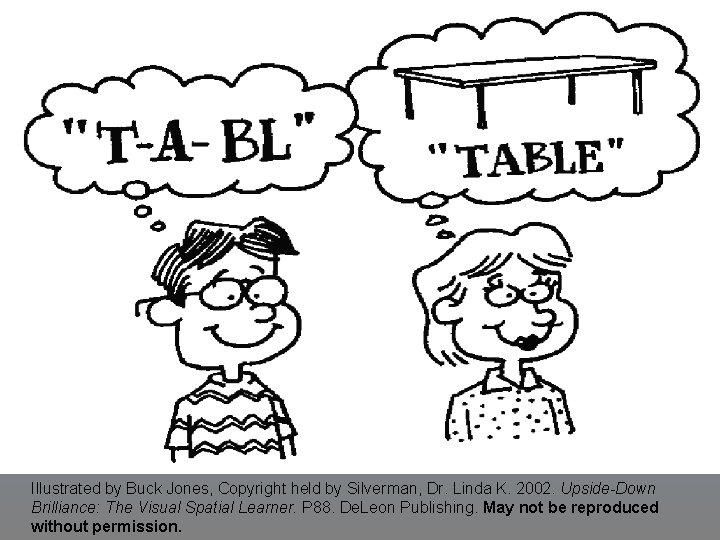
15. Do you have trouble spelling correctly?
16. Do you like taking things apart to see how they work?
Total up the number of Yeses and No’s. Let’s see where you are on the Auditory-Sequential Visual-Spatial Spectrum!
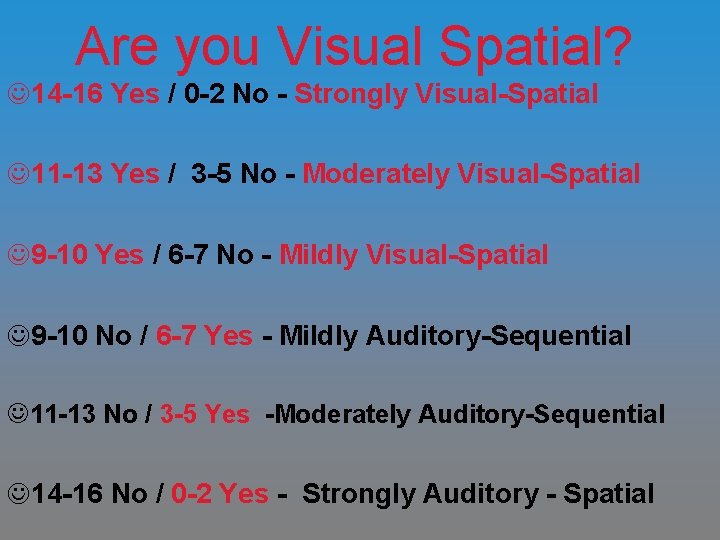
Are you Visual Spatial? 14 -16 Yes / 0 -2 No - Strongly Visual-Spatial 11 -13 Yes / 3 -5 No - Moderately Visual-Spatial 9 -10 Yes / 6 -7 No - Mildly Visual-Spatial 9 -10 No / 6 -7 Yes - Mildly Auditory-Sequential 11 -13 No / 3 -5 Yes -Moderately Auditory-Sequential 14 -16 No / 0 -2 Yes - Strongly Auditory - Spatial
Visual Spatial Learners enjoy: Blocks and Boxes Construx and Legos Gears and Tinker Toys Computers Daydreaming Movies Maps
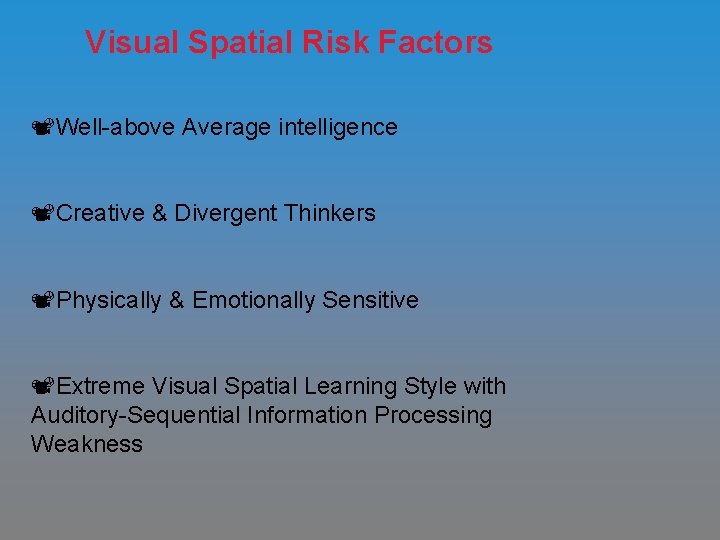
Visual Spatial Risk Factors Well-above Average intelligence Creative & Divergent Thinkers Physically & Emotionally Sensitive Extreme Visual Spatial Learning Style with Auditory-Sequential Information Processing Weakness
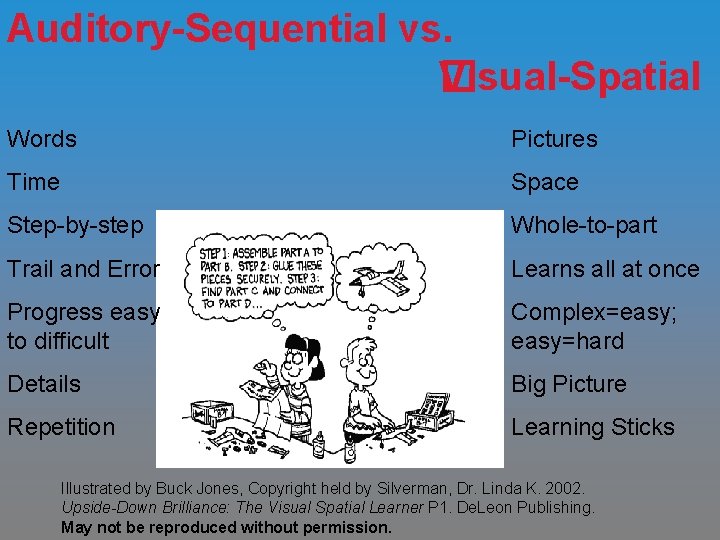
Auditory-Sequential vs. Visual-Spatial � Words Pictures Time Space Step-by-step Whole-to-part Trail and Error Learns all at once Progress easy to difficult Complex=easy; easy=hard Details Big Picture Repetition Learning Sticks Illustrated by Buck Jones, Copyright held by Silverman, Dr. Linda K. 2002. Upside-Down Brilliance: The Visual Spatial Learner P 1. De. Leon Publishing. May not be reproduced without permission.
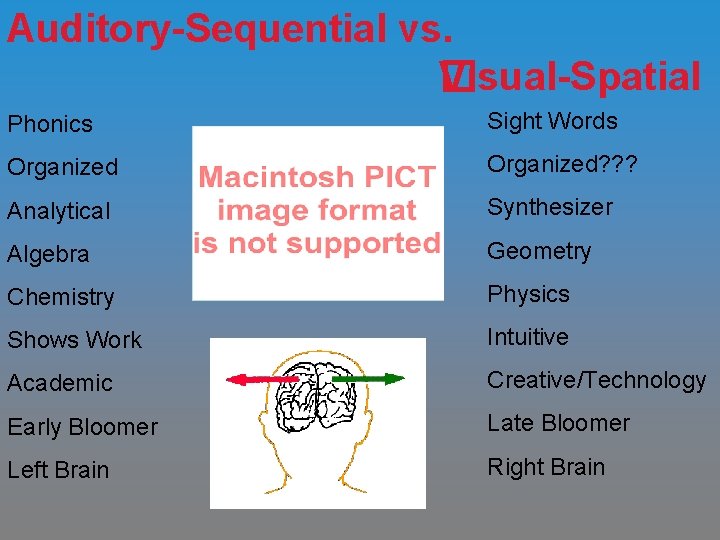
Auditory-Sequential vs. Visual-Spatial � Phonics Sight Words Organized? ? ? Analytical Synthesizer Algebra Geometry Chemistry Physics Shows Work Intuitive Academic Creative/Technology Early Bloomer Late Bloomer Left Brain Right Brain
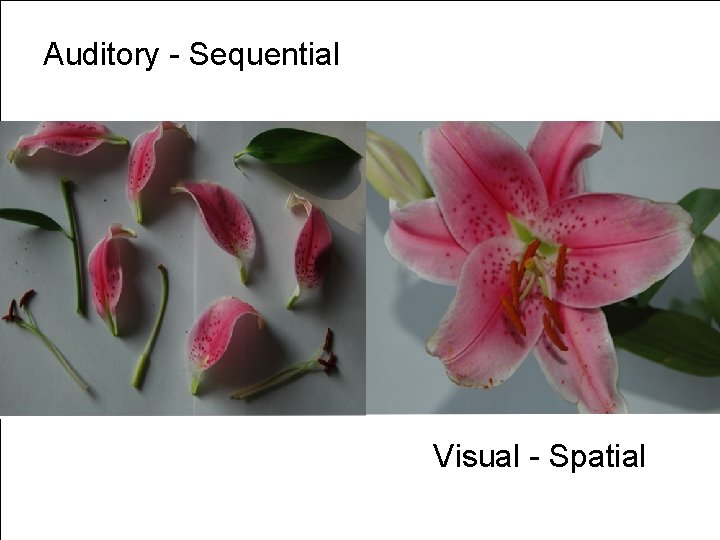
Auditory - Sequential Visual - Spatial
Why Visual Spatial Abilities? Employers of the 21 st century are looking for employees with strong visual skills, able to recognize larger patterns, intuition, a sense of proportion, imaginative vision, able to think outside of the box, and the apt connection between apparently unrelated things. Tom West. In the Mind’s Eye (1991)
So, why focus on Visual Spatial abilities? Now that information is readily available on the internet success in today’s world depends upon intuition, empathy, spirituality, and right-hemispheric directed abilities. “In the United States, the number of graphic designers has increased tenfold in a decade; graphic designers outnumber chemical engineers four to one. Since 1970, the United States has 30% more people earning a living as writers and 50% more earning a living by composing or performing music… More Americans today work in arts, entertainment, and design than work as lawyers, accountants, and auditors. ” (p 55) Pink, D. H. (2005) A Whole New Mind: Moving from the Information Age to the Conceptual Age
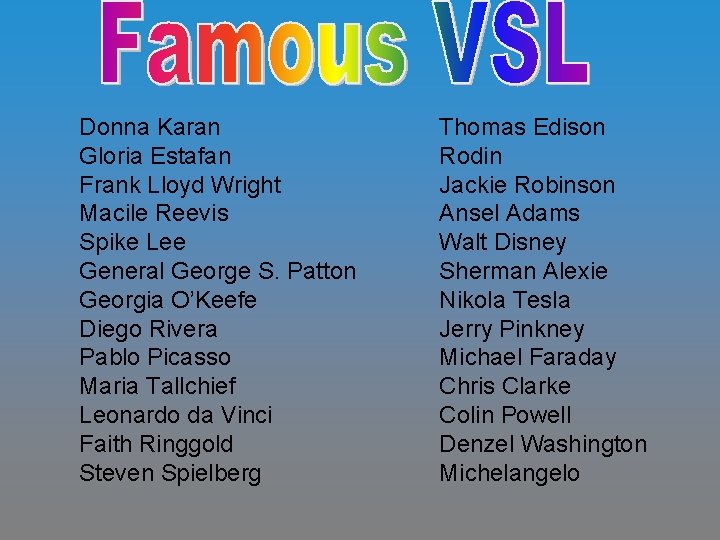
Donna Karan Gloria Estafan Frank Lloyd Wright Macile Reevis Spike Lee General George S. Patton Georgia O’Keefe Diego Rivera Pablo Picasso Maria Tallchief Leonardo da Vinci Faith Ringgold Steven Spielberg Thomas Edison Rodin Jackie Robinson Ansel Adams Walt Disney Sherman Alexie Nikola Tesla Jerry Pinkney Michael Faraday Chris Clarke Colin Powell Denzel Washington Michelangelo
Careers for Visual Spatial Learners: navigators, sculptors, visual artists, inventors, architects, interior designers, mechanics, engineers, video game designers, producers, actors, surgeons, dentists, photographers, fashion designers, interior designers, physics, aeronautics, "Intelligence is the ability to find and solve problems and create products of value in one's own culture. " -Dr. Howard Gardner
VSLs & Screeners/Aptitude Tests? Aptitude tests - High Scores on Block Design - WISC Comprehension (abstract reasoning)-WISC Abstract Visual Reasoning - SB-IV Matrix Reasoning - WAIS-III Nonverbal sections NNAT Source: Dr. Linda K. Silverman
Constructions Toys Creative Endeavors art, music, drama, dance, Destination Imagination, constructing computer programs, scientific experiments, Enjoy math, science, computers Dream of artistic/scientific fields Look at careers of parents Ear infection history Source: Dr. Linda K. Silverman
Learning does not occur in the classroom, it occurs in the students’ minds. The role of the teacher and the classroom s/he creates is to offer possibilities in such a way that students will both want and be able to learn. The richer the banquet we lay, the more students will partake and the linger they will stay at the table. Williams, L. V. 1983. Teaching for the Two Sided Mind: A guide to Right Brain/Left Brain Education. New York: Simon & Schuster. p 194
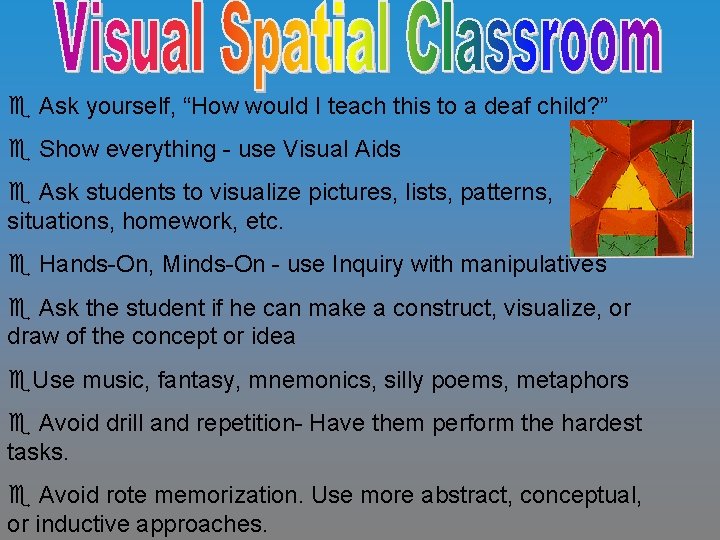
e Ask yourself, “How would I teach this to a deaf child? ” e Show everything - use Visual Aids e Ask students to visualize pictures, lists, patterns, situations, homework, etc. e Hands-On, Minds-On - use Inquiry with manipulatives e Ask the student if he can make a construct, visualize, or draw of the concept or idea e. Use music, fantasy, mnemonics, silly poems, metaphors e Avoid drill and repetition- Have them perform the hardest tasks. e Avoid rote memorization. Use more abstract, conceptual, or inductive approaches.
e Group VSL together for instruction. e Seat in front of room, but 4 -6’ from chalkboard e Avoid timed tests. e Have them discover their own methods of problemsolving. e Give them advanced, abstract, complex material at a faster pace even if they haven't mastered the easier, sequential work. e Emphasize mastery of higher level concepts rather than perfection of simpler concepts in competition with other students e Use inductive or discover techniques
e Use Color, Color on the visuals e Students use Color highlighters on key concepts, words e Organize EVERYTHING by Color e Color coordinate everything in one subject using the same color. e Have the VSL create Individual flashcards in Color e Copy activity sheets, graphic organizers, study guides, etc. on Color copy paper - easier to organize, too. e Encourage the use of computers e. Grade on material learned, not the process.
Illustrated by Buck Jones, Copyright held by Silverman, Dr. Linda K. 2002. Upside-Down Brilliance: The Visual Spatial Learner. P 88. De. Leon Publishing. May not be reproduced without permission.
May never be a good oral reader. Help the child before s/he makes a mistake and it imprints. Encourage the use of context clues. Vocabulary words need illustrations; flash cards Picture collages of words with same beginning / ending, etc. Speed Read- skipping the small words Get content first, then read for details Picture at Punctuation Vision-tracking instrument Test for comprehension with silent reading
Burcher, Sam, Max, and Bryan. 1998. Vocabulary Cartoons. New Monics Books. Burcher, Sam, Max, and Bryan. Vocabulary Cartoons I: SAT Word Power. New Monics Books. Burcher, Sam, Max, and Bryan. 2007. Vocabulary Cartoons II: SAT Word Power. New Monics Books.
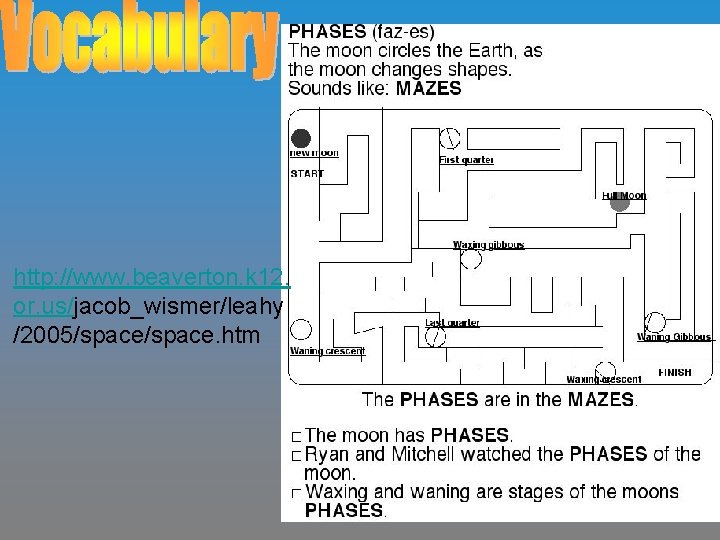
http: //www. beaverton. k 12. or. us/jacob_wismer/leahy /2005/space. htm
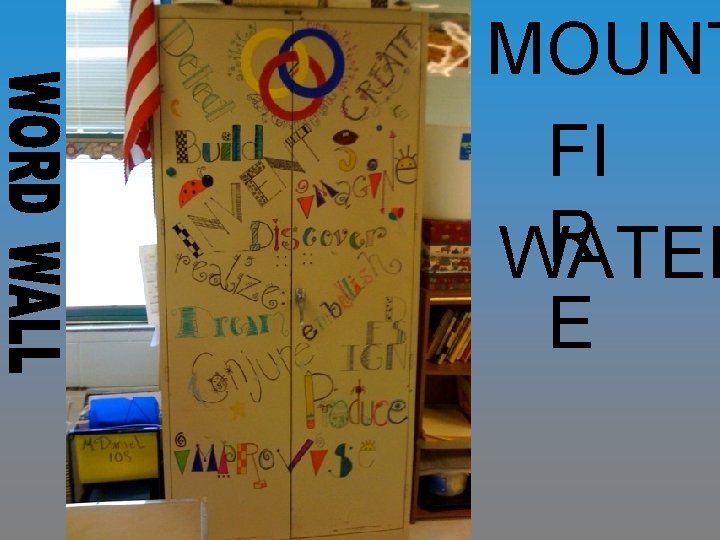
MOUNT FI R WATER E
As these students may suffer from deficits in mechanics, give more weight to the content of papers than to format. Give two grades, one for content & one for mechanics Illustrate the story first with a storyboard. Use a graphic organizer to web story, outline, write Dictate story Alternate assignments- birth certificate, tombstone, interviews, maps, role-playing, newspaper article, podcast, etc. Use computers to type stories/reports Encourage handwriting as art
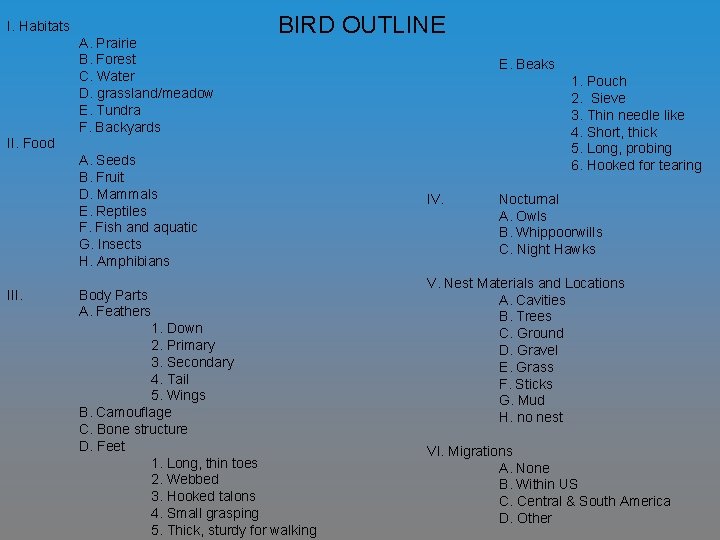
I. Habitats A. Prairie B. Forest C. Water D. grassland/meadow E. Tundra F. Backyards BIRD OUTLINE E. Beaks 1. Pouch 2. Sieve 3. Thin needle like 4. Short, thick 5. Long, probing 6. Hooked for tearing II. Food A. Seeds B. Fruit D. Mammals E. Reptiles F. Fish and aquatic G. Insects H. Amphibians III. Body Parts A. Feathers 1. Down 2. Primary 3. Secondary 4. Tail 5. Wings B. Camouflage C. Bone structure D. Feet 1. Long, thin toes 2. Webbed 3. Hooked talons 4. Small grasping 5. Thick, sturdy for walking IV. Nocturnal A. Owls B. Whippoorwills C. Night Hawks V. Nest Materials and Locations A. Cavities B. Trees C. Ground D. Gravel E. Grass F. Sticks G. Mud H. no nest VI. Migrations A. None B. Within US C. Central & South America D. Other
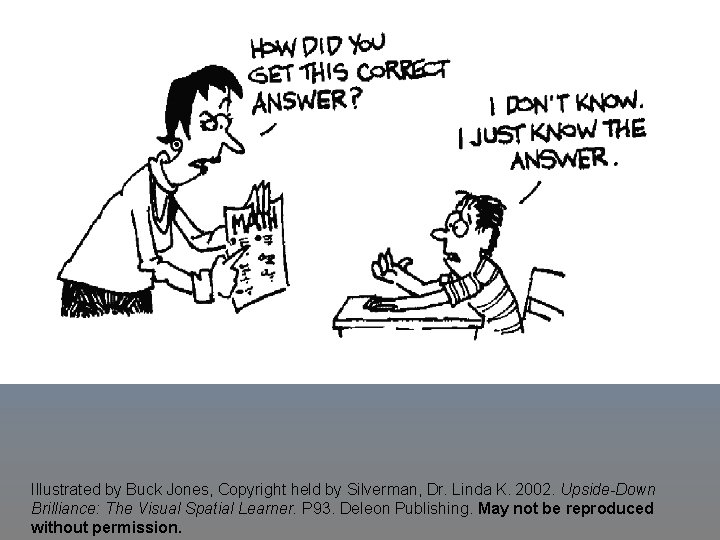
Illustrated by Buck Jones, Copyright held by Silverman, Dr. Linda K. 2002. Upside-Down Brilliance: The Visual Spatial Learner. P 93. Deleon Publishing. May not be reproduced without permission.
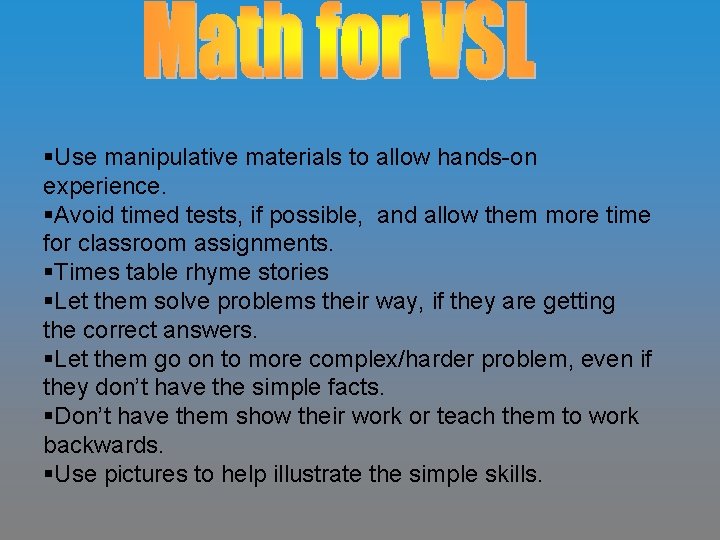
Use manipulative materials to allow hands-on experience. Avoid timed tests, if possible, and allow them more time for classroom assignments. Times table rhyme stories Let them solve problems their way, if they are getting the correct answers. Let them go on to more complex/harder problem, even if they don’t have the simple facts. Don’t have them show their work or teach them to work backwards. Use pictures to help illustrate the simple skills.
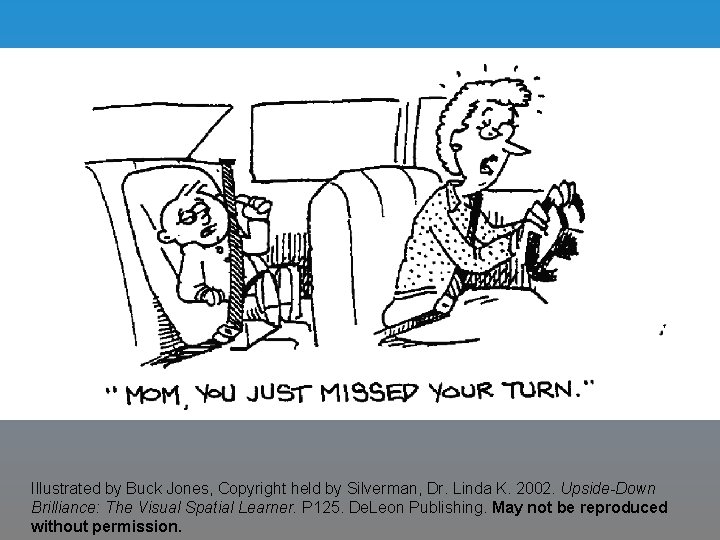
Illustrated by Buck Jones, Copyright held by Silverman, Dr. Linda K. 2002. Upside-Down Brilliance: The Visual Spatial Learner. P 125. De. Leon Publishing. May not be reproduced without permission.
Emphasize creativity, imagination, new insights, new approaches rather than the acquisition of knowledge. . Engage students in independent studies or group projects which involve problem-finding as well as problem-solving. Have the students discuss the ethical, moral and global implications of their learning and involve them in service-oriented projects. Students use illustrations when note-taking If too time consuming, use words and pictures for notes Tape record lectures Highlight information with different colored highlighters Box, circle or underline words to remember Use post-it notes to tag pages and important information Emphasize concepts Allow typed pages to be pasted into Lab books
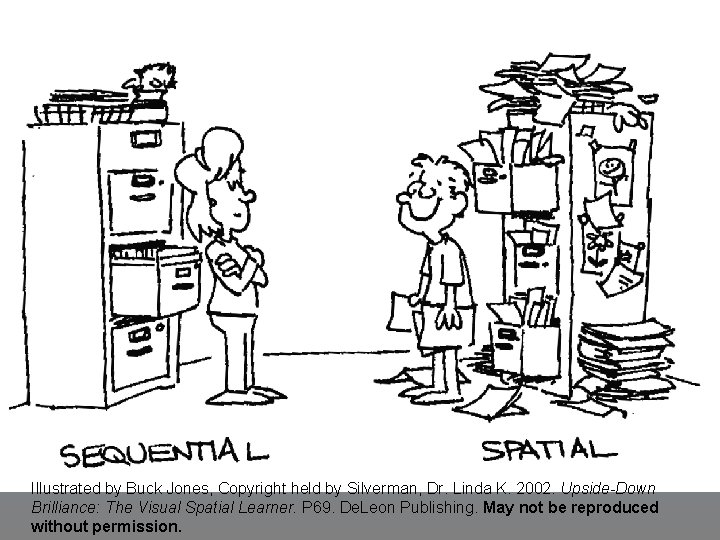
Illustrated by Buck Jones, Copyright held by Silverman, Dr. Linda K. 2002. Upside-Down Brilliance: The Visual Spatial Learner. P 69. De. Leon Publishing. May not be reproduced without permission.
Horizontal Stacker
Color Code subject areas. Pockets Calendars Computers Visualizing homework before end of school A place for everything and everything in its place
Moment of silence at end of day to visualize homework needs Reduce unpredictable noise Use wait time- allowing students to visualize Let student finish an answer - even if they seem of target Discipline in private and be nonjudgmental. Encourage the child’s strengths.
* Let’s look at it differently. * See how this works for you. * I can’t quite picture it. * Let’s draw a diagram or map. * I’d like to get a different perspective. * I never forget a face.
The words or the language, as they are written and spoken, do not seem to play any role in my mechanism of thought. The psychical entities which seem to serve as elements in thought are certain signs and… images… The above mentioned elements are, in my case, of visual and some of muscular type. Conventional words or other signs have to be sought for laboriously in a secondary stage… (Albert Einstein, quoted in J. Hadamard, The Psychology of Invention in the Mathematical Field, Princeton, NJ: Princeton University Press, 1949. )
Learning in school pushed students through pre-determined hoops in a prescribed way. Spatial ideas give an environment for thinking about relationships. It requires higher level cognition. Dr. Dana Johnson. 2006 NAGC
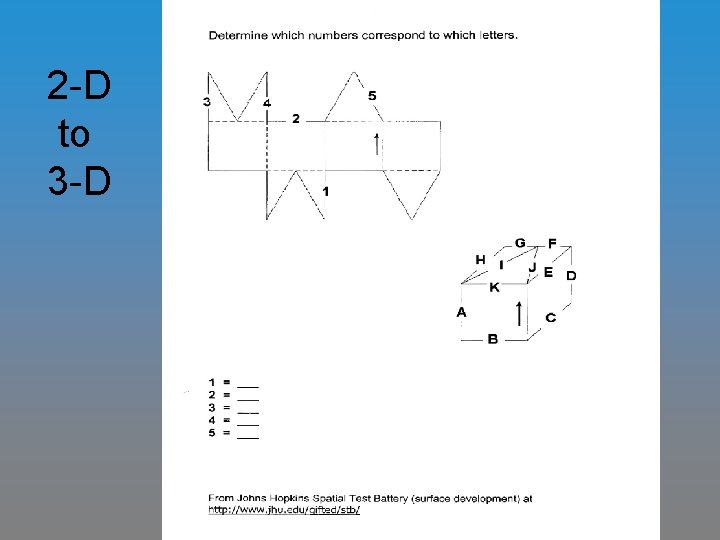
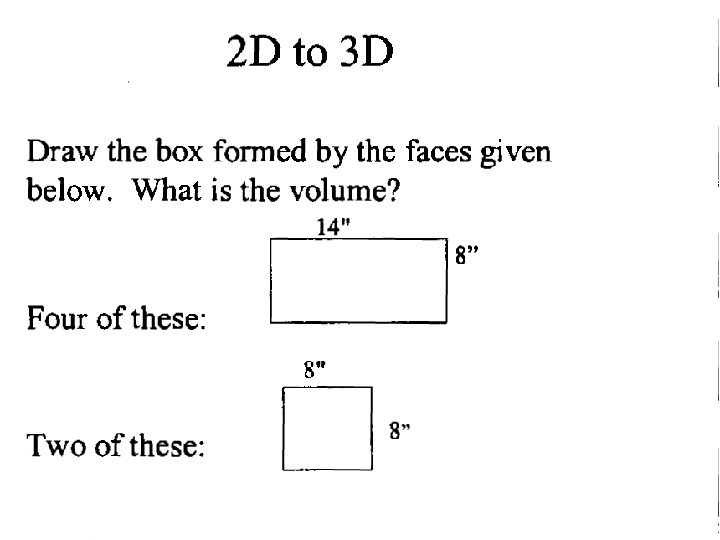
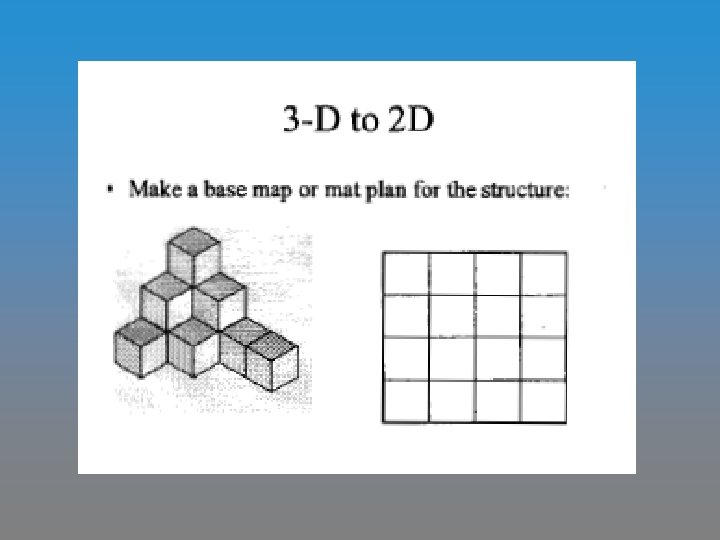
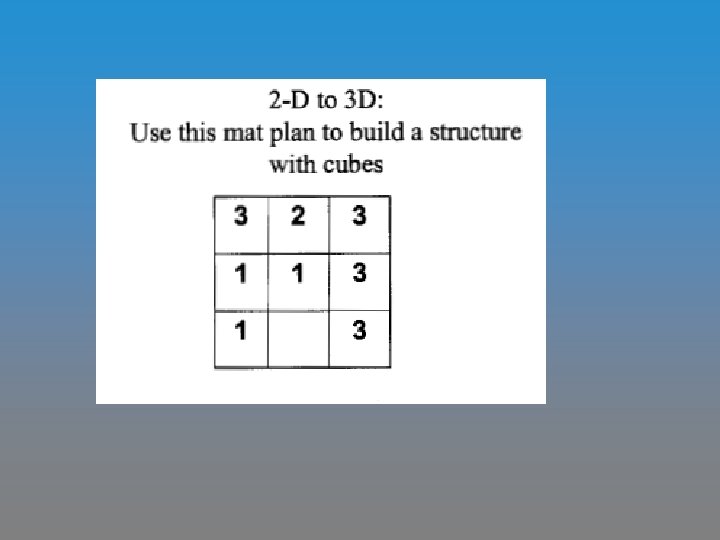
2 -D to 3 -D
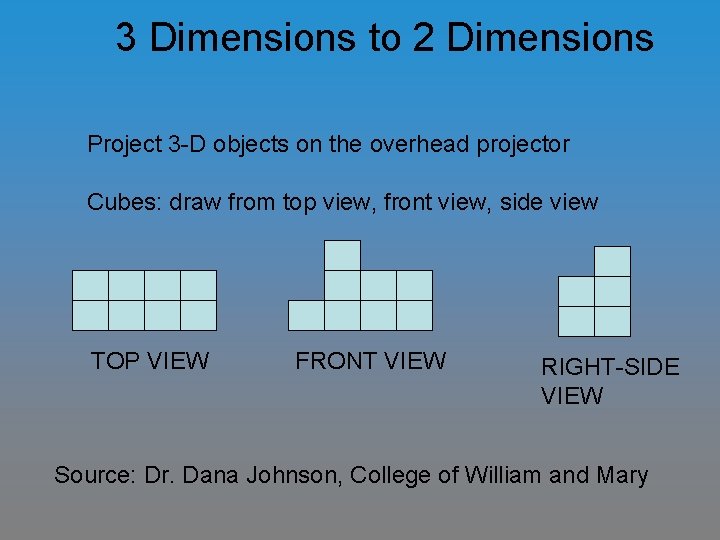
3 Dimensions to 2 Dimensions Project 3 -D objects on the overhead projector Cubes: draw from top view, front view, side view TOP VIEW FRONT VIEW RIGHT-SIDE VIEW Source: Dr. Dana Johnson, College of William and Mary
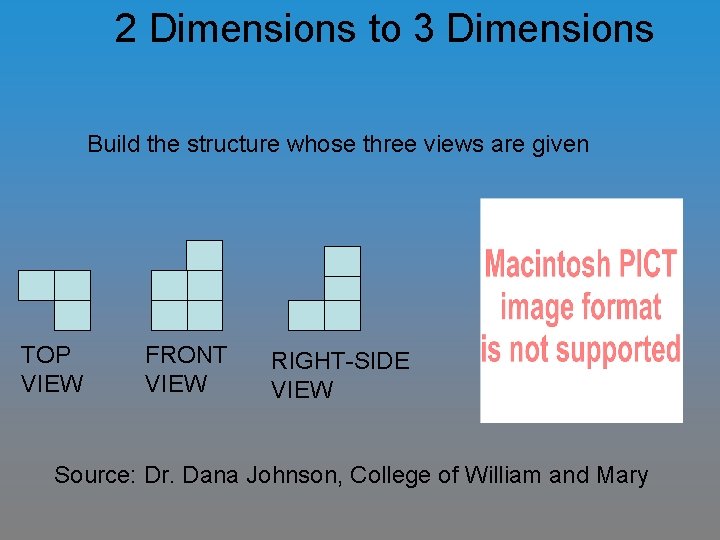
2 Dimensions to 3 Dimensions Build the structure whose three views are given TOP VIEW FRONT VIEW RIGHT-SIDE VIEW Source: Dr. Dana Johnson, College of William and Mary
What can we do differently in our Gifted classrooms to better meet the needs of the Visual-Spatial Learners, or over half of our classes? What is one thing you will try differently?
Ask yourself these few questions: 1. Am I presenting the material visually? 2. Are there additional maps, charts, graphs, photos, hands-on activities, or other materials I should incorporate? 3. Am I giving students enough time? 4. Are there opportunities for students to demonstrate mastery in visual-spatial friendly ways? 5. Am I successfully differentiating by honoring each student for his or her preferred learning style?
I visualize things in my mind before I have to do them. It is like having a mental workshop. Jack Youngblood, 1950 - , American The soul never thinks without a picture. Aristotle, Greek 384 -322 B. C.