
Visual Programming Vishal Dwivedi Institute for Software Research
![Carnegie Mellon University, School of Computer Science (Claimed) Disadvantages of VPLs l [Fred Lakin]](https://slidetodoc.com/presentation_image_h2/5e90426de3a73dcc47ef2527b669d90b/image-11.jpg "Carnegie Mellon University, School of Computer Science (Claimed) Disadvantages of VPLs l [Fred Lakin]")
![Carnegie Mellon University, School of Computer Science Taxonomies of Visual Languages (1) [Myers, 1990]](https://slidetodoc.com/presentation_image_h2/5e90426de3a73dcc47ef2527b669d90b/image-16.jpg "Carnegie Mellon University, School of Computer Science Taxonomies of Visual Languages (1) [Myers, 1990]")
![Carnegie Mellon University, School of Computer Science VPL research – key categories [Burnett, 1994]](https://slidetodoc.com/presentation_image_h2/5e90426de3a73dcc47ef2527b669d90b/image-19.jpg "Carnegie Mellon University, School of Computer Science VPL research – key categories [Burnett, 1994]")
- Slides: 47
Visual Programming Vishal Dwivedi Institute for Software Research Carnegie Mellon University 05 -899 D: Human Aspects of Software Development (HASD) Spring 2011 – Lecture 19
Agenda l l Definitions Motivation for using Visual Programming Languages (VPLs) Popular VPLs Understanding VPL Research via Taxonomies l Important Categories l l l Language Classifications Language Features Purpose Design Issues Studies l l l Carnegie Mellon University, School of Computer Science Empirical evidence for VPLs Empirical evidence against the use of VPLs Conclusions 2
Carnegie Mellon University, School of Computer Science Definitions Programming l “Programming” l l ‘‘The process of transforming a mental plan of desired actions for a computer into a representation that can be understood by the computer’’ – Jean-Michel Hoc and Anh Nguyen-Xuan “Single-dimensional characteristics” l The compilers or interpreters programs as long, onedimensional streams. 3
Carnegie Mellon University, School of Computer Science Definitions Visual Programming l “Visual Programming” l l “Programming in which more than one dimension is used to convey semantics. ” - Myers, 1990 “Token” l l “A collection of one or more multi-dimensional objects”. Examples: l l Multi-dimensional graphical objects Spatial relationships Use of the time dimension to specify “before-after” semantic relationships. “Visual Expression” l “A collection of one or more tokens” 4
Carnegie Mellon University, School of Computer Science Definitions Visual Programming Language l “Visual Programming Language” l “Any system where the user writes a program using two or more dimensions” [Myers, 1990] l “A visual language manipulates visual information or supports visual interaction, or allows programming with visual expressions” [Golin , 1990] l “A programming language that lets users create programs by manipulating program elements graphically rather than by specifying them textually”. l “A set of spatial arrangements of text-graphic symbols with a semantic interpretation that is used in carrying out communication actions in the world”. [Lakin, 1989] 5
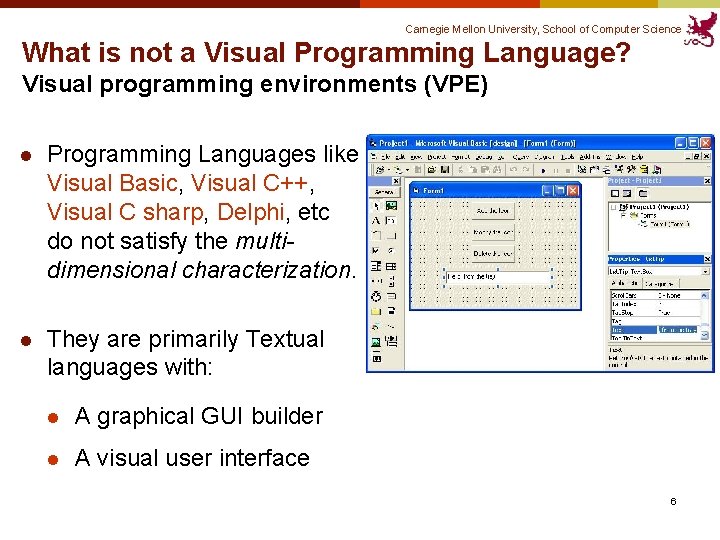
Carnegie Mellon University, School of Computer Science What is not a Visual Programming Language? Visual programming environments (VPE) l Programming Languages like Visual Basic, Visual C++, Visual C sharp, Delphi, etc do not satisfy the multidimensional characterization. l They are primarily Textual languages with: l A graphical GUI builder l A visual user interface 6
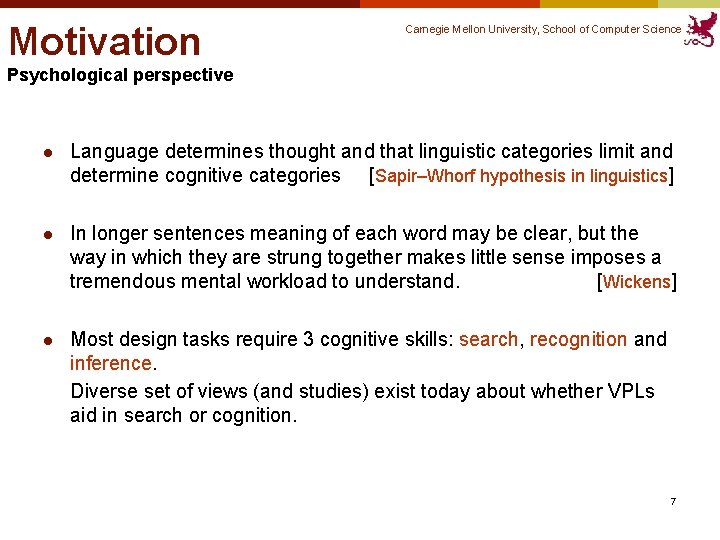
Motivation Carnegie Mellon University, School of Computer Science Psychological perspective l Language determines thought and that linguistic categories limit and determine cognitive categories [Sapir–Whorf hypothesis in linguistics] l In longer sentences meaning of each word may be clear, but the way in which they are strung together makes little sense imposes a tremendous mental workload to understand. [Wickens] l Most design tasks require 3 cognitive skills: search, recognition and inference. Diverse set of views (and studies) exist today about whether VPLs aid in search or cognition. 7
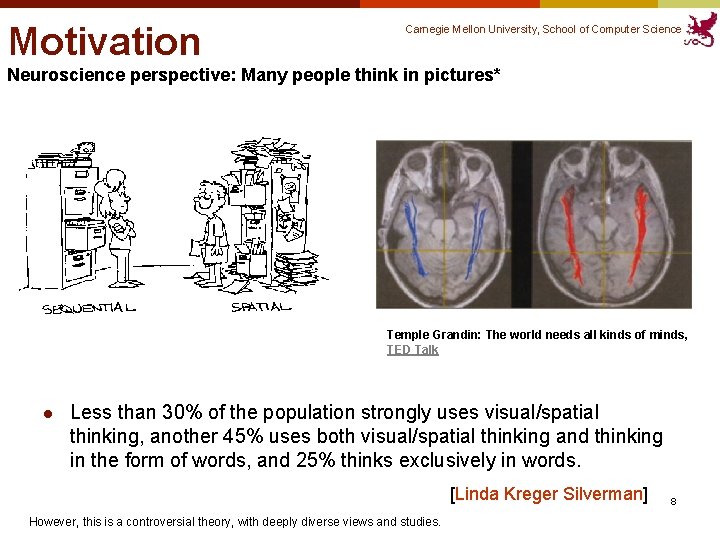
Motivation Carnegie Mellon University, School of Computer Science Neuroscience perspective: Many people think in pictures* Temple Grandin: The world needs all kinds of minds, TED Talk l Less than 30% of the population strongly uses visual/spatial thinking, another 45% uses both visual/spatial thinking and thinking in the form of words, and 25% thinks exclusively in words. [Linda Kreger Silverman] However, this is a controversial theory, with deeply diverse views and studies. 8
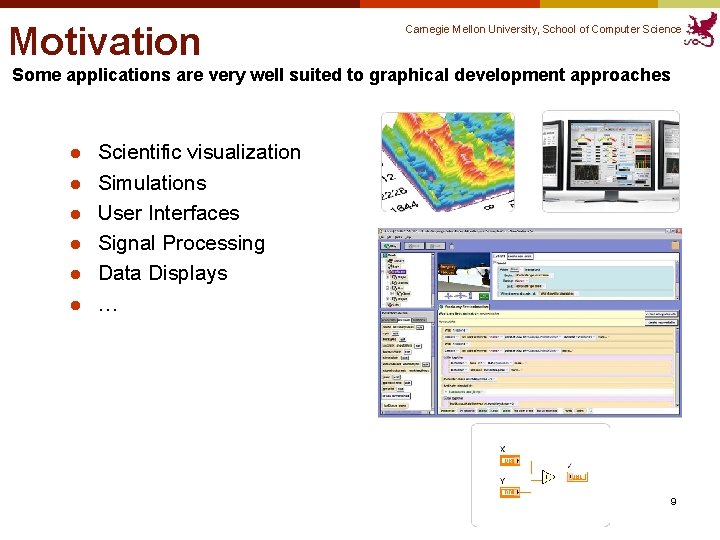
Motivation Carnegie Mellon University, School of Computer Science Some applications are very well suited to graphical development approaches l l l Scientific visualization Simulations User Interfaces Signal Processing Data Displays … 9
Carnegie Mellon University, School of Computer Science (Claimed) Advantages of VPLs l l l Fewer programming concepts Concreteness Explicit depiction of relationships Immediate visual feedback Parallel computation is a natural consequence of many visual programming paradigms 10
Carnegie Mellon University, School of Computer Science (Claimed) Disadvantages of VPLs l [Fred Lakin] “Deutsch Limit” * l The problem with visual programming is that you can't have more than 50 visual primitives on the screen at the same time. l Some situations in which text has superiority: l Documentation, l Naming to distinguish between elements that are of the same kind, and l Expressing well-known and compact concepts that are inherently textual, e. g. algebraic formulas. 11
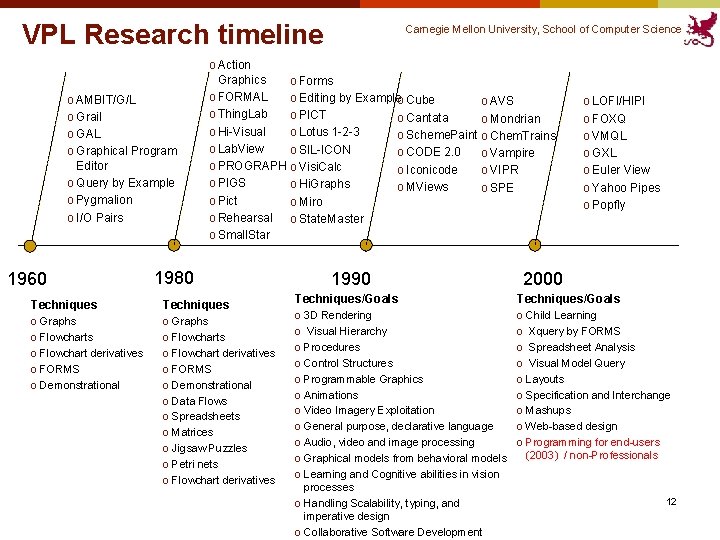
VPL Research timeline o AMBIT/G/L o Grail o GAL o Graphical Program Editor o Query by Example o Pygmalion o I/O Pairs 1960 Techniques o Graphs o Flowchart derivatives o FORMS o Demonstrational Carnegie Mellon University, School of Computer Science o Action Graphics o Forms o FORMAL o Editing by Exampleo Cube o AVS o Thing. Lab o PICT o Cantata o Mondrian o Hi-Visual o Lotus 1 -2 -3 o Scheme. Paint o Chem. Trains o Lab. View o SIL-ICON o CODE 2. 0 o Vampire o PROGRAPH o Visi. Calc o Iconicode o VIPR o PIGS o Hi. Graphs o MViews o SPE o Pict o Miro o Rehearsal o State. Master o Small. Star 1980 Techniques o Graphs o Flowchart derivatives o FORMS o Demonstrational o Data Flows o Spreadsheets o Matrices o Jigsaw Puzzles o Petri nets o Flowchart derivatives 1990 Techniques/Goals o 3 D Rendering o Visual Hierarchy o Procedures o Control Structures o Programmable Graphics o Animations o Video Imagery Exploitation o General purpose, declarative language o Audio, video and image processing o Graphical models from behavioral models o Learning and Cognitive abilities in vision processes o Handling Scalability, typing, and imperative design o Collaborative Software Development o LOFI/HIPI o FOXQ o VMQL o GXL o Euler View o Yahoo Pipes o Popfly 2000 Techniques/Goals o Child Learning o Xquery by FORMS o Spreadsheet Analysis o Visual Model Query o Layouts o Specification and Interchange o Mashups o Web-based design o Programming for end-users (2003) / non-Professionals 12
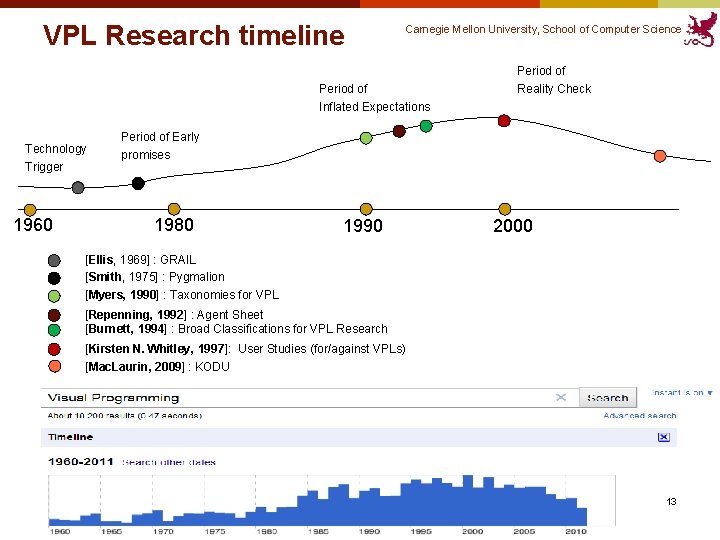
VPL Research timeline Carnegie Mellon University, School of Computer Science Period of Inflated Expectations Technology Trigger 1960 Period of Reality Check Period of Early promises 1980 1990 2000 [Ellis, 1969] : GRAIL [Smith, 1975] : Pygmalion [Myers, 1990] : Taxonomies for VPL [Repenning, 1992] : Agent Sheet [Burnett, 1994] : Broad Classifications for VPL Research [Kirsten N. Whitley, 1997]: User Studies (for/against VPLs) [Mac. Laurin, 2009] : KODU 13
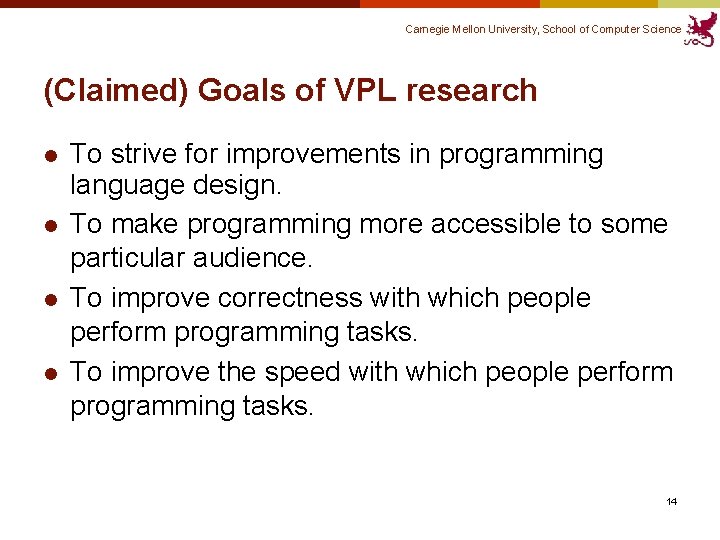
Carnegie Mellon University, School of Computer Science (Claimed) Goals of VPL research l l To strive for improvements in programming language design. To make programming more accessible to some particular audience. To improve correctness with which people perform programming tasks. To improve the speed with which people perform programming tasks. 14
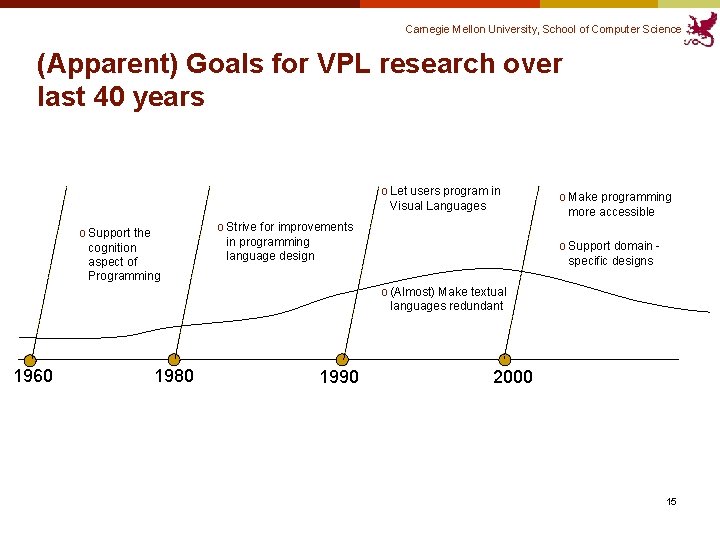
Carnegie Mellon University, School of Computer Science (Apparent) Goals for VPL research over last 40 years o Let users program in Visual Languages o Support the cognition aspect of Programming o Strive for improvements in programming language design o Make programming more accessible o Support domain specific designs o (Almost) Make textual languages redundant 1960 1980 1990 2000 15
Carnegie Mellon University, School of Computer Science Taxonomies of Visual Languages (1) [Myers, 1990] Classification (8 blocks) l Visual Programming or not, l Example-Based Programming or not, l Interpretive or Compiled. 16
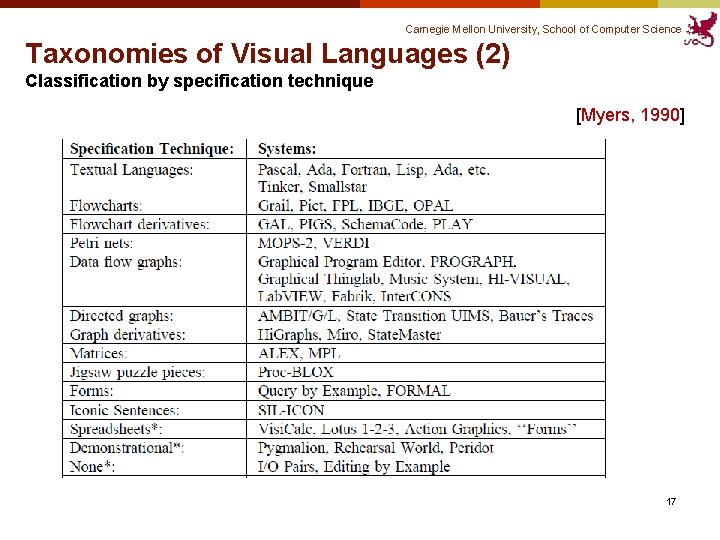
Carnegie Mellon University, School of Computer Science Taxonomies of Visual Languages (2) Classification by specification technique [Myers, 1990] 17
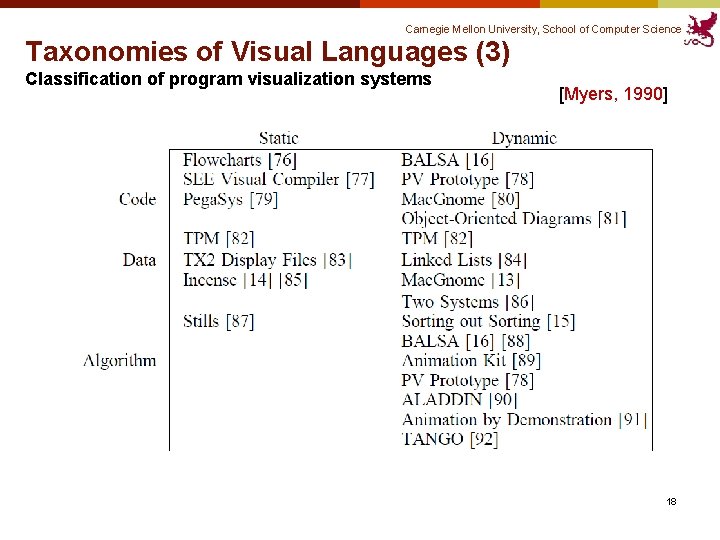
Carnegie Mellon University, School of Computer Science Taxonomies of Visual Languages (3) Classification of program visualization systems [Myers, 1990] 18
Carnegie Mellon University, School of Computer Science VPL research – key categories [Burnett, 1994] 19
Carnegie Mellon University, School of Computer Science VPL research – Classification based on Paradigms l l l Concurrent languages Constraint-based languages Data-flow languages Form-based and spreadsheet-based languages Functional languages Imperative languages Logic languages Multi-paradigm languages Object Oriented languages Programming-by-demonstration languages Rule-based languages 20
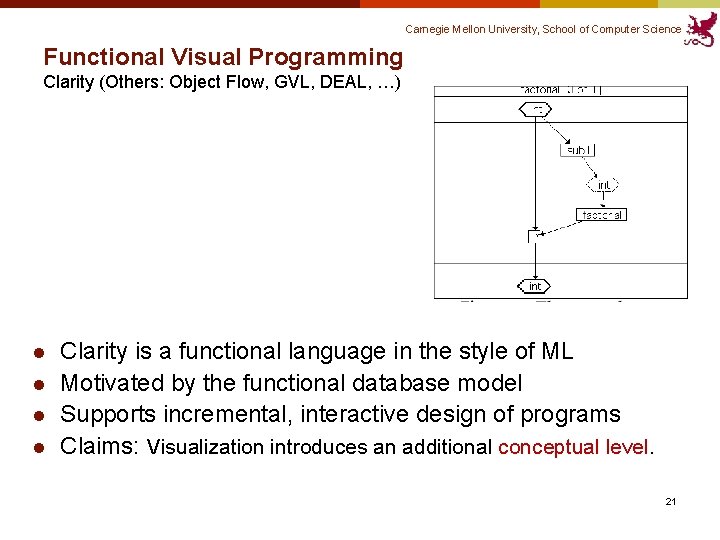
Carnegie Mellon University, School of Computer Science Functional Visual Programming Clarity (Others: Object Flow, GVL, DEAL, …) l l Clarity is a functional language in the style of ML Motivated by the functional database model Supports incremental, interactive design of programs Claims: Visualization introduces an additional conceptual level. 21
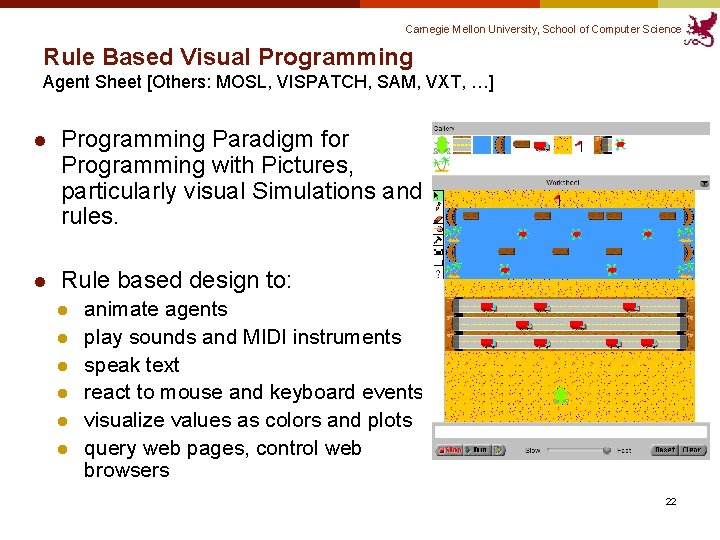
Carnegie Mellon University, School of Computer Science Rule Based Visual Programming Agent Sheet [Others: MOSL, VISPATCH, SAM, VXT, …] l Programming Paradigm for Programming with Pictures, particularly visual Simulations and rules. l Rule based design to: l l l animate agents play sounds and MIDI instruments speak text react to mouse and keyboard events visualize values as colors and plots query web pages, control web browsers 22
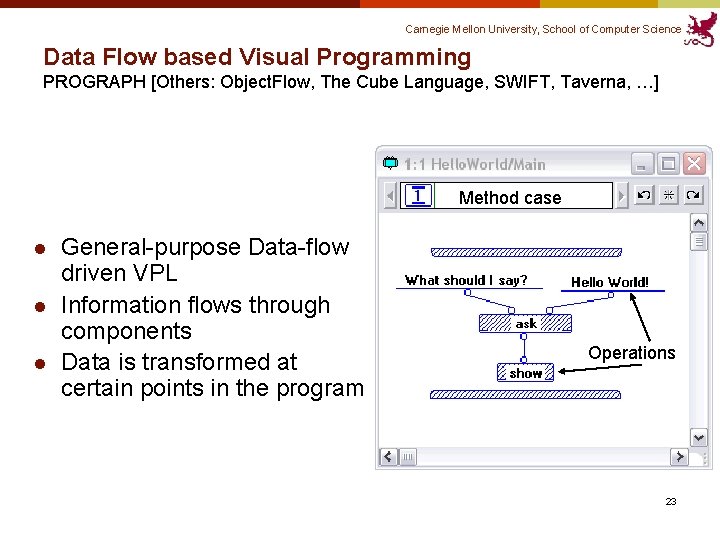
Carnegie Mellon University, School of Computer Science Data Flow based Visual Programming PROGRAPH [Others: Object. Flow, The Cube Language, SWIFT, Taverna, …] Method case l l l General-purpose Data-flow driven VPL Information flows through components Data is transformed at certain points in the program Operations 23
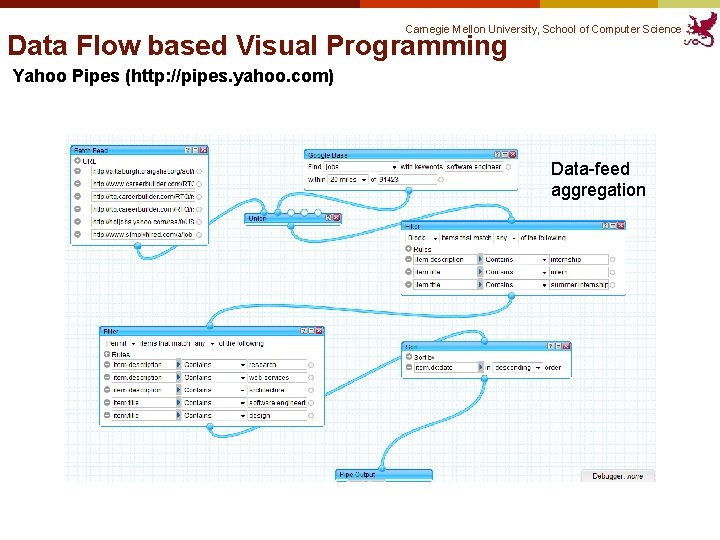
Carnegie Mellon University, School of Computer Science Data Flow based Visual Programming Yahoo Pipes (http: //pipes. yahoo. com) Data-feed aggregation
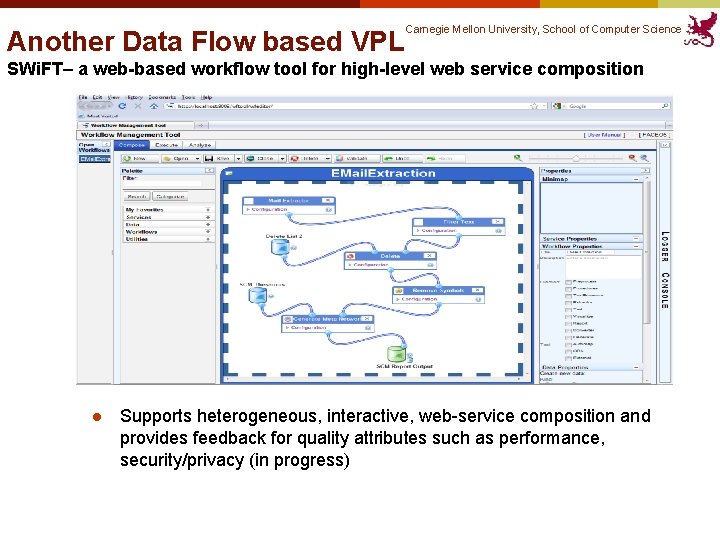
Another Data Flow based VPL Carnegie Mellon University, School of Computer Science SWi. FT– a web-based workflow tool for high-level web service composition l Supports heterogeneous, interactive, web-service composition and provides feedback for quality attributes such as performance, security/privacy (in progress)
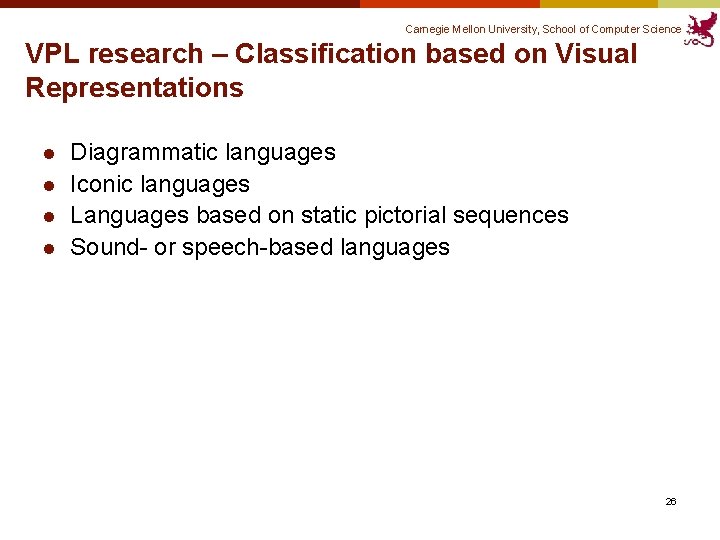
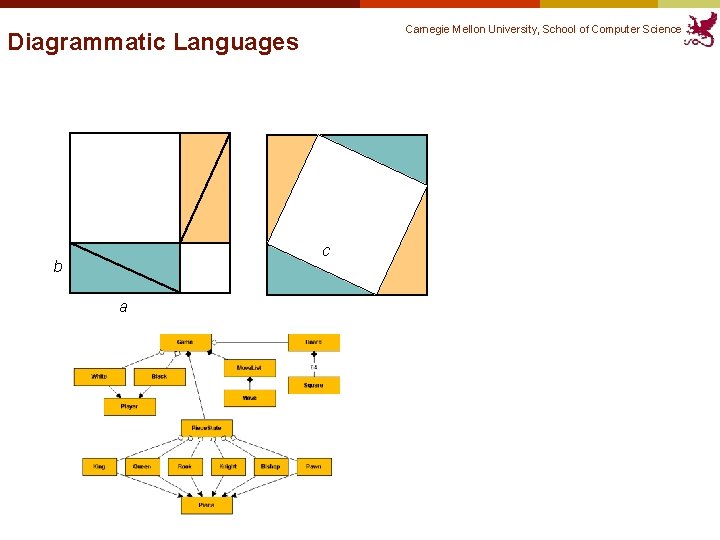
Carnegie Mellon University, School of Computer Science VPL research – Classification based on Visual Representations l l Diagrammatic languages Iconic languages Languages based on static pictorial sequences Sound- or speech-based languages 26
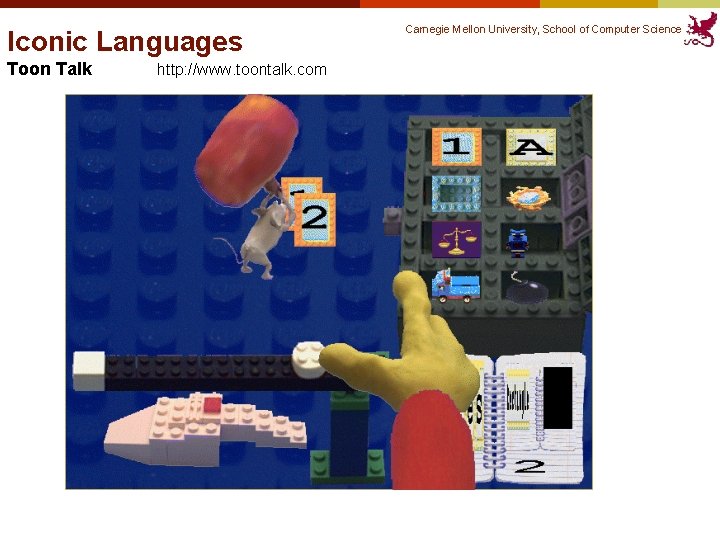
Carnegie Mellon University, School of Computer Science Iconic Languages Toon Talk http: //www. toontalk. com c a
Carnegie Mellon University, School of Computer Science Diagrammatic Languages c b a
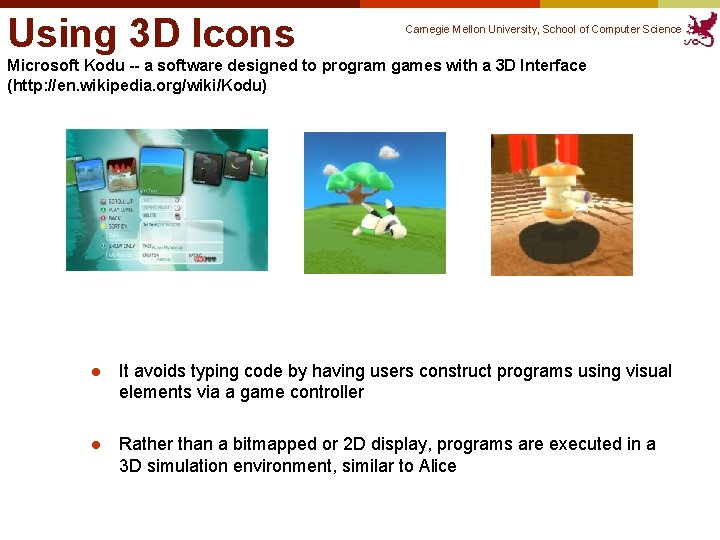
Using 3 D Icons Carnegie Mellon University, School of Computer Science Microsoft Kodu -- a software designed to program games with a 3 D Interface (http: //en. wikipedia. org/wiki/Kodu) l It avoids typing code by having users construct programs using visual elements via a game controller l Rather than a bitmapped or 2 D display, programs are executed in a 3 D simulation environment, similar to Alice
Carnegie Mellon University, School of Computer Science VPL research – Language Features l Abstraction l l l l Data abstraction Procedural abstraction Control flow Data types and structures Documentation Event handling Exception handling 30
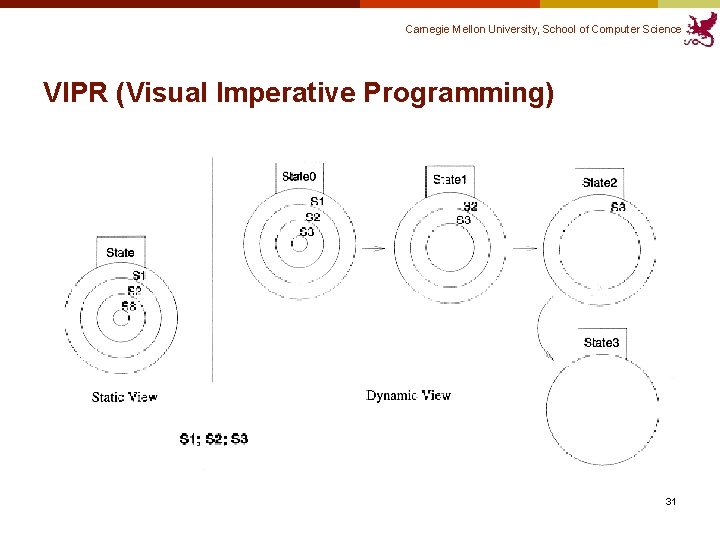
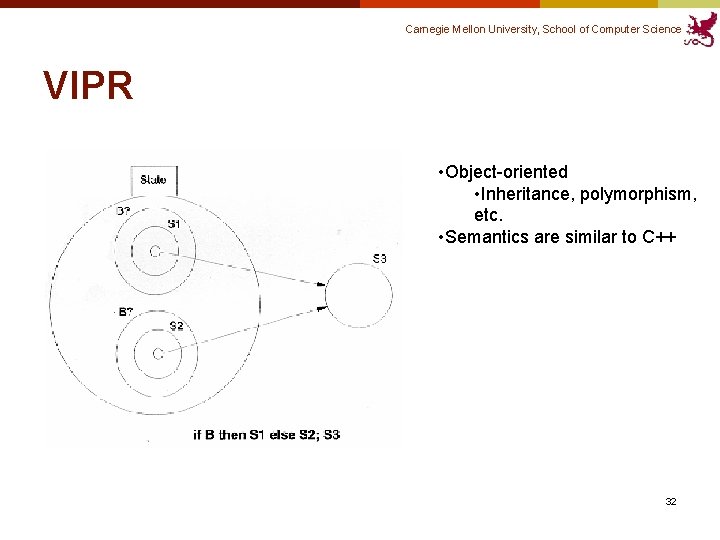
Carnegie Mellon University, School of Computer Science VIPR (Visual Imperative Programming) 31
Carnegie Mellon University, School of Computer Science VIPR • Object-oriented • Inheritance, polymorphism, etc. • Semantics are similar to C++ 32
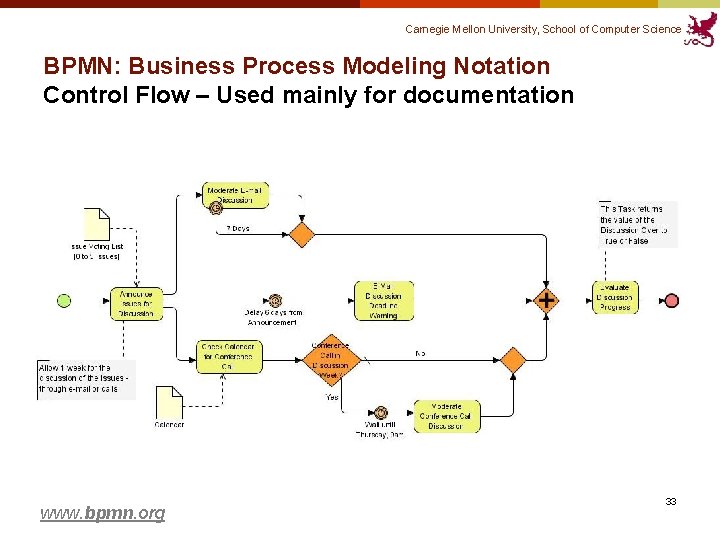
Carnegie Mellon University, School of Computer Science BPMN: Business Process Modeling Notation Control Flow – Used mainly for documentation www. bpmn. org 33
Carnegie Mellon University, School of Computer Science VPL research – Language Purpose l l l l General-purpose languages Database languages Image-processing languages Scientific visualization languages User-interface generation languages Languages for programming web-based applications Languages for education 34
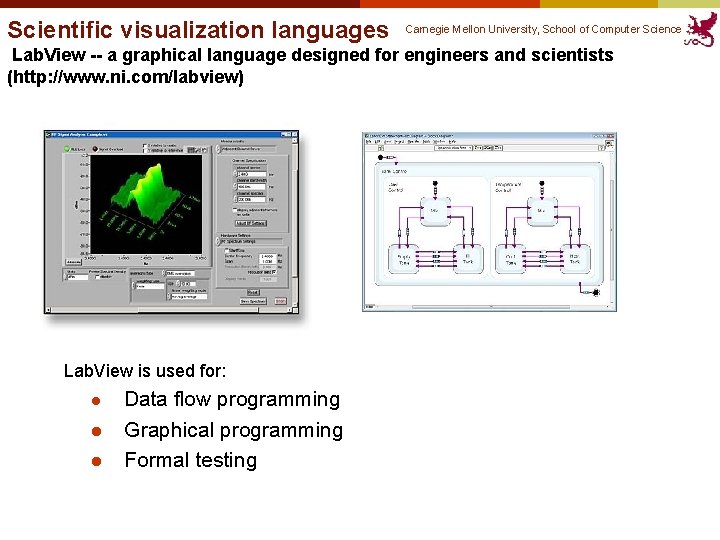
Scientific visualization languages Carnegie Mellon University, School of Computer Science Lab. View -- a graphical language designed for engineers and scientists (http: //www. ni. com/labview) Lab. View is used for: l l l Data flow programming Graphical programming Formal testing
Carnegie Mellon University, School of Computer Science Empirical Studies FOR/AGAINST use of VPLS 36
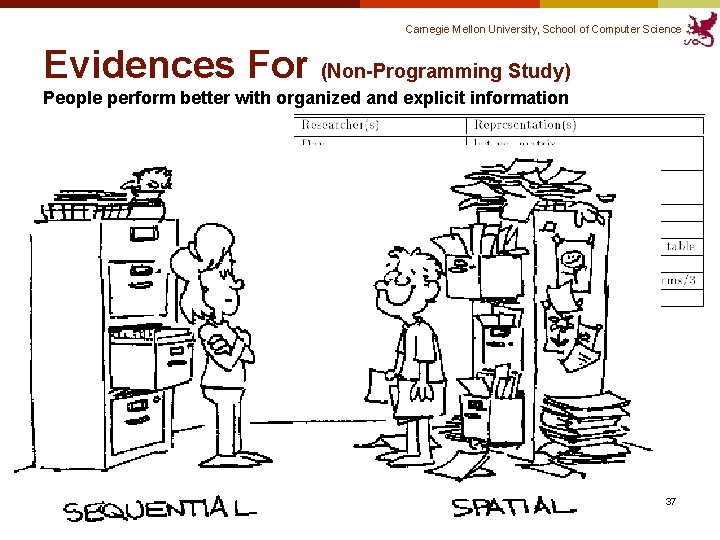
Carnegie Mellon University, School of Computer Science Evidences For (Non-Programming Study) People perform better with organized and explicit information 37
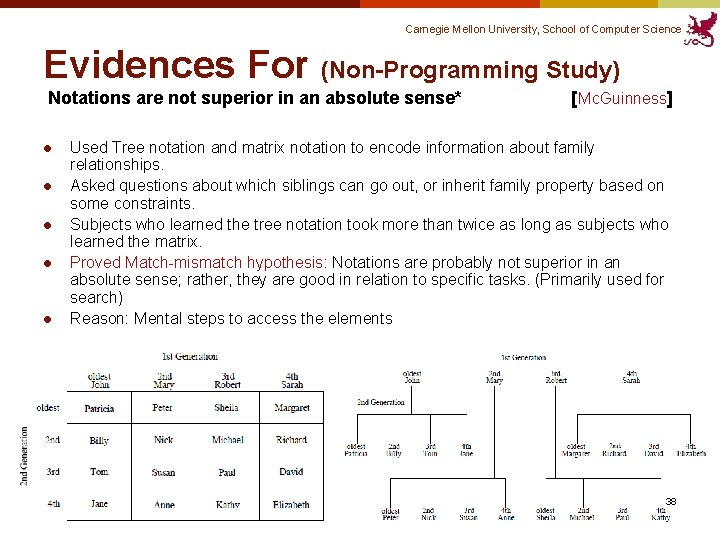
Carnegie Mellon University, School of Computer Science Evidences For (Non-Programming Study) Notations are not superior in an absolute sense* l l l [ Mc. Guinness] Used Tree notation and matrix notation to encode information about family relationships. Asked questions about which siblings can go out, or inherit family property based on some constraints. Subjects who learned the tree notation took more than twice as long as subjects who learned the matrix. Proved Match-mismatch hypothesis: Notations are probably not superior in an absolute sense; rather, they are good in relation to specific tasks. (Primarily used for search) Reason: Mental steps to access the elements 38
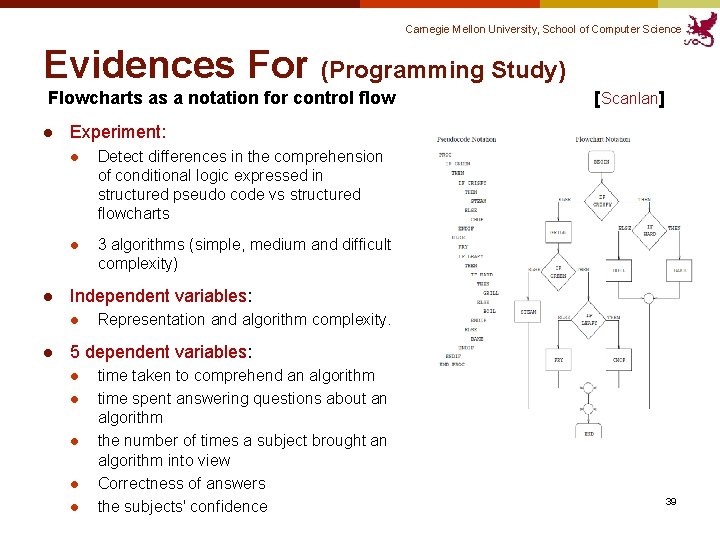
Carnegie Mellon University, School of Computer Science Evidences For (Programming Study) Flowcharts as a notation for control flow l l Experiment: l Detect differences in the comprehension of conditional logic expressed in structured pseudo code vs structured flowcharts l 3 algorithms (simple, medium and difficult complexity) Independent variables: l l [ Scanlan] Representation and algorithm complexity. 5 dependent variables: l l l time taken to comprehend an algorithm time spent answering questions about an algorithm the number of times a subject brought an algorithm into view Correctness of answers the subjects' confidence 39
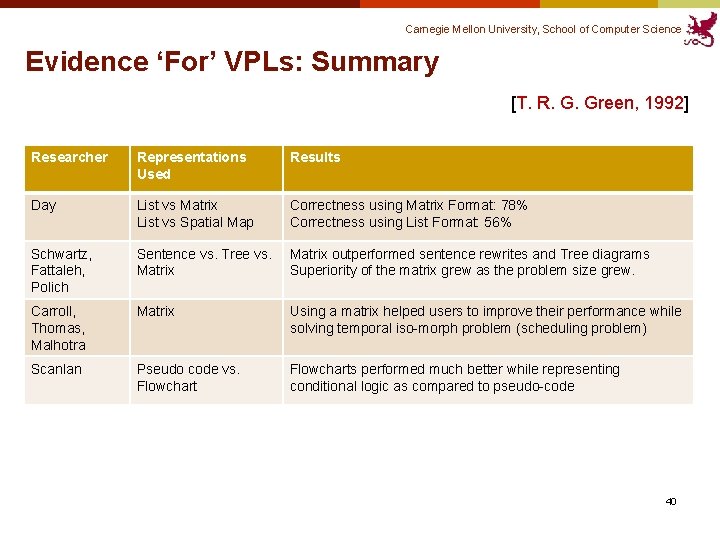
Carnegie Mellon University, School of Computer Science Evidence ‘For’ VPLs: Summary [T. R. G. Green, 1992] Researcher Representations Used Results Day List vs Matrix List vs Spatial Map Correctness using Matrix Format: 78% Correctness using List Format: 56% Schwartz, Fattaleh, Polich Sentence vs. Tree vs. Matrix outperformed sentence rewrites and Tree diagrams Superiority of the matrix grew as the problem size grew. Carroll, Thomas, Malhotra Matrix Using a matrix helped users to improve their performance while solving temporal iso-morph problem (scheduling problem) Scanlan Pseudo code vs. Flowcharts performed much better while representing conditional logic as compared to pseudo-code 40
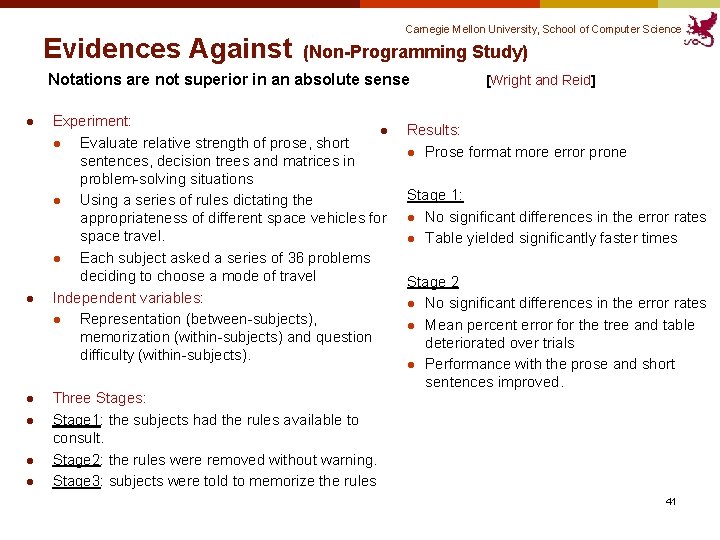
Evidences Against Carnegie Mellon University, School of Computer Science (Non-Programming Study) Notations are not superior in an absolute sense l l l Experiment: l l Evaluate relative strength of prose, short sentences, decision trees and matrices in problem-solving situations l Using a series of rules dictating the appropriateness of different space vehicles for space travel. l Each subject asked a series of 36 problems deciding to choose a mode of travel Independent variables: l Representation (between-subjects), memorization (within-subjects) and question difficulty (within-subjects). Three Stages: Stage 1: the subjects had the rules available to consult. Stage 2: the rules were removed without warning. Stage 3: subjects were told to memorize the rules [Wright and Reid] Results: l Prose format more error prone Stage 1: l No significant differences in the error rates l Table yielded significantly faster times Stage 2 l No significant differences in the error rates l Mean percent error for the tree and table deteriorated over trials l Performance with the prose and short sentences improved. 41
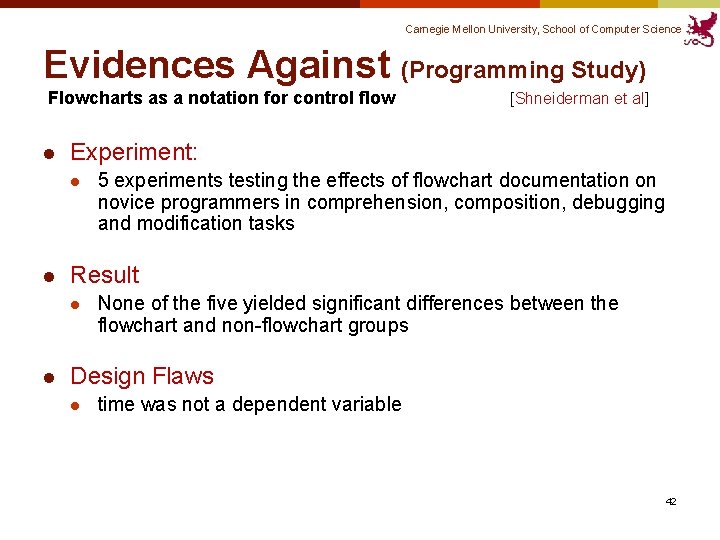
Carnegie Mellon University, School of Computer Science Evidences Against (Programming Study) Flowcharts as a notation for control flow l Experiment: l l 5 experiments testing the effects of flowchart documentation on novice programmers in comprehension, composition, debugging and modification tasks Result l l [Shneiderman et al] None of the five yielded significant differences between the flowchart and non-flowchart groups Design Flaws l time was not a dependent variable 42
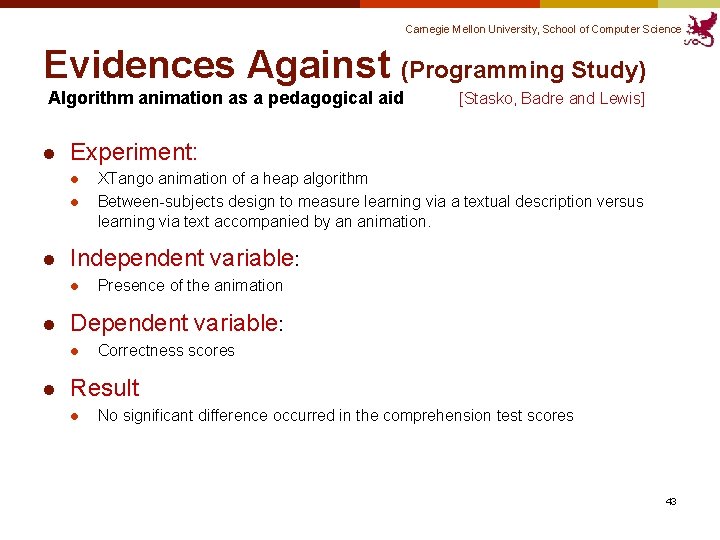
Carnegie Mellon University, School of Computer Science Evidences Against (Programming Study) Algorithm animation as a pedagogical aid l Experiment: l l l Presence of the animation Dependent variable: l l XTango animation of a heap algorithm Between-subjects design to measure learning via a textual description versus learning via text accompanied by an animation. Independent variable: l l [Stasko, Badre and Lewis] Correctness scores Result l No significant difference occurred in the comprehension test scores 43
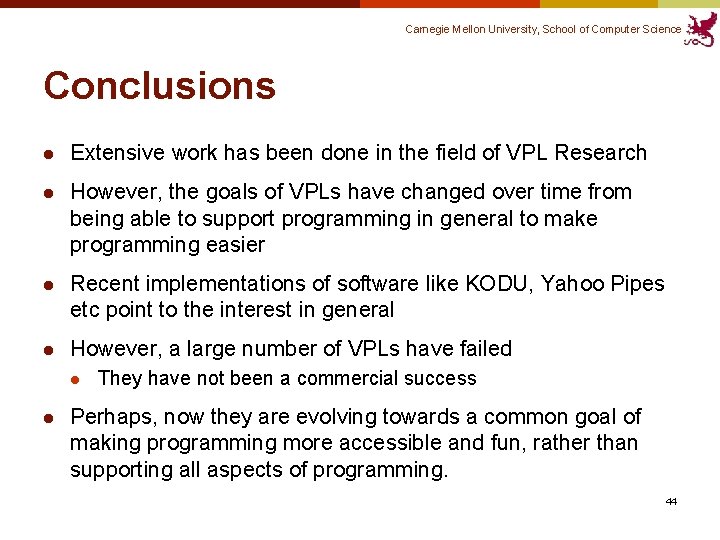
Carnegie Mellon University, School of Computer Science Conclusions l Extensive work has been done in the field of VPL Research l However, the goals of VPLs have changed over time from being able to support programming in general to make programming easier l Recent implementations of software like KODU, Yahoo Pipes etc point to the interest in general l However, a large number of VPLs have failed l l They have not been a commercial success Perhaps, now they are evolving towards a common goal of making programming more accessible and fun, rather than supporting all aspects of programming. 44
Carnegie Mellon University, School of Computer Science References 1. 2. 3. 4. 5. 6. 7. 8. 9. 10. Brad A. Myers. "Taxonomies of Visual Programming and Program Visualization, " Journal of Visual Languages and Computing. vol. 1, no. 1. March, 1990. pp. 97 -123. Margaret M. Burnett, “Visual Programming” In the Encyclopedia of Electrical and Electronics Engineering (John G. Webster, ed. ), 1999 Fred Lakin, John Wambaugh, Larry J. Leifer, Dave Cannon, Cecilia Sivard: The electronic design notebook: performing medium and processing medium. The Visual Computer 5(4): 214 -226 (1989) Eric J. Golin, Robert V. Rubin, James Walker II: The Visual Programmers Workbench. IFIP Congress 1989: 143 -148 Myers, B. A. , Smith, D. C. , and Horn, B. “Report of the `End-User Programming' Working Group, ” in Languages for Developing User Interfaces. 1992. Boston, MA: Jones and Bartlett. pp. 343 -366. Sapir, E. (1929): 'The Status of Linguistics as a Science'. In E. Sapir (1958): Culture, Language and Personality (ed. D. G. Mandelbaum). Berkeley, CA: University of California Press Christopher D. Wickens, “Engineering Psychology and Human Performance”, 3 rd Edition J. H. Larkin and H. A. Simon. Why a diagram is (sometimes) worth ten thousand words. Cognitive Science, 11: 65 -99, 1987. Temple Grandin: The world needs all kinds of minds http: //www. ted. com/talks/temple_grandin_the_world_needs_all_kinds_of_minds. html Kirsten N. Whitley. (1997). Visual Programming Languages and the Empirical Evidence For and Against. J. Vis. Lang. Comput. 8(1): 109 -142. 45
Carnegie Mellon University, School of Computer Science References 11. 12. 13. 14. 15. 16. T. R. G. Green, M. Petre. When Visual Programs are Harder to Read than Textual Programs. In Human-Computer Interaction: Tasks and Organisation, Proceedings ECCE-6 (6 th European Conference Cognitive Ergonomics) (1992). Thomas R. G. Green, Marian Petre: Usability Analysis of Visual Programming Environments: A 'Cognitive Dimensions' Framework. J. Vis. Lang. Comput. 7(2): 131 -174 (1996) Jonathan Edwards. 2007. No ifs, ands, or buts: uncovering the simplicity of conditionals. In Proceedings of the 22 nd annual ACM SIGPLAN conference on Object-oriented programming systems and applications (OOPSLA '07). ACM, New York, NY, USA, 639 -658. Avraham Leff and James T. Rayfield. 2007. Webrb: evaluating a visual domain-specific language for building relational web-applications. In Proceedings of the 22 nd annual ACM SIGPLAN conference on Object-oriented programming systems and applications (OOPSLA '07). ACM, New York, NY, USA, 281 -300. Seung Chan Slim Lim and Peter Lucas. 2006. JDA: a step towards large-scale reuse on the web. In Companion to the 21 st ACM SIGPLAN symposium on Object-oriented programming systems, languages, and applications (OOPSLA '06). ACM, New York, NY, USA, 586 -601. Daniel D Hils, "Visual Languages and Computing Survey: Data Flow Visual Programming Languages", Journal of Visual Languages and Computing (1992) 3, 69 -101 46
Carnegie Mellon University, School of Computer Science Other Links 17. 18. 19. 20. 21. 22. 23. 24. 25. 26. Temple Grandin: The world needs all kinds of minds http: //www. ted. com/talks/temple_grandin_the_world_needs_all_kinds_of_minds. html Simulating Graphs as Physical Systems, A. Frick, G. Sander and K. Wang in Dr. Dobbs Journal, August 1999 R. Davidson and D. Harel. Drawing Graphs Nicely Using Simulated Annealing. ACM Transactions on Graphics, 15(4): 301 -331, October 1996. Agent Sheet http: //www. agentsheets. com BPMN www. bpmn. org Clarity http: //www. clarity-support. com/ KODU VIDEO http: //research. microsoft. com/apps/video/default. aspx? id=138732 Lab. View http: //www. ni. com/labview Toon Talk http: //www. toontalk. com VIPR http: //www. cs. colorado. edu/department/publications/reports/docs/CU-CS-768 -95. pdf Yahoo Pipes http: //pipes. yahoo. com 47