
Visual Plate Waste Analysis of Residents Living in
- Slides: 1
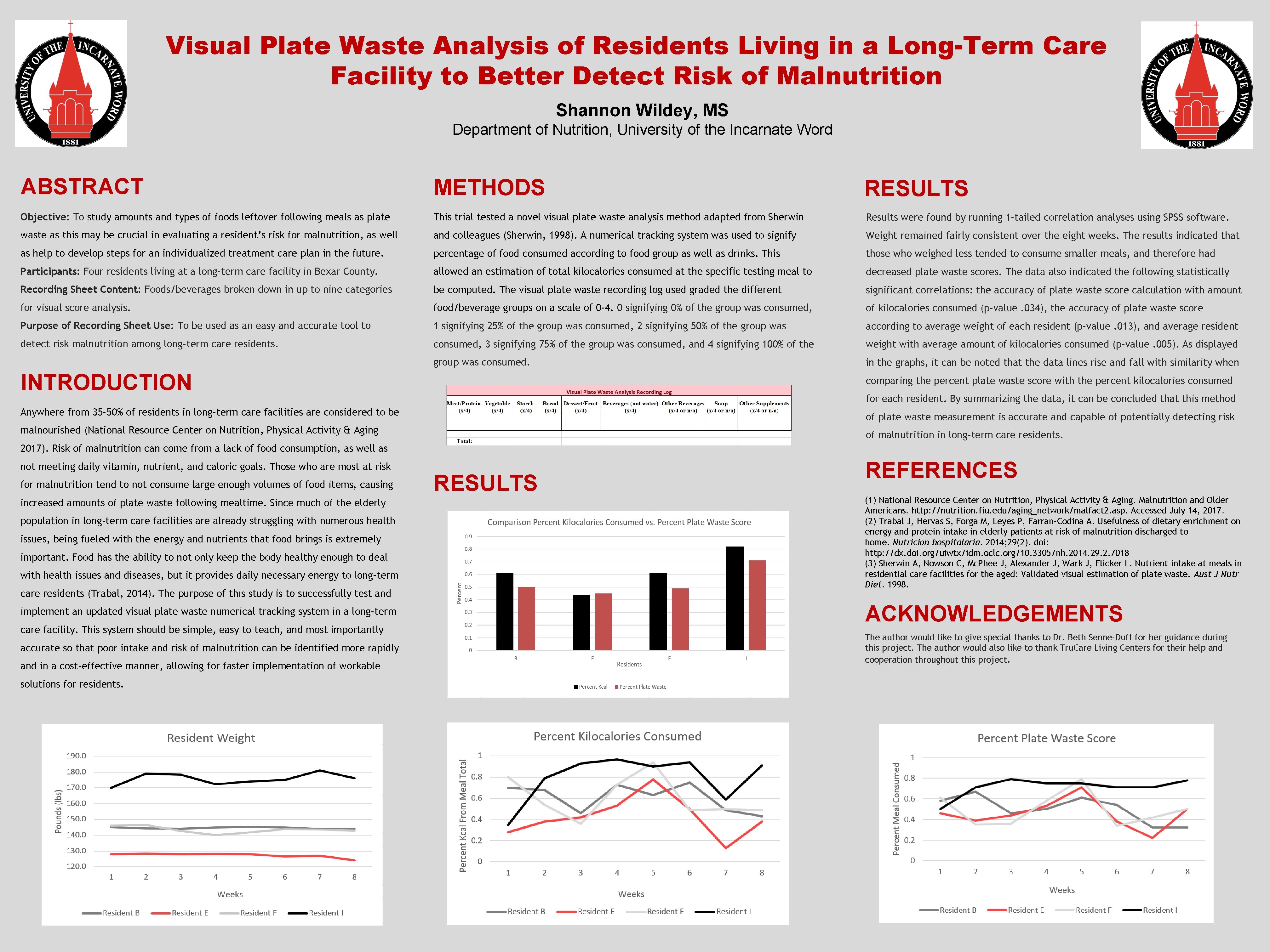
Visual Plate Waste Analysis of Residents Living in a Long-Term Care Facility to Better Detect Risk of Malnutrition Shannon Wildey, MS Department of Nutrition, University of the Incarnate Word ABSTRACT METHODS RESULTS Objective: To study amounts and types of foods leftover following meals as plate This trial tested a novel visual plate waste analysis method adapted from Sherwin Results were found by running 1 -tailed correlation analyses using SPSS software. waste as this may be crucial in evaluating a resident’s risk for malnutrition, as well and colleagues (Sherwin, 1998). A numerical tracking system was used to signify Weight remained fairly consistent over the eight weeks. The results indicated that as help to develop steps for an individualized treatment care plan in the future. percentage of food consumed according to food group as well as drinks. This those who weighed less tended to consume smaller meals, and therefore had Participants: Four residents living at a long-term care facility in Bexar County. allowed an estimation of total kilocalories consumed at the specific testing meal to decreased plate waste scores. The data also indicated the following statistically Recording Sheet Content: Foods/beverages broken down in up to nine categories be computed. The visual plate waste recording log used graded the different significant correlations: the accuracy of plate waste score calculation with amount for visual score analysis. food/beverage groups on a scale of 0 -4. 0 signifying 0% of the group was consumed, of kilocalories consumed (p-value. 034), the accuracy of plate waste score Purpose of Recording Sheet Use: To be used as an easy and accurate tool to 1 signifying 25% of the group was consumed, 2 signifying 50% of the group was according to average weight of each resident (p-value. 013), and average resident detect risk malnutrition among long-term care residents. consumed, 3 signifying 75% of the group was consumed, and 4 signifying 100% of the weight with average amount of kilocalories consumed (p-value. 005). As displayed group was consumed. in the graphs, it can be noted that the data lines rise and fall with similarity when INTRODUCTION comparing the percent plate waste score with the percent kilocalories consumed Anywhere from 35 -50% of residents in long-term care facilities are considered to be of plate waste measurement is accurate and capable of potentially detecting risk malnourished (National Resource Center on Nutrition, Physical Activity & Aging of malnutrition in long-term care residents. for each resident. By summarizing the data, it can be concluded that this method 2017). Risk of malnutrition can come from a lack of food consumption, as well as not meeting daily vitamin, nutrient, and caloric goals. Those who are most at risk for malnutrition tend to not consume large enough volumes of food items, causing increased amounts of plate waste following mealtime. Since much of the elderly population in long-term care facilities are already struggling with numerous health issues, being fueled with the energy and nutrients that food brings is extremely important. Food has the ability to not only keep the body healthy enough to deal with health issues and diseases, but it provides daily necessary energy to long-term care residents (Trabal, 2014). The purpose of this study is to successfully test and implement an updated visual plate waste numerical tracking system in a long-term care facility. This system should be simple, easy to teach, and most importantly accurate so that poor intake and risk of malnutrition can be identified more rapidly and in a cost-effective manner, allowing for faster implementation of workable solutions for residents. RESULTS REFERENCES (1) National Resource Center on Nutrition, Physical Activity & Aging. Malnutrition and Older Americans. http: //nutrition. fiu. edu/aging_network/malfact 2. asp. Accessed July 14, 2017. (2) Trabal J, Hervas S, Forga M, Leyes P, Farran-Codina A. Usefulness of dietary enrichment on energy and protein intake in elderly patients at risk of malnutrition discharged to home. Nutricion hospitalaria. 2014; 29(2). doi: http: //dx. doi. org/uiwtx/idm. oclc. org/10. 3305/nh. 2014. 29. 2. 7018 (3) Sherwin A, Nowson C, Mc. Phee J, Alexander J, Wark J, Flicker L. Nutrient intake at meals in residential care facilities for the aged: Validated visual estimation of plate waste. Aust J Nutr Diet. 1998. ACKNOWLEDGEMENTS The author would like to give special thanks to Dr. Beth Senne-Duff for her guidance during this project. The author would also like to thank Tru. Care Living Centers for their help and cooperation throughout this project.