
Visual Outcome and Stability of ClosedLoop Haptic Wide

Visual Outcome and Stability of Closed-Loop Haptic, Wide Optic, Single-Piece Foldable Acrylic IOL for Scleral Fixation Hongseok Yang, M. D. Dae Hee Kim, M. D. Department of Ophthalmology, Ajou University School of medicine, Suwon, Korea The authors have no financial interest
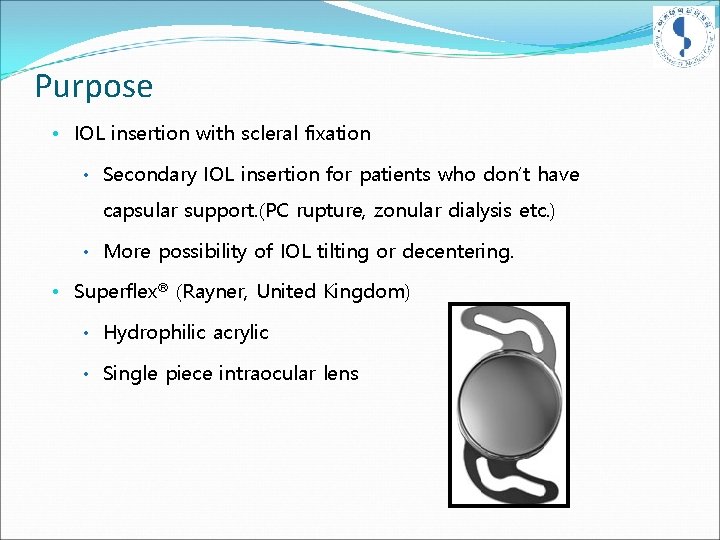
Purpose • IOL insertion with scleral fixation • Secondary IOL insertion for patients who don’t have capsular support. (PC rupture, zonular dialysis etc. ) • More possibility of IOL tilting or decentering. • Superflex® (Rayner, United Kingdom) • Hydrophilic acrylic • Single piece intraocular lens
Purpose • Superflex® (Rayner, United Kingdom) Specification • Optic : diameter - 6. 25 ㎜ overall diameter - 12. 50 ㎜ → wider optic and longer diameter expect less decentering • Haptic : closed loop style → easy to make knot for fixation • To evaluate the usefulness of single-piece, wide optic design IOL for scleral fixation
Patients and methods Patients with aphakia who underwent scleral fixation with Superflex. TM(Rayner, UK) IOL From July, 2007 to October, 2008 in Department of Ophthalmology, Ajou university School of Medicine Single surgeon Retrospective study Review of patient’s medical record
Patients and methods 21 eyes of 21 patients Evaluation of usefulness of this IOL Pre- and postoperative visual acuity (Snellen chart) Postoperative refractive error Postoperative manual keratometry All patients were evaluated more than 2 months after surgery.
Patients and methods Operation procedure 6. 0㎜ Superior, sclerocorneal incision Ab externo scleral fixation Fixation was done at 2 and 8 o’clock position sclera 1. 0㎜ away from limbus For wound closure , 2 interupted sutures with 10 -0 nylon was done Antibiotics and steroid eyedrops were used 4 times a day for 1 month after surgery
Results Demographic data Male : Female = 18 : 3 Age : 55. 43 ± 10. 83 years (25 ~ 74) Preoperative diagnosis IOL dislocation : 6 eyes (28. 6%) Lens dislocation : 5 eyes (23. 8%) Phacodonesis : 3 eyes (14. 3%) Aphkia for trauma (perforated laceration) : 3 eyes (14. 3%) Others : 4 eyes
Results Preoperative visual acuity (log. MAR) : 1. 27 ± 0. 53 (0. 50 ~ 1. 70) Postoperative best corrected visual acuity (log. MAR) : 0. 30 ± 0. 32 (0. 00 ~ 0. 90) Postoperative astigmatism (Refraction) : 1. 39 ± 1. 42 diopter ( 0. 00 ~ 5. 00 diopter) Postoperative Keratometric Astigmatism : 1. 20 ± 1. 35 diopter ( 0. 00 ~ 5. 50 diopter) Astigmatism by IOL (Total astigmatism – Postop. keratometric astigmatism)) : 0. 48 ± 0. 32 diopter ( 0. 00 ~ 1. 00 diopter)
Discussion 1~2 diopter astigmatism decreased visual acuity upto 0. 4 and 2~3 diopter did upto 0. 2 Routine 6. 0㎜ corneoscleral incision can make more than 1 diopter astigmatism Our study shows • Postoperative astigmatism average was 1. 39 diopter • Postoperative keratometiric astigmatism average was 1. 20 diopter • We calculated astigmatism average by IOL was 0. 48 diopter • There was no severe decenteration or dislocation of IOL
Discussion Postoperative astigmatism was not so severe and especially astigmatism by IOL was very small. Limitations • No method for evaluating objective IOL tilting • No control group • Retrospective study • Small number of patients
Conclusion Our results suggest closed loop, wide optic single piece foldable acrylic intraocular lens resulted in good postoperative visual acuity and less induced postoperative astigmatism in scleral fixation. This study has limitation of no accurate method to evaluate the exact position and centering of IOL. More study was demanded for final results.
- Slides: 11