
VISUAL LITERACY Introduction The importance of images and




- Slides: 19
VISUAL LITERACY
Introduction The importance of images and visual media in contemporary culture is changing what it means to be literate in the 21 st century. Today's society is highly visual, and visual imagery is no longer supplemental to other forms of information. New digital technologies have made it possible for almost anyone to create and share visual media. Yet the pervasiveness of images and visual media does not necessarily mean that individuals are able to critically view, use, and produce visual content. Individuals must develop these essential skills in order to engage capably in a visuallyoriented society. Visual literacy empowers individuals to participate fully in a visual culture. Visual Literacy Defined Visual literacy is a set of abilities that enables an individual to effectively find, interpret, evaluate, use, and create images and visual media. Visual literacy skills equip a learner to understand analyze the contextual, cultural, ethical, aesthetic, intellectual, and technical components involved in the production and use of visual materials. A visually literate individual is both a critical consumer of visual media and a competent contributor to a body of shared knowledge and culture. In an interdisciplinary, higher education environment, a visually literate individual is able to: • Determine the nature and extent of the visual materials needed • Find access needed images and visual media effectively and efficiently • Interpret and analyze the meanings of images and visual media • Evaluate images and their sources • Use images and visual media effectively • Design and create meaningful images and visual media • Understand many of the ethical, legal, social, and economic issues surrounding the creation and use of images and visual media, and access and use visual materials ethically Visual Literacy and Higher Education Across disciplines, students engage with images and visual materials throughout the course of their education. Although students are expected to understand, use, and create images in academic work, they are not always prepared to do so. Scholarly work with images requires research, interpretation, analysis, and evaluation skills specific to visual materials. These abilities cannot be taken for granted and need to be taught, supported, and integrated into the curriculum. Notably, some K-12 and higher education standards include visual literacy as one of several key literacies needed for success in contemporary society. 1 Many discussions of transliteracy, metaliteracy, and multimodal literacy also include visual literacy among the literacies important for today’s learners. A diverse body of literature on visual literacy and visual studies also exists. Yet standards outlining student learning outcomes around interdisciplinary visual literacy in higher education have not been articulated. The Visual Literacy Competency Standards for Higher Education addresses this gap in the literature and provides tools for educators seeking to pursue visual literacy with college and university students. The Visual Literacy Competency Standards for Higher Education establish an intellectual framework and structure to facilitate the development of skills and competencies required for students to engage with images in an academic environment, and critically use and produce visual media throughout their professional lives. The Standards articulate observable learning outcomes that can be taught and assessed, supporting efforts to develop measurable improvements in student visual literacy. In addition to providing tools for educators across disciplines, the Standards offer a common language for discussing student use of visual materials in academic work and beyond. Visual Literacy and Information Literacy The Visual Literacy Standards were developed in the context of the Information Literacy Competency Standards for Higher Education, and are intended to complement the Information Literacy Standards. The Visual Literacy Standards address some of the unique issues presented by visual materials. Images often function as information, but they are also aesthetic and creative objects that require additional levels of interpretation and analysis. Finding visual materials in text-based environments requires specific types of research skills. The use, sharing, and reproduction of visual materials also raise particular ethical and legal considerations. The Standards address these distinct characteristics of images and visual media and challenge students to develop a combination of abilities related to information literacy, visual communication, interpretation, and technology and digital media use. Implementation and Use of the Standards The Standards may be used as a whole, or in part, depending on curricular needs and overall learning goals of a program or institution. A visual studies course or a year-long series of courses involving visual materials may be an appropriate context for full implementation of the Standards. In other circumstances, the individual standards may be more useful as stand-alone tools for teaching and assessing specific sets of learning outcomes. Depending on the assignment or project, it is possible that two or three of the standards would be applicable and useful, but the remaining standards would not be relevant. Implementation of the Standards may also vary across disciplines, depending on how visual materials are used in that discipline. Individual disciplines may choose to articulate additional discipline-specific visual literacy learning outcomes. The Standards follow a linear structure, but it is understood that student information behavior is iterative. 2 Students may search, interpret, and evaluate simultaneously. Appropriate learning outcomes may be employed as needed, and visual literacy learning may not necessarily follow a progression from Standard 1 to Standard 7. Visual literacy education is typically a collaborative endeavor, involving faculty, librarians, curators, archivists, visual resources professionals, and learning technologists. Integrating visual literacy into the curriculum requires partnerships and shared implementation strategies across academic departments and units. Libraries play an important role in this process by selecting and providing
• • • Visual Literacy and the Classroom by Erin Riesland Although the definition of literacy remains a hotly contested topic among educators and researchers, it is hard to deny that technology is driving the debate. While reading and writing will most likely remain at the heart of standard literacy education, educators should reconsider what it means to be literate in the technological age. The New London Group, a cohort of educators and researchers interested in examining the teaching of new literacies, explains literacy this way: "one could say that its fundamental purpose is to ensure that all students benefit from learning in ways that allow them to participate fully in public, community, and economic life. " (1996) Multimedia, or new media, is changing the way society communicates in the virtual and real world. One major transition is the Microsoft Power. Point takeover of nearly every office boardroom and college lecture hall. Power. Point's saturation has created the sudden need for every office meeting or group gathering to show dynamic multimedia presentations, regardless of content. This kind of ubiquitous availability of technology crosses over to the classroom as well. More and more students are turning to Power. Point or equivalent programs for classroom presentations. These students are pushing their classmates to compete and setting classroom precedents. The speed at which technology is altering classroom communication is overwhelming. The time to address visual media literacy is now. Currently, in high schools across the country, many students are expected to present complex visual ideas using a variety of multimedia applications without serious direct instruction. Student ability to "participate fully in public, community, and economic life" is quickly being redefined through emerging technology. Anyone who has suffered through an 8 pt text-jammed Power. Point presentation can recognize the delicate balance between verbal and visual. As we move to an increasingly visually-dominated culture (Kress, 1998), where students are expected to code and decode complex messages in a variety of media, shouldn't literacy instruction include visual media as well? Redefining literacy The broad field of visual literacy is loosely defined in this paper as the ability to communicate and understand through visual means. The New London Group has included in their "Pedagogy of Multiliteracies" a definition of literacy that includes the "understanding and competent control of representational formats that are becoming increasingly significant in the overall communications environment, such as visual images and their relationship to the written word-- for instance, visual design in desktop publishing or the interface of visual and linguistic meaning in multimedia. "(1996) By educating students to understand communicate through visual modes, teachers empower their students with the necessary tools to thrive in increasingly media-varied environments. The definition of literacy is outdated and that the new definition must account for the technologically evolving landscape. For example, if students are to successfully meet the demands of new literacy, they must be able to navigate and communicate through evolving mediums such as hypermedia. Hypertext/Hypermedia Hypertext is most commonly seen and was developed in the 60 s as a way to creatively link text together. Hypermedia expands the term hypertext (where the word or media is a link that can be navigated to explore the idea behind the link further, ) to include audio-visual as well as written media. Because hypermedia is non-linear in nature and reflects a more genuine thinking style in the way each link can take the reader in many directions, hypermedia reading differs greatly from print reading. The increase in student use of online hypermedia for serious information gathering is altering the way students read and collect information, and will ultimately alter the way students write. Hypermedia writing/design challenges the student to organize compositions that give up sequential control of the text all the while struggling to integrate poignant illustrations through a variety of visual media. The audience or reader of hypermedia text is free to customize and tailor their experience according to interests and needs. Most hypermedia texts are designed for online display and therefore prompt the student to write and design specifically for an audience. Typeface size, style, color and page layout all must be considered, yet most students have no idea where to begin. What remains the cornerstone of hypertext is the reader/writer relationship where ultimately the reader takes on the role of the writer/designer. This shift is fundamentally changing the way generations to come will think about books, reading, and writing-- it cannot be ignored in the classroom much longer. Hypermedia work has been observed in the classroom with compelling results. Garthwait's (2001) experiment using a basic hypermedia design program was well received by students who were excited by the idea of implementing visual and sound elements into texts. Some students displayed high level graphics manipulation using skills they taught themselves, an indicator of high motivation. Other students began working with color to organize thoughts in a pleasing manner. The overt visual nature of creating these texts reinforces the attention visual literacy deserves. Moreover, it is the visual nature of classroom projects like these that is alluring to children. Traditionally, writers use language to convey ideas and metaphors while drawing upon images and graphs to reinforce writing. Kress has demonstrated a shift in science textbooks revealing the switch from visuals that support text explanations to text that supports visual explanations. Kress argues that graphics hold more meaning and are central to the meaning of modern texts and meaning-making systems. Hammerberg (2001) notes the increase in children's books that are interactive through sound or visual cues. These new books incorporate non-linear elements similar to hypermedia. Hammerberg argues that these visual and non-
You can watch this. • https: //www. youtube. com/watch? v=Jy. VHu. Lf 6 BZI
OOPS. Here is what I meant to show. • https: //www. youtube. com/watch? v=ipa. Nd. OK YFc. Q
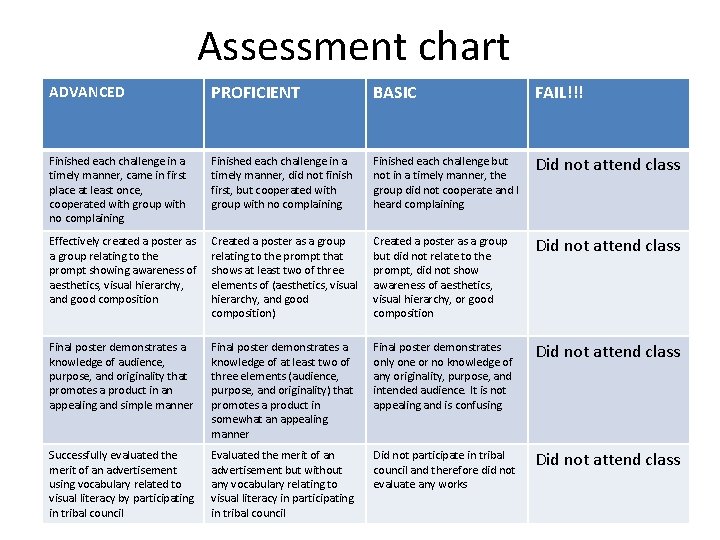
Assessment chart ADVANCED PROFICIENT BASIC FAIL!!! Finished each challenge in a timely manner, came in first place at least once, cooperated with group with no complaining Finished each challenge in a timely manner, did not finish first, but cooperated with group with no complaining Finished each challenge but not in a timely manner, the group did not cooperate and I heard complaining Did not attend class Effectively created a poster as a group relating to the prompt showing awareness of aesthetics, visual hierarchy, and good composition Created a poster as a group relating to the prompt that shows at least two of three elements of (aesthetics, visual hierarchy, and good composition) Created a poster as a group but did not relate to the prompt, did not show awareness of aesthetics, visual hierarchy, or good composition Did not attend class Final poster demonstrates a knowledge of audience, purpose, and originality that promotes a product in an appealing and simple manner Final poster demonstrates a knowledge of at least two of three elements (audience, purpose, and originality) that promotes a product in somewhat an appealing manner Final poster demonstrates only one or no knowledge of any originality, purpose, and intended audience. It is not appealing and is confusing Did not attend class Successfully evaluated the merit of an advertisement using vocabulary related to visual literacy by participating in tribal council Evaluated the merit of an advertisement but without any vocabulary relating to visual literacy in participating in tribal council Did not participate in tribal council and therefore did not evaluate any works Did not attend class
CHALLENGE #1 • • In your teams, determine how knowledgeable you are about the world of visuals and graphics. handed a single piece of paper, and some pencils as well. The piece of paper is numbered from 1 to 25. In groups, divide the piece of paper in two. Label one half Graphics, the other half Visual Literacy. Have them jot down all the ways we use visuals in our current culture on one side-and then on the other side list examples of why understanding visual language is important. They have five minutes for this activity. I will keep a time-watch online, and it will create a loud “buzz” once the time is expired. “Each team has a minute to share something, perhaps the most important thing they have put down. Go!” So take turns from group to group as they share about Graphics/and or Visual Literacy. After each team has shared, collect papers, and see who had the most total responses. The most answers responded on that sheet of paper is the winner. http: //www. online-stopwatch. com/
CHALLENGE # 2 • I will number you off 1 -3 in our groups • Go to the designated number in the other room • Complete challenge by looking at 3 posters from your area, answer questions • Afterward, turn your posters over. There are letters. Make a word out of it • Combine all three words into a poster
Rules • All three words must be depicted on the poster • No color may be used, unless I gave you some • Each member must draw their word • Your group can choose the message/product promoted in the ad • I will judge based on: Originality, group participation, is it convincing? Is it understandable? Holds a viewer’s gaze
CHALLENGE # 3 • Scavenger hunt: There are 12 questions • Each question has a clue that leads you to the answer, which is a name of a geographic region • Find that region, answer questions-report back to me • Winner gets double immunity
CHALLENGE #4 -FINAL CHALLENGE • To determine winner of SURVIVOR: MR. EUN SOO’S ISLAND!!!!! • Pick up a sheet • You have 40 minutes to create an effective ad • May use any materials • After time is up, we will present each of our ads
CRITERION • Originality: How creative is the ad? Does it make you think/look in a new way? • Effectiveness: Would you buy this product based on the ad? • Clarity: Does it get its message across clearly and would most understand it? • Means: Does it appeal to any emotion or any logic driven strategies? • Aesthetics: Ultimately, is it a good, clean, interestingly manipulated ad?
COKE JUICY FRUIT • http: //www. youtube. com/watch? feature=pla yer_embedded&v=a. MXQ 8 wq. L 8 k. M • http: //www. youtube. com/watch? feature=pla yer_embedded&v=GJ 92 qqzutc. E
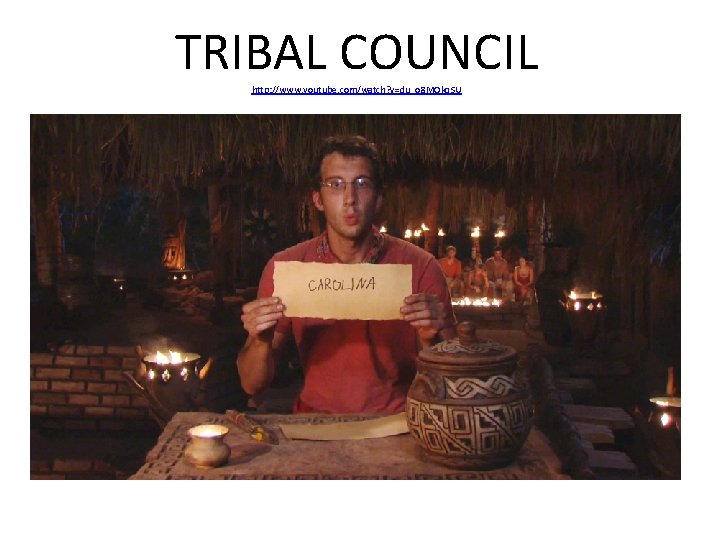
TRIBAL COUNCIL http: //www. youtube. com/watch? v=du_o 8 MOkq. SU
SURVIVOR WINNER!!!!
CONCLUSION Hand-outs Evaluation The END