
Visual Intelligence How We Create What We See
- Slides: 29
Visual Intelligence How We Create What We See Donald D. Hoffman Chapter 1 A Creative Genius for Vision
Ben
Sarah
Muneeb
We do not realize how we interpret the world Creative genius Visual virtuoso
Without exception, everything you see you construct: Color, shading, texture, motion, shape, visual objects, and entire visual scenes. For example. . .
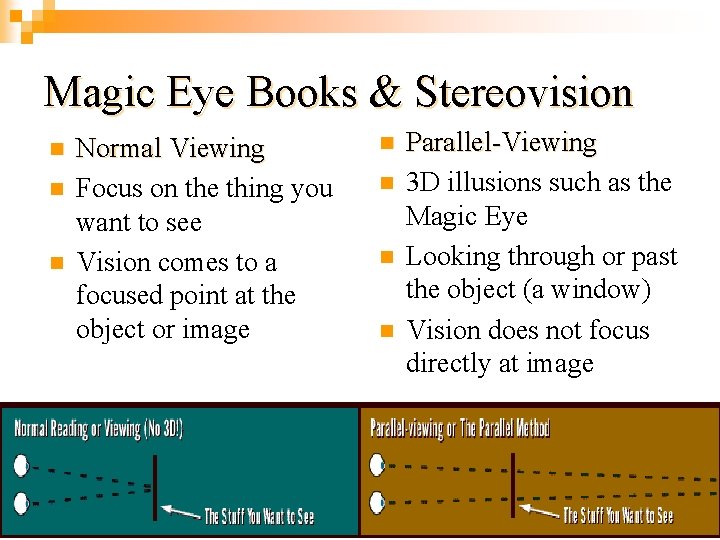
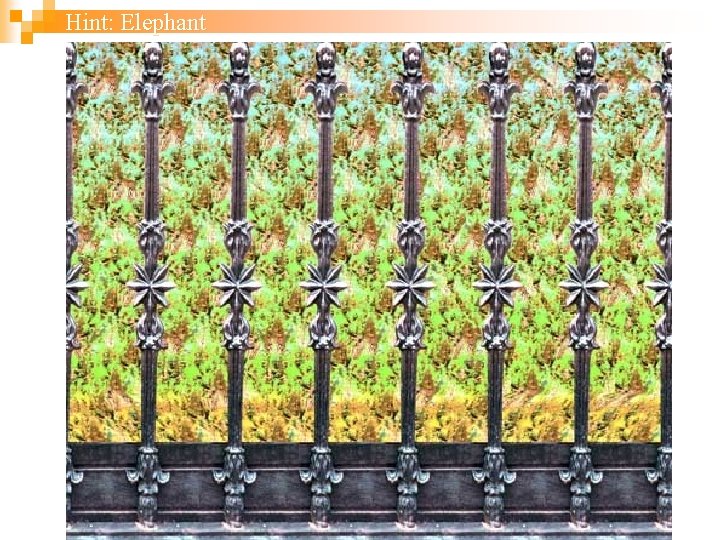
Magic Eye Books & Stereovision n Normal Viewing Focus on the thing you want to see Vision comes to a focused point at the object or image n n Parallel-Viewing 3 D illusions such as the Magic Eye Looking through or past the object (a window) Vision does not focus directly at image
Hint: Elephant
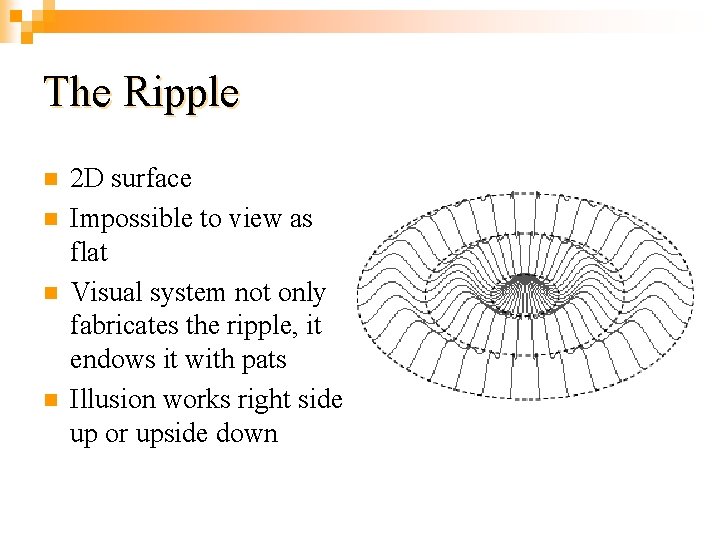
The Ripple n n 2 D surface Impossible to view as flat Visual system not only fabricates the ripple, it endows it with pats Illusion works right side up or upside down
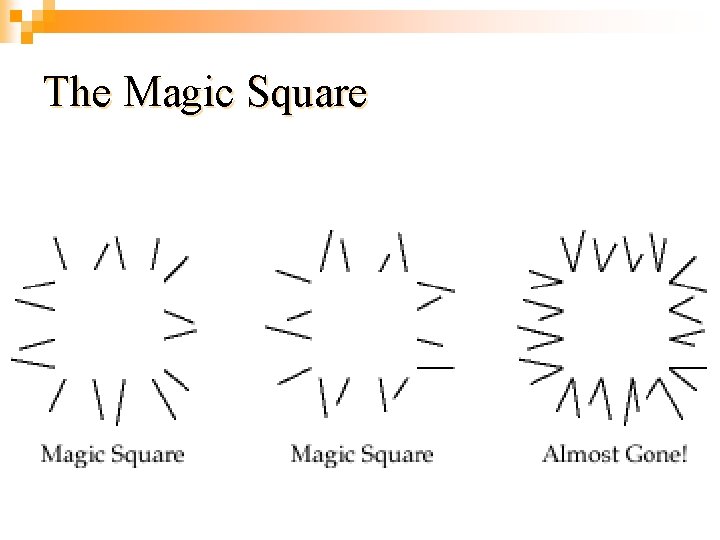
The Magic Square
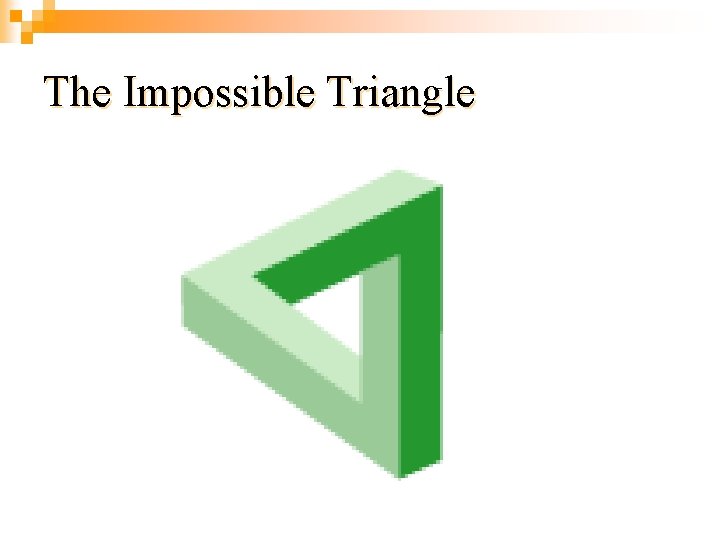
The Impossible Triangle
Wavy Lines
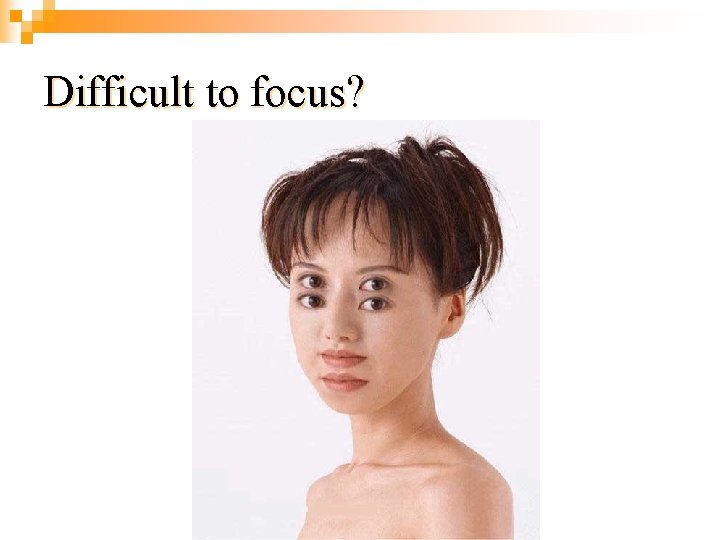
Difficult to focus?
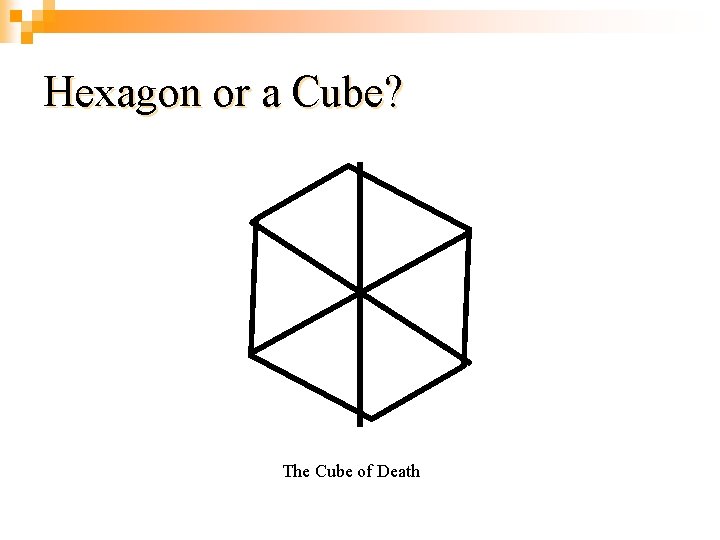
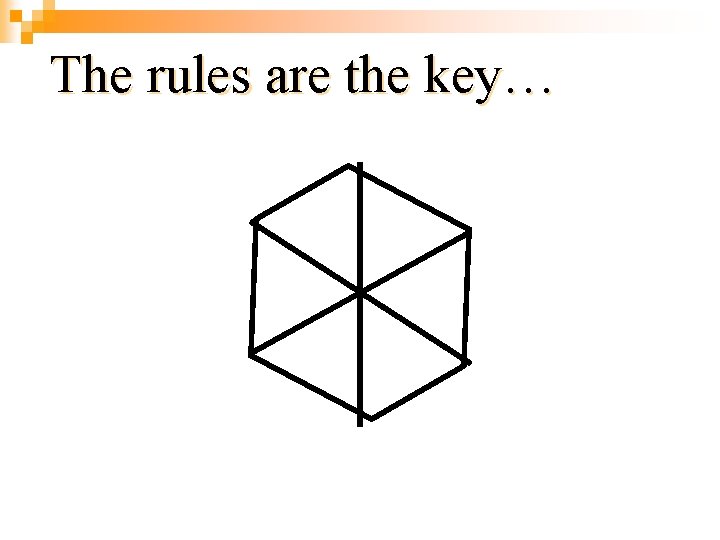
Hexagon or a Cube? The Cube of Death
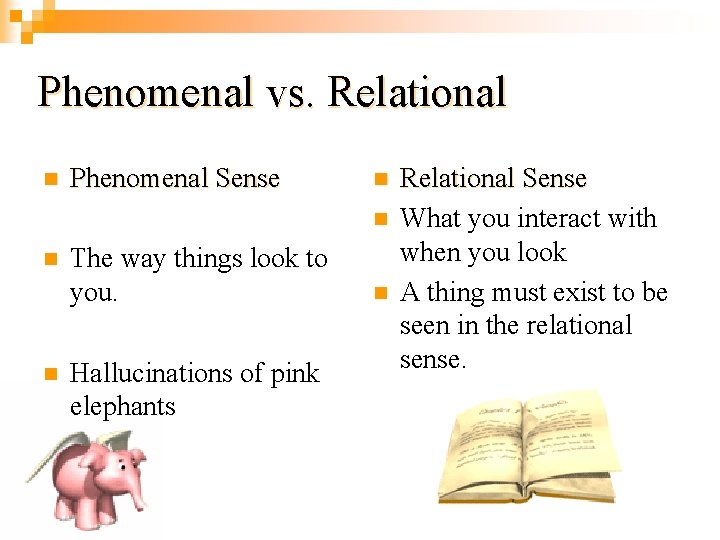
Phenomenal vs. Relational n Phenomenal Sense n n The way things look to you. Hallucinations of pink elephants n Relational Sense What you interact with when you look A thing must exist to be seen in the relational sense.
Questions: Fight Club –Is Brad Pitt Relational or Phenomenal Is it necessary to classify our vision into Relational and Phenomenal? Is there truly a difference in what we think we see and what we interact with?
The User-Friendly Icon Interface Our vision and the “icon metaphor”
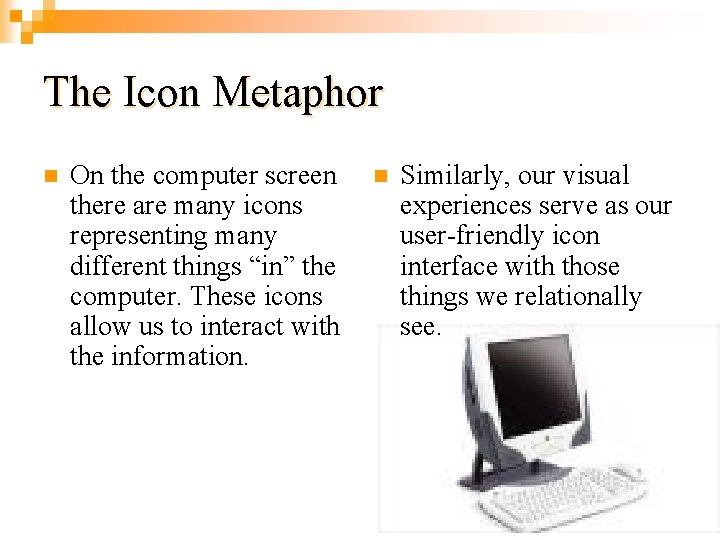
The Icon Metaphor n On the computer screen there are many icons representing many different things “in” the computer. These icons allow us to interact with the information. n Similarly, our visual experiences serve as our user-friendly icon interface with those things we relationally see.
Is the Icon Metaphor True? n Is this disk in my hand really the disk I am interacting with? n OR is it merely an icon representation of something else that I am really interacting with? n Is this something that I am interacting with, even really in this place? n OR is this just an icon representation I am using to access something in a different location of space? n Just as the icon on this computer screen allows me to interact the information of a given file.
Icon Metaphor Continuation: n Is the disk really a disk when you are not perceiving it? n Is the disk that I perceive, numerically identical to the one you perceive?
Semivision The vision of Animals Adrian Horridge n n n Gold fish have four color receptors Honeybees see ultraviolet light Flies use visual motion Day old chicks can discriminate shapes Animals’ vision serve many different purposes n Of all the species on earth and throughout time, how can we be sure our vision is the correct one?
To construct is the essence of vision. -Don Hoffman
The fundamental problem of vision: The image at the eye has countless possible interpretations…
How do all children learn to see in the same way? The Rules of Universal Vision and Visual Processing
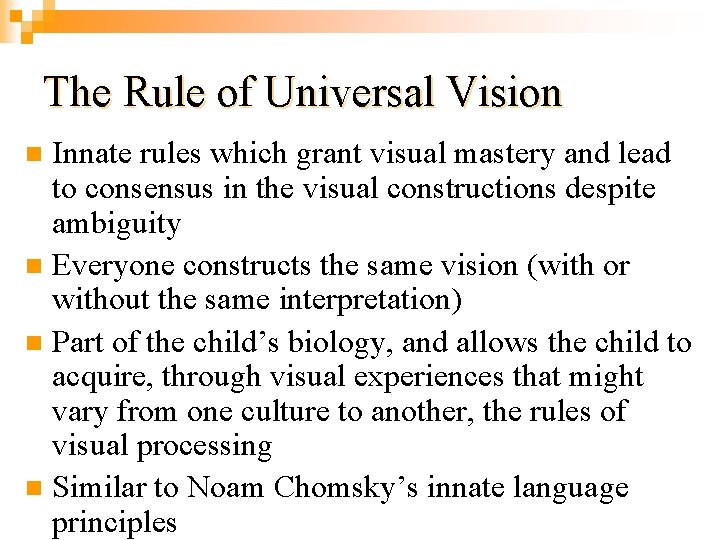
The Rule of Universal Vision Innate rules which grant visual mastery and lead to consensus in the visual constructions despite ambiguity n Everyone constructs the same vision (with or without the same interpretation) n Part of the child’s biology, and allows the child to acquire, through visual experiences that might vary from one culture to another, the rules of visual processing n Similar to Noam Chomsky’s innate language principles n
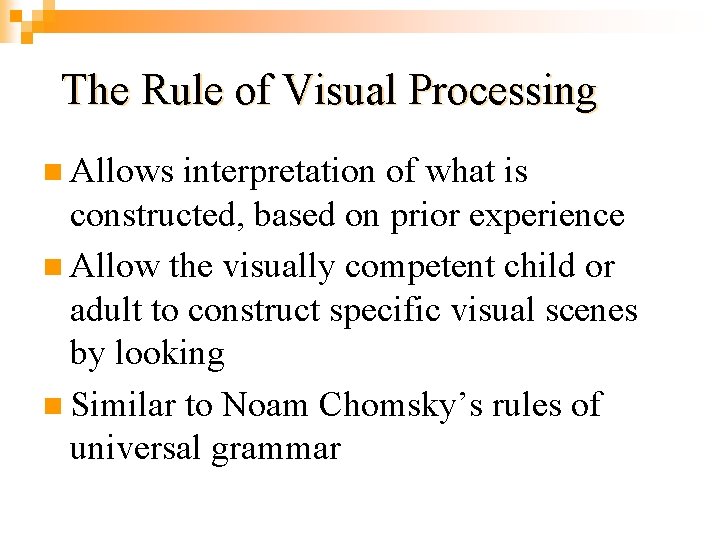
The Rule of Visual Processing n Allows interpretation of what is constructed, based on prior experience n Allow the visually competent child or adult to construct specific visual scenes by looking n Similar to Noam Chomsky’s rules of universal grammar
The rules are the key…