
Visual Impairments Presentation completed by Marjorie N Boeshansz
Visual Impairments Presentation completed by Marjorie N. Boeshansz EDSP 578
Just the Facts 4 Sources reveal that 80% of everything that a child learns is acquired through his or her visual system 4 What would happen if I took away your visual systems… 4 Time for an activity. . .
Lessons from the simulation 4 How did this activity make you feel 4 how much do you really rely on your visual systems? 4 Doesn’t this activity make you realize how important vision is to your education!
What is a Visual Impairment? A visual impairment means even after correction a child’s visual functioning significantly adversely affects his or her education.
Three types of Visual Impairments. 4 Functional Blindness- uses Braille but has vision for environmental tasks 4 Low Vision-can read with magnification or environmental modification and. . 4 Totally blind- must use hands and ears for learning; no input through vision
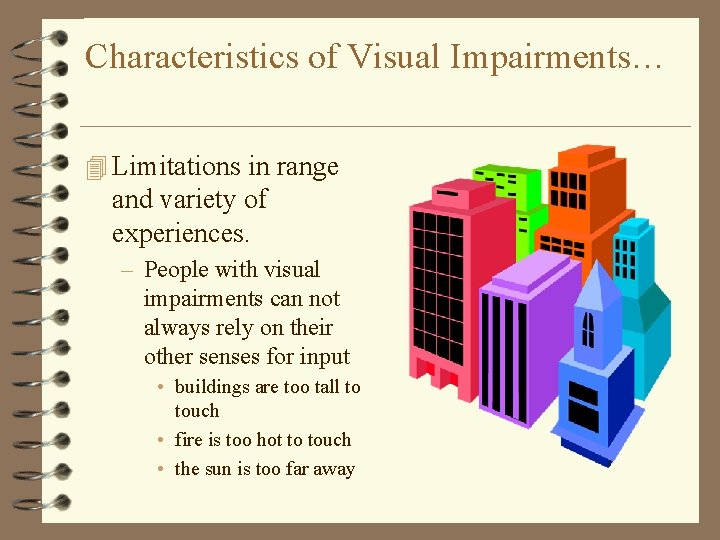
Characteristics of Visual Impairments… 4 Limitations in range and variety of experiences. – People with visual impairments can not always rely on their other senses for input • buildings are too tall to touch • fire is too hot to touch • the sun is too far away
Characteristics of Visual Impairments 4 Limitations in mobility – individuals who have impairments are limited in their movement through space • child may not be able to move through the environment properly as a result of poor distance acuity or depth perception
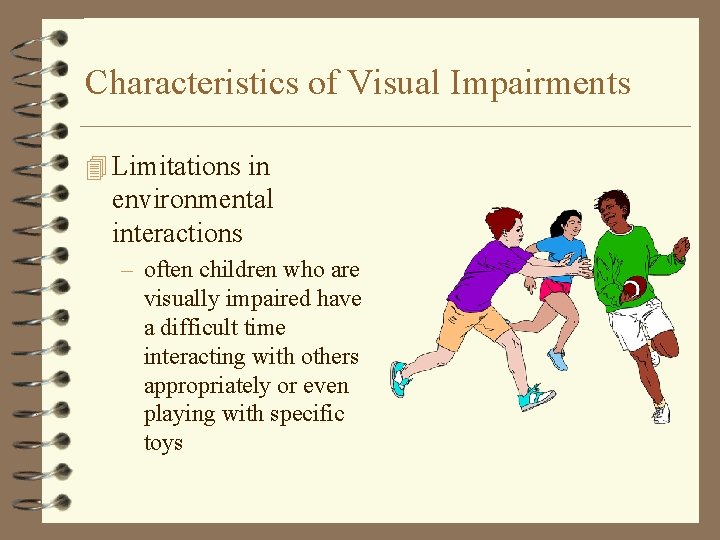
Characteristics of Visual Impairments 4 Limitations in environmental interactions – often children who are visually impaired have a difficult time interacting with others appropriately or even playing with specific toys
Another Simulation. . . 4 As a result of receiving unclear, incomplete or no visual input, a visual impairment can adversely affect object knowledge, social interactions and career development 4 to give you an idea of how difficult it is to only get information verbally, I want us to do another activity… this time we get to stretch our creative side. . .
The simulation- draw a house! 4 Draw a circle at the top 4 Inside the square toward right of your paper 4 next, in the center of the paper make a medium size triangle 4 then, at the bottom of the triangle make a medium size square the top make two small squares and have them next to each other 4 Inside the medium square and underneath the two small squares, draw a vertical rectangle 4 Now add grass to your lovely house!!!
Identifying the Causes 4 Because so many parts of the eye and Brain must work together in order for us to see well, there are three main ways for vision to be impaired. . . – Structural Impairments – Refractive Errors – Cortical Visual Impairments
Structural Impairments – Damage to one or more parts of the eye 4 Cataracts: cloudiness of the crystalline lens of the eye 4 Glaucoma: the pressure from fluid inside the eye is too high 4 Strabismus: “crossed eyes” 4 Albinism: decrease pigmentation in the eyes
Refractive Errors – Refractive errors are those that include the inability to sharply focus images 4 Nearsightedness: the inability to see objects far away 4 Farsightedness: the inability to see objects in close proximity 4 Astigmatism: a misshape of the eye
Cortical Visual Impairments – Are the result of damage to the vision center of the brain due to trauma or malformation
Do you qualify for a visual Impairment? 4 THE LAW – the law says, “that local educational agencies shall ensure that, at a minimum, test and other evaluation materials must be validated and tailored to assess specific areas of educational need for individual students with visual impairments. ” 4 A Nondiscriminatory evaluation
Types of evaluations – An IEP team may identify a child as having a visual impairment after three types of evaluations… – Functional vision evaluation – Optometrist evaluation – Orientation and mobility evaluation
Functional vision evaluations 4 Medical information- visual acuity measures, field loss information, and refractive corrections 4 Formal/ informal assessments- eye preference, color vision, observations in various situations 4 Educational and curricular implicationstypes of learning media
Optometrist evaluations 4 Diagnose eye conditions and examine the health of the eye, as well as to give prognosis of the visual field
Orientation and mobility evaluations 4 Evaluates child to determine if there are related mobility needs in home, school, or community
What happens after the evaluation 4 Specific services for the child can be identified – homebound instruction – special day services – resource room – regular classroom – 48% of children with visual impairments are served in the general education classroom!!!
Teacher interventions 4 Environmental considerations 4 Instructional considerations 4 Social skill development 4 Material considerations
Environmental Considerations 4 Seat the student close to the Board 4 Seat the student with back to the light 4 Keep supplies in the same place
Instructional Considerations 4 Read written directions aloud 4 Plan evaluations to be on tape or orally 4 Assist the student in actively developing listening skills
Social Development 4 Teach proper postures and customs 4 Teach proper mannerisms 4 Decrease habits such as head rolling or rocking back and forth
Material considerations 4 Large print books 4 concrete objects or manipulatives 4 speech computers 4 use of computers to do work 4 Optical devices- magnifiers and microscopes 4 Have a person to take notes
THE END –That’s all folks!
Sources… 4 4 4 4 www. orchlish. org/2_vis_imp/vhmanual 4. html www. viguide. com/vsninsvc. html www. empowermentzone. com/accomm. txt www. setbc. org/special/virg/p 3_01. html www. children-speical-needs. org/vision_therapy_books. html www. children-special-needs. org/parenting/learning_disabilities. html www. afb. org/info_document_veiw. asp? documentid=1737 (american foundation for the blind) wps. prenhall. com/chet_turnbull_exceptional_4/0, 8158, 953342 -navbar, 00. html www. tsbvi. edu (texas school for the blind) www. nichcy. org (national information center for children and youth) lecture notes, marta roth 2003, edsp 570 Turnbull, A. P. , Turnbull, H. R. , Shank, M & Smith J. (2002). Exceptional lives: Special education in todays schools. (3 rd Ed. ). Englewood cliffs, NJ: Prentice Hall Children with visual impairments: a parents guide M. Clay Holbrook Ph. D
- Slides: 27