
VISUAL BASIC CHAPTER ONE NOTES An Introduction to
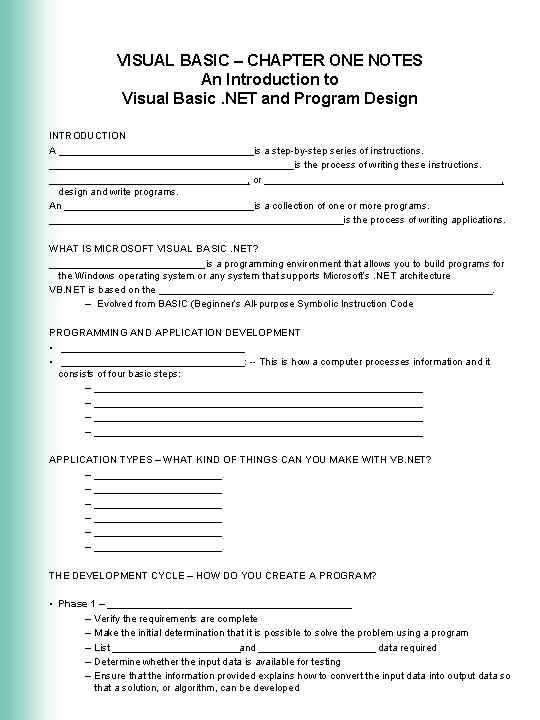
VISUAL BASIC – CHAPTER ONE NOTES An Introduction to Visual Basic. NET and Program Design INTRODUCTION A __________________ is a step-by-step series of instructions. ______________________is the process of writing these instructions. __________________, or ______________________, design and write programs. An _________________ is a collection of one or more programs. ___________________________is the process of writing applications. WHAT IS MICROSOFT VISUAL BASIC. NET? ______________ is a programming environment that allows you to build programs for the Windows operating system or any system that supports Microsoft’s. NET architecture VB. NET is based on the ______________________________. – Evolved from BASIC (Beginner’s All-purpose Symbolic Instruction Code PROGRAMMING AND APPLICATION DEVELOPMENT • _________________________________: -- This is how a computer processes information and it consists of four basic steps: – ___________________________________________________________ APPLICATION TYPES – WHAT KIND OF THINGS CAN YOU MAKE WITH VB. NET? – _______________________ – _______________________ THE DEVELOPMENT CYCLE – HOW DO YOU CREATE A PROGRAM? • Phase 1 – ______________________ – Verify the requirements are complete – Make the initial determination that it is possible to solve the problem using a program – List ____________and ___________ data required – Determine whether the input data is available for testing – Ensure that the information provided explains how to convert the input data into output data so that a solution, or algorithm, can be developed

VISUAL BASIC – CHAPTER ONE NOTES An Introduction to Visual Basic. NET and Program Design • Phase 2 – ___________________ – Develop a logical model that illustrates the sequence of steps you will take to solve the problem – _____________ are smaller pieces of a program – _____________ – illustrates the attributes and methods of an object • ___________ -- values that determine, for example, the appearance of an object. • ___________ -- instructions the object uses to generate output or perform actions. – ______________ graphically represent the logic used to develop an algorithm – _______________, included in flowcharts, allow the programmer to specify the code that will execute only if a condition is met – _______________ expresses the step-by-step instructions using keywords and depicts logical groupings or structures using indentation • Phase 3 – ___________________ – Validate, or check, the program design – Step through the solution with test data – Compare the program design with the original requirements • Phase 4 – ___________________ – Write the code that translates the design into a program – Create the user interface – Create comments, or notes, within the code that explains the purpose of the code – Test the code as it is written – THIS IS WHERE IT GETS FUN! You tried to write a program … does it work? Does it do what you wanted it to do? Is it user-friendly? Phase 5 – ___________________ – Test plan • Test cases – Make sure to set boundary values Phase 6 – ___________________ – Includes the requirements documents, program design documents, user interface documents, and documentation of the code – Code should be archived electronically OBJECT-ORIENTED PROGRAMMING AND OBJECT-ORIENTED DESIGN – _____________________________ • Data and the code that operates on the data are packaged into a single unit called an object – _____________________________ • Represents the logical plan of a program as a set of interactions among objects and operations
VISUAL BASIC – CHAPTER ONE NOTES An Introduction to Visual Basic. NET and Program Design Flowcharting 101: SHAPE DEFINITION
- Slides: 3