
Visual Awareness 9 012 Bryan C Russell OUTLINE
Visual Awareness 9. 012 Bryan C. Russell
OUTLINE: Intro stuff • Relate to prior lectures • Give philosophical questions • Blind spots, etc.
OUTLINE: Philosophical foundations • Mind-body problem • The problem of other minds
Neuropsychology of visual awareness
Definition of vision • “The process of acquiring knowledge about environmental objects and events by extracting information from the light they emit or reflect” • What about visual awareness?
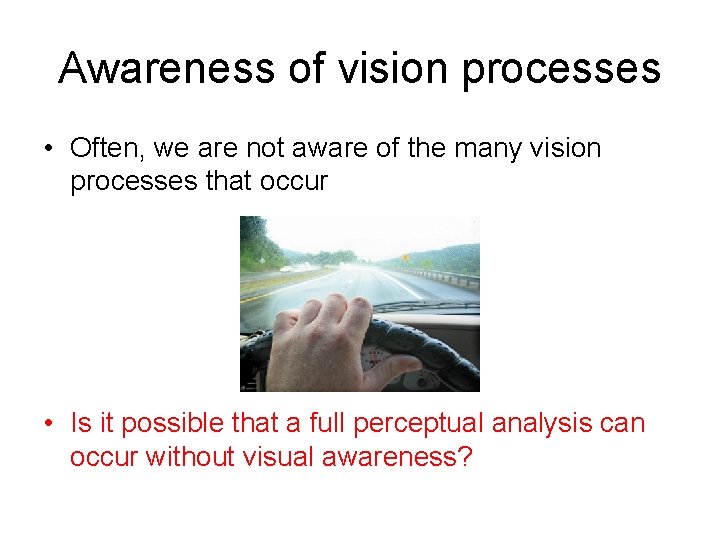
Awareness of vision processes • Often, we are not aware of the many vision processes that occur • Is it possible that a full perceptual analysis can occur without visual awareness?
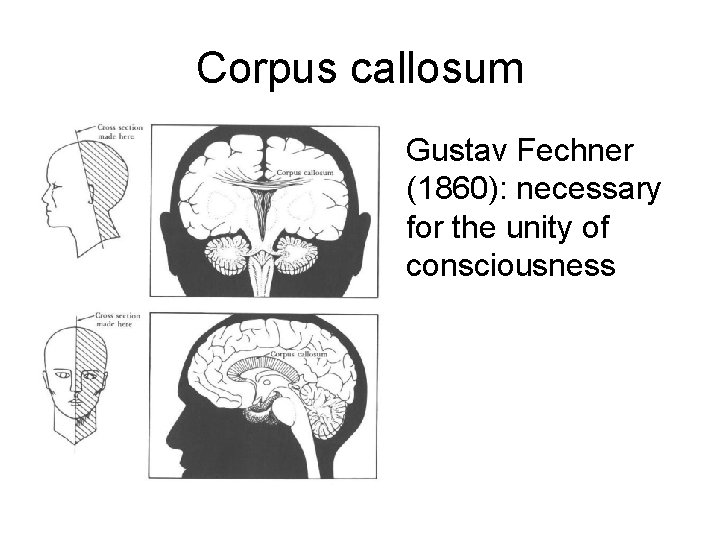
Corpus callosum • Gustav Fechner (1860): necessary for the unity of consciousness
Evil thought experiment • Suppose we could sever the corpus callosum • Would we get a person with two consciences?
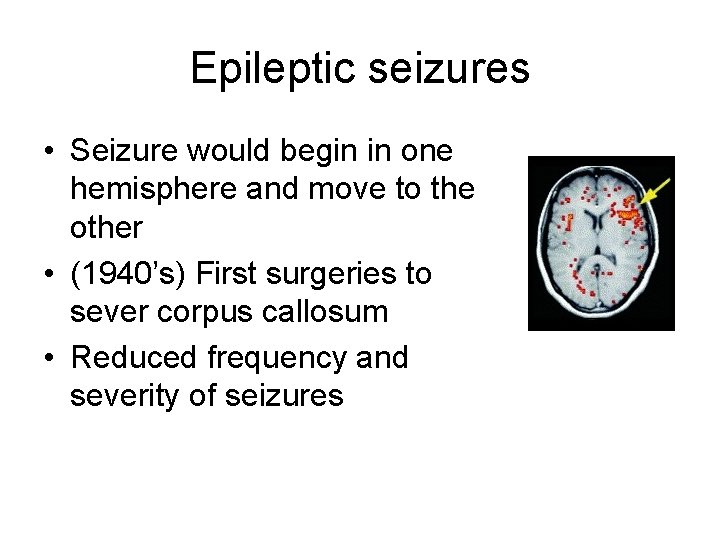
Epileptic seizures • Seizure would begin in one hemisphere and move to the other • (1940’s) First surgeries to sever corpus callosum • Reduced frequency and severity of seizures
Effect on consciousness • No immediate noticeable effect on consciousness • Karl Lashley: The function of the corpus callosum was simply to hold the two hemispheres together!
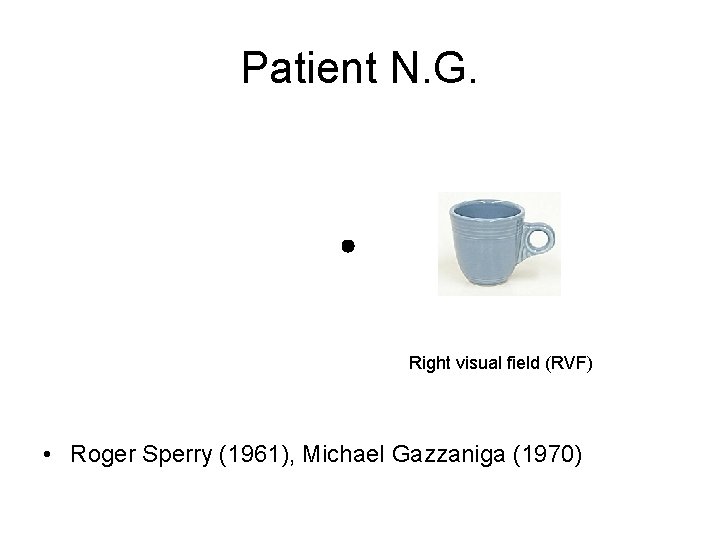
Patient N. G. Right visual field (RVF) • Roger Sperry (1961), Michael Gazzaniga (1970)
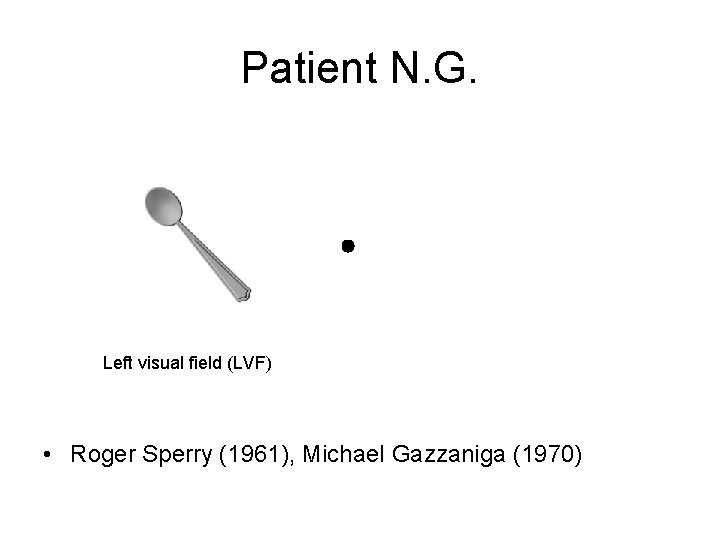
Patient N. G. Left visual field (LVF) • Roger Sperry (1961), Michael Gazzaniga (1970)
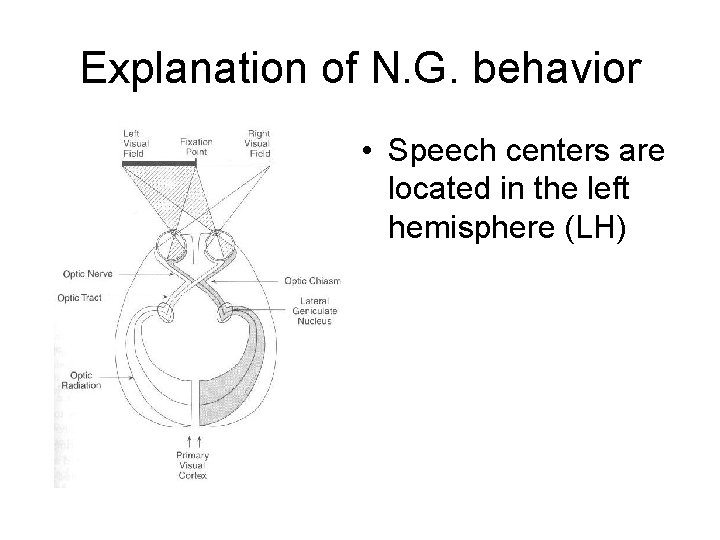
Explanation of N. G. behavior • Speech centers are located in the left hemisphere (LH)
N. G. conclusions • It seems that LH is conscious • Is RH visually aware? • Perhaps both LH and RH are visually aware of the object, but only LH can talk about it • Revisit the problem of other minds: what evidence do we need to believe that something is conscious?
Blindsight • Ability of certain patients to perform above chance on visual tasks but report that they cannot see
Patient D. B. • Had severe migraines due to enlarged blood vessels in the right visual cortex • The part of the brain containing the blood vessels was removed • Migraines stopped • What was the resulting effect on D. B. ’s vision?
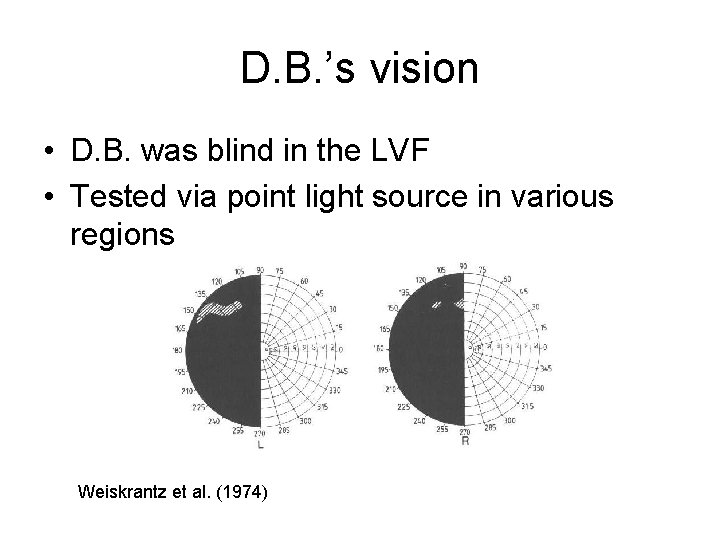
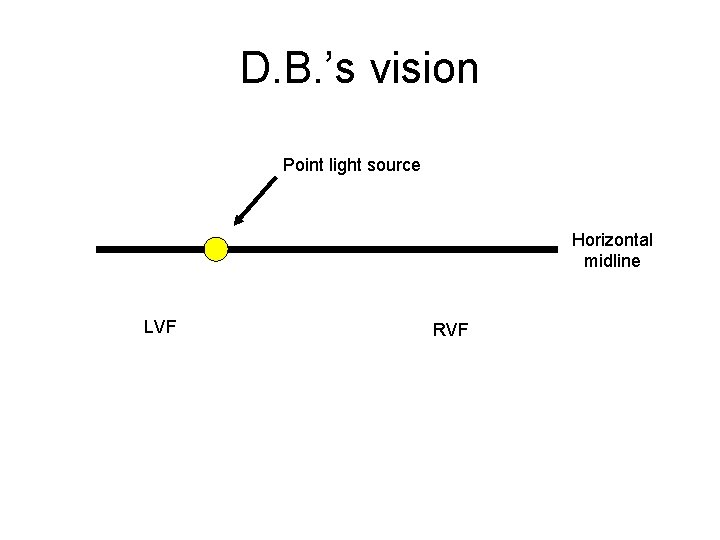
D. B. ’s vision • D. B. was blind in the LVF • Tested via point light source in various regions Weiskrantz et al. (1974)
D. B. ’s vision Point light source Horizontal midline LVF RVF
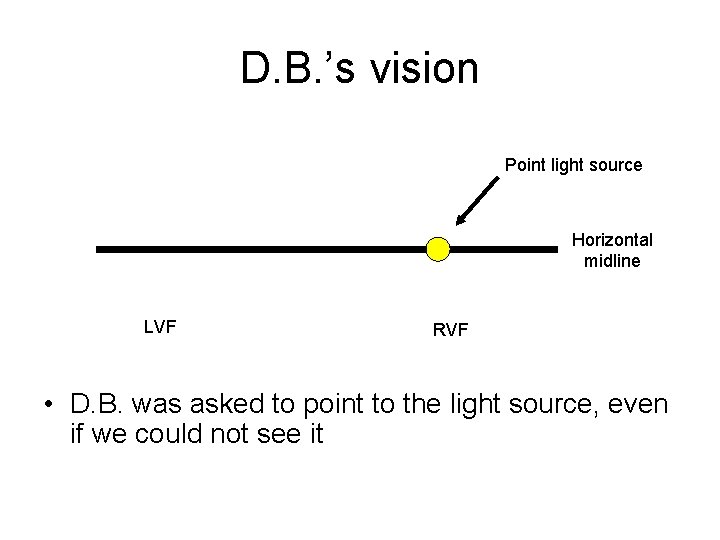
D. B. ’s vision Point light source Horizontal midline LVF RVF • D. B. was asked to point to the light source, even if we could not see it
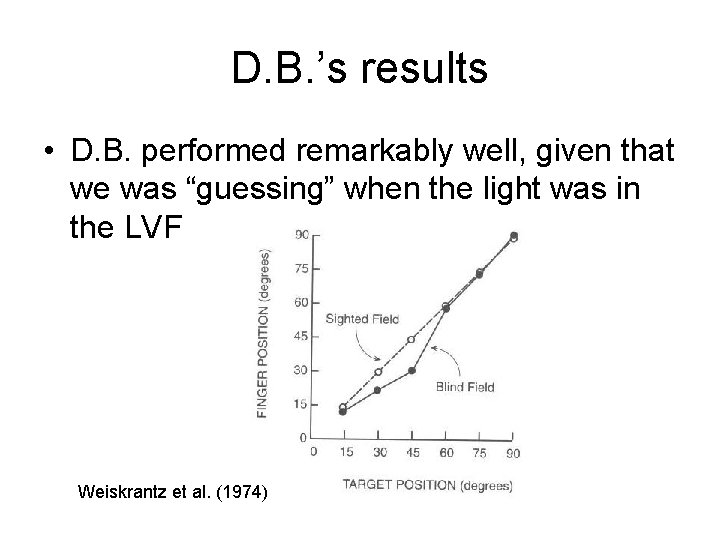
D. B. ’s results • D. B. performed remarkably well, given that we was “guessing” when the light was in the LVF Weiskrantz et al. (1974)
Other experiments • D. B. (in his LVF) could discriminate between: – “X” versus “O” – Horizontal versus vertical lines – Diagonal versus vertical lines • Performance was improved for larger and longer duration stimuli
Other experimental details • D. B. conscientiously reported when he visually saw something • Otherwise, D. B. simply guessed when prompted • How was D. B. ’s performance possible?
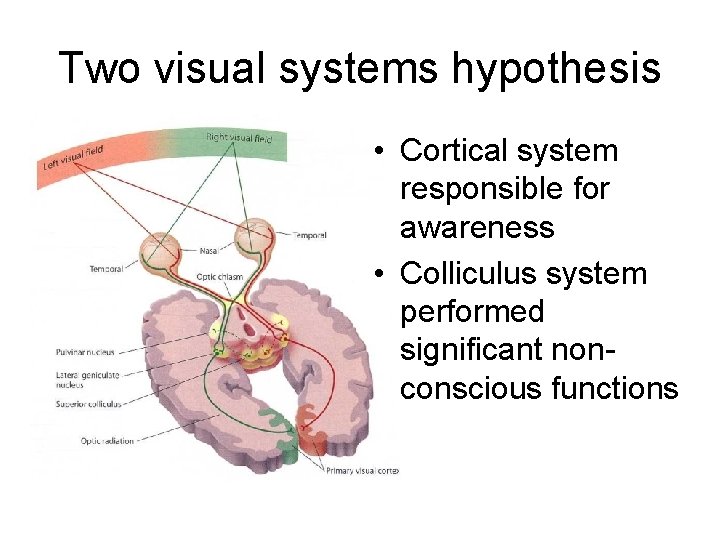
Two visual systems hypothesis • Cortical system responsible for awareness • Colliculus system performed significant nonconscious functions
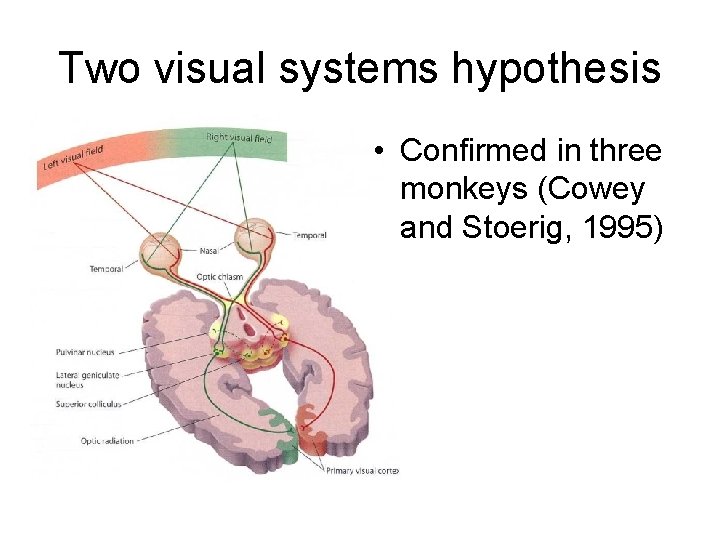
Two visual systems hypothesis • Confirmed in three monkeys (Cowey and Stoerig, 1995)
Methodological challenges • D. B. ’s eye movements were not tracked • Did not account for light scatter in the eye • Does not agree with experiences of patient C. L. T.
Patient C. L. T. • Suffered stroke in right occipital region • MRI showed extensive damage to visual cortex with islands of intact tissue • Superior colliculus unaffected because it uses a different blood stream Fendrich, Wessinger, and Gazzaniga (1992)
C. L. T experiments • Eye movement precisely tracked • Stimuli was presented to precise locations • Residual visual function throughout the retina was tested • Performed at chance for most of LVF except for small localizable areas • C. L. T. reported no visual experience in the small localizable areas
C. L. T. conclusions • Results challenge theory that unconscious superior colliculus mediates blindsight • However, does not agree with Cowley and Stoerig (1995) experiments – Perhaps monkey mechanisms different from humans (LGN projects to V 4 and MT? )
Blindsight summary • Patients can perform better than chance on discrimination tasks by “guessing” • Patients cannot “see” based on bottom-up processing of sensory information • Experimenters must provide top-down hypothesis tests; patients cannot do this • Blindsight is not helpful: patients cannot perform spontaneous intentional actions
Visual awareness in normal observers
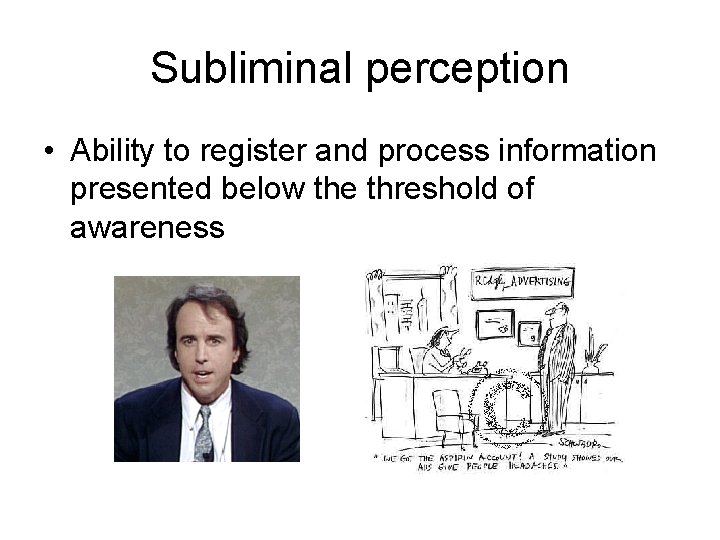
Subliminal perception • Ability to register and process information presented below the threshold of awareness
Subliminal experimentation scheme • Direct task – Subject performs detection task indicating if they see something – If subject performs at chance, then assume they are not visually aware of the stimulus • Indirect task – Subject asked to perform task that uses information from the stimulus of which the subject is not aware
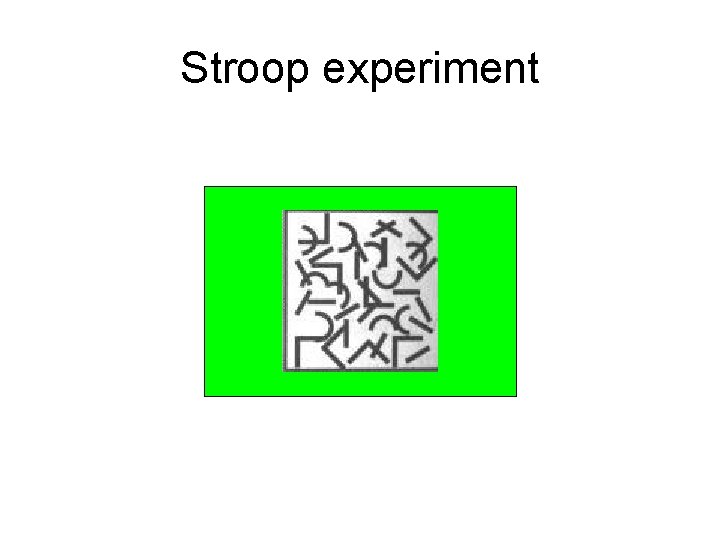
Marcel’s experiments (1983) • Used yes/no detection performance as measure of conscious experience YELLOW
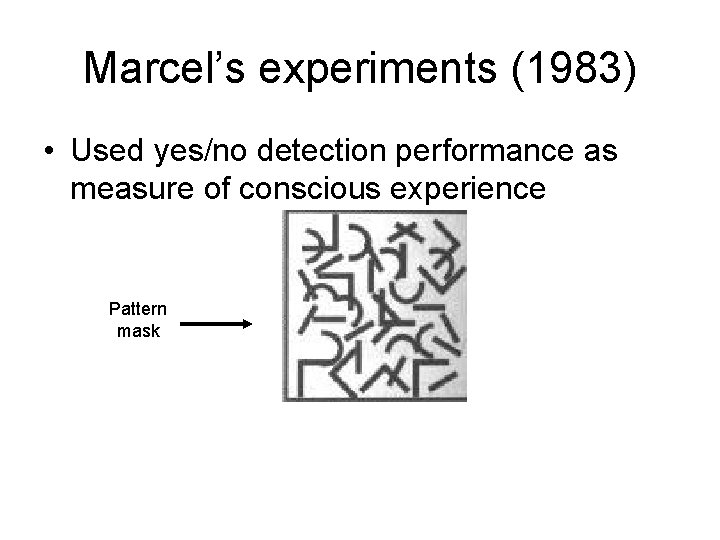
Marcel’s experiments (1983) • Used yes/no detection performance as measure of conscious experience Pattern mask YELLOW
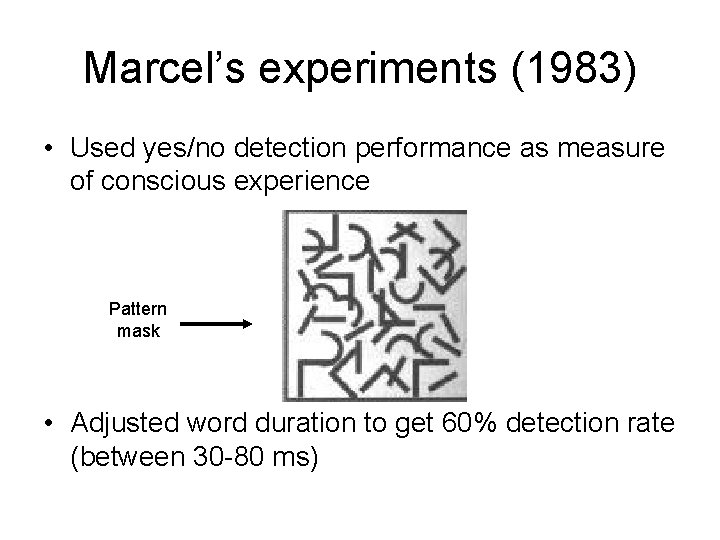
Marcel’s experiments (1983) • Used yes/no detection performance as measure of conscious experience Pattern mask YELLOW • Adjusted word duration to get 60% detection rate (between 30 -80 ms)
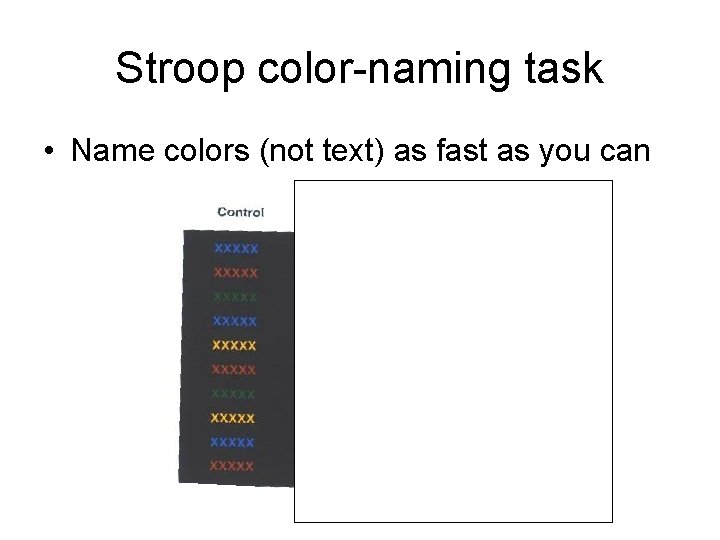
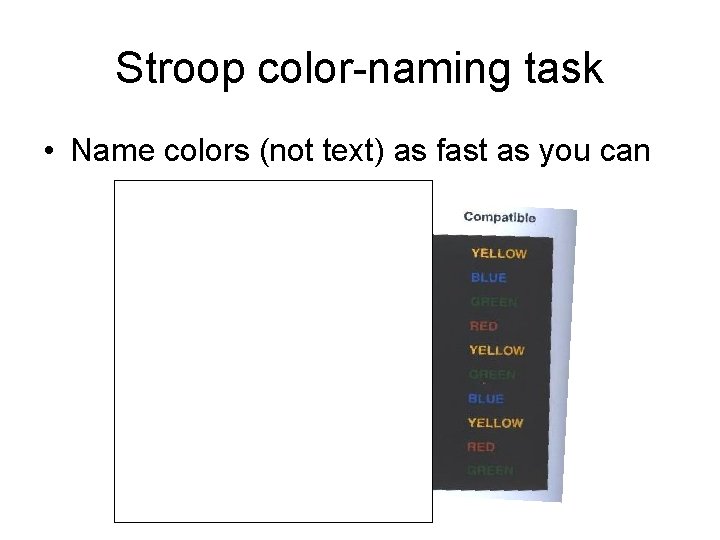
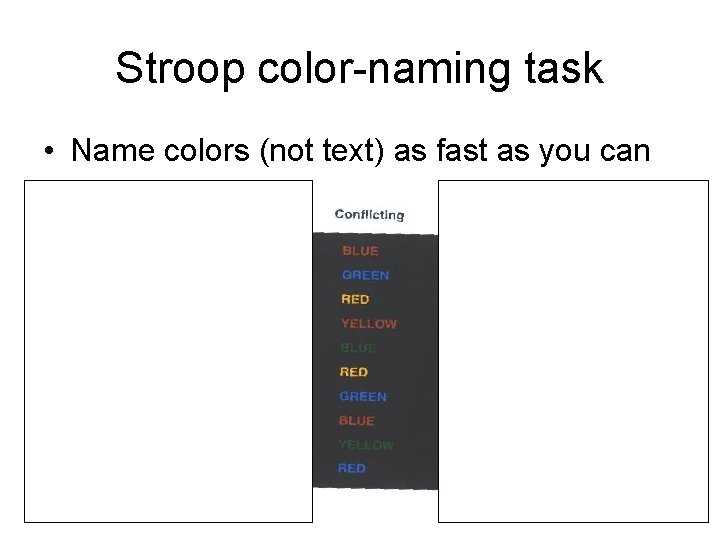
Stroop color-naming task • Name colors (not text) as fast as you can
Stroop color-naming task • Name colors (not text) as fast as you can
Stroop color-naming task • Name colors (not text) as fast as you can

Stroop experiment RED
Stroop experiment RED
Suprathreshold trial
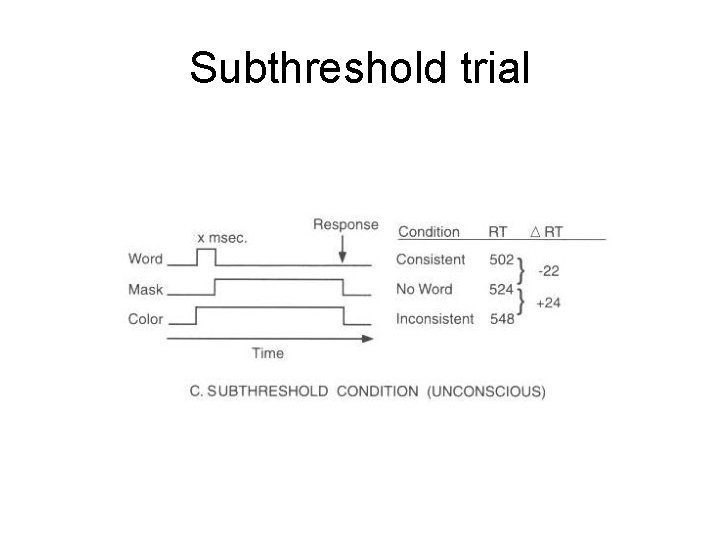
Subthreshold trial
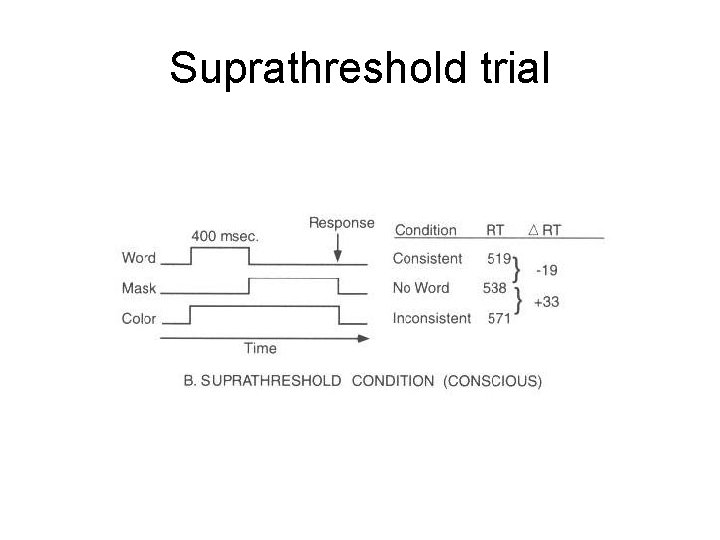
Marcel experiment conclusions • For subthreshold trial, the words were registered even though the subjects were not aware of them • Did the subjects actually not experience the words?
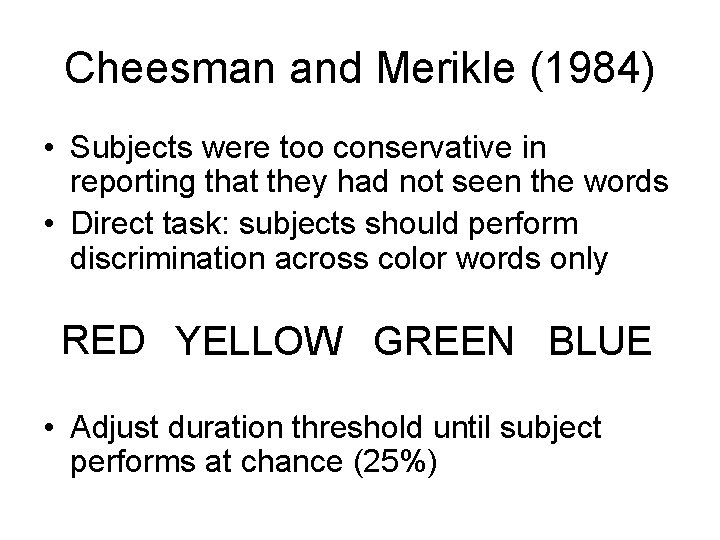
Cheesman and Merikle (1984) • Subjects were too conservative in reporting that they had not seen the words • Direct task: subjects should perform discrimination across color words only RED YELLOW GREEN BLUE • Adjust duration threshold until subject performs at chance (25%)
Cheesman and Merikle (1984) • Performed Marcel’s experiments with new threshold – No Stroop effects were found • Marcel’s threshold (Did you see anything or not? ): subjective threshold of awareness • Proposed threshold (Which of the words did you see? ): objective threshold of awareness
Discussion • Near objective threshold, subjects report that they are randomly guessing – Hence, nonconscious processing is included as awareness • Should nonconscious processing be included as awareness?
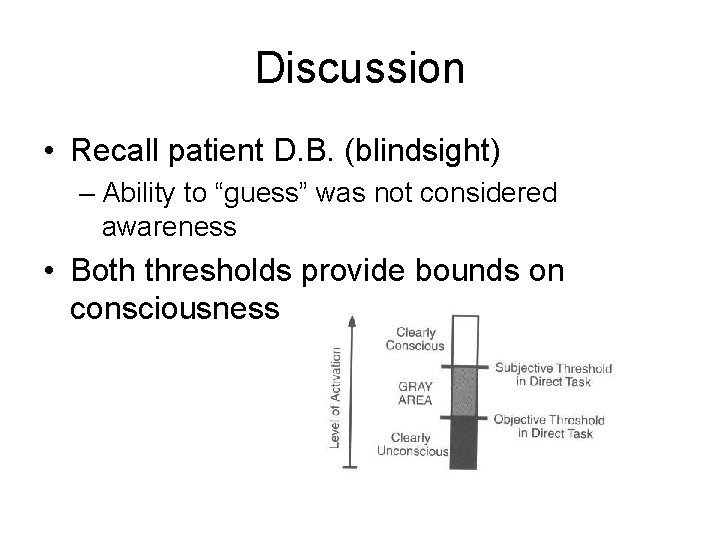
Discussion • Recall patient D. B. (blindsight) – Ability to “guess” was not considered awareness • Both thresholds provide bounds on consciousness
Ideal thresholding • Exhaustiveness: threshold should lie at the point where the contents of consciousness is exhausted – Main criticism against Marcel • Exclusiveness: threshold should lie at the point where only conscious experiences occur – Main criticism against Cheesman and Merikle
Theories of consciousness
Summary • Summarize major points
- Slides: 50