
Visual Approaches to Aid Communication Looking at visual
- Slides: 12
Visual Approaches to Aid Communication Looking at visual ways to Enhance and Facilitate Communication for Pupils with Autism… including PECS Communication in Print By Kristy Petroni
What is Communication? • Consists of exchanging messages between people • Expresses needs • Sharing thoughts, ideas and feelings • Can be verbal, non verbal or written
Autism and Communication • Difficulty in discovering the power and pleasure of social communication • Engage less in day-to-day exchanges • Slower to develop language • Don’t understand the social cues of communication • People with Autism tend to be visual learners and therefore need visual means to communicate
Visual Ways to Enhance Communication Objects, Photograph or Symbol? • Can be helpful to accompany speech and choice • Objects tend to be used in early developmental stages • Photographs used later on followed by symbols
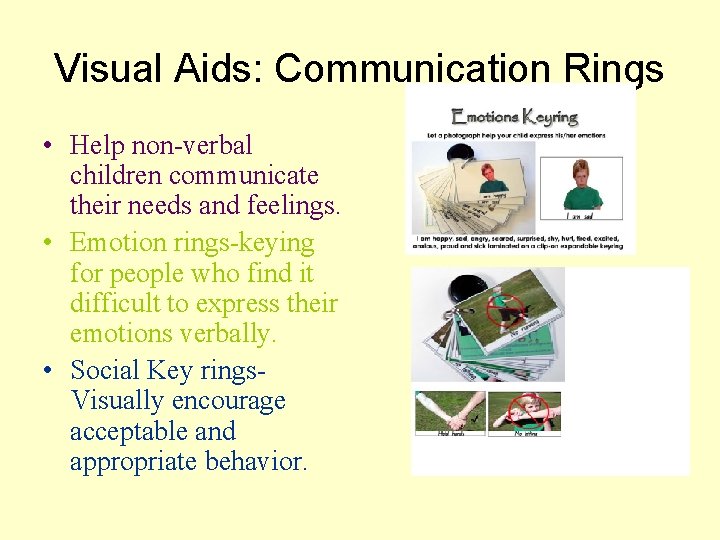
Visual Aids: Communication Rings • Help non-verbal children communicate their needs and feelings. • Emotion rings-keying for people who find it difficult to express their emotions verbally. • Social Key rings. Visually encourage acceptable and appropriate behavior.
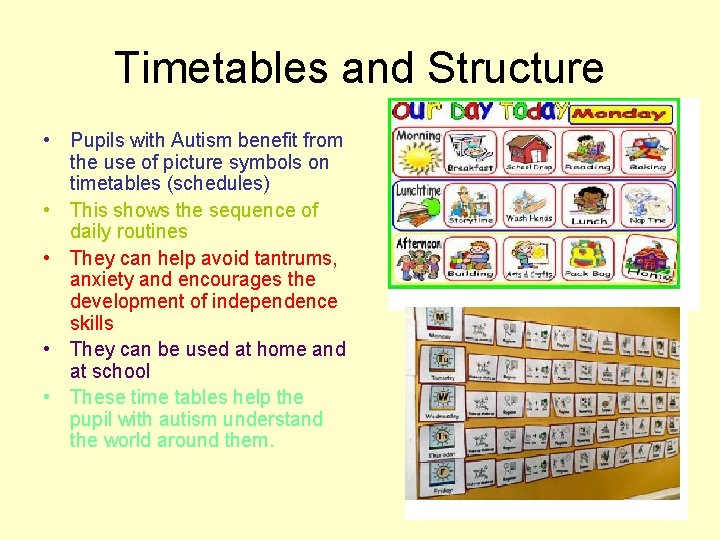
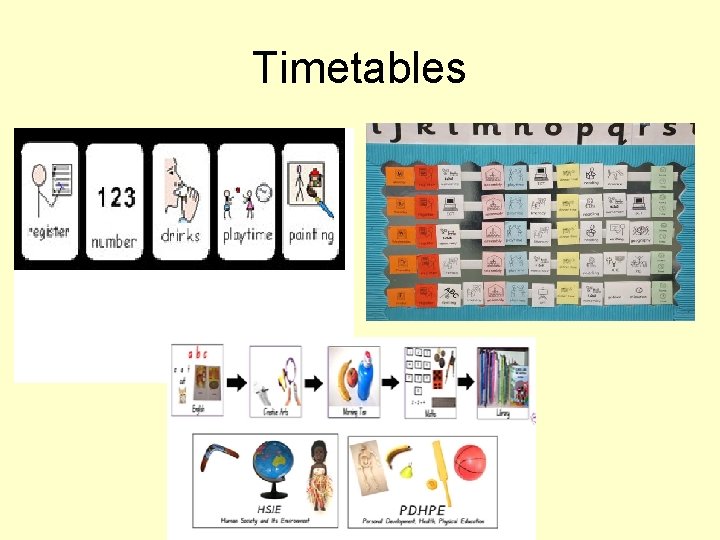
Timetables and Structure • Pupils with Autism benefit from the use of picture symbols on timetables (schedules) • This shows the sequence of daily routines • They can help avoid tantrums, anxiety and encourages the development of independence skills • They can be used at home and at school • These time tables help the pupil with autism understand the world around them.
Timetables
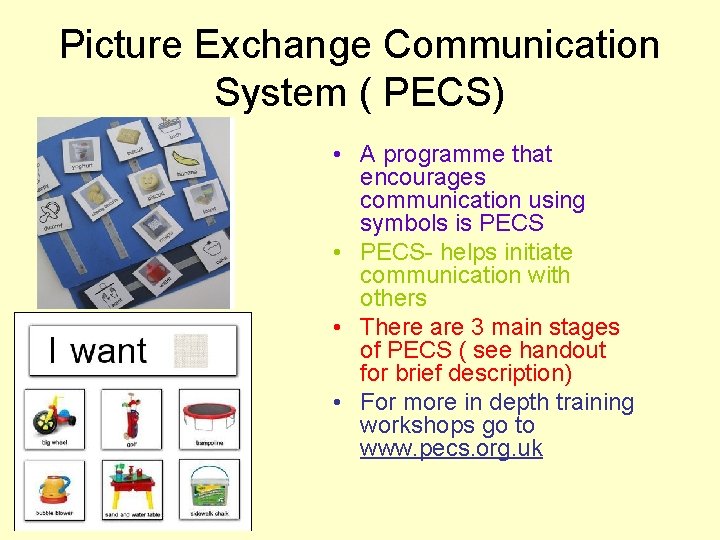
Picture Exchange Communication System ( PECS) • A programme that encourages communication using symbols is PECS • PECS- helps initiate communication with others • There are 3 main stages of PECS ( see handout for brief description) • For more in depth training workshops go to www. pecs. org. uk
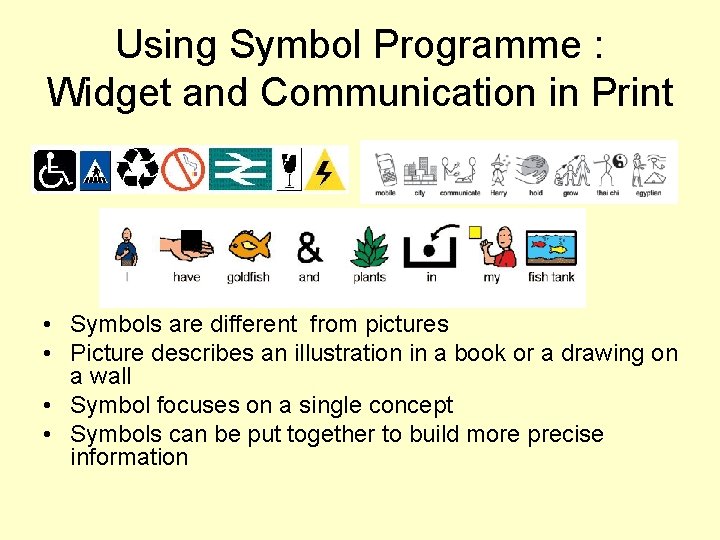
Using Symbol Programme : Widget and Communication in Print • Symbols are different from pictures • Picture describes an illustration in a book or a drawing on a wall • Symbol focuses on a single concept • Symbols can be put together to build more precise information
Symbols Continued • Symbols can help support: • Communication- help pupils make choices • Independence and Participation- aid understanding which can increase involvement, choice and confidence • Literacy and Learning- symbol software encourages users to ‘write’ by selecting symbols • More detailed information can be found at www. widgit. com ( there are free resources to download as well)
TOP TIPS • • Label your classroom and the equipment Create a visual timetable for the class or individual pupil Keep things clear of clutter and mess Keep displays simple and un busy ( this is dependent on the children you have) • Keep things Visual - Remember most autistic pupils are VISUAL LEARNERS- if they see it they are more likely to remember it! • Have CLEAR boundaries- use masking tap to give pupils own personal space or use as aid to keep pupil out of area’s you do not wish for them to enter.
Useful Resources • • • PECS- www. pecs. org. uk Widget/Communication in Printwww. widget. com Boardmaker http: //www. mayer-johnson. com. The program allows you to make communication displays, quickly find and paste pictures, Print displays, Make worksheets, picture instruction sheets, reading books, journals, or posters. • Do 2 Learn http: //www. do 2 learn. com Great website, free picture cards, link to facial expression game, product guide