
Visioning Training CREATING A VISION FOR CONTINUOUS IMPROVEMENT

- Slides: 18
Visioning Training CREATING A VISION FOR CONTINUOUS IMPROVEMENT UPDATED 8/13/18
How to use this training v. Select a facilitator (this should be the District Coordinator of School Improvement) v. Print enough copies of the note taking guide so that each participant has one v. Have participants sit at tables with pens/markers and sticky notes; make sure there is chart paper or a whiteboard that all participants can see v. Look at the presenter notes for guidance in facilitation v. Invite various stakeholders to the visioning process, including teachers, administrators, parents, students, support staff, etc. Repeat if necessary in multiple groups. UPDATED 8/13/18
Purpose and Outcome The purpose of this module is to guide campus teams through the first part of the school improvement process: Visioning. Outcome: We will create a vision statement that embodies a vision of change, establishes a sense of urgency, and creates a picture of a preferred future. If the campus already has a vision statement: Does it embody a vision of change that will resolves the campus’ low performance? Recommendation: test the current vision statement against the criteria in this presentation UPDATED 8/13/18
Selected Characteristics of an Effective Vision v. Imaginable: Conveys a picture of what the future state of the campus will look like v. Focused: Is concise and clear enough to provide guidance in decision making v. Communicable: Is easy to communicate and explain v. Collaborative: Created with input from all in order to establish a sense of ownership UPDATED 8/13/18
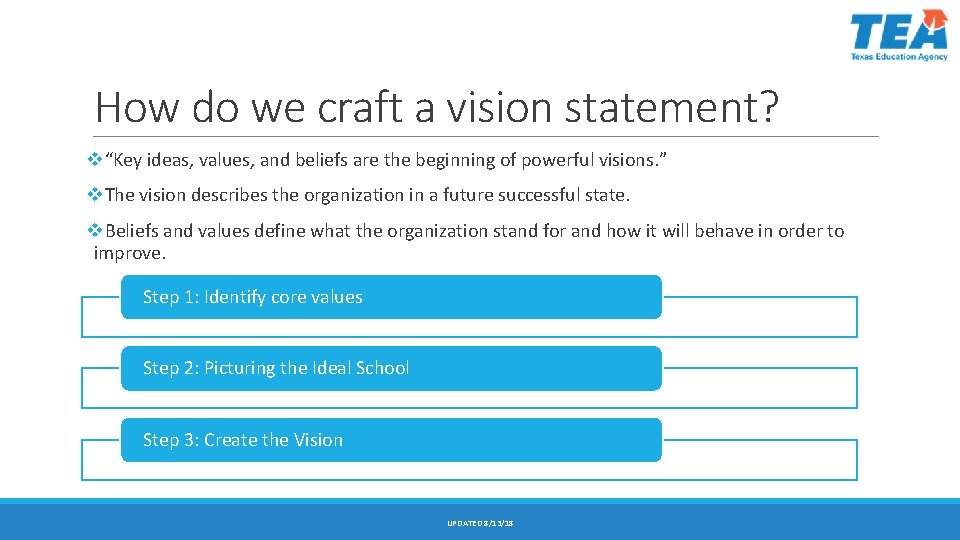
How do we craft a vision statement? v“Key ideas, values, and beliefs are the beginning of powerful visions. ” v. The vision describes the organization in a future successful state. v. Beliefs and values define what the organization stand for and how it will behave in order to improve. Step 1: Identify core values Step 2: Picturing the Ideal School Step 3: Create the Vision UPDATED 8/13/18
Step One: Identify Core Values v. Individually, complete the sentence stems under ”Step one: Identify Core Values Individual Reflection” in your note-taking guide. (Take 7 minutes) UPDATED 8/13/18
Step One: Identify core values v. Based on the ideas you generated to complete the sentence stem, select three beliefs you feel are the most important. These will be your core values. v. Write those core values on a sticky note. (One core value per sticky note. ) UPDATED 8/13/18
Step One: Identify core values (cont. ) v. In a group of 3 -5: Share your core values and group similar values v. As a group, come to a consensus on three to five core values. Record each of these on new sticky notes v. Whole group share out: v. In your note taking guide, answer the reflection question: What similarities do you notice about the core values from the entire group? UPDATED 8/13/18
Step Two: The ideal school v. Think of your ideal school. If you were observing your ideal school, what would you see? In your note-taking guide, complete the chart under step 2. (Take 10 minutes) UPDATED 8/13/18
Step Two: The ideal school v. Reflection question: With a partner, take 5 minute to discuss: How do the core values you identified in Step One create the conditions for these actions to occur? (Record your ideas in your notetaking guide) UPDATED 8/13/18
Step Three: Create the vision v. In this step, we will use the core values and the descriptions of the ideal school we’ve identified to create a vision for school improvement v. Remember, an effective vision is: v. Imaginable: Conveys a picture of what the future state of the campus will look like v. Focused: Is concise and clear enough to provide guidance in decision making v. Communicable: Is easy to communicate and explain v. Collaborative: Created with input from all in order to establish a sense of ownership UPDATED 8/13/18
Practice: Statement 1 v. Read the following vision statement: “Texas Middle School will create a dynamic learning environment with a culture of high expectations for all stakeholders in order to move students towards greatness and inspire the community. ” v. In your note-taking guide, answer: Does this statement meet the criteria for an effective vision statement? UPDATED 8/13/18
Practice: Statement 2 v. Read the following vision statement: ““All Paris High School students will achieve personal success in their learning and become responsible and productive citizens. ” v. In your note-taking guide, answer: Does this statement meet the criteria for an effective vision statement? UPDATED 8/13/18
Step Three: Create the vision v. Now let’s write our vision statement. v. Individually, write a draft vision statement in your notetaking guide. (Take 5 minutes to think and write) UPDATED 8/13/18
Step Three: Create the vision v. In groups of three: v. Evaluate each draft vision statement. Do they meet all the criteria for an effective vision? (5 minutes) v Develop a group draft vision statement that incorporates elements of the individual statements (10 minutes). Record this in your note-taking guide. UPDATED 8/13/18
Step Three: Create the vision v. Each group will share their vision statement with the whole group: v. Evaluate each draft vision statement. What elements would you want to keep in the campus’ vision statement? v. Write the whole group vision statement in your note-taking guide. UPDATED 8/13/18
Next step: v. Attend continuous improvement training at your region service center. v. Take this vision statement with you! UPDATED 8/13/18
Sources v. Kotter, John P. , Leading Change, Harvard Business Review Press, 2012, Boston, MA v. Creating a Vision: http: //mdk 12. msde. maryland. gov/process/leading/vision. html UPDATED 8/13/18