
VISIONBASED 3 D BICYCLE TRACKING USING DEFORMABLE PART

VISION-BASED 3 D BICYCLE TRACKING USING DEFORMABLE PART MODEL AND INTERACTING MULTIPLE MODEL FILTER Presentation by Jonathan Kaan De. Boy Paper by Hyunggi Cho, Paul E. Rybski and Wende Zhang 1
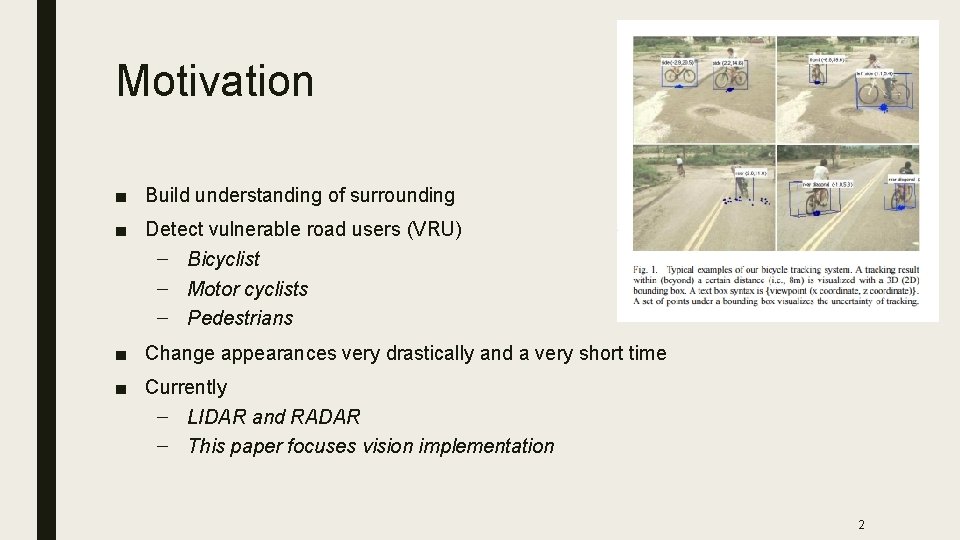
Motivation ■ Build understanding of surrounding ■ Detect vulnerable road users (VRU) – Bicyclist – Motor cyclists – Pedestrians ■ Change appearances very drastically and a very short time ■ Currently – LIDAR and RADAR – This paper focuses vision implementation 2
Vision Based Detection ■ Higher resolution view of the world ■ Color, texture, shape, contours ■ Low cost ■ Processor intensive—complicated backgrounds to extract from ■ Error prone to lightening changes, object shape, etc. 3
Other Forms of Detection ■ Planar LIDAR ■ Low resolution RADAR ■ Only RCS/LCS is available ■ High cost ■ Easy on processing ■ Not as susceptible to noise 4

3 MAJOR CONTRIBUTIONS 5
1 st – Model ■ Three-component bicycle model ■ Bicycle Kinematics have restrictive constraints on movement – Unlike pedestrians ■ Two motion models – IMM estimator – Extended Kalman Filter ■ Position and orientation in vehicle coordinates 6
2 nd – Tracking ■ Extension of single bicycle tracking ■ Rao-Blackwellized Particle Filter – Particle filter for data association ■ IMM for each bicycle tracking 7
3 rd – Bicycle Dataset ■ First public domain bicycle dataset ■ Available for anyone to conduct bicycle tracking research 8

PEDESTRIAN DETECTION 9
Single Template ■ Originally showed better performance ■ Capture whole human body with detection window – Haar wavelet with polynomial SVM ■ Dense Histogram of Oriented Gradient (HOG) then linear SVM 10
Part-Based ■ Began to look more promising – Flexible and rich models ■ Captures the pattern of each part—handles various appearances ■ Divide body into 4 parts: head, legs, left arm, right arm ■ Polynomial SVM fed into a classifier ■ Scale Invariant Feature Transform (SIFT) 11
Pedestrian Tracking ■ Statistical Probabilistic Methods – Extended Kalman Filter – Particle Filter – Alpha Beta Filter ■ Constant velocity 12
Bicycle Detection ■ Object detection and tracking by detection – Run every frame ■ Detector Virtual Sensor – 2 D bounding boxes ■ Different classes of bicycles – Road, mountain, etc. 13
DEFORMABLE PARTS MODEL 14
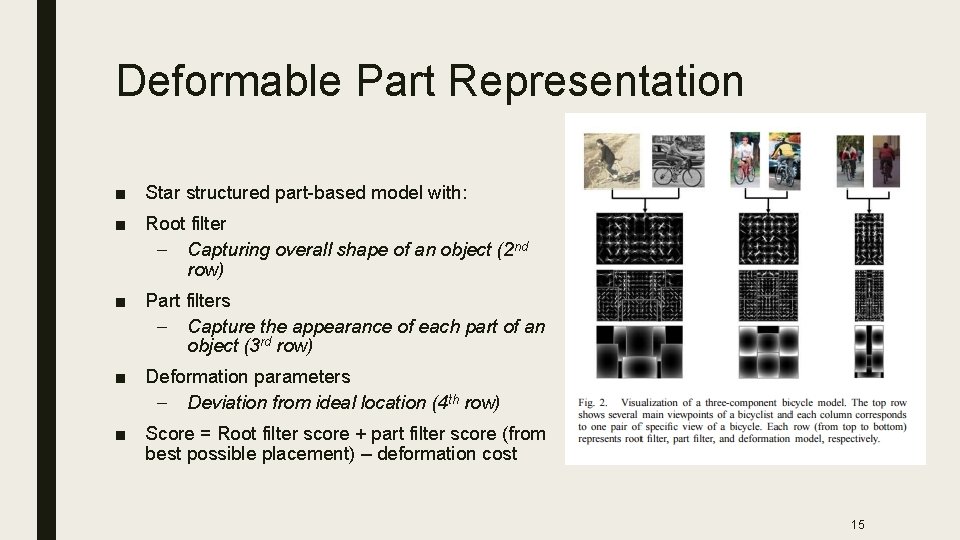
Deformable Part Representation ■ Star structured part-based model with: ■ Root filter – Capturing overall shape of an object (2 nd row) ■ Part filters – Capture the appearance of each part of an object (3 rd row) ■ Deformation parameters – Deviation from ideal location (4 th row) ■ Score = Root filter score + part filter score (from best possible placement) – deformation cost 15
Efficient Matching Process ■ Dynamic programing ■ Generalized distance transforms ■ Huge optimization model for matching ■ Important to use fast method for a detection task 16
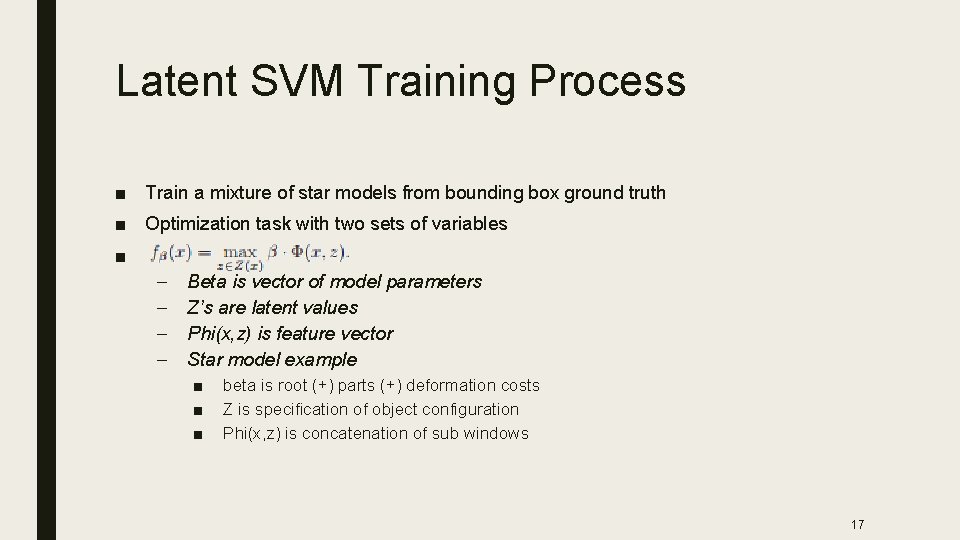
Latent SVM Training Process ■ Train a mixture of star models from bounding box ground truth ■ Optimization task with two sets of variables ■ – – Beta is vector of model parameters Z’s are latent values Phi(x, z) is feature vector Star model example ■ ■ ■ beta is root (+) parts (+) deformation costs Z is specification of object configuration Phi(x, z) is concatenation of sub windows 17
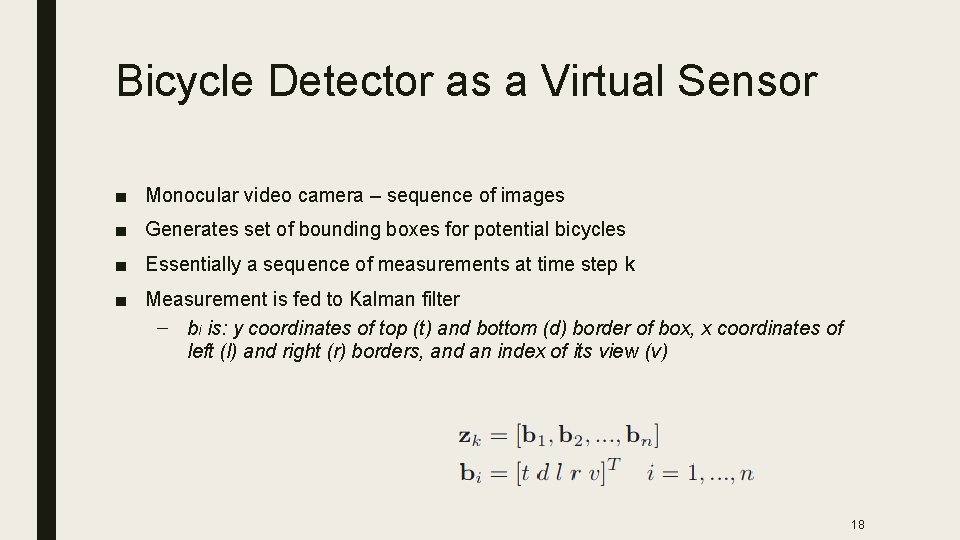
Bicycle Detector as a Virtual Sensor ■ Monocular video camera – sequence of images ■ Generates set of bounding boxes for potential bicycles ■ Essentially a sequence of measurements at time step k ■ Measurement is fed to Kalman filter – bi is: y coordinates of top (t) and bottom (d) border of box, x coordinates of left (l) and right (r) borders, and an index of its view (v) 18
Number of Viewpoints ■ Our camera is moving, detector must account ■ Tradeoff between increasing number of models and reducing time complexity. ■ 8 view-based bicycle detector was used ■ Paired and trained by symmetric counterpart 19
Multiple Bicycle Tracking with IMM Algorithm and a Rao-Blackwellized Particle Filter ■ Bicycle detector is very processor demanding ■ Need reliable tracking algorithm that is certain of its uncertainty for tracking Extended Kalman Filter 20
Alpha-Beta Filter ■ Tracks based off incoming data and previous velocity ■ Velocity is updated based on a weighted sum – Previous prediction (acquired from previous data points) – Current data point – Alpha and Beta are typically set weights 21
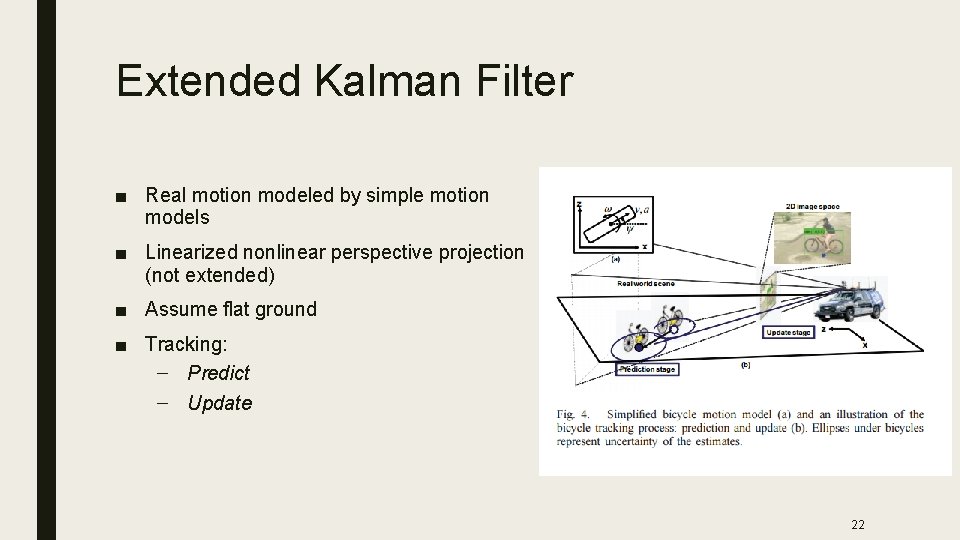
Extended Kalman Filter ■ Real motion modeled by simple motion models ■ Linearized nonlinear perspective projection (not extended) ■ Assume flat ground ■ Tracking: – Predict – Update 22
Bicycle Motion Model Set ■ Bicycles have unique kinematics – Difficult to measure when the object is in a rough bounding box ■ Instead comprehensive experiment results lead to moving mass with constant velocity model ■ To improve performance, – Add simplified versions of bicycle’s kinematics ■ Use a well-known IMM filter 23
Interactive Multiple Model (IMM) Filter ■ Multiple motion models representing dynamic behaviors – Maneuvering ■ Several motion models ran in parallel ■ Estimates a state through weighted sum of several filter results 24
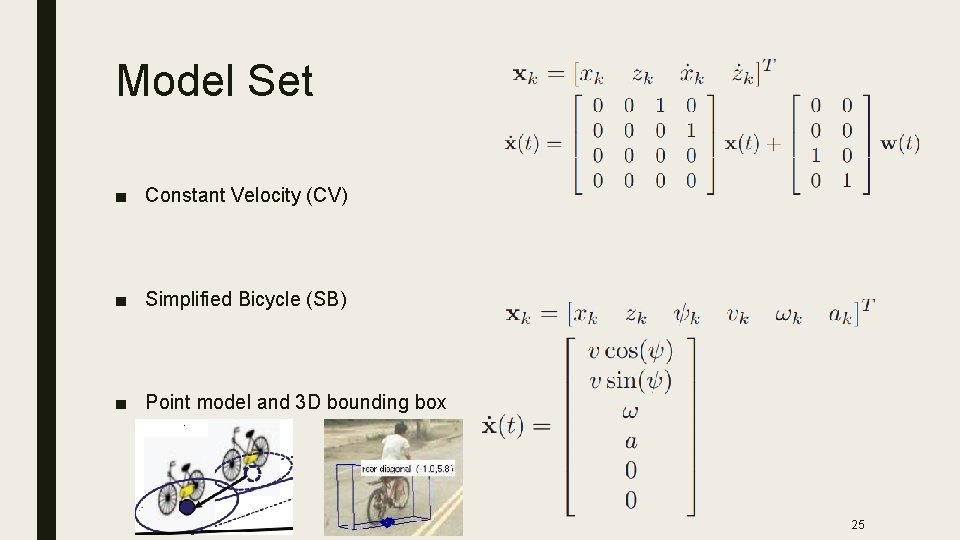
Model Set ■ Constant Velocity (CV) ■ Simplified Bicycle (SB) ■ Point model and 3 D bounding box 25
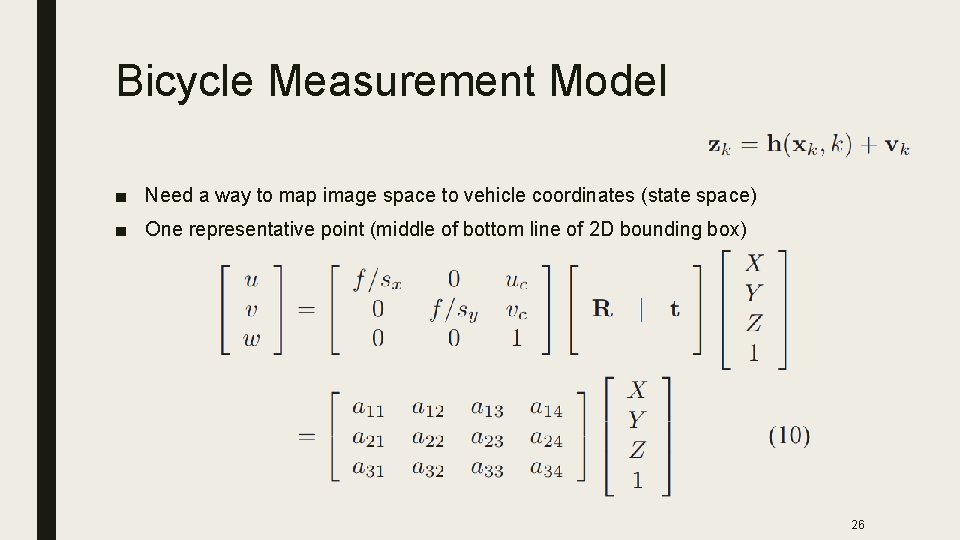
Bicycle Measurement Model ■ Need a way to map image space to vehicle coordinates (state space) ■ One representative point (middle of bottom line of 2 D bounding box) 26

EXTENSION TO MULTIPLE BICYCLE TRACKING 27
Rao-Blackwellized Particle Filter (RBPF) ■ Multiple measurements – no information on number of bicycles that exist ■ Break down huge state estimation into smaller problems – Analytical solutions and particle filter solution ■ Rao-Blackwellized Monte Carlo Data Association RBMCDA algorithm ■ Bayesian factorization ■ Separate posterior into number of bicycles and a tracking problem 28

EXPERIMENTAL RESULTS 29
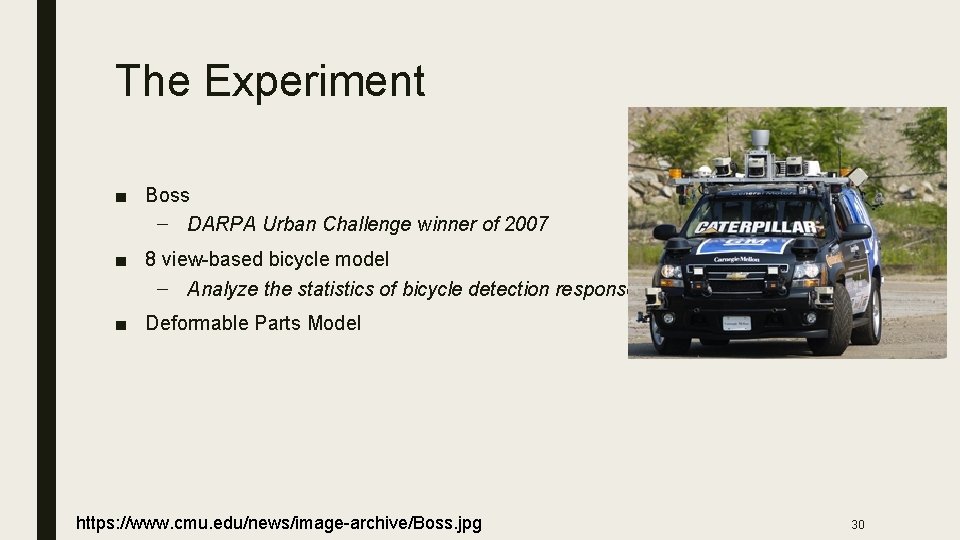
The Experiment ■ Boss – DARPA Urban Challenge winner of 2007 ■ 8 view-based bicycle model – Analyze the statistics of bicycle detection responses ■ Deformable Parts Model https: //www. cmu. edu/news/image-archive/Boss. jpg 30
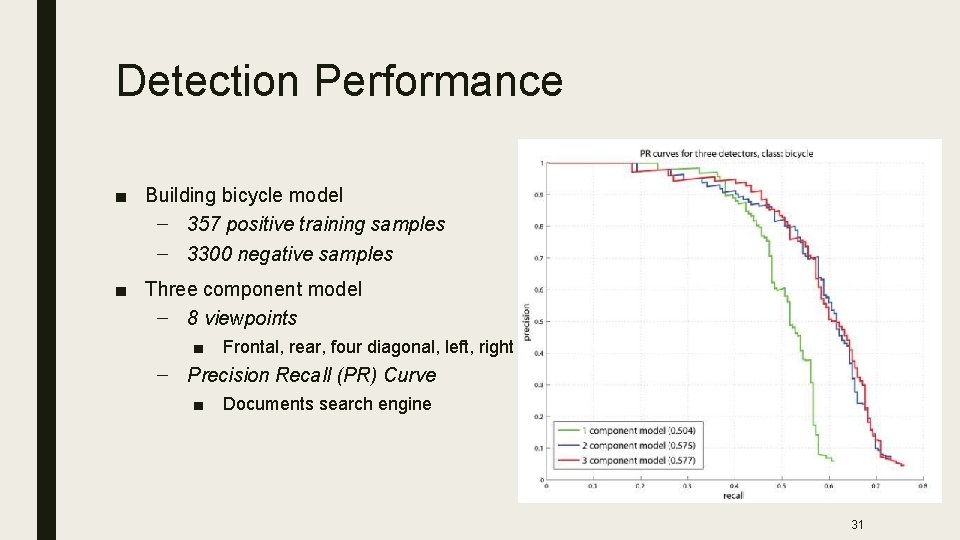
Detection Performance ■ Building bicycle model – 357 positive training samples – 3300 negative samples ■ Three component model – 8 viewpoints ■ Frontal, rear, four diagonal, left, right – Precision Recall (PR) Curve ■ Documents search engine 31
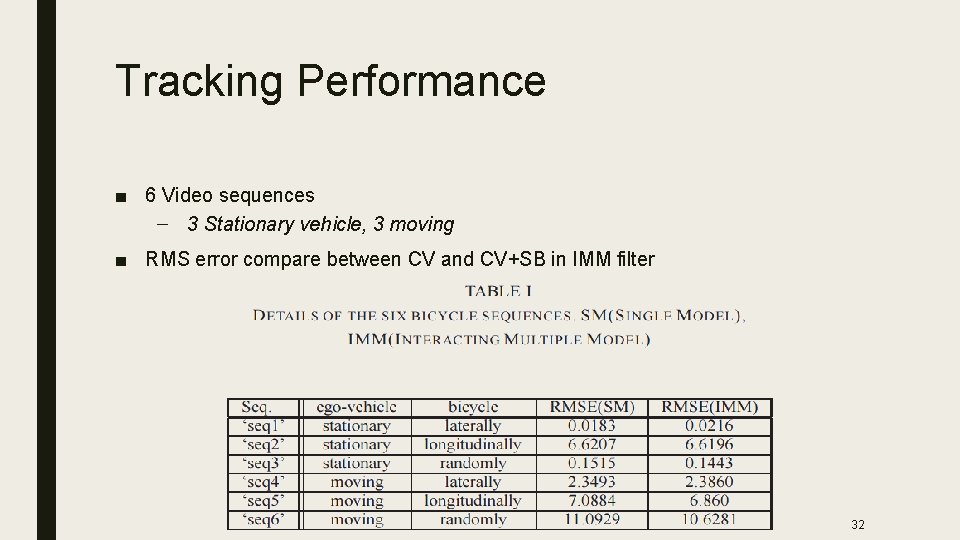
Tracking Performance ■ 6 Video sequences – 3 Stationary vehicle, 3 moving ■ RMS error compare between CV and CV+SB in IMM filter 32
33
Conclusions and Future Work ■ Deformable Parts Based Model to detect bicycles – 3 Part Bicycle Model ■ Two motion models: CV and SB – Sent to EKF to estimate position and velocity in vehicle coordinate system ■ IMM tracking algorithm – Extended with Rao-Blackwellized Particle Filter for multiple bicycles tracks ■ Future – New measurement mapping function to extract more info from 2 D bounding box 34
- Slides: 34