
Vision What is blindness to you Exercise 1
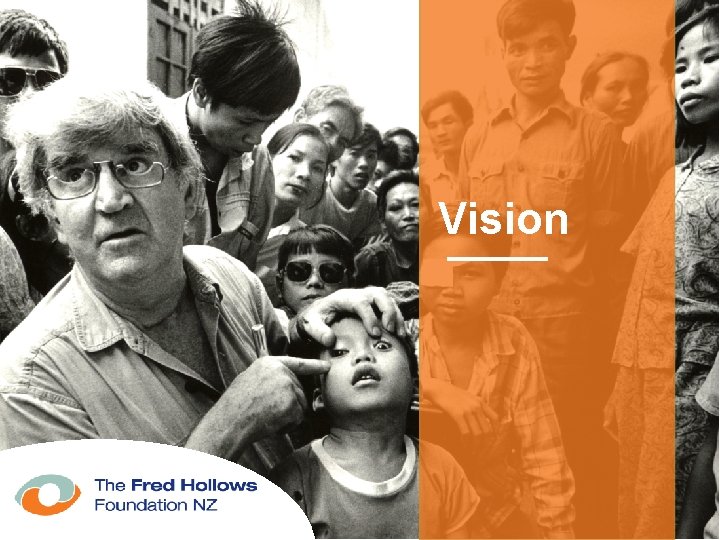
Vision

What is blindness to you? Exercise: 1. Write down your own definition of blindness. 2. Name other problems that people might have with their eyes. In pairs share your answers.
Definitions BLINDNESS: When a person is unable to see because of injury, disease, or a condition at birth. AVOIDABLE BLINDNESS: Blindness which could be either treated or prevented, also referred to as NEEDLESSLY BLIND. VISUAL IMPAIRMENT: Full or part loss of vision.

What is avoidable blindness? Exercise: 1. All students to stand up 2. Any students with glasses sit down 3. Any students who have parents who wear glasses sit down 4. Any students whose grandparents have had an eye operation sit down
The Fred Hollows Foundation NZ Fred Hollows NZ is a charitable organisation that works in the Pacific to eliminate avoidable blindness. In these areas 4 out of 5 people who are blind don’t need to be. In many cases, a short 20 -minute operation can restore sight or a dose of antibiotics can prevent blindness.
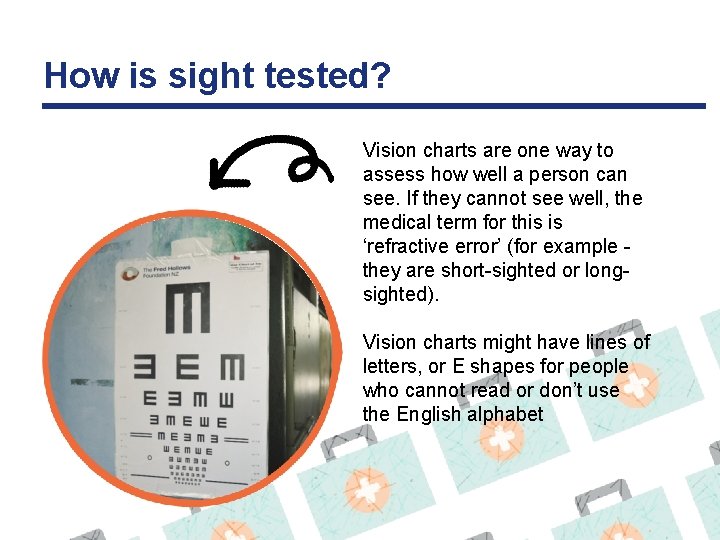
How is sight tested? Vision charts are one way to assess how well a person can see. If they cannot see well, the medical term for this is ‘refractive error’ (for example they are short-sighted or longsighted). Vision charts might have lines of letters, or E shapes for people who cannot read or don’t use the English alphabet
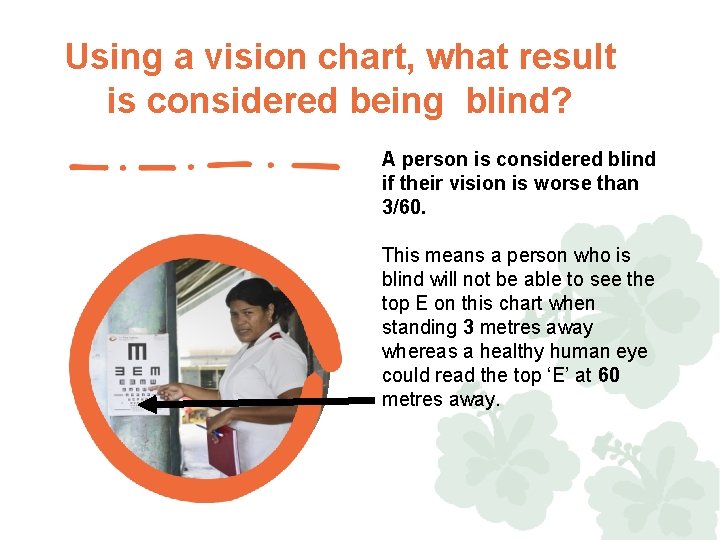
Using a vision chart, what result is considered being blind? A person is considered blind if their vision is worse than 3/60. This means a person who is blind will not be able to see the top E on this chart when standing 3 metres away whereas a healthy human eye could read the top ‘E’ at 60 metres away.
You can use a vision chart to compare your eye sight with your school mates. Exercise This will only give you an approximate idea of your vision. Your optometrist has much more precise tools to measure exactly how well you can see. Try it out!
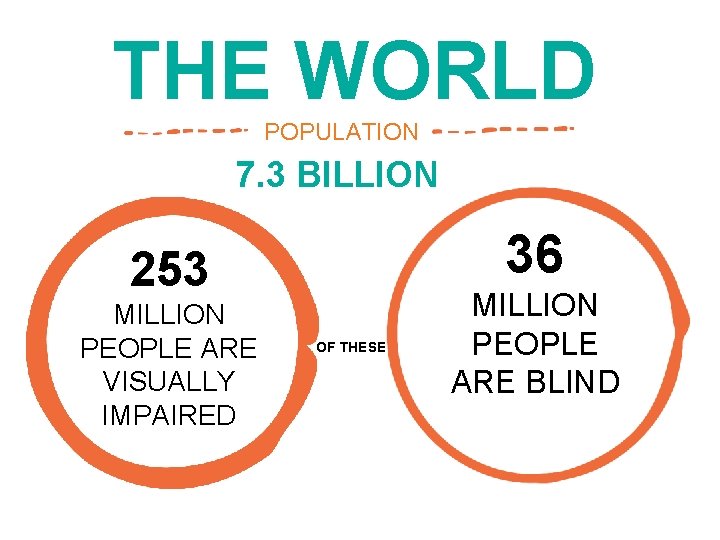
THE WORLD POPULATION 7. 3 BILLION 36 253 MILLION PEOPLE ARE VISUALLY IMPAIRED OF THESE MILLION PEOPLE ARE BLIND
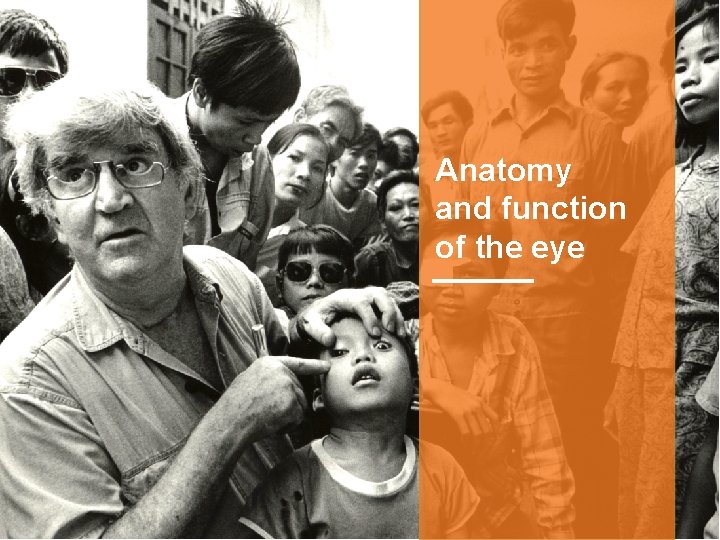
Anatomy and function of the eye
Watch the short film on eyes and then test yourself! Find out about eyes
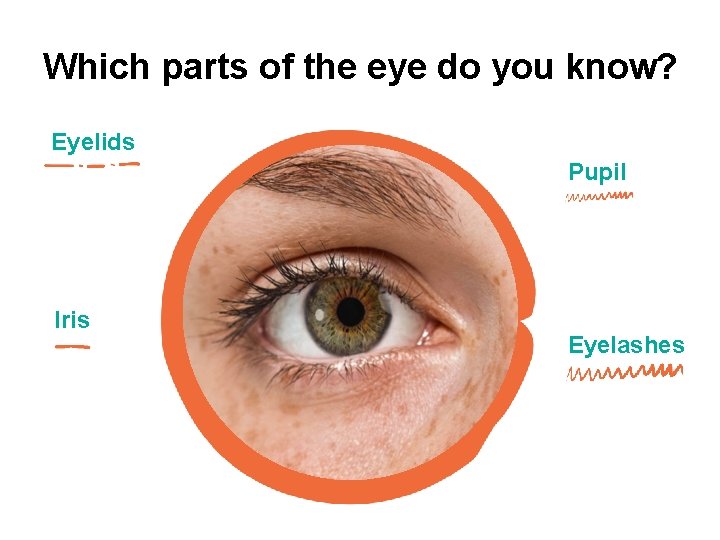
Which parts of the eye do you know? Eyelids Pupil Iris Eyelashes
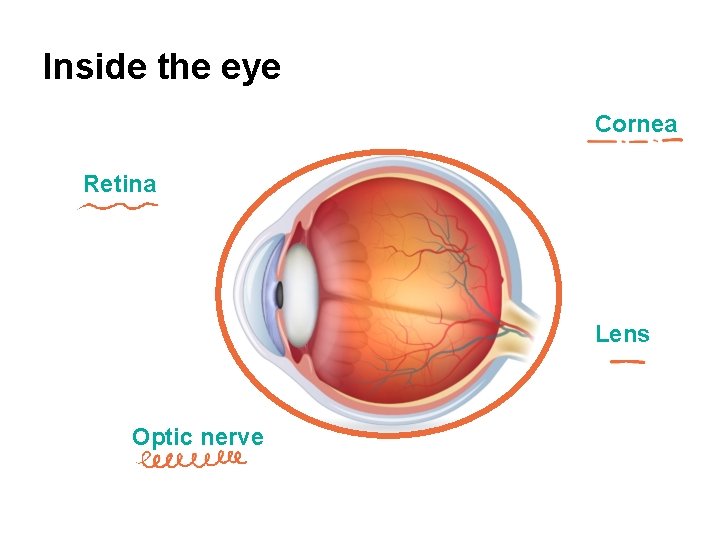
Inside the eye Cornea Retina Lens Optic nerve
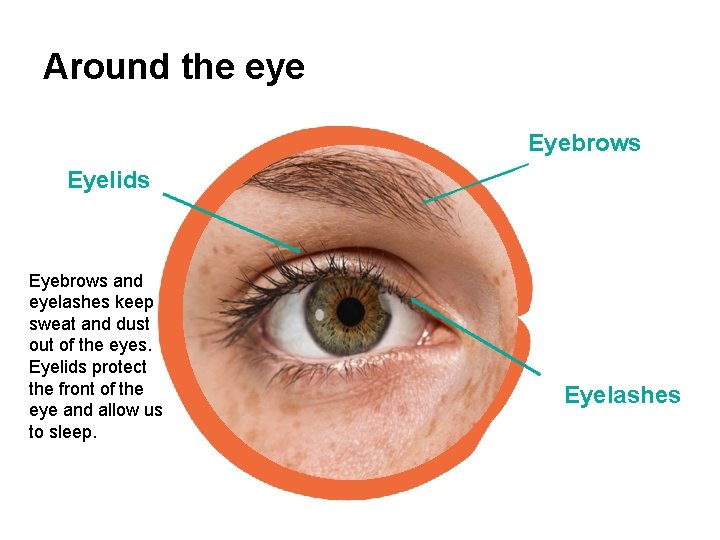
Around the eye Eyebrows Eyelids Eyebrows and eyelashes keep sweat and dust out of the eyes. Eyelids protect the front of the eye and allow us to sleep. Eyelashes
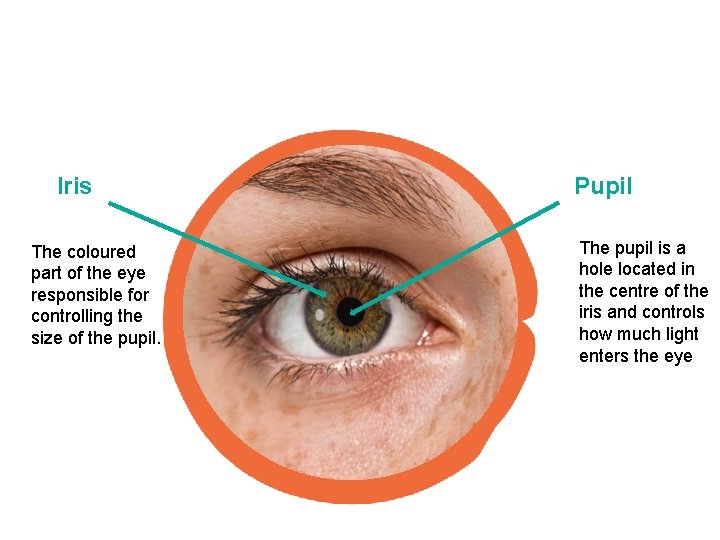
Iris The coloured part of the eye responsible for controlling the size of the pupil. Pupil The pupil is a hole located in the centre of the iris and controls how much light enters the eye
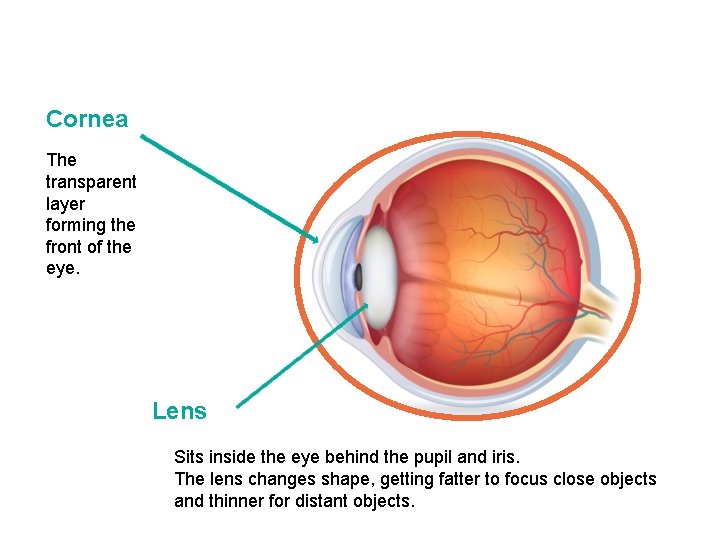
Cornea The transparent layer forming the front of the eye. Lens Sits inside the eye behind the pupil and iris. The lens changes shape, getting fatter to focus close objects and thinner for distant objects.
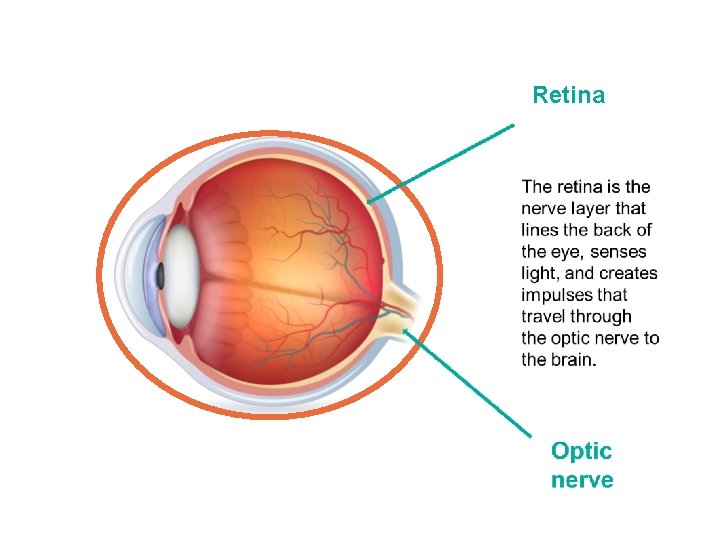
Retina
There are many causes of blindness and visual impairment. Three most common causes are: CAUSES • Cataract • Refractive Error • Diabetic Retinopathy (DR)
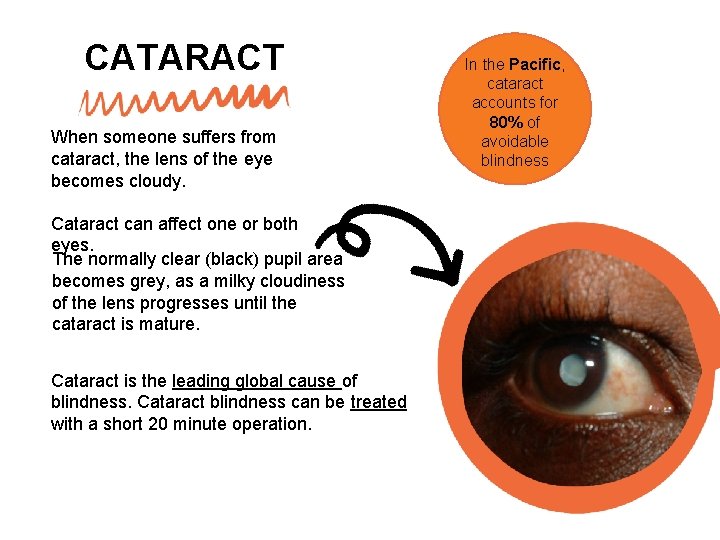
CATARACT When someone suffers from cataract, the lens of the eye becomes cloudy. Cataract can affect one or both eyes. The normally clear (black) pupil area becomes grey, as a milky cloudiness of the lens progresses until the cataract is mature. Cataract is the leading global cause of blindness. Cataract blindness can be treated with a short 20 minute operation. In the Pacific, cataract accounts for 80% of avoidable blindness
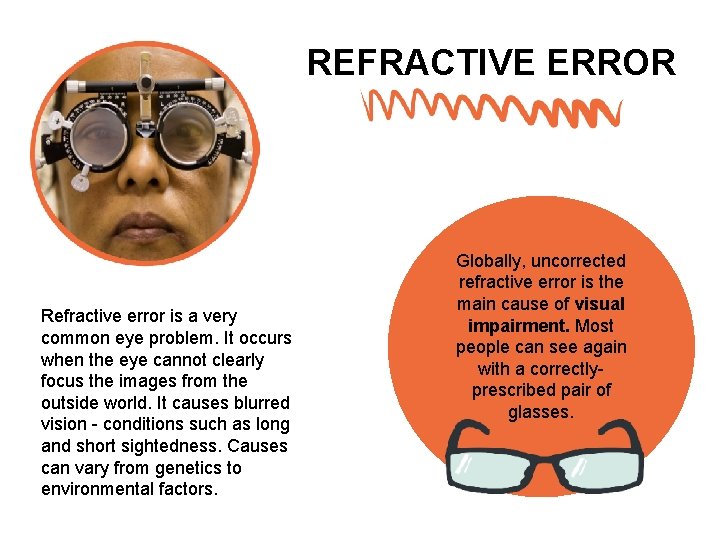
REFRACTIVE ERROR Refractive error is a very common eye problem. It occurs when the eye cannot clearly focus the images from the outside world. It causes blurred vision - conditions such as long and short sightedness. Causes can vary from genetics to environmental factors. Globally, uncorrected refractive error is the main cause of visual impairment. Most people can see again with a correctlyprescribed pair of glasses.
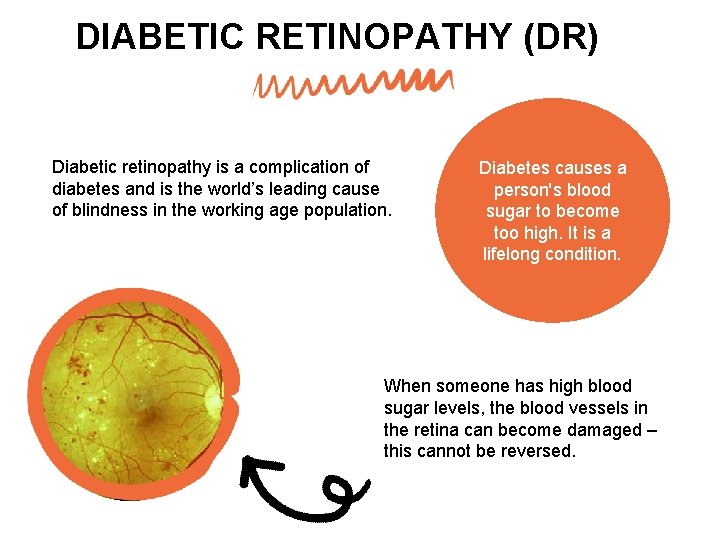
DIABETIC RETINOPATHY (DR) Diabetic retinopathy is a complication of diabetes and is the world’s leading cause of blindness in the working age population. Diabetes causes a person's blood sugar to become too high. It is a lifelong condition. When someone has high blood sugar levels, the blood vessels in the retina can become damaged – this cannot be reversed.

Who is affected by blindness and visual impairment? Almost 90% of people with visual impairment live in developing countries. Globally, around half a million children become blind each year. 55% of visually impaired people are women
Exercise 1. What does poverty mean to you? What do you think basic needs are? 2. What do you think the link is between poverty & blindness? 3. Discuss why you think the percentage of visual impairment is higher in women than men.
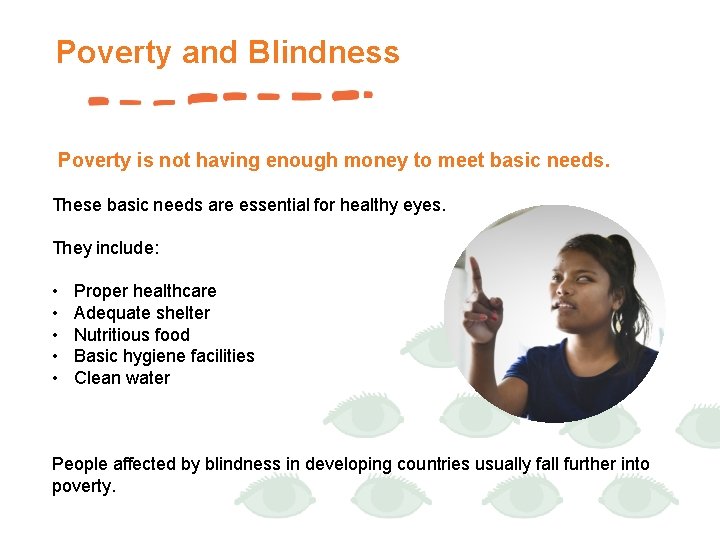
Poverty and Blindness Poverty is not having enough money to meet basic needs. These basic needs are essential for healthy eyes. They include: • • • Proper healthcare Adequate shelter Nutritious food Basic hygiene facilities Clean water People affected by blindness in developing countries usually fall further into poverty.
Storyboard activity Draw images to go along with the following story to create your own storyboard
Storyboard number: 1 Take a man in the Pacific with a bright future. He works hard and is able to provide for his family and contribute to the wider community. His life is full and enjoyable; his wife works and his daughter goes to the local school.
Storyboard number: 2 But then darkness sets in - over time, his sight starts to deteriorate. Suddenly, he can no longer work and his daughter now needs to stay home from school to look after her father, keeping her from her education.
Storyboard number: 3 Now, his wife is the sole earner for the household. She has to work to support the whole family. Money is tight because there is now only one person working.
HIT PAUSE! What impact do you think this is having on his family/relationships? What impact do you think not going to school will have on his daughter and her future?
Storyboard number: 4 The family hear that The Fred Hollows Foundation’s Pacific Outreach team are visiting his country and they are able to perform a 20 -minute sight-restoring operation. He is able to return the next day to have his bandages removed. He opens his eyes and light comes streaming in. He can now see the faces of his family again.
Storyboard number: 5 He has his life restored - he returns to work, independent and proud once more. Able to provide for his family, pay his bills and contribute to his community again.
Storyboard number: 6 His future looks bright, and so does his daughter’s future, now she is able to return to full-time schooling. She dreams of becoming an eye doctor to help people like her father.
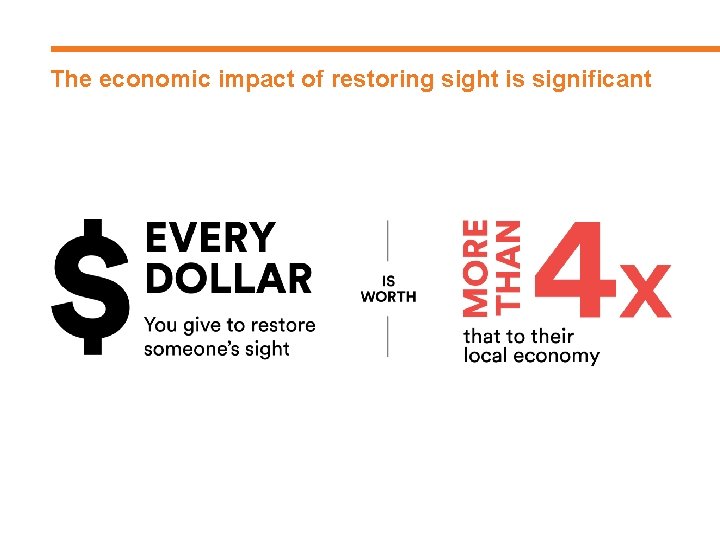
The economic impact of restoring sight is significant
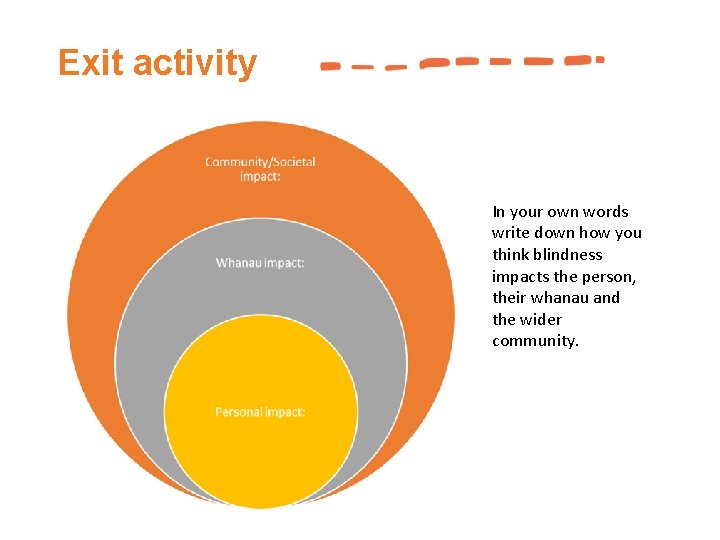
Exit activity In your own words write down how you think blindness impacts the person, their whanau and the wider community.
- Slides: 34