
Vision The Eye The eyes have three different



- Slides: 13
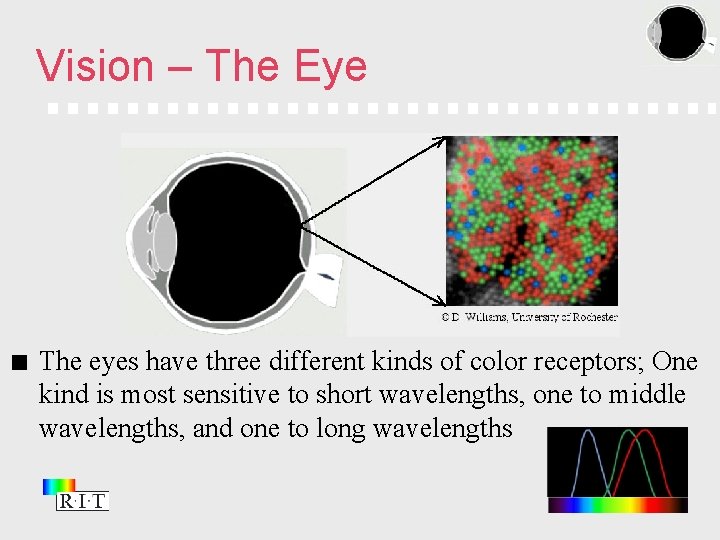
Vision – The Eye The eyes have three different kinds of color receptors; One kind is most sensitive to short wavelengths, one to middle wavelengths, and one to long wavelengths
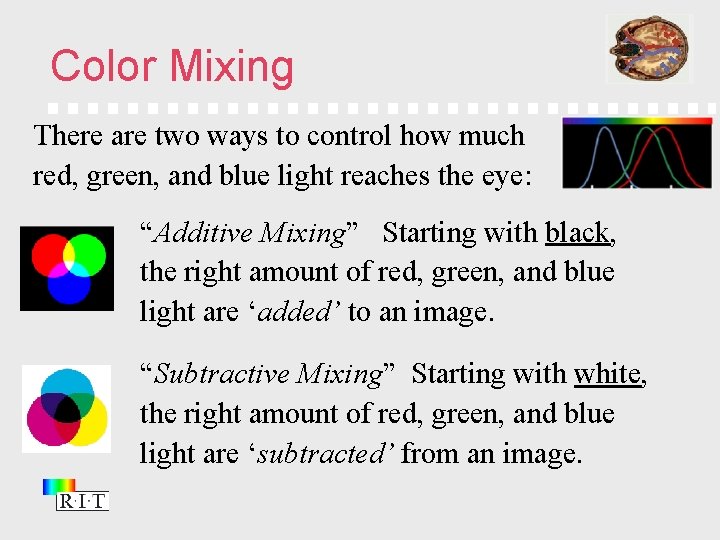
Color Mixing There are two ways to control how much red, green, and blue light reaches the eye: “Additive Mixing” Starting with black, the right amount of red, green, and blue light are ‘added’ to an image. “Subtractive Mixing” Starting with white, the right amount of red, green, and blue light are ‘subtracted’ from an image.
Additive Color Mixing By exciting the red, green, and blue sensitive cones, any color can be produced by adding together the three additive primaries (R, G, B). Mixing the three color sources is known as “additive mixing” to distinguish it from mixing paints or dyes (“subtractive mixing”).
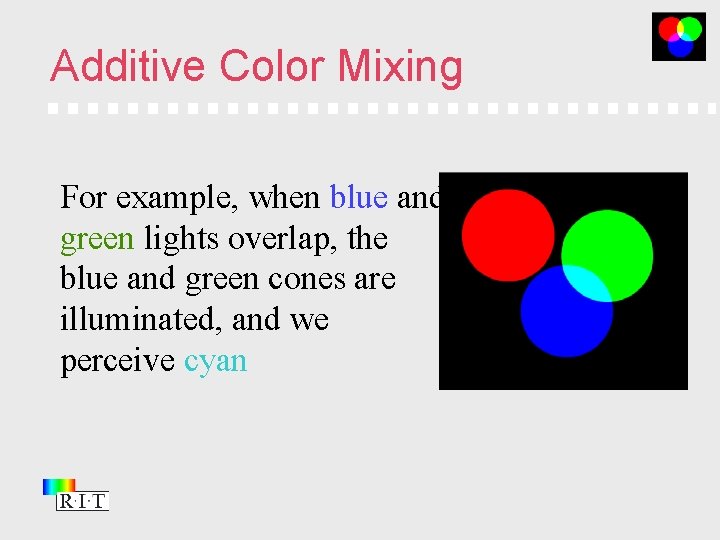
Additive Color Mixing For example, when blue and green lights overlap, the blue and green cones are illuminated, and we perceive cyan
Additive Color Mixing green + blue = cyan red + blue = magenta red + green = yellow red + green + blue = white
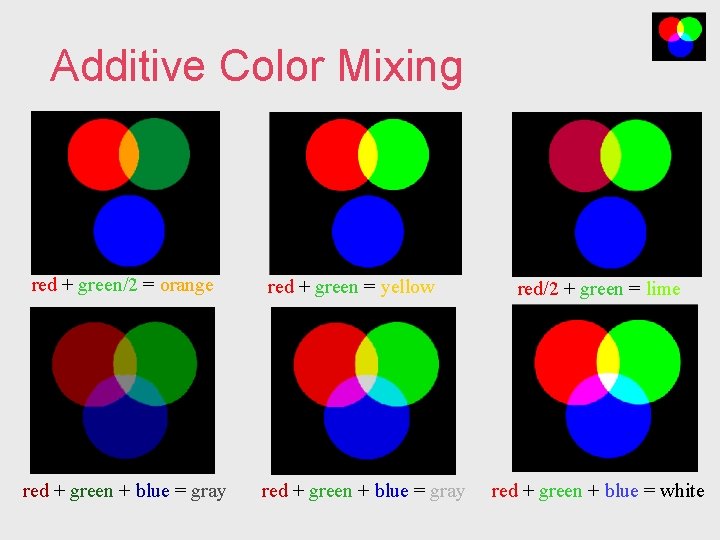
Additive Color Mixing red + green/2 = orange red + green + blue = gray red + green = yellow red + green + blue = gray red/2 + green = lime red + green + blue = white
Additive Color Reproduction Color video projectors use additive color mixing — Projected red, green, and blue images contribute RGB components to create color images R G B
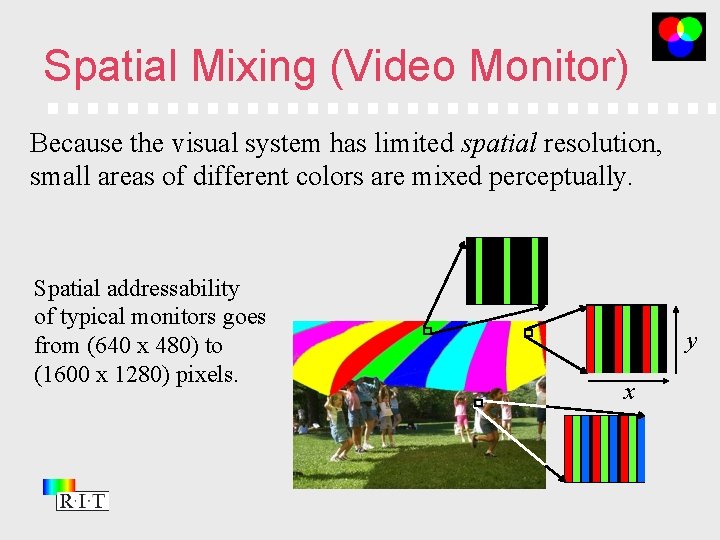
Spatial Mixing (Video Monitor) Because the visual system has limited spatial resolution, small areas of different colors are mixed perceptually. Spatial addressability of typical monitors goes from (640 x 480) to (1600 x 1280) pixels. y x
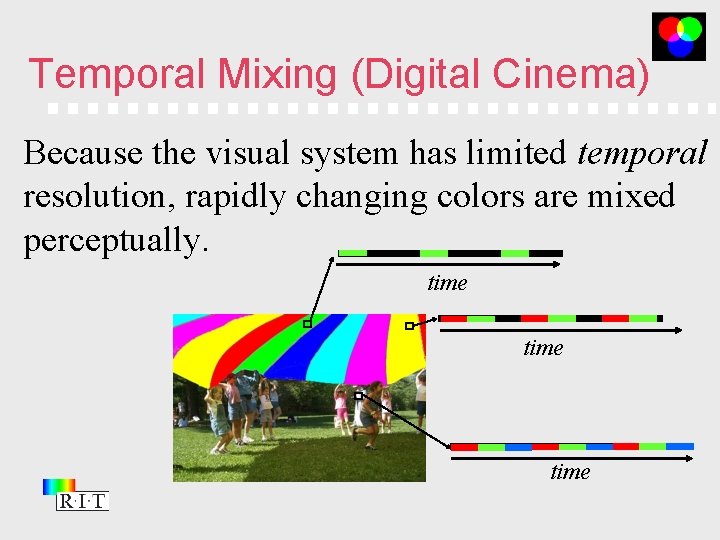
Temporal Mixing (Digital Cinema) Because the visual system has limited temporal resolution, rapidly changing colors are mixed perceptually. time
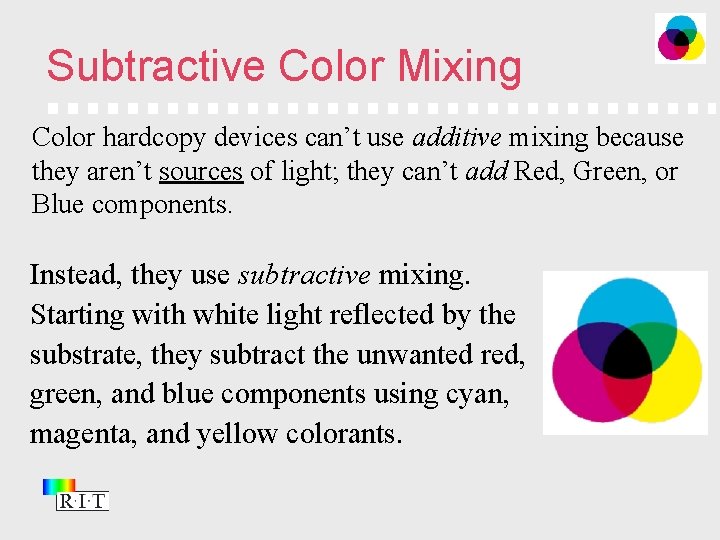
Subtractive Color Mixing Color hardcopy devices can’t use additive mixing because they aren’t sources of light; they can’t add Red, Green, or Blue components. Instead, they use subtractive mixing. Starting with white light reflected by the substrate, they subtract the unwanted red, green, and blue components using cyan, magenta, and yellow colorants.
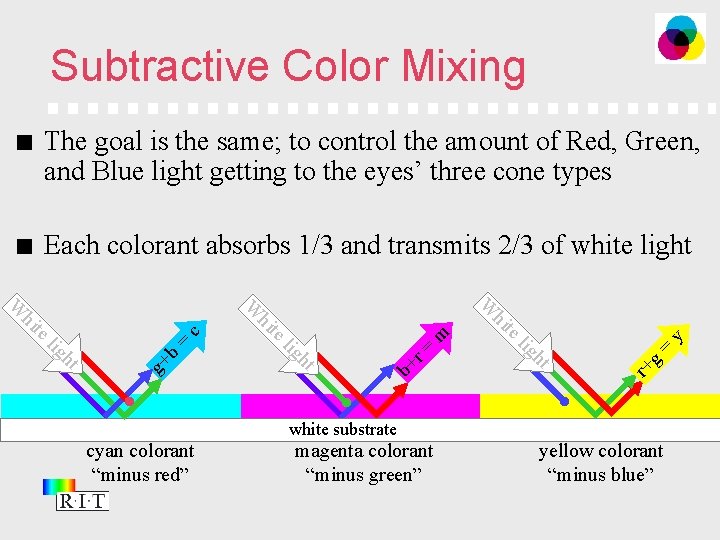
Subtractive Color Mixing The goal is the same; to control the amount of Red, Green, and Blue light getting to the eyes’ three cone types Each colorant absorbs 1/3 and transmits 2/3 of white light y = g r+ m r= b+ c = b ht lig g+ te hi W W white substrate cyan colorant “minus red” magenta colorant “minus green” yellow colorant “minus blue”
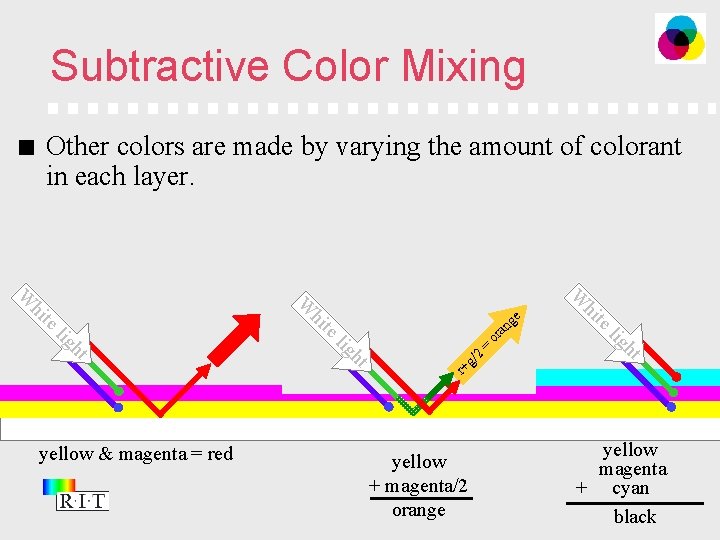
Subtractive Color Mixing Other colors are made by varying the amount of colorant in each layer. ge or an = ht lig ht /2 te hi W lig ht lig te hi W W yellow & magenta = red r+ g yellow + magenta/2 orange yellow magenta + cyan black
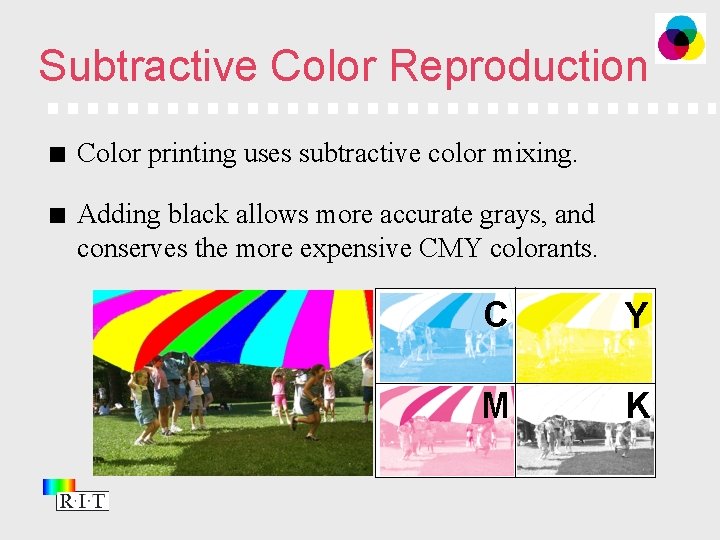
Subtractive Color Reproduction Color printing uses subtractive color mixing. Adding black allows more accurate grays, and conserves the more expensive CMY colorants. C Y M K