
VISION SCREENING TRAINING PreTest Indicate whether the following
- Slides: 77
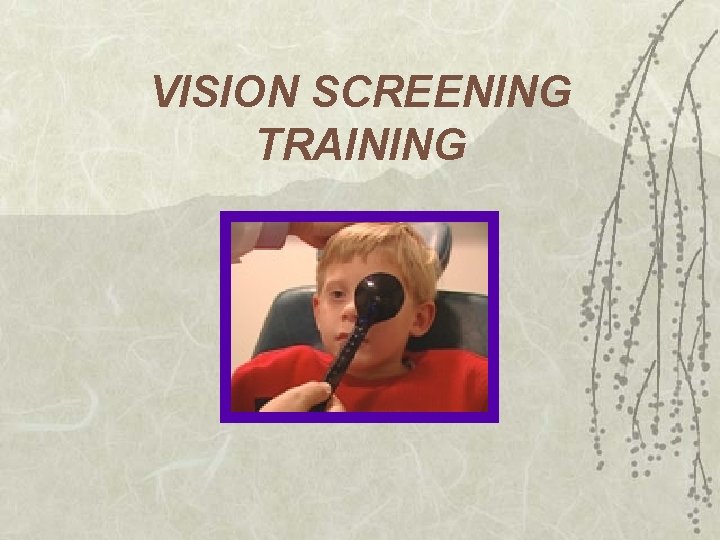
VISION SCREENING TRAINING
Pre-Test Indicate whether the following statements are True or False: 1. Vision acuity refers to the clarity of vision. 2. Learning is 50% visual. 3. Children may have visual problems yet show no symptoms. 4. The development of the seeing process stops at 4 years of age. 5. A person is considered legally blind at 20/100 with best possible correction in the better eye.
Vision & Hearing Screening Program and Audiometric Laboratory Adopted Rules Current Rules www. dshs. state. tx. us/vhs
Objectives Upon completion of this training, the learner will be able to: 1. Define and discuss visual acuity and common vision deficits 2. Summarize vision screening requirements 3. Differentiate between common visual problems 4. Use Hirschberg Corneal light reflex & cover/ uncover tests 5. Compare signs and symptoms of vision problems 6. Discuss approved eye charts and distinguish between pass/ fail visual acuity and referral status in all age groups.
VISION SCREENING TRAINING 1). Distance Acuity 2). Strabismus (a). Hirschberg Corneal Light Reflex (b). Cover & Uncover
DEFINITION OF VISION SCREENING BRIEF TEST(S) TO DETERMINE WHETHER A PERSON’S VISION FALLS WITHIN NORMAL RANGE
Why is vision screening important? EARLY DETECTION IDENTIFIES
80% LEARNING
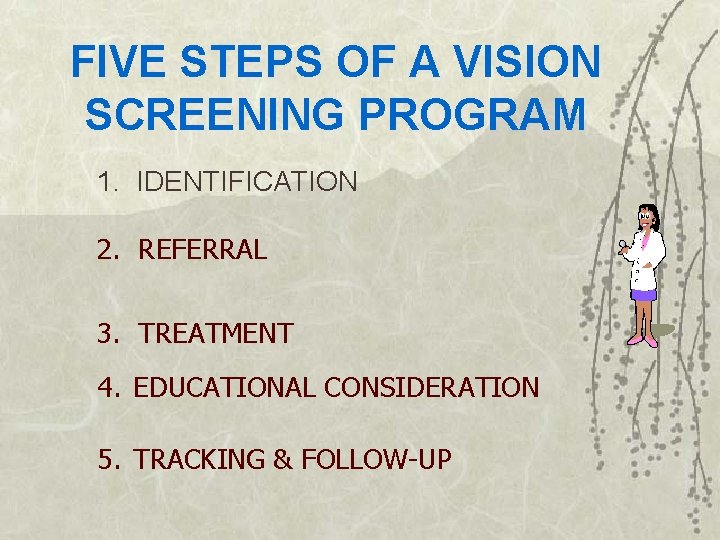
FIVE STEPS OF A VISION SCREENING PROGRAM 1. IDENTIFICATION 2. REFERRAL 3. TREATMENT 4. EDUCATIONAL CONSIDERATION 5. TRACKING & FOLLOW-UP
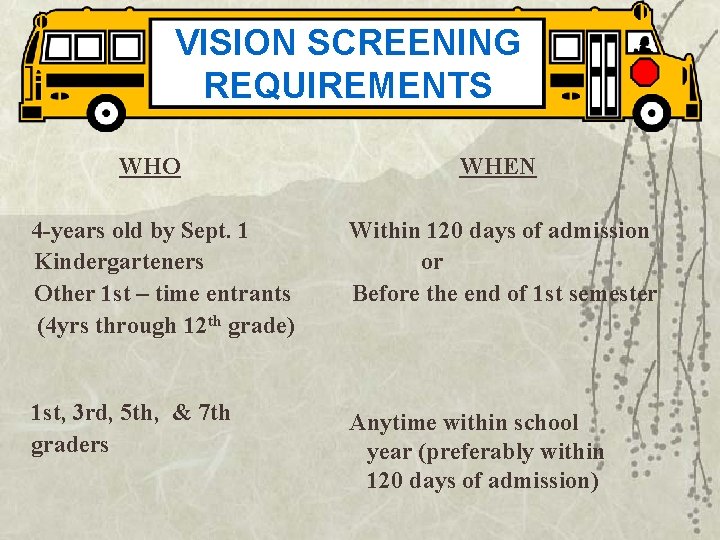
VISION SCREENING REQUIREMENTS WHO WHEN 4 -years old by Sept. 1 Kindergarteners Other 1 st – time entrants (4 yrs through 12 th grade) Within 120 days of admission or Before the end of 1 st semester 1 st, 3 rd, 5 th, & 7 th graders Anytime within school year (preferably within 120 days of admission)
School Vision Screening Children with poor vision in both eyes are usually identified by the families. Need to identify children with poor vision in one eye with no symptoms.
What is ‘vision acuity’? Commonly refers to the clarity of vision 1) the sharpness of the retinal focus within the eye 2) the health and function of the retina 3) the sensitivity of the interpretive faculty of the brain
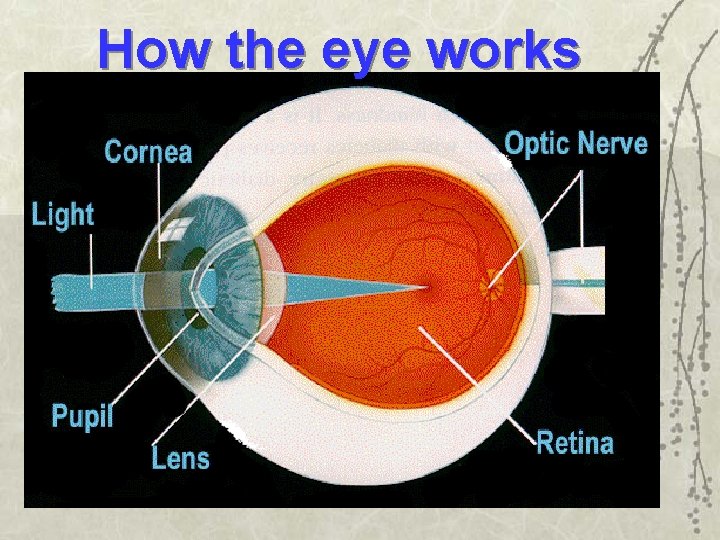
How the eye works
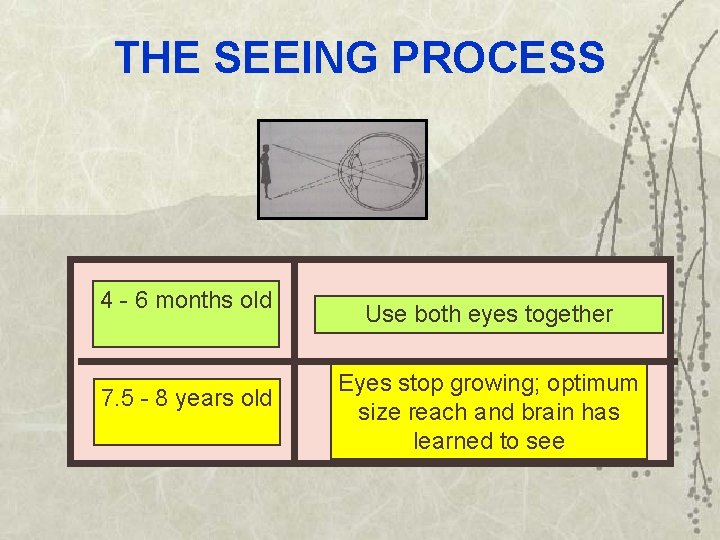
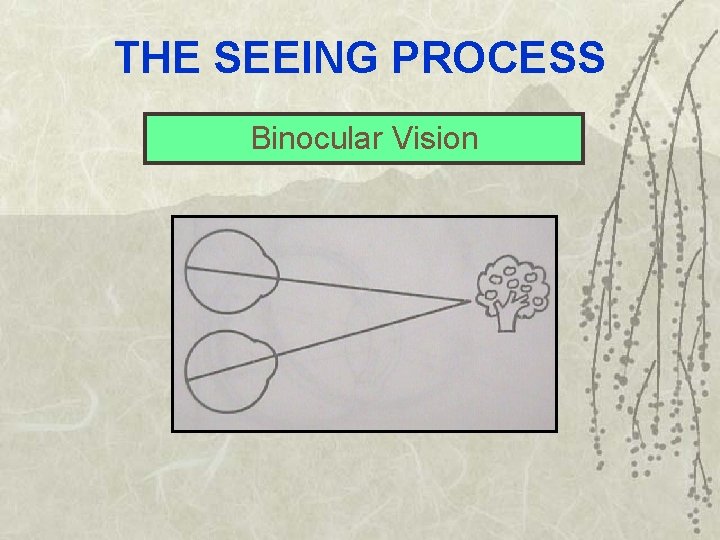
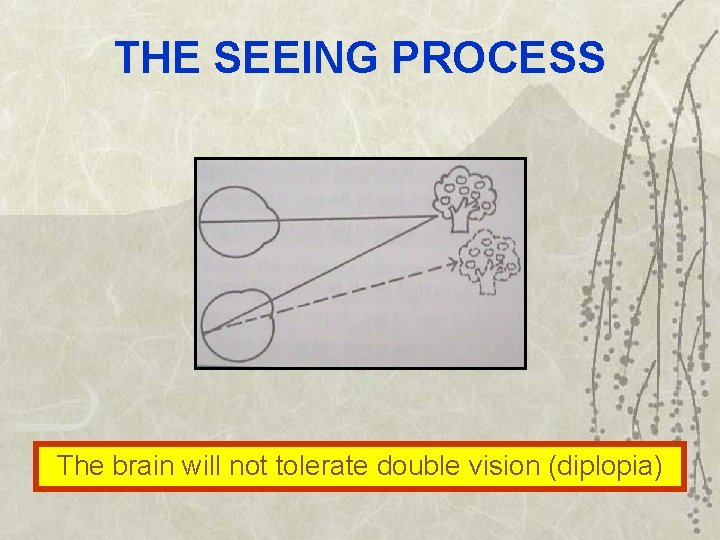
THE SEEING PROCESS 4 - 6 months old 7. 5 - 8 years old Use both eyes together Eyes stop growing; optimum size reach and brain has learned to see
THE SEEING PROCESS Binocular Vision
THE SEEING PROCESS The brain will not tolerate double vision (diplopia)
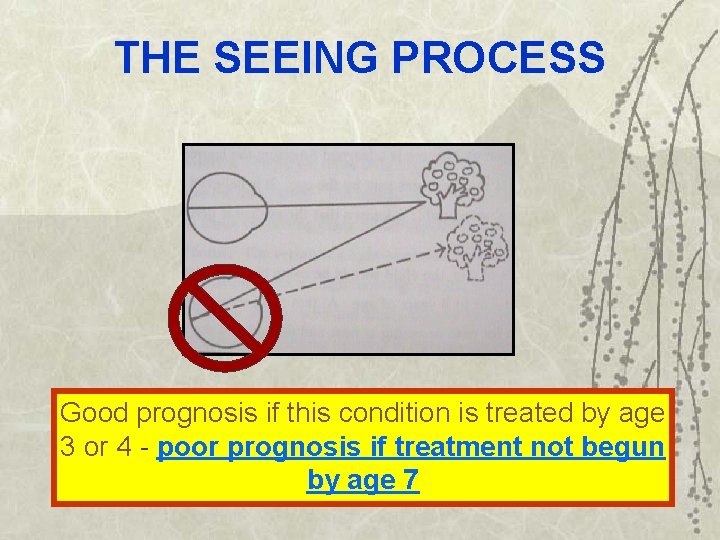
THE SEEING PROCESS Good prognosis if this condition is treated by age 3 or 4 - poor prognosis if treatment not begun by age 7
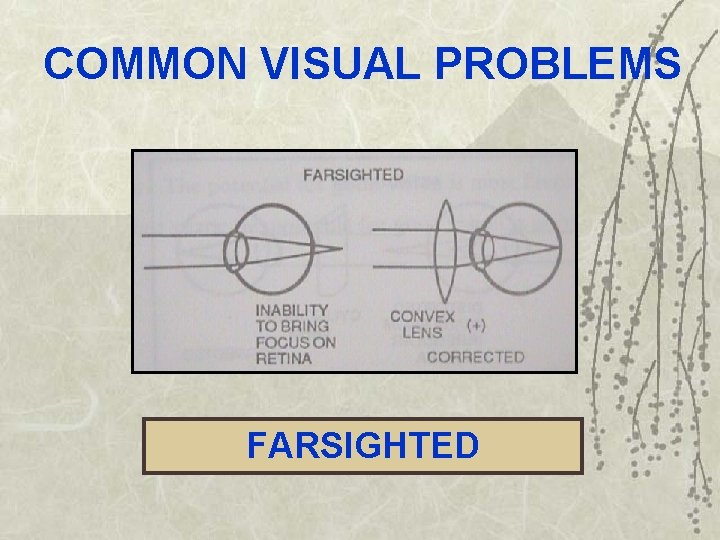
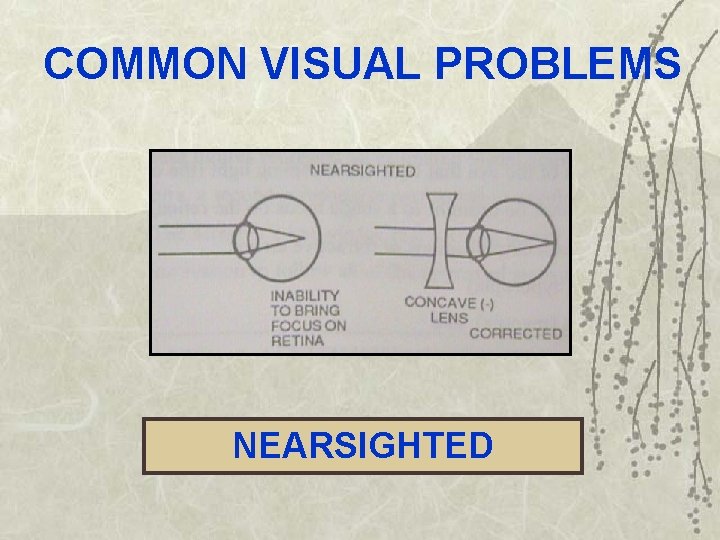
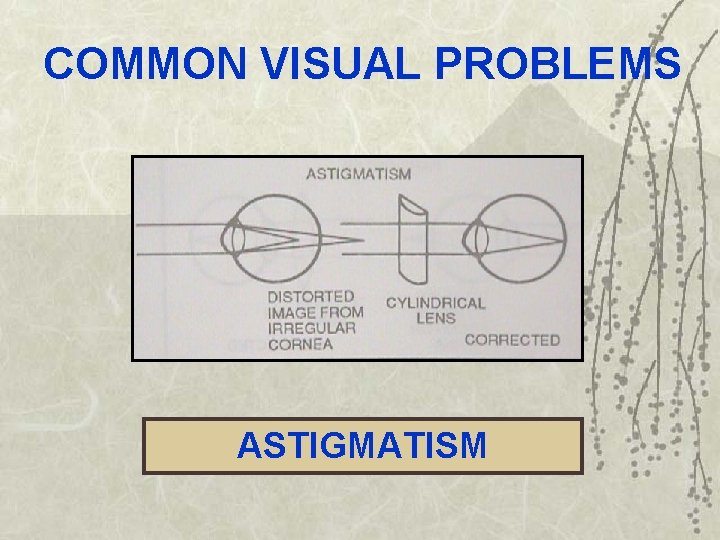
COMMON VISUAL PROBLEMS REFRACTIVE ERRORS FARSIGHTED NEARSIGHTED ASTIGMATISM
COMMON VISUAL PROBLEMS FARSIGHTED
COMMON VISUAL PROBLEMS NEARSIGHTED
COMMON VISUAL PROBLEMS ASTIGMATISM
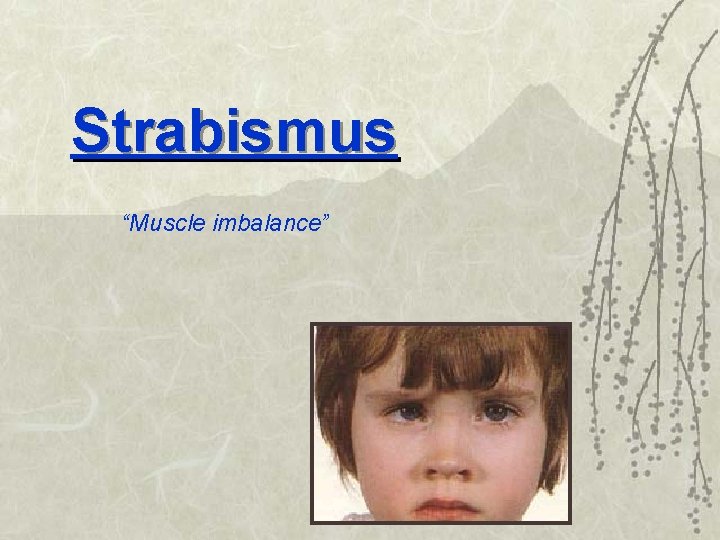
Strabismus “Muscle imbalance”
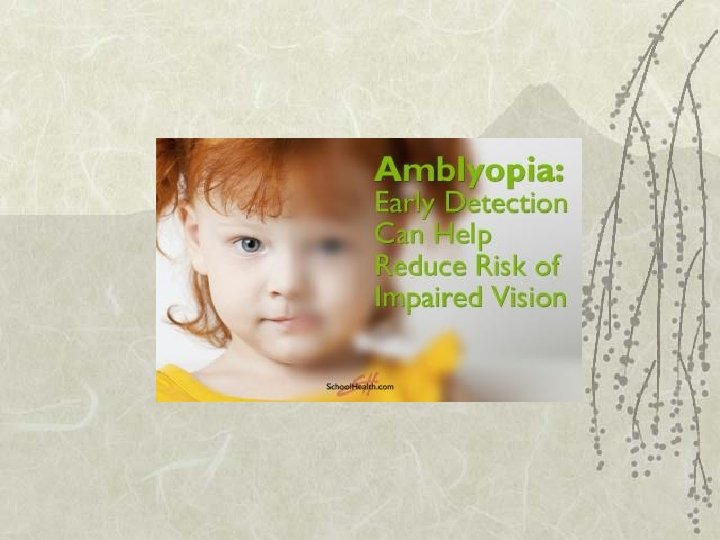
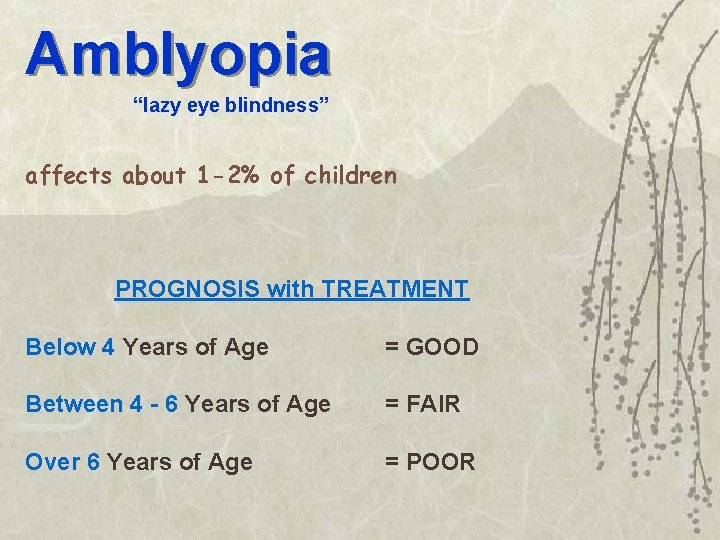
Amblyopia “lazy eye blindness” affects about 1 -2% of children PROGNOSIS with TREATMENT Below 4 Years of Age = GOOD Between 4 - 6 Years of Age = FAIR Over 6 Years of Age = POOR
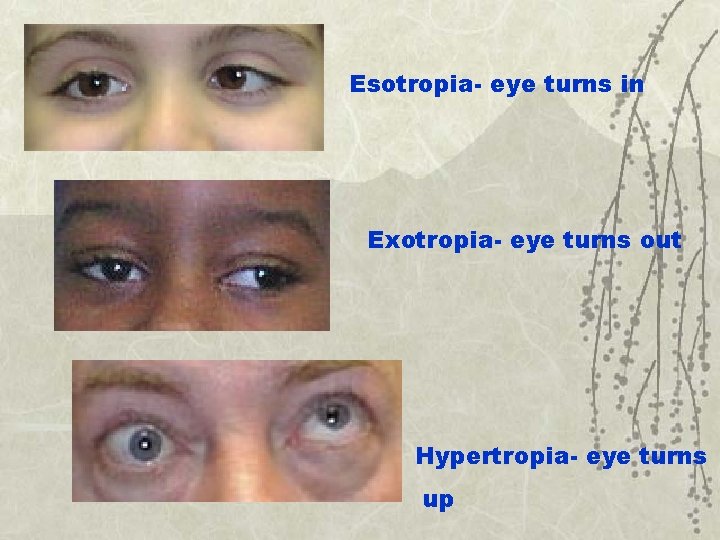
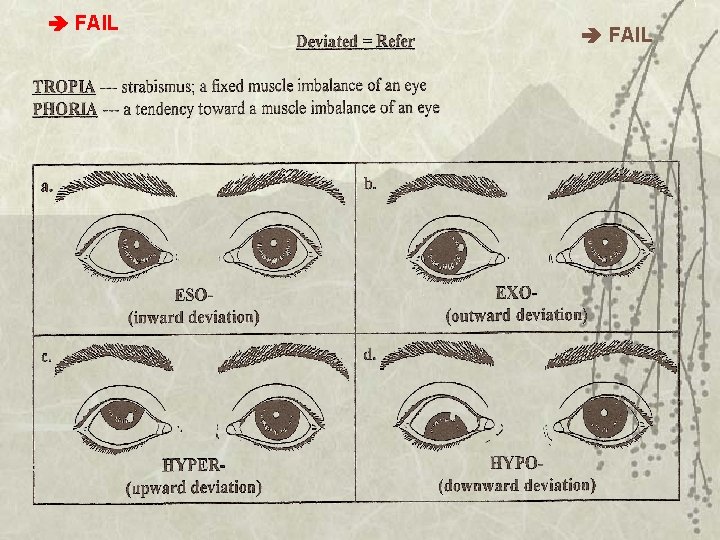
Esotropia- eye turns in Exotropia- eye turns out Hypertropia- eye turns up
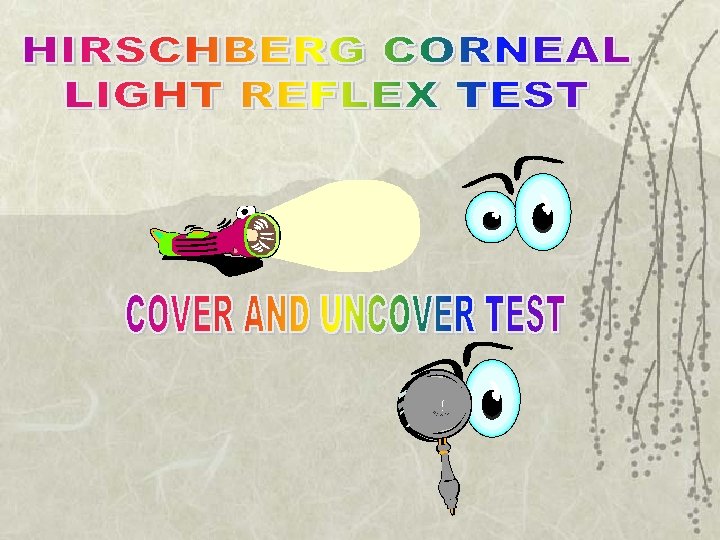
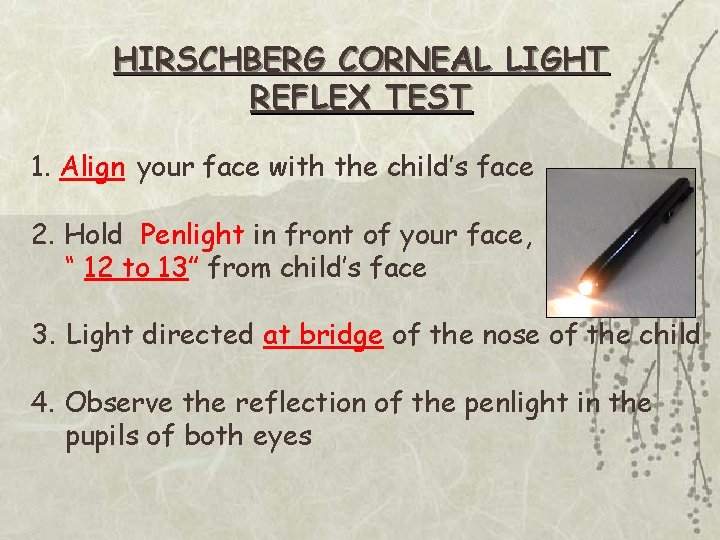
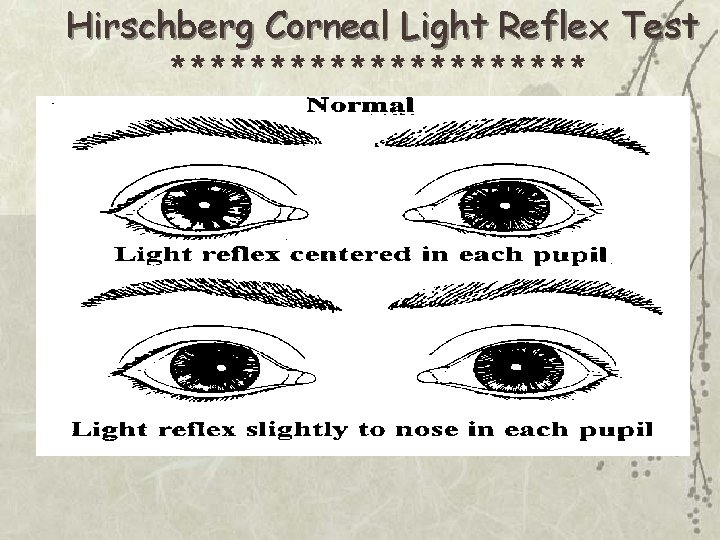
HIRSCHBERG CORNEAL LIGHT REFLEX TEST 1. Align your face with the child’s face 2. Hold Penlight in front of your face, “ 12 to 13” from child’s face 3. Light directed at bridge of the nose of the child 4. Observe the reflection of the penlight in the pupils of both eyes
Hirschberg Corneal Light Reflex Test ***********
FAIL
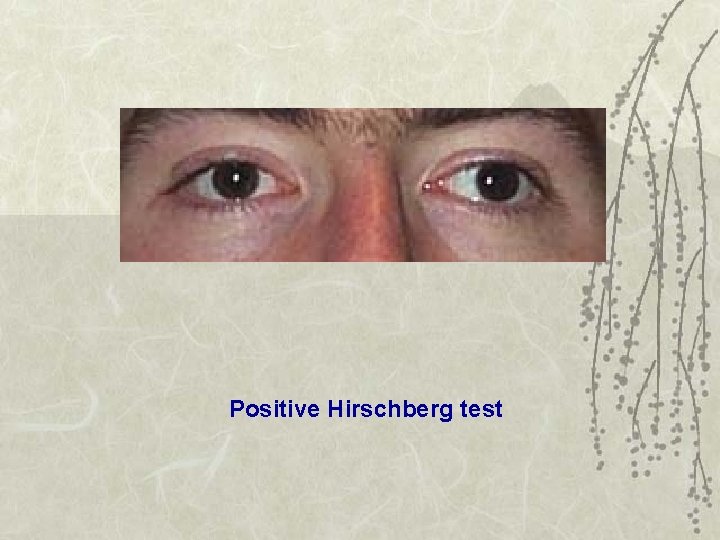
Positive Hirschberg test
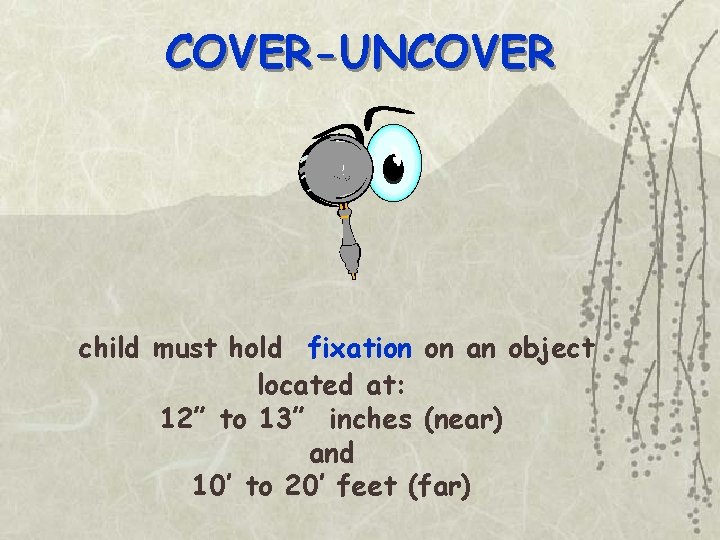
COVER-UNCOVER child must hold fixation on an object located at: 12” to 13” inches (near) and 10’ to 20’ feet (far)
Cover- Uncover Test Materials: Occluder 1. Align your eyes with the child’s eyes. 2. Hold target 12 to 13 inches from child’s eyes. 3. Child must fixate on the target (2 -3 seconds)
Continued… 4. Cover the right eye with occluder, watch left eye for movement. (Leave covered 2 -3 seconds) 5. Remove cover, watch right eye for movement. (allow 2 -3 seconds. . . for eyes… to fixate on target again) 6. Cover left eye and repeat steps.
Whew! Time for a BREAK! Be back in 10 minutes, please!
üCHECKLIST FOR SIGNS AND SYMPTOMS OF VISION PROBLEMS
Signs and Symptoms EYE APPEARANCE COMPLAINTS
VISUAL ACUITY 20 / 20
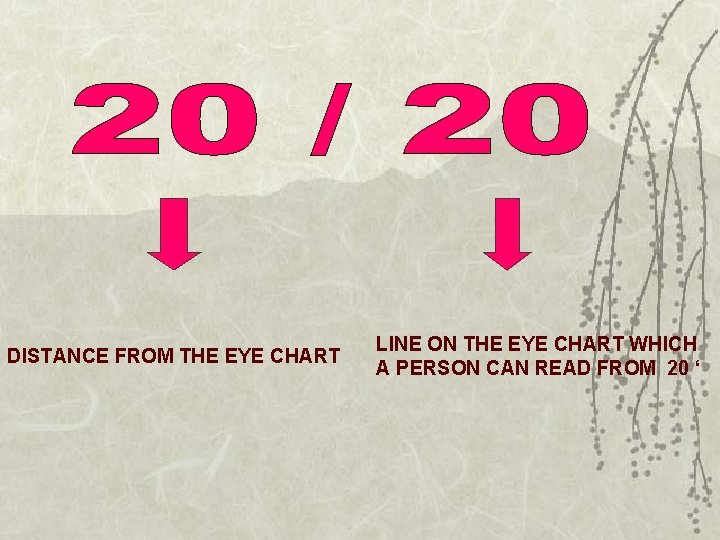
DISTANCE FROM THE EYE CHART LINE ON THE EYE CHART WHICH A PERSON CAN READ FROM 20 ‘
LEGALLY BLIND 20/200 in the better eye with the best possible correction
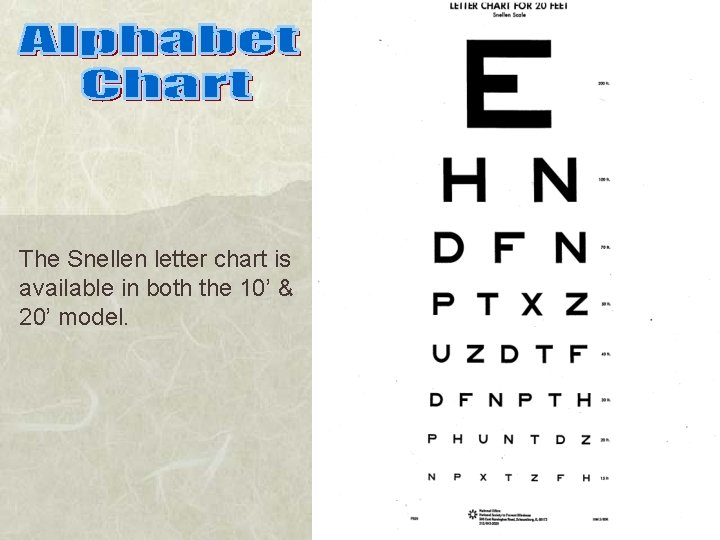
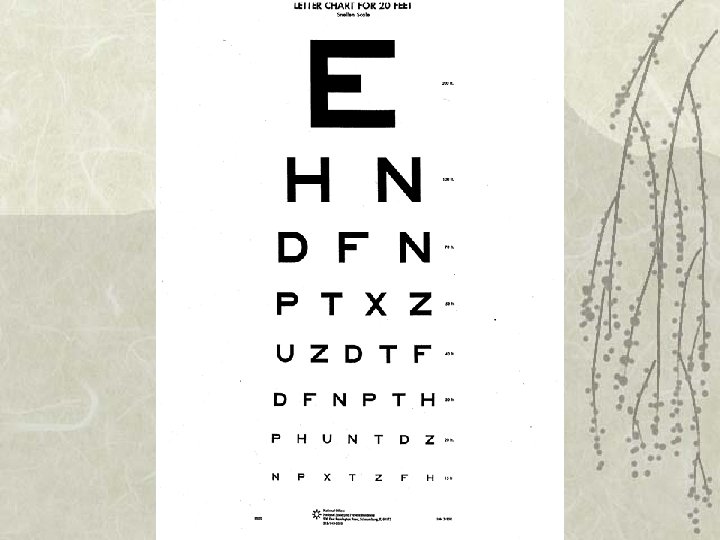
The Snellen letter chart is available in both the 10’ & 20’ model.
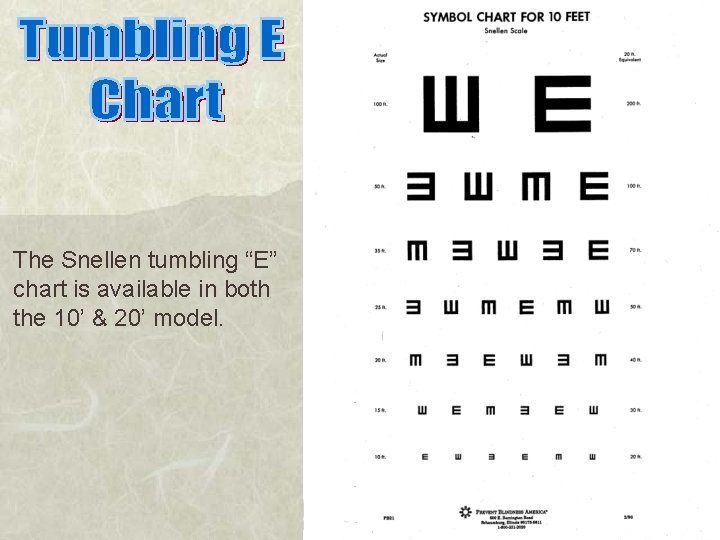
The Snellen tumbling “E” chart is available in both the 10’ & 20’ model.
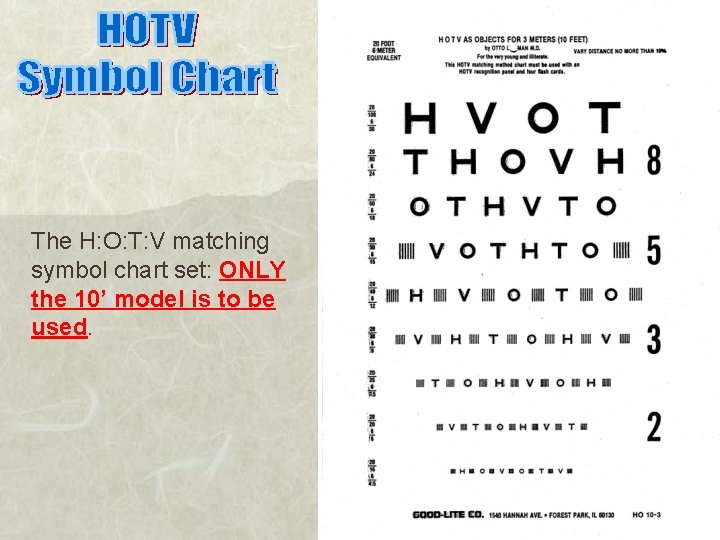
The H: O: T: V matching symbol chart set: ONLY the 10’ model is to be used.
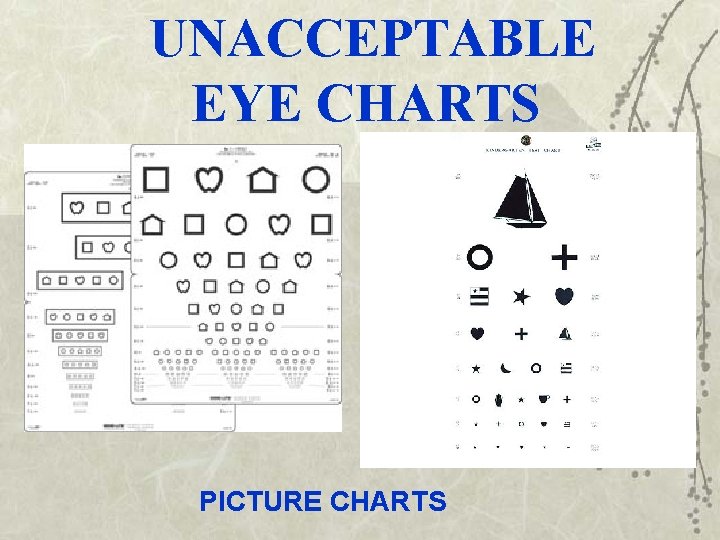
UNACCEPTABLE EYE CHARTS PICTURE CHARTS
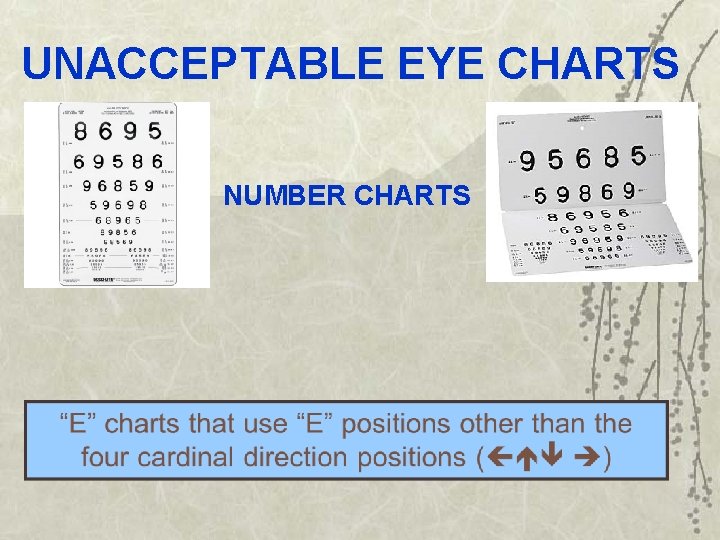
UNACCEPTABLE EYE CHARTS NUMBER CHARTS
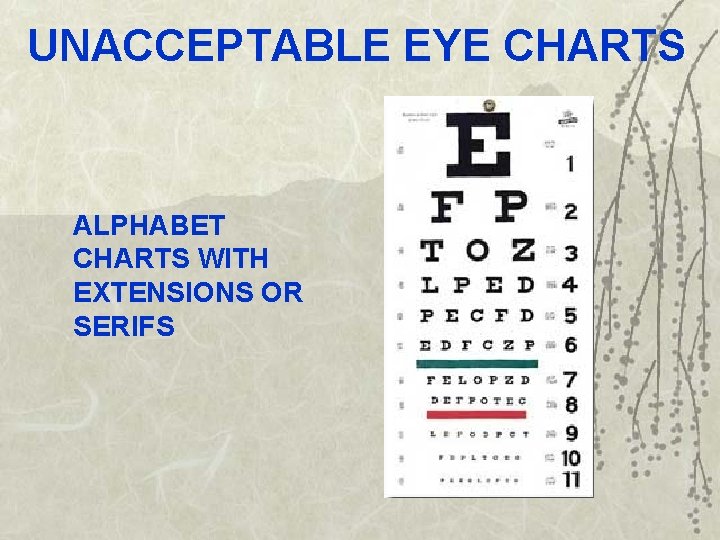
UNACCEPTABLE EYE CHARTS ALPHABET CHARTS WITH EXTENSIONS OR SERIFS
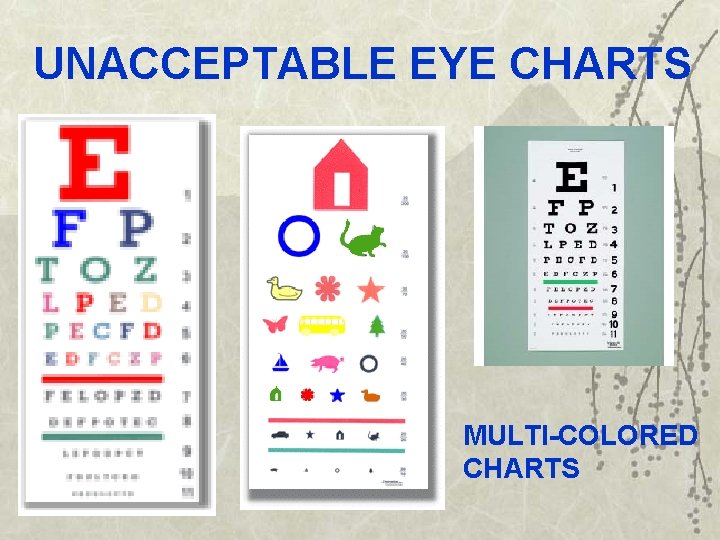
UNACCEPTABLE EYE CHARTS MULTI-COLORED CHARTS
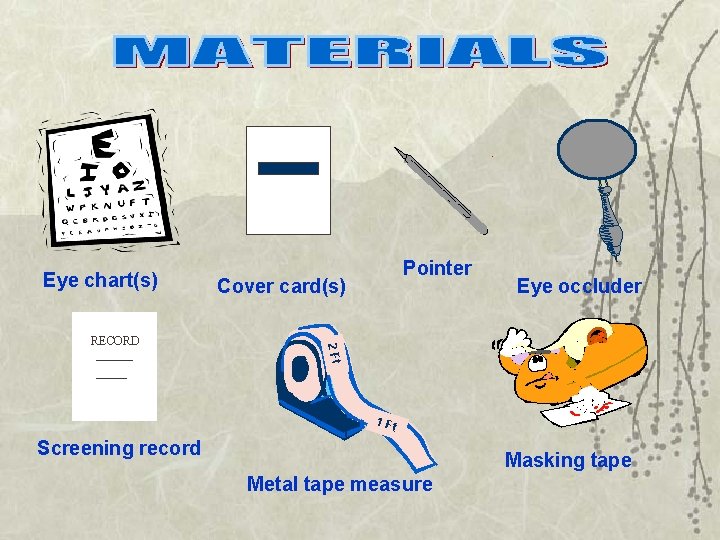
Eye chart(s) Cover card(s) Eye occluder 2 Ft RECORD Pointer 1 Ft Screening record Masking tape Metal tape measure
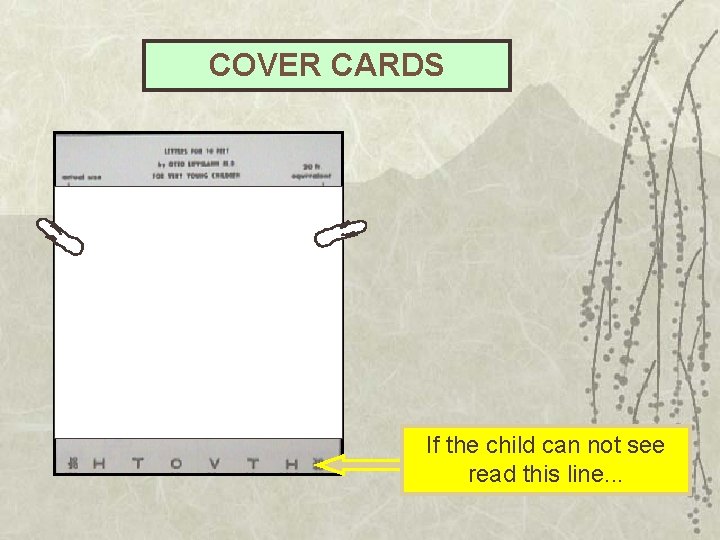
COVER CARDS If the child can not see read this line. . .
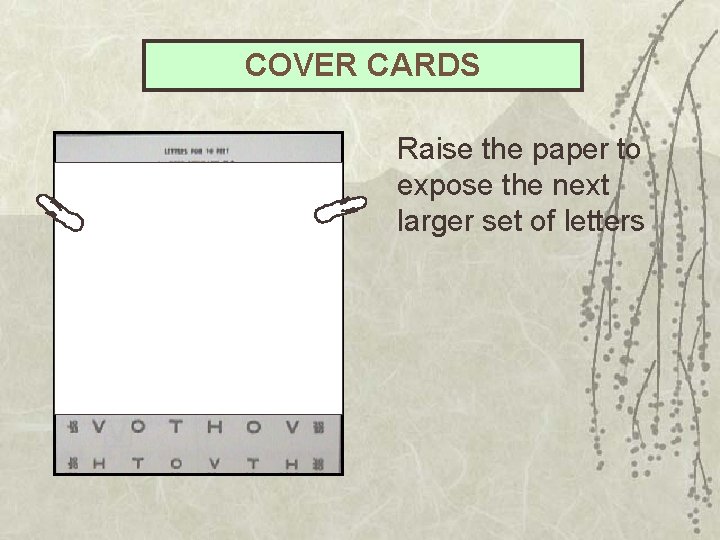
COVER CARDS Raise the paper to expose the next larger set of letters
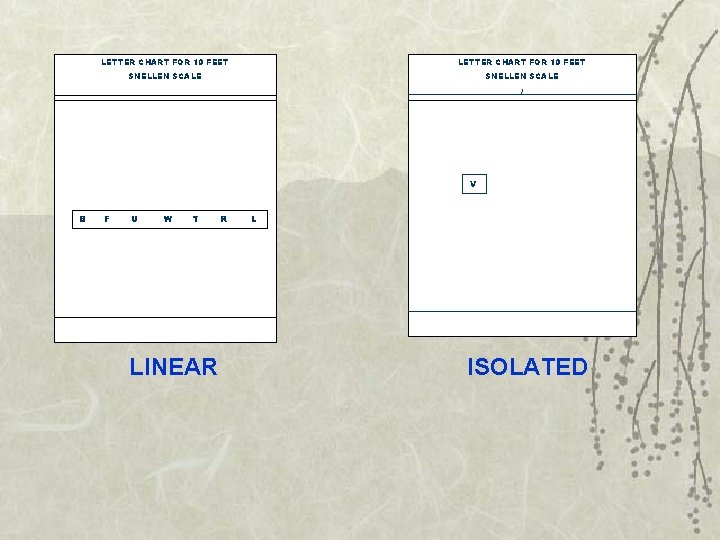
LETTER CHART FOR 10 FEET SNELLEN SCALE / V B F U W T LINEAR R L ISOLATED
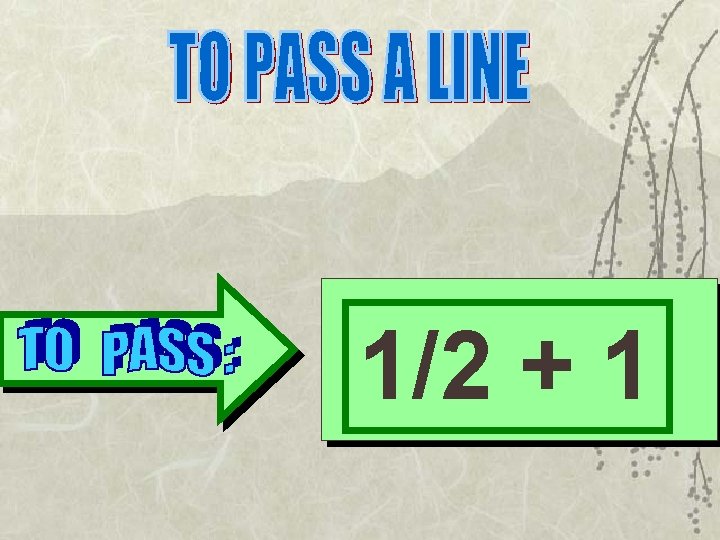
1/2 + 1
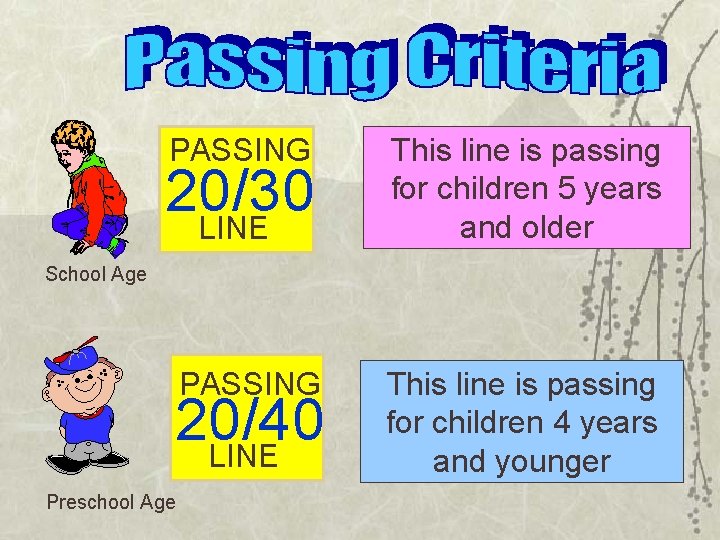
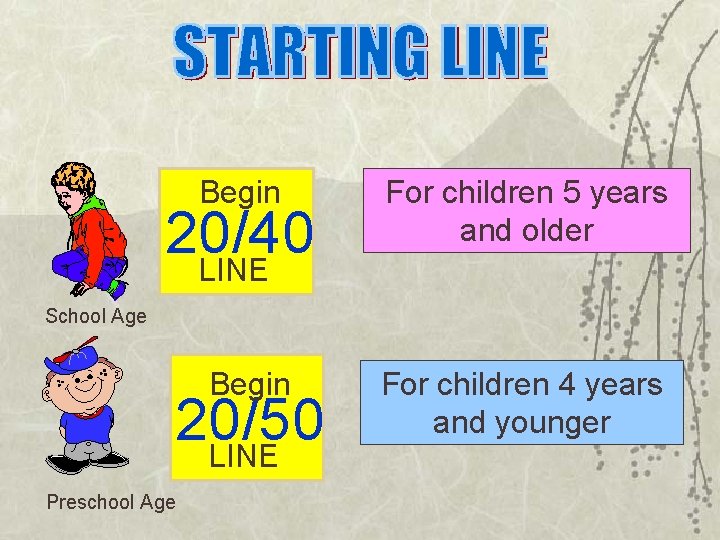
PASSING 20/30 LINE This line is passing for children 5 years and older School Age PASSING 20/40 LINE Preschool Age This line is passing for children 4 years and younger
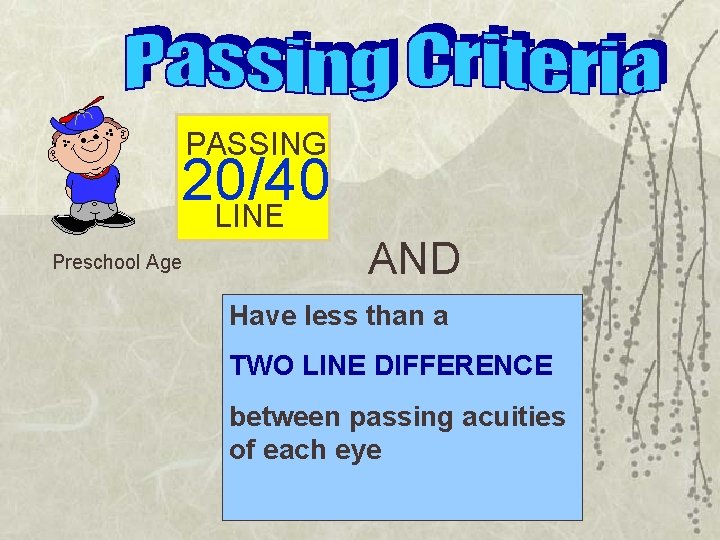
PASSING 20/40 LINE Preschool Age AND Have less than a TWO LINE DIFFERENCE between passing acuities of each eye
Begin 20/40 LINE For children 5 years and older School Age Begin 20/50 LINE Preschool Age For children 4 years and younger
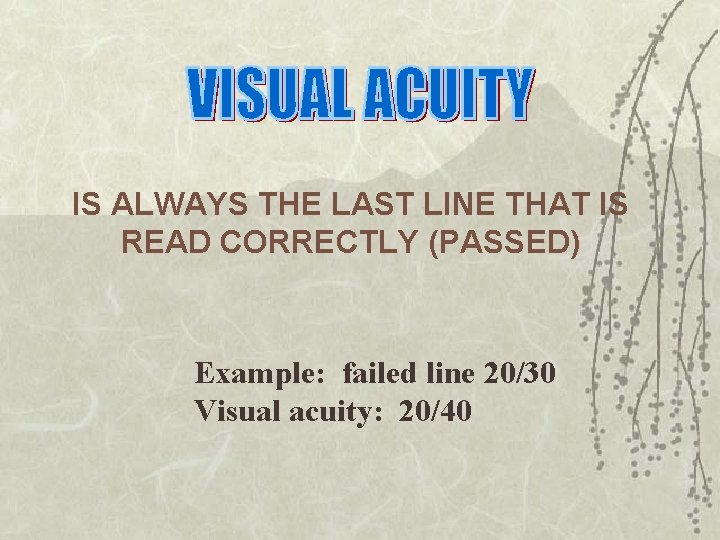
IS ALWAYS THE LAST LINE THAT IS READ CORRECTLY (PASSED) Example: failed line 20/30 Visual acuity: 20/40
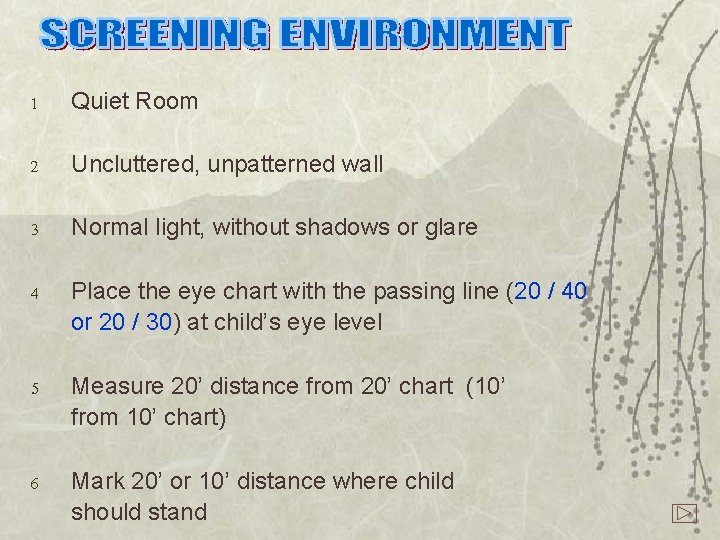
1 Quiet Room 2 Uncluttered, unpatterned wall 3 Normal light, without shadows or glare Place the eye chart with the passing line (20 / 40 or 20 / 30) at child’s eye level 4 Measure 20’ distance from 20’ chart (10’ from 10’ chart) 5 Mark 20’ or 10’ distance where child should stand 6
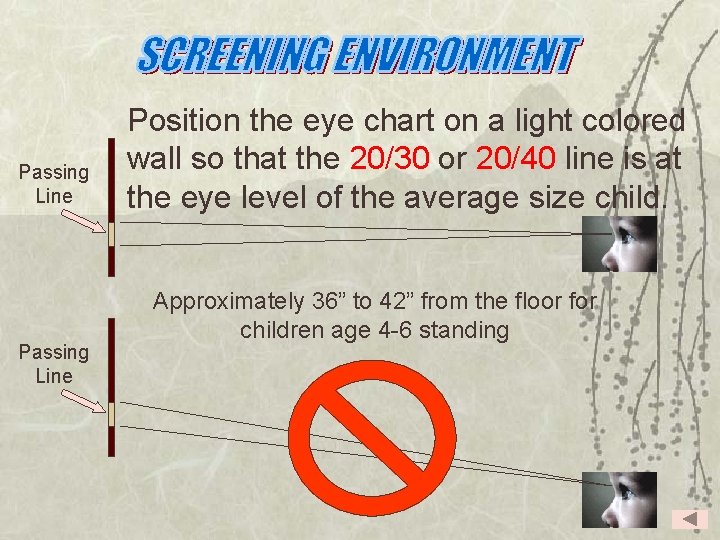
Passing Line Position the eye chart on a light colored wall so that the 20/30 or 20/40 line is at the eye level of the average size child. Approximately 36” to 42” from the floor for children age 4 -6 standing
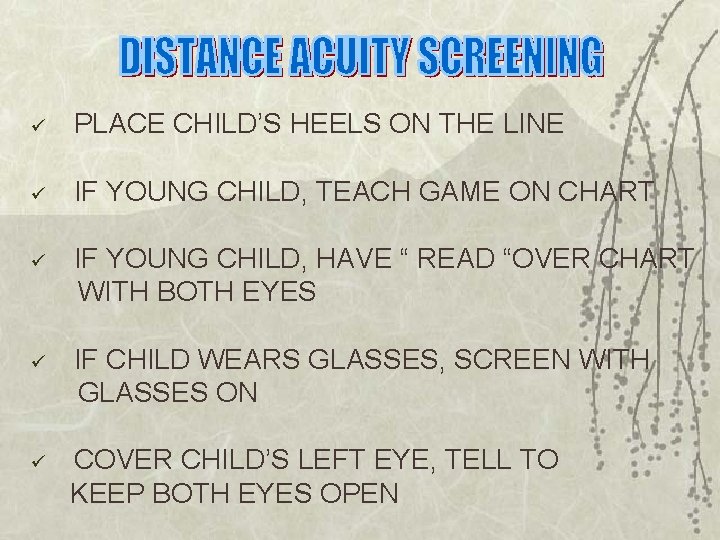
ü PLACE CHILD’S HEELS ON THE LINE ü IF YOUNG CHILD, TEACH GAME ON CHART IF YOUNG CHILD, HAVE “ READ “OVER CHART WITH BOTH EYES ü IF CHILD WEARS GLASSES, SCREEN WITH GLASSES ON ü COVER CHILD’S LEFT EYE, TELL TO KEEP BOTH EYES OPEN ü
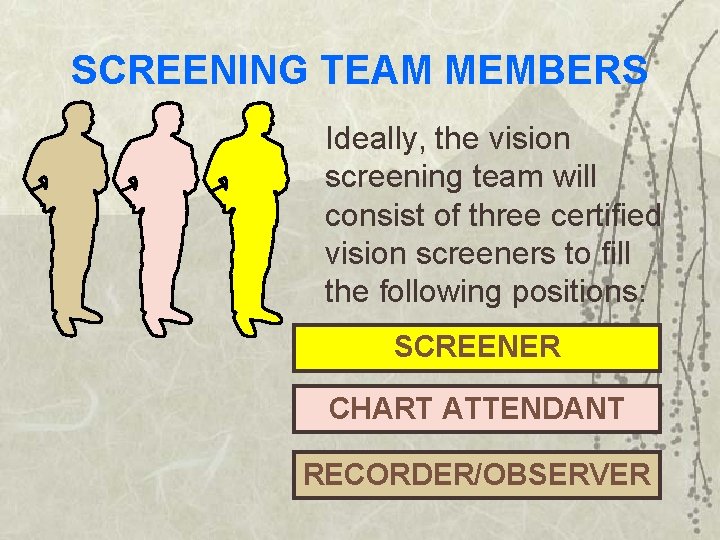
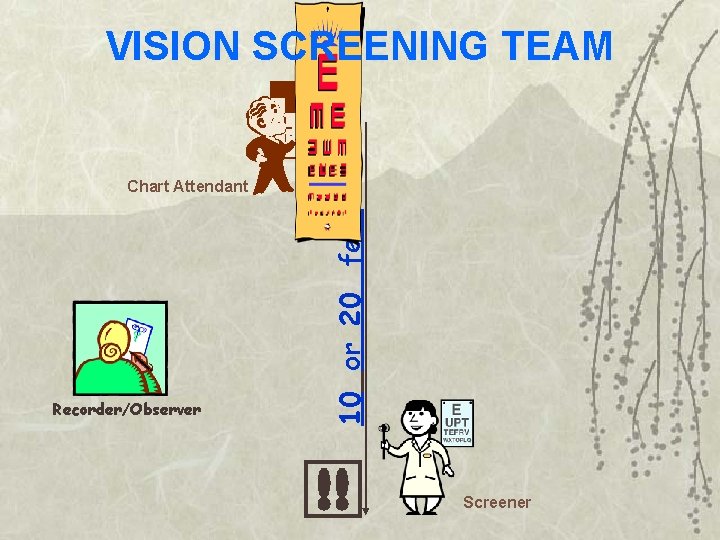
SCREENING TEAM MEMBERS Ideally, the vision screening team will consist of three certified vision screeners to fill the following positions: SCREENER CHART ATTENDANT RECORDER/OBSERVER
VISION SCREENING TEAM Recorder/Observer 10 or 20 feet Chart Attendant Screener
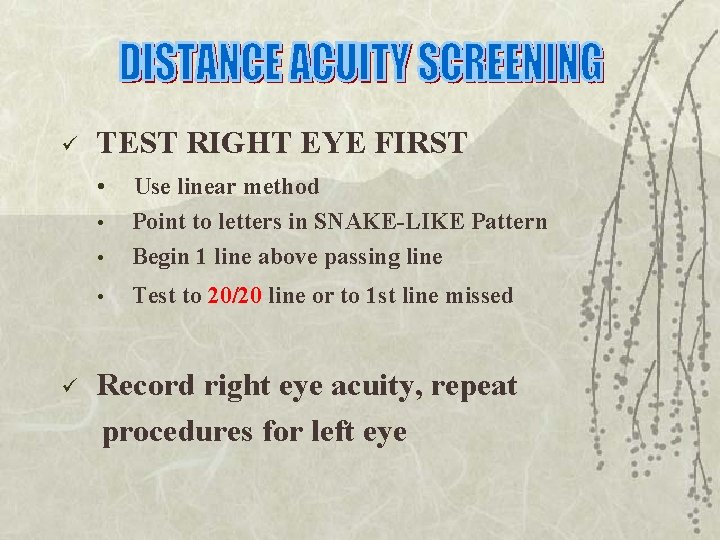
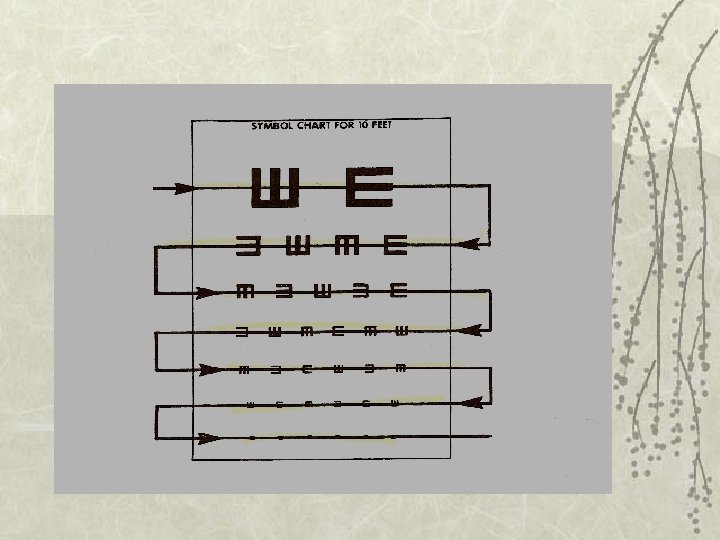
ü TEST RIGHT EYE FIRST • Use linear method Point to letters in SNAKE-LIKE Pattern Begin 1 line above passing line • Test to 20/20 line or to 1 st line missed • • ü Record right eye acuity, repeat procedures for left eye
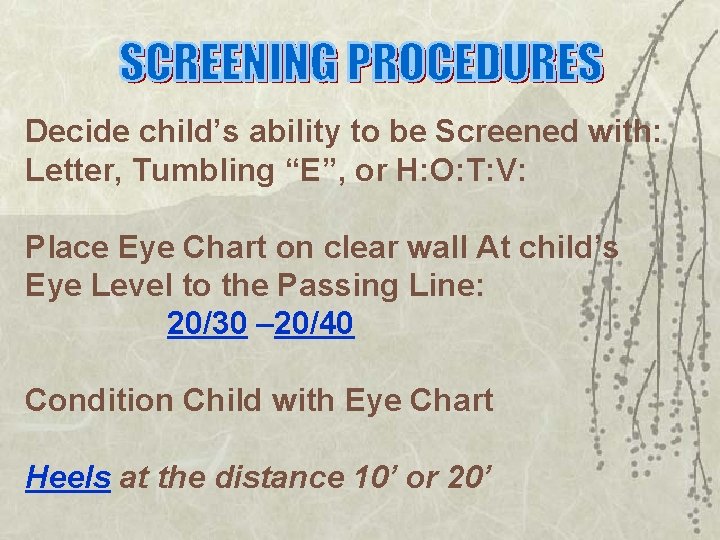
Decide child’s ability to be Screened with: Letter, Tumbling “E”, or H: O: T: V: Place Eye Chart on clear wall At child’s Eye Level to the Passing Line: 20/30 – 20/40 Condition Child with Eye Chart Heels at the distance 10’ or 20’
Distance Acuity Screening Tip of the pointer directly below each symbol. Always react to the child in a positive manner. Screen with glasses or contact lenses on. Screen Right Eye First If paper occluder is use, cup it to avoid touching the eye, throw away after each use.
Child reads “PRACTICE” Line With both Eyes open Cover Left Eye, telling the child to keep both eyes open. - start screening on practice line To pass a Line Child must identify One more than half the symbols on the line Screened to 20/20 or 1 st line missed Visual Acuity Is Always Last Line read correctly !
Rescreen Criteria Distance Acuity If child fails either or both eyes, rescreen in about 2 -3 weeks
REFER WHEN CHILD 1. Fails the 2 nd distance acuity screen (rescreen within approximately 2 -3 weeks) 2. Fails any muscle balance test 3. Shows signs or symptoms of a visual problem 4. Fails any other professional test
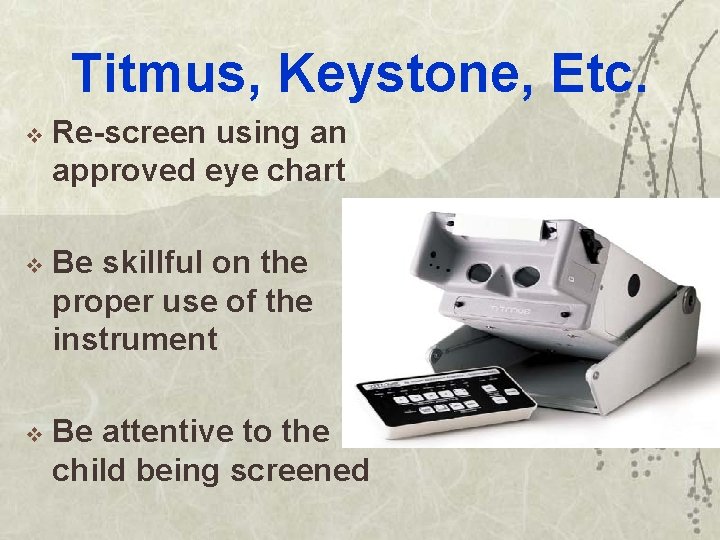
Titmus, Keystone, Etc. v Re-screen using an approved eye chart v Be skillful on the proper use of the instrument v Be attentive to the child being screened
FOLLOW - UP ( TRACKING ) LEARNING WHAT HAPPENS TO A CHILD AFTER REFERRAL
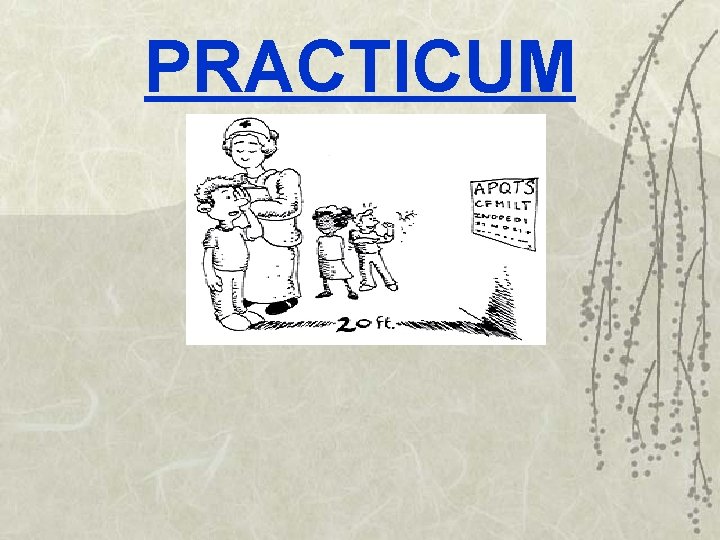
PRACTICUM
Passing Line Define the word “Acuity” 2 Line Difference/Large Visual Acuity Practice Line 2 Types Window Cards To Pass a line H: O: T: V: At what distance? 20/200 Acuity Begin Screening on 20/? ? line The Eye Chart should always be placed so that…. .
Post Test Turn in evaluation form with test